

Key Takeaways
- Phoenix offers three CSWE-accredited BSW programs, with net prices well below many national averages.
- Arizona LBSW licensure requires no post-degree supervised hours, so graduates can apply immediately after passing the exam.
- Advanced standing MSW pathways let BSW holders finish a master's degree in roughly one year instead of two.
- All Phoenix BSW options, including fully online formats, require 400 or more hours of in-person field placement.
Phoenix holds an unusual position in the Southwest: it's one of the few metro areas where three CSWE-accredited BSW programs compete within the same city limits, and the pricing gap between them is substantial. At University of Phoenix-Arizona, the net price runs about $13,520 per year; at Arizona State University, roughly $14,967; and at Grand Canyon University, closer to $22,472. All three meet the non-negotiable accreditation standard required for licensure and advanced standing MSW pathways. Arizona's licensing board adds a pragmatic layer: BSW graduates can apply for the Licensed Baccalaureate Social Worker (LBSW) credential immediately after passing the ASWB exam, with no post-degree supervised hours required.
Most Affordable BSW Programs in Phoenix, Arizona: Rankings & Cost Comparison
Phoenix is home to three CSWE-accredited Bachelor of Social Work programs, each with a distinct cost profile and delivery model. Below, we rank them by net price (what the typical student actually pays after grants and scholarships), then layer in median graduate debt and institution-wide earnings data so you can evaluate real value, not just sticker price. Keep in mind that the graduation rates listed are school-level figures from IPEDS, not BSW-specific completion rates.
- Net price after financial aid
- Median graduate debt load
- Institution-wide earnings outcomes
- Graduation and retention rates
- Program delivery and accessibility
- Internal program database
- NCES-IPEDS federal institutional data — nces.ed.gov
- Independent program research
- College Scorecard graduate earnings — collegescorecard.ed.gov

University of Phoenix-Arizona
University of Phoenix offers a fully online Bachelor of Science in Social Work with a flat tuition rate of $9,552, the same for in-state and out-of-state students. Its net price of $13,520 is the lowest among Phoenix BSW options, though the institution-wide graduation rate sits at roughly 21%, and median graduate debt of $31,553 is the highest of the three schools here. Median earnings ten years after enrollment are $37,752 at the institution level, yielding an ROI ratio near 1.2, which signals that graduates do recoup their investment but more slowly than at other area schools. Over 85% of undergraduates receive Pell Grants, making this one of the most financially accessible campuses in the region for lower-income students.
- Fully online delivery with 400 required field hours at approved sites
- CSWE-accredited program covering 120 total credits
- Tuition Guarantee locks per-credit rate from enrollment to graduation
- Courses run 5 to 15 weeks for scheduling flexibility
- Accepts transfer credits, prior learning, and military benefits
- Real-world faculty often practicing in Phoenix social services
- Educationally prepares graduates for state licensure in select states
Bachelor of Science in Social Work — Online

Arizona State University
Arizona State University's campus-based BSW is a strong value for Arizona residents, with in-state tuition at $12,223 and a net price of $14,967, only about $1,400 more than the lowest-cost option. The payoff, however, is dramatically different: ASU's institution-wide median earnings reach $62,668 ten years post-enrollment, and an ROI ratio of roughly 3.2 means graduates typically earn over three times their net educational investment. Median graduate debt of $19,500 is the lowest of all three programs. ASU holds Hispanic-Serving Institution (HSI) designation, and nearly 63% of undergraduates receive Pell Grants, reinforcing its role as an accessible research university. The institution-wide graduation rate of 68% and retention rate of 87% further distinguish it from the other Phoenix BSW providers.
- Campus-based program with optional online coursework available
- Generalist practice curriculum with supervised field instruction
- Partnerships with local Phoenix clinics for practicum placements
- 18:1 student-to-faculty ratio supports individualized mentorship
- HSI designation reflects a diverse, inclusive campus community
- Arizona-based grants and work-study positions help offset costs
- Prepares graduates for LBSW licensure and advanced standing MSW entry
Bachelor of Social Work — On-Campus

Grand Canyon University
Grand Canyon University rounds out the Phoenix BSW landscape with a hybrid program that lets students blend on-campus and online coursework. Its net price of $22,472 is the highest of the three, but median graduate debt of $22,114 falls well below the University of Phoenix figure, and institution-wide median earnings of $42,186 produce an ROI ratio near 1.9. GCU's 43.5% graduation rate and 72% retention rate land solidly between the other two schools. Over 70% of undergraduates receive Pell Grants, and the university has advertised scholarship awards of up to 30% off tuition for eligible students, which can meaningfully lower out-of-pocket costs for Phoenix-area residents.
- Hybrid delivery: mix on-campus (15-week) and online (8-week) courses
- CSWE-accredited, 120-credit program with 400 field experience hours
- Integrates a Christian worldview with culturally competent practice
- Covers trauma-informed care, advocacy, and ethical case management
- Practicum placements coordinated through local Phoenix agencies
- Scholarships of up to 30% off tuition available to eligible students
- Accepts up to 90 transfer credits to shorten time to degree
- 20:1 student-to-faculty ratio across the university
Bachelor of Social Work — Hybrid
What Makes a BSW Program Worth It? Key Evaluation Criteria
A program with a low sticker price and one with a low net cost are not the same thing, and confusing the two is one of the most common mistakes prospective social work students make. Before you commit to any BSW program in Phoenix, you need a clear framework for separating real value from surface-level affordability.
CSWE Accreditation: The Non-Negotiable Starting Point
Accreditation from the Council on Social Work Education is not a nice-to-have. It is the minimum requirement for two career-defining milestones: eligibility for social work licensure in Arizona and qualification for advanced standing in a Master of Social Work program, which can shave a full year off your graduate timeline. Every program in our ranked list holds current CSWE accreditation. If a program you are considering does not, walk away, regardless of how affordable it looks.
Net Price vs. Sticker Tuition
Published tuition rates rarely reflect what students actually pay. The effective net price accounts for the average institutional aid, federal grants, and scholarships that most enrollees receive. Think of it as the realistic out-of-pocket baseline after financial aid is applied. Two programs may list similar per-credit rates yet differ by thousands of dollars once aid is factored in. When comparing costs across the programs ranked here, use the net price figures as your apples-to-apples benchmark rather than catalog tuition.
Outcomes That Actually Matter
Cost means little in isolation. You want to know what graduates earn, how much debt they carry, and whether they land jobs. Four metrics deserve your attention:
- Median earnings one to two years after completion: This tells you how quickly graduates reach financial stability.
- Median debt at graduation: Lower debt relative to expected earnings signals a program that does not overburden its graduates.
- Employment share: The percentage of graduates who are employed shortly after finishing gives you a read on local job-market traction.
- Share earning above 150% of the federal poverty level: This filters out underemployment and shows whether graduates are earning a living wage, not just collecting a paycheck.
Not every program publishes all of these figures. Where data is not yet available for a specific program, that gap itself is worth noting as you evaluate your options.
Format Flexibility for Working Students
Phoenix's job market does not pause while you finish a degree. Many BSW candidates are already working in entry-level human services roles or juggling family responsibilities. Whether a program offers fully online coursework, evening and weekend classes on campus, or a hybrid schedule matters as much as price for students who cannot attend traditional daytime lectures. Field placement hours, which are required for every CSWE-accredited program, will still demand in-person commitments, so look closely at how each program structures its practicum schedule alongside its classroom format.
Questions to Ask Yourself
Online vs. On-Campus BSW Options in Phoenix
All three affordable Phoenix BSW programs require 120 credits and supervised field education hours, but they differ in delivery format, course pacing, and cost structure. Even fully online students must complete in-person practicum placements, so understanding how each school handles site matching is critical before you commit. Below is a side-by-side comparison of the key factors that shape your day-to-day experience and total investment.
| Factor | University of Phoenix (Online Only) | Arizona State University (On-Campus; Online Also Available) | Grand Canyon University (Hybrid: Online and On-Campus) |
|---|---|---|---|
| Delivery Format | Fully online coursework with 5 to 15 week course lengths | Traditional campus program in Tempe; ASU Online also delivers BSW coursework in accelerated 7.5 week sessions | Choose between 15 week on-campus semesters or 8 week online courses; students can blend both formats |
| Published Tuition (Annual) | $9,552 (same rate for in-state and out-of-state students) | $12,223 in-state; $33,139 out-of-state (campus rate). ASU Online tuition may differ; check current per-credit pricing. | $18,508 published rate. Online students pay roughly $485 per credit; campus students pay about $8,250 per semester. |
| Net Price After Aid | Approximately $13,520 | Approximately $14,967 | Approximately $22,472 |
| Additional Fees for Online Students | Yes. A per-course resource fee of $170 applies. | Yes. ASU Online charges additional program and technology fees beyond base tuition. | Yes. Online students should verify current technology and distance-learning surcharges. |
| Field Placement Hours | 400 hours of supervised field education, completed in person at an approved agency | Field instruction is required. ASU's field education office coordinates placements across the Phoenix metro area. | 400 hours of supervised field experience at a CSWE-approved site |
| Practicum Logistics for Online Learners | Online students work with program staff to identify and secure a qualified agency in or near their community for in-person hours. | ASU Online BSW students coordinate with the university's field education team, which maintains partnerships with agencies throughout Arizona. | GCU's field placement coordinators help match online students with local agencies, leveraging the university's Phoenix-area network. |
| Scheduling Flexibility | High. Asynchronous coursework suits working adults. Practicum hours must fit agency schedules. | Moderate on campus (daytime classes). ASU Online offers greater flexibility through shorter, accelerated sessions. | Moderate to high. Online 8 week courses allow faster pacing; campus students follow a traditional semester calendar. |
| Peer Interaction | Primarily virtual discussion boards and group projects | Strong in-person cohort culture on campus. Online students engage through virtual collaboration tools. | Campus students benefit from face-to-face cohorts. Online students connect through virtual forums and optional campus events. |
| Estimated Time to Degree | About 4.25 years for students starting with no transfer credits | Four years at standard pace; accelerated 7.5 week sessions can shorten the timeline for online students | Four years at standard pace. GCU accepts up to 90 transfer credits, which can significantly reduce time to completion. |
| Cost Savings Tip for Online Students | No commuting or campus housing costs; factor in the $170 per-course resource fee when budgeting. | Online students skip housing and parking expenses, but should compare ASU Online's per-credit rate against on-campus tuition. | Remote learners avoid the $8,250 per-semester campus rate but should confirm online per-credit pricing and any technology fees. |
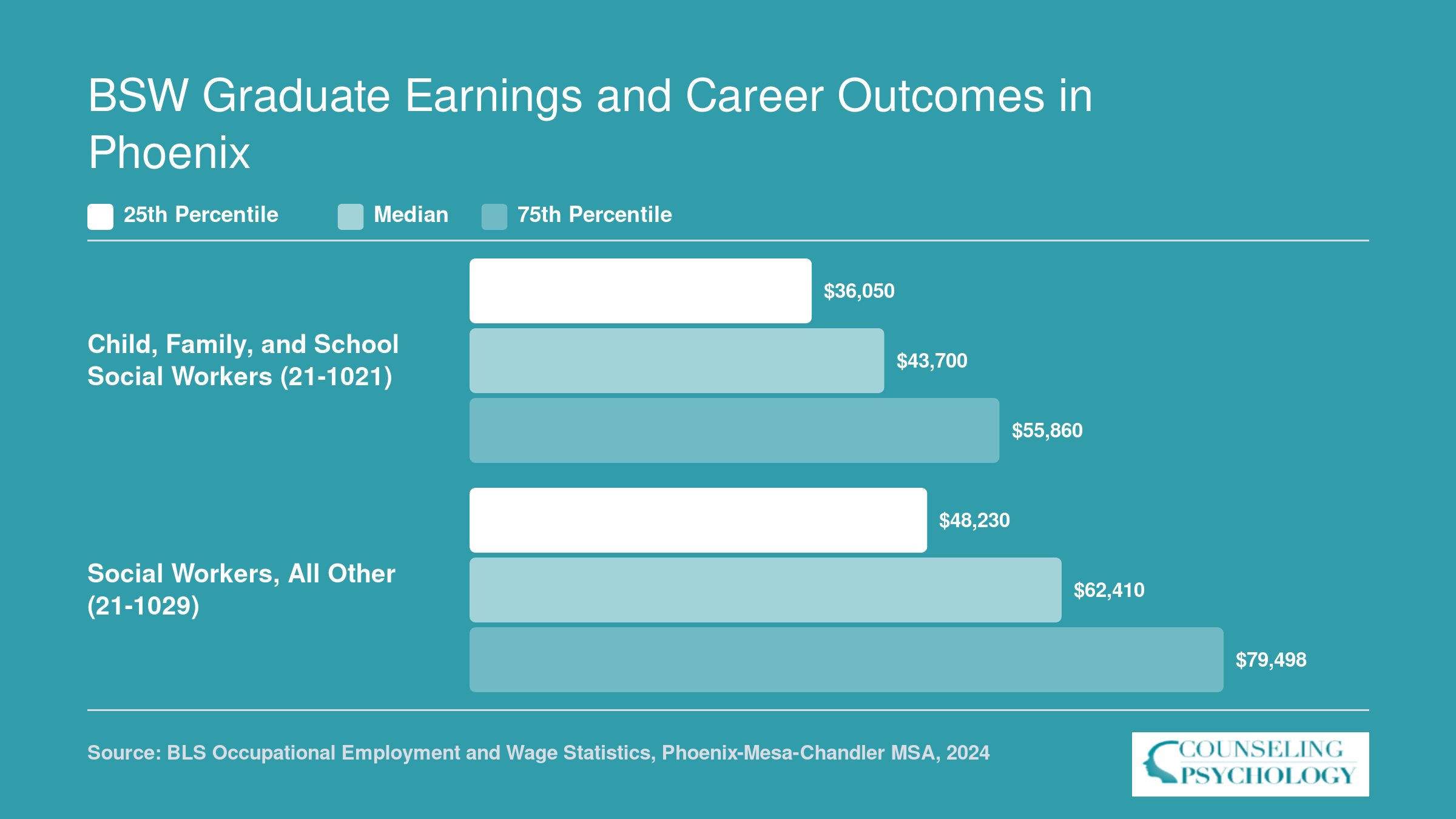
BSW Graduate Earnings and Career Outcomes in Phoenix
Phoenix-area social work salaries vary by specialization and experience level. The figures below reflect wage data for the Phoenix-Mesa-Chandler metropolitan statistical area. For the most current breakdowns, search the BLS Occupational Employment and Wage Statistics page for this MSA directly, and check individual program websites (such as Arizona State University's School of Social Work) for graduate employment reports that capture localized outcomes BLS may not publish.
BSW Career Paths and Job Market Demand in Arizona
A BSW degree opens doors to frontline social work roles across Arizona, from child welfare and mental health case management to school social work and community outreach. Understanding where the jobs are and how many will be available is key to making a smart investment in your education.
Projected Job Growth and Annual Openings
Arizona's demand for social workers continues to outpace many other fields. According to state labor market data, the broad category of child, family, and school social workers (SOC 21-1020) is projected to grow faster than the average for all occupations through 2032. This translates to hundreds of annual job openings statewide, driven by both new positions and replacements for workers leaving the field. The Arizona Office of Economic Opportunity and BLS Projections Central publish specific growth rates and numeric projections; checking these official sources gives you a realistic picture of long-term stability.
Top Employers and Industries
Social workers in Arizona find employment across several key sectors. - County and city agencies: Phoenix-area counties like Maricopa and Pima hire BSWs for child protective services, adult protective services, and community action programs. - Healthcare systems: Hospitals and integrated health networks employ social workers in discharge planning, patient advocacy, and behavioral health units. - School districts: K-12 districts across the state employ school social workers, though some positions may require an MSW or specific certification. - Nonprofit organizations: Community-based agencies focusing on homelessness, domestic violence, and substance abuse frequently list BSW-level openings.
University social work departments at ASU and UArizona often publish employer surveys and local labor market briefs that highlight these trends. If you are drawn to community-level behavioral health work, you might also explore a path as a community mental health counselor.
Real-Time Job Market Intelligence
For an immediate pulse on hiring demand, search job boards like Indeed and LinkedIn using terms such as "social worker BSW" or "case manager" filtered for Arizona. In a typical month in 2026, Phoenix-area listings might number in the hundreds, offering insight into salary ranges, experience requirements, and the most active employers. Pay attention to recurring names: state agencies like the Arizona Department of Child Safety, large healthcare providers, and school districts often dominate the listings.
Leveraging Professional Networks
Joining the National Association of Social Workers Arizona Chapter (NASW-AZ) connects you to local salary surveys, job fairs, and mentoring events. Their career center and member forums provide a ground-level view of emerging niches and employer preferences that raw numbers alone cannot capture. Attending a chapter meeting or joining their email list can shorten your job search after graduation.
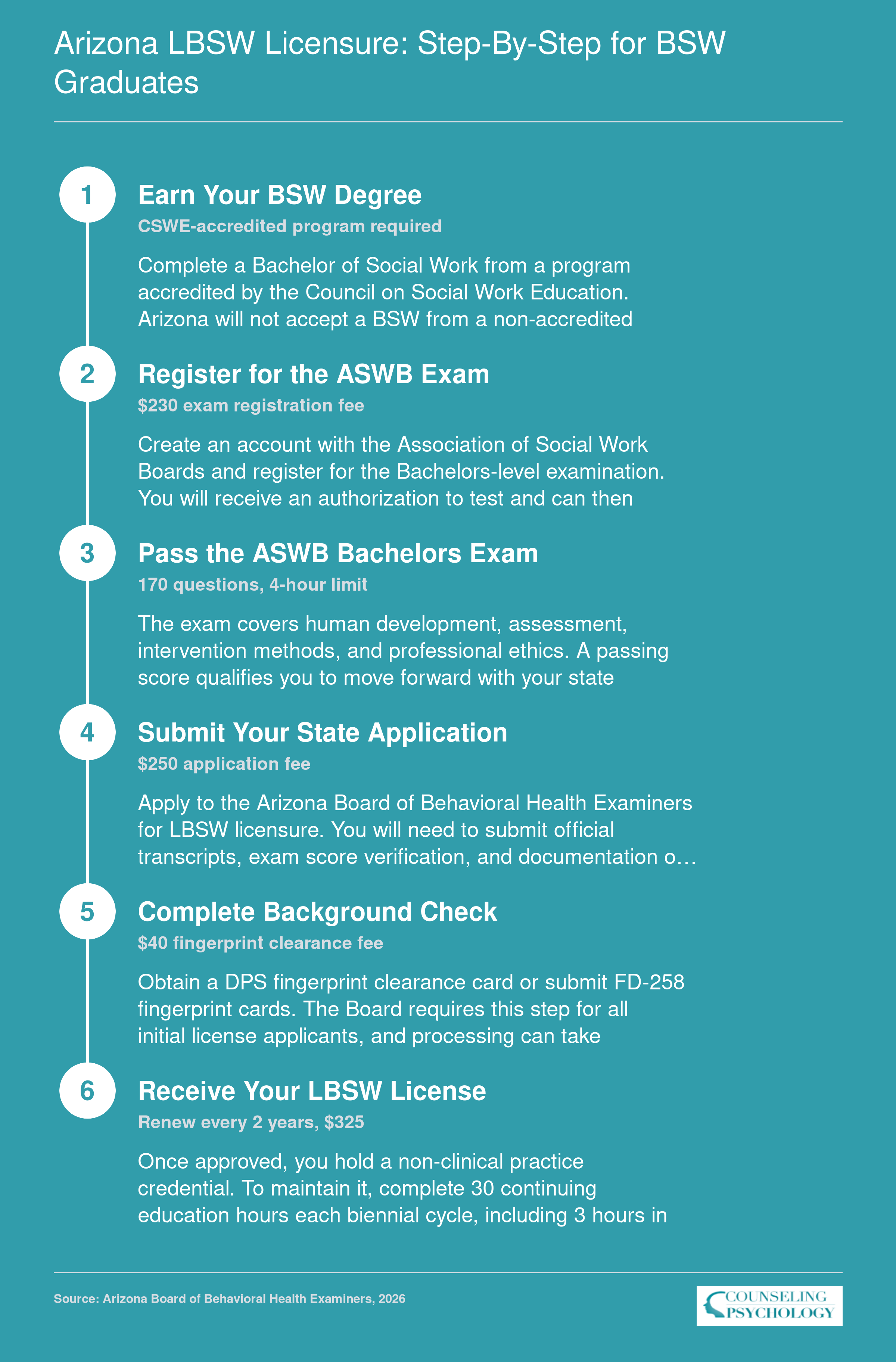
Arizona LBSW Licensure: Step-by-Step for BSW Graduates
One major advantage of pursuing LBSW licensure in Arizona: the state does not require any post-degree supervised hours before you can hold the credential. Unlike the LMSW or LCSW pathways, you can apply for your license immediately after passing the required exam. Here is the complete sequence from diploma to active license.
BSW to MSW: Advanced Standing Pathways in Arizona
Advanced standing is a fast-track option that allows BSW graduates to complete a Master of Social Work in roughly one year instead of two. The pathway exists because your undergraduate social work coursework already covers foundational content that traditional MSW students spend their first year learning. For graduates of CSWE-accredited BSW programs, this translates to significant savings in both time and tuition.
How Advanced Standing Works
MSW programs with advanced standing tracks recognize that BSW graduates arrive with field experience, social work theory, and professional ethics training already completed. Rather than repeating introductory material, you move directly into advanced clinical or macro practice courses. At Arizona State University, the Advanced Standing Direct Practice MSW requires 39 credits and 480 field practicum hours, compared to roughly 60 credits for the traditional two-year track.1
The catch: advanced standing is only available to graduates of CSWE-accredited BSW programs. This is one of the clearest reasons accreditation matters from day one. If your BSW comes from a non-accredited program, you will need to complete the full two-year MSW, erasing the time and cost advantages.
ASU Advanced Standing Requirements
Arizona State University's Advanced Standing Direct Practice MSW is the primary option for Phoenix-area BSW graduates. Admission requirements include:
- GPA minimum: 3.20 cumulative1
- BSW recency: Degree must have been completed within the past six years1
- References: Three letters of recommendation2
- Application fee: Required2
The program offers in-person delivery, and students with interest in child protective services may qualify for the Child Welfare Education Program, which covers in-state tuition and mandatory fees.3
The Financial Calculus
Combining the most affordable BSW net price from the Phoenix rankings with ASU's advanced standing MSW creates a compelling total investment picture. If your BSW costs between $8,000 and $15,000 net after aid, and the 39-credit advanced standing MSW adds roughly $25,000 to $35,000 depending on residency and funding, your total BSW-to-MSW investment may land between $33,000 and $50,000 for both degrees. Compare that to completing a full two-year MSW after a non-social-work bachelor's, which often exceeds $60,000 for the graduate degree alone.
Planning your BSW with advanced standing in mind means choosing a CSWE-accredited program, maintaining a strong GPA, and completing your bachelor's within six years of starting graduate study.
Field Placement and Practicum Partners in Phoenix
Some BSW students actively research and pursue their own placement sites, networking directly with agencies they admire, while others let their program's field education office handle every match. Both paths end with the same 400-plus hours of supervised practice that the Council on Social Work Education (CSWE) requires, but the journey can feel very different. Understanding the options, the key Phoenix partners, and the typical matching process helps you enter that final practicum year ready to learn rather than scrambling.
Meeting the CSWE Practicum Requirement
Every accredited BSW program mandates a minimum of 400 clock hours in the field, and many programs require closer to 480 hours. That translates to about 16 to 20 hours per week during the senior year, usually spread over two semesters. Whether you're studying online or on campus, this face-to-face, hands-on training cannot be waived or shortened. You'll work under a qualified field instructor, applying classroom theories to real clients and communities. The experience is the capstone of your degree and often the strongest factor in landing your first professional role.
Major Practicum Partners in the Phoenix Metro
Phoenix boasts a wide network of placement sites spanning child welfare, healthcare, behavioral health, and community services.1 Some of the most active hosts include: - Arizona Department of Child Safety (DCS): The state's child welfare agency offers internships in investigations, foster care, and adoption units, giving students frontline exposure to family systems. - Banner Health: One of the region's largest health systems, with opportunities in hospital social work, discharge planning, and patient advocacy. - Terros Health: A community health center where interns support integrated care teams addressing mental health, substance use, and crisis services. - City of Phoenix Community Assistance Program (CAP): A rare paid internship ("Caseworker Internship") placing students 16 to 20 hours per week in direct casework, helping residents access emergency resources. Vetting starts through ASU's field office before the city application.2 - Mayo Clinic Arizona Social Work Internship: A clinical internship requiring two years of field instructor experience and a schedule of two 8-hour days per week. Students must clear background checks, immunizations, drug screening, and carry health insurance.3 - Catholic Charities Community Services Refugee Programs: Focuses on refugee resettlement and employment services, with three certified field instructors on staff.4 - A New Leaf: Provides case-by-case internships in social work, case management, and nonprofit functions.5 Other frequent partners include Southwest Behavioral Health, Jewish Family & Children's Service, and local school districts, broadening access to mental health, aging services, and educational settings.
How the Matching Process Works
Most Phoenix programs have a designated field education office that coordinates placements. At Arizona State University, for example, students use an online system called "Sonia" to browse openings and track applications.1 Some programs allow students to self-select: you identify an agency, confirm a supervisor, and seek approval. Others use a more structured matching process, interviewing students and aligning interests with site availability. Usually, planning starts in the junior year so everything is secured by the start of senior-level practicum. Sites like Mayo Clinic impose additional compliance steps (background checks, drug screens, immunization records) that can take weeks, so early action is key.
Questions to Ask Before You Enroll
Don't wait until capstone year to discover your program's placement limitations. When evaluating a BSW, ask: How many active agency partnerships does the program maintain? What is the typical travel radius for sites? Does the field office assign placements, or can students propose their own? Are all students guaranteed a placement, or is there a competitive selection? Inquire about support if a placement falls through and whether any sites offer stipends or paid opportunities. Students interested in how to become a child abuse counselor should pay special attention to programs partnered with DCS and similar agencies. A responsive field education team and a deep local network can turn the practicum from a logistical headache into a transformative launchpad for your career.
Phoenix-area BSW programs deliver CSWE-accredited degrees at net prices well below many national averages, giving graduates a direct path to Arizona LBSW licensure without mandatory post-degree supervised hours. Paired with competitive early-career earnings in a growing social services market, these programs represent some of the strongest value propositions for aspiring social workers in the Southwest.
Frequently Asked Questions About BSW Programs in Phoenix
Choosing a BSW program involves weighing cost, accreditation, career outcomes, and licensure logistics. Below are answers to the questions prospective social work students in the Phoenix area ask most often, drawn from program data and Arizona licensing requirements covered earlier in this article.