
Key Takeaways
- West Virginia requires a master's degree for school counselor certification, so a graduate certificate alone will not qualify you.
- In-state tuition for WV school counseling programs currently ranges from roughly $9,510 to $11,412 per year.
- The BLS reports a $55,420 state median salary for WV school counselors, below the national median but offset by lower living costs.
- WV residents can layer state grants, federal PSLF eligibility, and institutional scholarships to reduce out-of-pocket program costs.
West Virginia faces a widening gap between the number of certified school counselors and the number of PK-12 students who need them, with the state employing roughly 1,390 educational, guidance, and career counselors as of the most recent Bureau of Labor Statistics count. For Charleston-area residents considering a career change or advancement, the cost of a master's degree in school counseling looms large: in-state tuition at West Virginia public institutions now runs between approximately $9,510 and $11,412 per year, and the state requires a master's for initial certification.
Both Marshall University and West Virginia University offer accredited programs that meet WVDE certification standards, but they differ sharply in format, calendar length, and access to clinical placements. Balancing tuition, time to degree, and eligibility for financial aid often determines which program fits a working adult's budget and schedule.
The median annual wage for school counselors in West Virginia is $55,420, well below the national median but paired with one of the lowest costs of living in the United States. That wage reality shapes both the return on your degree investment and the urgency of finding scholarships, employer tuition assistance, or public-service loan forgiveness.
Best Affordable School Counseling Programs Near Charleston, WV
Charleston-area residents looking for an economical path into school counseling have two strong public university options within West Virginia. Both institutions serve as primary pipelines for PK-12 school counselor certification in the state, and each offers a distinct format and cost profile worth weighing carefully. Below, we rank them by net price and unpack what matters most for your investment.
- Net price after financial aid
- Institution-wide graduation rate
- Delivery format and accessibility
- Graduate debt relative to earnings
- Program alignment with WV licensure
- NCES-IPEDS federal institutional data — nces.ed.gov
- College Scorecard graduate earnings — collegescorecard.ed.gov
- Independent program research
- Internal program database

Marshall University
Marshall University, located roughly 50 miles west of Charleston in Huntington, is one of the most cost-effective public pathways to school counselor certification in West Virginia. Its hybrid delivery model blends online coursework with campus sessions, keeping commuting and relocation costs down for Charleston-area students. The institution-wide graduation rate sits at 51.2%, which is modest and worth noting (this figure reflects all undergraduates, not the counseling program specifically), while the median debt for graduates is $23,250 against median earnings of $46,354 ten years after entry.
- Hybrid format mixes online and on-campus learning
- Requires 60 credit hours (66 without a teaching background)
- Prepares candidates for WV school counselor certification
- Covers child and adolescent counseling techniques
- Includes legal and ethical issues coursework
- Praxis II required before internship placement
- Open to both education and non-education majors
- Alternative certification pathway available
Master of Arts in Counseling, School Counseling — Hybrid

West Virginia University
West Virginia University in Morgantown is the state's flagship research institution and offers a CACREP-accredited M.S. in Counseling with a School Counseling concentration. That accreditation can streamline licensure reciprocity if you ever move out of state. The higher net price ($15,634 vs. Marshall's $7,502) comes with a notably stronger institution-wide graduation rate of 64.7% and higher median earnings of $55,939 at the ten-year mark. Median graduate debt of $22,500 is actually slightly lower than Marshall's, which improves the long-term return picture. The program is campus-based, so Charleston residents should factor in travel or relocation.
- CACREP-accredited program recognized nationally
- Campus-based format in Morgantown
- Prepares graduates for WV PreK-Adult school counselor licensure
- Requires a minimum 3.0 GPA in coursework
- Emphasizes cultural issues and crisis intervention skills
- Includes hands-on practicum and field experience
- Covers counseling theory, techniques, and ethical standards
- Requires bachelor's degree with 2.75 undergraduate GPA
M.S. in Counseling, School Counseling — On-Campus
How to Become a Licensed School Counselor in West Virginia
West Virginia requires a master's degree in school counseling from an accredited institution for anyone seeking initial licensure as a school counselor.1 The West Virginia Department of Education (WVDE) oversees the certification process, and all candidates must follow a specific sequence of education, examination, supervised experience, and application steps. If you are exploring affordable school counseling programs near Charleston, you will want to confirm that your chosen program aligns with WVDE requirements before you enroll.
Degree and Program Requirements
The entry-level credential for school counseling in West Virginia is the Initial School Counselor Certificate.2 To qualify, you must complete a master's degree in school counseling from a regionally accredited college or university. The program must be designed specifically to prepare counselors for work in public schools. While a graduate certificate in school counseling may supplement an existing degree, it does not, on its own, satisfy the degree requirement for initial licensure. Many accepted programs hold CACREP accreditation, but the state also recognizes other approved programs that include core coursework in areas such as human development, counseling theory, ethics, assessment, and cultural competence.
Required Exam
The WVDE requires a qualifying score on the Praxis School Counselor exam (test code 5422).1 This standardized test measures knowledge in areas including professional practice, ethical standards, and counseling interventions. You must request that your official scores be sent directly to the WVDE as part of the application. Scores cannot be more than 10 years old at the time of application.
Supervised Experience
During your graduate program, you will complete a supervised practicum and internship in a school setting under the guidance of a licensed school counselor. These clinical hours are built into the master's curriculum. After you earn the Initial School Counselor Certificate, you must complete two full years of school counseling employment, with at least one of those years occurring in a West Virginia public school, to convert to a Professional School Counselor Certificate.2 The initial certificate is valid for three years, giving you a clear timeline to meet this experience requirement. For broader context on the profession, our guide on how to become a school counselor covers national standards and typical career paths.
Application Steps
Once you have finished your master's program and passed the Praxis exam, you apply through the WVDE Certification Portal.2 The online application requires official transcripts, exam scores, and verification of program completion. Every applicant must also pass a background check, which includes fingerprinting processed through an approved vendor. You will submit a completed application form and pay the processing fee. Once all materials are approved, the WVDE issues the Initial School Counselor Certificate.
Reciprocity and Alternative Routes for Career Changers
If you already hold a teaching license in West Virginia or have earned a school counselor license in another state, you may qualify for a streamlined route to certification. Out-of-state candidates who possess a valid, comparable school counselor license typically receive an evaluation for a West Virginia certificate of equivalent grade. The WVDE reviews transcripts and credentials on an individual basis; applicants may need to complete additional coursework or pass the Praxis exam if their previous preparation does not align with state standards.3 Individuals who hold National Certified School Counselor (NCSC) status through the National Board for Certified Counselors often find that their credentials strengthen an application for reciprocity.
Renewal and Continuing Education
All West Virginia school counselor certificates must be kept current through periodic renewal. The Initial School Counselor Certificate is valid for three years and is non-renewable: you must meet the experience requirements to upgrade during that window. Once you hold a Professional Certificate, you must complete six credit hours of continuing education every five years to renew.2 Additionally, attendance at the West Virginia School Counselors Association Conference is required once every two years to maintain active status.3 Both requirements help counselors stay current with evolving best practices and legal mandates in education.
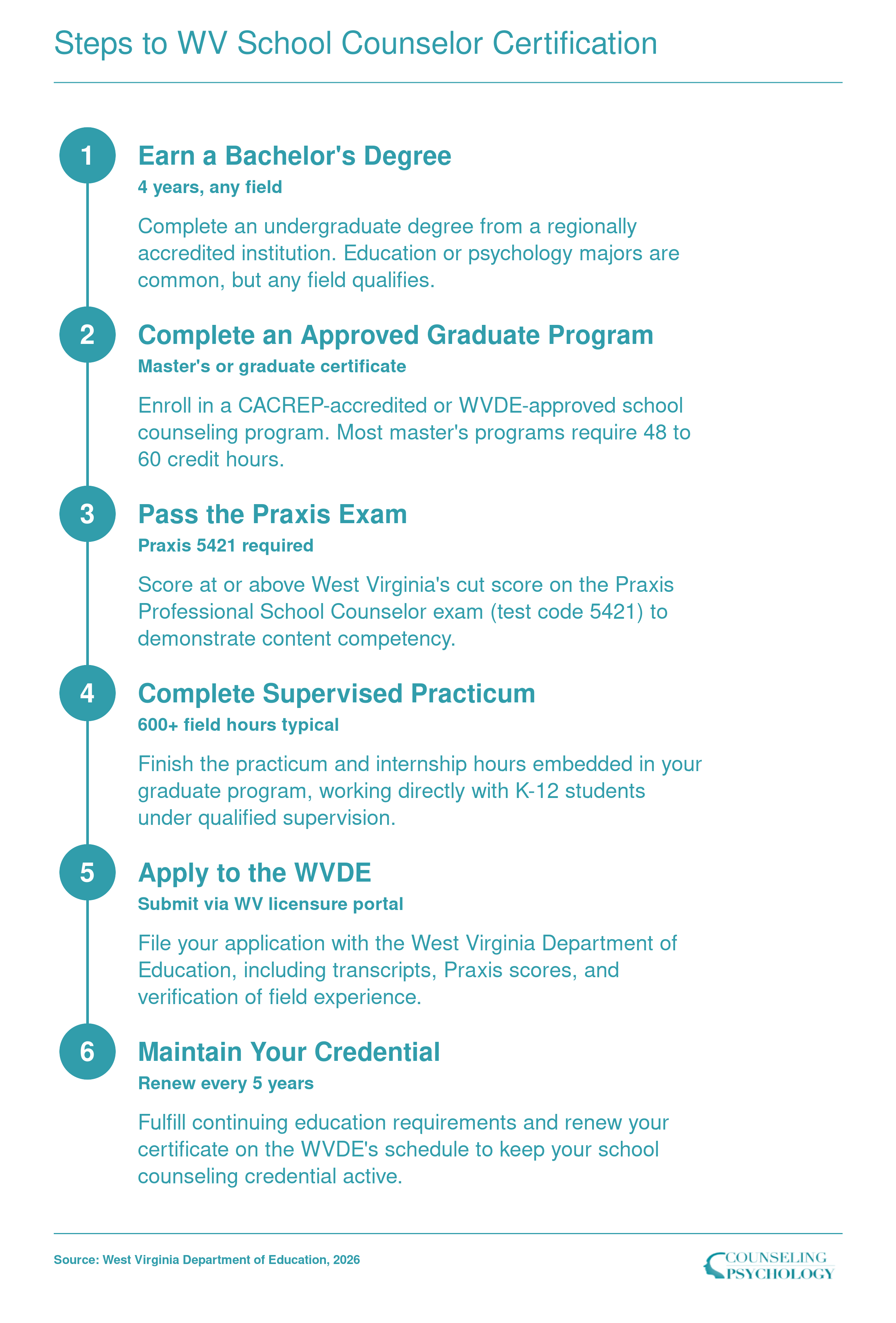
Steps to WV School Counselor Certification
West Virginia requires a specific sequence of education, testing, and supervised experience before you can work as a school counselor. Here is the certification pathway at a glance.
What Does a School Counseling Program Cost in West Virginia?
School counseling graduate programs in West Virginia currently range from approximately $9,510 to $11,412 per year in tuition for state residents, while out-of-state students can expect to pay between $22,192 and $29,538 annually based on 2023-2024 rates. These figures represent the published sticker price before any financial aid, and most students pay substantially less after scholarships, grants, and institutional support are applied.
Per-Credit and Total Program Costs Near Charleston
Marshall University in Huntington, the closest major public institution to Charleston, charges in-state students $9,510 per year, while out-of-state learners pay $22,192. The school counseling master's program spans 60 to 66 credit hours, bringing the total pre-aid cost to approximately $28,530 to $31,383 for West Virginia residents completing in three years, or $66,576 to $73,270 for out-of-state students. West Virginia University in Morgantown lists slightly higher tuition at $11,412 annually for residents and $29,538 for non-residents. Because WVU's program requires fewer credits, total costs may be comparable despite the higher per-credit rate. For a broader look at counseling options statewide, explore our guide to the best masters in counseling West Virginia.
What Students Actually Pay: Net Price After Aid
Published tuition tells only part of the story. The average net price, what students actually pay after scholarships, grants, and other aid, is considerably lower. Marshall University reports a net price of roughly $7,502 for undergraduates, while WVU's net price averages $15,634. These figures serve as approximations for graduate students, not guarantees. Your personal net cost depends on your financial need, academic record, and eligibility for assistantships or employer tuition reimbursement. Graduate students often qualify for fewer federal grants than undergraduates, but teaching and research assistantships, employer benefits, and state-specific scholarships can meaningfully reduce out-of-pocket expenses.
Online and Out-of-State Considerations
Some online school counseling programs charge a single per-credit rate regardless of residency, effectively erasing the in-state versus out-of-state divide. If you are considering an online program based outside West Virginia, compare its flat rate to Marshall's or WVU's in-state tuition. A program that charges $500 per credit for all students totals $30,000 to $33,000 for a 60 to 66-credit degree, competitive with WV resident rates and far cheaper than out-of-state tuition at public universities.
Debt and Monthly Payment Reality
Graduates of Marshall University carry a median debt of $23,250 at completion, while WVU alumni leave with a median of $22,500. These figures encompass all undergraduate and graduate debt, not just the school counseling program alone. Federal student loan calculators project that $23,000 in debt on a standard ten-year repayment plan yields a monthly payment near $260. Borrowing the full sticker price of a master's program without aid or assistantships pushes debt higher and monthly obligations above $300, underscoring the importance of minimizing loans through scholarships, part-time work, and employer partnerships.
Related Articles
Graduate Certificate vs. Master's in School Counseling: Which Do You Need?
West Virginia's school counselor certification requirements are clear: you need a master's degree to earn your initial credential.1 A graduate certificate alone will not qualify you for WVDE school counselor certification. Understanding this distinction helps you invest your time and tuition wisely.
Master's Degree: The Standard Pathway
A master's in school counseling is the primary route to becoming a licensed school counselor in West Virginia. These programs typically require 48 to 60 credit hours and take two to three years to complete for full-time students.2 You will need a bachelor's degree for admission, though it does not have to be in education or psychology.
The master's curriculum covers everything state certification demands: developmental theory, assessment techniques, crisis intervention, career counseling, and supervised practicum hours in school settings. Graduates emerge eligible to apply directly for WVDE certification through Form 20SR.3
- Credit hours: 48 to 60
- Time to complete: 2 to 3 years (full-time)
- Prerequisite: Bachelor's degree
- WV licensure eligible: Yes
- Best for: Career changers, bachelor's holders seeking initial school counselor certification
Graduate Certificate: A Specialized Add-On
Graduate certificates in school counseling serve a different purpose entirely. These shorter programs, usually 15 to 24 credits, require applicants to already hold a master's degree. In West Virginia, a certificate by itself does not lead to school counselor certification.1
So who pursues a certificate? Typically, licensed teachers or professionals who already hold a master's in a related field (such as education or mental health counseling) and want to add school counseling competencies to their credentials. Some institutions, like PennWest University, offer post-master's school counseling certificate programs designed specifically for these career transitions.4
- Credit hours: 15 to 24
- Time to complete: 6 months to 1 year
- Prerequisite: Master's degree
- WV licensure eligible: No (on its own)
- Best for: Existing master's holders adding a counseling endorsement or specialization
Making the Right Choice
If you hold only a bachelor's degree and want to work as a school counselor in West Virginia, a master's program is your path. The graduate certificate option makes sense only if you already have a master's and want to pivot toward school counseling or strengthen your credentials. Before enrolling in any certificate program, confirm with the WVDE whether the specific coursework will help you meet certification requirements given your existing credentials.
Questions to Ask Yourself
Online vs. Hybrid vs. On-Campus Options for WV Residents
Delivery format can make or break your ability to finish a school counseling degree while working, and West Virginia residents have more choices than you might expect.
In-State Format Options
Among programs near Charleston, Marshall University offers its Master of Arts in Counseling with a School Counseling concentration in a hybrid format, blending online coursework with periodic on-campus sessions in Huntington. That structure is especially practical for working educators who cannot commute to campus every week. West Virginia University's CACREP-accredited Counseling M.S. with a School Counseling concentration is a traditional on-campus program in Morgantown, though prospective students should confirm current enrollment availability directly with the department, as admissions status can shift from year to year.1
Out-of-State Online Programs Worth Considering
West Virginia does not maintain an exclusive approved-programs list for school counselor certification.2 Instead, the West Virginia Department of Education requires candidates to hold a degree from a CACREP-accredited school counseling program with appropriate K-12 practicum and internship hours. That opens the door to fully online CACREP-accredited programs at institutions like Lamar University, Adams State University, Liberty University, and William & Mary's online counseling program, all of which deliver their school counseling master's degrees online.2 Most CACREP-accredited online programs permit students to complete field placements in their home state, subject to site and supervisor approval by the program's field placement office. Before enrolling, contact both the program and the WVDE to verify that a given out-of-state degree will satisfy West Virginia certification requirements.
Practicum and Internship Logistics
Regardless of whether your coursework is online or on campus, you will need to complete a minimum of 100 practicum hours and 600 internship hours in a school setting.2 For students living in the Charleston metro area, Kanawha County Schools and surrounding districts regularly host counseling interns, giving you access to diverse K-12 placements without relocating. Even if your program is based out of state, securing a local site is typically straightforward as long as the school district and your program's field placement coordinator agree on supervision standards.
Trade-Offs to Weigh
- Flexibility: Online programs let you keep a teaching or paraprofessional position while earning your degree, a significant financial advantage.
- Networking: Campus and hybrid formats tend to foster closer relationships with faculty and cohort peers, which can translate into job referrals in West Virginia's relatively tight education community.
- Mentorship: On-campus students often have easier access to faculty-led research, conference opportunities, and informal advising that can shape long-term career direction.
- Cost: Out-of-state online tuition varies widely. Compare it against Marshall's in-state graduate tuition of roughly $9,510 per year to make sure the convenience premium is worth it.
The bottom line: confirm CACREP accreditation, verify that the program allows West Virginia-based practicum placements, and match the delivery format to your schedule and professional goals. The CACREP program directory is the most reliable starting point for that search.
Career Outlook and Salary for School Counselors in Charleston, WV
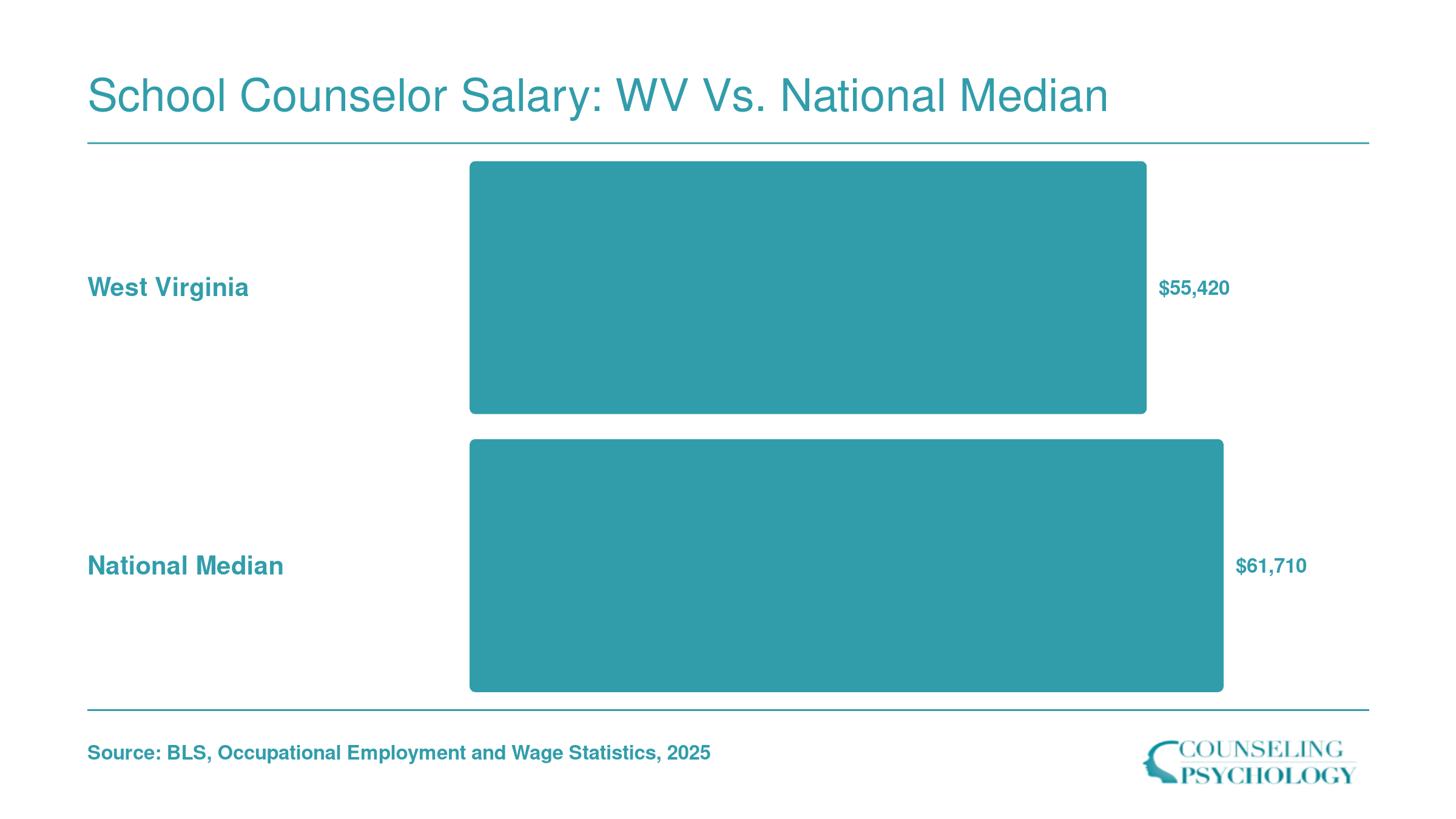
West Virginia employed roughly 1,390 educational, guidance, and career counselors and advisors as of the most recent BLS data. The state's median annual wage of $55,420 falls below the national median for this occupation, which the BLS reports at approximately $61,710. For students weighing program costs against earning potential, this context matters: if a CACREP-accredited master's program in the region costs between $25,000 and $45,000 in total tuition, a graduate entering at the state median salary could reasonably recoup that investment within one to two years of full-time employment, depending on financial aid received and total debt at graduation.
| Wage Measure | West Virginia (Annual) |
|---|---|
| 25th Percentile | $44,360 |
| Median (50th Percentile) | $55,420 |
| Mean (Average) | $54,910 |
| 75th Percentile | $63,160 |
| Total State Employment | 1,390 |
School Counselor Salary: WV vs. National Median
West Virginia school counselors earn less in raw dollars than the national median, but the state's significantly lower cost of living stretches each paycheck further. Housing, transportation, and everyday expenses in the Charleston metro area run well below the U.S. average, narrowing the real gap between these two figures.
Financial Aid and Scholarships for WV School Counseling Students
Funding a graduate program in school counseling takes some planning, but West Virginia students have access to several aid layers worth understanding before you commit to a program.
State-Level Aid: What Applies to Graduate Students
Two well-known West Virginia scholarships come up often in conversations about educator funding, but both carry important limitations for graduate students. The WV Higher Education Grant is a need-based award administered through the College Foundation of West Virginia, and as of the 2024-2025 award year it is limited to first-time undergraduates.1 If you are already pursuing or planning a master's in school counseling, this grant will not apply to your studies.
The Underwood-Smith Teaching Scholars program is similarly aimed at high school seniors and recent graduates entering teacher preparation, and its eligible fields include math, science, elementary education, and special education.2 School counseling is not currently listed among its covered disciplines, so most counseling students will not qualify for the scholarship itself.
That said, a related program deserves attention. The Underwood-Smith Teacher Loan Assistance Program offers up to $3,000 toward loan repayment for educators working in shortage fields, and counseling is explicitly listed as an eligible occupation.3 If you complete your degree and take a position in a qualifying school setting, this program could offset a portion of your borrowing.
Federal Aid Options Worth Pursuing
At the federal level, two programs are particularly relevant to school counseling graduates. The TEACH Grant provides funding to students committed to teaching or serving in high-need fields at low-income schools. Eligibility requirements are specific and the grant converts to a loan if service obligations are not met, so read the program terms carefully through the Federal Student Aid office before applying.
Public Service Loan Forgiveness (PSLF) can be a significant long-term benefit for school counselors employed by public school districts. Because public schools are government employers, positions there typically qualify. After ten years of qualifying payments on an income-driven repayment plan, remaining federal loan balances may be forgiven entirely.
Graduate Assistantships and Departmental Aid
Many of the most accessible funding opportunities do not come from state or federal programs at all. Graduate assistantships, tuition waivers, and departmental scholarships are awarded directly by counseling programs, and they can meaningfully reduce what you pay out of pocket. The share of students receiving grant aid at programs like Marshall University signals that institutional aid is part of the picture at schools serving working adults and lower-income students. Contact each program's financial aid or graduate studies office early in your application process to ask specifically about assistantship availability and any counselor education fellowships. These opportunities are rarely advertised prominently and often go to students who ask.
WV residents pursuing a school counseling degree can stack multiple sources of support: state grants like the Higher Education Adult Part-Time Student program, federal PSLF for those working in public schools, and institutional scholarships from your program. Applying for every available layer of aid can bring your total out-of-pocket cost down substantially, so leave nothing on the table.
Frequently Asked Questions About School Counseling in WV
Prospective school counselors in the Charleston area often have similar questions about costs, credentials, and the path to certification. Below are answers grounded in current West Virginia requirements and program data.