
What you’ll learn in this article…
- Tennessee has three APA-accredited counseling psychology doctoral programs: UT Knoxville, Memphis, and Tennessee State.
- Tennessee's median wage for clinical and counseling psychologists falls below the national median of $96,100.
- UT Knoxville PhD students typically receive funded assistantships, making Knoxville's low cost of living a real advantage.
- Becoming a licensed counseling psychologist in Tennessee requires a doctoral degree, supervised hours, and two board exams.
Can you earn a counseling psychology doctorate and complete the licensure pipeline without leaving the Knoxville area? The University of Tennessee-Knoxville runs the state's flagship APA-accredited PhD program in counseling psychology, admitting just five students a year. Within two hours, East Tennessee State University's master's in clinical mental health counseling and Johnson University's MA in counseling are CACREP-accredited. Online and hybrid programs from Lipscomb and Freed-Hardeman add flexibility. For students weighing all their options, reviewing counseling psychology phd programs nationally can provide useful context.
Bachelor's graduates here can pursue LPC licensure or enter doctoral training. Lower regional costs and assistantships ease finances, but competitive doctoral funding requires early planning.
Best Counseling Psychology Programs Near Knoxville, Tennessee
Tennessee offers a strong network of counseling psychology programs at every degree level, from bachelor's tracks that prepare you for graduate study to APA-accredited doctoral programs that lead directly to licensure as a psychologist. Below, we rank the best options within reach of Knoxville, weighing institutional outcomes, program quality, and regional relevance so you can zero in on the right fit.
- Accreditation and licensure alignment
- Graduation and retention rates
- Tuition and net price affordability
- Regional practicum partnerships
- Program depth and degree levels
- College Scorecard graduate earnings — collegescorecard.ed.gov
- Internal program database
- NCES-IPEDS federal institutional data — nces.ed.gov
- Independent program research

The University of Tennessee-Knoxville
The University of Tennessee, Knoxville is the only school on this list located in the city itself, offering counseling psychology at three distinct levels: a CACREP-accredited MS in Counseling, an MS Counseling Major, and an APA-accredited Counseling Psychology Ph.D. that has held accreditation since 1980. Faculty research centers on Appalachian and rural mental health, and students complete practicum hours at community agencies, VA facilities, and schools across East Tennessee. Schools offering these programs have an institution-wide graduation rate of 73.9%.
- APA-accredited since 1980 with scientist-practitioner-advocate model
- Admits roughly 5 students per year for personalized mentoring
- East Tennessee practicum sites including VA and community agencies
- Faculty research emphasis on Appalachian and rural mental health
- Designed for applicants with undergraduate or master's backgrounds
- Prepares graduates for Health Service Psychologist licensure in TN
- CACREP-accredited, 60-credit-hour curriculum
- Concentrations in Clinical Mental Health and School Counseling
- Over 1,000 supervised clinical hours across local partner sites
- No GRE required; holistic admissions process
- Full-time (two-year) and part-time options available
- Aligned with Tennessee LPC-MHSP licensure requirements
- CACREP-accredited 60-credit program
- Prepares students for LPC-MHSP licensure in Tennessee
- Approximately 2.5 years to complete on campus
- Strong focus on diversity, inclusion, and experiential learning
- Practicum placements in Knox County schools and area clinics
- Individualized licensure advising for Tennessee applicants
Counseling Psychology Ph.D. — On-Campus
MS in Counseling (Clinical Mental Health or School Counseling) — On-Campus
Counseling Major, MS — On-Campus

Lipscomb University
Lipscomb University in Nashville delivers a CACREP-accredited Clinical Mental Health Counseling master's that boasts a reported 100% licensure exam pass rate. Specializations in play therapy and addiction counseling set it apart, and small class sizes allow close faculty mentoring. Tuition runs $17,334 per year (in-state and out-of-state are identical as a private institution), with a net price of roughly $24,739. Schools offering this program have an institution-wide graduation rate of 72.2%.
- CACREP-accredited with reported 100% licensure exam pass rate
- Specializations available in play therapy and addiction counseling
- 61 credit hours at roughly $962 per credit hour
- 750 hours of supervised clinical experience required
- Integration of faith perspectives with evidence-based practice
- Meets Tennessee LPC-MHSP licensure standards
- Small class sizes with personalized faculty guidance
Clinical Mental Health Counseling, MS — Online
placeholder_remove — On-Campus

Trevecca Nazarene University
Trevecca Nazarene University offers a CACREP-accredited M.A. in Clinical Mental Health Counseling with one of the lower per-credit costs among private schools on this list, at about $775 per credit hour. The program's cohort model and partnerships with over 100 internship agencies across Tennessee give students broad clinical exposure. Schools offering this program have an institution-wide graduation rate of 53.2%.
- CACREP-accredited 60-credit-hour program
- Cohort model with small class sizes
- Approximately $775 per credit hour (roughly $46,500 total)
- Partnerships with 100+ internship agencies statewide
- Fall, spring, and summer start dates available
- Prepares directly for Tennessee LPC licensure
- Conditional admission option for applicants below GPA threshold
M.A. in Clinical Mental Health Counseling — On-Campus

Freed-Hardeman University
Freed-Hardeman University in Henderson stands out for its hybrid delivery format, combining web-conference sessions with periodic in-person classes. That flexibility makes the CMHC master's accessible to East Tennessee students who cannot relocate. The program reports a 96% pass rate on the Counselor Preparation Comprehensive Examination, and its school counseling track is among Tennessee's shortest paths to K-12 licensure. Schools offering these programs have an institution-wide graduation rate of 70.8%.
- Hybrid format blending web-conference and in-person sessions
- 96% reported CPCE pass rate
- $680 per credit hour; completable in 2 to 3 years
- Meets licensing requirements in Tennessee and most other states
- 3.0 GPA and 12 behavioral science credit hours required for admission
- Practicum and internship integrated into the curriculum
- Accessible to students across Tennessee without full relocation
- Hybrid format suitable for working teachers across Tennessee
- 37 credit hours at roughly $665 per credit hour
- Among Tennessee's shortest school counseling programs
- Prepares for Tennessee K-12 school counselor licensure
- Web-conference classes with periodic on-site meetings
- Designed for educators who want to remain in their current districts
M.S. in Clinical Mental Health Counseling — On-Campus
M.S. in School Counseling — On-Campus

Lee University
Lee University in Cleveland, about 90 minutes south of Knoxville, serves students at both the undergraduate and master's levels. The bachelor's psychology program with a counseling emphasis acts as a pipeline into Tennessee graduate counseling programs, while the M.S. in School Counseling prepares candidates for PreK-12 licensure through partnerships with East Tennessee school districts. Schools offering these programs have an institution-wide graduation rate of 62.6%.
- Campus-based undergraduate program in Cleveland, TN
- Coursework in crisis intervention and counseling theories
- Field experience component builds practical skills early
- Designed as a launchpad for graduate counseling programs
- Combines psychology foundations with counseling specialization
- Covers community services and mental health applications
- 60-semester-hour on-campus curriculum
- 100 practicum hours plus 600 internship hours required
- Partnerships with Cleveland City and Bradley County schools
- Prepares for Tennessee PreK-12 school counselor licensure
- Includes training in cultural contexts and career development
- Located in southeast Tennessee near Appalachian school systems
Psychology, Emphasis in Counseling (B.S.) — On-Campus
M.S. in School Counseling (PreK-12) — On-Campus

University of Memphis
The University of Memphis offers an APA-accredited Ph.D. in Counseling Psychology alongside CACREP-accredited master's tracks in Clinical Mental Health Counseling and Clinical Rehabilitation Counseling. The doctoral program admits only 7 to 8 students annually and emphasizes urban, diverse populations in West Tennessee. In-state tuition of $11,628 makes it one of the most affordable doctoral options in the state. Schools offering these programs have an institution-wide graduation rate of 50.9%.
- APA-accredited scientist-practitioner training model
- Admits 7 to 8 students per year for close mentorship
- Four-year structure: three years of coursework plus predoctoral internship
- Focus on serving diverse urban populations
- Competitive graduate assistantships available
- Prepares for psychologist licensure in Tennessee and beyond
- CACREP-accredited in-person program
- Focused on ethical counseling practices across diverse settings
- Campus-based classes in Memphis
- Prepares graduates for Tennessee LPC-MHSP licensure
- Master of Science degree with clinical practicum hours
- CACREP-accredited on-campus program
- Specializes in rehabilitation counseling populations
- Prepares students for diverse clinical and community settings
- Requires a bachelor's degree for admission
- Complements the department's doctoral and CMHC offerings
Ph.D. in Counseling Psychology — On-Campus
Clinical Mental Health Counseling, MS — On-Campus
Clinical Rehabilitation Counseling, MS — On-Campus

Austin Peay State University
Austin Peay State University in Clarksville is the only Tennessee school on this list with a Psy.D. in Counseling Psychology, offering a practitioner-scholar model with a distinctive concentration in serving military personnel, veterans, and their families. With Fort Campbell nearby, students gain clinical training opportunities uncommon at other programs. In-state tuition of $10,518 and a net price near $9,735 make it the most affordable option on this ranking. Schools offering these programs have an institution-wide graduation rate of 40.2%.
- Practitioner-scholar model with APA accreditation in process
- Unique focus on military and military family mental health
- Requires a master's degree in counseling or related field
- Small cohort sizes with licensed faculty
- Hands-on clinical training across Tennessee health systems
- Addresses psychological distress in diverse populations
- Specialized track for serving military personnel and veterans
- Fort Campbell proximity provides distinctive practicum access
- APA Commission on Accreditation site visit authorized
- Faculty with extensive military-related clinical backgrounds
- Selective admission with small cohort model
- Prepares for psychologist licensure across Tennessee
- 60 credit hours aligned with Tennessee LPC licensure
- Includes practicum and internship in community settings
- Dual-track option available on a case-by-case basis
- 12 hours of psychology prerequisites required
- Campus-based program in Clarksville
- Prepares for private practice and agency settings
- CACREP-accredited 60-credit-hour program
- Reported 100% job placement rate
- Prepares for Tennessee school counselor certification
- Covers social and cultural diversity in school settings
- Admission by application and interview
- Emphasizes ethical practice and professional development
Psy.D. in Counseling Psychology (General Concentration) — On-Campus
Psy.D. in Counseling Psychology (Military Concentration) — On-Campus
Counseling, M.S. (Clinical Mental Health Counseling) — On-Campus
Counseling, M.S. (School Counseling) — On-Campus

Maryville College
Maryville College sits just 20 to 25 minutes from downtown Knoxville in Blount County, making it the closest undergraduate option to the city. Its Psychology-Counseling bachelor's track is designed as a springboard into graduate counseling programs, with local practicum and service-learning placements in Knox and Blount County agencies. A 12-to-1 student-faculty ratio ensures personalized advising. Schools offering this program have an institution-wide graduation rate of 50%.
- Located in Maryville, roughly 20 minutes from Knoxville
- Coursework in neuroscience, abnormal psychology, and counseling techniques
- Local practicum sites in Blount and Knox Counties
- 12-to-1 student-faculty ratio for close mentorship
- Explicitly designed as a pipeline to UT Knoxville and regional master's programs
- Prepares graduates for immediate entry into social service roles
Psychology-Counseling (B.A.) — On-Campus

Belmont University
Belmont University in Nashville offers a CACREP-accredited M.A. in Mental Health Counseling with four distinct concentrations: Clinical Mental Health, Marriage, Couple and Family Counseling, Pastoral Therapy, and School Counseling. Students log 700 clinical hours across Nashville's diverse health care landscape. Belmont reports strong licensure exam pass rates, and its School Counseling concentration is available online. Schools offering these programs have an institution-wide graduation rate of 70.7%.
- CACREP-accredited 60-credit-hour program
- 700 hours of practicum and internship in Nashville clinical sites
- Integrates Christian spiritual insights with evidence-based practice
- Meets Tennessee LPC-MHSP licensure requirements
- Emphasis on ethical practice, diversity, and social justice
- On-campus instruction with interprofessional collaboration
- Prepares for LMFT licensure in Tennessee
- 700 clinical hours across diverse training sites
- Campus-based with state-of-the-art simulation labs
- Reported high board exam pass rates
- Focus on holistic, family-centered care
- Strong alumni network in Nashville health care
- Integrates spirituality with clinical counseling skills
- 700 clinical hours in diverse settings
- Meets Tennessee licensure requirements
- 60-credit-hour campus-based curriculum
- Emphasis on ethical practice and interprofessional work
- Designed for students seeking faith-integrated therapy careers
- Available online for flexibility across Tennessee
- Reported 100% Praxis pass rate
- Prepares for Tennessee school counselor licensure
- 700 clinical hours with diverse placements
- 60 credit hours with CACREP accreditation
- Small class sizes with personalized supervision
M.A. in Mental Health Counseling, Clinical Mental Health Concentration — On-Campus
M.A. in Mental Health Counseling, Marriage, Couple and Family Concentration — On-Campus
M.A. in Mental Health Counseling, Pastoral Therapy Concentration — On-Campus
M.A. in Mental Health Counseling, School Counseling Concentration — On-Campus

East Tennessee State University
East Tennessee State University in Johnson City is about 1.5 to 2 hours northeast of Knoxville and serves the broader Appalachian region with CACREP-accredited master's concentrations in Clinical Mental Health, School Counseling, and Couple and Family Counseling. The department operates a free community counseling clinic that doubles as a hands-on training site, and faculty provide state-specific licensure advising for Tennessee boards. In-state tuition of $11,366 keeps costs accessible. Schools offering these programs have an institution-wide graduation rate of 53.2%.
- CACREP-accredited with focus on multicultural Appalachian contexts
- Prepares directly for Tennessee LPC-MHSP licensure
- Free community counseling clinic integrated into training
- Extensive fieldwork opportunities in Northeast Tennessee
- On-campus program in Johnson City
- Faculty provide individualized Tennessee licensure advising
- CACREP-accredited campus-based program
- Prepares for Tennessee school counselor licensure
- Emphasizes multicultural awareness in Appalachian schools
- Hands-on fieldwork in regional school districts
- Faculty advisor support throughout the program
- Professional development focus with diverse student body
- CACREP-accredited with dual licensure pathway options
- On-campus learning in Johnson City, TN
- Emphasis on multicultural awareness and family systems
- Hands-on clinical experience in community settings
- Supports Tennessee licensure for couple and family counseling
- Free community counseling services as training component
Master's in Counseling, Clinical Mental Health Concentration — On-Campus
Master's in Counseling, School Counseling Concentration — On-Campus
Master's in Counseling, Couple and Family Counseling Concentration — On-Campus
How We Ranked These Programs
Four metrics from federal College Scorecard data drive the ranking: net price, graduation rate, program-level earnings, and median debt. Each factor is converted to a percentile and aggregated into a weighted composite score, with programs ordered from highest to lowest. We prioritize publicly available, comparable figures so that every program can be evaluated on a consistent foundation.
What the Composite Score Measures
- Net price: The average annual cost after grants and scholarships, capturing affordability for in-state and out-of-state students.
- Graduation rate: The institution's overall rate of full-time, first-time students completing within 150% of normal time, signaling student support and outcomes.
- Program-level earnings: The median earnings of students who completed the specific counseling psychology program, drawn from the U.S. Department of Education's College Scorecard.
- Median debt: Federal loan debt at graduation, providing a debt load benchmark.
The four components carry equal weight. We relied on the most recent data available as of May 2026.
Defining 'Near Knoxville'
The list includes campus-based programs within a roughly 60-mile radius of downtown Knoxville, covering institutions in Knox, Anderson, and Blount counties. To ensure accessibility for working adults and those unable to relocate, we also included online and hybrid programs offered by Tennessee universities that a Knoxville resident can complete without prolonged travel. Programs from neighboring states are not included unless they maintain a local instructional site.
Accreditation and Transparency
Accreditation status from APA or CACREP is not part of the composite score, but we clearly indicate each program's accreditation standing. This approach calls attention to a critical threshold for licensure without conflating accreditation with the value-for-cost metrics that drive the ranking. If you are exploring clinical mental health counseling online programs more broadly, accreditation remains equally important in those evaluations.
Understanding the Data's Limitations
Graduation rates are institution-wide figures and may not mirror department-specific success. Net price reflects the average for all students, not just counseling psychology majors. Program-level earnings data represent all completers with federal aid, not only recent graduates, and may be unavailable for some programs. These limitations are inherent in federal datasets, yet they remain the most transparent starting point for side-by-side comparison.
Counseling Psychology vs. Clinical Psychology vs. Counseling Degrees
If you search for "counseling programs Tennessee," you will find dozens of master's degrees in clinical mental health counseling, but very few doctoral programs in counseling psychology. These are fundamentally different pathways, and understanding the distinctions will save you time and help you choose a credential that matches your career goals.
Counseling Psychology Doctorates: A Strengths-Based Model
Counseling psychology PhD and PsyD programs train you in a scientist-practitioner or scientist-practitioner-advocate model.1 The emphasis falls on developmental issues, adjustment, wellness, career concerns, and multicultural competence. Rather than centering on psychopathology, counseling psychology approaches clients from a strengths-based perspective, asking what resources and capacities a person brings to their challenges. Graduates typically work in college counseling centers, outpatient therapy settings, and with general adult populations. In Tennessee, completing a counseling psychology doctorate puts you on track for psychologist licensure, not counselor licensure.3
Clinical Psychology Doctorates: Diagnosis and Higher-Acuity Care
Clinical psychology PhD programs also follow a scientist-practitioner model, but with a heavier focus on psychopathology assessment and treating moderate to severe mental illness.2 Clinical psychologists often work in hospitals, inpatient units, or with specialized and higher-risk populations, including children with complex needs. Like counseling psychology, this is a doctoral pathway to psychologist licensure in Tennessee.
Master's-Level Counseling: LPC and MHSP Credentials
Best masters in mental health counseling programs are practice-oriented with limited research components. Graduates provide general mental health counseling and can diagnose within the counselor scope of practice. After completing supervised experience, you earn the LPC credential and can add the Mental Health Service Provider (MHSP) designation.5 This route leads to counselor licensure, not psychologist licensure, meaning a different scope of practice and a different professional identity.
Why This Matters for Your Search
When browsing programs near Knoxville, recognize that most "counseling" results will be master's-level CMHC degrees. If you want to practice as a licensed psychologist with the autonomy and scope that entails, you need a counseling psychology or clinical psychology doctorate. If your goal is to enter the workforce sooner and provide outpatient counseling in community or private practice settings, a master's in counseling may be the better fit.
Tennessee Counseling Psychology PhD Programs Compared: UT Knoxville, Memphis, and Tennessee State
Tennessee has three APA-accredited counseling psychology doctoral programs, and the differences between them matter when you are deciding where to apply.
University of Tennessee, Knoxville
UT Knoxville is the flagship option for doctoral training in the state. The program follows a scientist-practitioner-advocate model with a strong emphasis on multicultural competency and social justice.1 Admission is exceptionally competitive: roughly 4 percent of applicants received offers in 2024, with a cohort of approximately five students per year.2 The minimum GPA requirement is 2.7, though admitted students typically present stronger records, and GRE scores are not required thanks to a current GRE waiver policy.3
Funding is a genuine draw. Incoming students receive a guaranteed assistantship and tuition waiver in their first year, with stipends running approximately $18,500 to $20,700 for the 2023-24 academic year.2 The degree requires 108 credit hours and typically takes five to six years to complete.3 Internship placement data is reported through the program's publicly available admissions and outcomes disclosure, which prospective students should review directly.2
University of Memphis
The University of Memphis Counseling Psychology PhD is also APA-accredited and draws on its urban location to offer a diverse, community-facing practicum network. Memphis historically enrolls slightly larger cohorts than UTK, and its city setting means exposure to a wide range of clinical populations across socioeconomic and cultural backgrounds. Prospective applicants should check directly with the program for current stipend figures, as published details can shift from cycle to cycle.
Tennessee State University
Tennessee State University in Nashville holds APA accreditation and has built a program with an explicit commitment to serving historically underrepresented populations. Its location in a mid-size state capital provides access to community mental health, government, and healthcare practicum sites. Students whose professional goals center on health equity and underserved communities may find TSU's mission especially aligned with their interests. Those drawn to related applied fields might also explore health psychology phd programs for complementary doctoral training options.
Choosing Between Them
All three programs provide the APA-accredited training required for licensure as a psychologist in Tennessee. The practical differences come down to location, cohort culture, funding packages, and the clinical populations each program's practicum network emphasizes. Visiting each program, speaking with current students, and reviewing each program's publicly posted outcomes data are the most reliable ways to make a final call.
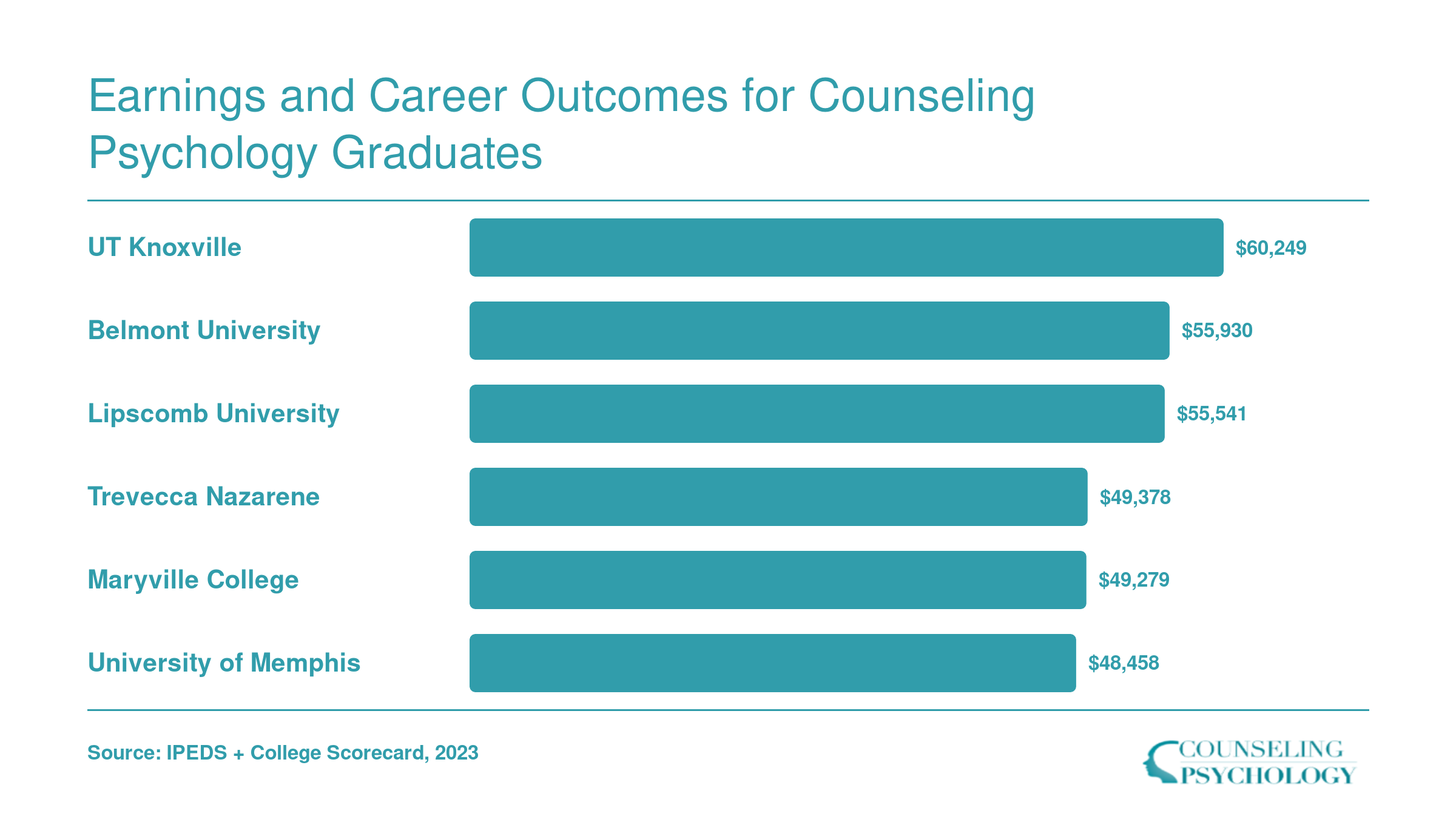
Earnings and Career Outcomes for Counseling Psychology Graduates
Graduates from counseling psychology programs enter a range of roles, from licensed professional counselors and clinical mental health counselors to doctoral-level counseling psychologists working in community agencies, hospitals, and private practice. The institution-level median earnings shown below reflect all graduates from each school (across all programs), not only those who pursued licensure as psychologists. Program-level earnings for these specific counseling psychology tracks are not yet available through federal reporting, so these broader figures serve as a useful benchmark rather than a direct measure of counseling psychology outcomes alone.
What Counseling Psychologists Earn in Tennessee and Nationally
Bureau of Labor Statistics data for Clinical and Counseling Psychologists shows that Tennessee wages sit below the national median for this occupation. The BLS reports a national median annual wage of $96,100 for clinical and counseling psychologists, while Tennessee's median comes in at $92,320. Note that BLS does not publish a separate wage estimate for the Knoxville metropolitan area for this occupation, so statewide figures are the most granular data available. Tennessee employs roughly 780 clinical and counseling psychologists statewide.
| Metric | Tennessee | National |
|---|---|---|
| Median Annual Wage | $92,320 | $96,100 |
| Mean Annual Wage | $103,190 | $106,510 |
| 25th Percentile Wage | $81,790 | $76,080 |
| 75th Percentile Wage | $120,450 | $122,650 |
| Total Employment | 780 | 38,350 |
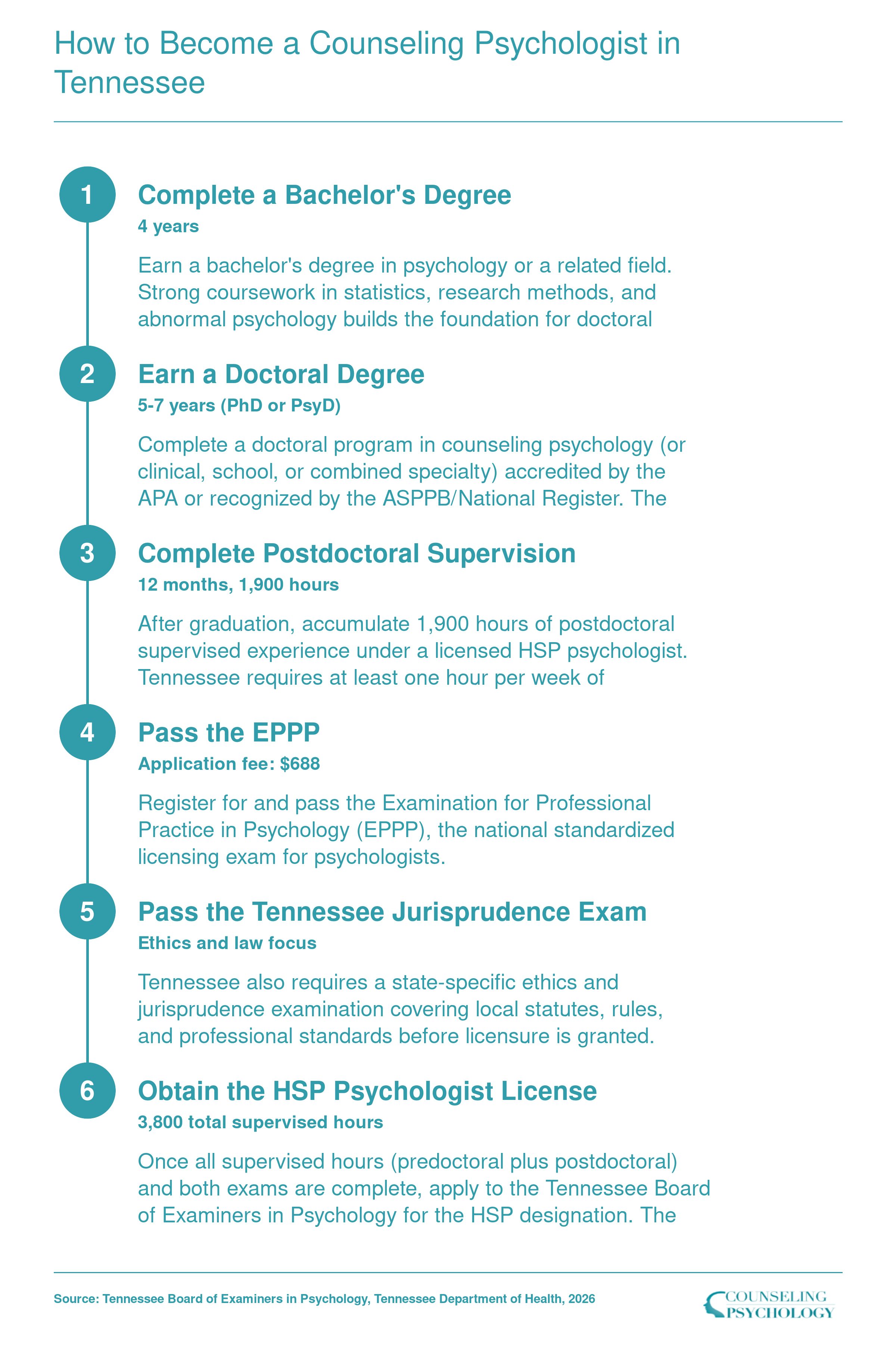
How to Become a Counseling Psychologist in Tennessee
Earning the Health Service Provider (HSP) psychologist license in Tennessee requires a doctoral degree, thousands of supervised clinical hours, and two board exams. The Tennessee Board of Examiners in Psychology oversees the entire credentialing process. This timeline differs significantly from the LPC/MHSP pathway, which requires only a master's degree and serves master's-level counselors rather than doctoral-level psychologists.
Funding, Costs, and Financial Aid at Knoxville-Area Programs
For most prospective doctoral students, the real question is not just which program fits best academically, but whether they can afford to attend without accumulating unsustainable debt. At the PhD level in counseling psychology, those two concerns often resolve together, because the strongest programs typically offer full funding as a condition of admission.
UT Knoxville Counseling Psychology PhD Funding
UT Knoxville's Counseling Psychology PhD program operates on a fully funded model.1 The department admits only the students it can fully support, which in practice means a cohort of roughly five students per year out of a total program enrollment of around 25 to 30.1 Admitted students receive funding tied to graduate assistantships, covering core program costs rather than requiring students to self-finance their doctoral training.
The specific stipend amount is not published on the program's public-facing materials as of 2026.1 Before making any enrollment decision, contact the graduate program coordinator directly and ask for the current stipend figure, confirmation of what costs are covered, whether funding is guaranteed across the full program duration, and whether health insurance is included. Getting those details in writing protects you if departmental budgets shift between your admission and your second or third year.
Counselor Education Funding at UT Knoxville
The adjacent PhD in Counselor Education offers a clearer published picture. All full-time doctoral students are eligible for graduate assistantships covering tuition, fees, and health insurance for up to three years.2 That package is meaningful: health coverage alone can represent thousands of dollars in annual value that rarely appears in headline stipend comparisons.
National Benchmarks and Outside Fellowships
Across fully funded clinical and counseling psychology doctoral programs nationally, stipends typically fall somewhere in the range of $20,000 to $30,000 per year, though figures vary by institution, cost of living, and assistantship duties. Use that range as a baseline when evaluating any offer, and factor in Knoxville's relatively modest cost of living compared to larger metro areas.
Beyond institutional funding, two fellowship programs are worth pursuing independently:
- NSF Graduate Research Fellowship Program (GRFP): Provides a multi-year stipend and cost-of-education allowance. Winning this award signals research independence and strengthens your record for post-doctoral opportunities.
- APA Minority Fellowship Program: Supports doctoral students from underrepresented groups pursuing careers in mental health. Awards are competitive and come with professional development resources alongside the funding.
Applying for external fellowships before matriculating, or in your first year, can supplement institutional support and reduce reliance on a single funding source if assistantship renewals are not guaranteed in writing.
What It's Like to Study in Knoxville
How affordable is Knoxville for a graduate student living on a stipend? That depends on rent, but the short answer is: more affordable than most major metros where comparable doctoral training happens.
Cost of Living and Housing
Knoxville consistently lands below the national average on cost-of-living indexes. Tools like BestPlaces.net and the University of Tennessee's own cost-of-living estimator can give you a current snapshot, and the figures shift, so check them close to your application cycle rather than relying on year-old numbers.
For housing, run a fresh search on Zillow or Apartments.com filtered to the neighborhoods closest to campus (Fort Sanders, Bearden, North Knoxville, South Knoxville). Then cross-check what you find against UT Knoxville's off-campus housing office, which vets listings and posts roommate boards. A one-bedroom near campus typically runs notably less than equivalent units in Nashville, Atlanta, or the Research Triangle, but rents have climbed since 2020, so verify rather than assume.
Practicum and Internship Sites
Knoxville offers a denser-than-expected training network for a metro its size. Doctoral students in counseling psychology typically rotate through sites such as the Tennessee Valley Healthcare System (VA), Cherokee Health Systems, the Helen Ross McNabb Center, and university-based counseling centers. Before banking on any specific site, do two things:
- Pull the current practicum list directly from the program's website, or email the program director and ask. Site rosters change year to year.
- Confirm each placement against the APA accreditation database and the Tennessee Board of Examiners in Psychology to make sure the hours will count toward licensure.
That verification step protects your timeline and your future application for licensure.
Tips for Choosing the Right Counseling Psychology Program
A scientist-practitioner (Boulder model) program and a practitioner-scholar (Vail model) program can both lead to the same credential, but the day-to-day experience, dissertation expectations, and career trajectory they prepare you for are genuinely different. Picking the right fit starts with understanding what kind of psychologist you want to become.
Put APA Accreditation at the Top of Your List
Accreditation from the American Psychological Association is not a nice-to-have; it is functionally essential. Most APA-accredited internship sites, which you will need to complete before licensure, require applicants to come from APA-accredited doctoral programs. Tennessee's licensing board accepts degrees from programs that meet specific accreditation standards, and many employers in hospitals, VA centers, and university counseling centers screen for APA-accredited training as a baseline. If a program you are considering is not yet accredited, ask whether it has applied and what its timeline looks like.
Match the Training Model to Your Goals
Boulder model programs balance research production and clinical hours roughly equally. If you see yourself publishing, teaching at a university, or contributing to evidence-based treatment development, this model fits. Vail model programs tilt heavily toward applied clinical work, with less emphasis on independent research. If your goal is a full-time therapy practice or a clinical directorship, a practitioner-scholar program may get you there more efficiently. Neither model is inherently better, but choosing the wrong one can leave you frustrated for four to six years. Understanding the full landscape of degrees in psychology can help you weigh how a doctoral program fits into your broader career plan.
Look Past Prestige to Everyday Fit
Rankings capture broad reputations, but your lived experience depends on smaller details. Consider these when comparing programs:
- Cohort size: A cohort of six students creates a very different dynamic than one of twenty. Smaller cohorts often mean closer faculty mentorship but less peer diversity.
- Faculty research interests: Make sure at least two faculty members work in areas that excite you. If only one does and they leave, your research support disappears.
- Clinical placement variety: Programs that rotate students through community mental health centers, schools, hospitals, and private practice sites produce more versatile clinicians.
- Internship match rates: Ask for the program's APPIC match rate over the past three to five years. A rate consistently above 80 percent is a positive signal; anything below that warrants questions.
Do Your Homework Before You Commit
Visit every program you are seriously considering, even if the trip costs time and money. Sit in on a class, eat lunch with current students, and ask them what they wish they had known before enrolling. If you are still exploring whether becoming a psychologist is the right path, these campus visits can be especially clarifying. Request detailed funding offers in writing and compare them side by side: stipend amounts, tuition waivers, summer funding, and health insurance coverage can vary dramatically across programs that look similar on paper. A program offering full tuition plus a livable stipend may be a better long-term investment than a higher-ranked program that leaves you with six figures of debt.
Frequently Asked Questions About Counseling Psychology Programs in Knoxville
These are the questions prospective students ask most often about counseling psychology training in the Knoxville area. Each answer draws on specifics covered elsewhere in this article, including program details, licensure steps, and career data.
More Counseling Psychology Programs to Consider Near Knoxville
If you are still exploring your options, here are additional counseling psychology programs in Tennessee worth investigating. Each program page has full details on admission requirements, curriculum, and financial aid.
East Tennessee
- Clinical Mental Health Counseling (general)
- Clinical Mental Health Counseling (addictions counseling)
- Counseling (School Counseling)
- Master of Arts in Counseling (Clinical Mental Health Counseling)
- Master of Arts in Counseling (School Counseling)
- Master of Science in Counseling (Clinical Mental Health Counseling)
- Master of Science in Counseling (School Counseling)
Nashville Area
- Ph.D. in Psychology (Counseling Psychology)
- Masters of Science in Counseling, Clinical Mental Health Concentration (Clinical Mental Health Counseling)
- Master of Science in Professional School Counseling