
What you’ll learn in this article…
- North Carolina's LCAS credential requires a master's degree, while the CADC and CSAC pathways accept graduate certificates or less.
- Fully online and hybrid addiction counseling programs now appear across multiple NC universities for 2026.
- Graduate certificates typically run 12 to 18 credit hours and can be completed in under two years.
- BLS projects strong national growth for substance abuse counselors, and NC state investment in behavioral health is fueling local demand.
Addiction counseling programs in North Carolina prepare students for state-regulated credentials, including the Licensed Clinical Addiction Specialist (LCAS), Certified Alcohol and Drug Counselor (CADC), and Certified Substance Abuse Counselor (CSAC), each with distinct education and supervision requirements. With seven universities currently offering dedicated graduate certificates or masters in addiction counseling degrees, the state provides multiple entry points depending on where you are in your career.
The practical tension is straightforward: graduate certificates can be completed in as few as 12 credit hours and satisfy LCAS educational requirements for professionals who already hold a master's degree, while a full 60-credit-hour master's program builds licensure eligibility from the ground up. In-state tuition for these programs ranges from roughly $3,600 to over $39,000 per year, so the cost gap between pathways is significant. North Carolina's opioid crisis funding and Medicaid expansion continue to drive employer demand for credentialed addiction counselors statewide.
Top Addiction Counseling Programs in North Carolina for 2026
North Carolina offers a strong mix of graduate certificates and master's degrees for students pursuing addiction counseling credentials. The programs below span fully online, hybrid, and campus-based formats, and most are structured to satisfy the educational requirements for the Licensed Clinical Addictions Specialist (LCAS) or Certified Alcohol and Drug Counselor (CADC) credential. Graduation rates listed are institution-wide figures reported by IPEDS, not specific to any individual program. Program-level earnings data is not yet available for any of these addiction counseling offerings.
- Licensure alignment and accreditation
- Net price and affordability
- Institutional graduation and retention
- Format flexibility and accessibility
- Program depth and clinical components
- NCES-IPEDS federal institutional data — nces.ed.gov
- College Scorecard graduate earnings — collegescorecard.ed.gov
- Independent program research
- Internal program database

University of North Carolina at Charlotte
UNC Charlotte stands out as one of only five North Carolina schools approved by the NCASPPB, giving students a direct, board-recognized track toward LCAS licensure. The university pairs a CACREP-accredited Master of Arts in Addiction Counseling (reporting a 100% licensure exam pass rate) with a Post-Masters Certificate for counselors who already hold a graduate degree. Its IC&RC membership also supports credential portability if you plan to practice outside North Carolina.
- CACREP-accredited, 60-credit-hour program
- 100% licensure exam pass rate reported by the department
- Practical field experiences embedded in the curriculum
- Eligibility for both LCAS and LPC within two years of graduation
- Recognized as an Outstanding National Program
- Scholarship opportunities available through the department
- Award-winning faculty with active clinical backgrounds
- Requires a prior master's from a CACREP-accredited program
- 180 clock hours of coursework plus 300 clinical hours
- Covers addiction theories, assessment, and treatment planning
- Prepares graduates for LCAS certification in North Carolina
- Admission requires a statement of purpose and professional evaluations
- On-campus format with structured cohort scheduling
Master of Arts in Addiction Counseling — On-Campus
Post-Masters Certificate in Addiction Counseling — On-Campus

University of North Carolina at Greensboro
UNC Greensboro's Post-Baccalaureate Certificate in Addiction Treatment is fully online, blending synchronous and asynchronous sessions across five three-credit courses. It can be completed in as few as 12 months full-time or stretched on a part-time schedule, and rolling admissions keep the entry barrier low. With a net price of $10,965, UNCG is among the most affordable options on this list while still meeting both LCAS and CADC educational requirements.
- 100% online with synchronous and asynchronous components
- Completable in 12 months full-time or at a flexible part-time pace
- Rolling admissions with no fixed application deadline
- Satisfies educational requirements for both LCAS and CADC
- Five courses delivered in intensive 7-week sessions
- Requires only a bachelor's degree (minimum 2.7 GPA)
- Emphasizes culturally responsive, evidence-based practices
- Net price of $10,965 is among the lowest in this ranking
Post-Baccalaureate Certificate in Addiction Treatment — Online

Wake Forest University
Wake Forest University brings its CACREP-accredited Master of Arts in Counseling with an Addiction concentration entirely online, a format well suited to working professionals. The 60-semester-hour program spans roughly three years (including summers) and does not require GRE scores for admission. Wake Forest's institution-wide graduation rate of 89.2% is the highest among all schools in this ranking, and its 10:1 student-to-faculty ratio signals close mentorship throughout clinical training.
- CACREP-accredited, fully online delivery
- 60 semester hours completed over approximately three years
- No GRE required for admission
- Embedded clinical experiences alongside coursework
- Prepares graduates for professional counselor licensure
- 10:1 student-to-faculty ratio across the university
- Institution-wide graduation rate of 89.2%
Master of Arts in Counseling, Addiction Concentration — Online

East Carolina University
East Carolina University's Graduate Certificate in Treating Substance Use Disorders is tailored specifically for MSW students looking to add the LCAS credential. Delivered entirely online by credentialed faculty, the program focuses on real-world clinical applications and ethical standards in addiction treatment. ECU's net price of $15,739 and 83% retention rate reflect a strong value proposition within the UNC system.
- Fully online format designed for current MSW students
- Curriculum prepares graduates for LCAS certification
- Taught by faculty with active addiction counseling credentials
- Emphasizes ethical standards and clinical practice skills
- Covers intervention strategies for substance use disorders
- In-state tuition of $7,658 per year (IPEDS)
Graduate Certificate in Treating Substance Use Disorders — Online

University of North Carolina Wilmington
UNC Wilmington delivers its Substance Use Disorders and Addictions Certificate in a hybrid format that combines online coursework with in-person sessions, including evening classes for working professionals. The program is built around intensive seven-and-a-half-week courses and integrates clinical supervision training, a component not always included at the certificate level. Coursework specifically addresses ethics and HIV/AIDS education, both of which align with state practice requirements.
- Hybrid format blending online and in-person instruction
- Evening classes accommodate working schedules
- Intensive 7.5-week course blocks
- Clinical supervision training included in the curriculum
- Covers ethics and HIV/AIDS as part of NC requirements
- Designed for MSW students and community practitioners
- Meets educational requirements for LCAS licensure
- Financial aid available for eligible students
Substance Use Disorders and Addictions Certificate — Hybrid

University of North Carolina at Pembroke
UNC Pembroke's Graduate Certificate in Addictions Counseling is a compact 12-credit-hour online program that meets NCASPPB requirements for the LCAS. It is open to current graduate students, recent alumni, and community applicants who already hold a relevant master's degree. An optional addictions-specific internship gives students supervised field experience directly tied to substance abuse treatment, a practical advantage for those building clinical hours.
- Fully online, 12-credit-hour program
- Meets NCASPPB educational requirements for LCAS
- Optional addictions-specific internship available
- Covers psychopharmacology, family impact, and special populations
- Open to current students and community applicants with master's degrees
- Lowest in-state tuition in this ranking at $6,928 (IPEDS)
- B-minus or higher required in each course
Graduate Certificate in Addictions Counseling — Online

Western Carolina University
Western Carolina University's Addiction Studies Certificate is a 12-credit-hour campus-based program that fulfills the NC Addictions Specialist Professional Practice Board's 180-hour educational requirement. It is designed for students already enrolled in master's-level Social Work, Clinical Mental Health Counseling, or Clinical Psychology programs, as well as licensed practitioners seeking continuing education. With a 14:1 student-to-faculty ratio (institution-wide), WCU offers a more personalized learning environment than many larger UNC campuses.
- 12-credit-hour on-campus certificate
- Meets 180-hour NCASPPB educational requirement
- Designed for master's-level MSW, CMHC, or Clinical Psych students
- Also available to licensed practitioners for continuing education
- Prepares for LCAS or Master-level CADC credentials
- Net price of $13,315 offers solid affordability in the UNC system
Addiction Studies Certificate — On-Campus
Graduate Certificates vs. Master's Degrees in Addiction Counseling
Graduate certificates and master's degrees in addiction counseling serve fundamentally different career objectives, and choosing the wrong pathway can cost you both time and money. A graduate certificate typically requires 12 to 18 credit hours and takes one to two semesters to complete, while a master's degree demands 48 to 60 credit hours spread across two to three years. The critical question is not which program is better, but which credential aligns with your licensure goals and career timeline in North Carolina.
Credit Requirements and Stackability
Many UNC system schools structure their graduate certificates to stack into master's programs, allowing certificate credits to count toward a full degree if you decide to continue. For example, some institutions offer addiction-focused certificates that fulfill elective or concentration requirements within their master's in counseling or social work programs. However, stackability is not universal. Check individual program websites at UNC Chapel Hill, NC State, East Carolina University, and UNC Greensboro for explicit credit transfer policies. If a school's published materials are unclear, contact the program coordinator directly via email or phone to ask whether certificate courses will transfer and what additional coursework would be required to complete a master's degree. Typical responses take three to five business days, and coordinators can often share cohort-specific timelines and prerequisite waivers. You can also compare online graduate certificates in addiction counseling to see how stackability works across different institutions.
Licensure Pathways and Career Scope
The North Carolina Substance Abuse Professional Practice Board (NCSAPPB) governs addiction counseling credentials in the state, and your academic degree determines which licensure tiers you can pursue. A graduate certificate alone typically qualifies you for entry-level credentials like the Certified Alcohol and Drug Counselor (CADC) or Certified Substance Abuse Counselor (CSAC), which require supervised practice hours and passing the IC&RC exam. A master's degree, by contrast, opens pathways to the Licensed Clinical Addiction Specialist (LCAS) and, with additional coursework, the Licensed Clinical Mental Health Counselor (LCMHC). For a broader look at the steps involved, our guide on how to become a substance abuse counselor covers the full licensure process. The Bureau of Labor Statistics does not publish separate wage data for certificate-only counselors versus master's-prepared clinicians, but state licensure boards consistently reserve clinical supervision, independent practice, and third-party billing privileges for master's-level licensees. If your goal is private practice or clinical leadership, a certificate will not suffice.
Cost and ROI Considerations
Graduate certificates at North Carolina public universities range from approximately 4,000 to 9,000 dollars in total tuition, while master's programs cost between 24,000 and 50,000 dollars depending on residency status and institution. Certificates offer a faster, lower-cost entry point for professionals already holding a bachelor's degree in addiction counseling or a related field, as well as those seeking an add-on credential to an existing license. Master's degrees, though more expensive, provide broader career mobility and higher earning potential over a 20-year career span. Review the NCSAPPB licensure requirements alongside your financial aid options before committing to either pathway.
Questions to Ask Yourself
NC Licensure Pathways: LCAS, CADC, and CSAC Requirements
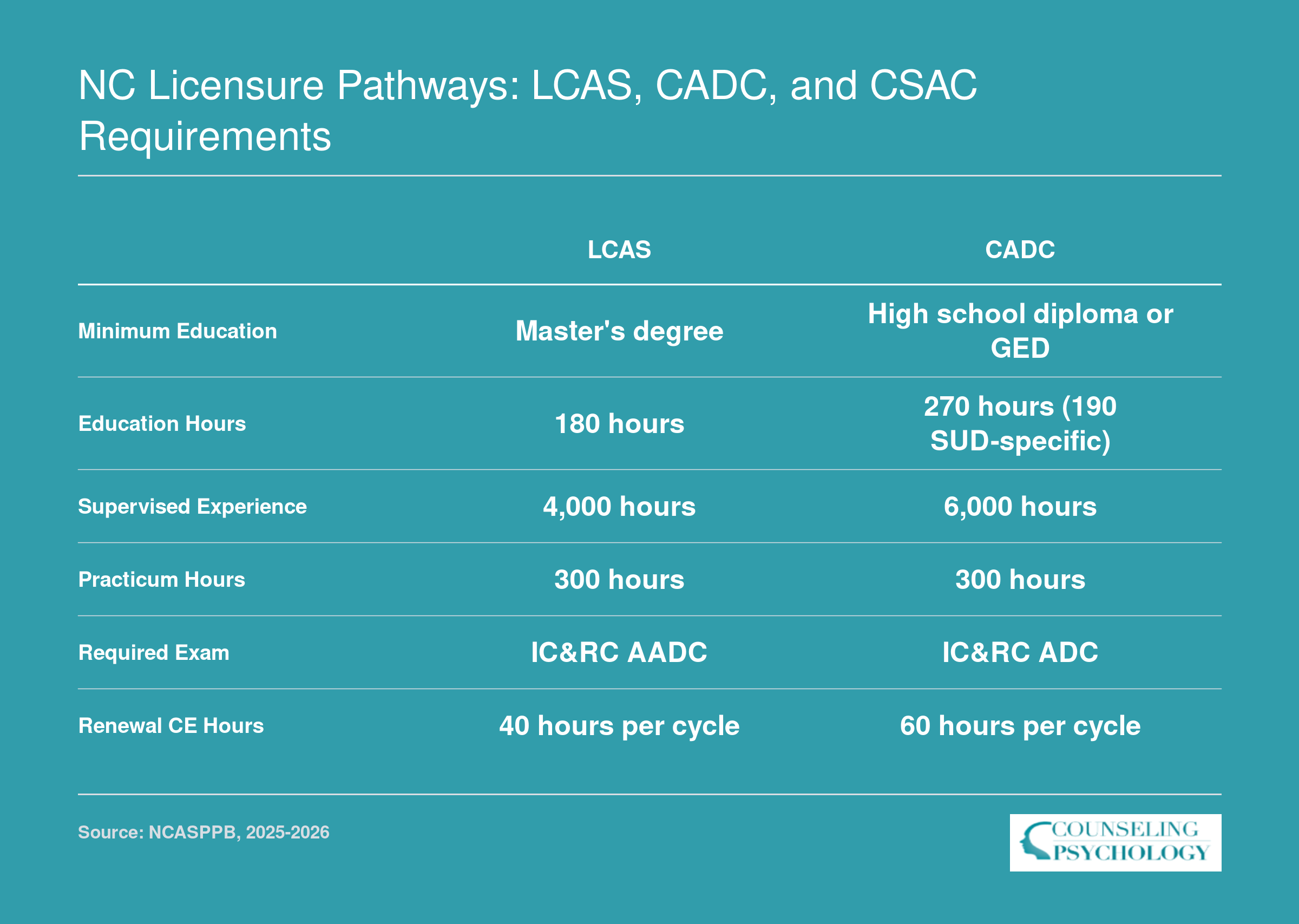
North Carolina's addiction counseling credentials are governed by the NC Addictions Specialist Professional Practice Board (NCASPPB). The LCAS is the highest-level credential and requires a master's degree, making it the target for graduates of the master's programs ranked on this page. The CADC (which has replaced the former CSAC designation) can be pursued with as little as a high school diploma or GED, so a graduate certificate alone can satisfy its education requirements and then some. Several of the ranked NC programs explicitly map their coursework to the 180 or 270 substance-use-specific hours these credentials demand.
Which NC Programs Align with Each Credential?
Not every addiction counseling program in North Carolina prepares you for the same credential, and the distinction matters. The Licensed Clinical Addiction Specialist (LCAS) is the most widely pursued license in the state, but some programs also satisfy educational requirements for the Certified Alcohol and Drug Counselor (CADC) credential. The table below shows which programs explicitly align with LCAS coursework requirements and whether the North Carolina Addictions Specialist Professional Practice Board (NCASPPB) recognizes them as Criteria C approved schools, meaning the program's curriculum has been formally reviewed and accepted as meeting the 180 hours of addiction-specific education needed for LCAS eligibility.
| Institution | Program Name | Degree Level | Primary Credential Alignment | NCASPPB Criteria C Approved |
|---|---|---|---|---|
| UNC Pembroke | Graduate Certificate in Addictions Counseling (CMHC track) | Graduate Certificate | LCAS | Yes |
| UNC Pembroke | Graduate Certificate in Substance Use Disorder Treatment & Recovery (MSW track) | Graduate Certificate | LCAS | Yes |
| UNC Charlotte | Master of Counseling, Substance Abuse Counseling Concentration | Master's | LCAS | Yes |
| UNC Charlotte | Post-Masters Certificate in Addiction Counseling | Graduate Certificate | LCAS | Yes |
| UNC Greensboro | Post-Baccalaureate Certificate in Addiction Treatment | Graduate Certificate | LCAS, CADC | No |
| NC Central University | Master of Arts in Counseling, Addictions Counseling Focus | Master's | LCAS | Yes |
| NC State University | Master of Social Work, Addiction and Recovery Specialization | Master's | LCAS | Yes |
| UNC Chapel Hill | Master of Social Work, Substance Use & Addictions Specialist | Master's | LCAS | Yes |
| UNC Wilmington | MSW with Substance Use Disorders and Addictions Certificate | Master's + Certificate | LCAS | Yes |
| Western Carolina University | Addiction Studies Certificate (Social Work) | Graduate Certificate | LCAS | Yes |
| Wake Forest University | Master of Arts in Counseling, Addiction Track | Master's | LCAS | Yes |
| University of Mount Olive | Master of Science in Counseling: Clinical Mental Health Counseling | Master's | LCAS | Yes |
| East Carolina University | Graduate Certificate in Treating Substance Use Disorders | Graduate Certificate | LCAS | N/A |
Program Comparison: Cost, Format, and Time to Completion
The table below compares key details across North Carolina's addiction counseling graduate certificate and master's programs. Because program-specific tuition for certificates is not always published separately from institutional graduate rates, the per-credit figures shown for UNC Pembroke reflect confirmed 2025-2026 data, while other schools' costs are estimated from published institutional graduate tuition schedules. Always verify current rates directly with each school before applying.
| School | Program | Credits | Format | Estimated Timeline | Approx. Total Cost (In-State) |
|---|---|---|---|---|---|
| UNC Pembroke | Graduate Certificate in Addictions Counseling | 12 | Online | 1-2 semesters | $4,600-$4,700 |
| UNC Greensboro | Post-Baccalaureate Certificate in Addiction Treatment | 15 (five 3-credit courses) | Online (synchronous and asynchronous) | 12 months full-time; part-time option available | Contact school for certificate-specific rate |
| Western Carolina University | Addiction Studies Certificate | 12 | On campus | Varies; contact school | Contact school for certificate-specific rate |
| UNC Charlotte | Post-Masters Certificate in Addiction Counseling | Approx. 180 clock hours coursework plus 300 clinical hours | On campus | Varies; contact school | Contact school for certificate-specific rate |
| East Carolina University | Graduate Certificate in Treating Substance Use Disorders | Contact school | Online | Contact school | Contact school for certificate-specific rate |
| UNC Wilmington | Substance Use Disorders and Addictions Certificate | Contact school | Hybrid (online plus evening in-person) | 7.5-week course blocks | Contact school for certificate-specific rate |
| Wake Forest University | M.A. in Counseling, Addiction Concentration | 60 semester hours | Online | 3 years | Approx. $39,141/year (private tuition, no in-state distinction) |
Multiple North Carolina programs now offer fully online or hybrid addiction counseling graduate certificates, expanding access across the state. Both campus-based and online formats appear in the 2026 rankings, allowing working professionals and rural students to complete LCAS-aligned coursework without relocating.
Admissions Requirements and How to Apply
Getting into an addiction counseling program in North Carolina starts with understanding what each program actually needs from you, and the requirements vary more by program type than by school prestige.
Degree Prerequisites
The biggest dividing line in admissions is whether you are applying to a graduate certificate or a master's degree program. Most graduate certificate programs in addiction counseling are designed for people who already hold a relevant graduate degree. UNC Charlotte's post-master's certificate, for example, requires a master's degree in counseling from a CACREP-accredited program.1 UNC Pembroke's Graduate Certificate in Addictions Counseling is open to applicants who hold a qualified master's degree with clinical internship experience, or who are currently enrolled in UNCP's Clinical Mental Health Counseling master's program.2
That said, master's degree programs in counseling with an addiction focus are generally more flexible about undergraduate backgrounds. Many accept applicants from a wide range of fields, including social work, education, health sciences, and liberal arts. You do not need a psychology degree to be competitive, though if you are wondering how hard it is to get into grad school for psychology, the admissions bar for counseling-focused programs tends to be more approachable than clinical psychology tracks.
GPA and Academic Standards
Across NC programs, the working GPA floor for graduate certificates tends to fall between 2.7 and 3.0.3 UNC Pembroke's Clinical Mental Health Counseling master's program, which serves as a pathway into the addictions certificate, requires a minimum undergraduate GPA of 2.8.4 Once enrolled in some certificate programs, students are expected to earn a B or higher in each course to continue, so academic performance does not become less important after admission.2
Application Materials
Most programs ask for a standard package:
- Transcripts: Official records from all colleges or universities attended.
- Personal statement: Usually framed as a statement of purpose, covering your professional goals and interest in addiction counseling specifically.
- Letters of recommendation: Typically two to three; UNC Charlotte requires three evaluations from professional or academic references.1
- Background check: Not always required at the point of application, but programs that include a supervised practicum commonly require one before field placement begins.
The GRE is generally not required for graduate certificate programs in this field, which removes a significant barrier for working professionals returning to school.3
Deadlines and Rolling Admissions
Deadlines vary and can shift from year to year. UNC Pembroke's addictions certificate had a May 2026 deadline for Summer I entry, which reflects a rolling or cohort-based structure rather than a single annual cycle.2 Check each program's current admissions page directly, since some accept applications on a rolling basis while others set firm semester cutoffs. Applying early is almost always advisable, particularly for programs with limited cohort sizes.
NC Addiction Counseling Job Growth and Employer Demand
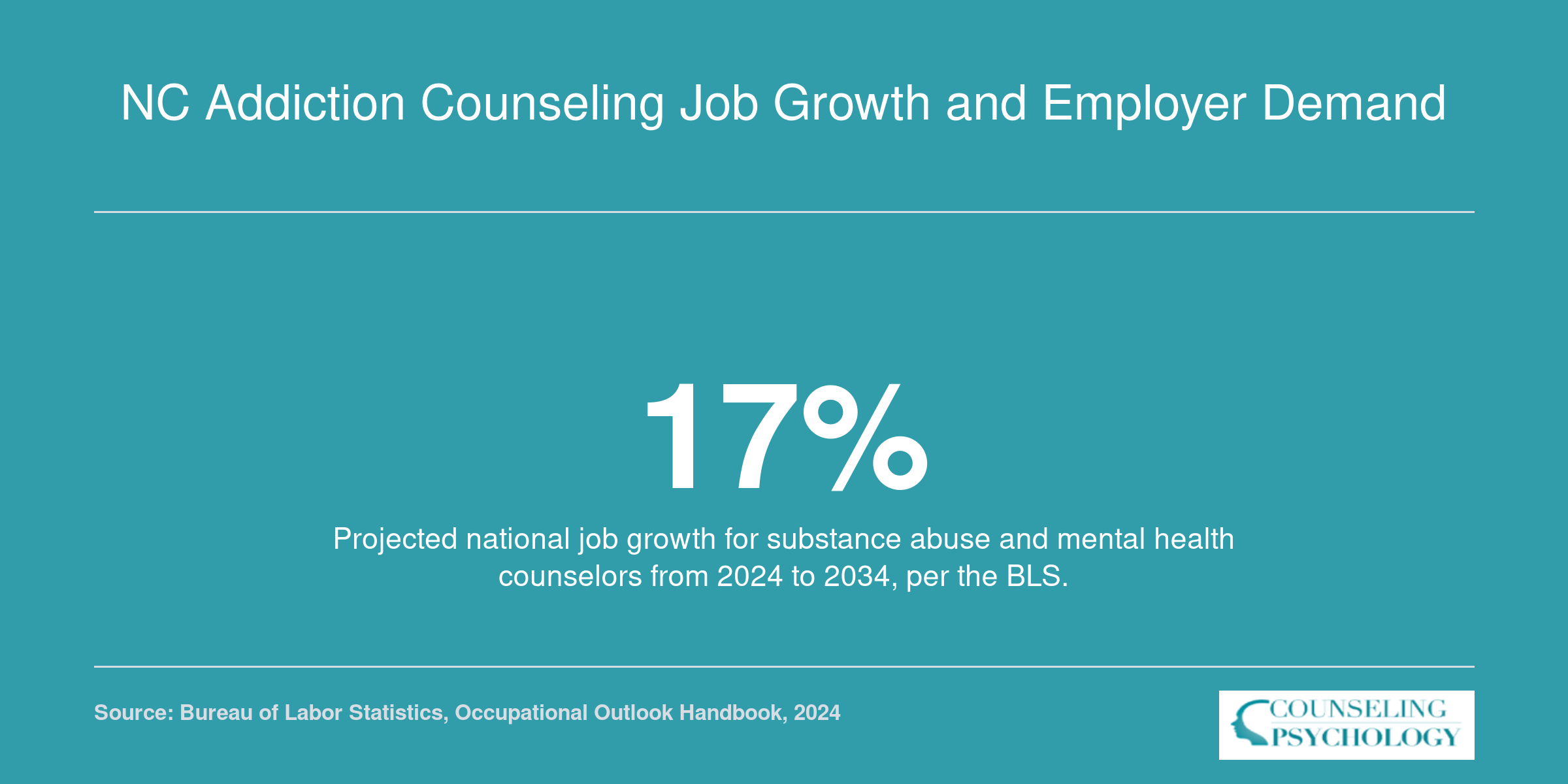
North Carolina's addiction counseling workforce is expanding alongside significant state investment in behavioral health infrastructure. The state's opioid response programs, Medicaid expansion efforts, and state-funded treatment center buildouts have created sustained demand for credentialed substance abuse counselors across outpatient centers, residential facilities, hospitals, and government agencies. Nationally, the Bureau of Labor Statistics projects 17% growth for substance abuse, behavioral disorder, and mental health counselors from 2024 to 2034, well above the average for all occupations, with roughly 48,300 openings anticipated each year. While North Carolina's specific projected growth rate has not been separately published at this time, the state's top employing industries (outpatient mental health centers, individual and family services, hospitals, residential facilities, and government) mirror the national pattern, suggesting comparable or stronger local demand given ongoing workforce initiatives.
Financial Aid and Scholarships for Addiction Counseling Students
Paying for a graduate certificate or master's degree in addiction counseling is a real concern, and students often discover that more funding sources exist than they initially expect. The challenge is knowing which programs and credentials qualify for which types of aid.
Federal Aid for Certificate Students
Graduate certificate students frequently overlook federal aid options, assuming loans and grants are reserved for degree seekers. If your program is enrolled in the federal Title IV system, you may qualify for federal Direct (Stafford) loans to cover tuition and living costs. Pell Grants, traditionally associated with undergraduate study, can also extend to eligible post-baccalaureate certificate students under certain conditions. Whether you qualify depends on your prior degrees, enrollment status, and the institution's participation in Title IV programs. Check directly with the financial aid office of any program you are seriously considering.
HRSA Behavioral Health Workforce Programs
The Health Resources and Services Administration runs the Behavioral Health Workforce Education and Training (BHWET) program, which funds institutions rather than individual students directly.2 BHWET grants support the creation and expansion of internships and field placements in areas including substance use disorder prevention and treatment. When a school receives a BHWET award, students in those programs often gain access to supported field placements, supervision resources, or stipends that reduce out-of-pocket training costs. Current awards extend through the 2025-2026 academic year and beyond, with some performance periods running through mid-2029.3 Ask prospective programs whether they hold an active BHWET grant before committing.
North Carolina-Specific Funding Sources
Several funding streams are particular to North Carolina students:
- NC Community College Behavioral Health Initiative: This statewide program supports alcohol and drug counseling certificate students at community colleges across North Carolina for 2025-2026.1 If you are pursuing an entry-level credential, community college programs participating in this initiative may offer reduced-cost or subsidized training paths.
- NC State Education Assistance Authority: The SEAA administers state grant programs for North Carolina residents. Graduate and certificate students should review current SEAA offerings, as eligibility and award amounts shift year to year.
- UNC System tuition benefits: State employees enrolled in UNC system programs may qualify for tuition waivers or reduced rates. If you work for a public behavioral health agency, hospital, or county social services department, confirm your employer's education benefits before enrolling.
- Employer tuition reimbursement: Many private behavioral health agencies, treatment centers, and nonprofit providers in North Carolina offer tuition assistance as a recruitment and retention tool. This is worth asking about during any job interview or when negotiating employment at a current position.
SAMHSA and Loan Repayment Options
The Substance Abuse and Mental Health Services Administration periodically funds scholarship and loan repayment initiatives targeting the behavioral health workforce. Separately, HRSA's National Health Service Corps offers loan repayment for credentialed substance use disorder counselors who commit to working in federally designated Health Professional Shortage Areas. Rural and underserved communities across North Carolina have a strong presence of shortage designations, making this a realistic option for graduates willing to work outside major metro areas. Students who eventually pursue a doctorate in addiction counseling may find even more federal funding opportunities at the doctoral level.
Taken together, these programs mean that determined students can significantly reduce net costs. The key is applying early, confirming Title IV eligibility with each school, and asking financial aid offices directly about program-specific funding rather than relying solely on general scholarship searches.
Frequently Asked Questions
Below are answers to the most common questions prospective students ask about addiction counseling programs and credentials in North Carolina. Each response is kept brief so you can quickly find the information that matters most to your planning.