Best Addiction Counseling Programs in Minnesota for 2026
Compare top-ranked Minnesota programs by cost, format, and LADC licensure alignment to find your best fit.
By Tara Moretti, LMHCReviewed by CounselingPsychology.org TeamUpdated May 22, 202610+ min read
Key Takeaways
Minnesota's LADC pathway typically takes three to five years, combining coursework, supervised hours, and a licensing exam.
Substance abuse and mental health counselors in Minnesota earn a median annual wage of $58,720.
Holding both the LADC and LPCC lets clinicians bill for substance use and mental health services, boosting employability.
Online, hybrid, and on-campus program formats each serve different schedules, so matching format to your life matters.
Minnesota consistently ranks among the top ten states for drug overdose death rate increases, and the state's treatment infrastructure has not kept pace. The Minnesota Board of Behavioral Health and Therapy reports a steady backlog of LADC applicants, yet rural counties still lack enough licensed addiction counselors to meet caseload demand. For prospective students, the challenge is matching the right program to both a career timeline and a budget.
Credential pathways in the state vary significantly: some programs prepare you for LADC licensure in under two years, while master's-level tracks open dual-licensure routes combining the LADC with the LPCC, a combination that is rapidly becoming the hiring standard at integrated behavioral health clinics. In fact, these states have the highest need for counselors, and Minnesota's shortage mirrors a broader national pattern. Median salaries for addiction counselors in Minnesota sit near $58,720, but dual-licensed clinicians command notably higher rates. The gap between a certificate and a master's degree is not just academic; it translates directly into billing authority, employer preference, and long-term earning power.
Best Addiction Counseling Programs in Minnesota: Our Rankings
Minnesota's addiction counseling programs range from graduate certificates designed for quick entry into LADC practice to comprehensive master's degrees that position graduates for dual licensure in both substance use and mental health counseling. Our rankings weigh program quality, licensure alignment, clinical training depth, and return on investment to help you find the best fit for your career goals and life circumstances.
NCES-IPEDS federal institutional data — nces.ed.gov
MI
Minnesota State University Moorhead#1
Moorhead, MN · ~$18,000/yr (est.)
★Best for: Working professionals seeking stackable credentials
Minnesota State University Moorhead stands out for its stackable pathway: students can begin with a Graduate Certificate in Addiction Counseling and seamlessly roll those credits into a 60-credit MS in Counseling with an Addiction Counseling concentration. Both programs use a hybrid format with evening scheduling tailored for working professionals across western Minnesota and eastern North Dakota. Strong partnerships with regional SUD providers in the Fargo-Moorhead corridor and the broader Red River Valley create a reliable practicum and employment pipeline.
Graduate Certificate in Addiction Counseling — Hybrid
Minnesota State University Moorhead
Hybrid format blending online coursework with optional in-person classes
Meets both Minnesota LADC and North Dakota licensure requirements
Open to holders of a bachelor's or master's degree
No entrance exam required for admission
Evening course scheduling designed for working adults
Credits stack directly into the MS in Counseling program
★Best for: Career changers adding LADC to existing licenses
The University of Minnesota-Twin Cities offers a Master of Professional Studies in Addictions Counseling that draws on the research depth and clinical infrastructure of the state's flagship university. The 30-credit, campus-based program includes 880 supervised internship hours and offers both traditional and accelerated completion tracks. Graduates from schools offering this program earn a median of $69,020 ten years after enrollment, reflecting the institution's broad career outcomes, and the typical graduate carries $19,500 in debt.
Master of Professional Studies in Addictions Counseling — On-Campus
University of Minnesota-Twin Cities
30-credit campus-based program at $850 per credit
Traditional (3-year) or accelerated (1.75-year) completion options
880 supervised internship hours with major Twin Cities health systems
Curriculum covers Minnesota statutes, ethics, and public health approaches
No GRE required; 3.0 GPA minimum for admission
Designed for clinicians adding LADC to LPCC, LMFT, or MSW credentials
Evidence-based curriculum addressing biological, social, and psychological factors
Faculty with deep ties to Minnesota's integrated behavioral health network
★Best for: Urban clinicians focused on co-occurring disorders
Metropolitan State University's Co-occurring Disorders Recovery Counseling master's program is one of the few NASAC-accredited options in Minnesota, training graduates to treat substance use and mental health conditions simultaneously. The 60-credit program is grounded in culturally responsive, trauma-informed practice, with strong ties to community clinics and justice-involved treatment settings throughout the Twin Cities. The institution's median graduate debt of $17,100 is among the lowest on this list, while ten-year median earnings for graduates of schools offering this program reach $64,705.
Winona State University's Addictions Counseling graduate certificate is built directly around the Minnesota Board of Behavioral Health and Therapy's LADC requirements, including the full 880 practicum hours needed for licensure eligibility. The hybrid format pairs flexible online coursework with an in-person practicum, and the program's location creates a strong placement network across the Winona-Rochester-La Crosse corridor. With in-state tuition around $10,886 and ten-year median earnings of $58,532 for graduates of schools offering this program, WSU offers a cost-effective entry point into addiction counseling.
Hybrid format with online coursework and in-person practicum
Directly aligned with Minnesota BBHT requirements for LADC
Accepts students with a bachelor's degree; no master's required
Fall and summer start dates available
880 practicum hours included to satisfy licensure eligibility
Strong practicum network in southeastern Minnesota and western Wisconsin
Advising pathways available for students pursuing graduate LPCC programs
Curriculum updated to address opioid use disorder and MAT education
SA
Saint Mary's University of Minnesota#5
Winona, MN · $12,000/yr (net price)
Saint Mary's University of Minnesota offers a fully online Graduate Certificate in Addiction Studies that fits professionals who need geographic flexibility while completing Minnesota LADC-aligned coursework. The 25-credit program costs $655 per credit, includes a required practicum with established Minnesota treatment providers, and can be completed in about two years. Students interested in broader clinical practice can combine the certificate with Saint Mary's M.A. in Counseling and Psychological Services to pursue concurrent LPCC and LADC eligibility.
Graduate Certificate in Addiction Studies — Online
Saint Mary's University of Minnesota
Fully online 25-credit program at $655 per credit
Aligned with Minnesota LADC academic requirements
Practicum included with Minnesota-based SUD treatment providers
Multiple start dates throughout the year
Requires a bachelor's degree in a healthcare-related field
Completion in approximately two years
Can be combined with the M.A. in Counseling for dual LPCC and LADC eligibility
Curriculum covers evidence-based practices, cultural sensitivity, and telehealth skills
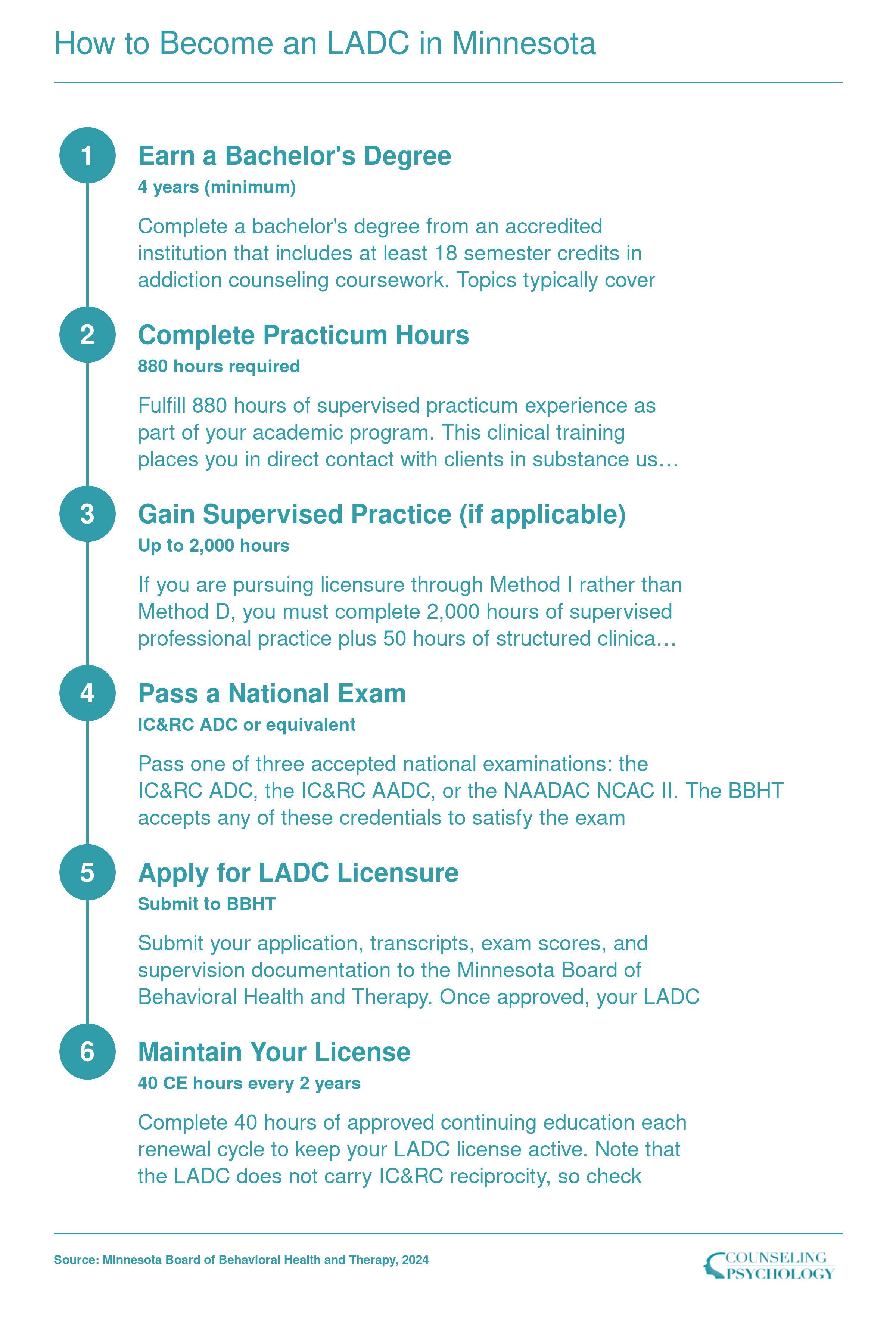
The path to becoming a Licensed Alcohol and Drug Counselor (LADC) in Minnesota is regulated by the Minnesota Board of Behavioral Health and Therapy (BBHT). Depending on whether you pursue direct licensure after a bachelor's degree or accumulate supervised practice hours first, the timeline from program start to full licensure typically ranges from three to five years. Here is the step-by-step progression.
LADC Licensure Requirements: Education, Hours, and Exams
Earning your Licensed Alcohol and Drug Counselor (LADC) credential in Minnesota involves meeting specific benchmarks in education, supervised practice, and examination. Understanding each layer before you enroll helps you choose a program that checks every box without extra coursework down the road.
Education: Degree, Credits, and Coursework Domains
Minnesota requires a bachelor's degree to qualify for LADC licensure, but the degree itself can be in any major. On top of your bachelor's, you need at least 18 semester credits (or 270 clock hours) of addiction-specific coursework covering the 12 core functions of substance use disorder counseling. Programs approved by the Minnesota Board of Behavioral Health and Therapy typically organize those hours across several domains:
Pharmacology of substance use: Covers how alcohol, opioids, stimulants, and other substances affect the brain and body.
Counseling theories and techniques: Includes motivational interviewing, cognitive-behavioral approaches, and relapse prevention strategies.
Ethics and professional responsibility: Addresses confidentiality rules (including 42 CFR Part 2), dual relationships, and scope of practice.
Assessment and screening: Teaches validated screening instruments and diagnostic criteria for substance use disorders.
Case management and treatment planning: Focuses on documentation, referral networks, and individualized care planning.
Group counseling dynamics: Prepares students to facilitate psychoeducational and process-oriented groups.
Because the degree field is flexible, students who already hold a bachelor's in psychology, social work, criminal justice, or a related discipline can often complete just the 18-credit addiction studies component to satisfy the education requirement. If you are still weighing your undergraduate options, our overview of a typical work day for an addictions counselor can help you decide whether this career path fits your goals.
Supervised Practice: Hours, Direct Contact, and Supervisor Qualifications
After finishing your coursework, you must complete a practicum of at least 880 hours plus an additional supervised practice period totaling 2,000 hours.23 During this supervised practice, you will also accumulate at least 50 hours of formal clinical supervision.3 Minnesota rules specify that at least 75% of those supervision hours must be conducted in person (teleconference may cover the remainder), and at least 50% must be individual rather than group supervision.3
Your supervisor must hold a current LADC license and meet the board's requirements for supervision training. A temporary practice permit is available so you can begin accumulating hours while working under an approved supervisor, which is the path most candidates follow immediately after graduation.2
Examination: IC&RC ADC, AADC, or NAADAC NCAC II
Minnesota accepts several nationally recognized exams for LADC licensure, including the IC&RC Alcohol and Drug Counselor (ADC) exam, the IC&RC Advanced Alcohol and Drug Counselor (AADC) exam, and the NAADAC National Certified Addiction Counselor Level II (NCAC II) exam.4 The most commonly taken option is the IC&RC ADC, a non-comprehensive, criterion-referenced test.4 You register through your state's IC&RC member board and typically receive results within a few weeks. Candidates who do not pass on the first attempt may retake the exam, though waiting periods and attempt limits vary by testing body. Publicly available pass-rate data for these exams is limited, so prospective test-takers should consult the IC&RC or NAADAC directly for the most current figures.
Accelerated and Bridge Pathways
Minnesota does offer bridge pathways for candidates who hold an associate degree or substantial coursework in a related field. If you already have an associate degree in addiction studies or a similar discipline, you can ladder into a bachelor's completion program that builds on your existing credits, potentially shaving a year or more off your timeline. Several Minnesota colleges structure their addiction studies programs specifically for this purpose, accepting transfer credits from accredited two-year programs and aligning remaining coursework with the board's 18-credit, 270-clock-hour requirement. Students interested in broader counseling career paths may also want to explore how to choose the right counseling specialty before committing to a single track. Those with a bachelor's degree in an unrelated field face the shortest path: complete the 18 credits of addiction-specific coursework, secure a temporary permit, and begin supervised practice while preparing for the licensing exam.
Regardless of which pathway you follow, confirming that your program's curriculum maps directly onto the board's required domains will save you from needing supplemental coursework later.
Questions to Ask Yourself
Are you already working in a clinical or social services role that could count toward your supervised practice hours?
If your current job qualifies for LADC supervision, a flexible online or hybrid program lets you earn hours on the clock while you study. Choosing the wrong format could mean adding unpaid practicum time on top of a full work schedule.
Do you need evening or weekend class options, or can you attend daytime sessions on campus?
Many Minnesota programs offer evening and weekend cohorts designed for working adults, while traditional daytime schedules often move through material faster. Your availability during business hours directly shapes which programs are realistic choices.
Is finishing as quickly as possible your top priority, or would you prefer a self-paced timeline?
Accelerated tracks can get you licensed sooner, but they demand intense weekly commitments. A self-paced format spreads the workload, which matters if you are balancing family, employment, or financial constraints.
Do you value building an in-person professional cohort, or are you comfortable networking remotely?
On-campus cohorts often lead to strong local referral networks that pay off after graduation. If your career goals are location-flexible or you already have a professional community, a fully online format may serve you just as well.
Comparing Minnesota Program Formats: Online, Hybrid, and On-Campus
Choosing the right delivery format is one of the most practical decisions you will make when pursuing an addiction counseling credential in Minnesota. Each format brings trade-offs in scheduling flexibility, hands-on training logistics, networking opportunities, and cost. Keep in mind that every pathway, including fully online programs, still requires supervised practicum hours at a clinical site, so your proximity to treatment centers and community agencies matters regardless of how your coursework is delivered.
Factor
Online
Hybrid
On-Campus
Minnesota Programs Using This Format
Saint Mary's University of Minnesota (Graduate Certificate in Addiction Studies)
Minnesota State University Moorhead (Graduate Certificate and MS in Counseling); Winona State University (Addictions Counseling Graduate Certificate)
University of Minnesota, Twin Cities (Master of Professional Studies in Addictions Counseling); Metropolitan State University (Co-occurring Disorders Recovery Counseling Master's)
Scheduling Flexibility
Highest flexibility; coursework completed asynchronously with multiple start dates throughout the year
Moderate flexibility; most coursework is online, but select sessions or intensives are held on campus
Least flexible; classes follow a set weekly schedule, though some programs offer part-time tracks
Practicum Logistics
Students must independently secure a local practicum site, which can require extra coordination
Programs may help place students at regional clinical sites near the campus or within partner networks
Practicum placements are often arranged through established partnerships in the Twin Cities metro or surrounding area
Peer Networking and Faculty Access
Networking happens primarily through virtual discussion boards and remote group projects
Daily in-person interaction with classmates and faculty; strongest environment for mentorship and professional connections
Typical In-State Tuition (Annual)
Approximately $12,474 (Saint Mary's charges the same rate for all students)
Approximately $11,902 (MSU Moorhead) to $10,886 (Winona State)
Approximately $22,017 (University of Minnesota, Twin Cities) or $11,323 (Metropolitan State University)
Best Suited For
Working professionals who need maximum schedule control and live far from a campus
Students who want a blend of remote convenience and periodic face-to-face learning
Students who prefer immersive, structured training and easy access to metro-area clinical sites
Tuition and Financial Aid for Minnesota Addiction Counseling Programs
The table below compares published tuition rates, average net price after financial aid, and median graduate debt for each ranked program. Note that net price figures are institution-wide averages reflecting all aid received by typical students; your actual cost will vary depending on your financial situation, program level, and aid package. Program-level cost data is not yet available for these addiction counseling programs specifically, so the figures shown reflect the broader institution. Beyond sticker price, students should explore federal student loans, the HRSA Behavioral Health Workforce Education and Training (BHWET) grants (which fund accredited institutions to expand the behavioral health pipeline), Minnesota State Grant eligibility, employer tuition reimbursement programs, and federal or state loan repayment programs for substance abuse counselors who commit to working in underserved communities.
School
Annual Tuition (In-State)
Annual Tuition (Out-of-State)
Avg. Net Price After Aid
Median Graduate Debt
Saint Mary's University of Minnesota
$12,474
$12,474
$11,704
$21,500
University of Minnesota, Twin Cities
$22,017
$33,249
$16,778
$19,500
Metropolitan State University
$11,323
$11,323
$16,863
$17,100
Winona State University
$10,886
$15,953
$17,503
$21,500
Minnesota State University Moorhead
$11,902
$11,902
$17,997
$20,000
Career Outcomes and Salary Expectations in Minnesota
Understanding what you can expect to earn as a licensed addiction counselor in Minnesota helps you weigh program costs against long-term return on investment. The good news: demand for substance abuse, behavioral disorder, and mental health counselors continues to grow across the state, and wages reflect that need.
Where Minnesota Salaries Stand
The Bureau of Labor Statistics publishes detailed wage data for this occupation (SOC 21-1011) at both the state and metro-area level.1 The most recent fully published figures cover May 2024. To look up current statewide and Minneapolis-St. Paul-Bloomington metro area wages, including median pay and percentile breakdowns from the 10th through 90th percentile, visit the BLS Occupational Employment and Wage Statistics page and filter by Minnesota or by the Minneapolis-St. Paul-Bloomington metropolitan statistical area.2 May 2025 figures have not yet been fully released for this occupation and geography, so the 2024 data remains the best publicly available benchmark.
The Minnesota Department of Employment and Economic Development (DEED) also publishes state-specific wage reports and labor market projections. DEED data often includes annual wage percentiles and total employment counts, giving you a useful cross-reference against BLS numbers and a sense of how quickly the field is expanding statewide.
Digging Deeper Into Salary Data
Published averages only tell part of the story. Several factors influence where you land on the pay scale:
Licensure level: Holding a full LADC rather than a temporary permit typically commands higher starting pay. Adding an LPCC or other clinical credential pushes earnings further.
Setting: Counselors in hospital-based or integrated care settings often earn more than those in community nonprofit agencies, though nonprofit roles may offer loan forgiveness benefits.
Geography: The Twin Cities metro tends to pay above the state median, while greater Minnesota positions may offer lower base salaries offset by lower cost of living.
Experience: Entry-level counselors should expect wages near the lower percentiles. Within five to seven years, many practitioners move into the upper quartile, especially if they take on supervisory duties or specialize in co-occurring disorders.
Counselors who specialize in high-demand niches can accelerate their earnings growth; for broader context on where the field needs practitioners most, see this look at the nation's most needed counseling specialists.
How to Get the Most Accurate Picture
Beyond government data, consider reaching out to professional organizations like the Minnesota Addiction Counselors Association or the Minnesota Board of Behavioral Health and Therapy. Both may conduct or link to salary surveys with granularity that government databases lack, such as breakdowns by employer type, caseload size, or telehealth versus in-person roles.
Local colleges and universities offering addiction studies or mental health counseling programs are another underused resource. Many publish graduate outcome reports that include median starting salaries and job placement rates within six to twelve months of graduation. If a program you are considering does not share this data on its website, contact the admissions or career services office directly and ask. Programs that track and share outcomes signal confidence in the career readiness of their graduates. If you are still weighing degree levels, it is also worth exploring which master's degree in counseling is right for you before committing to a specific program.
Taking 30 minutes to cross-reference BLS data, DEED reports, and program-level outcomes will give you a realistic salary range before you commit tuition dollars, helping you choose a program that aligns with both your clinical goals and your financial plan.
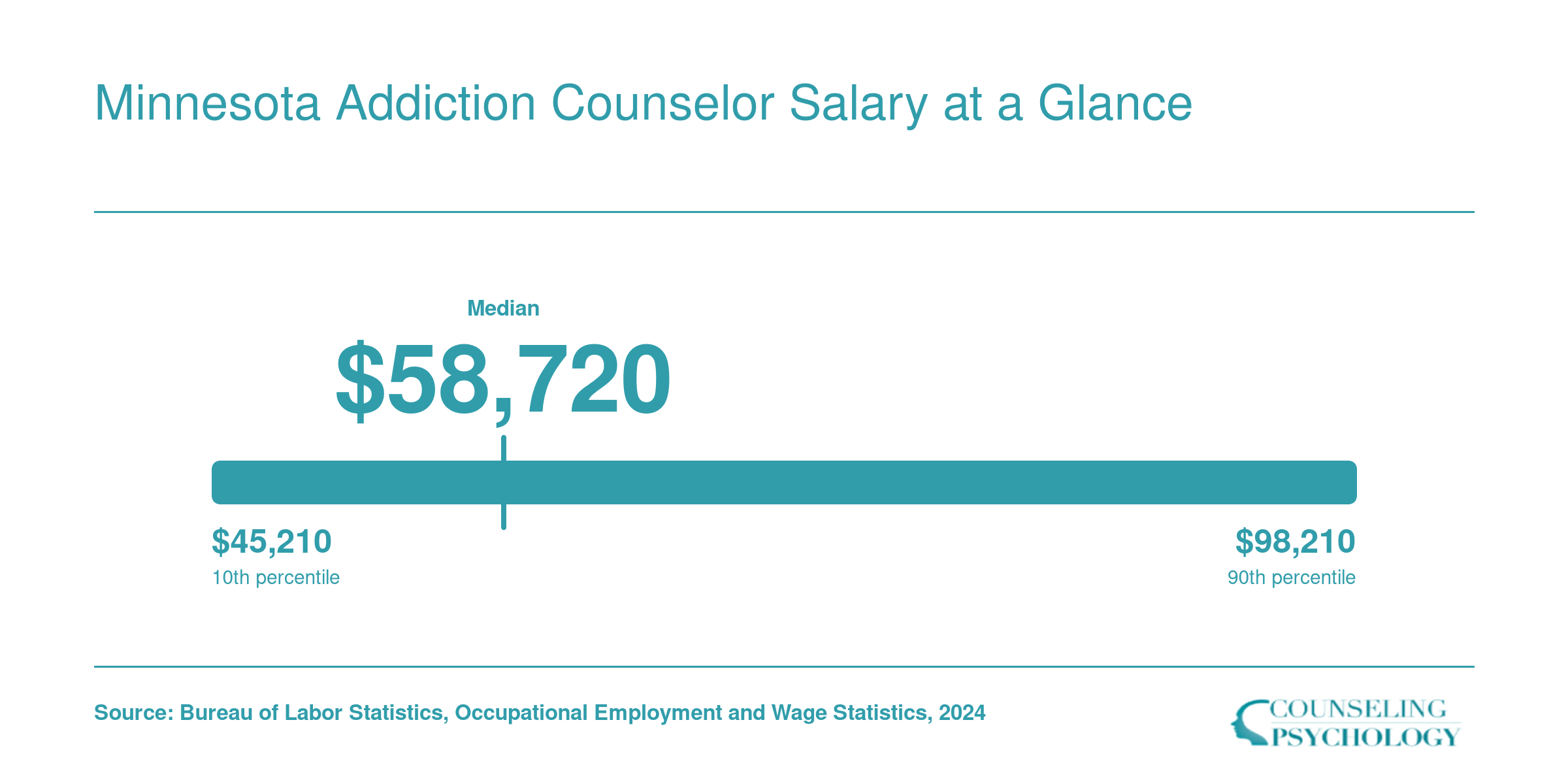
Minnesota Addiction Counselor Salary at a Glance
Substance abuse, behavioral disorder, and mental health counselors in Minnesota earn a median annual wage of $58,720, just below the national median of $59,190. The salary range is broad, reflecting differences in experience, credentials, setting, and whether a counselor holds dual licensure. Note that program-specific earnings reported on federal scorecards may differ from these occupation-wide BLS figures because they capture graduates across all employment paths, not just those working in counseling roles.
Co-Occurring Disorders and Dual-Licensure Pathways (LADC + LPCC)
Treating clients who present with both a substance use disorder and a mental health condition is now the norm rather than the exception in most clinical settings. In Minnesota, holding both the Licensed Alcohol and Drug Counselor (LADC) credential and the Licensed Professional Clinical Counselor (LPCC) credential positions you to serve this population with full scope-of-practice authority, and it can significantly expand your employability and reimbursement options.
Understanding the Scope-of-Practice Distinction
The Minnesota Board of Behavioral Health and Therapy (BBHT) governs both the LADC and LPCC licenses, but each credential carries a different legal scope of practice. An LADC is authorized to assess, diagnose, and treat substance use disorders, while an LPCC can independently diagnose and treat the full range of mental health conditions. Clinicians who hold only one of these licenses must refer out when a client's needs fall outside their authorized scope. Holding both eliminates that barrier and lets you deliver integrated, co-occurring disorders treatment under a single provider. Visit the BBHT website directly for the most current regulatory language on what each license permits.
Graduate Programs Designed for Both Tracks
Several graduate programs in Minnesota structure their curricula so that students can satisfy the educational requirements for both the LADC and the LPCC within a single master's degree. Institutions such as the University of Minnesota and Saint Mary's University of Minnesota have historically offered coursework that aligns with both credential tracks, though program structures and elective requirements can change from year to year. Before enrolling, confirm with each program's admissions office that the current curriculum still maps to both sets of BBHT educational standards. A misaligned elective sequence could leave you needing extra coursework after graduation. Understanding the distinction between a therapist vs. counselor can also help you evaluate which program structure best fits your career goals.
Navigating Supervised-Hours Overlap
One of the most practical questions prospective dual-licensure candidates face is whether supervised clinical hours can count toward both credentials simultaneously. The BBHT has specific rules about how supervision hours may overlap, including requirements around the credentials of your clinical supervisor and the types of client contact that qualify. Because these rules are nuanced and subject to revision, contact the BBHT directly or consult a professional association such as the Minnesota Association of Marriage and Family Therapy for current guidance. Planning your supervision strategy before you begin accumulating hours can save you months of extra work.
Verifying Requirements With Reliable Sources
The Bureau of Labor Statistics (BLS.gov) offers useful general information about licensure trends and occupational requirements for substance abuse and mental health counselors, but it does not capture every state-level detail. Use BLS data as a starting point, then cross-reference it with the BBHT's administrative rules and the Minnesota Statutes governing behavioral health practice. State board rules are the authoritative source, and they sometimes change between legislative sessions, so checking annually is a sound habit.
Practical Considerations
Timeline: Completing a dual-track master's program typically takes two to three years of full-time study, with an additional period of post-degree supervised practice before you qualify for both independent licenses.
Supervision planning: Identify supervisors who hold both an LADC and an LPCC (or the appropriate supervisory credential for each) early in your clinical training.
Employer demand: Treatment centers, community mental health agencies, and integrated care clinics across Minnesota increasingly prefer or require clinicians who can bill for both substance use and mental health services.
Continuing education: Once licensed, you will need to meet separate continuing education requirements for each credential, so budget time and resources accordingly.
Pursuing dual licensure requires more planning upfront, but the payoff in clinical versatility and career resilience is substantial.
Worth Noting
Clinicians who hold both the LADC and LPCC can bill for substance use disorder treatment and mental health services under a single roof. In Minnesota's growing integrated care landscape, that versatility makes dual-licensed professionals significantly more employable, opens the door to higher reimbursement rates, and positions you as a one-stop provider for clients navigating co-occurring conditions.
Accreditation and Clinical Training Requirements
Accreditation is one of those details that feels bureaucratic until you move to another state and discover your credentials do not transfer. Before you enroll in any addiction counseling program in Minnesota, understanding the two major accreditation frameworks will save you time, money, and frustration down the road.
CACREP vs. NASAC: What Each Covers
CACREP (the Council for Accreditation of Counseling and Related Educational Programs) is the gold standard for graduate-level counseling programs, including those with an addiction counseling specialty. Under the 2024 CACREP standards, accredited programs must cover eight foundational curriculum areas, employ core faculty who hold doctoral degrees, and meet strict clinical training benchmarks.1 NASAC (the National Addiction Studies Accreditation Commission), now operating under NCC AP, focuses specifically on addiction studies curricula and is more common among certificate and associate-level programs.
Why the distinction matters: CACREP accreditation is widely recognized across all 50 states. If you graduate from a CACREP-accredited program, your degree is far more likely to satisfy licensure requirements should you relocate. NASAC accreditation is well regarded within the addiction counseling field but carries less weight for cross-state licensure portability, especially if you pursue clinical counseling credentials alongside your LADC.
In Minnesota, several graduate counseling programs hold CACREP accreditation with addiction-related coursework. Fewer programs carry NASAC accreditation specifically, though some undergraduate and certificate-level addiction studies programs align with NASAC standards.
Clinical Training Hour Requirements
CACREP-accredited programs set a high bar for supervised clinical experience. Under the 2024 standards, students must complete:2
Practicum: A minimum of 100 total hours, with at least 40 hours of direct client service. Students receive at least one hour of individual or triadic supervision and 1.5 hours of group supervision each week.
Internship: A minimum of 600 total hours, including at least 240 hours of direct service.
Supervision ratios: Faculty maintain a 1:6 ratio for individual supervision and 1:12 for group supervision. Site supervisors must hold at least a master's degree and have a minimum of two years of relevant professional experience.
Programs that are not CACREP-accredited may structure clinical hours differently. Some Minnesota programs exceed these minimums, while others meet only the state's LADC requirements. When comparing programs, ask specifically about total practicum and internship hours, how many of those hours involve face-to-face client contact, and whether the program assists with site placement.
How to Verify a Program's Accreditation
Do not rely on a school's marketing materials alone. CACREP maintains a searchable online directory of accredited programs, updated regularly, where you can confirm a program's current status and the specific specialty areas covered. For NASAC-aligned programs, check the NCC AP website. You can also contact the Minnesota Board of Behavioral Health and Therapy directly to confirm that a specific program's curriculum satisfies LADC education requirements.
A Note on Non-Accredited Programs
Minnesota does not require CACREP or NASAC accreditation for LADC licensure. A non-accredited program can meet the state's education standards, and many working addiction counselors in Minnesota earned their credentials through such programs. However, if there is any chance you might practice in another state, a program without recognized accreditation could create hurdles. Some states require graduation from a CACREP-accredited program as a condition of licensure, and others impose additional coursework or supervised hours for applicants from non-accredited schools. If you are weighing the pros and cons of different program types at the graduate level, be aware of mistakes to avoid when enrolling in a master's degree in counseling program. Choosing an accredited program from the start is the simplest way to keep your options open.
Frequently Asked Questions About Addiction Counseling Programs in Minnesota
Below are answers to the most common questions prospective students ask about addiction counseling education and licensure in Minnesota. Each response draws on the licensure steps, program details, and salary data discussed earlier in this article.
How do I become a licensed alcohol and drug counselor (LADC) in Minnesota?
You must complete an approved addiction counseling program, accumulate supervised clinical hours, and pass a nationally recognized exam such as the IC&RC ADC or the NAADAC NCC AP. Once you meet all education, practicum, and examination requirements, you submit your application to the Minnesota Board of Behavioral Health and Therapy. The process combines academic coursework with hands on training to ensure you are prepared for clinical practice.
What education do you need to be an addiction counselor in Minnesota?
Minnesota requires at least 18 semester credits in alcohol and drug counseling coursework for LADC licensure. These credits may be embedded in an associate, bachelor's, or master's degree program. Core topics include pharmacology, ethics, counseling techniques, and co-occurring disorders. Many employers prefer candidates with a bachelor's or higher, especially for roles in integrated treatment settings.
How long does it take to complete an addiction counseling program in Minnesota?
Timelines vary by degree level and enrollment status. A certificate or associate program typically takes one to two years. A bachelor's program runs about four years, while a master's takes two to three years beyond the bachelor's. Part time and online formats may extend the timeline, but they also offer more scheduling flexibility for working adults.
What is the difference between LADC and LPCC in Minnesota?
An LADC (Licensed Alcohol and Drug Counselor) specializes in substance use disorders, while an LPCC (Licensed Professional Clinical Counselor) holds a broader mental health counseling credential. The LPCC requires a master's degree and additional supervised hours in general clinical counseling. Pursuing both credentials, sometimes called dual licensure, lets you treat co-occurring mental health and substance use conditions and bill for a wider range of services.
How much do addiction counselors make in Minnesota?
According to the Bureau of Labor Statistics, substance abuse, behavioral disorder, and mental health counselors in Minnesota earn a median annual salary near $53,000, with experienced professionals in metropolitan areas or supervisory roles earning more. Dual licensed counselors holding both the LADC and LPCC can command higher compensation because they qualify for broader insurance reimbursement and can treat more complex caseloads.
Are there online addiction counseling programs in Minnesota?
Yes. Several Minnesota colleges offer fully online or hybrid addiction studies programs. Online formats let you complete coursework remotely while arranging practicum and clinical hours at approved sites near you. When evaluating online options, confirm the program is approved by the Minnesota Board of Behavioral Health and Therapy and that it meets the 18 credit hour coursework requirement for LADC eligibility.
Can I get an LADC with a bachelor's degree in Minnesota?
Absolutely. A bachelor's degree that includes the required 18 semester credits in addiction counseling coursework satisfies the educational component for LADC licensure. You will still need to complete supervised clinical hours and pass a qualifying examination. A bachelor's level LADC often opens the door to further graduate study or dual licensure pathways if you decide to expand your scope of practice later.