
What you’ll learn in this article…
- 65.6% of Jewish mental health professionals perceive antisemitism in their programs.
- Duquesne University failed to protect Professor Kranjec from antisemitic retaliation.
- APA accreditation does not explicitly address or sanction antisemitism.
Antisemitic incidents on U.S. college campuses surged 84% in 2024, reaching 1,694 cases, the highest total ever recorded. Within counseling, psychology, and social work training programs, this wave has taken specific forms, from hate speech in graduate seminars to institutional retaliation against faculty who report it.
The October 2024 case at Duquesne University, where a master's in psychology student celebrated the Hamas attacks and a Jewish professor faced backlash for objecting, exposed how antisemitism can fester unchecked in academic departments. These failures are not isolated; they reflect gaps in curricula, accreditation standards, and faculty preparedness.
Without explicit attention to antisemitism, the mental health field's diversity commitments ring hollow for Jewish students and clients, and training programs remain vulnerable to ethical breaches that undermine their core mission.
The Prevalence of Antisemitism in Psychology Education
Despite the mental health field's growing emphasis on diversity, equity, and inclusion, antisemitism remains a largely overlooked issue in psychology and social work education. A 2025 survey of Jewish mental health professionals in North America revealed that 65.6% perceived a significant increase in antisemitism over the past year, and 91% felt that antisemitism is taken less seriously than other forms of discrimination. In clinical and academic settings, 74% of respondents reported hearing negative comments about Jews, and 39% experienced direct antisemitic harassment.1
A Climate of Increasing Hostility
These professional experiences mirror broader societal trends. Antisemitic incidents in the U.S. surged to 9,354 in 2024, a 344% increase over five years and an 893% increase over ten years.2 Jewish students and practitioners frequently encounter rhetoric that blends anti-Israel hostility with antisemitic tropes, creating environments where 90% of Jewish mental health professionals have heard negative comments about Israel.1 This blurring of boundaries leaves many feeling isolated: 73% said they feel less secure in the field than they did five years ago.1
Gaps in Research and Curriculum
Despite these indicators, research on antisemitism within psychology and social work training programs remains sparse. A 2025 analysis found that antisemitism coverage is absent from social work curricula,2 and psychology programs often lack systematic data-gathering on student experiences of religious discrimination. The American Psychological Association opened a civil rights investigation in 2026, partly in response to concerns that accreditation standards fail to address antisemitism.3 Until programs formally track incidents and integrate training on Jewish identity and trauma, Jewish students may continue to navigate hostile climates without institutional support, undermining their sense of belonging and professional development.
Questions to Ask Yourself
Why Antisemitism Matters in Mental Health Training
Some psychology programs treat antisemitism as a peripheral topic; others embed it as a core cultural competency. The difference determines whether Jewish students and clients receive adequate support or face compounded trauma in the very spaces meant to heal.
The Mental Health Toll of Antisemitism
Research consistently shows that antisemitic experiences, whether overt assaults, subtle microaggressions, or identity invalidations, have profound psychological consequences. A 2025 study of Jewish college community members found strong correlations between these experiences and symptoms of anger, depression, hypervigilance, and physical stress. Microassaults and microinvalidations, often overlooked in diversity training, were particularly associated with heightened emotional distress.1 A separate 2024 study of California Jews revealed that 60% had experienced an antisemitic event, contributing to a 30% rise in depressive symptoms and a 45% increase in anxiety symptoms over the prior year.2 These findings underscore that antisemitism is not merely a social issue but a direct threat to mental health, demanding clinical attention.
Ethical Standards Demand Action
Both the APA Code of Ethics and the National Association of Social Workers (NASW) ethics code mandate cultural competence, non-discrimination, and the well-being of trainees and clients. Ignoring antisemitism in training curricula violates these principles. When faculty dismiss antisemitic harassment as acceptable political expression, as in a recent report on antisemitism at Duquesne University, they fail to protect Jewish students and model ethical practice. Cultural competence gaps leave clinicians unprepared to support Jewish clients, who may face increased vulnerability if their identities are not affirmed. Embedding antisemitism awareness into competency standards is essential for upholding the profession’s ethical foundation and ensuring equitable care.
Antisemitic incidents on U.S. college campuses spiked 84% in 2024 to 1,694 cases, the highest level ever, according to the Anti-Defamation League’s annual audit. The increase since 2022 underscores a growing crisis.
Curriculum Reform: Integrating Antisemitism Awareness Into Coursework
Integrating antisemitism awareness into mental health curricula often means finding space in already crowded diversity sequences, yet the absence leaves a blind spot that can harm Jewish clients and colleagues. Several frameworks now offer plug-and-play materials that fit directly into existing courses without requiring a full redesign.
Embedding Antisemitism in Existing Diversity Modules
The Council on Social Work Education’s 2023 teaching guide provides a ready-to-use 5-minute video discussion exercise. Students watch a short piece on contemporary antisemitism, then split into small groups to list three ways antisemitism has changed over time, followed by a whole-class conversation. The same guide pairs the Holocaust with anti-Black racism in America by analyzing Anne Frank and Emmett Till as parallel cases of murder driven by social hatred. This intersectional approach opens space for comparative oppression analysis.
Interactive and Reflective Exercises
Steven Soifer’s infusion framework adds micro- and macro-practice components. Students explore their own ethnic and religious identities through reflective writing to surface stereotypes, while role-plays address antisemitic incidents in agencies and communities. These exercises ground abstract concepts in clinical and institutional realities, reinforcing that antisemitism is not a historical relic but a current issue in mental health settings.
Intersectional and Historical Context
Courses at Gratz College and the University of Duisburg-Essen layer clinical frameworks with historical depth. Gratz’s “Antisemitism and Mental Health” course examines trauma, resilience, and healing, while Duisburg-Essen’s modules use timeline group puzzles and media analysis to illustrate scapegoating, conspiracy, and dehumanization mechanisms. The ADL’s “Awareness to Action” program then builds allyship skills through real-world scenario analysis. Together, these materials move antisemitism from a footnote in diversity training to a fully integrated competency.
Ignoring antisemitism in DEI work leaves Jewish students and clients invisible, and violates core ethical principles of our professions.
Faculty Training and Institutional Responsibility
Faculty training and institutional responsibility form the backbone of any meaningful effort to address antisemitism in mental health education. Without structured professional development and clear organizational policies, individual incidents, like those at Duquesne University, can escalate into systemic failures. Effective action requires both equipping educators with practical skills and embedding safeguards into the fabric of academic departments.
Training Models for Faculty and Supervisors
A growing number of programs now offer actionable models for building cultural competence around antisemitism, ranging from brief overviews to long-term fellowships. - Short workshops: The Tikvah Healing Center provides a two-hour session specifically for mental health professionals, focusing on recognizing and responding to antisemitic bias in clinical and academic settings.1 - Multi-day intensives: The National Coalition Building Institute (NCBI) runs a “Taking on Antisemitism” training over three days, piloted on three campuses to help participants interrupt prejudice and foster inclusive environments.2 - Extended programs: UNESCO’s six-month “Addressing Antisemitism Through Education” program targets teachers and principals3, while Touro University’s Teaching Fellowship supports professors in developing strategies to combat antisemitism in their classrooms.4 - Discipline-specific pilots: A Harvard Psychology Training Initiative, currently in its pilot phase, equips doctoral programs with tools to integrate culturally responsive pedagogy that explicitly addresses antisemitism.5
Building Institutional Safeguards
Beyond training, institutions must adopt explicit policies that prevent discrimination and retaliatory behavior. The American Jewish Committee’s education-sector framework recommends mandatory antisemitism training for all faculty and staff, paired with curriculum that includes historical education on Jewish communities.6 Similarly, the International Holocaust Remembrance Alliance advises universities to designate a contact person for antisemitism concerns, a measure that creates a clear reporting pathway and deters the kind of backlash Alex Kranjec endured.7 When these layers, training plus policy, work in tandem, academic departments become safer and more equitable for Jewish students, faculty, and the clients they will one day serve.
Accreditation and Ethical Standards: Where Does Antisemitism Fit?
Current accreditation standards for psychology and social work programs mention diversity and inclusion in broad terms but fail to name antisemitism explicitly, leaving a critical gap in accountability.
Existing Standards and Blind Spots
The APA Commission on Accreditation includes religion among its protected diversity categories,1 and a 2007 APA resolution condemns prejudice based on religion.2 The APA Inclusive Language GuideAPA Inclusive Language Guide defines religious discrimination and explicitly references antisemitism, yet accreditation competencies stop short of requiring programs to address antisemitism head-on.accreditation standards Social work accreditation through the Council on Social Work Education (CSWE) similarly emphasizes cultural competence and social justice but stops short of naming antisemitism as a distinct form of hate. This omission means that programs can meet current standards while ignoring antisemitic rhetoric or failing to prepare students to work effectively with Jewish clients.
Advocacy for Change
Professional groups, including the American Jewish Committee and ad hoc networks of Jewish psychologists, have increasingly called for explicit inclusion. They argue that antisemitism is often marginalized in diversity discussions and that accreditation bodies must set clear expectations. Advocacy letters and conference proposals have urged the APA and CSWE to update competency benchmarks, though formal revisions have not yet occurred. The 2025 APA memo suspending evaluation of diversity recruitment and retention standards under federal legal developments may further complicate these efforts,3 but advocates stress that combating antisemitism remains an ethical imperative.
Proposed Revisions
Accreditation language could be amended to require programs to demonstrate knowledge of historical and contemporary antisemitism and its impact on mental health, along with policies for addressing antisemitic speech in clinical and academic environments. For example, a revised competency might read: "Programs must provide training on recognizing and countering antisemitism as part of their commitment to diverse and inclusive practice." Such specificity would move institutions beyond vague statements of nondiscrimination toward genuine accountability.
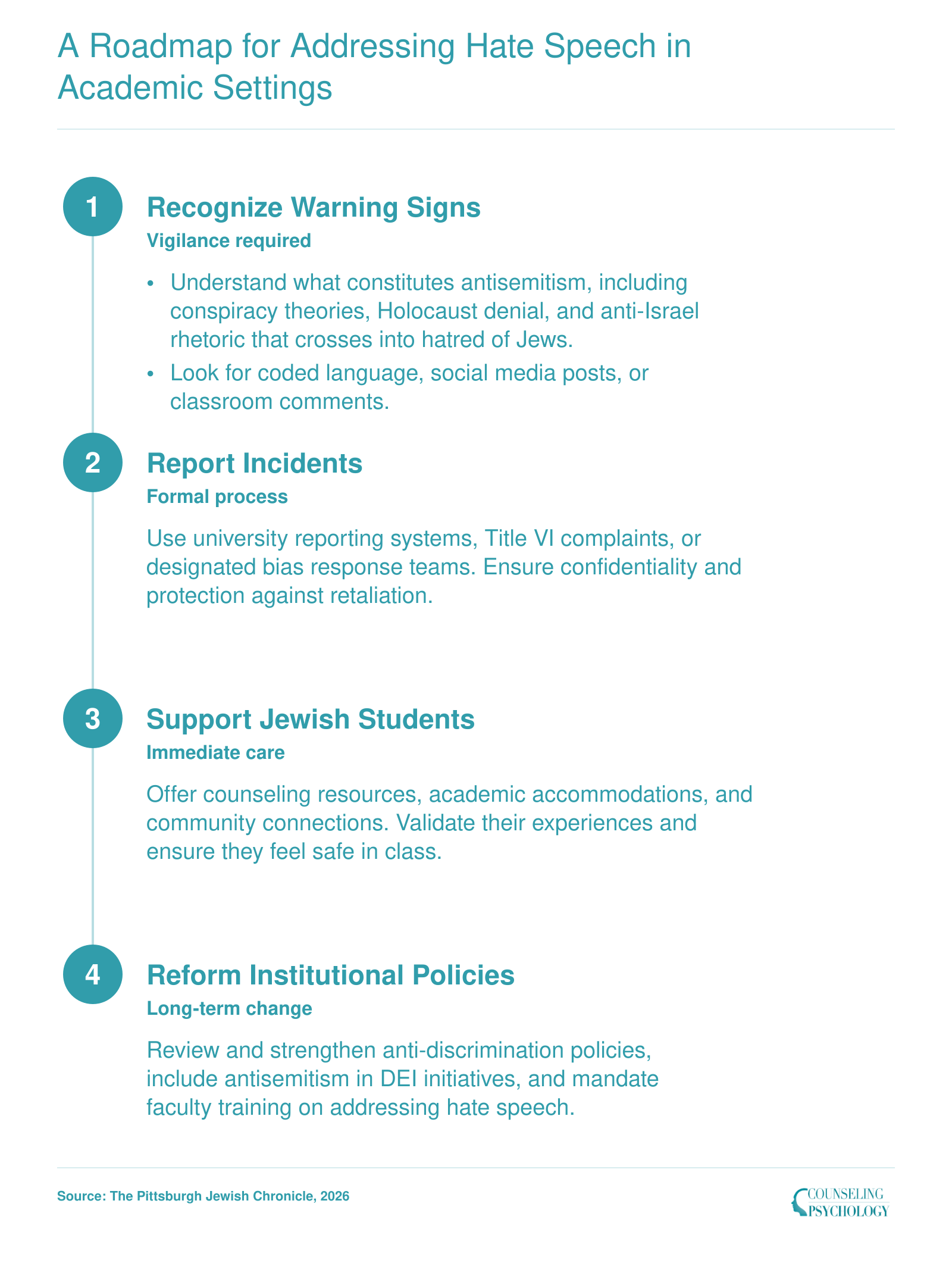
A Roadmap for Addressing Hate Speech in Academic Settings
Lessons From the Duquesne University Case: A Systemic Failure
In October 2024, a graduate student in Duquesne University's psychology department amplified a social media post celebrating the October 7, 2023 Hamas attack, including the phrase "happy Oct. 7 eve" and praise for Yahya Sinwar. When Professor Alex Kranjec, the department's sole Jewish faculty member, reported the post, colleagues responded with defensiveness and attacked him for raising the issue. The student's faculty adviser characterized the post as within an acceptable range of opinions on the Israel/Hamas conflict. In the aftermath, Kranjec faced retaliation: a course was created as an alternative to his required class without his knowledge, graduate students were encouraged to report him, his office was targeted, and he was removed from a Jewish graduate student's exam committee. Only one former graduate student publicly supported him.
This case lays bare a systemic failure. It is not merely about one student's hateful expression but about how an academic department chose to protect that expression and retaliate against the professor who sought to uphold anti-discrimination norms. The response transformed an incident of antisemitic speech into a broader climate of hostility: the very definition of a hostile environment under Title VI of the Civil Rights Act, which prohibits discrimination based on shared ancestry.1 The U.S. Department of Education's Office for Civil Rights has made clear that antisemitism falls within this protection when tied to ethnic or ancestral identity, and that institutions must take "immediate and appropriate action" to respond.1
Here, the department's dismissiveness and the ensuing retaliation signal deliberate indifference, a standard that can trigger institutional liability.2 While public institutions must navigate First Amendment boundaries,3 the targeted retaliation against Kranjec goes beyond protected speech; it includes adverse academic actions and informal discouragement, both prohibited under federal guidance.1 The Duquesne case reveals how easily training programs can become complicit in antisemitism when they fail to investigate harassment seriously and instead penalize those who speak up. For psychology and social work education, which prides itself on diversity and ethics, this is a stark reminder that policies are only as strong as the courage to enforce them.
Positive Models: Universities Taking a Stand
Positive models for addressing antisemitism in psychology and social work education are gradually emerging, though they are not yet widespread. Locating them requires a proactive search across multiple sources, as many initiatives are still in early stages or embedded within broader diversity, equity, and inclusion (DEI) frameworks.
Where to Look for Effective Programs
- Department websites: Review DEI sections, syllabi, or program descriptions for explicit mention of antisemitism awareness or Jewish inclusion. Some programs may list related workshops, speaker series, or curricular modules.
- Professional associations: The American Psychological Association (APA) and National Association of Social Workers (NASW) publish ethics codes and diversity guidelines that can inform antisemitism-related initiatives. Monitoring their websites for position statements, reports, or task force recommendations is a useful step.
- Campus Jewish organizations: Hillel chapters and Jewish Student Unions often document campus climate and may be aware of successful institutional responses or faculty champions. Direct outreach can uncover models not yet publicized.
- Academic databases: Searches in JSTOR, Education Source, or similar platforms using keywords like "antisemitism awareness curriculum social work" can yield case studies or evaluations, even if published in niche journals.
By synthesizing these sources, psychology and social work departments can adapt existing practices to their own contexts and contribute to a growing base of effective strategies.