
What you’ll learn in this article…
- Iowa delayed public disclosure of ethics charges for over a year.
- Sexual boundary violations almost always cause permanent license revocation.
- A board complaint can end a license; an association complaint cannot.
When a licensing board takes three years to publicly disclose disciplinary charges, the lag itself becomes part of the story. In July 2025, the Iowa Board of Behavioral Health Professionals filed ethics charges against mental health counselor Linda Diane Lawman, alleging failure to comply with the American Counseling Association's code of ethics. The case did not appear in public records until June 2026, after the Iowa Department of Inspections, Appeals and Licensing assumed oversight of licensing boards.1
Delays like this erode client trust and leave practitioners exposed to prolonged uncertainty. Ethics violations carry real consequences, from license suspension to permanent revocation, and the process can drag on for years. Understanding mental health counselor career paths means reckoning with the accountability structures that govern them from day one.
For counselors, the lesson is twofold: know your ethical obligations inside and out, and understand how your state board operates. The gap between violation and sanction can be just as damaging as the offense itself.
Iowa Counselor Ethics Case: What Happened and Why It Matters
Transparency in professional discipline cases has become a pressing concern for mental health counselors, as delays in public disclosure can erode client trust long before a final ruling is made. The ongoing case of Linda Diane Lawman, a mental health counselor who practiced in Grundy Center, Iowa, illustrates how state licensing processes and systemic backlogs can leave practitioners and the public in the dark for years.
Case Timeline: From Investigation to Public Disclosure
According to reporting by the Iowa Capital Dispatch,1 the Iowa Board of Behavioral Health Professionals filed disciplinary charges against Lawman on July 29, 2025. The charges allege failure to comply with the American Counseling Association's code of ethics. The underlying investigation, however, began much earlier: board records show an inquiry was initiated in 2022, meaning the case (number 22-0202) has been active for over four years without resolution.2 Lawman's mental health counseling license expired in 2024, yet charges were pursued beyond that date. The specific nature of the alleged ethical violation has not been disclosed, and Lawman could not be reached for comment. A hearing was originally set for June 1, 2026, but was rescheduled to July 22, 2026.3 The board's statement of charges was not published until the week of June 22, 2026, when the Iowa Capital Dispatch story brought the matter to public attention.
DIAL's Oversight and the Transparency Gap
The Iowa Department of Inspections, Appeals, and Licensing (DIAL) assumed responsibility for licensing boards in 2023, consolidating oversight that was previously dispersed across multiple agencies.2 This transition contributed to significant delays in public disclosure of disciplinary actions. In Lawman's case, the investigation predated the DIAL takeover, and the lag between the initial complaint and the public statement of charges now spans multiple years. Such gaps can undermine confidence in the regulatory process and leave clients unaware of potential risks. Practitioners who value their professional reputation should factor in that even resolved complaints may surface publicly much later, often with lingering consequences. For counselors thinking about how insurance changes affect mental health counselors, reputational exposure from delayed board disclosures adds another layer of financial and professional risk to consider.
Why Expired Licenses Don't End Accountability
A critical lesson from this case is that allowing a license to expire does not halt an ongoing ethics investigation. Lawman's license lapsed in 2024, but the board continued to pursue the charges and published its findings. Disciplinary records, once public, can appear on board websites and in news reports indefinitely, potentially affecting future employment, credentialing, and professional standing. Mental health counselors should understand that ethical obligations and board oversight persist beyond the active licensure period. Anyone considering a career change to mental health counseling should also be aware that this accountability extends throughout a counselor's professional history.
Practical Takeaways for Practitioners
To avoid being blindsided, practitioners should regularly review their licensing board's docket and the DIAL Public Meeting Calendar, where agendas are posted about a week before each scheduled meeting and may be updated as late as 24 hours before the meeting.3 If you have an open complaint or investigation, stay in communication with your board and seek legal or professional ethics consultation early. Even if you plan to let a license lapse, address any pending matters proactively. The Lawman case serves as a stark reminder that the timeline of ethics enforcement is increasingly unpredictable, and transparency delays can magnify reputational harm.
Most Common Types of Ethics Violations Among Mental Health Counselors
Ethics violations are breaches of the professional standards counselors pledge to uphold. They range from blatant misconduct, like a sexual relationship with a client, to seemingly minor oversights, such as failing to lock a file cabinet. Knowing the most frequent types helps practitioners spot danger zones before a complaint lands on a licensing board's desk.
Boundary Violations: The Most Common Offense
Boundary infractions dominate state board complaints. In Texas, for example, 56.1% of all cases against licensed professional counselors involve a boundary issue.1 Nationally, the American Counseling Association's disciplinary data show that sexual relationships with clients account for 20% of complaints, and nonsexual dual relationships add another 7%.2 Sexual misconduct, in particular, leads to the harshest consequences: it is tied to half of all licensure revocations.2 The therapist license revocation for sexual misconduct process involves both state board action and, in many cases, civil liability.
- Sexual relationships: Any romantic or sexual contact with a current client, even if initiated by the client, is an automatic violation.
- Nonsexual dual relationships: These include accepting a client's social media friend request, hiring a client for a side business, or socializing at the same private gatherings without the structure of a professional role.
- Emotional boundary blurring: Excessive self-disclosure, playing favorites between partners in couples therapy, or texting after hours about non-clinical topics.
Confidentiality Breaches and Documentation Gaps
Confidentiality breaches consistently rank among the top three complaint categories. In Texas, they appear alongside boundary infractions and documentation shortfalls.1 Nationwide, malpractice claims against mental health counselors jumped 40% in 2025, with confidentiality lapses cited frequently.3
- Unauthorized disclosure: Discussing a client by name in a restaurant, leaving a voicemail that reveals identifiable treatment details, or forwarding session notes to a physician without signed consent.
- Sloppy recordkeeping: Progress notes missing key elements, failure to document the rationale for a treatment decision, or storing client files on an unencrypted personal laptop.
- Telehealth documentation gaps: Providing teletherapy without obtaining a client's informed consent about the risks of virtual platforms, or not having a plan for technological interruptions.
Competence, Billing, and Supervision Failures
Inappropriate fee assessment makes up 12% of ACA complaints,2 while competence and scope-of-practice issues are consistently flagged in national risk reports. Counselors also face sanctions when clinical supervision hours for licensure are not properly documented or oversight of supervisees is neglected.
- Practicing beyond competence: Offering a specialized treatment such as EMDR without proper certification, or accepting a client with a severe eating disorder when the counselor has no training in that area.
- Billing and insurance fraud: Waiving co-pays without documenting hardship, reporting a 60-minute session that lasted 40 minutes, or billing for services not rendered.
- Supervision failures: Not observing a supervisee's session when it was required, or ignoring a supervisee's boundary lapse, which can result in sanctions for the supervisor as well.
Ethics Violation vs. Malpractice: Not the Same Thing
An ethics violation is a breach of a professional code (such as the APA Code of Ethics guide for psychologists and counselors) and is adjudicated by a state licensing board. Malpractice is a civil lawsuit that requires proof of negligence causing actual harm. A single act can be both: a sexual relationship with a client triggers board discipline and can underpin a malpractice suit. Many ethics violations, like failing to complete a certain number of continuing education hours, would not usually support a malpractice claim. Board sanctions range from a private letter of reprimand to license revocation, regardless of whether a court finds the counselor legally liable.
How Licensing Boards Investigate and Sanction Ethics Violations
When a complaint reaches a state licensing board, it triggers a structured process designed to protect the public while giving the accused practitioner a fair opportunity to respond. Understanding each stage helps counselors recognize what is at stake and how long the road can be.
The typical investigation cycle moves through several distinct phases.1 First, the board accepts a written complaint, reviews supporting documents, and acknowledges receipt to the complainant.2 An investigator then gathers records, interviews witnesses, and builds a case file. At a designated point, the licensee receives written notice and a chance to respond before any formal charges are filed. If the evidence is sufficient, the board issues a statement of charges and schedules a hearing. The hearing itself is prosecuted by the state Attorney General's office in many jurisdictions, heard by an administrative law judge, and then reviewed by the full board before a final decision is rendered.3 Outcomes range from dismissal to probation, suspension, or full license revocation.
Timelines vary considerably by state and by the complexity of the case. In California, for example, the intake and investigation phase alone can run up to 180 days, and the complete disciplinary process from complaint to final decision can extend as long as 540 days.3 Statutes of limitations add another layer: California allows charges to be filed up to three years from the date of discovery or seven years from the date of the incident, whichever comes first, with a ten-year window reserved for sexual misconduct cases.3
The Iowa case illustrates how these timelines play out in practice. The investigation into Linda Diane Lawman opened in 2022, yet disciplinary charges were not filed until July 2025 and a hearing was not held until mid-2026, a span of roughly four years. Part of that delay traces to structural changes: Iowa's Department of Inspections, Appeals and Licensing absorbed responsibility for licensing boards in 2023, and the transition slowed public disclosure of disciplinary actions.
For practitioners, the takeaway is that an open investigation can linger quietly for years before becoming a matter of public record. Maintaining accredited mental health counseling programs standards throughout a career, staying current on licensing renewals, and adhering scrupulously to your profession's ethics code are the most effective ways to avoid ever entering this pipeline. If a complaint is filed, consult an attorney with licensing board experience immediately rather than waiting for formal charges to arrive.
Typical Board Sanctions: From Reprimand to License Revocation
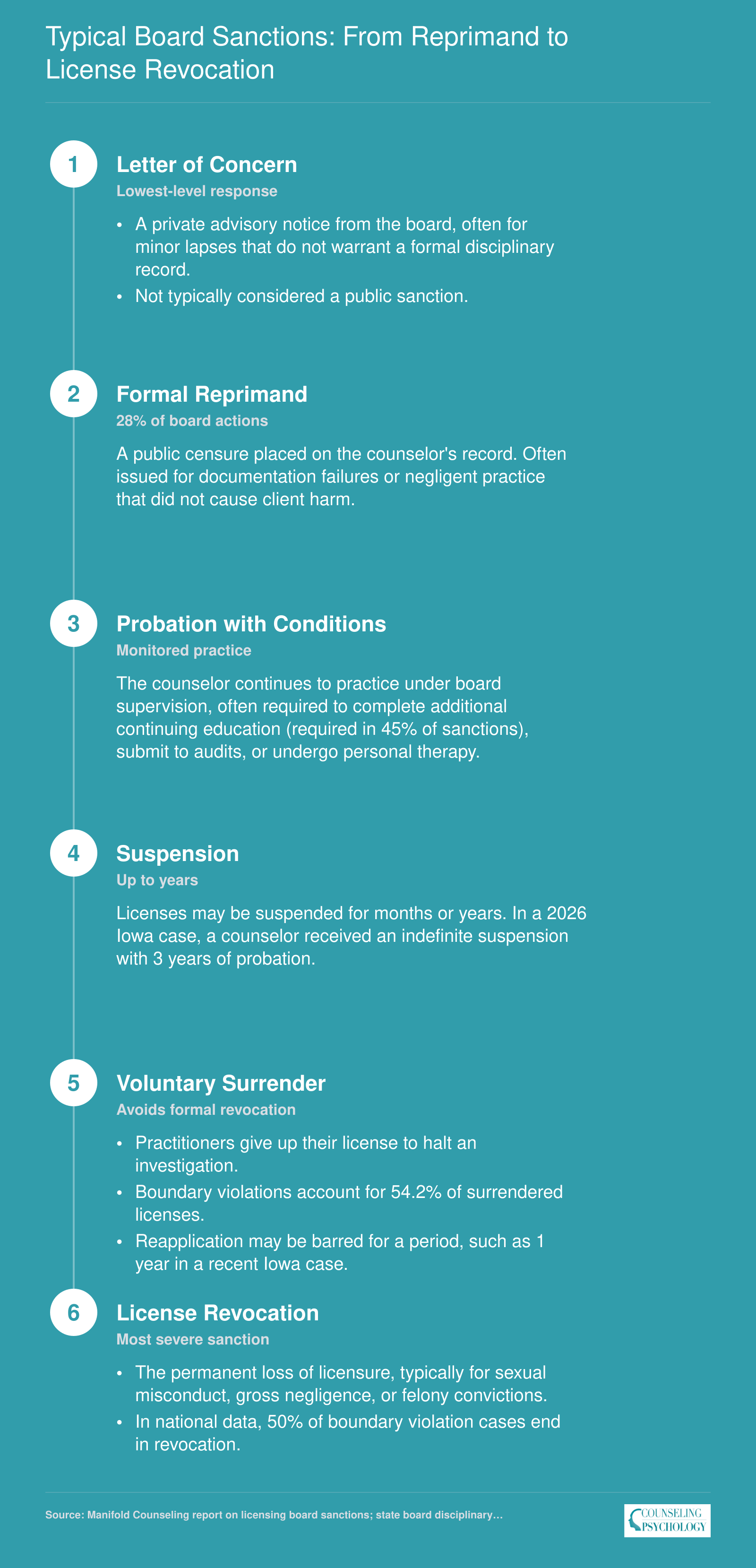
When a counselor violates ethical standards, licensing boards impose sanctions that escalate based on the severity of the offense. Minor documentation errors may result in a formal reprimand, while sexual boundary violations almost always lead to license revocation. The following ladder illustrates the typical progression of disciplinary actions.
ACA, NAADAC, APA, and NASW Ethics Codes Compared
When juggling multiple licensures or collaborating across disciplines, counselors often face a dilemma: which ethical code takes precedence? Each code aligns with its profession's values and scope, but practitioners working across fields must reconcile differences without compromising client care. Comparing these foundational documents lets you identify where guidance aligns and where it diverges.
Core Values and Aspirations
The American Counseling Association's code rests on six core values: autonomy, nonmaleficence, beneficence, justice, fidelity, and veracity.1 In contrast, the National Association of Social Workers centers its code on service, social justice, dignity and worth of the person, the importance of human relationships, integrity, and competence.2 The American Psychological Association's code distinguishes itself with five aspirational principles, such as beneficence and nonmaleficence, paired with ten enforceable standards.3 The NAADAC code, designed for addiction professionals, integrates a strong confidentiality framework including 42 CFR Part 2 protections.4
Structure and Enforceability
ACA's code spans nine sections covering the counseling relationship, confidentiality, professional responsibility, and more.1 APA's structure splits into general principles (aspirational) and specific ethical standards that are enforceable. A 2019 comparative analysis found 144 total differences between the APA and ACA codes, with 67 relating specifically to competency expectations.3 NASW's code, last revised in 2021, now explicitly addresses self-care as a professional obligation.2 NAADAC's living document approach means its code is regularly updated, most recently in June 2025, to reflect evolving issues like technology-assisted services.4
Specialized Focus Areas
Each code's target population shapes its emphasis. The ACA code speaks to types of counseling degrees and the professional counselors who hold them; NAADAC targets addiction professionals; APA covers psychologists across clinical, counseling, school, and industrial-organizational settings; NASW serves social workers in dual degree programs and all other practice areas. Understanding CACREP vs. APA accreditation can also clarify which ethical framework governs a given program's graduates. When working in integrated care settings, the recommended practice is to follow the stricter provision if multiple codes apply, for example, holding to the higher standard of confidentiality between an addiction-focused and a general counseling code.5
For those researching scope-of-practice overlaps, salary data, or employer preferences, authoritative sources like the Bureau of Labor Statistics, program accreditation bodies, and peer-reviewed journals can clarify how these professions compare in the job market. The starting point for ethical decision-making, however, remains a thorough understanding of your own profession's code and a working knowledge of the others you may encounter.
How to Report a Counselor Ethics Violation to a Licensing Board
State board complaint versus professional association grievance: these are two separate paths with distinct outcomes, and understanding when to use each protects both the public and the profession. A state licensing board has legal authority to suspend or revoke a license, while an association like the American Counseling Association (ACA) enforces its ethical code among members through sanctions like membership termination.
State Board vs. Professional Association: Two Separate Paths
Filing with a state licensing board is the primary route for serious ethical breaches, especially when client harm is involved. The board's investigation can result in disciplinary action that becomes part of a counselor's permanent public record. The ACA ethics committee only has jurisdiction over its own members1 and can issue sanctions such as reprimand, suspension, or expulsion from the association. These processes are independent, so a complainant may pursue one or both. Often, clients or family members file with the state board, while colleagues or supervisors may also notify the ACA if the counselor is a member.
A Step-by-Step Process for Filing with a State Board
- Identify the correct board: Each state has a specific regulatory body. For example, North Carolina's Board of Licensed Clinical Mental Health Counselors, California's Board of Behavioral Sciences, and the Texas Behavioral Health Executive Council all oversee licensed professional counselors in their jurisdictions.
- Gather documentation: Compile dates, communications, records, and any evidence that supports the violation. Cite specific ethical code sections if possible; many complaint forms ask for the relevant codes. North Carolina's board, for instance, requires complainants to cite ACA ethical codes and applicable legal provisions.2
- Submit the written complaint: Most boards require using an official form.3 California's BreEZe portal allows online submission, while Texas accepts a complaint form by mail or online.4 Some boards, like Louisiana's, do not accept anonymous complaints unless the documentation clearly shows a violation.5
- Understand the timeline: After submission, boards typically acknowledge receipt and may request additional information. South Dakota's board, for example, requests a response within 20 days.6 Investigations can take months, and complainants are generally updated on the final outcome but not necessarily on every step.7
Addressing Common Fears and Confidentiality
Retaliation protections exist in many states for those who file complaints in good faith. The complaint process is confidential to the extent allowed by law, but a counselor will eventually see the complaint details as part of their due process. The case of a therapist peer support network can also help practitioners navigate the emotional weight of either filing or responding to an ethics complaint. While the timeline can feel slow, most boards prioritize cases involving imminent client danger.
Who Can File: Mandatory vs. Voluntary Reporters
In some states, licensed colleagues and supervisors are mandatory reporters who must file when they witness certain violations. Clients, family members, and the public are voluntary reporters. Regardless of status, anyone with credible evidence of an ethical violation can initiate a complaint.
Ethics Violation Prevention Checklist for Counseling Practitioners
Preventing ethics violations isn't about memorizing rules; it's about building habits that catch problems before they escalate. For counselors, this means actively tending to the areas where missteps most often occur: boundaries, documentation, informed consent, consultation, and self-care.
Boundaries and Dual Relationships
Clear boundaries protect both client and counselor. A prevention checklist for this domain includes: - Social media policy: Maintain a written policy that clarifies you will not accept friend requests from current or former clients. Discuss this during informed consent. - Role clarity: Avoid overlapping roles, such as seeing a client you also know socially. If unavoidable, document the steps taken to minimize harm. - Gift guidelines: Define a threshold (e.g., value under $20) and the therapeutic meaning before accepting any gift. Apply ethical decision-making models if unsure.
Documentation and Record-Keeping
Thorough, timely documentation is your first line of defense if a complaint arises. - Contemporaneous notes: Write progress notes within 24 hours; include clinical rationale for decisions. - Objective language: Focus on observable behaviors and client statements, not assumptions. - Secure storage: Use encrypted, HIPAA-compliant systems; never leave files in unsecured locations.
Informed Consent, Especially for Telehealth
Telehealth introduces unique risks that counselors must address head-on. Telehealth clinical hours for psychology students can vary significantly by state board, so verifying jurisdiction-specific rules before each session is essential. Ensure your consent process covers: - Cross-state practice: Verify licensing laws in the client's physical location at each session. Do not practice across state lines without proper authorization. - Platform security: Use secure, encrypted video platforms (not standard consumer apps). Confirm that the client understands the privacy limits of digital communication. - Digital consent: Obtain explicit consent for telehealth, including emergency procedures and what happens if the connection fails.
Supervision and Consultation
Isolation breeds ethical drift. Build consultation into your regular practice. - Scheduled peer consultation: Join a consultation group that meets monthly, not just when a crisis hits. - Supervision for gray areas: Whenever you face a dilemma that makes you uncomfortable, seek supervision before acting. MFT supervised experience and mentorship models offer useful frameworks for structuring ongoing consultation, even for fully licensed practitioners.
Self-Care and Impairment Monitoring
Counselors who are depleted or impaired cannot ethically serve clients. Self-monitoring includes: - Burnout self-assessments: Use tools like the Maslach Burnout Inventory periodically. - Personal issues: Be honest about when your own problems (e.g., divorce, substance use) might affect your work. Reduce caseload or take leave before harm occurs.
Using Ethical Decision-Making Models in Gray Areas
When a situation doesn't fit neatly into a rule, structured models prevent reactive choices. Two widely used models are: - Forester-Miller and Davis model (7 steps): Rooted in the ACA Code of Ethics, it begins with identifying the problem, applying the code, considering ethical principles (autonomy, beneficence, nonmaleficence, justice, fidelity), generating potential courses of action, weighing consequences, selecting and implementing the best option, and evaluating the outcome.1 - Corey, Corey, Corey, and Callanan model (9 steps): Places more emphasis on laws, consultation, and consequence analysis. Steps include identifying the dilemma, knowing applicable laws and regulations, obtaining consultation, considering possible courses of action, enumerating consequences, deciding on the best course of action, implementing the plan, and evaluating the results.2 Imagine a client offers you a handmade gift valued at $50. Using either model, you would identify the dilemma, review your ethics code and agency policy, consult a supervisor, weigh the therapeutic meaning against the risk of boundary blurring, choose a response, and document your rationale.2 The model is less important than the habit of pausing to work through steps instead of acting on impulse.
Prevention Is a Practice, Not a Policy
A binder of policies on a shelf offers little protection. The most effective prevention comes from living these habits: regular peer consultation, annual ethics continuing education, honest self-assessment, and a willingness to pause before acting. Documentation is vital, but the real safeguard is a mindset that treats ethics as an ongoing practice; one that catches small concerns before they become board complaints.
What Happens to Clients After an Ethics Violation?
The counseling field is increasingly recognizing that ethics violations harm not just professional standards but the very clients who placed their trust in the therapeutic relationship.
The Immediate Aftermath: Referrals and Continuity of Care
When a mental health counselor is sanctioned for an ethics violation, clients often find themselves abruptly without a provider. Licensing boards generally do not proactively notify affected clients unless a specific safety threat exists; instead, it falls to the sanctioned counselor, their employer, or the local agency to facilitate a smooth transition. While state laws like mandatory duty to warn (required in 23 states including California and Virginia1) compel immediate reporting of threats to identifiable victims, post-sanction client notification remains inconsistent across jurisdictions. In permissive-duty states like Florida and Texas, or no-duty states like Nevada and North Carolina,2 clients may only learn of violations through public board records or news stories.
Clients have the right to request their treatment records be transferred to a new therapist, and many board orders require the sanctioned counselor to assist in coordinating referrals. Restitution options, such as reimbursement for counseling costs, may be ordered by the board if financial harm occurred, though this varies by case and state.
Trauma-Informed Considerations for Affected Clients
Ethics violations by a trusted counselor can trigger betrayal trauma, making it profoundly difficult for clients to re-engage in therapy. New providers should screen for this history and adopt a trauma-informed care principles approach that prioritizes safety, transparency, and shared decision-making. Key signs include heightened distrust of authority, reluctance to disclose sensitive information, and physiological anxiety during sessions.
- Rebuilding trust: The new counselor should explicitly acknowledge the potential impact of the prior violation and invite the client to set the pace for disclosure.
- Normalizing hesitation: Validating the client's ambivalence about returning to treatment helps reduce self-blame and shame.
- Safety measures: Clear boundaries, consistent scheduling, and documented informed consent procedures offer a corrective relational experience.
Institutional Responsibilities and Client Rights
Clinics and agencies bear the responsibility to mitigate harm when one of their counselors commits an ethics violation. This includes:
- Records transfer: Ensuring timely release of client files to the new provider with proper authorization, while safeguarding confidentiality.
- Continuity of care: Assigning another qualified clinician within the practice to bridge the transition, or providing a list of vetted community referrals.
- Insurance and billing resolution: Addressing any billing irregularities resulting from the violation, such as charges for services not rendered, and working with insurers to prevent collection actions against the client.
Agencies should also review their internal reporting procedures and licensed professional counselor supervision structures to prevent recurrence and demonstrate an institutional commitment to ethical practice.
Related Articles
Common Questions About Counselor Ethics Violations
Clients and practitioners often have pressing questions about ethics violations, from reporting concerns to understanding board sanctions. This FAQ draws on real case findings and the ACA code of ethics to provide clear, practical answers.