
What you’ll learn in this article…
- Projected shortage of 30,000 social workers by 2030 in North Carolina.
- Public Service Leadership Program will train 2,000 social workers over five years.
- Partnership unites 25 universities, state agencies, and philanthropies for workforce growth.
Some North Carolina counties have no licensed social workers; in others, vacancy rates for child welfare and mental health positions run double the state average. Statewide, the gap is projected to reach 30,000 unfilled positions by 2030.1 In response, 25 universities, state agencies, and private funders launched the Public Service Leadership Program (PSLP) in spring 2026, aiming to graduate 2,000 additional social workers over five years and place them in underserved rural communities. The program’s public-private financing and pipeline from high school through graduate school offer a replicable model for states confronting similar workforce crises.
How Severe Is North Carolina's Social Worker Shortage?
North Carolina is facing a social worker shortfall so large it could leave roughly 30,000 positions unfilled by 20301, a gap that touches every corner of the state. With only about 12.7 practicing social workers for every 10,000 residents2, the current workforce is stretched thin, reflecting a broader mental health workforce shortage that reaches into mental health clinics, child welfare agencies, schools, and healthcare settings.
The Rural-Urban Divide
The shortage is not spread evenly. In North Carolina's metropolitan counties, the rate of licensed clinical social workers (LCSWs) sits at nearly 10 per 10,000 residents, but in non-metro areas that rate drops to fewer than 5 per 10,0002. Three counties , Camden, Hyde, and Tyrrell , recorded zero LCSWs in 2024.3 The state's Rural Health Division reports a vacancy rate of 19.4%, far above the 13.2% in the broader Social Services Division. Meanwhile, LCSW availability ranges from 0 to 25.26 per 10,000, with regions served by Area L AHEC and Northwest AHEC falling well below the statewide average2.
Shortages Across Practice Areas
Child welfare has been particularly hard-hit: a 2020 survey found 13.8% of child welfare social worker positions vacant4, and by 2025 the NCDHHS Child & Family Well-Being Division reported 14.8% unfilled roles. State-operated healthcare facilities faced a 15.4% vacancy rate. The pipeline for public mental health is also constrained , fewer than half of North Carolina's social workers hold the credentialing required for public behavioral health settings2. These gaps emerge against rising demand: the Charlotte-Concord-Gastonia metro area expects a 16.6% growth in healthcare social worker jobs over the decade.
Why New Partnerships Are Essential
Without intervention, rural counties will continue to lose access to addiction counseling, elder care, school-based support, and child protective services , a widening rural mental health services gap. The severity of the shortage is exactly why the Public Service Leadership Program was created , to expand enrollment, lower financial barriers, and steer graduates toward the communities where they are needed most.
By 2030, North Carolina faces a projected shortage of roughly 30,000 social workers, with the most severe gaps concentrated in rural communities that already struggle to provide mental health and child welfare services.
Inside the Public Service Leadership Program (PSLP)
The Public Service Leadership Program (PSLP) represents one of the most ambitious state-level efforts to rebuild the social work workforce, uniting 25 higher education institutions, state agencies, and private philanthropy behind a single coordinated strategy.
A Broad Coalition with a Shared Mission
The PSLP brings together the NC Department of Health and Human Services, the Blue Cross Blue Shield of North Carolina Foundation, and the 25 university and college members of the Social Work Coalition on NC Workforce Development. This public-private partnership draws on state funds, foundation grants, and contributions from both public and private universities to create a sustainable funding model. By pooling resources, the coalition aims to produce 2,000 additional social workers over five years across undergraduate (BSW programs) and graduate (MSW programs)1.
From Classroom to Community: The PSLP Experience
Eligibility is open to students at any member institution pursuing a BSW or MSW. The pipeline starts early, engaging high school and community college students to ignite interest in social work careers.3 Applications for the first cohort opened in March 20262, with participants selected through their universities. Once enrolled, students engage in an immersive, resilience-focused curriculum designed to build both professional competence and leadership skills.3 Field placements pair them with understaffed public agencies such as state hospitals, child welfare offices, and rural clinics, where they gain real-world experience while filling critical gaps. After graduation, participants commit to three years of service in high-need communities, and in return the program provides loan repayment for their educational debt.4
Financial Incentives: Loan Forgiveness and Scholarships
Federal Public Service Loan Forgiveness (PSLF)
Social workers in North Carolina can access the federal Public Service Loan Forgiveness (PSLF) program, which offers complete forgiveness of remaining Direct Loan balances after 10 years of qualifying payments.1 To qualify, you must work full-time for a government agency or a 501(c)(3) nonprofit organization, common employers in social work. Eligible fields include social work services, public service for individuals with disabilities, and services to the elderly.2 PSLF requires 120 qualifying monthly payments under an income-driven repayment plan or the 10-year Standard plan; for new borrowers after mid-2026, the new Repayment Assistance Plan (RAP) also qualifies.3 The forgiven amount is tax-free and has no dollar cap, making it especially valuable for those with significant graduate debt.1
Stacking PSLF with Program-Based Support
While the Public Service Leadership Program’s (PSLP) specific scholarship amounts, loan forgiveness terms, and rural placement stipends have not yet been publicly released, the program’s design suggests it will complement federal benefits. Students in PSLP partner universities may receive scholarship support funded by the state, private foundations like the Blue Cross Blue Shield of North Carolina Foundation, and participating universities. These funds can reduce the amount you need to borrow, and when combined with PSLF, could leave you with little to no debt after a decade of public service, making an MSW worth it for committed professionals. Additionally, North Carolina state-level loan repayment programs for social workers exist but are not centrally consolidated; check with the NC Department of Health and Human Services and individual universities for current offerings.
The Role of Philanthropic Funding
Philanthropic investment is critical to making these incentives possible. The PSLP’s public-private partnership model channels foundation dollars directly into student support, enabling scholarships and stipends that would be impossible through state budgets alone. This approach not only reduces financial barriers for students but also targets incentives toward high-need areas like rural communities, where a mental health provider shortage is especially acute, and a stipend can make the difference in a graduate’s decision to serve an underserved population.
In rural North Carolina counties, vacancy rates for child welfare and mental health social workers are twice the state average. Some counties have no licensed social workers at all, leaving vulnerable residents without essential support.
Social Worker Salaries in North Carolina: Metro Area Breakdown
While North Carolina's overall median social worker salary reached $64,800 in 2026, pay varies sharply across metro areas and specialties. The largest group, child, family, and school social workers, often earns less, with a national mean of $58,570. Rural county-level pay trails further behind: Piedmont nonmetro regions report a median of just $52,217 compared to $62,540 in Raleigh. Healthcare social workers tend to outearn their child welfare counterparts by several thousand dollars statewide. The Public Service Leadership Program addresses these gaps with targeted loan forgiveness and stipends, aiming to make rural service more financially viable for graduates.
| Metro Area | Employment | Median Annual Wage (2024) |
|---|---|---|
| Charlotte-Concord-Gastonia, NC-SC | 4000 | 60670 |
| Raleigh-Cary, NC | 1550 | 62540 |
| Greensboro-High Point, NC | 880 | 54980 |
| Durham-Chapel Hill, NC | 810 | 60360 |
| Fayetteville, NC | 630 | 50070 |
| Winston-Salem, NC | 580 | 54430 |
| Hickory-Lenoir-Morganton, NC | 550 | 58970 |
| Wilmington, NC | 530 | 62350 |
| Asheville, NC | 520 | 57550 |
| Greenville, NC | 320 | 54790 |
How to Become a Social Worker in North Carolina: Education and Licensure
North Carolina’s social work landscape is shifting rapidly as workforce shortages drive new partnerships and accelerated pathways for becoming a social worker. The traditional route remains grounded in accredited education and state-regulated licensure, but new programs like the Public Service Leadership Program (PSLP) are smoothing entry points and creating structured support for emerging practitioners.
The Standard Licensure Pathway
- Earn a social work degree from a CSWE-accredited program: Start with a Bachelor of Social Work (BSW) or a Master of Social Work (MSW). The MSW is required for clinical licensure.
- Complete supervised practice: After graduating, candidates must accrue post-degree supervised experience, typically 3,000 hours for full clinical licensure, with at least 100 hours of supervision.
- Pass the ASWB exam: The Association of Social Work Boards (ASWB) administers exams at different levels; clinical candidates take the Clinical exam.
- Apply to the NC Social Work Certification and Licensure Board: Submit transcripts, verification of supervised hours, and exam scores to receive your license.
Licensure Levels and What They Entitle You to Do
- Licensed Clinical Social Worker Associate (LCSWA): A provisional license enabling you to practice clinical social work under supervision while accruing hours toward full licensure.
- Licensed Clinical Social Worker (LCSW): The full independent clinical license, allowing you to diagnose and treat mental health conditions, provide psychotherapy, and open a private practice as a mental health social worker.
- Certified Master Social Worker (CMSW): An advanced non-clinical license for macro-practice roles in administration, policy, or community organizing.
- Certified Social Work Manager (CSWM): For management-level direct services and administrative supervision.
How PSLP Creates a Faster, More Supported Track
The PSLP initiative directly addresses common barriers. Participating schools offer structured field placements in the five critical shortage areas, including mental health and child welfare, ensuring that clinical hours align with high-demand roles. Students also receive exam preparation workshops and cohort-based mentoring, which studies show can boost licensure pass rates. For those committed to rural communities, additional supports may include relocation stipends and pipeline programs that begin with undergraduate recruitment.
Career Changers and Advanced Standing Options
If you hold a BSW from an accredited program, advanced standing MSW programs can be completed in as little as one year. For those entering with a bachelor’s in another field, traditional MSW programs welcome diverse backgrounds, no prerequisite major is required, though some coursework in psychology or sociology is helpful. North Carolina’s expanding workforce initiatives mean that even non-traditional students can find accelerated paths to licensure and a meaningful career in social services.
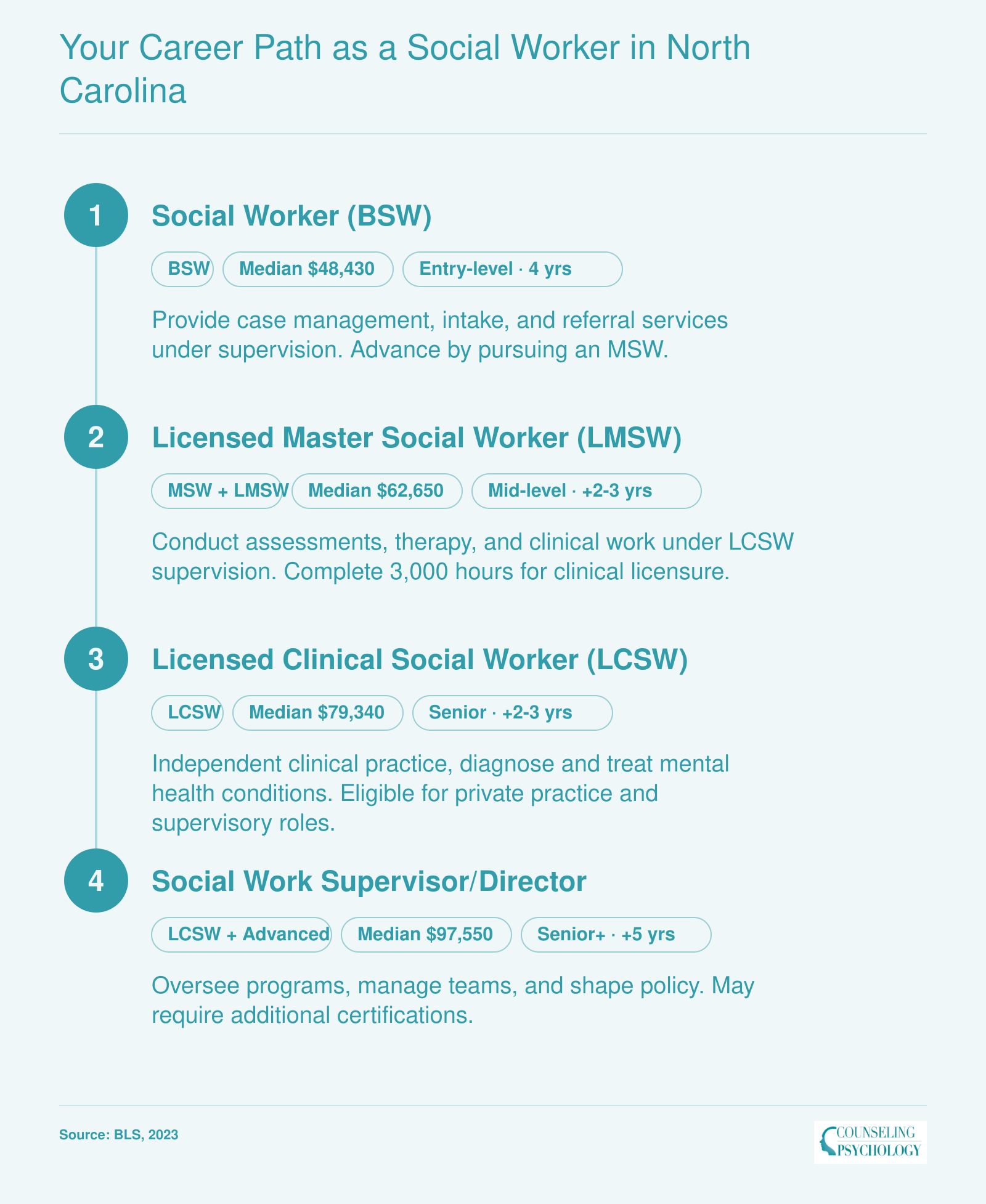
Your Career Path as a Social Worker in North Carolina
Pursuing a social work career in North Carolina follows a structured progression from undergraduate education to advanced clinical licensure. The pathway outlined below reflects typical milestones, timelines, and salary benchmarks based on 2023 Bureau of Labor Statistics data for the state.
Rural Focus and Underserved Communities
The decision to practice social work in a rural community often comes with a tradeoff: greater autonomy and community impact versus fewer professional resources and lower salaries. The Public Service Leadership Program (PSLP) leans directly into this tension, designing pathways that make rural service both viable and rewarding.
Why Rural Areas Need Social Workers Most
North Carolina’s projected shortage of 30,000 social workers by 2030 is not evenly distributed. Rural counties face the steepest gaps across all five critical shortage areas: mental health, child welfare, elder services, intellectual and developmental disabilities, and justice system support. In many small towns, a single community mental health counselor may be the only accessible provider for dozens of miles. PSLP addresses this by targeting a significant percentage of its 2,000 new graduates for placement in these underserved communities.
Preparing Students for Rural Practice
Universities in the coalition are embedding rural readiness into their curricula. Students receive training in: - Technology in counseling and telehealth delivery: critical when the nearest specialist is an hour away. - Cultural competency: understanding the values, stigma patterns, and informal support networks unique to small communities. - Rotations and field placements: hands-on experience in child welfare offices, rural mental health clinics, and aging services centers deep in shortage counties.
These experiences ensure graduates enter the workforce not just willing but equipped to handle the complexity of rural practice.
From Classroom to Community
Placement does not happen by chance. PSLP partners with local agencies, county departments of social services, and nonprofit providers to create clear hiring pipelines that launch a social work career journey in high-need communities. Contractual obligations and scholarship incentives often tie graduates to high-need areas for a set period, turning classroom preparation into long-term community presence.
Related Articles
Will These Partnerships Actually Solve the Social Worker Shortage?
Adding thousands of new graduates to the workforce is one thing; ensuring they stay in the field beyond a few grueling years is another. The Public Service Leadership Program (PSLP) stakes its success on both fronts, but the real test will be whether it can move the needle on long-term retention in a profession known for high turnover.
Measuring What Matters: Beyond Graduation Numbers
The PSLP intends to track not just how many social workers it produces, but where they end up and how long they remain. Planners are looking at placement rates in targeted rural areas, as well as retention milestones at the one-, three-, and five-year marks. Early indications from similar pipeline models suggest that embedding financial incentives and robust supervision from the start significantly improves three-year retention, though data from North Carolina programs will take time to accumulate.
Retention Strategies Built into the Model
The partnership layers multiple retention-focused features. Loan forgiveness awards are structured to require successive years of service, directly addressing the is an MSW worth it question for graduates with significant student debt. Supervision models prioritize supportive, hands-on mentorship, a factor repeatedly cited by national research as a buffer against burnout.7 Caseload standards remain a point of advocacy; North Carolina's own Child Welfare Crisis Compensation and Classification Study recommended revisions,1 and the state's workforce plan calls for manageable workloads as a core retention lever.2 Even innovative training methods, like the virtual simulation used in Cumberland County's Department of Social Services,3 aim to give new hires a realistic job preview4 before they face real clients.
Lessons from Other States
North Carolina can look to models like Michigan's Child Welfare Fellows program, which combines tuition support with a post-graduation service obligation, and Kentucky's University Training Consortium, which integrates specialized coursework with field placements in underserved areas. Both have reported stronger retention among graduates compared to non-participants. A multi-state review by the Southern Area Consortium of Human Services, spanning eight project sites, similarly found that pay differentials of 10 to 15 percent, when paired with clear career ladders, reduced first-year attrition.5
Persistent Challenges
Even well-designed partnerships face hurdles. Securing long-term funding beyond initial philanthropic support remains uncertain. Placing graduates in extremely rural counties with few supervisory resources strains the model's promises of supportive oversight, and early career therapist supervision struggles can make retention even harder. And burnout drivers like excessive caseloads, limited autonomy, and poor work-life balance are deep-seated. National data consistently point to these as the primary reasons social workers leave,6 and no single program can fully resolve system-wide underfunding.
A Balanced Outlook
These partnerships represent a significant, concrete step toward closing the 30,000-worker gap. But solving a shortage of this magnitude demands more than a cohort of committed graduates. It will require sustained investment across salaries, supervision, and working conditions that make a career in social work viable for the long haul.
Frequently Asked Questions About Social Work Careers and PSLP in NC
Learn more about the Public Service Leadership Program and social work careers in North Carolina. Below, we answer common questions from prospective students and professionals considering this innovative workforce initiative.