

What you’ll learn in this article…
- COAMFTE accreditation streamlines licensure portability, but most states now accept online MFT degrees from regionally accredited schools.
- Public hybrid MFT programs can cost under $12,000 per year, roughly a third of many private program tuitions.
- State licensing boards require between 1,500 and 3,000 supervised clinical hours, and online students arrange these locally.
- From enrollment to independent LMFT practice, the full timeline typically spans three to five years.
Twenty-six states now allow fully online MFT degrees to count toward licensure, provided practicum hours are completed in person under qualified supervision. That regulatory shift has opened access to COAMFTE-accredited programs for students who cannot relocate or leave the workforce, but it has also widened the tuition gap. Among the programs ranked here, annual net costs range from under $7,000 at California State University-Northridge to more than $50,000 at Northwestern, even though both meet the same clinical-hour benchmarks and prepare graduates for the same licensing exams.
The practical challenge is not finding a program that leads to licensure (most do) but identifying one that aligns with your state's specific supervision rules, your financial constraints, and the format you can realistically complete. Many students overestimate the portability of their degree or underestimate the post-graduation supervision burden, which in most states requires two to three additional years of supervised practice before you can sit for the LMFT exam. Students still weighing broader counseling degrees and career directions should clarify that decision before narrowing to MFT-specific programs.
This page ranks programs by return on investment, breaks down COAMFTE accreditation's actual effect on licensure timelines, explains how online students secure practicum placements, and maps state-by-state compatibility for distance learners. The goal is not to steer you toward a single program type but to clarify the trade-offs between cost, format, accreditation, and post-graduation requirements so you can choose a path that works in your state and within your budget.
Top Marriage and Family Therapy Master's Programs for 2026
The programs below represent the strongest MFT master's options we identified for 2026, evaluated across affordability, accreditation standing, clinical training depth, and graduate outcomes. Each listing includes tuition figures, median debt at the institution level, and earnings data where available. Because program-level earnings and employment outcomes are not yet published for most of these programs, we rely on institution-wide figures from federal sources as a proxy. Graduation rates listed are also institution-wide and should be read as general quality signals rather than MFT-specific completion metrics.
- Accreditation by COAMFTE or CACREP
- Net price and median graduate debt
- Institution-wide graduation rate
- Clinical training hour requirements
- Program format and flexibility
- Internal program database
- Independent program research
- NCES-IPEDS federal institutional data — nces.ed.gov
- College Scorecard graduate earnings — collegescorecard.ed.gov

California State University-Northridge
California State University-Northridge stands out for combining COAMFTE and IACSTE accreditation with one of the lowest net prices on this list at roughly $7,021. The program's accelerated eight-week course format lets most students finish in under two years while preparing for both LMFT and LPCC licensure in California and most other states. With a median graduate debt of only $13,872 and institution-wide median earnings of $59,115 ten years after enrollment, CSUN delivers a strong return on investment for students who can take advantage of in-state tuition of $8,982.
- COAMFTE and IACSTE dual accreditation
- Prepares graduates for both LMFT and LPCC licensure
- One course at a time in eight-week blocks
- Completable in less than two years with year-round scheduling
- Covers family therapy theories, ethics, and clinical intervention
- Hybrid format with diversity awareness and psychosocial assessment training
- In-state tuition approximately $8,982; out-of-state approximately $19,062
Master of Science in Marriage and Family Therapy — Hybrid

Texas Woman's University
Texas Woman's University offers a COAMFTE-accredited Master of Science in Marriage and Family Therapy through a hybrid model with campuses in Denton, Dallas, and Houston. Most students complete the degree in about three years, and the curriculum fulfills Texas state board requirements for the LMFT licensure exam. TWU requires no GRE or letters of recommendation, lowering the admissions barrier, while the institution-wide median graduate debt of $19,218 remains below the average for programs on this list.
- COAMFTE accredited; meets Texas licensure exam requirements
- Hybrid format across Denton, Dallas, and Houston campuses
- Typical completion in approximately three years
- No GRE scores or letters of recommendation required
- Thesis option available for research-oriented students
- In-state tuition approximately $8,520; out-of-state approximately $15,900
- Institution-wide median graduate debt of $19,218
Master of Science in Marriage and Family Therapy — Hybrid

Purdue University Northwest
Purdue University Northwest's Couple and Family Therapy master's is one of the most affordable COAMFTE-accredited options in the Midwest, with in-state tuition near $6,638 and a net price of roughly $6,079. The rigorous 67-credit, scholar-practitioner curriculum requires 500 hours of client contact, 100 hours of supervision, and a thesis with oral defense. Graduates meet licensure requirements in Indiana, Illinois, and other states.
- COAMFTE accredited with a scholar-practitioner model
- 67 credits required, including thesis and oral defense
- 500 client contact hours and 100 supervision hours
- Small cohort sizes with diverse client training
- Hybrid delivery; fall admission with January deadline
- In-state tuition approximately $6,638; out-of-state approximately $11,960
- Meets licensure requirements in Indiana, Illinois, and other states
Couple and Family Therapy, M.S. — Hybrid

Western Kentucky University
Western Kentucky University's CACREP-accredited Marriage, Couple, and Family Counseling program pairs hybrid coursework with hands-on clinical training at the on-campus Talley Family Counseling Center. In-state tuition starts at $12,140, and the institution reports a median graduate debt of $22,095 with institution-wide median earnings of $43,889 ten years after enrollment. The program prepares students for licensure as marriage and family therapists.
- CACREP accredited; prepares for MFT licensure
- Hybrid format blending online and on-campus components
- Clinical training at the Talley Family Counseling Center
- Practical experience with couples, families, and individuals
- In-state tuition approximately $12,140; out-of-state approximately $18,340
- Financial support options may be available through the department
Marriage, Couple, and Family Counseling, M.A. — Hybrid
Capella University
Capella University offers a fully online, COAMFTE-accredited Master of Science in Marriage and Family Therapy that appeals to students who need maximum scheduling flexibility. The program requires 72 quarter credits, two brief in-person residencies, and four internship courses supervised by AAMFT-approved supervisors. No GRE is required and there is no application fee, though tuition totals an estimated $36,864 to $46,080 depending on transfer credits. The institution-wide graduation rate of 20% is low but reflects Capella's largely nontraditional, part-time student population rather than program-specific completion.
- COAMFTE accredited; fully online GuidedPath format
- 72 quarter credits with 14 core courses
- Two required in-person residency experiences
- Four internship courses overseen by AAMFT-approved supervisors
- No application fee, no GRE or GMAT required
- Tuition approximately $512 per credit; estimated total $36,864 to $46,080
- Up to 16 quarter credits may transfer; state enrollment restrictions apply
MS in Marriage and Family Therapy — Online

Oregon Institute of Technology
Oregon Institute of Technology's Marriage and Family Therapy M.S. distinguishes itself with three available concentrations: Medical Family Therapy, Substance Use Disorder Treatment, and Integrated Behavioral Healthcare. The hybrid curriculum emphasizes rural mental health, trauma-informed care, and multicultural competence. Institution-wide median earnings reach $72,273 ten years after enrollment, among the highest on this list, though that figure reflects the school's engineering-heavy student body and should not be read as MFT-specific.
- Hybrid delivery with focus on rural mental health populations
- Three concentrations: Medical Family Therapy, Substance Use Disorder Treatment, Integrated Behavioral Healthcare
- Emphasis on trauma-informed care and cultural humility
- In-state tuition approximately $22,470; out-of-state approximately $36,164
- Institution-wide median graduate debt of $22,500
- Covers AAMFT and ACA codes of ethics
- Student-to-faculty ratio of 17:1
Marriage and Family Therapy M.S. — Hybrid

University of Oregon
The University of Oregon's Couples and Family Therapy M.S. is a COAMFTE-accredited, 90-credit program housed in a Research I institution. Students complete 350 direct client contact hours through clinical training at the Center for Healthy Relationships and community externship sites. A Spanish Language Specialization is available for students serving bilingual communities. Cohorts of 22 to 24 students benefit from small supervision groups and a noncompetitive learning environment. Institution-wide median earnings are $61,324 ten years after enrollment.
- COAMFTE accredited; 90-credit cohort-based program
- 350 direct client contact hours including 150 relational hours
- Clinical training at the Center for Healthy Relationships
- Spanish Language Specialization available
- 22 to 24 students admitted per cohort annually
- No prerequisite degree-specific requirements; bachelor's in any discipline accepted
- In-state tuition approximately $19,474; out-of-state approximately $33,379
Couples and Family Therapy, M.S. — Hybrid

Prescott College
Prescott College delivers a CACREP-accredited Master of Science in Counseling with a Marriage, Couple, and Family Counseling concentration through a hybrid model that pairs mostly online coursework with a brief three-day campus residency. At $830 per credit for a 60-credit program, total costs can run around $49,800 before aid, though the institution-wide median graduate debt is a moderate $16,300. The curriculum integrates social justice themes and offers post-graduate certificate options. Prescott's intimate 8:1 student-to-faculty ratio supports personalized mentoring.
- CACREP accredited; 60 credits at $830 per credit
- Hybrid format with three-day campus colloquium
- Social justice curriculum focus with elective options
- Post-graduate certificate pathways available
- Priority application deadlines in October and May
- 8:1 student-to-faculty ratio for individualized attention
- Prepares graduates for professional counselor licensure
Master of Science in Counseling, Marriage, Couple, and Family Counseling concentration — Hybrid

Central Connecticut State University
Central Connecticut State University's COAMFTE-accredited Master of Science in Marriage and Family Therapy is a 63-credit program designed with working adults in mind, offering flexible evening scheduling and requiring no GRE or GMAT. The curriculum includes practicum and internship components in a state-of-the-art clinical lab. In-state tuition runs approximately $14,562, and the institution-wide median earnings are $58,562 ten years after enrollment. The program meets Connecticut licensure requirements for marriage and family therapists.
- COAMFTE accredited; meets Connecticut MFT licensure requirements
- 63-credit program with flexible evening schedule
- No GRE or GMAT required for admission
- Practicum and internship in a state-of-the-art clinical lab
- Eligible for AAMFT clinical membership upon completion
- In-state tuition approximately $14,562; out-of-state approximately $18,920
- Institution-wide median graduate debt of $22,300
Marriage and Family Therapy, M.S. — Hybrid

Grand Canyon University
Grand Canyon University offers two online master's pathways with an MFT emphasis: a CACREP-accredited MS in Clinical Mental Health Counseling with a Marriage and Family Therapy emphasis (74 credits), and an MS in Professional Counseling with an MFT focus. Both require over 700 supervised field hours and integrate a Christian worldview. Tuition is $600 per credit with eight-week course terms. Note that these programs prepare students for Licensed Associate Counselor and Licensed Professional Counselor credentials in Arizona rather than direct LMFT licensure.
- CACREP accredited; 74 credits with 700+ supervised field hours
- Online delivery in eight-week course terms at $600 per credit
- Prepares for LAC and LPC licensure in Arizona
- Covers family systems theory, substance use, and trauma counseling
- Christian worldview integrated throughout curriculum
- 2.8 GPA required (2.5 with GRE/GMAT scores)
- Does not directly lead to LMFT licensure
- Online master's with supervised internship and practicum
- Prepares for National Board for Certified Counselors exam
- Focus on family systems theory and diverse client populations
- Aligned with NBCC standards for professional counseling
- Coursework in Arizona licensure requirements
MS in Clinical Mental Health Counseling with an Emphasis in Marriage and Family Therapy — Online
MS in Professional Counseling with an Emphasis in Marriage and Family Therapy — On-Campus

Western Michigan University
Western Michigan University's Master of Arts in Marriage, Couple, and Family Counseling is a 60-credit program grounded in family systems theory with extensive clinical requirements: 100 practicum hours and 600 internship hours at on-campus clinics in Kalamazoo and Grand Rapids. The program emphasizes evidence-based skills and cultural awareness. Financial support includes scholarships, assistantships, grants, and loans, though institution-wide median graduate debt runs $26,188.
- 60-credit program with family systems theory focus
- 100 practicum hours and 600 internship hours required
- On-campus clinics in both Kalamazoo and Grand Rapids
- Emphasizes cultural awareness and evidence-based counseling
- Prepares for both professional counselor and MFT licensure
- Financial aid includes scholarships and assistantships
- In-state tuition approximately $20,103; out-of-state approximately $29,681
M.A. in Marriage, Couple, and Family Counseling — Hybrid

John Brown University
John Brown University's CACREP-accredited Master of Science in Counseling offers a Marriage and Family Therapy concentration alongside Play Therapy and Adventure Therapy tracks, all within a 60-credit hybrid program designed for working professionals. Weekend and online classes make up over 70% of coursework, with clinical hours completed in person at JBU's Community Counseling Clinics. The university reports a 100% clinical placement rate and an institution-wide graduation rate of 71.8%, one of the highest on this list. Tuition for the graduate program is approximately $14,880.
- CACREP accredited; 60 credits with MFT emphasis
- 100 practicum hours and 600 internship hours required
- Hybrid format: over 70% online and weekend coursework
- 100% clinical placement rate across 44 clinical sites
- No GRE or application fee; 2.75 GPA minimum
- Class sizes capped at 24 students
- Christ-centered academic training with licensed faculty
- Play Therapy emphasis within 60-credit CACREP program
- Same hybrid delivery with weekend and online classes
- Faculty interview required for admission
- Prepares for LPC and LMHC licensure
- 82% NCE pass rate reported for recent cohorts
- Adventure Therapy track within 60-credit counseling degree
- CACREP accredited through 2032
- 91% job placement rate reported
- Meets Arkansas LPC requirements
- Integrates faith-based and experiential learning approaches
Master of Science in Counseling, Marriage and Family Therapy concentration — Hybrid
Master of Science in Counseling, Play Therapy concentration — Hybrid
Master of Science in Counseling, Adventure Therapy concentration — Hybrid

Saint Mary's University of Minnesota
Saint Mary's University of Minnesota offers a COAMFTE-accredited Master of Arts in Marriage and Family Therapy through a 48-credit hybrid program, making it one of the shorter curricula on this list. Students complete at least 300 clinical hours, including 150 hours of direct relational work with couples and families. The net price of roughly $11,704 is competitive for a private institution, and no GRE or MAT is required. The institution-wide graduation rate of 66% reflects a relatively strong completion culture.
- COAMFTE accredited; 48 credits (among the shortest on this list)
- 300 clinical hours with 150 relational hours required
- Hybrid format blending face-to-face and online learning
- No GRE or MAT required; 3.0 GPA minimum
- Meets Minnesota MFT licensure requirements
- Includes capstone course, theory of change paper, and oral exam
- Net price approximately $11,704; median graduate debt $21,500
Master of Arts in Marriage and Family Therapy — Hybrid

City University of Seattle
City University of Seattle's Master of Arts in Counseling with a Marriage, Couple, and Family Counseling concentration emphasizes cultural attunement, self-awareness, and ethical grounding. The program is designed for working professionals seeking flexibility through its online format. With a 5:1 student-to-faculty ratio, CityU offers an unusually high level of faculty access. Institution-wide median earnings reach $69,460 ten years after enrollment, though median graduate debt runs $25,000.
- Online format designed for working professionals
- Emphasis on cultural attunement and ethical grounding
- 5:1 student-to-faculty ratio for close mentorship
- Supervised practicum included for hands-on clinical training
- Prepares students for MFT licensure
- Tuition approximately $12,533
- Institution-wide median earnings of $69,460 ten years after enrollment
M.A. in Counseling, Marriage, Couple, and Family Counseling concentration — Hybrid

Lancaster Bible College
Lancaster Bible College offers a 60-credit Master of Arts in Marriage, Couple and Family Counseling that blends biblical principles with evidence-based counseling techniques. The hybrid program in Lancaster, PA, includes 800 hours of combined practicum and internship and prepares graduates for Pennsylvania's Licensed Professional Counselor credential and the National Counselor Examination. Admission is selective at a 55.9% acceptance rate, and the institution-wide graduation rate of 66.7% signals solid student support.
- 60-credit hybrid program in Lancaster, PA
- 800 hours of combined practicum and internship
- Prepares for LPC licensure and NCE exam in Pennsylvania
- Biblical integration with evidence-based counseling techniques
- 3.0 GPA minimum; admissions interview and references required
- Up to 18 credits may transfer
- Institution-wide median graduate debt of $20,500
Master of Arts in Marriage, Couple and Family Counseling — Hybrid

Houston Christian University
Houston Christian University's Master of Arts in Marriage and Family Therapy is a 60-credit program aimed at Texas LMFT licensure. It includes 700 hours of supervised practicum and internships and is available in both residential and online formats, though online students complete some on-campus components. The institution reports median earnings of $55,933 ten years after enrollment and a median graduate debt of $22,642.
- 60 credits; prepares for Texas LMFT licensure
- 700 hours of supervised practicum and internships
- Available in residential and online formats
- Comprehensive exam required for degree completion
- 3.0 GPA minimum with admissions interview
- Research-based clinical skills for couples and families
- Three-semester practicum sequence with licensed therapist supervision
Master of Arts in Marriage and Family Therapy — Hybrid

Hardin-Simmons University
Hardin-Simmons University's Master of Arts in Clinical Counseling and Marriage and Family prepares students for dual licensure as LPCs and LMFTs in Texas. The 60-credit program requires 700 clinical experience hours and includes coursework in assessment, psychopathology, ethics, and family therapy. Faith integration is woven throughout the curriculum, and electives such as play therapy allow further specialization.
- 60 credits; prepares for both LPC and LMFT licensure in Texas
- 700 clinical experience hours required
- CACREP-accredited track available
- GRE scores may be waived upon review
- Electives include play therapy
- Seven-year maximum completion timeline
- Transfer up to 12 graduate credit hours
Clinical Counseling and Marriage and Family, M.A. — Hybrid

Oklahoma Baptist University
Oklahoma Baptist University's Master of Science in Marriage and Family Therapy features an on-site MFT community clinic where graduate students gain supervised experience with real clients. An integrated undergraduate-to-graduate pathway enables completion of both bachelor's and master's degrees in approximately six years. The curriculum blends family therapy and psychology courses within a Christian perspective, and departmental scholarships are available for upper-class students.
- On-site MFT community clinic with supervised client work
- Integrated undergraduate-to-graduate pathway (about six years total)
- Faculty mentorship and state organization networking
- Christian faith integrated throughout the curriculum
- Departmental scholarships available for advanced students
- Separate application required beyond undergraduate admission
Master of Science in Marriage and Family Therapy — Hybrid

Mount Mercy University
Mount Mercy University's COAMFTE-accredited Master of Arts in Marriage and Family Therapy is the only COAMFTE-accredited MFT program in Iowa. It uses a hybrid structure of in-person evening classes, online coursework, and residential intensives in five- and ten-week blocks. Students gain clinical experience at the on-site Olson Marriage and Family Therapy Clinic. Three concentrations are available: Neuroscience and Psychophysiology, Leadership and Social Justice, and Advanced Couples Therapy.
- COAMFTE accredited; the only such program in Iowa
- Hybrid evening classes, online, and residential intensives
- On-site Olson MFT Clinic for practicum experience
- No GRE or specific prerequisite coursework required
- Systems approach with neuroscience underpinnings
- Designed for working professionals with flexible scheduling
- Leadership and Social Justice focus within MFT curriculum
- Same COAMFTE-accredited hybrid delivery model
- Clinical practicum at the on-site Olson Clinic
- Faculty with active clinical experience
- Financial aid, scholarships, and referral scholarships available
- Advanced Couples Therapy specialization track
- COAMFTE accredited with hybrid evening and weekend format
- On-site clinical practicum included
- No GRE or specific prerequisite courses required
- Personalized learning environment with faculty mentorship
Master of Arts in Marriage and Family Therapy, Neuroscience and Psychophysiology concentration — Hybrid
Master of Arts in Marriage and Family Therapy, Leadership and Social Justice concentration — Hybrid
Master of Arts in Marriage and Family Therapy, Advanced Couples Therapy concentration — Hybrid

University of Massachusetts Global
University of Massachusetts Global delivers a fully online Master of Arts in Marriage and Family Therapy that can be completed in 60 credits (standard) or 69 credits with a combined MFT and Professional Clinical Counseling emphasis for dual licensure eligibility. The program requires 400 practicum hours and must be completed within seven years. A 3.0 GPA is required for both admission and continued enrollment.
- Fully online delivery; 60 credits for standard MFT track
- 400 practicum hours with clinical supervision
- 3.0 GPA required for admission and throughout the program
- Transfer up to 12 semester credits
- Seven-year maximum completion timeline
- State-specific authorization may limit enrollment in some states
- 69 credits for combined MFT and PCC dual-licensure pathway
- Adds three courses to the standard MFT curriculum
- Covers psychopathology, couples therapy, and substance abuse assessment
- Online format with U.S. residency required
- Advancement examination required before practicum
Master of Arts in Marriage and Family Therapy — Online
Master of Arts in Marriage and Family Therapy, Combined MFT and Professional Clinical Counseling emphasis — Online

California State University-Long Beach
California State University-Long Beach's Master of Science in Counseling Psychology prepares students for dual LMFT and LPCC licensure through a 65-unit curriculum covering trauma, family systems, cross-cultural interventions, and child and adolescent counseling. The program features live supervision and an on-site clinic. A two-year or two-and-a-half-year track is available, no GRE is required, and admissions follow a fall-only cycle. The institution-wide graduation rate of 68.9% and median earnings of $64,403 are both strong.
- 65-unit program preparing for both LMFT and LPCC licensure
- Two-year or two-and-a-half-year track options
- On-site clinic with live supervision
- No GRE required; fall-only admission cycle
- Covers trauma, family systems, and cross-cultural interventions
- Board of Behavioral Sciences approved in California
- Institution-wide median earnings of $64,403 ten years after enrollment
Master of Science in Counseling Psychology — Hybrid

Northwestern University
Northwestern University's online Master of Science in Marriage and Family Therapy carries COAMFTE accreditation and the prestige of a top-tier research university. The program requires 25 courses and 400 clinical hours, with full-time students finishing in as few as 21 months and part-time students in 36 months. Synchronous online classes with live instruction keep students connected, and placement assistance helps them secure clinical sites near their home communities. No GRE is needed, though the $95 application fee and higher overall cost reflect the institution's positioning.
- COAMFTE accredited; fully online with synchronous live classes
- 25 courses and 400 clinical hours (100 relational hours)
- Full-time completion in 21 months; part-time in 36 months
- No GRE required; $95 application fee
- Placement assistance for clinical sites near students' communities
- Cohort-based structure with one immersive experience
- Institution-wide graduation rate of 95.1%
Master of Science in Marriage and Family Therapy — Online

Regis University
Regis University's COAMFTE-accredited Master of Arts in Marriage and Family Therapy is a 60-credit on-campus program in the Denver metro area built around experiential learning and small class sizes. Tuition runs $896 per credit for the 2025-2026 year, and the program takes roughly 2.5 to 3 years. Students complete practicum and internship hours at the Regis Center for Counseling, Family and Play Therapy, with evening and weekend scheduling that accommodates working students.
- COAMFTE accredited; 60 credits over 2.5 to 3 years
- $896 per credit for 2025-2026 academic year
- Practicum and internship at the Regis Center for Counseling, Family and Play Therapy
- Evening and weekend class scheduling
- Small class sizes with experiential learning emphasis
- Prepares for Colorado LMFT licensure (2,000 post-graduation hours required)
- On-campus interview and two admissions essays required
M.A. in Marriage and Family Therapy — Hybrid

University of Mary Hardin-Baylor
The University of Mary Hardin-Baylor offers a CACREP-accredited Master of Arts in Counseling with a Marriage, Family, and Child Counseling concentration. The 60-credit program covers 36 hours of counseling core courses, 12 hours of specialized marriage and family coursework, and 9 hours of clinical instruction. Graduates must complete a 3,000-hour post-graduation internship and pass licensure exams to become Licensed Marriage and Family Therapists in Texas.
- CACREP accredited; 60 credits with hybrid delivery
- 36 hours counseling core, 12 hours specialized MFCC courses
- 9 hours of clinical instruction including practicum and internship
- Prepares for Texas LMFT licensure
- Comprehensive examination required
- 3,000-hour post-graduation internship before licensure
- Covers marriage and family theories, psychopathology, and ethics
Master of Arts in Counseling, Marriage, Family, and Child Counseling concentration — Hybrid
Our Ranking Criteria: How We Evaluated MFT Programs
Most MFT program rankings lean heavily on reputation and admissions selectivity, but for students weighing a significant financial and time investment, the real tension is between a program's price tag and the career outcomes it delivers. Our approach prioritizes affordability and earnings data so you can see which programs offer a genuine return on your tuition dollars.
What Drives Our Rankings
Affordability is the primary filter. We only include online or hybrid MFT programs, and we weigh net price (what students actually pay after grants and scholarships) alongside financial aid metrics as the most influential factors. This means a program with a higher published tuition can still rank well if it consistently reduces out-of-pocket costs for students.
The Data We Use
Every program in our list is evaluated using public, verifiable data sources:
- Earnings and debt: College Scorecard provides median earnings and median debt for graduates, helping us gauge near-term financial outcomes.
- Graduation rates: Institution-level completion data gives a sense of student momentum and support.
- Net price and tuition: We look at both published tuition and the average net price after aid, drawn from federal reporting, to capture true affordability.
What We Left Out
Transparency means being clear about what our rankings do not measure. We do not factor in curriculum quality, faculty-to-student ratios, or student satisfaction surveys. While those matter, they are often subjective and inconsistent across institutions. By sticking to audited, outcome-oriented figures, we avoid the halo effect of prestige and keep the focus on what you can track and verify. Students exploring the broader counseling landscape can apply similar cost-versus-outcome logic when comparing counseling master's programs online.
Why This Approach Matters
Many competitor lists rely on peer assessment scores or historical brand recognition, which can mask poor value. Ours is built entirely on quantifiable outcomes: what graduates earn relative to what they owe, and whether institutions graduate students efficiently. If a program appears here, it has demonstrated solid financial footing for its students, not just a well-known name.
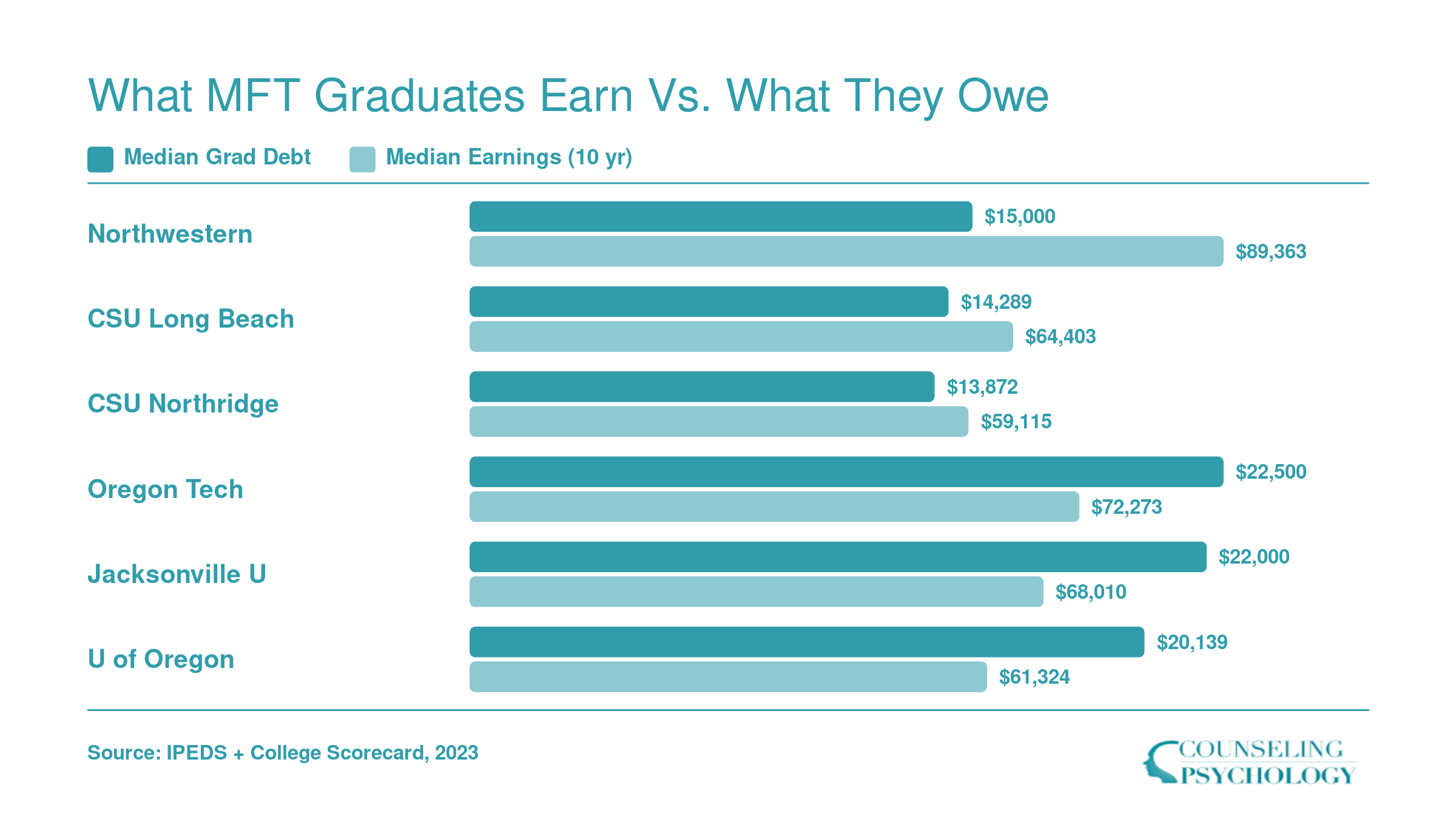
What MFT Graduates Earn Vs. What They Owe
How quickly can you expect to recoup your investment in an MFT degree? The chart below compares institution-level median graduate debt against median earnings ten years after enrollment for the six programs with the strongest return-on-investment ratios in our ranking. Note: program-level early-career earnings are not yet available for these MFT programs, so the figures shown are institution-wide College Scorecard data, not MFT-specific outcomes.
COAMFTE Accreditation and Its Impact on Your MFT License
A COAMFTE-accredited program and a regionally accredited program with equivalent coursework can both lead to licensure, but the paths differ in predictability and portability. Understanding what COAMFTE accreditation actually requires, and whether your target states value it, is essential before committing to a program.
What COAMFTE Accreditation Requires
The Commission on Accreditation for Marriage and Family Therapy Education (COAMFTE) sets rigorous standards for MFT graduate programs. Under Version 12.5 of the accreditation standards, programs must demonstrate competence across six curriculum domains: relational and systemic foundations, clinical practice, human development, multicultural competence, ethics, and research. The framework is outcomes-based, meaning programs must show that graduates actually achieve defined competencies rather than simply completing seat time.
Historically, COAMFTE has benchmarked clinical training at 500 direct client contact hours and 100 hours of supervision during the degree. Faculty must hold appropriate graduate degrees and demonstrate competence in MFT practice and education. Clinical supervisors must be licensed and have documented training in supervision methodology. These requirements create consistency: a COAMFTE graduate from any program will have met the same baseline standards.
State Licensure and COAMFTE: The Practical Reality
Here is what surprises many prospective students: no U.S. state currently requires COAMFTE accreditation explicitly for LMFT licensure. Most states accept graduates from regionally accredited programs provided the coursework and practicum hours align with state-specified requirements. California, for example, accepts programs that are regionally accredited, COAMFTE-accredited, or approved by the Bureau for Private Postsecondary Education.
The practical difference lies in how easily your credentials transfer. COAMFTE programs are designed to meet or exceed requirements across multiple states, which simplifies license endorsement if you relocate. Graduates from non-COAMFTE programs sometimes face course-by-course evaluations or supplemental requirements when applying for licensure in a new state.
The Cost-Benefit Calculation
COAMFTE-accredited programs often carry higher tuition, reflecting the resources required to maintain accreditation. Whether that premium is worth paying depends on your career trajectory. If you plan to practice in one state for your entire career and that state accepts regionally accredited programs, a well-structured non-COAMFTE program may serve you well at lower cost. If you anticipate relocating, working in telehealth across state lines, or seeking positions at agencies that prefer COAMFTE credentials, the investment in accreditation can pay dividends in smoother licensure pathways.
COAMFTE vs. CACREP: Different Paths for Different Professions
Prospective students sometimes confuse COAMFTE with CACREP, but these accreditors serve distinct professions. COAMFTE accredits programs specifically in marriage and family therapy, emphasizing relational and systems-based approaches. CACREP accredits clinical mental health counseling programs, which prepare graduates for Licensed Professional Counselor credentials. The clinical orientations, theoretical frameworks, and licensure outcomes differ meaningfully. If your goal is to become an LMFT and practice from a family systems perspective, COAMFTE-accredited programs align most directly with that career path.
Related Articles
Questions to Ask Yourself
How Online MFT Students Complete Clinical Practicum Hours
The distance that makes online MFT programs flexible can also create anxiety about how you will get enough face-to-face clinical hours to graduate and eventually qualify for licensure. State licensing boards typically require between 1,500 and 3,000 LMFT supervision hours post-degree, but the first major threshold is the 300 to 500 total practicum hours embedded in your master's program, including 225 to 300 hours of direct client contact. These hours are not just a curriculum checkbox; they are the bridge from classroom systems theory to real therapeutic work with couples and families.
Clinical Hour Requirements
Most online MFT master's programs fall within a total practicum range of 300 to 500 hours, with direct client contact comprising the bulk of that experience. For instance, Pepperdine University's online MFT program requires 700 total practicum hours, of which 225 to 240 must be direct client contact, and up to 500 hours can count toward California's pre-licensure threshold. This means you can graduate with a significant head start on your state's post-degree supervised experience requirements, provided your program is recognized by the relevant board.
How Online Programs Arrange Local Placements
The placement model varies across programs but generally falls into three categories: program-supported placement, student-initiated site approval, or a hybrid. Programs with strong field placement offices, like Pepperdine's, actively coordinate with community agencies, hospitals, and private practices to secure sites within a reasonable radius of each student's location. Others, such as Loma Linda University's online MFT track, require you to identify a potential site in your own geographic area and submit it for university approval to ensure it meets COAMFTE or state standards. Before enrolling, ask explicitly how the program will help you find a site, especially if you live outside the university's home state, because placement support can make the difference between graduating on time and delaying your clinical sequence by one or two semesters.
Supervision for Distance Learners
Supervision during the practicum is typically a weekly rhythm of individual and group sessions, both of which are now routinely conducted via secure video platforms. Individual supervision pairs you with an on-site supervisor (a licensed clinician at your placement) and a university-appointed supervisor who monitors your progress through recorded session review and discussion of cases. Group supervision cohorts meet synchronously online to present cases, review recorded sessions, and engage in conceptualization exercises that mirror an in-person consultation team. The use of telesupervision has become widely accepted, so your physical distance from campus does not weaken the quality of oversight.
The Challenge: Rural and Underserved Areas
A practical hurdle for some online MFT students is geographic scarcity. If you live in a rural area or a region with few community mental health agencies, the number of approved placement sites that can offer the required family and couple therapy caseload may be limited. While telehealth clinical hours are increasingly accepted by state boards, most master's-level practicum still requires a meaningful portion of in-person direct client work. Before you commit to a program, contact the field placement office and ask whether they have active partnerships or a history of placing students in your zip code. If the answer is vague, you may need to plan for a commute, relocate temporarily, or consider a program with a stronger network in your region.
MFT Degree Costs, Debt, and Financial Outcomes
The price tag on an MFT master's has fractured into two very different markets over the past decade: public hybrid programs running under $12,000 a year in net cost, and brand-name private programs charging two to three times that. Among the ranked programs on this list, net price (the average a student actually pays after grant aid, not the sticker price) ranges from roughly $7,000 per year at California State University-Northridge to about $29,000 per year at Northwestern University. Cal State Long Beach ($10,440), Texas Woman's University ($11,963), and Oregon Tech ($15,706) anchor the affordable middle. That spread matters: over a two-to-three-year program, the gap between the cheapest and most expensive option can exceed $50,000.
Debt and Early-Career Earnings
Graduate-level debt and program-specific earnings data for MFT cohorts is still thin in federal reporting, and most of the programs above do not yet have published program-level debt or post-graduation earnings figures specific to their MFT track. What we can see is institutional median graduate debt, which clusters between roughly $14,000 and $25,000 across the ranked schools. Northwestern reports the lowest median graduate debt on the list (around $15,000), while Regis University and City University of Seattle sit at the higher end near $25,000. Program-level earnings outcomes (one-year, two-year, and four-year post-completion medians) have not been reported for these MFT programs yet, so any ROI estimate at this stage is institutional, not program-specific.
The BLS Long-Run Picture
For a longer horizon, the Bureau of Labor Statistics is the better anchor. The national median wage for marriage and family therapists was $63,780 in 2024, with employment of about 77,800. BLS projects 13% job growth from 2024 to 2034, adding roughly 9,800 positions, well above the average for all occupations. Earnings climb meaningfully with licensure and years in practice, and therapists in private practice or specialized clinical settings typically out-earn those in community agencies. For a full walkthrough of the licensure path, career timeline, and salary trajectory, see our guide on how to become a marriage and family therapist.
Practical Ways to Cut Costs
- In-state tuition: Public programs like CSULB, CSUN, TWU, and Oregon Tech charge residents thousands less per year than non-residents. Establishing residency before enrollment, where feasible, is the single biggest lever.
- Employer tuition assistance: Hospitals, school districts, and community mental health agencies often reimburse $3,000 to $5,250 annually for relevant graduate coursework.
- FAFSA for grad students: Master's students remain eligible for federal Direct Unsubsidized Loans (up to $20,500 per year) and Grad PLUS Loans, plus institutional grants and assistantships. File the FAFSA even if you assume you will not qualify for need-based aid; many schools require it for any aid package.
State Licensure Compatibility for Online MFT Graduates
Every state sets its own rules for who can become a licensed marriage and family therapist, and those rules determine whether your online MFT degree will be accepted without complication. The good news is that most states now accept online degrees for LMFT licensure, provided the program meets educational and clinical standards. The challenge lies in navigating the specific requirements of the state where you plan to practice, particularly around COAMFTE accreditation and supervised clinical hours.
COAMFTE Accreditation: Required, Preferred, or Optional?
No state currently requires COAMFTE accreditation as an absolute prerequisite for LMFT licensure. However, many state boards strongly prefer it, and some offer faster or streamlined pathways for graduates of COAMFTE-accredited programs. In practice, this means you can pursue licensure with a non-COAMFTE degree, but you may face additional scrutiny during the application review process or need to provide supplemental documentation proving your coursework meets state standards.
California, Texas, New York, Florida, Illinois, Ohio, Pennsylvania, Georgia, North Carolina, and Virginia all accept online MFT degrees for licensure and do not mandate COAMFTE accreditation. That said, holding a COAMFTE degree often simplifies the process, particularly if you plan to relocate or pursue licensure in multiple states over the course of your career. For a broader overview of the licensure journey, see our guide on counseling licensure.
Clinical Hour Requirements by State
Supervised clinical hours vary widely. California, Texas, Illinois, Ohio, and Pennsylvania each require 3,000 post-degree supervised hours before you can sit for the licensing exam. Virginia sets the bar higher at 4,000 hours.4 Florida requires 1,500 hours, while New York mandates between 1,500 and 1,750 hours depending on the specific license track. Georgia's requirement ranges from 2,000 to 3,000 hours, and North Carolina falls between 1,500 and 2,000 hours.6
These differences matter not only for timeline but also for financial planning. States with higher hour requirements extend the period between graduation and full licensure, during which you will work under supervision at a lower wage.
Online-Specific Restrictions
Most states do not impose additional restrictions on online MFT graduates beyond what applies to campus-based students. However, you should verify that your program's clinical training model aligns with your state's supervision and practicum requirements. Some states require in-person supervision, while others allow telehealth supervision. If your program arranges practicum placements in your home state, compatibility is typically straightforward. If you are responsible for securing your own site, confirm that your state board will accept the supervision format your program offers.
Before enrolling, consult your target state's licensing board directly. State regulations change, and early confirmation protects you from costly surprises later.
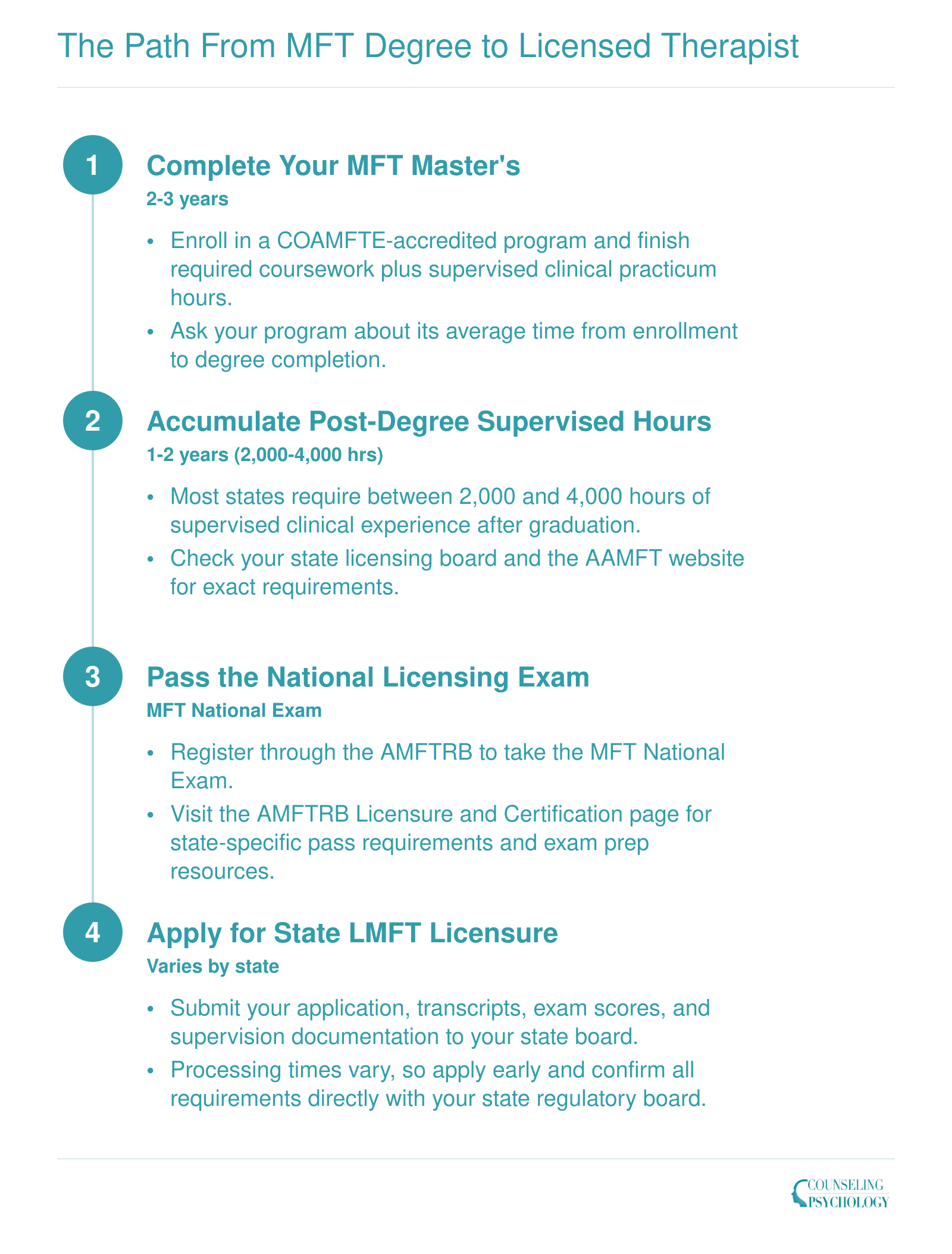
The Path From MFT Degree to Licensed Therapist
Earning your LMFT license involves a structured sequence that typically spans 3-5 years from enrollment to independent practice. Exact requirements differ by state, so verify details with your state licensing board, the AAMFT, and the Association of Marital and Family Therapy Regulatory Boards (AMFTRB). The BLS also publishes general licensure timelines and supervised-hour ranges that can help you plan.
Online Vs. On-Campus MFT Programs: Choosing the Right Format
Choosing between an online and on-campus MFT program is rarely just about convenience. Each format shapes your training experience, your finances, and even your licensure pathway in meaningful ways. Consider these trade-offs carefully before committing.
Pros
- Online programs let you enroll across state lines, giving you access to specialized concentrations or faculty expertise unavailable locally.
- Staying in your current community while studying online means you can build practicum relationships in the area where you plan to practice.
- Campus programs typically offer same-day faculty consultations, impromptu role-play practice, and observation labs that deepen clinical skills organically.
- On-campus cohorts often move through the curriculum together, creating accountability structures and professional bonds that persist well beyond graduation.
Cons
- Synchronous online sessions can be difficult to schedule when classmates and instructors span multiple time zones, limiting spontaneous discussion.
- A handful of state licensing boards apply closer review to degrees earned entirely online, so researching your target state's stance before enrolling is essential.
- Campus students are generally limited to programs within commuting or relocating distance, which may mean fewer COAMFTE-accredited options to compare.
- Leaving or reducing employment for a full-time on-campus program creates significant opportunity cost that can take years of post-licensure earnings to recover.
Admissions, Timelines, and Accelerated Options for MFT Programs
Speed and preparation exist in constant tension when planning your MFT graduate education. Accelerated programs can shave a year off your timeline, but they often demand more upfront and compress the clinical training that forms the heart of this degree. Understanding what programs expect from applicants, and what you can realistically handle, will help you choose a path that leads to licensure without burning out along the way.
What Most MFT Programs Require for Admission
The barrier to entry for MFT master's programs is lower than many prospective students assume. Most programs require:
- Bachelor's degree: Any field from a regionally accredited institution (psychology or counseling majors are not required)
- Minimum GPA: Typically 2.7 to 3.0, though competitive programs may expect higher
- Personal statement: Describing your interest in family systems work and career goals
- Letters of recommendation: Usually two or three, often from academic or professional references
- GRE: No longer required by most programs
The GRE has largely disappeared as an admissions requirement across MFT education. Programs at Northwestern, Pepperdine, Capella, and the University of La Verne all waive standardized testing, reflecting a broader shift in graduate admissions.
Applicants without a psychology background may need to complete prerequisite coursework before or during their program. Common prerequisites include Introduction to Psychology, Abnormal Psychology, and Human Development. Northwestern, for example, requires Introduction to Psychology and Human Development for non-psychology majors, while the University of La Verne expects Introduction to Psychology and Abnormal Psychology with a minimum C minus grade.3
Timeline Options: Standard, Part-Time, and Accelerated
MFT master's programs offer flexibility in pacing:
- Full-time standard track: 24 to 27 months is typical, with Pepperdine's program completing in 27 months and Northwestern's in 24 months
- Part-time track: Extends completion to 3 to 4 years, allowing students to maintain employment or family responsibilities
- Accelerated track: Compresses to 18 to 24 months through year-round enrollment and heavier course loads
Accelerated programs are not simply the same curriculum delivered faster. They often require students to begin practicum hours earlier, maintain continuous enrollment through summer terms, and carry heavier credit loads each quarter or semester. Capella's 24-month completion timeline, for instance, assumes consistent progress without breaks.
What Accelerated Timelines Actually Demand
Students drawn to 18 to 24 month completion should consider the tradeoffs carefully. Accelerated programs may require:
- Year-round enrollment with no summer break
- Completing prerequisites before admission rather than during the program
- Starting clinical practicum placements earlier, which means arranging supervision and site agreements sooner
- Higher weekly time commitments, often 25 to 30 hours per week including coursework and clinical hours
For working professionals, the math can be challenging. If your employer cannot accommodate a flexible schedule for daytime practicum hours, the accelerated timeline may not be realistic regardless of how quickly you can complete coursework. Students in that situation may find that a licensed professional counselor online degree, which sometimes offers more scheduling flexibility, is worth exploring as an alternative.
Programs That Welcome Career Changers
If you are transitioning from an unrelated field, you are not alone. Many MFT programs explicitly welcome career changers and design their curricula accordingly. Pepperdine notes that its online program is open to all educational backgrounds. Northwestern welcomes career changers who complete the required prerequisites before enrollment.
The key is completing foundational psychology coursework before or early in your program. If your undergraduate degree was in business, education, or another non-related field, expect to add one to three prerequisite courses to your timeline. Some programs allow you to complete these during your first semester, while others require them before admission.
Common Questions About MFT Master's Programs
Choosing the right graduate program involves sorting through a lot of practical details. Below are answers to the questions prospective MFT students ask most often, grounded in current accreditation standards, licensure rules, and financial aid policies.
What to Expect in an MFT Master's Program: Core Courses and Clinical Training
A master's in marriage and family therapy is a 60 to 70 credit clinical degree1 that combines classroom coursework in systems theory and psychopathology with supervised hands-on work seeing real clients. The classroom half builds your theoretical foundation. The clinical half turns that theory into a licensable skill set. Both halves are required, and both are shaped by the accreditation standards set by the Commission on Accreditation for Marriage and Family Therapy Education (COAMFTE).
Core Coursework You Will Encounter
Most accredited MFT programs online share a common academic backbone.2 Expect to take courses in:
- Family systems theory: The theoretical foundation of the field, covering structural, strategic, Bowenian, and narrative approaches.
- Couples therapy: Assessment and intervention with romantic partnerships, including evidence-based models like Emotionally Focused Therapy and the Gottman Method.
- Psychopathology and diagnosis: DSM-based diagnostic training and treatment planning.
- Human development across the lifespan: Individual and family development from childhood through later life.
- Professional ethics and law: Legal and ethical standards governing clinical practice.
- Research methods: Reading, evaluating, and applying clinical research.
Many programs also offer specialization tracks, such as child and adolescent therapy, medical family therapy, trauma, or substance use. Some students also pursue a marriage and family therapy certificate alongside or after their master's to deepen a specialty area.
Clinical Training Requirements
The clinical portion is where the degree gets serious. Programs typically require between 300 and 500 direct client contact hours completed through practicum and internship placements. For example, Mount Mercy University requires 300 clinical hours with 60 hours of supervision,3 while Mercer, Pfeiffer, and Fairfield each require 500 clinical hours (including 100 to 200 relational hours with couples or families) and 100 supervision hours.46
That supervised experience, paired with coursework in diagnosis, treatment planning, and systemic intervention, is what prepares you to sit for state licensure exams after graduation.
Best MFT Programs by State
- Alabama
- Alaska
- Arizona
- Arkansas
- California
- Colorado
- Connecticut
- Delaware
- Florida
- Georgia
- Hawaii
- Idaho
- Illinois
- Indiana
- Iowa
- Kansas
- Kentucky
- Louisiana
- Maine
- Maryland
- Massachusetts
- Michigan
- Minnesota
- Mississippi
- Missouri
- Montana
- Nebraska
- Nevada
- New Hampshire
- New Jersey
- New Mexico
- New York
- North Carolina
- North Dakota
- Ohio
- Oklahoma
- Oregon
- Pennsylvania
- Rhode Island
- South Carolina
- South Dakota
- Tennessee
- Texas
- Utah
- Vermont
- Virginia
- Washington
- Washington DC
- West Virginia
- Wisconsin
- Wyoming