What you’ll learn in this article…
- Online counseling psychology programs typically cost between $7,000 and $30,000 per year in net tuition depending on residency status.
- No U.S. state grants independent counseling licensure at the bachelor's level, so a master's degree and supervised hours are required.
- Bachelor's graduates qualify for entry-level roles such as case manager, behavioral health technician, and community outreach worker.
- Counseling psychology curricula emphasize client-facing skills like motivational interviewing, unlike general psychology's research focus.
Can you earn a bachelor's in counseling psychology fully online? Yes, regionally accredited programs use asynchronous coursework and virtual field experiences to deliver the same curriculum as on-campus versions. The degree is a pre-counseling launchpad: it qualifies you for entry-level behavioral health roles such as case manager, behavioral technician, or intake coordinator, while building the academic foundation for a master's-to-licensure track.
Nationally, median wages for these positions range from roughly $35,000 to $45,000, though figures shift by state and employer. Ranked programs, tuition comparisons, curriculum structures, and a step-by-step licensure map are detailed throughout. Students exploring related specializations, such as an online addiction counseling degree, will find that many of the same foundational courses apply. But the bachelor's alone will not lead to independent practice; every U.S. state mandates a master's degree and supervised clinical hours for counselor licensure.
Best Online Bachelor's in Counseling Psychology Programs
Earning an online bachelor's degree in counseling psychology prepares students for entry-level roles in human services, community mental health, and social work while also laying the academic foundation for graduate-level licensure programs. The schools below were selected for the strength of their online counseling-related undergraduate curricula, affordability, student support services, and career outcomes. Rankings weigh program relevance, institutional reputation, flexibility, and federal data on earnings and graduation rates.
- Independent program research
- U.S. Department of Education College Scorecard (collegescorecard.ed.gov)
- National Center for Education Statistics (NCES-IPEDS) (nces.ed.gov)
New Mexico State University
New Mexico State University offers an online Bachelor of Arts in Counseling and Community Psychology that blends core psychology theory with practical community-based intervention skills. With a net price under $9,000 per year and in-state tuition of roughly $8,183, it is one of the most affordable options nationally. NMSU's median graduate debt of $17,095 is well below the national average, making it a strong value for students seeking an accessible path into the counseling field.
- Focuses on counseling theory and community intervention
- In-state tuition around $8,183/yr; out-of-state $25,307/yr
- Median graduate debt of $17,095, well below national average
- Covers multicultural counseling and human development
- Prepares students for graduate study in counseling or social work
- Offers flexible asynchronous coursework for working adults
- Includes foundational research methods and statistics courses
BA in Counseling and Community Psychology — Online
Capella University
Capella University is widely recognized for its competency-based and self-paced online programs, including a Bachelor of Science in Psychology with a pre-counseling specialization designed to prepare students for graduate counseling programs. The curriculum aligns with foundational CACREP knowledge areas, giving graduates a head start on master's-level coursework. Capella's FlexPath learning format allows motivated students to accelerate through material they already understand.
- Pre-counseling track aligned with CACREP knowledge areas
- FlexPath option lets students set their own pace
- Covers lifespan development, abnormal psych, and ethics
- Designed as a bridge to MS in Clinical Mental Health Counseling
- Includes applied research and evidence-based practice skills
- 24/7 online library, tutoring, and academic coaching
- No set class login times, fully asynchronous coursework
BS in Psychology, Pre-Counseling Specialization — Online
Bay Path University
Bay Path University's American Women's College division offers online bachelor's programs with a strong focus on psychology and counseling foundations. The university is known for its supportive learning community and personalized advising tailored to adult and nontraditional students. Graduates report median earnings of $55,383 ten years after enrollment, reflecting solid career outcomes for a private institution.
- Offered through The American Women's College online division
- Focuses on counseling psychology foundations and human behavior
- Net price approximately $14,271/yr after financial aid
- Median graduate earnings of $55,383 at ten years post-enrollment
- Personalized academic advising for adult learners
- Accelerated course format with multiple start dates per year
- Coursework in abnormal psychology, group dynamics, and ethics
BS in Psychology, Counseling Concentration — Online
Campbellsville University
Campbellsville University provides affordable online bachelor's programs in psychology with counseling-oriented electives, grounded in a Christian liberal arts tradition. The school's online division is well established and serves a large population of adult learners across the country. Small virtual class sizes and faith-integrated coursework distinguish Campbellsville from larger online competitors.
- Affordable tuition with generous financial aid packages
- Christian liberal arts perspective integrated into curriculum
- Covers developmental psychology, counseling theory, and ethics
- Small class sizes with personalized faculty interaction
- Flexible online format designed for working professionals
- Prepares graduates for graduate study in counseling or social work
- Multiple start dates and accelerated course options available
BS in Psychology (Online) — Online
Eastern University
Eastern University blends rigorous academic preparation in psychology with a commitment to social justice and faith-based service, making it an excellent fit for students drawn to counseling as a vocation. The university offers online undergraduate psychology coursework that builds a strong foundation for its well-regarded graduate counseling psychology program. Eastern's emphasis on community engagement provides practical exposure alongside classroom learning.
- Faith-integrated curriculum with a social justice emphasis
- Strong pipeline to Eastern's MA in Counseling Psychology
- Coursework in abnormal psych, human development, and research
- Flexible scheduling designed for adult and transfer students
- Fieldwork and service-learning components available
- Accredited by Middle States Commission on Higher Education
BS in Psychology (Online) — Online
Felician University
Felician University offers online psychology programs with a counseling focus rooted in the Franciscan tradition of compassionate service. With a net price near $15,400 and a 91% acceptance rate, Felician provides accessible entry for students beginning their counseling education journey. The school's location in the New York metropolitan area also connects students to a broad network of clinical and community mental health resources.
- Franciscan values of compassion integrated into coursework
- Net price approximately $15,404/yr after financial aid
- Covers counseling theories, psychopathology, and ethics
- 91% acceptance rate supports broad student access
- Prepares students for Felician's online MA in Counseling Psych
- Located near NYC metro clinical placement opportunities
- Median earnings of $57,273 ten years post-enrollment
BS in Psychology, Counseling Track (Online) — Online
National University
National University is a nonprofit institution with deep experience serving military-affiliated and working-adult students through flexible online degree programs. Its psychology offerings include coursework in counseling fundamentals, behavioral science, and applied research, and the university's four-week course format allows students to focus on one subject at a time. National University is regionally accredited by the WASC Senior College and University Commission.
- Unique four-week course format, one class at a time
- Military-friendly with Yellow Ribbon and VA benefit support
- Covers counseling foundations, research methods, and ethics
- WASC-accredited with monthly enrollment start dates
- Pathway to National University's MA in Counseling Psychology
- Designed for working adults and career changers
- Supportive advising and career services for online students
BA in Psychology (Online) — Online
Regis College
Regis College provides online psychology programs within a Catholic liberal arts framework, emphasizing ethics, service, and the development of culturally competent helping professionals. The school reports a 72% graduation rate and median earnings of $52,873 ten years after enrollment. Regis's smaller enrollment fosters close faculty-student relationships that benefit students pursuing the relational skills central to counseling.
- Catholic liberal arts tradition with emphasis on ethics
- 72% graduation rate reflects strong student support
- Net price approximately $27,477/yr after financial aid
- Median graduate earnings of $52,873 at ten years
- Small cohort sizes promote mentorship and engagement
- Coursework in developmental, abnormal, and social psychology
- Prepares students for graduate counseling or social work programs
BS in Psychology (Online) — Online
Counseling Psychology Vs. General Psychology Bachelor's: Key Differences
Both degrees carry the word "psychology," but the curricula diverge sharply from the first semester. A counseling psychology bachelor's treats the undergraduate years as preparation for client-facing work, while a general psychology degree keeps its options open, weighting research methods and cognitive science over applied skills.
Curriculum Focus
Counseling psychology programs build their core requirements around courses that directly support therapeutic practice: counseling theories, helping skills, multicultural counseling, group dynamics, addictions, and ethics in counseling.1 Practicum placements, which pair students with supervised real-world experience, are a graduation requirement.2 None of those courses are standard requirements in a general psychology program, and a practicum is typically optional or absent entirely.
General psychology programs take a broader approach. Students cover developmental, cognitive, biological, and social psychology alongside a heavier emphasis on research methods and statistics.3 That breadth is intentional. It keeps the door open for paths that include experimental research, neuroscience graduate programs, or PhD-level study.
Graduate School Alignment
The downstream difference matters most when you look at graduate admissions. Counseling psychology bachelor's programs are structured to align with what CACREP-accredited master's programs expect: familiarity with counseling theory, multicultural frameworks, and professional ethics before the first graduate seminar.4 Arriving with those courses already completed can ease the transition and reduce the number of remedial prerequisites some programs informally require.
A general psychology degree prepares students for a wider range of graduate programs, including clinical PhD programs, research-focused master's degrees, and even programs outside psychology altogether. That flexibility is a genuine strength, but it comes with less direct preparation for licensure-track counseling careers.
Choosing Based on Your Career Direction
The practical question is how certain you are about your path. If becoming a licensed counselor, marriage and family therapist, or school counselor is your goal, an online bachelor's degree in counseling gives you a concrete head start. The applied coursework and practicum hours build professional vocabulary and supervised experience that pay dividends in graduate interviews and early fieldwork.
If you are still exploring, or if research or psychology-adjacent fields like behavioral economics or public health interest you, a general psychology degree offers more room to pivot without penalty. Exploring careers in psychology early can help you gauge which track fits best. The two paths are not equally interchangeable, and choosing with your graduate and career goals in mind is the more efficient route.
What You'll Learn in a Counseling Psychology Bachelor's Program
A counseling psychology bachelor's curriculum is more deliberately sequenced than a general psychology degree. Rather than a loose collection of electives, you move through three recognizable phases: foundational knowledge, counseling-specific theory and skills, and applied practice.
The Foundational Layer
The first year or two covers the psychology core that any undergraduate would recognize: introduction to psychology, developmental psychology across the lifespan, abnormal psychology, research methods, and statistics. These courses build the vocabulary and conceptual framework you need before anything counseling-specific makes sense. They are not filler; understanding abnormal psychology, for instance, directly shapes how you interpret client distress later in the program.
Where Counseling Psychology Diverges
This is where the curriculum separates itself from a generic psych degree. Courses shift toward applied, relational, and clinical content:
- Helping skills and techniques: Active listening, reflective responding, and basic interview structure, practiced through role-play and recorded sessions.
- Theories of counseling: Cognitive-behavioral, person-centered, Adlerian, solution-focused, and others, examined both conceptually and as practical tools.
- Multicultural counseling: How culture, identity, and systemic factors shape the counseling relationship and client experience.
- Group dynamics and facilitation: Running groups is a distinct skill set, and undergraduate exposure to group theory is a genuine differentiator.
- Addictions counseling: Substance use disorders are among the most common presenting concerns across every practice setting. A dedicated course here is something a general psych degree rarely includes.
- Crisis intervention: Recognizing and responding to acute risk, including suicide assessment frameworks and de-escalation approaches.
- Ethics in counseling: Professional codes, confidentiality, dual relationships, and the legal landscape, topics that go well beyond a general research-ethics module.
The Applied Capstone or Practicum
Most programs close with a capstone experience, either a supervised practicum placement at a community agency or a rigorous integrative project that synthesizes earlier coursework. This is where classroom learning meets real-world expectations, and it can also clarify whether you want to become a counselor or pursue a related path in the broader mental health field.
Curriculum Standards and Graduate School Readiness
Many programs, even those without formal CACREP accreditation, build their learning outcomes to align with CACREP and APA standards at the undergraduate level. That alignment is practical: graduate admissions committees recognize the terminology, the skill domains, and the clinical vocabulary when they review your application. Students who plan to continue their education often transition into online master's in psychology programs that build directly on this undergraduate foundation. Online sections of these programs carry the same curriculum requirements as their on-campus counterparts within regionally accredited institutions, so the degree you earn reflects the same academic standards regardless of delivery format.
Related Articles
Questions to Ask Yourself
Do I want to work directly with clients, or am I more drawn to research and data?
Which master's program am I planning to pursue after graduation?
Can I attend live online sessions at scheduled times, or do I need a fully flexible, asynchronous schedule?
Am I comfortable with the fact that a bachelor's degree alone does not qualify me for independent licensure as a counselor?
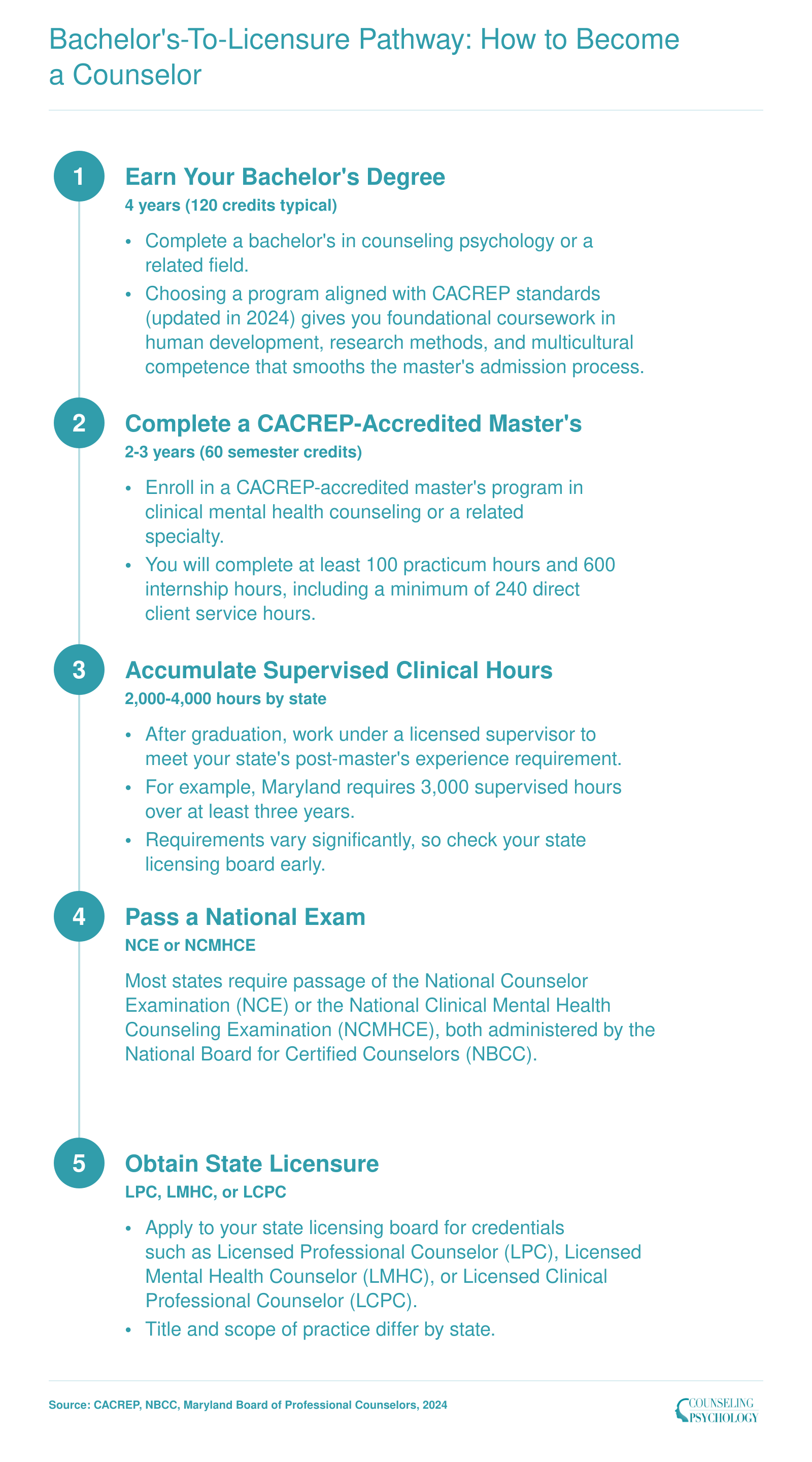
Bachelor's-To-Licensure Pathway: How to Become a Counselor
A bachelor's in counseling psychology is a critical first step, but it does not qualify you for independent counseling licensure in any U.S. state. Every state requires at least a master's degree plus supervised experience. Here is the credentialing ladder from undergraduate enrollment to licensed professional counselor.
How Much Does an Online Counseling Psychology Bachelor's Cost?
The cost of an online counseling psychology bachelor's degree varies widely depending on the institution, residency status, and whether the school offers a flat per-credit rate for all online learners. Among the programs highlighted in this article, estimated annual net prices (after typical grant and scholarship aid) range from roughly $7,000 to over $20,000. Programs at public universities tend to fall in the lower to mid range, especially for in-state students, while private institutions often sit at the higher end but may offset sticker price with generous institutional aid. Many online programs now charge a single per-credit rate regardless of where you live, effectively eliminating the in-state vs. out-of-state distinction. Active-duty military students and veterans frequently benefit from tuition caps tied to Department of Defense agreements or Yellow Ribbon participation, which can reduce out-of-pocket costs substantially. Before comparing sticker prices alone, request each school's net price calculator result and confirm whether federal financial aid, employer tuition assistance, or military education benefits apply.
| School | Estimated Annual Net Price | Flat Rate for All Online Students | Notes on Residency or Discounts |
|---|---|---|---|
| Arizona State University (ASU Online) | Approx. $14,000 to $16,000 | Yes, flat per-credit rate | Same tuition for in-state and out-of-state online learners |
| Liberty University | Approx. $14,000 to $17,000 | Yes, flat per-credit rate | Military tuition discount available; institutional aid can lower net cost |
| Grand Canyon University | Approx. $13,000 to $16,000 | Yes, flat per-credit rate | Competency-based options and employer partnerships may reduce costs |
| University of the Cumberlands | Approx. $7,000 to $10,000 | Yes, flat per-credit rate | Among the most affordable options; generous institutional scholarships reported |
| Southern New Hampshire University | Approx. $10,000 to $13,000 | Yes, flat per-credit rate | Military and transfer-credit discounts commonly applied |
| Regent University | Approx. $15,000 to $18,000 | Yes, flat per-credit rate | Merit scholarships and ministry discounts available |
| Touro University Worldwide | Approx. $12,000 to $15,000 | Yes, flat per-credit rate | Rolling admissions; financial aid packages vary |
| Purdue University Global | Approx. $11,000 to $14,000 | Yes, flat per-credit rate | ExcelTrack competency-based pricing may lower total cost for experienced students |
Careers With a Bachelor's in Counseling Psychology
A bachelor's in counseling psychology opens the door to direct-service roles in mental health, social services, and community care. These are not corner-office positions with high salaries on day one. They are hands-on, people-facing jobs where you will work alongside licensed professionals, build clinical intuition, and gain the supervised experience that graduate programs value.
Entry-Level Roles Worth Knowing
The career landscape at the bachelor's level is broader than most students expect, and more specific than the generic "human resources" track that often gets mentioned elsewhere.
- Case Manager: Coordinates care plans for clients navigating mental health, housing, or substance use services. Day-to-day work involves intake assessments, referrals, and follow-up calls. The broader community health and social services worker category (which includes case management roles) had a national median annual wage around $48,000 to $56,000 in recent BLS data, though figures vary by employer type and setting.
- Behavioral Health Technician: Provides direct support to clients in residential or outpatient settings under clinical supervision. National salary data for behavioral health specialists shows a range of roughly $44,808 to $67,778 depending on organization and region.4
- Psychiatric Aide: Assists patients in inpatient psychiatric facilities with daily routines and therapeutic activities. The national median annual wage for psychiatric aides was $41,590 in 2024, with growth projections at 16 percent through 2034.1
- Residential Counselor: Supports individuals in group homes or transitional living programs, often helping clients with mental illness or developmental disabilities practice independent living skills.
- Community Health Worker: Connects underserved populations to health and social services, often working in clinics, nonprofits, or public health agencies. The national median wage for behavioral health workers broadly was $55,952 in 2023.3
- Crisis Line Specialist: Responds to calls from people in emotional distress, applying de-escalation techniques and connecting callers to appropriate resources.
The Counselor vs. Therapist Pay Question
Many students wonder who earns more: a counselor or a therapist. The honest answer is that the title itself is not the determining factor. Both "counselor" and "therapist" at a clinical level require a master's degree and state licensure. Salary differences come down to practice setting (private practice vs. community mental health vs. hospital), specialization (substance use, trauma, marriage and family), and geography. A licensed therapist working in a hospital system may earn more than a private-practice counselor in a rural area, and vice versa. For a deeper breakdown by degree level and specialty, see our counselor salary guide.
For context, the national median annual wage for psychologists was $94,310 in 2024.2 That figure reflects doctoral-level practitioners, not bachelor's-level roles.
Honest Framing: These Are Stepping Stones
For most graduates, the bachelor's in counseling psychology is not a terminal degree. The roles above are meaningful and necessary, but they come with limited autonomy and an earnings ceiling. The degree's strongest return comes from the graduate school launchpad it provides: the direct-service experience, the faculty relationships, and the foundational theory that makes master's applications more competitive. Students interested in clinical work as a crisis intervention specialist or substance abuse counselor will almost always need additional credentials, but the bachelor's degree builds the foundation those programs demand. Students who treat the bachelor's as phase one of a longer plan consistently report better outcomes than those who view it as a destination.
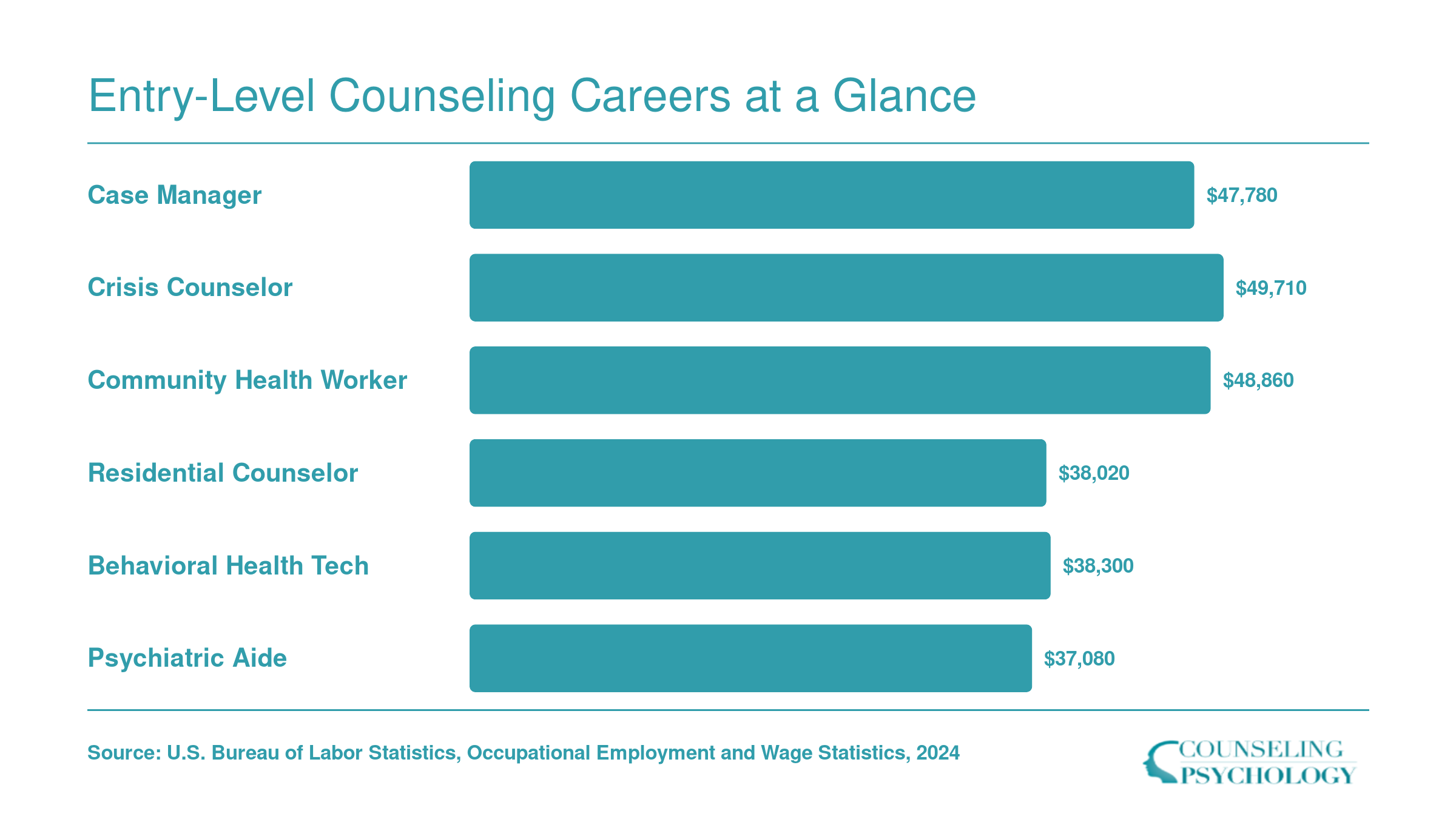
Entry-Level Counseling Careers at a Glance
Bachelor's-level roles in counseling and behavioral health span a wide salary range depending on the position and setting. The figures below reflect national median annual wages; actual pay varies significantly by state, employer type, and years of experience.
How Counseling Skills Are Taught Online
How do online programs actually teach the hands-on counseling skills, like reflective listening, building rapport, and guiding a client through a crisis, when students aren't in a physical classroom? It's a fair question, and one that quality programs answer with a blend of synchronous practice, simulation technology, and structured feedback.
Technology That Brings Counseling Practice Online
The core of online skill-building often happens through platforms designed specifically for counselor education. GoReact lets students upload videos of mock sessions; instructors and peers can then give time-stamped feedback directly on moments of strong empathy or missed nonverbal cues. Theravue, used in some undergraduate and graduate programs, offers standardized client simulations where learners respond to pre-recorded or AI-driven client statements and receive immediate coaching on their active listening, open-ended questioning, and verbal affirmations. For example, the University of Bridgeport integrates simulations and role-playing scenarios that target empathetic communication, teaching students to recognize and practice micro-skills like verbal encouragers and paraphrasing that build therapeutic alliance.1
Synchronous Labs and Role-Play Formats
Live practice is kept central through synchronous group labs. NYU's online counseling programs, for instance, run virtual counseling labs where students meet via video conference to engage in real-time role-play with classmates, observed by faculty who debrief afterward.2 Lehigh University's mental health counseling master's program uses structured synchronous role-play sessions to let students rehearse intake interviews and basic intervention techniques.3 Many undergraduate programs adopt similar formats with Zoom breakout rooms, assigning triads (counselor, client, observer) for rotating practice, often recorded for later self-review and instructor critique.
On-Campus or Local Requirements to Watch For
Even within a fully online bachelor's degree, some schools require a short on-campus intensive, typically a weekend or week-long residency, to practice advanced skills face-to-face under supervision. Others arrange a local practicum placement at a community agency near the student's home, bridging online coursework with real-world application. These components aren't universal, so checking a program's field experience details before enrolling is essential. When present, they provide the in-person nuance that video calls can't fully replicate.
Accreditation Ensures Equal Standards
Regional accreditation and program-specific endorsements mean online graduates meet the same counseling skill benchmarks as on-campus peers. Schools map every simulation, lab, and assessment to the learning outcomes set by the counseling psychology curriculum: whether delivered in a classroom or through a webcam, the competency standards don't change. That's why accredited online programs consistently produce graduates who are prepared to step into entry-level helping roles or competitive counseling master's programs online.
Admissions Requirements and How to Apply
For most applicants, the real tradeoff at this stage is speed versus selectivity: online bachelor's programs in counseling psychology are built for accessibility, but that does not mean every program is the right fit. Knowing what schools actually require, and what they don't, helps you target programs efficiently rather than over-preparing for a process that is far lighter than graduate admissions.
Typical Admissions Criteria
Most online bachelor's programs in counseling psychology or general psychology share a common baseline:
- GPA: A minimum cumulative GPA of 2.0 is common, with some programs requiring 2.5 or higher for transfer applicants.
- Prior education: A high school diploma or GED for first-year applicants; an associate degree or college coursework for transfers.
- Transcripts: Official high school and any college transcripts sent directly from the issuing institution.
- Application materials: An online application, application fee, and sometimes a short personal statement or goals essay.
- Prerequisites: Introduction to Psychology is occasionally expected before declaring the major, but many programs let you take it as part of the curriculum.2
What you usually will not need at the bachelor's level: GRE or other standardized test scores, letters of recommendation, or a research writing sample. Those belong to master's and counseling doctoral programs.
Transfer Credit Policies
If you have completed community college coursework, online bachelor's programs are often a strong landing spot. Many accept up to 60 semester credits of transferable work, and some systems go higher: California State University campuses, for example, accept up to 70 semester units of lower-division transfer credit.4 That can cut your time to degree roughly in half.
Application Timeline
Most online programs use rolling admissions with multiple start dates per year, often six or eight 8-week terms.3 Aim to submit your application and transcripts four to six weeks before your intended start date to allow time for transfer credit evaluation, financial aid processing, and course registration.
Frequently Asked Questions About Online Counseling Psychology Degrees
Prospective students tend to ask many of the same questions before committing to an online counseling psychology program. The answers below address the most common concerns about format, legitimacy, career options, and the path from a bachelor's degree to professional licensure.
- Can you get a bachelor's in counseling psychology completely online?
- Yes. Several regionally accredited universities offer fully online bachelor's programs in counseling psychology. Some require a brief practicum, field experience, or capstone that may involve in-person hours at a local site, so review each program's requirements carefully before enrolling.
- Is an online counseling psychology degree legitimate?
- Absolutely, provided the institution holds regional accreditation (or its updated equivalent through an agency recognized by the U.S. Department of Education). Employers and graduate admissions committees evaluate the accreditation status of the school, not the delivery format. Online graduates earn the same credential as their on-campus peers.
- What can you do with a bachelor's in counseling psychology?
- Graduates typically qualify for entry-level roles such as case manager, behavioral health technician, residential counselor, community outreach coordinator, or human services assistant. Many also move into crisis intervention or youth mentoring positions. Independent clinical practice requires graduate education and licensure.
- How does a counseling psychology bachelor's prepare you for a master's in counseling?
- The undergraduate curriculum introduces foundational theories, research methods, multicultural counseling concepts, and basic helping skills. This preparation gives you a head start on graduate coursework and often satisfies prerequisite requirements for master's programs in clinical mental health counseling, marriage and family therapy, or school counseling.
- Who gets paid more, a counselor or a therapist?
- Compensation depends more on licensure level, specialization, and setting than on job title. According to the Bureau of Labor Statistics, national median pay for substance abuse, behavioral disorder, and mental health counselors differs from that of marriage and family therapists, though both occupations fall within a broadly similar range. Therapists in private practice may earn more, while agency counselors often receive stronger benefits packages.
- Does a bachelor's in counseling psychology qualify you for licensure as a professional counselor?
- No. Every U.S. state requires at least a master's degree, supervised clinical hours, and a passing score on a licensing exam (typically the NCE or NCMHCE) before granting a professional counselor license. A bachelor's degree is the starting point, not the finish line, for anyone pursuing independent clinical work.
- How long does it take to finish an online counseling psychology bachelor's degree?
- Most programs are designed for completion in four years of full-time study (roughly 120 credits). Transfer students or those in accelerated formats often finish in two to three years. Part-time enrollment extends the timeline but offers more flexibility for working adults.
- Does CACREP accreditation matter at the bachelor's level?
- CACREP accredits master's and doctoral counseling programs, not bachelor's degrees. At the undergraduate level, focus on regional accreditation of the institution itself. That said, choosing a school whose graduate programs hold CACREP accreditation can signal strong counseling faculty and a well-developed curriculum, which benefits you if you continue at the same university.