

What you’ll learn in this article…
- Online engineering psychology master's programs typically cost well below the national average of roughly $62,820 for a graduate degree.
- Board certification through BCPE or HFES strengthens career prospects after graduation, though a master's alone qualifies you for most roles.
- BLS data shows top-paying states and metros for related occupations can push median salaries significantly above national figures.
- The full path from undergraduate study through optional doctoral work spans roughly 8 to 14 years for most professionals.
Engineering psychology sits at the intersection of cognitive neuroscience and system design, applying research on perception, attention, and decision-making to make complex systems safer and more effective. Demand for these specialists is growing steadily in defense contracting, medical device development, and consumer technology, where even minor interface errors can have serious consequences.
Searching for programs can be confusing: universities list nearly identical curricula under human factors, applied experimental psychology, or engineering psychology. Accreditation and curriculum matter far more than the label on the diploma, but knowing the terminology helps you find programs that might otherwise slip past your radar.
A master's degree, not a doctorate, is the standard entry credential for most industry roles in this field.
What Is Engineering Psychology and How Does It Differ From Human Factors?
The Human Factors and Ergonomics Society (HFES) counts approximately 4,000 professionals in North America who specialize in the psychological aspects of system design, a domain known as engineering psychology. This field applies principles of cognitive science, perception, and experimental psychology to the design of tools, interfaces, and systems that align with human capabilities and limitations. Despite its name, engineering psychology is a subfield of applied and experimental psychology, not a branch of engineering itself. Practitioners typically hold psychology degrees and draw on research methods from cognitive and perceptual psychology to inform the design of everything from cockpit displays to surgical equipment.
Engineering Psychology Within the Human Factors Ecosystem
The relationship between engineering psychology and human factors engineering can be understood as nested disciplines. Human factors engineering serves as the umbrella term, encompassing all efforts to optimize the interaction between people and systems, whether those efforts draw on psychology, physiology, biomechanics, or industrial design. Engineering psychology is the psychological science core within that umbrella, focusing specifically on cognition, attention, memory, decision-making, and perception. Professionals in this space share methodological roots with the broader cognitive psychologist career path, though they apply those methods to system design rather than clinical or academic research. User experience (UX) and human-computer interaction (HCI) represent the industry-facing application layer, translating research findings into practical design guidelines for software, websites, and consumer products. While engineering psychology provides the theoretical foundation and empirical methods, UX/HCI teams implement those insights in commercial and organizational contexts.
Why Program Names Vary Across Universities
Graduate programs that train students for careers in engineering psychology appear under several labels. You will see master's degrees titled Engineering Psychology, Human Factors Psychology, Applied Experimental Psychology, or Human Factors and Ergonomics. These naming variations reflect departmental traditions and accreditation histories rather than meaningful differences in curriculum or career outcomes. All of these programs emphasize experimental design, usability testing, psychometrics, and human performance measurement, and all feed graduates into the same professional pipeline. Employers hiring for human factors specialists, usability researchers, or applied cognitive scientists draw from all four program types interchangeably.
Combining Engineering and Psychology in One Career
A common question from undergraduates is whether a career exists that genuinely combines engineering and psychology. The answer is yes, and a bachelor's degree in psychology is one of the most common feeder majors. While some students enter graduate programs with undergraduate engineering backgrounds, most engineering psychologists begin with psychology coursework that includes statistics, research methods, and experimental design. The engineering side of the discipline is learned at the master's level through coursework in system design, task analysis, and applied research methods. Students ready to explore broader options can also review online master's in psychology programs to compare curriculum structures. This career path allows psychology majors to apply their training to tangible design problems in aviation, healthcare, defense, consumer products, and software, bridging the gap between human behavior research and engineering practice.
Online Engineering Psychology Master's Programs to Consider
Finding the right online engineering psychology master's degree often comes down to balancing program specificity against delivery flexibility. Some universities offer degrees titled explicitly as "engineering psychology," while others house nearly identical curricula under labels like "human factors," "applied experimental psychology," or "human systems engineering." Knowing where to look, and how to verify what you find, matters more than most applicants realize.
Where to Start Your Program Search
The most reliable first step is checking official university websites directly. Engineering psychology programs may sit in a psychology department, an engineering college, or an interdisciplinary unit, so searching only one department can cause you to miss relevant options. Look carefully at degree titles, delivery modes (fully online, hybrid, or on-campus with remote options), and credit-hour requirements, since these details vary substantially even among peer institutions.
Professional associations are another critical resource. The Human Factors and Ergonomics Society (HFES) maintains a directory of graduate programs in human factors and ergonomics that includes engineering psychology tracks. This directory often lists program concentrations, faculty research areas, and whether a program aligns with HFES professional standards. It is one of the few centralized tools that filters specifically for this niche field.
Programs Worth Investigating
As of 2025-2026, a handful of universities offer online or hybrid master's programs in this space. Exact degree titles, credit requirements, and delivery formats should always be confirmed with the institution before applying, but the following schools have been associated with relevant graduate offerings:
- Wright State University: Has offered a master's in human factors and industrial/organizational psychology, historically with some hybrid or flexible components.
- Embry-Riddle Aeronautical University: Known for a master's in human factors that has been available in online formats, focusing on aviation and aerospace applications.
- Wichita State University: Offers graduate work in human factors psychology, with the program housed in the psychology department.
- George Mason University: Has a well-regarded human factors and applied cognition program at the graduate level.
- San Jose State University: Offers a master's in human factors and ergonomics, which shares significant overlap with engineering psychology curricula.
Other schools to explore include the University of Central Florida, Clemson University, and Old Dominion University, each of which has graduate programs touching engineering psychology topics under varying degree titles. Delivery formats at these institutions range from fully on-campus to hybrid models that incorporate online coursework with periodic in-person lab sessions.
Because program structures change frequently, especially regarding online availability, do not rely solely on third-party listings or older catalog information.
Verify Before You Commit
Two verification steps are non-negotiable before you invest time in an application:
First, contact admissions offices directly. Even when a university website lists a program as "online," there may be on-campus intensives, proctored exams, or required lab residencies that are not prominently disclosed. A quick email or phone call can save you months of misaligned expectations.
Second, confirm regional accreditation through the U.S. Department of Education's database. Regional accreditation (from bodies like the Higher Learning Commission, SACSCOC, or WASC) is the baseline standard that employers and doctoral programs recognize. A degree from a non-accredited or nationally accredited (as opposed to regionally accredited) institution may not transfer, may not satisfy licensure prerequisites in certain states, and may carry less weight on a resume. The Department of Education's online search tool lets you verify an institution's accreditation status in minutes.
Engineering psychology is a small enough field that program availability shifts from year to year. Bookmark the HFES directory, revisit university program pages seasonally, and treat admissions staff as your most current source of information. The extra diligence upfront prevents costly surprises after you have already enrolled.
Tuition, Costs, and Financial Aid for Online Programs
How much does an online master's in engineering psychology or human factors actually cost, and how do programs compare on price?
The short answer: significantly less than the national average for a master's degree, which EducationData.org pegs at roughly $62,820 for 2026 (or about $48,870 at public institutions).1 Most of the online and hybrid programs in this field fall well below those benchmarks, though the range is wide enough that careful comparison shopping pays off.
Per-Credit Rates and Total Program Costs
Based on 2025, 2026 published tuition, here is what you can expect across several well-known programs:
- Wichita State University (M.S. in Human Factors Psychology): Approximately $450 to $500 per credit, with a total estimated cost of $16,000 to $18,000.
- San José State University (M.S. in Human Factors/Ergonomics): Roughly $500 to $570 per credit, totaling around $18,000 to $20,500.
- George Mason University (M.A. in Human Factors and Applied Cognition): About $650 to $700 per credit, with a total near $19,500 to $21,000.
- Wright State University (M.S. in Human Factors and Industrial/Organizational Psychology): Around $600 to $650 per credit, totaling approximately $25,000 to $27,000.
- Embry-Riddle Aeronautical University (M.S. in Human Factors): The priciest option at $1,100 to $1,200 per credit, bringing the total to roughly $39,000 to $43,000.
Some programs, particularly those at state universities with strong online infrastructure, charge a flat per-credit rate regardless of residency. Others still distinguish between in-state and out-of-state tuition. Wichita State and Wright State, for instance, often extend in-state or reduced rates to online students; George Mason's online pricing can vary depending on your home state and whether Virginia reciprocity agreements apply. Always confirm directly with each admissions office, because published rates sometimes lag behind actual billing.
Additional Costs to Budget For
Tuition is not the whole picture. Plan for several recurring expenses:
- Technology and course fees: Many programs charge $50 to $150 per course for online platform access or lab software licenses.
- Proctoring fees: Remote exam proctoring services typically run $25 to $50 per exam, and some courses require multiple proctored assessments.
- Textbooks and materials: Budget $500 to $1,200 for the full program, though open-access resources are becoming more common in human factors coursework.
- Hybrid residency travel: Programs with on-campus intensives or lab components (Embry-Riddle's Daytona Beach sessions, for example) mean airfare, lodging, and meals for one to three visits. These costs add up quickly if you live far from campus.
Financial Aid and Funding Strategies
Federal student loans remain the most accessible option. Filing the FAFSA opens the door to Direct Unsubsidized Loans, which currently cover up to $20,500 per academic year for graduate students.
Graduate assistantships are harder to secure in fully online programs, though hybrid or on-campus versions of the same degree may offer them. If you can attend even part-time on campus, it is worth asking.
Employer tuition reimbursement is particularly common for students already working in defense, aerospace, automotive, and tech sectors. Companies like Lockheed Martin, Raytheon, and Boeing routinely reimburse $5,250 or more per year for graduate coursework aligned with job duties, and engineering psychology fits squarely within many of their approved fields.
Finally, the Human Factors and Ergonomics Society (HFES) offers scholarships and fellowships specifically for graduate students in human factors and related disciplines. Awards vary year to year, but they provide both funding and a valuable professional credential on your CV. Check the HFES website early in the fall for upcoming application cycles.
Questions to Ask Yourself
Can I commit to occasional on-campus lab intensives, or do I need a program that is fully asynchronous?
Is my employer willing to help cover tuition, and does the program schedule fit around a full-time job?
Am I more drawn to defense and aerospace human factors work than to commercial UX design?
Do I have enough quantitative background to meet typical admissions prerequisites?
What You'll Learn: Curriculum and Coursework Overview
An online master's in engineering psychology blends advanced study of human cognition, perception, and behavior with the practical design of safer, more efficient systems. The curriculum is structured to give you both a theoretical foundation and hands-on skills in usability, research, and design. Most programs require 40 to 60 credits and take two to three years of part-time or full-time study to complete.
Core Curriculum: Building a Foundation in Human-Centered Design
The core courses are remarkably consistent across programs, covering the essential areas of engineering psychology and human factors.2 You will study research methods and applied statistics, learning to design experiments and analyze data using tools like R, Python, and SPSS.2 Courses in cognitive engineering and human-computer interaction teach you to model how people think and interact with technology. You also dive into perception and sensation, exploring how visual, auditory, and tactile information is processed. Practical classes in usability testing, display design, and control design give you the skills to evaluate and improve everything from cockpit interfaces to mobile apps. Ergonomics and biomechanics often round out the core, with a focus on physical workspace design.
Hands-On Learning in an Online Environment
Online programs have developed creative ways to deliver the hands-on lab components that are central to this field. Remote usability testing is a cornerstone: you will use screen-sharing platforms and specialized tools like Qualtrics and Gorilla to design studies, recruit participants, and collect data from anywhere.2 Virtual simulation software replicates real-world environments, letting you practice tasks like air traffic control layout evaluation or medical device testing without a physical lab. Some programs require a short on-campus intensive, typically one to two weeks, for activities that demand specialized equipment such as eye-tracking studies, motion capture, or physical ergonomics assessments. Many also encourage or require a local internship, where you apply psychology skills at an employer near you, turning your workplace into an applied learning site.
Capstone, Thesis, or Applied Project
Most online programs culminate in either a capstone project or a thesis. The applied capstone is the more common option: you tackle a real design problem, often for an industry partner, producing a portfolio-ready solution and a detailed report. Thesis tracks are available at some institutions, but they tend to require closer collaboration with a faculty advisor, which may involve periodic video meetings or even occasional campus visits. The choice depends on your career goals. A thesis is valuable if you are considering a PhD or a research-intensive role, while a capstone better serves those heading directly into industry.
Elective Tracks and Specializations
Elective offerings are where programs differentiate themselves. You can tailor your degree with a concentration in UX research and design, aviation and aerospace human factors, medical device and healthcare systems design, or autonomous and automated systems. These tracks allow you to dive deeper into the domain that matches your career ambitions, selecting courses that build expertise in areas like flight deck interface evaluation, surgical ergonomics, or human-automation interaction.
Online Vs. Hybrid Vs. On-Campus: Choosing the Right Format
Does the format of your master's degree actually matter to employers in human factors and engineering psychology?
The short answer: what matters most is regional accreditation and the skills you bring to the job, not whether you logged into a virtual classroom or sat in a lecture hall. Many defense contractors and tech firms already employ remote human factors engineers, so an online credential from an accredited institution carries real weight. That said, each delivery format comes with trade-offs worth weighing carefully.
Flexibility and Schedule Fit
Fully online programs are the strongest option for working professionals, especially those already embedded in defense or tech roles where project timelines are unpredictable. Asynchronous coursework lets you complete assignments around shift schedules or travel. Hybrid programs typically require periodic on-campus intensives (often one weekend per month or a week-long residency each semester), which demands more calendar coordination. Traditional on-campus programs follow fixed class schedules and generally assume full-time enrollment.
Lab Access and Hands-On Learning
If you want direct experience with ergonomics equipment, eye-tracking hardware, or usability testing labs, hybrid programs tend to offer the best balance. They pair online theory courses with scheduled lab sessions where you work with physical instruments and real participants. Fully online programs compensate with remote simulation tools and virtual prototyping software, but some students find that less satisfying than hands-on bench work. On-campus programs, naturally, provide the most consistent lab access.
Networking and Cohort Experience
On-campus cohorts build relationships through daily proximity, which can be valuable for collaborative research. Hybrid models often create tight-knit groups during intensive weekends. Online programs increasingly use structured group projects and virtual meetups, though building organic professional connections requires more intentional effort from you.
Time to Completion and Cost
Most formats target completion in about two years for full-time students, though online programs frequently allow part-time pacing that stretches to three years. Cost differences are real: online students often avoid campus fees, housing, and commuting expenses. According to the National Center for Education Statistics, roughly 28 percent of graduate students enrolled exclusively online as of Fall 2021, with hybrid enrollment at 33 percent and fully on-campus at 39 percent.1 More recent data from 2022 show some rebalancing, with fully online enrollment at 26 percent, hybrid at 28 percent, and on-campus at 46 percent. These shifts reflect evolving employer and student acceptance of remote learning.
Quick Comparison
- Flexibility: Fully online is highest; on-campus is lowest.
- Lab access: Hybrid offers the best middle ground; online relies on virtual tools.
- Networking: On-campus is strongest organically; online requires deliberate effort.
- Typical completion: Two years full-time across all formats; online allows part-time pacing.
- Cost: Online generally lowest total cost after factoring in living and commuting savings.
When evaluating any program, confirm it holds regional accreditation. That single credential signals quality to licensing boards, doctoral programs, and hiring managers alike, regardless of how the courses were delivered.
Admissions Requirements and Prerequisites
The gap between what you already have on your transcript and what a program actually requires is smaller than most applicants expect, but closing it strategically can make or break your application.
GPA and Prerequisite Coursework
Most online engineering psychology and human factors master's programs set a minimum cumulative GPA of 3.0 on a 4.0 scale, consistent with the threshold published by programs such as the one at New Mexico State University.1 Some departments evaluate applicants holistically, meaning a GPA slightly below 3.0 paired with strong professional experience or upward grade trends may still earn an offer.
On the coursework side, expect to demonstrate competency in a few core areas before enrollment:
- Statistics: At least one undergraduate course in statistical methods or data analysis.
- Research methods: A course covering experimental design, ideally within a behavioral science context.
- Introductory psychology: General psychology at the college level.
- Cognitive psychology or human factors: Some programs list one of these as a preferred (though not always required) prerequisite. Tufts University, for example, expects applicants to hold a BS in engineering or science, reflecting a more technical baseline.4
If your transcript is missing one of these, many programs allow you to complete prerequisite coursework after admission but before starting core graduate classes.
GRE Policies
The GRE landscape has shifted significantly since 2020. A growing number of programs, including the MS in Applied Psychology at the University of Southern California and Pepperdine University's online psychology master's programs, no longer require standardized test scores.23 Some departments still recommend GRE scores as a way for applicants to strengthen a borderline application, but mandatory submission is increasingly the exception rather than the rule. Check each program's current admissions page directly, as policies can change from one cycle to the next.
Can You Be an Engineering Psychologist with a Psychology Degree?
Yes. A BA or BS in psychology is the single most common feeder major for engineering psychology graduate programs. That said, admissions committees regularly admit students from industrial engineering, kinesiology, computer science, and even design backgrounds. What matters more than the name on your diploma is whether you can demonstrate quantitative skills and an interest in how people interact with systems and technology. Graduates from these programs often pursue paths similar to those of an applied psychologist, applying behavioral science principles within technical environments.
Supplemental Application Materials
Beyond transcripts and test scores, programs typically ask for:
- Statement of purpose: Articulate why engineering psychology specifically, not just "grad school," appeals to you. Mention research interests or professional goals tied to human factors, UX, or systems design.
- Letters of recommendation: Two to three letters are standard. New Mexico State requires three;1 Pepperdine asks for two.3 Faculty who supervised your research or coursework carry weight, but supervisors from relevant industry roles work well too.
- Professional resume: Especially important for working professionals. Highlight any experience in UX research, ergonomics, usability testing, or systems engineering.
- Relevant work or research experience: Not always mandatory, but practical exposure to human-centered design, cognitive task analysis, or product testing can distinguish your file in a competitive pool.
Holistic review processes, like the one Pepperdine uses, weigh all of these elements together rather than filtering purely on numbers.3 That is good news for career changers and nontraditional applicants who bring real-world perspective to the cohort.
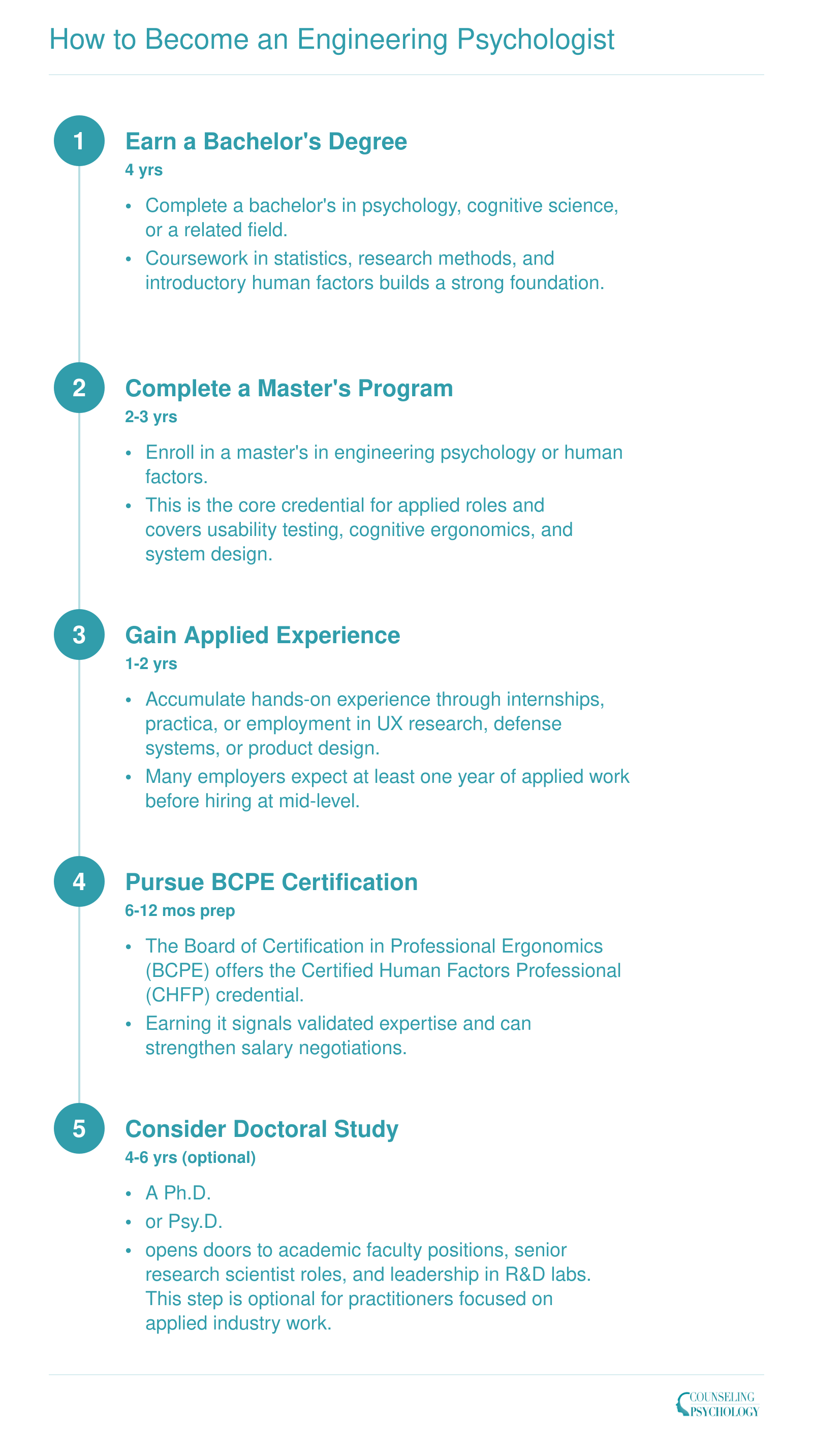
How to Become an Engineering Psychologist
The path to becoming an engineering psychologist follows a structured credentialing ladder. While individual timelines vary, most professionals can expect the full journey from undergraduate study through optional doctoral work to span roughly 8 to 14 years.
Related Articles
Career Paths and Salary Expectations for Engineering Psychologists
Engineering psychology graduates pursue a range of roles that sit at the intersection of human behavior and system design. Common job titles include human factors engineer, UX researcher, usability analyst, systems engineer, and ergonomist. The Bureau of Labor Statistics does not track "engineering psychologist" as a standalone occupation, so the figures below reflect the two closest BLS proxy categories: Industrial Engineers and Web and Digital Interface Designers. Defense contractors, aerospace firms, medical device companies, and major tech employers represent the primary hiring sectors for these graduates. Because actual engineering psychology roles can blend elements of both categories, individual salaries will vary based on employer, industry, and specific job function.
| BLS Proxy Occupation | National Employment | 25th Percentile Salary | Median Salary | 75th Percentile Salary | Projected Growth (2024 to 2034) |
|---|---|---|---|---|---|
| Industrial Engineers | 350,230 | $81,910 | $101,140 | $127,480 | 11% |
| Web and Digital Interface Designers | 111,400 | $64,990 | $98,090 | $141,860 | N/A |
Highest-Paying States and Metro Areas for Engineering Psychology Careers
Geography plays a significant role in earning potential for professionals who apply engineering psychology skills. The tables below draw from 2024 BLS wage data for two occupational categories that closely overlap with engineering psychology work: Industrial Engineers and Web and Digital Interface Designers. Keep in mind that these are broad federal classifications, not engineering psychologist titles specifically. States anchoring defense installations, aerospace hubs, and major tech corridors tend to appear near the top, though some Midwestern manufacturing states also post strong median wages for industrial engineering roles.
| State | Occupation | Median Annual Wage | 25th Percentile | 75th Percentile | Total Employment |
|---|---|---|---|---|---|
| Virginia | Industrial Engineers | $99,990 | $78,900 | $128,870 | 5,240 |
| Illinois | Industrial Engineers | $99,990 | $80,300 | $120,900 | 16,590 |
| Iowa | Industrial Engineers | $99,960 | $80,460 | $108,860 | 3,920 |
| Michigan | Industrial Engineers | $99,680 | $80,710 | $123,810 | 31,850 |
| Ohio | Industrial Engineers | $99,490 | $80,490 | $122,000 | 22,310 |
| Maine | Industrial Engineers | $99,260 | $83,960 | $124,030 | 920 |
| Alabama | Industrial Engineers | $99,120 | $80,090 | $119,890 | 8,040 |
| South Carolina | Industrial Engineers | $98,830 | $81,160 | $115,330 | 7,270 |
| Georgia | Industrial Engineers | $98,550 | $79,710 | $119,690 | 7,410 |
| Tennessee | Industrial Engineers | $98,230 | $79,740 | $116,230 | 7,200 |
| Utah | Web and Digital Interface Designers | $99,300 | $73,380 | $127,800 | 1,140 |
| Oregon | Web and Digital Interface Designers | $98,970 | $73,880 | $132,040 | 1,350 |
| Connecticut | Web and Digital Interface Designers | $96,200 | $72,600 | $97,180 | 1,040 |
| Illinois | Web and Digital Interface Designers | $94,660 | $63,650 | $123,310 | 2,140 |
| District of Columbia | Web and Digital Interface Designers | $91,820 | $62,540 | $126,050 | 660 |
| Maryland | Web and Digital Interface Designers | $89,680 | $60,310 | $122,400 | 1,350 |
| Texas | Web and Digital Interface Designers | $89,630 | $62,490 | $126,910 | 7,360 |
| Ohio | Web and Digital Interface Designers | $88,170 | $63,770 | $123,820 | 1,940 |
| New Jersey | Web and Digital Interface Designers | $87,070 | $68,810 | $124,060 | 2,450 |
| North Carolina | Web and Digital Interface Designers | $84,990 | $61,740 | $127,730 | 3,360 |
Certifications and Professional Development After Graduation
How do you turn a new engineering psychology master's degree into recognized credentials and career momentum? Earning your degree opens the door, but many graduates pursue board certification and professional memberships to strengthen their standing in the field. Two organizations set the standard: the Board of Certification in Professional Ergonomics (BCPE) for formal credentialing, and the Human Factors and Ergonomics Society (HFES) for ongoing professional development and networking.
Board Certification in Professional Ergonomics (BCPE)
The BCPE offers the Certified Professional Ergonomist (CPE) and Associate Human Factors Professional (AHFP) credentials, which signal expertise to employers and clients. Visit bcpe.org and check the Certification or How to Apply sections for current requirements. The CPE typically requires a master's degree in human factors, ergonomics, or a closely related field, plus four years of professional experience and passing a comprehensive exam. The AHFP credential is designed for newer practitioners with a relevant degree and limited experience, serving as a stepping stone to the CPE.
BCPE does not require specific program accreditation from bodies like ABET or APA. Instead, it evaluates whether your coursework covered the core ergonomics and human factors competencies: human performance, biomechanics, anthropometry, work physiology, systems analysis, environmental factors, and professional practice. If your online master's included these topics, you are likely eligible. The BCPE website maintains detailed education and experience matrices and exam content outlines, updated annually.
Human Factors and Ergonomics Society (HFES) Membership
HFES.org is the primary professional home for engineering psychologists and human factors practitioners. New graduates typically join as Associate Members (for those with a bachelor's degree) or Full Members (for those with a graduate degree and professional practice). Benefits include access to the annual international meeting, regional chapter events, technical group webinars, the peer-reviewed journal Human Factors, and a members-only job board. Student membership transitions smoothly to Associate or Full status after graduation, maintaining continuity in your professional network. Graduates interested in defense sector work, for example, may find that HFES connections complement roles like those of an army psychologist.
Cross-Referencing Salary and Job Market Data
The Bureau of Labor Statistics groups engineering psychologists under the Human Factors Engineers and Ergonomists category (SOC code 17-2112). The BLS.gov Occupational Outlook Handbook for this occupation reports median wages, job outlook, and typical education requirements. As of the most recent update, the national median annual wage for human factors engineers exceeds 95,000 dollars, with faster-than-average job growth projected through 2032. The Handbook also notes that while certification is not universally required, employers increasingly prefer candidates with CPE or AHFP credentials, especially for senior roles in aerospace, defense, and healthcare.
Cross-referencing BLS data with BCPE and HFES resources gives you a realistic view of how certification and membership translate to career opportunities and earning potential. Many practitioners report that the CPE credential opens doors to consulting work, federal contracts, and leadership positions that prioritize board-certified professionals.
Engineering psychology is one of the few applied psychology fields where a master's degree is the recognized professional credential, not a launching pad toward a doctorate. That means completing a two-year online program positions you to enter the workforce as a qualified engineering psychologist, not as a student still years away from practice.
Frequently Asked Questions About Engineering Psychology Programs
Prospective students often have practical questions about what an engineering psychology master's entails, how it compares to related fields, and what doors it opens. Below are answers to the most common questions we hear from applicants and early-career professionals.
- Can you become an engineering psychologist with a psychology degree?
- Yes. A bachelor's degree in psychology is one of the most common entry points. Most online master's programs in engineering psychology accept applicants from psychology, cognitive science, or related behavioral science backgrounds. You may need to complete a few prerequisite courses in statistics or research methods if your undergraduate program did not cover them, but a psychology degree provides a strong foundation.
- Are online master's degrees in psychology respected by employers?
- Employers in UX, defense, and human factors consulting increasingly accept online credentials, especially from regionally accredited institutions. What matters most is the program's accreditation status, curriculum rigor, and any practicum or applied research components. Hiring managers in technology and government sectors typically evaluate your portfolio and competencies rather than whether your coursework was delivered on campus or online.
- What is the difference between engineering psychology and human factors?
- The two fields overlap significantly and are sometimes used interchangeably. Engineering psychology tends to emphasize the cognitive and perceptual research side, studying how people process information and interact with systems. Human factors is often broader, encompassing ergonomics, physical design, and system safety. In practice, many programs combine both under titles like 'Human Factors and Engineering Psychology.'
- Is an online master's in engineering psychology worth it for career advancement?
- For most professionals, yes. A master's degree qualifies you for senior analyst, UX researcher, and human factors engineer roles that typically require graduate training. It can also lead to meaningful salary increases compared to bachelor's level positions. The online format lets you continue working while you study, which means you can apply new skills immediately and build your portfolio in real time.
- How long does it take to complete an online engineering psychology master's?
- Most programs require 30 to 36 credit hours and can be completed in about two years of full-time study. Part-time students often finish in two and a half to three years. Some accelerated options compress the timeline to 18 months. The exact duration depends on your course load, whether the program runs year-round, and any thesis or capstone requirements.
- Do you need a PhD to work as an engineering psychologist?
- Not necessarily. A master's degree is sufficient for many applied roles in industry, including UX research, systems design, and human factors analysis. A PhD becomes more relevant if you want to lead independent research programs, work in academia, or hold certain senior government research positions. Many successful engineering psychologists build entire careers at the master's level.
- What industries hire engineering psychologists?
- The field spans a wide range of sectors. Aerospace and defense companies hire engineering psychologists to improve cockpit interfaces and mission systems. Technology firms recruit for UX research and product design teams. Healthcare organizations need professionals who can reduce medical errors through better device and workflow design. Automotive, transportation safety, consumer electronics, and government agencies (including the Department of Defense and NASA) are also consistent employers.
Can I Get a Master's in Engineering Psychology With an Engineering Background?
Coming in from psychology and coming in from engineering are two very different paths into the same graduate program, and admissions committees know it. Yes, you can earn a master's in engineering psychology degree with an engineering bachelor's, and in many cases you will be a competitive applicant, provided you can show the psychology foundation the program expects.
Why Engineers Are Competitive Applicants
Engineering graduates arrive with exactly the skills these programs are built around: quantitative reasoning, systems thinking, experimental design instincts, and comfort with data.1 Feeder degrees include industrial engineering, mechanical engineering, systems engineering, software engineering, and computer science.2 Programs like Tufts University's Human Factors Engineering MS explicitly expect an engineering or science background,3 and Rochester Institute of Technology's MS in Experimental Psychology reviews applicants case by case rather than requiring a psychology bachelor's.4
Prerequisite Coursework You'll Likely Need
What engineers usually lack is the psychology coursework, and most programs are transparent about what they want to see:5
- Foundational psychology credits: typically 12 to 15 credits, or roughly 15 semester hours, in undergraduate psychology.
- Core courses: introductory psychology, research methods, and statistics. Some programs also list experimental psychology.
- Conditional admission: many programs will admit strong engineering applicants who are missing one or two prerequisites, with the requirement that those courses be completed early in the program or before matriculation.
How Work Experience Strengthens Your Application
One to two years of relevant professional experience can offset a thin psychology transcript.6 Work in human factors, user experience research, aerospace, defense, or human-computer interaction signals that you already understand the applied side of the field. Strong psychology graduate school admissions guidance consistently advises pairing that experience with a clearly written personal statement connecting your engineering work to human performance questions, so your file reads as a natural fit rather than a career pivot. If you later decide to continue beyond the master's level, exploring an engineering psychology PhD is a logical next step.