
What you’ll learn in this article…
- Four Georgia institutions near Macon offer graduate counseling certificates, spanning online, on-campus, and hybrid formats.
- Child counseling certificates emphasize developmental and play therapy coursework that general programs do not include.
- Georgia LPC licensure requires 60 graduate semester hours, so a certificate alone does not meet that threshold.
- Many Georgia universities allow certificate credits to transfer into a full master's program, potentially saving a semester.
Central Georgia has seen a sharp rise in referrals for child and adolescent mental health services since 2023, and school systems across the Macon region now report waitlists for both in-school counselors and community-based providers. Graduate certificates in counseling offer a faster, narrower credential than a full master's degree, typically requiring 9 to 21 semester hours and finishing in one or two semesters. They serve distinct purposes: some prepare you for specialty licensure in substance use or school counseling, others deepen an existing clinical skill set in marriage and family therapy, and a few provide faith-based training that does not lead to state licensure.
Four institutions within reasonable reach of Macon publish graduate certificate options in counseling, but none offers a dedicated child-counseling certificate by that exact name. Instead, programs concentrate on school counseling, addiction counseling, or marriage and family therapy, each of which serves children and adolescents in different settings. Cost spreads from under $8,000 at public campuses to more than $27,000 at private institutions, and only some certificate credits count toward Georgia's 60-hour LPC education requirement.
Understanding how each certificate aligns with state licensure tracks, which format fits your work schedule, and what salary return the underlying occupation delivers will determine whether a certificate moves your career forward or becomes an expensive credential dead end.
Best Graduate Certificate in Counseling Programs Near Macon, Georgia
Georgia offers a handful of graduate certificate options in counseling within reasonable reach of Macon, each targeting a different professional niche. Whether you want to specialize in substance use treatment, school counseling, marriage and family therapy, or biblical counseling, the programs below span online, campus, and hybrid formats so you can match coursework to your schedule. Program-level earnings data are not yet available for these certificates, but we include institutional tuition figures and graduation rates to help you weigh costs against outcomes.
- Program relevance and specialization
- Institutional graduation and retention rates
- Tuition affordability and net price
- Delivery format flexibility
- Accreditation and licensure alignment
- Independent program research
- NCES-IPEDS federal institutional data — nces.ed.gov
- Internal program database

University of Georgia
The University of Georgia pairs a flagship research environment with two distinct graduate certificates in counseling. Its online Substance Use Counseling certificate is built around evidence-based treatment and meets the coursework requirements for Georgia's Certified Advanced Alcohol and Drug Counselor (CAADC) credential, while its on-campus School Counseling certification track targets professionals who already hold a provisional license. Schools offering these programs have a graduation rate of 89.7%, and the 17:1 student-to-faculty ratio keeps graduate cohorts relatively accessible despite UGA's size.
- Fully online, 12 semester hours
- Meets Georgia CAADC educational requirements
- Covers trauma assessment and group work
- Requires an existing graduate degree for admission
- Multidisciplinary faculty with clinical expertise
- Evidence-based treatment curriculum
- Flexible pacing suited to working professionals
- On-campus program at the Athens campus
- Designed for provisional school counseling license holders
- Requires concurrent employment as a school counselor
- CACREP-accredited degree preferred for applicants
- Summer semester start only
- Focuses on practical, field-based experience
Graduate Certificate in Substance Use Counseling — Online
Certification in School Counseling — On-Campus

Augusta University
Augusta University's Post Master's Certificate in Advanced Counseling is tailored for practicing counselors who already hold a master's degree and want to add a School Counseling concentration. The credit range of 9 to 21 hours lets students build an individualized study plan, and a required 3.25 graduate GPA at admission helps maintain cohort quality. Schools offering this program have a graduation rate of 48.8%. In-state tuition of $6,992 makes Augusta one of the more affordable public options in the state.
- Campus-based program in Augusta, about 2.5 hours from Macon
- 9 to 21 credit hours depending on prior coursework
- School Counseling concentration
- Minimum 3.25 graduate GPA required for admission
- Individualized study plans for each candidate
- Designed for professionals with an existing master's degree
- 16:1 student-to-faculty ratio across the university
Post Master's Certificate in Advanced Counseling, School Counseling — On-Campus

Luther Rice College & Seminary
Luther Rice College and Seminary in Lithonia offers a compact, fully online Graduate Certificate in Biblical Counseling that integrates a faith-based perspective into core therapeutic skills. At just 9 credit hours and an advertised total cost of roughly $4,089, it is the shortest and least expensive certificate on this list. The program covers foundations of counseling, marriage and family counseling, and crisis counseling, and credits can transfer into a Luther Rice master's degree if you decide to continue. The 9:1 student-to-faculty ratio supports close mentorship in a smaller institutional setting.
- Fully online, 9 credit hours
- Advertised total program cost of approximately $4,089
- Courses in marriage and family counseling, crisis counseling
- Credits transferable into a Luther Rice master's degree
- Biblical perspective woven into counseling frameworks
- 9:1 student-to-faculty ratio
- No transfer credits accepted into the certificate
- Follows standard graduate admission requirements
Graduate Certificate in Biblical Counseling — Online

Columbus State University
Columbus State University rounds out the list with two counseling certificates: a Marriage and Family Therapy (MFT) graduate certificate and a CACREP-accredited Post Graduate Certificate in School Counseling delivered in a hybrid format. The MFT option spans 21 semester hours covering therapy techniques, professional ethics, and case studies, while the school counseling track prepares graduates for P-12 certification without requiring prior teaching experience. In-state tuition sits at $8,268, and schools offering these programs have a graduation rate of 41.8%.
- 21 semester hours of coursework
- Covers therapy, case studies, and professional ethics
- Designed for professionals in diverse helping fields
- Campus-based delivery in Columbus, about 1.5 hours from Macon
- Applicable across clinical and community settings
- 16:1 student-to-faculty ratio
- CACREP nationally accredited program
- Hybrid learning format combining online and in-person sessions
- No prior teaching experience required
- Prepares candidates for P-12 school counseling certification
- Covers eight comprehensive counseling content areas
- Flexible scheduling for working professionals
Graduate Certificate in Marriage and Family Therapy — On-Campus
Post Graduate Certificate in School Counseling — Hybrid
What You'll Study in a Child Counseling Graduate Certificate
A general counseling certificate covers broad clinical skills, while a child-focused certificate zeroes in on the developmental, emotional, and relational challenges unique to younger populations. That clinical specificity is what sets child counseling certificates apart and makes them valuable for practitioners who want to deepen their work with children, adolescents, and families. If you are still exploring whether this specialization fits your career goals, our guide on how to become a child counselor provides a useful starting point.
Core Coursework Areas
Although exact course titles vary from one Georgia program to the next, most child counseling graduate certificates draw from a common set of content areas:
- Child and adolescent development: Foundational coursework covering cognitive, social, and emotional milestones, along with how deviations from typical development signal clinical concerns.
- Play therapy: Techniques for engaging younger clients who lack the verbal fluency for traditional talk therapy. Directive and non-directive models are usually both addressed.
- Family systems theory: Understanding how a child's presenting issues connect to broader family dynamics, communication patterns, and intergenerational influences. Augusta University, for example, includes a Couples and Family Counseling course (3 credits) in its Post-Master's Certificate in Advanced Counseling & Supervision.2
- Trauma-informed care: Approaches to assessment and intervention that account for adverse childhood experiences. Richmont Graduate University offers a dedicated course, Trauma in Developmental Perspective (2 credits), within its Graduate Certificate in Child and Adolescent Counseling.1
- Child and adolescent psychopathology: Diagnostic frameworks for disorders commonly first identified in youth, such as ADHD, anxiety disorders, and oppositional defiant disorder. Richmont's catalog lists this as a 2-credit course.1
Credit Hours and Practicum Expectations
Credit requirements in Georgia span a fairly wide range. Specialty-focused certificates that assume you already hold a graduate counseling degree may require as few as 9 to 12 credits.2 Programs designed to fill licensure or endorsement gaps can run from 12 to 21 credits.2 A supervised practicum or internship component is common, typically accounting for 3 to 6 credits and requiring 300 to 600 clinical hours with child or adolescent populations.2 Practitioners interested in childhood trauma counseling will find that many practicum placements emphasize trauma-informed modalities.
Prerequisites and the Knowledge They Assume
Most Georgia programs build on existing graduate-level counseling knowledge rather than starting from scratch. Richmont's certificate, for instance, requires a licensure-eligible counseling degree before admission.1 That means foundational topics like ethics, multicultural counseling, and group dynamics are treated as prerequisites, not repeated within the certificate itself. If your prior graduate work did not cover those areas, you may need to complete bridge coursework first.
Because curriculum structures, practicum placements, and prerequisite policies differ across institutions, contact admissions offices directly to confirm the course sequence and clinical requirements for any program you are considering. Small differences in how a program sequences its trauma or play therapy coursework can affect your timeline and readiness for supervised practice.
Online vs. On-Campus Counseling Certificates in Georgia
Graduate certificate programs near Macon split roughly evenly between online and on-campus delivery. Among the programs profiled here, the University of Georgia and Luther Rice College & Seminary offer fully online certificates, while Augusta University and Columbus State University run campus-based programs. Understanding the tradeoffs of each format helps you choose the option that fits your schedule, learning style, and clinical training goals.
Pros
- Online certificates let working professionals in Macon study asynchronously without relocating to Athens, Augusta, or another college town.
- Campus-based programs like those at Augusta University and Columbus State give you face-to-face clinical skill practice with real-time instructor feedback.
- On-campus cohorts create natural networking opportunities with classmates and local practitioners, which can help with job placement later.
- Online programs often cost less in indirect expenses because you eliminate commuting, parking, and housing costs associated with campus attendance.
- Campus students typically have easier access to coordinated practicum placements through their university's existing community partnerships.
Cons
- Fully online students may still need to complete practicum or supervised hours in person, which can require travel or arranging a local site on your own.
- Campus-based schedules are less flexible, making it harder to balance coursework with a full-time job or family responsibilities.
- Online learners miss out on spontaneous peer interaction and hands-on role-play exercises that strengthen clinical skills in real time.
- On-campus options near Macon are limited, so you may face a commute of an hour or more to reach Augusta or Columbus for class sessions.
- None of the programs profiled here currently advertise a hybrid format, so students looking for a blended online and in-person experience may need to look beyond this list.
Related Articles
Tuition and Cost-Per-Credit Comparison
The table below compares published tuition rates and average net prices for the four Georgia institutions offering graduate certificates in counseling near Macon. Net price figures reflect an institution-wide average for all students receiving financial aid, drawn from federal IPEDS reporting. They are not guaranteed quotes for graduate certificate students specifically. Note that the three public universities cluster between roughly $13,100 and $13,900 in average net price, while the single private institution (Luther Rice College & Seminary) carries a substantially higher average net price of nearly $27,900. That gap is largely driven by differences in institutional aid and state subsidies available at public schools. Program-level earnings and debt outcomes are not yet available for these specific certificate programs, but institution-wide median graduate debt is included for general context.
| School | Sector | In-State Tuition | Out-of-State Tuition | Avg. Net Price (Institution-Wide) | Median Graduate Debt (Institution-Wide) |
|---|---|---|---|---|---|
| Columbus State University | Public | $8,268 | $10,140 | $13,115 | $26,000 |
| Augusta University | Public | $6,992 | $21,060 | $13,787 | $20,500 |
| University of Georgia | Public | $11,002 | $29,774 | $13,936 | $18,500 |
| Luther Rice College & Seminary | Private | $7,626 | $7,626 | $27,883 | $34,153 |
Questions to Ask Yourself
Career Outcomes and Earnings After Completing a Counseling Certificate
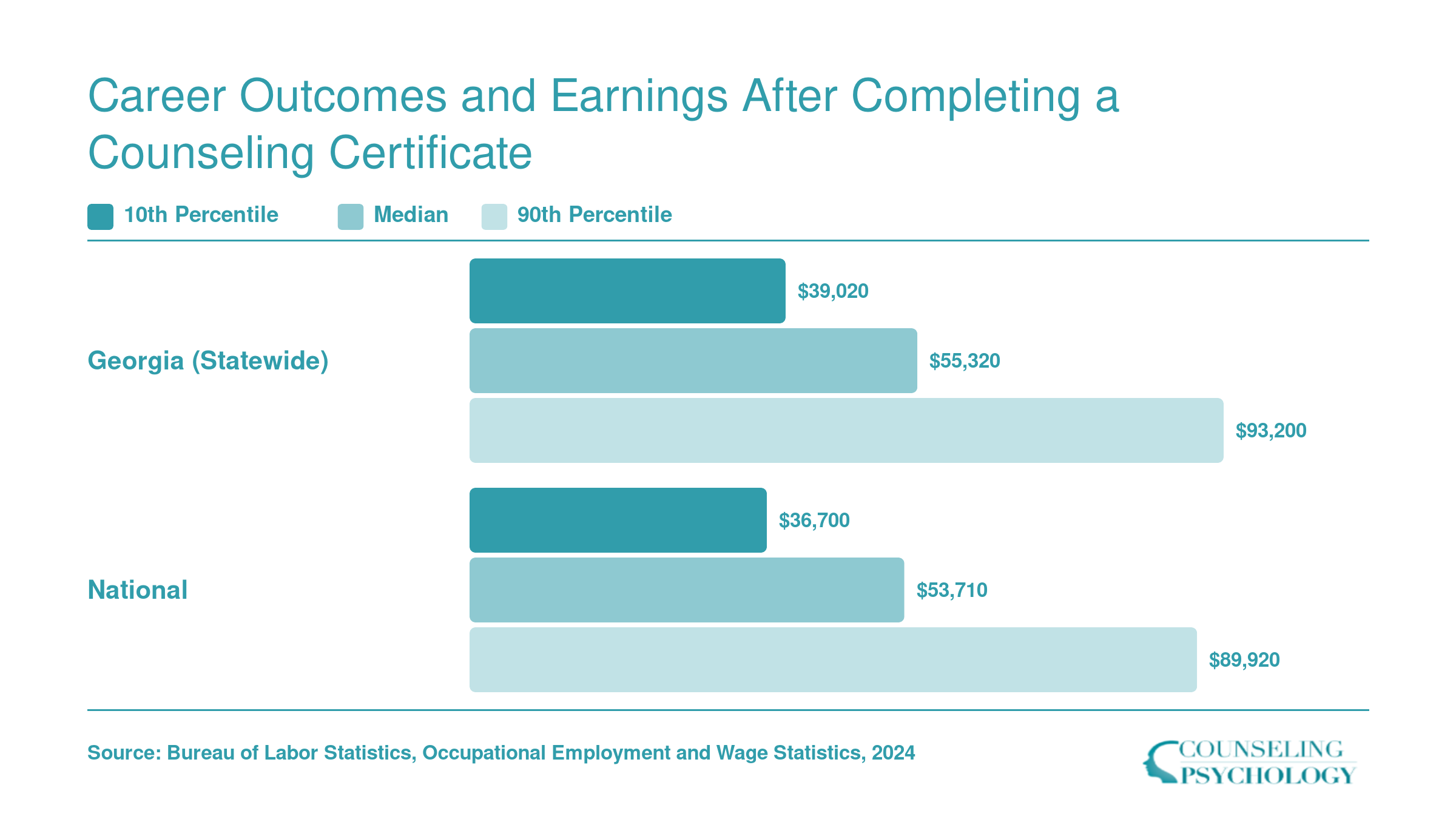
Program-level earnings data for the graduate certificate programs near Macon are not yet published, so we cannot compare median wages across individual schools. However, BLS occupational wage figures offer a useful benchmark. Georgia's statewide median for substance abuse, behavioral disorder, and mental health counselors sits at $55,320, slightly above the national median of $53,710 for the same occupational group. Nationally, mental health counselors specifically earn a median of $59,190. Bibb County and much of central Georgia are federally designated mental health professional shortage areas, which often translates into strong local hiring demand for certificate holders entering the workforce.
How a Graduate Certificate Supports Georgia LPC Licensure
Georgia's Licensed Professional Counselor (LPC) application requires 60 semester hours of graduate-level education, a threshold that far exceeds the 48-hour minimum for many master's programs.1 If you're considering a graduate certificate in child counseling near Macon, it's important to understand how those credits interact with the state's licensure rules.
The 60-Hour Education Requirement and Certificate Credit
The Georgia Composite Board of Professional Counselors, Social Workers, and Marriage & Family Therapies mandates that applicants complete a master's or higher degree in counseling or a related field from a regionally accredited institution.1 Within those 60 semester hours, at least 48 must be directly related to counseling coursework, as outlined in Chapter 135-5 of the Georgia Rules and Regulations.2
A graduate certificate alone will not make you eligible for LPC licensure. However, if you already hold a master's degree that falls short of the 60-hour total, certificate credits from a regionally accredited school can often be applied toward the remaining hours. The board does not explicitly authorize post-degree certificate credits by name, but many applicants have successfully used advanced counseling coursework to bridge the gap between a 48-credit master's and the required 60.3 You must ensure the certificate program's content aligns with the board's curricular standards, covering topics like assessment, career development, and clinical intervention. Always verify that the institution is regionally accredited; credits from nationally accredited schools that lack regional approval are not accepted.1 If you're exploring broader options, our guide to counseling certificate programs covers accredited offerings across the country.
Understanding CACREP Accreditation at the Certificate Level
CACREP (Council for Accreditation of Counseling and Related Educational Programs) sets the gold standard for counselor education, but it currently accredits only master's and doctoral degree programs. No graduate certificate program carries standalone CACREP accreditation.4 This does not mean a certificate is worthless; it simply means that its quality and recognition are tied to the parent institution. When evaluating Macon-area programs or online options in Georgia, check whether the university itself holds regional accreditation and, ideally, whether its master's in counseling program is CACREP-accredited. A certificate offered by a school with CACREP-aligned coursework is more likely to satisfy the board's content requirements, even if the certificate didn't undergo separate review. For those interested in specializations, a graduate certificate in mental health counseling can provide focused clinical training that maps well to Georgia's curricular standards.
Supervised Experience: Where Certificate Practicum Fits In
LPC licensure in Georgia also requires 3,000 hours of supervised post-master's clinical experience under an approved supervisor. Some graduate certificate programs include a practicum or internship component, but the board generally expects the bulk of supervised hours to come after the final degree is conferred. A certificate-level practicum may count toward the experience requirement only if it was completed after your master's and meets the board's supervision criteria. Don't assume it will automatically transfer; contact the board to clarify whether your specific certificate's clinical work qualifies.
Verifying Your Path with the Georgia Composite Board
Because licensure rules can evolve and each applicant's educational history is unique, the safest approach is to seek a preliminary evaluation before enrolling. The Georgia Composite Board can review your transcripts and planned coursework to determine whether a given certificate will satisfy the missing content areas.1 This step prevents costly miscalculations and ensures you don't invest in credits that won't move you closer to LPC eligibility. In a field where every credit hour counts, direct confirmation from the board is the most reliable compass.
Many Georgia universities allow graduate certificate credits to count toward a full master's in counseling, which can shorten your degree timeline by a semester or more. Before you enroll, ask the admissions office directly whether a formal articulation agreement exists between the certificate program and any master's degree track you plan to pursue.
Admission Requirements and How to Apply
Admission requirements for graduate counseling certificate programs vary by institution, so going directly to each program's official website is the single most reliable way to get accurate, current information.
Start With the Official Program Pages
For programs accessible from Macon, your first stops should be the graduate certificate pages at Mercer University, Georgia College and State University, and Middle Georgia State University. Do not rely on third-party aggregators or older PDF brochures. Requirements can change from cycle to cycle, and only the institution's own pages reflect the latest policies on deadlines, prerequisites, and enrollment formats.
Most programs list their requirements under a graduate admissions tab or a specific certificate program page. If you cannot locate a dedicated certificate page, contact the department's graduate coordinator directly. They can confirm whether the certificate operates on a separate admissions track from the master's program.
What Programs Typically Require
While specifics differ, graduate counseling certificate applicants generally need:
- A completed bachelor's degree: Most programs accept applicants from any undergraduate major, though some prefer a background in psychology, education, or a related human services field.
- Minimum GPA: Many Georgia programs set a floor around 2.7 to 3.0 on a 4.0 scale, but verify this for each school.
- GRE policy: A growing number of counseling programs have waived GRE requirements entirely. Confirm the current policy before preparing for the exam.
- Application materials: Expect to submit official transcripts, two or three letters of recommendation, a personal statement, and a current resume or CV.
Asking program coordinators whether prior counseling coursework is required or whether introductory-level undergraduate study suffices can save you significant time in planning.
Licensure-Related Prerequisites
If your goal extends beyond the certificate to eventual licensure as a professional counselor in Georgia, check the Georgia Board of Professional Counselors, Social Workers, and Marriage and Family Therapists for any prerequisites that affect which courses count toward licensure. You may also want to explore best masters in counseling programs in Georgia if a full degree better fits your licensure pathway. The American Counseling Association also publishes guidance on common training standards that can help you evaluate whether a certificate program's curriculum aligns with your longer-term goals. Students interested in specializing in family practice should consider reviewing marriage and family therapy certificate options as a complementary credential.
Apply Early and Communicate Directly
Cohort-based certificate programs often fill quickly, and some run only one intake per year. Assembling strong recommendation letters and a focused personal statement takes more time than most applicants expect. Begin gathering materials at least two to three months before the posted deadline, and do not wait until the last week to reach out to the program office with questions.
Frequently Asked Questions About Counseling Certificates in Georgia
Prospective students often have similar questions before committing to a graduate certificate in counseling. Below are answers grounded in publicly available resources and guidance from credentialing bodies. Where specifics vary by program, we point you to the most reliable sources so you can verify details for yourself.