
What you’ll learn in this article…
- Nine accredited programs made the 2026 ranking, with in-state tuition ranging from $6,693 at FAU to $24,830 at Nova Southeastern.
- CACREP accreditation simplifies license portability across states, but Florida also accepts state-approved programs for certification.
- Miami metro school counselors earn above the national median, and Miami-Dade's 372:1 student-to-counselor ratio signals strong hiring demand.
- Most Florida programs require 60 credits and take two to three years to complete, including a 600-hour field experience.
What does it cost to become a school counselor in Florida, and which programs near Miami actually prepare you for state certification?
Miami-Dade County Public Schools, the nation's fourth-largest district, employs hundreds of school counselors across its campuses, yet demand continues to outpace supply as student-to-counselor ratios remain above recommended levels. For candidates weighing graduate programs, in-state tuition ranges from roughly $6,700 at Florida Atlantic University to nearly $25,000 at Nova Southeastern University, with format options spanning traditional campus instruction, fully online delivery, and hybrid cohorts designed for working professionals.
Nine programs made our 2026 ranking. Most hold CACREP accreditation; all meet Florida Department of Education requirements for PK-12 certification. The sections ahead break down rankings, ROI, certification steps, and format trade-offs.
Top School Counseling Master's Programs Near Miami in 2026
These nine Florida programs represent the strongest pathways to school counselor certification in the state, ranked by a combination of institutional quality, affordability, and alignment with CACREP or state-approved standards. Several sit within easy reach of Miami, while others offer online or hybrid delivery that makes geography a non-issue. Because program-level earnings and debt data are not yet published for these school counseling tracks, the financial figures below reflect institution-wide medians. Graduation rates are also institution-wide and should not be read as specific to any single program.
- Accreditation and FDOE alignment
- Tuition and net price affordability
- Institutional graduation and retention rates
- Program format and field experience depth
- Graduate debt relative to earnings
- Internal program database
- NCES-IPEDS federal institutional data — nces.ed.gov
- College Scorecard graduate earnings — collegescorecard.ed.gov
- Independent program research

Florida International University
Florida International University is the only institution on this list physically located in Miami, making it the most direct pipeline into Miami-Dade County schools. Designated a Hispanic-Serving Institution with over 81% Pell Grant recipients, FIU reflects the demographic makeup of the communities its graduates will serve. The counselor education faculty emphasize multicultural and multilingual competence in urban K-12 settings, a priority that resonates strongly in South Florida's diverse school systems. In-state tuition of roughly $11,334 and a net price near $9,288 keep this public option affordable, with institution-wide median graduate debt at $16,500.
- Prepares candidates for both FDOE and national school counselor certification
- Curriculum blends online coursework with required in-person clinical components
- Focuses on multicultural competence for diverse K-12 populations
- Practicum and internship placements available in Miami-Dade schools
- Courses cover ethics, developmental psychology, and research methods
- Non-education majors may need to complete prerequisite coursework
- In-state tuition approximately $11,334 per year
Master of Science in Counselor Education, School Counseling — On-Campus

Florida Atlantic University
Florida Atlantic University in Boca Raton is the closest CACREP-accredited public option north of Miami, sitting roughly 50 miles from downtown. FAU is also a Hispanic-Serving Institution, enrolling a student body that mirrors much of South Florida's population. The 60-credit M.Ed. in School Counseling pairs developmental counseling theory with supervised field placements across Palm Beach and Broward County districts. With the lowest published in-state tuition on this list at $6,693 and a net price near $8,752, FAU delivers strong value, though applicants should note the program may require a Professional Teaching Certificate or equivalent FDOE prerequisites.
- CACREP accredited through 2032
- 60 credit hours with practicum and internship components
- Reports a 100% rehire rate among program graduates
- Emphasizes developmental counseling, prevention, and early intervention
- Admission may require Professional Teaching Certificate or FDOE prereqs
- Application deadlines: September 15 for Spring, January 15 for Fall
- In-state tuition approximately $6,693 per year
School Counseling M.Ed. — On-Campus

Nova Southeastern University
Nova Southeastern University, a private Hispanic-Serving Institution in Fort Lauderdale, offers its 48-credit school counseling concentration entirely online with two required weekend residential institutes on the Davie campus. That structure is especially practical for working professionals in the Miami metro who want local field placements without a daily commute. The program holds CAEP accreditation and ASCA recognition, with field experiences explicitly approved by FDOE for Florida school counselor certification. As the only private university on this list, NSU carries a higher price tag: tuition is $24,830 and the net price sits near $30,371, with median graduate debt of $24,250 institution-wide.
- 48 credit hours delivered online with fall-only start dates
- Two required on-campus residential institutes at Fort Lauderdale campus
- CAEP-accredited and ASCA-Recognized School Counselor Preparation program
- Field experiences approved by FDOE for Florida certification eligibility
- Multiple annual start windows: August, January, and May
- Aligns with Florida Department of Education school counseling requirements
- Institution-wide median graduate debt of $24,250
Master of Science in Counseling, School Counseling — Online

University of Florida
The University of Florida pairs one of the highest institutional graduation rates in the state (91.1%) with a CACREP-accredited, 72-credit dual master's and specialist degree in school counseling. Graduates leave with both the M.Ed. and Ed.S., positioning them for advanced roles and meeting FDOE certification standards. UF's statewide reputation as a top research university makes it a strong credential for candidates applying to competitive districts across South Florida. Net price for in-state students is approximately $6,541, and median graduate debt institution-wide is $15,000.
- 72 credit hours covering both master's and specialist degrees
- CACREP and NCATE accredited
- Prepares graduates for FDOE school counseling certification
- Emphasis on individual and group counseling, classroom guidance
- Placements available in elementary, middle, and secondary schools
- Passing score on Florida Teacher Certification Examination required
- Institution-wide net price approximately $6,541 for in-state students
School Counseling (Dual M.Ed./Ed.S.) — On-Campus

Florida State University
Florida State University delivers its CACREP-accredited school counseling program fully online, combining M.S. and Ed.S. credentials. That format allows Miami-area students to earn an advanced degree from a flagship university without relocating. FSU has temporarily waived the GRE requirement for applicants, and the program emphasizes data-driven strategies to close achievement gaps in K-12 settings. Institution-wide, FSU reports an 85.6% graduation rate, median graduate debt of $18,000, and a net price around $11,297 for in-state students.
- Fully online, CACREP-accredited program
- Combines master's and specialist degrees in one track
- GRE waived through Fall 2026 for qualified applicants
- Focuses on data-driven strategies for closing achievement gaps
- Minimum 3.0 GPA required for admission
- Prepares graduates for FDOE certification in K-12 settings
- Institution-wide median graduate debt of $18,000
School Counseling (Online M.S./Ed.S.) — Online

University of Central Florida
The University of Central Florida is a designated Hispanic-Serving Institution enrolling over 70% Pell Grant recipients, reflecting the kind of economic diversity Miami-area students know well. UCF's 60-credit MA in Counselor Education with a school counseling track is CACREP accredited and includes a 600-hour internship in K-12 schools. The campus-based format in Orlando requires relocation or commuting, but the program's affordable in-state tuition near $8,872 and strong placement record across Florida districts make it worth considering. Median graduate debt institution-wide is $18,190.
- CACREP-accredited, 60 credit hours beyond the bachelor's degree
- Includes practicum and 600-hour K-12 internship
- Covers core counseling theories, multicultural counseling, career development
- In-state tuition approximately $369.65 per credit hour
- Prepares students for pre-K through postsecondary certification
- Strong ethical and legal counseling foundation in the curriculum
- Hispanic-Serving Institution with broad student diversity
Counselor Education (MA), School Counseling Track — On-Campus

University of South Florida
The University of South Florida in Tampa offers a campus-based MA in Counselor Education with a school counseling concentration that prepares graduates for FDOE certification. USF blends theoretical coursework with hands-on application through individual and group counseling, academic interventions, and family collaboration. With in-state tuition near $10,428 and a net price of roughly $9,812, costs remain competitive among Florida's public flagships. The institution-wide graduation rate is 76.8%, and median graduate debt sits at about $17,988.
- Campus-based program in Tampa
- Prepares graduates for Florida School Counselor Certification
- Curriculum combines counseling theory with practical K-12 application
- Emphasis on collaboration with educators and families
- Financial aid options available to manage tuition costs
- Bachelor's degree required for admission
- Institution-wide median graduate debt approximately $17,988
Master of Arts in Counselor Education, School Counseling Concentration — On-Campus

University of North Florida
The University of North Florida in Jacksonville offers a 60-credit hybrid M.Ed. in Counselor Education that blends online coursework with periodic in-person sessions. Its cohort model runs over two years and includes more than 700 hours of supervised field experience, exceeding the minimum at many peer programs. The hybrid format may appeal to Miami-area working professionals willing to travel occasionally for intensive weekends. Net price is about $10,154 for in-state students, and institution-wide median graduate debt is $15,531.
- 60-credit hybrid program completed in a two-year cohort
- Over 700 hours of supervised PK-12 field experience
- Designed for working professionals across Florida
- Admission requires letter of intent, three recommendations, and interview
- Focus on leadership and academic rigor support in schools
- Assistantships and tuition waivers available to eligible students
- Institution-wide median graduate debt approximately $15,531
Counselor Education in School Counseling (M.Ed., Hybrid) — Hybrid

Florida Gulf Coast University
Florida Gulf Coast University in Fort Myers rounds out the list with a two-year campus-based MA in School Counseling that includes 600 hours of supervised internship. FGCU waives the GRE for applicants with a 3.0 or higher GPA in their final 60 undergraduate credits, a useful perk for career changers. Non-certified teachers can follow a defined pathway requiring six additional credits to meet FDOE competency areas. In-state tuition is about $8,961, though net price runs higher at roughly $12,568. The institution-wide graduation rate of 57.4% is the lowest on this list, so prospective students should ask about program-level completion data directly.
- Two-year campus-based program in Fort Myers
- 600 hours of supervised internship in K-12 settings
- GRE waived for applicants with 3.0+ GPA in last 60 credits
- Defined pathway for non-certified teachers (6 additional credits)
- Aligns with ASCA curriculum standards
- Covers counseling theories, legal and ethical practices, intervention strategies
- Actively recruiting for the 2026 cohort
School Counseling (M.A.) — On-Campus
How We Ranked These Miami-Area School Counseling Programs
Five core factors shaped this ranking: net price, institution-wide graduation rate, program-level earnings and debt where available, accreditation status, and format availability. Each metric reflects real-world affordability, student success, and career outcomes, not reputation polls or institutional self-reports.
Geographic Scope and Eligibility
Programs included in this ranking meet two criteria: physical campuses within commuting distance of Miami (approximately 60 miles) or online programs based at Florida institutions. This geographic filter ensures every option is either reachable by car or delivered under Florida regulatory oversight, which simplifies licensure alignment and in-state tuition eligibility for many students. If you are also exploring broader options across the state, our guide to masters in mental health counseling Florida programs covers additional accredited paths. Programs outside Florida, even if nationally ranked, were excluded from this list.
Net Price: What the Number Means
Net price represents the average annual cost after federal, state, and institutional aid, calculated at the institution level by the U.S. Department of Education's College Scorecard. This figure includes tuition, fees, books, and living expenses, minus typical aid packages. It is not a guaranteed quote for graduate students. Graduate aid structures differ sharply from undergraduate packages, and many master's programs offer assistantships, employer reimbursement, or state-specific grants that do not appear in the published net price. Treat this metric as a directional indicator of affordability, not a billing statement.
Earnings and Debt Data: Why This Ranking Differs
Where available, we integrated program-level median earnings one year after graduation and median federal loan debt, both drawn from College Scorecard datasets. Many competitor rankings rely solely on advertised tuition or anecdotal placement claims. By anchoring to Scorecard-backed earnings and debt, this ranking prioritizes measurable career ROI over marketing narratives. When program-level data were unavailable, we noted the gap rather than inventing figures or extrapolating from unrelated cohorts.
Accreditation and Format Availability
CACREP accreditation and Florida Department of Education approval status both factor into the ranking, as each credential pathway depends on one or both endorsements. Format availability (on-campus, hybrid, online) weighs heavily for working professionals who cannot relocate or attend daytime classes. Students weighing fully remote options may also want to review best online master's in counseling programs nationwide for comparison. Programs offering multiple formats score higher for accessibility, all else equal.
CACREP Accreditation vs. Florida State Approval: What's the Difference and Why It Matters
Understanding CACREP Accreditation
The Council for Accreditation of Counseling and Related Educational Programs (CACREP) sets the gold standard for graduate counseling education in the United States.1 CACREP accreditation signals that a program meets rigorous standards for curriculum, faculty qualifications, clinical training, and student outcomes. For aspiring school counselors, CACREP accreditation matters most when you seek licensure portability. Many states require CACREP graduation to qualify for professional counselor licensure, and some school districts give hiring preference to CACREP graduates. If you plan to move out of Florida during your career, CACREP credentials simplify credential transfer and reciprocity. For a broader look at what each state expects, review our guide on counseling licensure requirements.
Florida Department of Education State Approval
Florida operates its own approval pathway for school counselor preparation programs through the Department of Education.2 Graduates of state-approved programs can apply for the Florida Professional School Counselor Certificate and work in Florida public schools without issue. However, state approval alone does not guarantee that your credentials will transfer smoothly to other states. If you earn a degree from a program that holds only Florida DOE approval, you may face additional coursework, testing, or evaluation requirements when applying for certification in another state.
Which Miami-Area Programs Hold CACREP Accreditation?
As of 2026, only one program in the Miami metro area carries CACREP accreditation for school counseling.1 Florida International University offers a CACREP-accredited M.S. or M.Ed. in Counselor Education with a School Counseling track, and that program is also fully approved by the Florida Department of Education.3
Several other programs in South Florida hold state approval but not CACREP accreditation for school counseling:
- Nova Southeastern University: The M.S. in Counseling with a School Counseling concentration is CAEP-accredited and recognized by the American School Counselor Association, and it meets Florida DOE requirements. It is not CACREP-accredited for school counseling.4
- Barry University: Offers a Counselor Education program with a School Counseling track that is FDOE-approved but not CACREP-accredited.2
- Florida Atlantic University: The Counselor Education program with a School Counseling specialization holds FDOE approval but not CACREP accreditation.2
- Palm Beach Atlantic University: Provides school counseling preparation approved by Florida DOE, without CACREP accreditation.2
- University of Miami: Offers a MPCAC-accredited M.S.Ed. in Mental Health Counseling but does not offer a school counseling program.5
Advice for Students Who May Relocate
If there is any chance you will move out of Florida for personal or professional reasons, prioritize CACREP-accredited programs. The investment in portability pays dividends when you apply for certification in another state or pursue clinical licensure later in your career. Students weighing online options alongside local programs can compare best online masters in school counseling to see how CACREP-accredited alternatives stack up. If you are certain you will remain in Florida and work exclusively in Florida public schools, state-approved programs will meet your needs and may offer greater schedule flexibility or lower tuition. Weigh your long-term career plans carefully before you commit to a program.
Questions to Ask Yourself
Online, Hybrid, or On-Campus: Comparing Program Formats Near Miami
Choosing a delivery format is one of the most consequential decisions you will make when selecting a school counseling master's program. Among the nine ranked programs in our 2026 list, the majority are traditional on-campus offerings (University of Florida, UCF, FIU, USF, FAU, and Florida Gulf Coast University), one is fully online (Florida State University), one is hybrid (University of North Florida), and one offers online delivery as a private institution (Nova Southeastern University). Regardless of format, every student pursuing Florida school counselor certification must complete a minimum of 700 supervised fieldwork hours, including 100 practicum hours and 600 internship hours with at least 240 hours of direct service. Fully online does not mean zero face time: you will be in schools, working with real students. Students enrolled in online programs typically bear the responsibility of identifying their own practicum and internship placements, and Miami-Dade County sites are not guaranteed by out-of-area institutions.
| Dimension | On-Campus | Hybrid | Online |
|---|---|---|---|
| Schedule Flexibility | Low to moderate. Fixed class meeting times, usually weekday evenings or daytime slots. Best for students who live near campus. | Moderate to high. Most coursework is asynchronous or meets virtually, with periodic on-campus intensives or weekend residencies. | Highest. Asynchronous lectures let you study around a work schedule. Synchronous sessions, if any, are typically held in the evening. |
| Practicum and Internship Logistics | Programs like FIU and FAU place students in nearby schools and often maintain established partnerships across Miami-Dade and Broward counties. | UNF, for example, requires 700+ supervised field hours. Students coordinate placements locally, though the program may assist with site approval. | FSU and Nova Southeastern deliver coursework remotely, but students must secure their own practicum sites. No guarantee of a Miami-Dade placement through the institution. |
| Networking Opportunities | Strong. Regular face-to-face cohort interaction, faculty office hours, and local school district connections built during fieldwork. | Moderate. Cohort bonds form during residencies and group projects, supplemented by virtual collaboration between sessions. | Varies. Virtual discussion boards and live sessions create community, but building local professional relationships depends largely on your own initiative during internship. |
| Typical Time to Completion | Two to three years full time (60 to 72 credit hours depending on the program). UF's dual master's and specialist track is 72 credits. | About two years in a structured cohort model (UNF runs a 60-credit, two-year cohort). | Two to three years. Part-time pacing is common, which can extend timelines. FSU's program is designed for completion alongside employment. |
| Cost Range (In-State Graduate Tuition) | Public university tuition ranges from roughly $6,700 (FAU) to about $12,700 (UF) per year. FIU sits near $11,300. | UNF's in-state graduate tuition is approximately $10,400 per year, comparable to other public options. | FSU charges about $10,600 in-state. Nova Southeastern, a private university, lists tuition near $24,800 per year, making it the most expensive option in the rankings. |
| Programs in Our Rankings | UF, UCF, FIU, USF, FAU, FGCU | UNF | FSU, Nova Southeastern University |
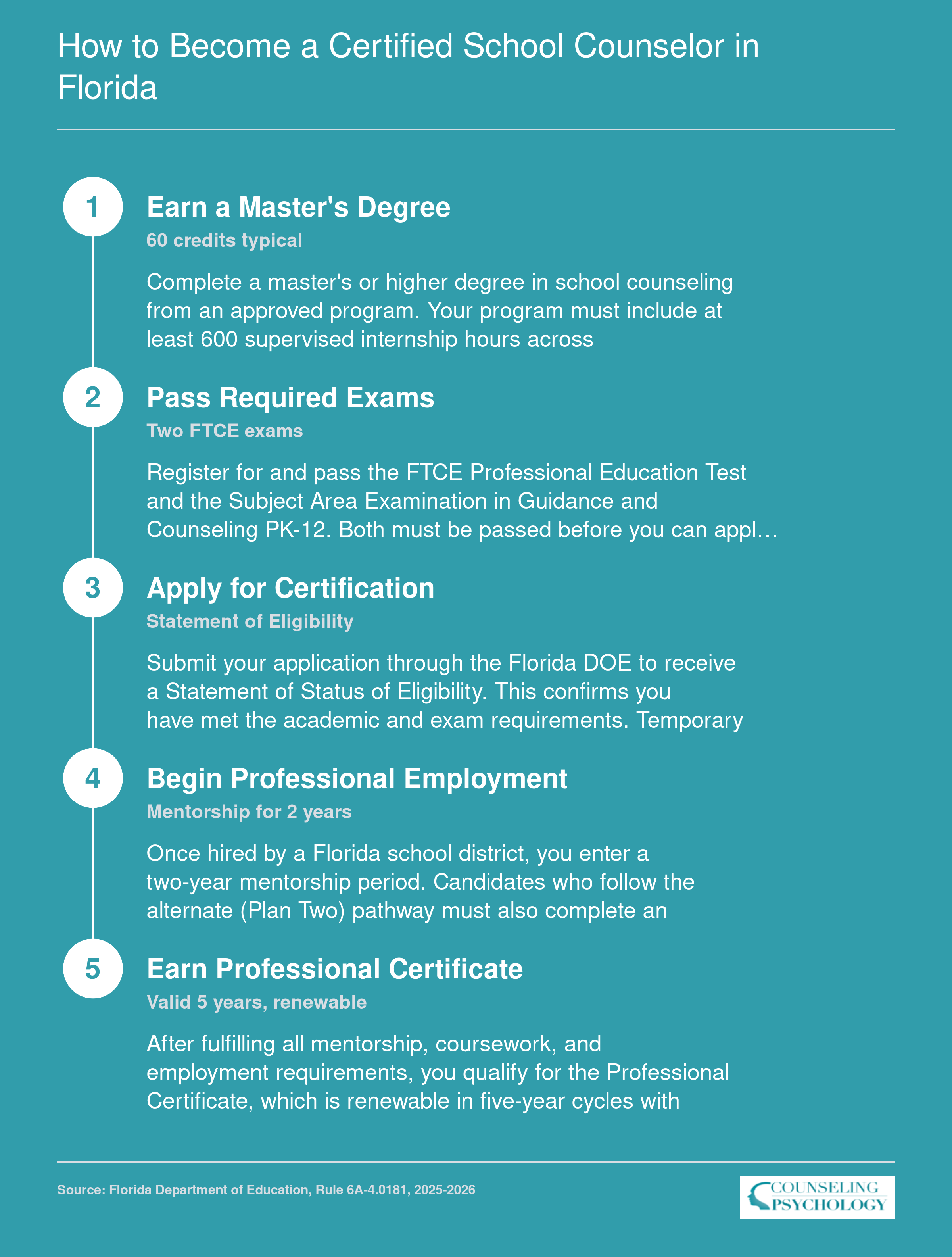
How to Become a Certified School Counselor in Florida
Florida's Department of Education oversees school counselor certification under Rule 6A-4.0181. The pathway is straightforward but has firm deadlines and exam requirements you need to plan around. Here is the sequence most candidates follow.
Costs, Earnings, and ROI for School Counseling Graduates
In-state tuition among ranked school counseling programs near Miami starts at $6,693 at Florida Atlantic University and reaches $24,830 at Nova Southeastern University. Out-of-state students face a tighter spread, from $18,482 at FAU to $31,216 at Florida Gulf Coast University. Median federal loan debt at program completion tells a similar story: graduates carry balances as low as $15,000 (University of Florida) and as high as $24,250 (Nova Southeastern), with most programs clustering between $15,500 and $18,200.
Long-Term Earnings and Return on Investment
Program-level earnings data for the first few years after graduation is not yet available for these schools. However, longer-term median earnings, measured roughly a decade after entering the program, show clear patterns. The University of Florida leads with median earnings of $71,588, translating to an ROI ratio of 4.77, meaning graduates earn nearly five times their debt. Florida International University ($60,249) and Florida State University ($61,675) also post strong ratios above 3.4. At the other end, Florida Gulf Coast University ($54,560) and the private Nova Southeastern option ($59,209, but with higher debt) deliver more modest returns. For prospective students weighing cost against long-term gain, the public universities in the University of Florida and Florida State systems stand out as high-value paths.
National Salary Benchmarks and Miami's Market
The Bureau of Labor Statistics reports a national median annual wage of $55,410 for school and career counselors (2017 data).1 While metro-level salary data for the Miami-Fort Lauderdale area is not directly available from BLS, regional pay typically aligns with or exceeds the national median due to cost-of-living adjustments. Nationally, wages range from $32,660 at the 10th percentile to $91,960 at the 90th percentile, illustrating meaningful upside for experienced professionals.1 School counselors employed in Miami-Dade or Broward County public schools often start on step scales that rise with experience and advanced degrees. Checking local district salary schedules gives the most accurate picture of early career pay.
Monthly Debt Payments in Perspective
A typical median debt load of $17,622 translates to a monthly federal student loan payment of about $196 under a standard 10-year repayment plan (assuming 6% interest). Against a hypothetical starting salary near the national median, that payment represents less than 5% of gross monthly income, a manageable debt-service ratio. Even with the highest debt in the group ($24,250), the monthly obligation sits around $270, well within recommended thresholds for education debt. This affordability underscores why a master's in school counseling remains a financially sound investment for those committed to the field.
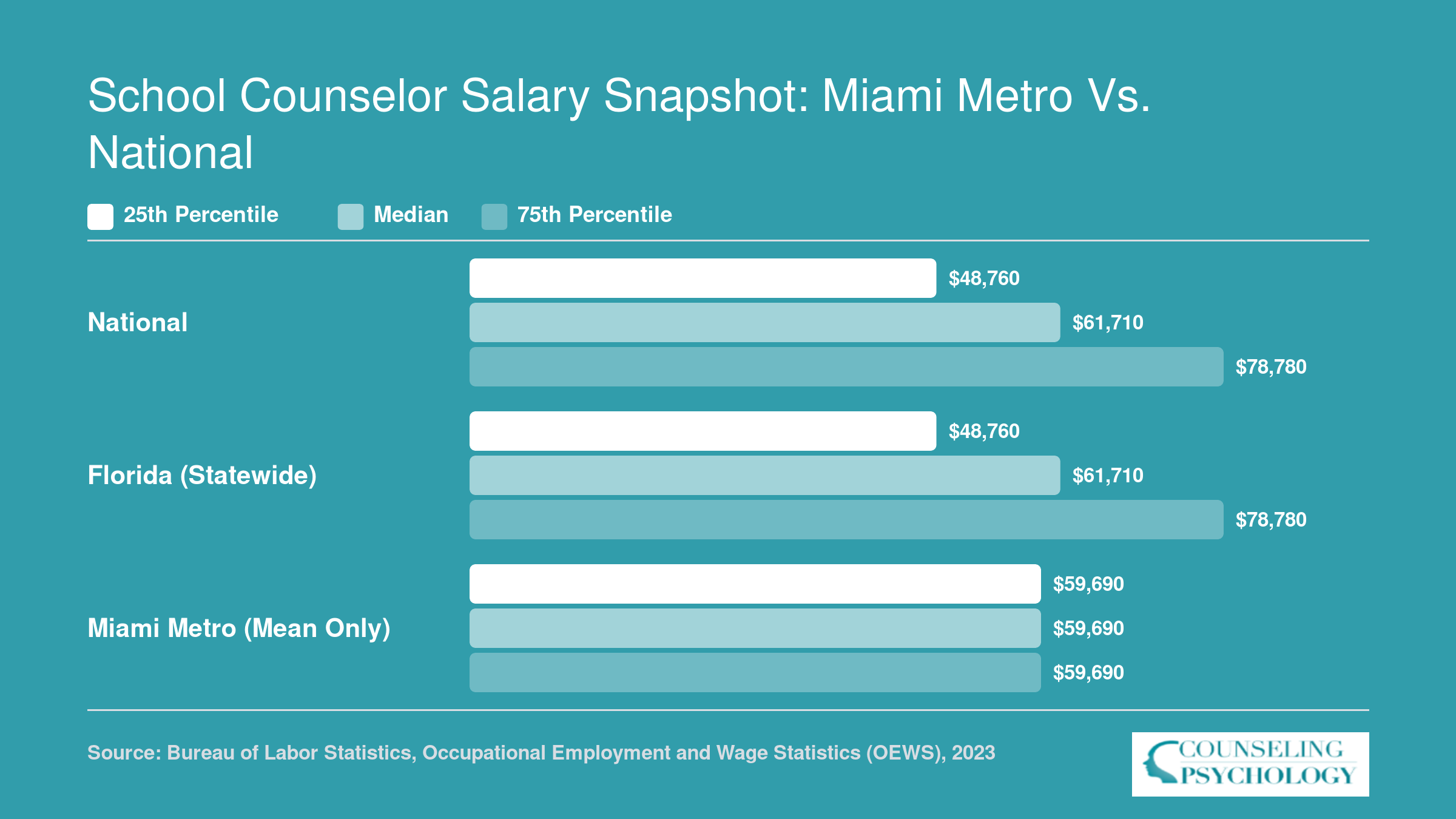
School Counselor Salary Snapshot: Miami Metro vs. National
How do school counselor earnings in the Miami-Fort Lauderdale metro stack up against Florida statewide and national figures? The BLS groups school counselors under Educational, Guidance, and Career Counselors and Advisors (SOC 21-1012), so the figures below reflect that broader occupational category. Note that metro-level percentile breakdowns were not published for the Miami area; the mean annual wage is shown instead for that geography.
How Long Does It Take to Get a Master's in School Counseling in Florida?
Planning your timeline before you apply saves real frustration later. The practical path from enrollment to licensure-ready graduation involves more moving parts than credit hours alone, and Florida programs tend to sit at the longer end of the national range.
Credit Hours and Full-Time Pacing
CACREP-accredited school counseling programs require a minimum of 60 graduate credits.1 Florida programs generally align with that 60-credit benchmark rather than the shorter 48-credit tracks sometimes seen in non-accredited counseling degrees. At full-time enrollment, completing 60 credits typically takes two to three years. Students who enter with a related bachelor's degree in education or psychology often have an easier time satisfying prerequisite coursework, which can smooth the first semester considerably without formally shortening the program.
Part-Time and Online Tracks
Several programs reviewed on this site offer part-time enrollment or fully online formats designed for working professionals. Those flexibilities are real, but the tradeoff is time: a part-time student carrying six to nine credits per semester should expect three to four years to degree completion. Online and hybrid programs near Miami, including those structured for working teachers seeking a career pivot into school counseling, commonly offer these extended-pacing options.
The Fieldwork Bottleneck
Regardless of how quickly a student finishes coursework, fieldwork requirements set a hard floor on completion. CACREP standards require 100 hours of practicum and 600 hours of internship, totaling at least 700 supervised hours in school settings.2 Securing placements in Miami-area schools, coordinating supervisor schedules, and fitting that volume of hours around a job or family commitments is consistently what stretches timelines for otherwise accelerated students. Even ambitious full-time students should budget for the possibility that internship placement logistics push graduation one semester beyond their original plan.
Realistic Planning Benchmarks
Putting the pieces together:
- Full-time, on-campus: 2 to 2.5 years is achievable, though 3 years is common once fieldwork scheduling is factored in.
- Part-time or online: 3 to 4 years is the realistic window for most students balancing work or family.
- Accelerated cohort programs: A small number of programs run structured cohort models that aim for completion closer to 24 months, but these still must satisfy the full 700-hour fieldwork requirement.
The safest approach is to confirm placement support resources with each program before enrolling. How readily a program connects students with Miami-Dade County or Broward County school placements has as much impact on your timeline as any academic schedule. For broader context on counseling schools and how Florida programs compare nationally, review accreditation details directly through CACREP.
Miami-Dade County Public Schools is the fourth largest district in the nation, employing a substantial number of school counselors across hundreds of campuses. Nationally, the student-to-counselor ratio sits at roughly 372:1, well above the 250:1 that the American School Counselor Association recommends. As federal and state policymakers push to close that gap, districts of this scale are likely to add counseling positions, making the Miami metro area a particularly promising market for new graduates.
Frequently Asked Questions About School Counseling Programs Near Miami
Choosing a school counseling program is a major decision, and prospective students in the Miami area tend to have many of the same questions. Below are concise answers drawn from the data and details covered throughout this article.