
What you’ll learn in this article…
- Florida PhD programs in clinical psychology accept roughly 5 to 15 percent of applicants each cycle.
- APA accreditation is essential because Florida licensure and many employers require graduation from an accredited doctoral program.
- Expect 8 to 12 years from your first undergraduate course to full Florida clinical psychologist licensure.
- Public university PhD programs generally offer the strongest funding and debt to earnings ratios statewide.
How do you identify an APA-accredited clinical psychology program in Florida that balances rigorous training with manageable debt? The state projects 14% growth in psychologist positions over the next decade, yet fewer than a dozen doctoral programs hold APA accreditation, the licensure prerequisite for most clinical roles. That supply-demand gap means strong job prospects for graduates who choose wisely.
Ranked programs, earning comparisons, and licensing timelines help cut through the noise, but the core tension is financial: tuition at private PsyD programs can eclipse $40,000 per year, while funded PhD paths may offer full tuition remission. With median clinical psychologist salaries in Florida hovering around $84,000, programs that leave graduates with six-figure debt can stretch loan repayment well beyond a decade.
Best Clinical Psychology Programs in Florida: Our Ranked List
Florida is home to a strong mix of public research universities and specialized private institutions offering clinical psychology training at every degree level. The programs below span APA-accredited doctoral tracks, master's pathways to Florida licensure, and undergraduate foundations, each evaluated on affordability, graduate outcomes, and institutional strength. Whether you are drawn to a scientist-practitioner PhD, a practice-focused PsyD, or a master's degree that leads directly to Licensed Mental Health Counselor (LMHC) credentials, this ranked list will help you compare your options side by side.
- Graduate earnings and debt load
- Institutional graduation rate
- Net price and tuition costs
- Program accreditation status
- Return on investment ratio
- Internal program database
- Independent program research
- College Scorecard graduate earnings — collegescorecard.ed.gov
- NCES-IPEDS federal institutional data — nces.ed.gov

Florida State University
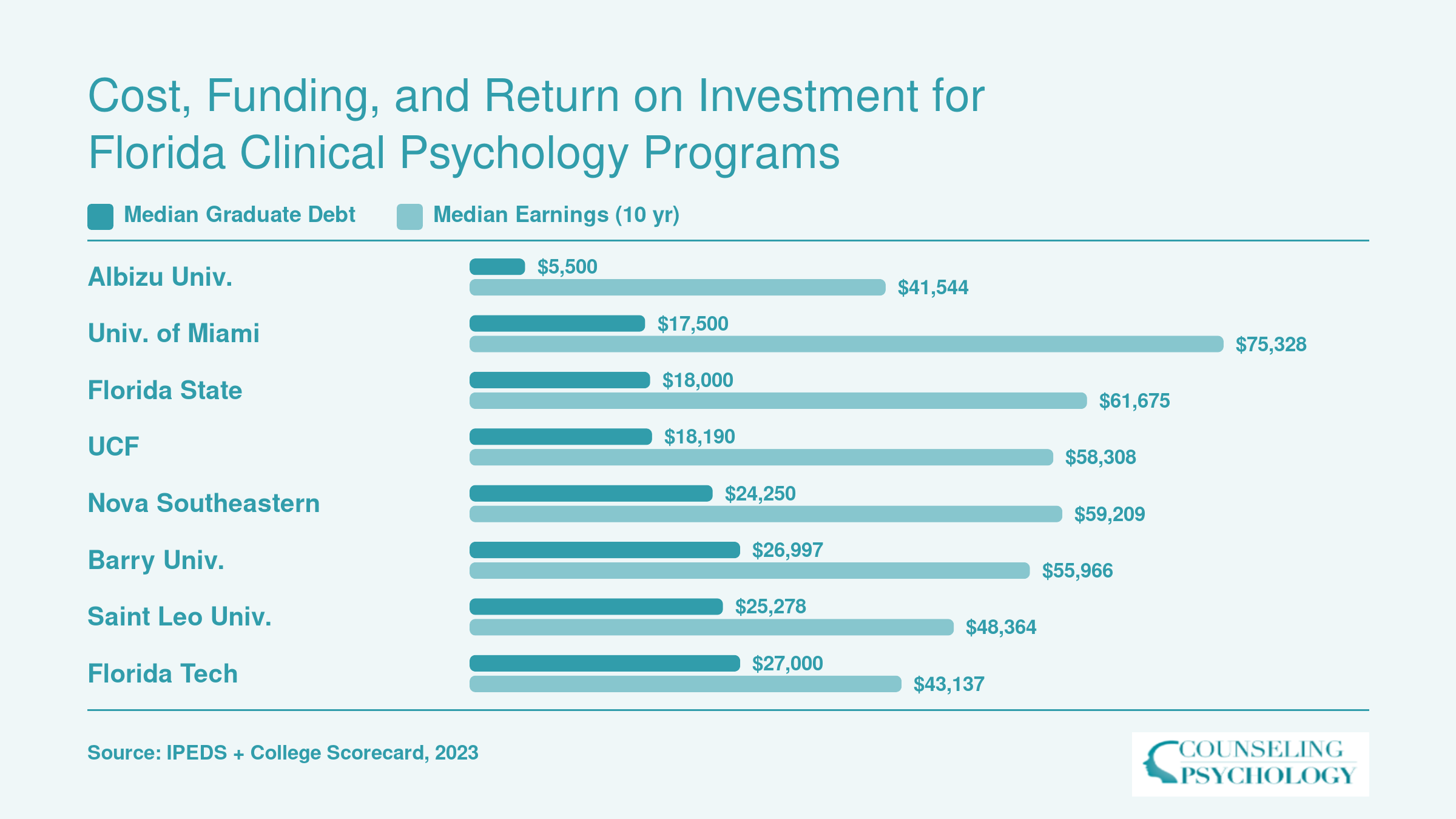
Florida State University is a public R1 research institution in Tallahassee with a 17:1 student-to-faculty ratio and an 85.6% graduation rate. Its APA-accredited Clinical Psychology doctoral program follows a clinical science model, integrating rigorous research training with extensive supervised practice at the university's Psychology Clinic. In-state doctoral students benefit from one of the lowest tuition rates on this list, and the institution reports a median graduate debt of $18,000, making it a strong value proposition among Florida's top programs.
- APA-accredited clinical science doctoral program
- Five- to seven-year training timeline
- Two-year practicum at FSU's Psychology Clinic
- Multiple external clinical placement sites
- Emphasis on empirically supported treatments
- Nationally recognized for science-practice integration
- In-state tuition around $10,553 per year
Clinical Psychology (PhD) — On-Campus

University of Miami
The University of Miami is a private research university in Coral Gables with an 11:1 student-to-faculty ratio and an 83.7% graduation rate. Its Clinical Psychology doctoral program holds both APA and PCSAS accreditation and has been continuously APA-accredited since 1974. Students choose from four clinical focus areas and train in one of the most culturally diverse metropolitan settings in the country. Median earnings for graduates reach $75,328 at ten years, the highest among schools on this list.
- Dual APA and PCSAS accreditation since 1974
- Mentor-model research training approach
- Adult clinical psychology specialization track
- Prepares directly for Florida psychologist licensure
- Monthly diversity and equity committee initiatives
- Located in culturally diverse Coral Gables/Miami
- Health clinical psychology focus area
- Science-practice integration curriculum
- Culturally informed training environment
- Four substantive clinical focus areas available
- Community engagement and outreach opportunities
- Faculty mentorship drives the research agenda
- Child and family clinical specialization
- Training with diverse pediatric populations
- Research mentorship from admission onward
- Cultural competence woven through coursework
- Meets all Florida licensure requirements
- Strong emphasis on inclusivity and equity
Clinical Psychology (PhD), Adult Clinical Concentration — On-Campus
Clinical Psychology (PhD), Health Clinical Concentration — On-Campus
Clinical Psychology (PhD), Child/Family Concentration — On-Campus

University of Central Florida
The University of Central Florida is a public institution in Orlando designated as a Hispanic-Serving Institution (HSI), with an undergraduate graduation rate of 78% and in-state tuition of roughly $8,872. UCF offers clinical psychology programs at the bachelor's, master's, and doctoral levels, giving students flexibility to enter the field at multiple points. The APA-accredited PhD follows a scientist-practitioner model, while the 61-credit applied MA track leads directly to Florida LMHC licensure eligibility after supervised postdegree experience.
- 61-credit-hour program for LMHC licensure pathway
- 1,000-hour supervised clinical internship
- Offered at the Sanford/Lake Mary campus
- Multicultural therapy training included
- Affordable in-state rate of roughly $370 per credit
- Designed for students targeting community practice
- 38-credit-hour research-focused master's track
- Close faculty mentorship on thesis projects
- Intended as preparation for doctoral study
- Not eligible for LMHC licensure on its own
- Flexible elective course selection
- Low in-state tuition for Florida residents
- APA-accredited scientist-practitioner program
- 90 semester credit hours over roughly six years
- Adult assessment and community partnerships
- Off-site predoctoral internship required
- Diverse and inclusive training environment
- Prepares graduates for Florida state licensure
- Available fully online for flexibility
- Foundation in psychopathology and assessment
- Capstone project requirement
- Encourages undergraduate research participation
- In-state tuition around $212 per credit hour
- Prepares students for graduate-level study
Clinical Psychology (MA), Applied Pre-Licensure/Non-Thesis — On-Campus
Clinical Psychology (MA), Research/Thesis — On-Campus
PhD in Clinical Psychology — On-Campus
Psychology (BS), Clinical Psychology Track — On-Campus

Albizu University-Miami
Albizu University-Miami is a private, specialized institution and HSI located in Miami, focused almost exclusively on behavioral science and psychology training. Its APA-accredited PsyD in Clinical Psychology emphasizes cultural sensitivity, a critical asset in Miami's multilingual communities. Students can specialize in clinical neuropsychology, health psychology, or forensic psychology. The school reports a notably low median graduate debt of $5,500 at the institutional level, and a 12:1 student-to-faculty ratio supports close mentorship.
- APA-accredited doctoral program
- Campus-based training in Miami
- Cultural sensitivity integrated throughout curriculum
- Generalist foundation with specialization options
- Small 12:1 student-to-faculty ratio
- Science-based assessment and intervention training
- Dedicated neuropsychology track within APA-accredited PsyD
- Research opportunities in brain-behavior relationships
- Assessment-focused clinical training
- Culturally responsive practice emphasis
- Campus-based practicum experiences
- Prepares for neuropsychology postdoctoral work
- Health psychology specialization within PsyD
- Focus on mind-body health interventions
- Science-based generalist coursework foundation
- Professional skill development in clinical settings
- Culturally sensitive training model
- Located in Miami for diverse patient exposure
- Forensic psychology concentration within APA-accredited PsyD
- Campus-based learning in Miami
- Cultural sensitivity and forensic assessment training
- Science-based foundational curriculum
- Prepares students for forensic clinical roles
- Small class sizes support individualized mentoring
Doctor of Psychology (PsyD) in Clinical Psychology — On-Campus
PsyD in Clinical Psychology, Clinical Neuropsychology Concentration — On-Campus
PsyD in Clinical Psychology, Health Psychology Concentration — On-Campus
PsyD in Clinical Psychology, Forensic Psychology Concentration — On-Campus

Nova Southeastern University
Nova Southeastern University is a private institution in the Fort Lauderdale area, designated as an HSI, that operates one of the largest clinical psychology training programs in the state. Its PsyD follows a practitioner-informed model with 119 credits, seven specialized concentrations, and access to 15 on-campus working clinics. The school also offers a PhD in Clinical Psychology with small cohorts of about ten students for those who want a more research-intensive path. Nova reports nearly 100% internship matching rates, a strong signal for doctoral applicants.
- APA-accA accredited practitioner-model doctorate
- Five-year curriculum totaling 119 credits
- Seven specialized concentration options
- 15 on-campus clinics for diverse training
- Nearly 100% APPIC internship match rate
- Prepares graduates for Florida state licensure
- Forensic psychology track within APA-accredited PsyD
- Specialized forensic assessment and intervention training
- One-year clinical internship required
- Access to 15 on-campus working clinics
- Five-year program with 119 total credits
- Strong internship matching outcomes
- Health psychology concentration within PsyD
- Evidence-based practitioner training model
- Diverse clinical experience with South Florida populations
- On-campus Fort Lauderdale/Davie location
- Prepares for health service psychologist licensure
- Nearly 100% internship matching rate
- APA-accredited research-focused doctoral track
- Small cohorts of approximately ten students
- Minimum 118 credits over five years
- Close faculty mentorship and research opportunities
- 15 on-campus clinics for clinical training
- High internship matching rate
- Clinical neuropsychology concentration within PhD
- APA-accredited five-year program
- 118 total credits required
- Small cohort sizes for individualized training
- Diverse patient populations in South Florida
- Faculty-guided research from year one
PsyD in Clinical Psychology — On-Campus
PsyD in Clinical Psychology, Clinical Forensic Psychology Concentration — On-Campus
PsyD in Clinical Psychology, Clinical Health Psychology Concentration — On-Campus
PhD in Clinical Psychology, Clinical Health Psychology Concentration — On-Campus
PhD in Clinical Psychology, Clinical Neuropsychology Concentration — On-Campus

Florida Institute of Technology
Florida Institute of Technology's online division offers a fully online Bachelor of Arts in Applied Psychology with a Clinical Psychology focus, designed for working professionals who want a foundation in psychological disorders, multicultural issues, and substance abuse. With a 6:1 student-to-faculty ratio and a pay-by-the-course tuition model, the program provides scheduling flexibility uncommon at this degree level. Note that this is an undergraduate credential; students will need graduate education to pursue clinical licensure in Florida.
- 100% online bachelor's degree program
- 121 credit hours covering clinical foundations
- Flexible start dates for working professionals
- Pay-by-the-course tuition structure
- Covers abnormal psychology and substance abuse
- Multicultural issues integrated into coursework
- No application fee for prospective students
Bachelor of Arts in Applied Psychology, Clinical Psychology — Online

Barry University
Barry University is a private Catholic institution in Miami, designated as an HSI, known for its MS in Clinical Psychology accredited by the Masters in Psychology and Counseling Accreditation Council (MPCAC). The program blends academic coursework with a 700-hour clinical internship and specifically prepares graduates for Florida LMHC licensure. Evening classes accommodate working professionals, and a 7:1 student-to-faculty ratio ensures personalized advising. Median institutional earnings reach $55,966 ten years after enrollment.
- MPCAC-accredited master's program
- 700-hour daytime clinical internship in final year
- Evening coursework for working professionals
- Prepares graduates for Florida LMHC licensure
- Eclectic theoretical orientation across modalities
- Small class sizes with 7:1 faculty ratio
- Financial aid and scholarships available
Clinical Psychology (MS) — On-Campus

Saint Leo University
Saint Leo University is a private Catholic institution north of Tampa offering a Bachelor's in Psychology with a Clinical/Counseling concentration available online, on campus, or at regional education centers. The 120-credit program covers cognitive psychology, personality theory, and biological bases of behavior, with internship and community service components built in. It is designed primarily for working professionals seeking career-entry credentials in human services, counseling support roles, or preparation for graduate study.
- Available online, on campus, or at education centers
- 120 credit hours over four years
- Internship and community service projects included
- Covers cognitive psychology and personality theory
- Biological bases of behavior coursework
- Designed for working professionals seeking flexibility
- Prepares students for graduate-level psychology programs
Bachelor's Degree in Psychology, Clinical/Counseling Concentration — Online
PhD vs. PsyD vs. Master's: Choosing the Right Clinical Psychology Pathway
Acceptance rates for clinical psychology PhD programs in Florida hover between 5 and 15 percent, making them among the most competitive graduate pathways in the state.1 Understanding the differences between doctoral and master's options is essential before you commit years of study and significant financial resources to your education.
Doctoral Degrees: The Only Path to Independent Licensure
In Florida, only doctoral degree holders can become licensed as clinical psychologists and practice independently. This is a firm regulatory boundary. If your goal is to conduct psychological assessments, diagnose mental disorders, and provide psychotherapy under your own license, you need either a PhD or a PsyD in clinical psychology.
The PhD route emphasizes research training alongside clinical preparation. Florida programs typically take five to seven years to complete, and admission is highly selective. Because PhD programs train students as scientist-practitioners, most offer full funding in the form of tuition waivers and annual stipends.1 Graduates often leave with minimal debt, typically ranging from zero to $50,000 nationally.
PsyD programs prioritize clinical training over research. They generally take four to six years in Florida, and acceptance rates are less restrictive, ranging from 20 to 50 percent.1 The trade-off is cost: most PsyD programs are tuition-driven, meaning students pay out of pocket. Nationally, PsyD graduates report median debt between $100,000 and $200,000, a substantial financial burden that shapes career choices for years after graduation.
Master's Degrees: A Different Career Ceiling
Master's programs in clinical or counseling psychology prepare graduates for roles such as licensed mental health counselor, but they do not qualify you for licensure as a psychologist in Florida. If your career vision includes the psychologist title, independent practice, or certain assessment privileges, a master's degree will not get you there. For a broader look at what each credential level involves, our overview of degrees in psychology can help clarify the landscape.
That said, master's programs offer a faster entry into the mental health workforce, usually taking two to three years, and at a lower total cost. Graduates can pursue meaningful work in community mental health, schools, and private practices under supervision or with LMHC credentials.
APA Accreditation: A Doctoral Distinction
The American Psychological Association accredits only doctoral programs in clinical psychology. This accreditation matters because it signals that a program meets rigorous training standards and, critically, because many states and employers require graduation from an APA-accredited program for licensure or hiring eligibility. Master's programs fall under different accrediting bodies, such as CACREP for counseling tracks, which serve a distinct professional pipeline.
Comparing Your Options at a Glance
- PhD: Five to seven years, 5 to 15 percent acceptance rate in Florida, typically fully funded, strong research emphasis, leads to independent licensure.
- PsyD: Four to six years, 20 to 50 percent acceptance rate in Florida, tuition-driven with significant debt potential, clinical focus, leads to independent licensure.
- Master's: Two to three years, more accessible admission, moderate cost, prepares for LMHC or similar credentials, does not lead to psychologist licensure.
Choosing among these pathways depends on your career ambitions, financial situation, and tolerance for competitive admissions processes. The PhD suits those who want research careers or are committed to minimizing debt. The PsyD appeals to students focused on clinical practice who can manage or finance higher tuition costs. The master's degree offers a quicker, more affordable route into mental health work, but with a clearly defined ceiling on scope of practice and title.
Questions to Ask Yourself
APA Accreditation and Why It Matters for Florida Programs
APA accreditation is the clearest signal of doctoral program quality in clinical psychology, and choosing a program without it can create real obstacles at every stage of your career.
What APA Accreditation Actually Is
The American Psychological Association conducts a voluntary, rigorous review of doctoral programs in clinical, counseling, and school psychology. Programs that earn accreditation have demonstrated they meet national standards for curriculum, training quality, faculty qualifications, and student outcomes. Because the review is demanding and periodic, accreditation status can change, which is why verifying a program's current standing on the APA accredited programs database before you apply is not just advisable, it is essential.
Florida currently has four APA-accredited clinical psychology doctoral programs.1 The University of Florida's Clinical and Health Psychology PhD has held accreditation since 1953.2 Florida State University's Clinical Psychology PhD earned accreditation in 1954 and received a ten-year renewal in 2019.3 The University of Central Florida's Clinical Psychology PhD has been accredited since 2003, with its next scheduled review in 2033.4 Florida Institute of Technology offers the only APA-accredited PsyD in the state, holding accreditation since 1983.5
Accreditation and Florida Licensure
The Florida Board of Psychology does not strictly require graduation from an APA-accredited program for licensure eligibility. Graduates of programs designated by the ASPPB/National Register can also qualify. That said, the smoothest path through Florida's licensure process runs directly through APA-accredited training. Programs outside that approval structure may require additional documentation, committee review, or appeals, adding time and uncertainty to an already lengthy process.
The Internship Match Advantage
Perhaps the most immediate practical consequence of attending an accredited program shows up during the APPIC internship match. Students from APA-accredited doctoral programs consistently match at substantially higher rates than applicants from unaccredited programs. Internship placement is a required step before licensure in Florida, so a lower match rate is not an abstract concern. It can delay graduation, extend your training timeline, and complicate your entry into the workforce.
Not every program marketed as a clinical psychology program in Florida holds current APA accreditation. Before submitting an application, confirm the program's accreditation status directly on the APA's Commission on Accreditation website, where you can see the precise scope of accreditation and any conditions attached to it.
Cost, Funding, and Return on Investment for Florida Clinical Psychology Programs
The gap between what you borrow and what you earn afterward varies dramatically across Florida's clinical psychology programs. Public universities and well-funded PhD programs tend to produce the strongest debt-to-earnings ratios, while private PsyD and master's programs often carry heavier loan burdens. Funding packages at schools like the University of Florida (which offers a minimum stipend of $31,000 plus a tuition waiver covering 24 credits per year) can slash real costs to near zero for doctoral students, whereas private institutions such as Nova Southeastern or Barry University rarely offset sticker price to the same degree. When comparing the numbers below, keep in mind that a lower median debt paired with higher post-graduation earnings signals a stronger return on your educational investment.
Specializations Available at Florida Clinical Psychology Programs
Florida's doctoral programs in clinical psychology offer a wide array of specialization tracks that allow you to tailor your training to specific populations, clinical areas, or theoretical approaches. Understanding which concentrations are available, and how to verify their current status, is essential as you build your application list and shape your career trajectory.
Finding Specialization Information on Program Websites
Every APA-accredited program maintains a website with detailed curriculum information. Navigate to the "Doctoral Program," "Curriculum," or "Areas of Study" page to locate lists of concentration tracks and specializations. For example, the University of Florida's clinical psychology program offers child and adolescent psychology, behavioral medicine, and neuropsychology tracks. Florida State University features health psychology, child clinical psychology, and neuropsychology concentrations. Florida International University provides training in child and adolescent clinical psychology and neuropsychology, while the University of Miami emphasizes health psychology, pediatric psychology, and child and family tracks. Nova Southeastern University's PsyD program offers concentrations in child and adolescent psychology, neuropsychology, and health psychology. Florida Institute of Technology includes forensic psychology and clinical child psychology as named specializations, and Carlos Albizu University Miami offers concentrations in neuropsychology and child and adolescent psychology.
Verifying Accreditation and Accessing Self-Study Reports
The APA Commission on Accreditation maintains an online directory at accreditation.apa.org where you can verify each program's accreditation status. Many programs post their self-study reports, detailed documents submitted during the accreditation review process, that outline available tracks, faculty expertise, training resources, and clinical placement opportunities specific to each specialization. These reports provide deeper insight than marketing materials and reveal the infrastructure supporting each track.
Using Professional Association Resources
Specialized professional associations maintain curated lists of training programs with relevant concentrations. The Society for Pediatric Psychology (APA Division 54) publishes directories of programs offering pediatric and child health training. The American Board of Clinical Neuropsychology lists programs with neuropsychology tracks, and the Society for Health Psychology identifies programs emphasizing behavioral medicine and health psychology. These resources help you identify programs with strong faculty, practicum placements, and research productivity in your area of interest.
Contacting Programs Directly for Current Information
Program websites are not always updated immediately when new tracks are added or existing ones are restructured. Email or call admissions offices directly to request current information on available specializations, faculty supervising each track, and any recent curriculum changes. Admissions coordinators can also clarify whether a given specialization is a formal concentration with dedicated coursework or an informal emphasis shaped by elective selection and dissertation topic.
Related Articles
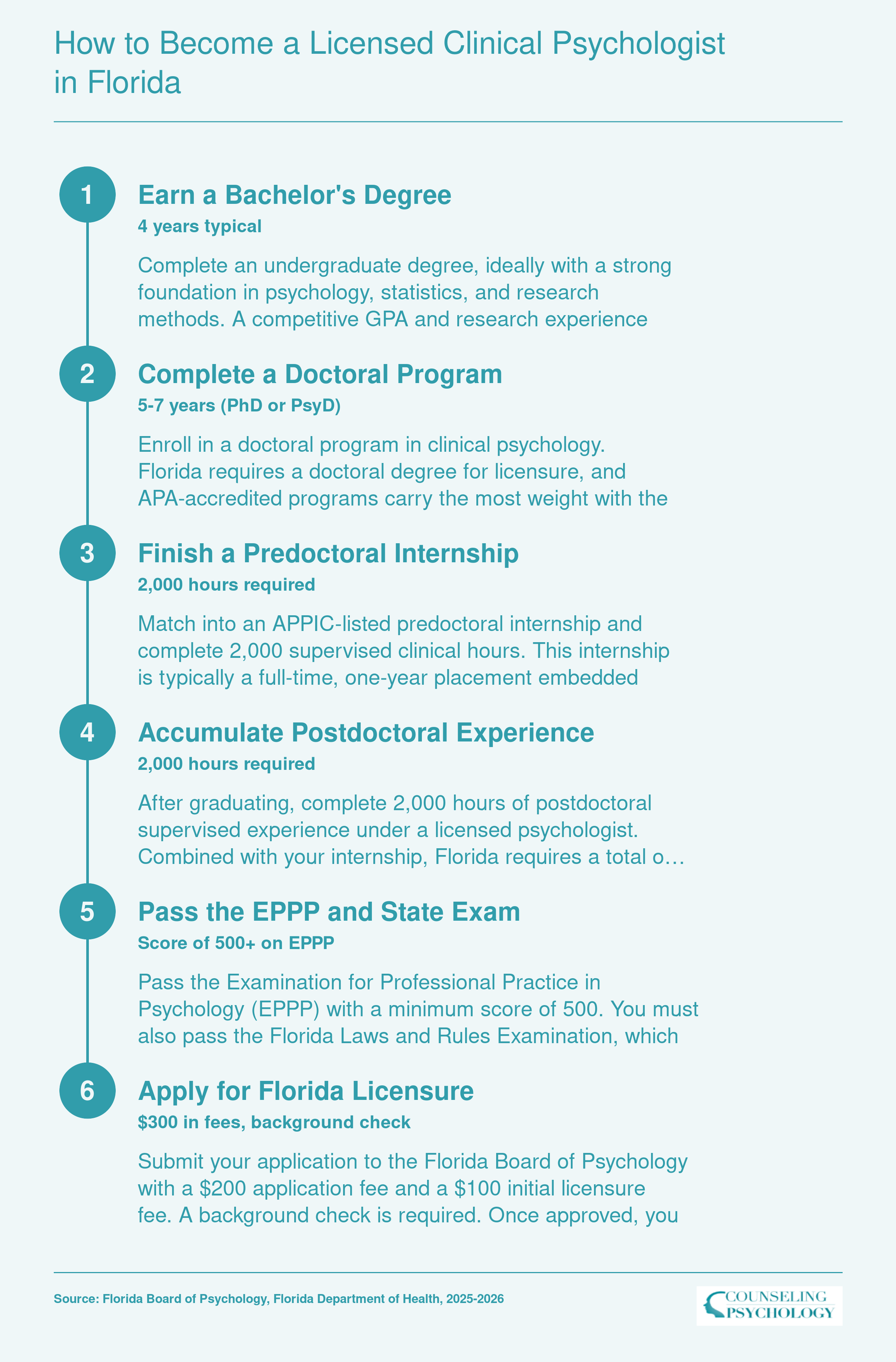
How to Become a Licensed Clinical Psychologist in Florida
Earning your license as a clinical psychologist in Florida is a structured but lengthy process. From your first undergraduate course to the day you receive your license number, expect roughly 8 to 12 years of education, training, and supervised practice. Here is the step-by-step pathway as defined by the Florida Board of Psychology.
Admissions Benchmarks and Competitiveness at Florida Programs
What GPA and GRE scores do you need to get into a clinical psychology doctoral program in Florida? That question has no single clean answer, because each program sets its own standards and those standards shift from cycle to cycle. Here is a practical framework for finding accurate, current information.
Start With Each Program's Official Admissions Page
The most reliable place to find admissions benchmarks is the program's own website. Look for sections labeled "Admissions," "Prospective Students," or "How to Apply." These pages typically spell out minimum GPA thresholds (often 3.0 to 3.5 on a 4.0 scale for doctoral programs), GRE policies, required application materials, and sometimes expected cohort sizes. Program pages at institutions like the University of Florida, Florida State University, Florida International University, the University of Miami, and Nova Southeastern University are updated annually, so bookmark them rather than relying on cached screenshots from applicant forums.
GRE Policies Are in Flux
Several prominent Florida programs have moved to GRE-optional or test-blind admissions in recent years. UF, FSU, and FIU are among those that have revised their testing requirements, though policies can reverse or change with little notice. Never assume a program's GRE stance based on what you read in a forum post from two cycles ago. Check the admissions page directly before you spend time or money on testing. If you are also weighing broader counseling psychology phd programs, the same advice applies: verify testing requirements at the source.
Use the APA Directory to Confirm Accreditation and Cohort Size
The APA maintains a searchable directory of accredited programs that includes basic program information, including typical cohort sizes. It is not a substitute for each school's admissions page, but it is useful for confirming active accreditation status and pulling contact information so you can ask the program coordinator specific questions.
Applicant Forums Fill in the Gaps, With Caveats
Sites like The GradCafe and Reddit's r/ClinicalPsychology collect self-reported data from applicants: interview dates, acceptance notifications, GPA ranges, and anecdotal GRE scores. Scanning multiple posts across multiple cycles can reveal useful patterns, such as whether a program tends to invite interviews in December or February, or how competitive a given cohort appeared. Treat this data as directional rather than definitive. Self-reporting is unverified, sample sizes are small, and outliers can skew your perception of what a "typical" admitted applicant looks like.
The bottom line: triangulate across official program pages, the APA directory, and applicant forums, then follow up directly with admissions coordinators when you need clarification. That combination gives you the most complete picture without overcommitting to any single source.
Online and Hybrid Clinical Psychology Programs in Florida
The demand for flexible graduate education has grown steadily, and several Florida institutions now offer online or hybrid formats for students pursuing clinical psychology. While fully online doctoral programs in clinical psychology remain relatively rare (especially those carrying APA accreditation), hybrid models that blend virtual coursework with in-person clinical training have become more common.
Hybrid programs typically require students to complete didactic coursework online while attending on-campus intensives, practica, or lab sessions at scheduled intervals. This structure appeals to working professionals and students who cannot relocate full-time but still need the hands-on clinical hours that licensure demands. Schools like Nova Southeastern University and Carlos Albizu University have been early adopters of blended delivery in Florida, offering PsyD tracks that incorporate significant online components alongside required clinical rotations.
When evaluating online or hybrid options, keep a few things in mind:
- Accreditation status matters most. APA accreditation is the gold standard, and not all hybrid programs hold it. Verify a program's standing before enrolling.
- Clinical practicum requirements will still involve in-person supervision. Make sure you understand the time commitment and location logistics.
- Some employers and licensing boards view fully online doctorates with skepticism, so a hybrid model with strong clinical training can offer a practical middle ground.
- Tuition for hybrid programs can vary widely. Factor in travel costs for any required on-campus residencies.
If you are weighing doctoral options beyond Florida, exploring clinical psychology doctorate programs nationally can help you benchmark what hybrid and online formats look like across the field. Students interested in related graduate paths in the state may also want to review the best MFT programs in Florida for an additional point of comparison.
Yes, people with autism and other disabilities can and do become licensed clinical psychologists. The Americans with Disabilities Act requires graduate programs and licensing boards to provide reasonable accommodations throughout training, examinations, and the licensure process. Many successful clinicians bring lived experience with disability into their practice, often enhancing their therapeutic work with clients facing similar challenges.
Frequently Asked Questions About Clinical Psychology in Florida
Prospective students often have similar questions about clinical psychology training in Florida. Below are straightforward answers grounded in current program data, Florida Board of Psychology requirements, and Bureau of Labor Statistics figures.