

What you’ll learn in this article…
- Phoenix offers three CSWE-accredited BSW programs, with net prices well below the national bachelor's degree average.
- Arizona's LBSW license requires no post-degree supervision, so BSW graduates can apply immediately after finishing.
- Over 85% of students at the most affordable Phoenix BSW programs receive need-based financial aid.
- Most Phoenix BSW graduates secure employment within one year, making the degree a strong return on investment.
A bachelor's degree is now the floor for professional social work practice in Arizona, and the state's aging population and mental health needs are driving caseloads higher. Three CSWE-accredited BSW programs in the Phoenix area offer a direct route to the Licensed Baccalaureate Social Worker (LBSW) credential, with net prices ranging from $13,500 to $22,500 after aid. The schools differ in delivery, graduation rates, and student outcomes; cost comparisons, licensure steps, and financial aid strategies all inform the return-on-investment analysis. Program-level earnings data for BSW graduates in Phoenix is not yet published, but national median earnings for bachelor's-level social workers near $58,000 make net price a critical variable in the debt-to-income equation.
Best Affordable BSW Programs in Phoenix for 2026
Phoenix is home to three institutions offering CSWE-accredited Bachelor of Social Work programs, each at a different price point and delivery format. We ranked them by net price after financial aid, then weighed graduation rates, student outcomes, and program features. All graduation rates cited below are institution-wide figures, not specific to the BSW program. Program-level earnings data are not yet available for these BSW offerings, so we reference institution-wide median earnings ten years after enrollment where relevant.
- Net price after financial aid
- Institution-wide graduation rate
- Delivery format and flexibility
- Field education requirements
- Long-term graduate earnings
- College Scorecard graduate earnings — collegescorecard.ed.gov
- Internal program database
- NCES-IPEDS federal institutional data — nces.ed.gov
- Independent program research

University of Phoenix-Arizona
University of Phoenix-Arizona offers a fully online Bachelor of Science in Social Work that requires 120 credits and includes 400 hours of in-person field education at approved sites. The program is CSWE-accredited and designed for working adults, with courses ranging from five to fifteen weeks. At a net price of $13,520 after aid, it is the lowest-cost BSW option in the Phoenix area, though its institution-wide graduation rate of 20.8% is something prospective students should weigh carefully.
- Fully online delivery with 400 field education hours required
- CSWE-accredited, preparing graduates for state licensure
- 120 total credits at $398 per credit plus fees
- Approximately 4.25-year program length
- Courses range from 5 to 15 weeks for scheduling flexibility
- Transfer credits and military tuition savings accepted
- Focus on advocacy, client assessment, and research skills
- Career services and scholarship opportunities included
Bachelor of Science in Social Work — Online

Arizona State University
Arizona State University's campus-based BSW program emphasizes generalist social work practice, blending coursework in social policy, human behavior, and research with hands-on field instruction. ASU partners with local clinics for practicum placements, a strong advantage for students who want field experience in the Phoenix metro area. The institution-wide graduation rate sits at 68%, the highest among these three schools, and the median earnings figure of $62,668 ten years after enrollment reflects outcomes across all ASU graduates. In-state tuition is $12,223, with a net price of $14,967 after aid.
- Campus-based program with local clinic practicum partnerships
- Focuses on generalist social work practice
- Includes field instruction integrated into the curriculum
- Covers social policy, human behavior, and research
- Builds skills in advocacy and case management
- Accepts GED, HiSET, and other equivalency pathways for admission
- Financial aid options available; 62.8% of undergrads receive Pell Grants
- Next cohort start date of August 20, 2026
Bachelor of Social Work — On-Campus

Grand Canyon University
Grand Canyon University offers a hybrid Bachelor of Social Work that students can complete online, on campus, or through a combination of both. GCU integrates a Christian worldview into its social work curriculum and places particular emphasis on cultural competency, trauma-informed care, and ethical practice. The program requires 120 credits, including 400 hours of supervised field experience. At a net price of $22,472 after aid, it is the most expensive option on this list, but the institution-wide graduation rate of 43.5% and median graduate debt of $22,114 remain competitive among private universities.
- Hybrid format with online ($485/credit) and campus ($8,250/semester) options
- CSWE-accredited with 400 hours of supervised field experience
- 120 total credits: 72 major, 34 to 40 general education, 8 to 14 electives
- Integrates a Christian worldview throughout the curriculum
- Emphasizes trauma-informed care and cultural competency
- 8-week online courses and 15-week campus courses available
- Up to 90 transfer credits accepted
- Capstone project required for graduation
Bachelor of Social Work — Hybrid
How We Ranked These BSW Programs
Some affordability lists simply sort schools by sticker price, while others bury their methodology entirely. Neither approach serves students trying to make informed financial decisions about their education. Here, we prioritize transparency so you understand exactly what these rankings reflect and what they cannot tell you.
Data Sources and What They Measure
Our rankings draw from two primary federal databases. The College Scorecard provides both institution-level metrics and program-specific data where available, including median earnings for graduates and debt figures. IPEDS (Integrated Postsecondary Education Data System) supplies tuition rates, enrollment figures, and financial aid statistics directly reported by colleges.
These sources offer standardized, verified information rather than self-reported marketing claims. When a school reports data to the federal government, there are consequences for inaccuracy.
How We Weighted the Factors
Because this is an affordability-focused guide, net price carries the heaviest weight in our methodology. Net price represents the average cost after scholarships and grants for students receiving financial aid. This figure matters more than published tuition because it reflects what students actually pay.
We also factor in the percentage of students receiving institutional aid and the average aid package size. Schools that stretch their aid dollars across more students rank higher than those offering large packages to only a handful of recipients.
Graduation rates provide a secondary signal. A program that costs less but graduates fewer students may not deliver real savings. Note that graduation rates are institution-wide figures, not specific to BSW programs.
What These Numbers Cannot Tell You
Net price is an average, not a personalized quote. Your actual cost depends on your family income, residency status, academic record, and the specific aid you receive. A student qualifying for substantial need-based aid might pay significantly less than the stated average, while an out-of-state student with higher family income could pay more. Use these figures as starting points for comparison, then request individualized estimates through each school's net price calculator.
BSW Program Comparison: Cost, Accreditation, and Delivery
This side-by-side breakdown covers the three CSWE-accredited BSW programs available in the Phoenix metro area as of 2026. All three hold Council on Social Work Education (CSWE) accreditation, which is the standard required for licensure eligibility in Arizona. Net price figures reflect average costs after financial aid for students receiving aid, sourced from federal data.
| School | In-State Tuition | Out-of-State Tuition | Avg. Net Price | Graduation Rate | Pell Grant Recipients | Format | CSWE Accredited | Est. Field Placement Hours |
|---|---|---|---|---|---|---|---|---|
| University of Phoenix | $9,552 | $9,552 | $13,520 | 20.8% | 85.8% | Online | Yes | 400 hours |
| Arizona State University | $12,223 | $33,139 | $14,967 | 68% | 62.8% | On Campus | Yes | 480 hours |
| Grand Canyon University | $18,508 | $18,508 | $22,472 | 43.5% | 70.6% | Hybrid | Yes | 400 hours |
What to Look for in an Accredited BSW Program
A low tuition price matters, but it means little if the degree does not lead to licensure. In Arizona, as in most states, the non-negotiable first filter for any Bachelor of Social Work program is accreditation by the Council on Social Work Education (CSWE).1 Without it, graduates cannot sit for the Arizona social work licensing exam or pursue the Licensed Baccalaureate Social Worker (LBSW) credential. Every program in this ranking holds that mark, so you can weigh cost without sacrificing the credential that starts your career.
Accreditation Opens the Door to Licensure
CSWE accreditation signals that a BSW program meets the rigorous standards laid out in the 2022 Educational Policy and Accreditation Standards (EPAS).2 The standards are organized around a program's mission and goals, an explicit curriculum, an implicit curriculum, and a system of continuous assessment. Across all approved delivery formats, whether traditional campus, hybrid, or fully online coursework, the program must demonstrate that students master nine core competencies. These range from ethical and professional behavior to policy practice and research-informed intervention. The accreditation extends to branch campuses and off-site locations, so even a budget-friendly public university's satellite program in the Phoenix area remains fully recognized.1
Curriculum That Builds Generalist Competence
Every CSWE-accredited BSW curriculum is built as a generalist foundation. Expect courses in human behavior and the social environment (HBSE), social welfare policy, research methods, and practice with individuals, families, groups, and communities. The signature pedagogy, however, is field education. No amount of online simulation replaces the learning that happens under supervision in a real agency setting. This is where theory meets practice, and it is non-negotiable for licensure.
Online Coursework, In-Person Field Placements
Many affordable BSW programs now offer online or hybrid course delivery, which can save on commuting and open access for working adults. But understand this: field placements are almost always completed in person, regardless of the format of your academic classes. CSWE accreditation requires that field sites be appropriately vetted and that the total experience meets the minimum hour threshold.2 The convenience of online lectures does not extend to the direct practice hours you log at a child welfare office or hospital.
Field Education Minimums and Local Opportunities
The CSWE mandates a minimum of 400 hours of field education for BSW students, typically spread across an academic year.2 In the Phoenix metropolitan area, placement options mirror the region's diverse social service landscape. Common settings include child welfare and public human services (many students work with the Arizona Department of Child Safety), as well as large integrated health systems like Banner Health. Community behavioral health agencies, school districts, homeless shelters, aging services, and nonprofit community clinics also host BSW interns.3 The depth of these placements depends on the program's local partnerships, so when comparing costs, ask how the field office supports students in securing a site that aligns with your career goals.
Questions to Ask Yourself
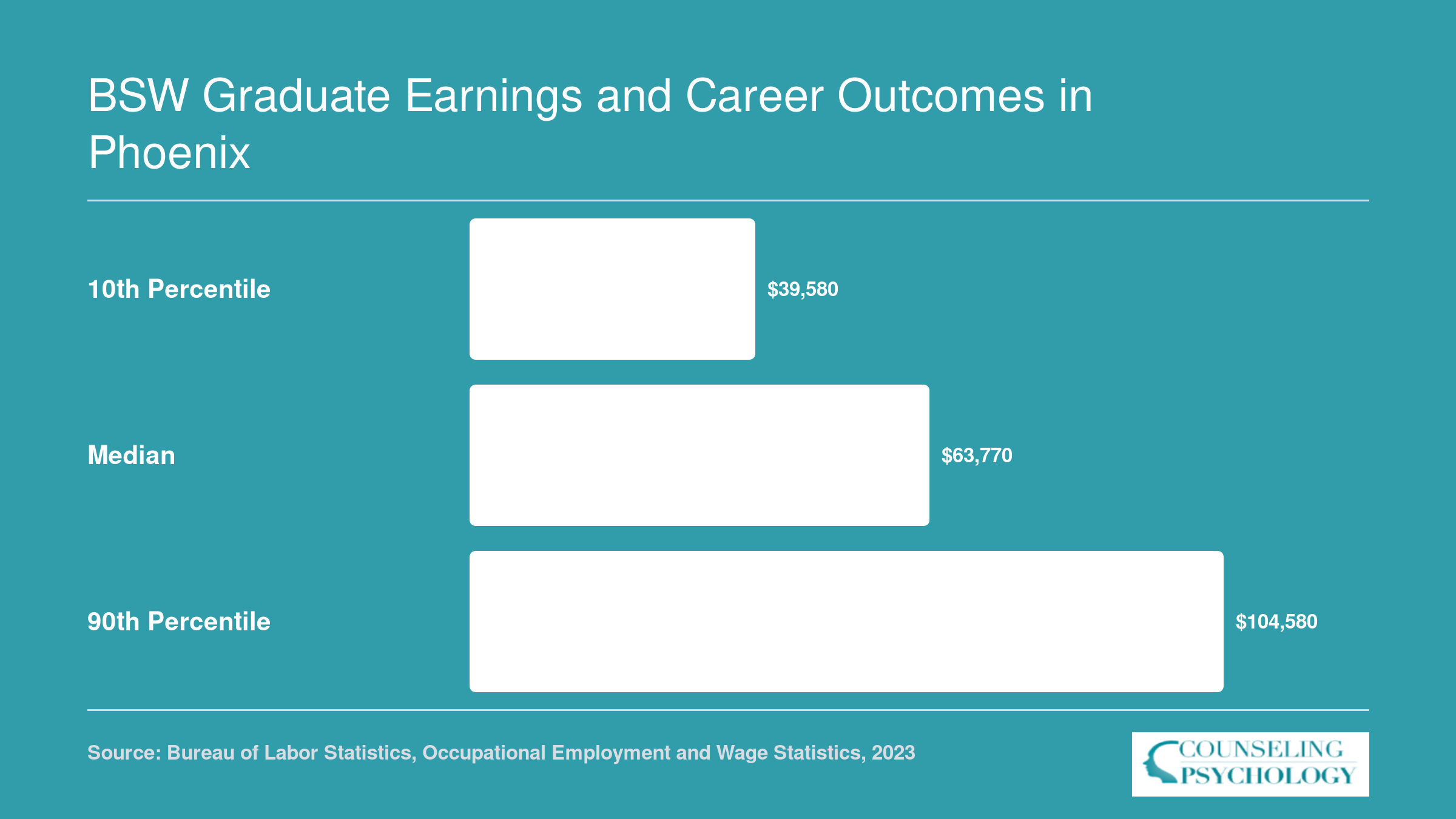
BSW Graduate Earnings and Career Outcomes in Phoenix
The Bureau of Labor Statistics tracks wages for social workers nationally under SOC code 21-1020. While Phoenix-Mesa-Chandler MSA-specific wage data for the "Social Workers, All Other" subcategory (21-1029) was not separately published for the most recent reporting period, the national figures below give BSW graduates a useful baseline. For localized salary estimates, consult school-specific outcome reports or reach out to the Arizona chapter of the National Association of Social Workers (NASW) for regional graduate salary surveys.
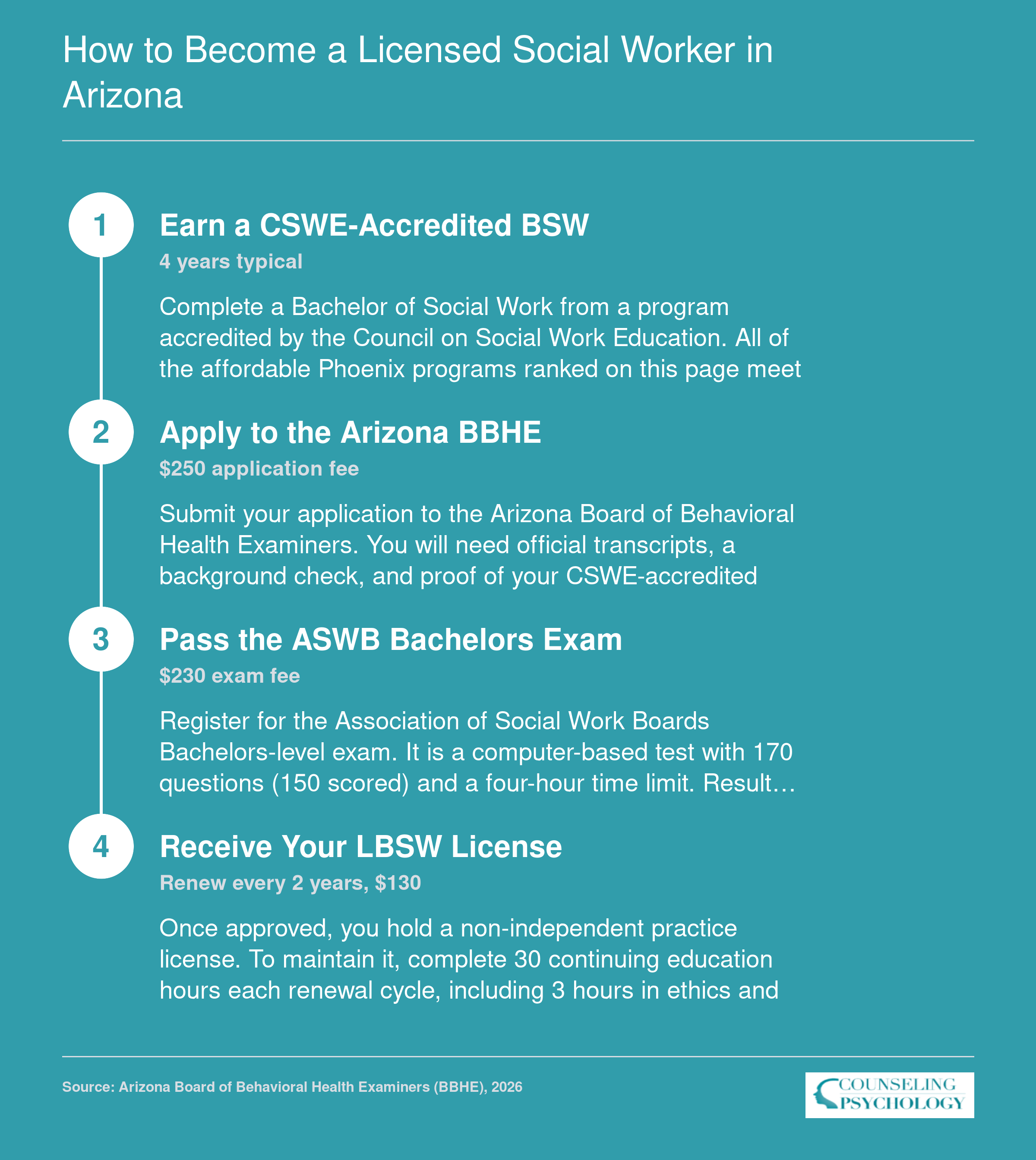
How to Become a Licensed Social Worker in Arizona
Arizona's Licensed Baccalaureate Social Worker (LBSW) credential is the entry-level license for BSW graduates who want to practice in the state. The process is straightforward: no post-degree supervision is required, so you can apply for licensure as soon as you graduate. Budget roughly $480 in combined application and exam fees to get started, and plan for 30 continuing education hours every two years to keep your license active. Every program in our ranked list above holds CSWE accreditation, which means any of them satisfies the degree requirement for LBSW eligibility.
Financial Aid and Scholarships for BSW Students in Arizona
Financial aid for a Bachelor of Social Work degree includes grants, scholarships, loans, and work-study programs that can dramatically reduce your out-of-pocket costs. At the most affordable BSW programs in the Phoenix area, need-based aid is especially common: 85.78% of students at University of Phoenix-Arizona receive federal Pell Grants, while 70.63% at Grand Canyon University and 62.75% at Arizona State University also qualify. These high percentages reflect schools where many students use federal aid to finance their education, and they signal that you are not alone in seeking support.
Federal and State Aid Options
Start with the Free Application for Federal Student Aid (FAFSA) to unlock the Pell Grant (up to $7,395 for 2026-27), Direct Subsidized and Unsubsidized Loans, and Federal Work-Study. For Arizona residents, state-specific programs add valuable layers:1
- Arizona Promise Program: A state grant covering tuition and fees at public universities for students who receive a Pell Grant, maintain a 2.5 GPA, and file the FAFSA by April 1.
- College Ready AZ FAFSA Scholarship: Twenty-five awards of $2,000 each for 2026-27, encouraging early FAFSA filing.2
- Education Forward Arizona Scholarship: Up to four years of support for students with financial need.3
- Adelante Scholarship: For DACA and Prop 308 eligible students.3
- Native American Scholarship Program: Aid for students affiliated with federally recognized tribes.3
- Dorrance Scholarship: A $12,000 award for first-generation students attending Arizona public universities.4
- Keep Your Chin Up Scholarship Fund: For Arizona residents age 25 or older returning to college.4
Social Work-Specific Scholarships
Beyond general aid, several scholarships target BSW students directly. The National Association of Social Workers (NASW) Foundation offers competitive scholarships for BSW and MSW students who demonstrate commitment to social justice. The Council on Social Work Education (CSWE) Minority Fellowship Program supports students from underrepresented backgrounds, including those with financial need. In Arizona, the Chicanos Por La Causa (CPLC) Scholarship at ASU provides up to $10,000 per year for students who maintain a 3.0 GPA and complete 20 volunteer hours per semester.5 Additionally, the Arizona Department of Child Safety administers the Title IV-E Child Welfare Stipend, which covers tuition and fees in exchange for a work commitment of one year per year of stipend in a public or tribal child welfare agency after graduation.6
Tips for Maximizing Your Financial Aid
File the FAFSA as early as possible: some state programs have limited funds and April 1 deadlines. Check with your employer if you already work in human services, as many organizations offer tuition reimbursement for employees earning a BSW. Work-study placements at local nonprofits or social service agencies can provide income while building your resume. Finally, bookmark the Public Service Loan Forgiveness (PSLF) program, which can erase federal student loan balances after 10 years of qualifying employment for social workers in government or nonprofit roles.
Is a BSW Degree Worth It?
A high school diploma can land you an entry-level social services assistant role, but a BSW is the baseline credential for professional social work practice in Arizona. Without it, career advancement and the ability to become licensed remain out of reach. The question of value goes beyond tuition costs: it encompasses job security, earnings potential, and the door to graduate-level education.
Job Market for Social Workers in Arizona
Arizona's overall employment is projected to grow at an annualized rate of 2.2 percent through 2030, adding over 720,000 jobs across all sectors.1 For social workers specifically, the national outlook shows growth on par with the average for all occupations: about 6 percent from 2024 to 2034, with roughly 74,000 openings each year nationally.2 For state-level details, the Arizona Office of Economic Opportunity publishes occupation-specific projections. Checking those figures can clarify local demand for child, family, school, healthcare, and mental health social workers.
Much of this demand stems from an aging population, increased need for mental health services, and ongoing efforts to address substance abuse. In the Phoenix metro area, social workers are employed across hospitals, schools, government agencies, and nonprofit organizations. A BSW qualifies graduates for many of these direct-service positions and is the typical entry requirement for case management, community outreach, and behavioral health technician roles.
Faster Path to an MSW
One of the strongest financial arguments for a BSW is the accelerated route it provides to a Master of Social Work (MSW). Most MSW programs offer advanced standing to BSW graduates, which can reduce the master's timeline by as much as a full year. Instead of two years of full-time study, BSW holders may complete an MSW in about 12 months, slashing tuition costs and allowing faster entry into higher-paying clinical positions.
Without a BSW, aspiring clinical social workers typically need to earn a bachelor's in another field and then commit to a longer MSW program. That pathway not only costs more but delays the ability to sit for the Licensed Clinical Social Worker (LCSW) exam. The National Association of Social Workers (NASW) Arizona chapter counsels students that the BSW-to-MSW pipeline is the most efficient route to full licensure and independent practice. Students weighing related helping professions may also want to explore MFT programs in Arizona, which offer another path into clinical work.
Long-Term Career Growth and Stability
Licensure at the bachelor's level, known as Licensed Baccalaureate Social Worker (LBSW) in Arizona, opens more advanced positions than those requiring only a high school diploma or an unrelated degree. While per-credit costs for BSW programs in Phoenix can be kept low through public institutions, the real return on investment accumulates over time. With an MSW and LCSW, salaries often exceed national medians for social workers, and private practice becomes an option.
Beyond personal earnings, the field offers recession-resistant employment. Social work roles are consistently listed among occupations with projected steady demand, even during economic downturns. For those committed to serving vulnerable populations, the combination of job security and meaningful work makes the BSW a degree that pays back in more than just wages.
For detailed career outlooks and mentorship, the NASW Arizona chapter offers networking events, continuing education, and job boards. Those resources can help confirm that the BSW is not merely a stepping stone but a solid foundation for a durable career.
BSW programs in Phoenix deliver strong return on investment. Net tuition costs run well below the national bachelor's degree average, and graduates typically secure employment within one year of completing their degree. For students seeking an affordable, practical entry into social work, Phoenix's accredited BSW options offer a clear pathway to licensure and career advancement in Arizona's growing behavioral health sector.
Frequently Asked Questions About BSW Programs in Phoenix
Choosing a BSW program is a significant decision, and prospective students often have overlapping questions about cost, timeline, and career value. Below are answers to the most common questions we hear from students exploring affordable BSW options in the Phoenix area.