
What you’ll learn in this article…
- Public MSW tuition near Houston ranges from roughly $6,000 to $9,300 per year, while private programs can exceed $20,000 annually.
- CSWE accreditation is non-negotiable because the Texas BHEC requires it before you can pursue LCSW licensure.
- All MSW students must complete at least 900 supervised field placement hours, which build both clinical skills and professional networks.
- Prairie View A&M University is the closest CSWE-accredited MSW program to downtown Houston, about 45 miles west of the city.
Public flagship versus private university is rarely a simple prestige comparison in social work education. At stake are tuition differences of $30,000 or more over two years, accreditation status that determines your Texas LCSW eligibility, and clinical concentrations that shape which job market you enter.
Houston is the fourth-largest city in the country and one of the most ethnically diverse, which translates into sustained employer demand across hospital systems, community mental health centers, public schools, and child welfare agencies. That demand does not automatically simplify the program choice. Students still face real friction: CSWE accreditation is non-negotiable for licensure, but not every nearby program carries full accreditation status. Tuition for accredited options near Houston spans from under $7,500 per year at public universities to over $38,000 at private institutions.
The field is also growing faster than the national average. Social work occupations overall are projected to add jobs at a pace above average for all occupations nationally through 2033. In a metro like Houston, that signal is meaningful, but starting salaries still cluster in a range that makes program cost a legitimate financial variable, not an afterthought.
Top MSW Programs Near Houston: Rankings Overview
Houston-area students pursuing a Master of Social Work have a mix of local, regional, and fully online options across Texas. The program closest to the city is Prairie View A&M University, roughly 45 miles west of downtown Houston, while several other accredited MSW programs deliver coursework online and can coordinate field placements in Greater Houston agencies. Below, we break down each school's strengths, format, concentrations, and cost so you can zero in on the right fit. Note that all graduation rates listed are institution-wide figures, not specific to the MSW program.
- Net price and tuition affordability
- Institution-wide graduation and retention rates
- Program concentrations and format flexibility
- Accreditation status and licensure alignment
- Regional relevance to Houston students
- NCES-IPEDS federal institutional data — nces.ed.gov
- College Scorecard graduate earnings — collegescorecard.ed.gov
- Internal program database
- Independent program research

Prairie View A & M University
Prairie View A&M University is the closest MSW provider to Houston and the only HBCU in Texas offering this degree. Its online MSW channels students into Medical Social Work and Behavioral Health concentrations built around an Africentric, health-disparities lens, with supervised practicum placements in Houston-area hospitals, clinics, and behavioral health agencies. For students who want to live and work in Greater Houston while completing their degree, PVAMU's proximity and healthcare focus create a direct pipeline to the region's job market. The institution-wide graduation rate is 43.2%.
- Online format with Houston-area practicum placements
- Only HBCU MSW program in the state of Texas
- Africentric curriculum addressing health disparities
- Advanced standing available for BSW graduates (3.0 GPA)
- Prepares graduates for LCSW licensure in Texas
- Supervised internships in hospitals and community clinics
- Micro, mezzo, and macro practice levels covered
- Online delivery designed for working professionals
- Focus on trauma-informed behavioral health interventions
- Traditional and advanced standing pathways offered
- Evidence-based clinical skills for diverse populations
- 2.75 minimum GPA for traditional admission
- Statistics prerequisite required before enrollment
- Field practicums coordinated in student's home community
Master of Social Work, Medical Social Work — Online
Master of Social Work, Behavioral Health — Online

Texas Christian University
TCU's CSWE-accredited MSW stands out for its hybrid format and trauma-informed curriculum, with two concentration tracks in Health and Mental Health and Children and Families. No GRE is required, and BSW graduates can finish in as few as nine months through the 30-credit advanced standing pathway. Dual-degree options with Brite Divinity School add an unusual interdisciplinary angle. The institution-wide graduation rate is 85.5%, the highest on this list, and the 14:1 student-faculty ratio supports personalized advising and practicum matching.
- Hybrid format blending online coursework and campus sessions
- 60-credit traditional track or 30-credit advanced standing
- No GRE required for admission
- Trauma-informed, culturally responsive curriculum
- Dual degree options with Brite Divinity School
- Licensure exam preparation resources included
- CSWE-accredited with 14:1 student-faculty ratio
- Concentration in familial systems and developmental challenges
- Full-time completion in nine months to two years
- Up to 10 transfer credits accepted
- Micro, mezzo, and macro intervention training
- Personalized practicum placement matching
- Certification options in Women and Gender Studies available
- No GRE requirement lowers admission barriers
Master of Social Work, Health and Mental Health — Hybrid
Master of Social Work, Children and Families — Hybrid

Baylor University
Baylor's MSW program in Waco offers both on-campus and fully online pathways, making it accessible to Houston-area students who prefer a faith-integrated curriculum. The on-campus track features Clinical Practice and Community Practice concentrations at $875 per credit hour, while the online version charges $1,100 per credit hour and coordinates localized field placements statewide, including in Houston agencies. Advanced standing for BSW graduates can compress the timeline to roughly 12 months. The institution-wide graduation rate is 80%.
- Campus-based in Waco with social justice curriculum
- 30 to 58 credit hours depending on pathway
- $875 per credit hour for on-campus enrollment
- Advanced standing completion in approximately 12 months
- Dual degree options with Truett Seminary and business school
- Practicum education and LCSW licensure preparation
- CSWE-accredited with 15:1 student-faculty ratio
- Macro-level focus on policy, advocacy, and organizational leadership
- Faith-integrated curriculum with community engagement emphasis
- Same tuition and advanced standing structure as clinical track
- Full-time and part-time enrollment available
- Field practicums in community development settings
- Prepares graduates for nonprofit and government roles
- 100% virtual coursework with localized field placements
- Completion in 16 to 32 months depending on track
- Clinical and community practice specializations offered
- $1,100 per credit hour for online enrollment
- Advanced standing option for BSW graduates
- Houston-area students can complete placements locally
- Mental health and social justice training emphasis
Master of Social Work, Clinical Practice — On-Campus
Master of Social Work, Community Practice — On-Campus
Master of Social Work (Online) — On-Campus

Angelo State University
Angelo State University pairs low public-university tuition with a flexible MSW that can be completed entirely online or on campus in San Angelo. Students choose between Advanced Generalist Practice and Clinical Practice concentrations, both aligned with Texas LMSW and LCSW licensure requirements. A summer study-abroad component is available for students interested in international perspectives. As a federally designated Hispanic-Serving Institution, Angelo State draws a student body that reflects the diversity of many Houston-area communities. The institution-wide graduation rate is 44%.
- Available 100% online or on campus in San Angelo
- CSWE-accredited with small class sizes
- Advanced standing completion in as little as 12 months
- Emphasis on systemic interventions and policy analysis
- Licensed faculty with clinical practice backgrounds
- Summer study-abroad opportunity offered
- HSI designation serving a diverse student population
- Clinical concentration focused on mental health assessment
- Evidence-based therapeutic techniques and trauma-informed care
- Prepares graduates for both LMSW and LCSW exams
- Online format allows Houston residents to enroll remotely
- Field education placements coordinated in student's area
- No Houston-specific cohort but statewide placement support
Master of Social Work, Advanced Generalist Practice — Online
Master of Social Work, Clinical Practice — Online

Texas A&M University-Texarkana
Texas A&M University-Texarkana's 60-credit MSW zeroes in on mental health, trauma-informed care, and substance abuse, a combination that maps well onto high-demand roles in the Houston behavioral health market. The on-campus program in Texarkana offers full-time (two-year) and part-time (four-year) plans, with CSWE accreditation and a clear LCSW licensure pathway. At a net price of roughly $12,997, it is one of the more affordable options on this list, though students based in Houston would need to plan around the distance or seek field-placement accommodations.
- 60-credit curriculum with dedicated trauma and substance abuse training
- On-campus delivery in Texarkana with part-time option
- Full-time completion in two years or part-time in four
- CSWE-accredited with pathway to LCSW licensure
- Minimum 2.8 GPA and three professional references required
- Multi-level interventions across individuals, families, and groups
- $30 application fee with critical thinking essay component
- Intensive clinical focus on psychological assessment
- Prepares students to work across pediatric to geriatric settings
- Field practicum experiences in diverse agency settings
- Adaptable study plans for working professionals
- Addresses complex mental health challenges in underserved areas
- Specialized track within the 60-credit MSW framework
- Advanced practice techniques for trauma survivors
- Emphasis on diverse populations and cultural responsiveness
- Extensive field practicum hours built into curriculum
- Direct pathway to Licensed Clinical Social Worker certification
Master of Social Work, Mental Health, Trauma-Informed Care, Substance Abuse — On-Campus
Master of Social Work, Mental Health — On-Campus
Master of Social Work, Trauma-Informed Care — On-Campus

The University of Texas Permian Basin
UT Permian Basin delivers its MSW entirely online with a distinctive emphasis on rural healthcare and clinical social work. The 65-credit program includes 900 practicum hours and requires no GRE, keeping the admissions process straightforward for career changers. As another federally designated Hispanic-Serving Institution, UTPB serves a student body that mirrors much of Houston's demographic diversity. Houston-based students should know that the curricular focus leans toward rural and frontier practice settings rather than urban contexts. The institution-wide graduation rate is 39.7%.
- Fully online with 65 total credit hours required
- 900 practicum hours for extensive hands-on training
- No GRE required for admission
- 12:1 student-faculty ratio for personalized support
- Minimum 3.0 undergraduate GPA for admission
- HSI designation reflecting a diverse student body
- Prepares graduates for LMSW exam and licensure
- Clinical concentration targeting healthcare and rural settings
- Advanced therapeutic techniques and trauma-informed care
- Evidence-based intervention strategies across populations
- Flexible online format for working professionals
- Diverse elective options to tailor the degree
- Interdisciplinary collaboration and ethical practice emphasis
Master of Social Work — Online
Master of Social Work, Clinical Social Work — Online

East Texas A&M University
East Texas A&M University (formerly Texas A&M University-Commerce) offers a CSWE-accredited MSW that is fully online and asynchronous, making it one of the most schedule-friendly options for Houston-area working professionals. Two tracks are available: a 33-credit Advanced Generalist Practice path for BSW holders and a 57-credit Foundation path open to any bachelor's degree holder. No thesis is required, and field education is coordinated in the student's home community, so Houston residents can complete placements locally. As an HSI, the institution serves a large proportion of first-generation and Pell-eligible students. The institution-wide graduation rate is 42.8%.
- 100% online asynchronous delivery for maximum flexibility
- 33-credit advanced standing or 57-credit foundation track
- No thesis and no foreign language requirement
- CSWE-accredited with Texas LMSW licensure eligibility
- Field placements arranged in student's home community
- Texas resident tuition approximately $3,669 per semester
- Fall, spring, and summer admission cycles available
- HSI serving a high percentage of Pell-eligible students
Master of Social Work — Online
Clinical vs. Macro MSW Concentrations in Houston
The choice between a clinical and a macro concentration is one of the most consequential decisions you will make in an MSW program, yet many students arrive without a clear sense of what each path actually involves day to day.
What Each Track Looks Like in Practice
A clinical MSW focuses on direct practice: individual therapy, mental health assessment, crisis intervention, and work with families. Graduates typically pursue roles in community mental health centers, hospital social work departments, or private practice. The critical licensing step is the Licensed Clinical Social Worker (LCSW) credential, which in Texas requires a master's degree from a CSWE-accredited program plus roughly 3,000 hours of supervised post-graduate clinical experience before you can sit for the clinical exam.
A macro MSW takes a different angle entirely.1 The coursework centers on community organizing, policy analysis, program development, and nonprofit or public-sector leadership. Graduates move into roles as agency directors, policy advocates, grant managers, and community development coordinators. Macro practice does not require post-MSW supervised clinical hours or clinical licensure, which means some professionals enter leadership positions sooner after graduation.
What Houston-Area Programs Offer
The University of Houston Graduate College of Social Work is the most prominent MSW program with a Houston address and explicitly lists a Macro Practice concentration among its offerings.2 The program is CSWE-accredited and can be completed in 51 credit hours through traditional coursework. Students who already hold a BSW from a CSWE-accredited program may qualify for advanced standing, reducing the requirement to 34 credit hours.2 That shorter timeline applies whether you pursue clinical or macro coursework, and it is one of the more meaningful ways BSW holders can accelerate their path. Delivery options at UH GCSW span face-to-face, hybrid, and online formats.
Programs available through or near the Houston region also include tracks with clinical emphases, such as mental health, behavioral health, and medical social work concentrations at other Texas institutions. If your goal is LCSW licensure, confirm before enrolling that the program holds full CSWE accreditation (not candidacy status), since Texas licensure boards require a degree from a fully accredited program.
Deciding Between the Two
Ask yourself a practical question: do you want to sit with clients in a therapeutic relationship, or do you want to shape the systems those clients navigate? If the answer is the former, plan for the post-MSW supervision period as a genuine part of your career timeline, not an afterthought. If it is the latter, a macro concentration opens doors to leadership roles in Houston's large nonprofit sector and Harris County's public health infrastructure without that licensure requirement. Students drawn to clinical work with specific populations, such as childhood trauma counseling, should verify that their chosen program offers relevant electives or field placement sites.
Neither path is more valuable than the other, but they require different planning. For students weighing whether the MSW is the right terminal credential, or whether a DSW or PhD might be the better long-term fit, it helps to explore whether an MSW is a terminal degree. BSW holders deciding between tracks should also weigh whether advanced standing is available at their target program, since it meaningfully reduces time and cost regardless of which concentration you choose.
Questions to Ask Yourself
How Much Does an MSW Cost in Houston?
Tuition for accredited MSW programs near Houston varies dramatically depending on whether you attend a public or private institution. The five public universities listed below charge Texas residents between roughly $6,000 and $9,300 per year, while the two private schools carry sticker prices above $38,000. Keep in mind that the net price figures shown are institution-wide averages after grants and scholarships, not MSW-specific numbers, so your actual out-of-pocket cost may differ. Program-level debt and monthly payment estimates, where available, are based on federal data for all graduate borrowers at each school. Financial aid, scholarships, and loan forgiveness programs can reduce your total cost substantially, and the next section walks through the options Houston-area MSW students should explore.
| School | Type | In-State Tuition | Out-of-State Tuition | Avg. Net Price (After Aid) | Median Graduate Debt | Est. 10-Year Monthly Payment |
|---|---|---|---|---|---|---|
| Texas A&M University, Texarkana | Public | $6,036 | $15,492 | $12,997 | $18,953 | N/A |
| East Texas A&M University | Public | $7,338 | $14,718 | $11,841 | $20,500 | N/A |
| Angelo State University | Public | $7,509 | $14,889 | $15,091 | $20,000 | N/A |
| Prairie View A&M University | Public | $7,993 | $17,378 | $13,570 | $27,000 | N/A |
| UT Permian Basin | Public | $9,276 | $19,116 | $12,723 | $17,750 | N/A |
| Texas Christian University | Private | $38,658 | $38,658 | $36,660 | $21,500 | N/A |
| Baylor University | Private | $43,578 | $43,578 | $41,104 | $23,000 | N/A |
Related Articles
Scholarships, Financial Aid, and Loan Forgiveness for Houston MSW Students
Paying for an MSW does not have to mean graduating with six figures of debt. Houston-area students have access to a layered set of funding options, from university-specific awards to federal forgiveness programs, and knowing where to look is half the battle.
Start With Your Program's Financial Aid Office
The most current, program-level scholarship information lives on the financial aid pages of individual universities. Check the University of Houston Graduate College of Social Work, UT Austin Steve Hicks School of Social Work, and Texas State University's School of Social Work for updated award listings each academic year. Each of these programs participates in Title IV-E funding, a federally supported stipend for students who commit to post-graduation work in public child welfare agencies. Stipend amounts and service obligations vary, so read the specific terms before applying.
NASW Texas Chapter and NASW Foundation Awards
The National Association of Social Workers Texas Chapter website and the NASW Foundation list several scholarships open to graduate social work students, including the Jane B. Aron Doctoral Fellowship and the Verne LaMarr Lyons Memorial Scholarship. Some awards require current NASW membership, which carries its own annual fee, so factor that cost into your planning. Deadlines typically fall in the spring, meaning you should start the application process well before the fall semester you intend to enroll.
Public Service Loan Forgiveness
For students who expect to carry federal loans into their careers, Public Service Loan Forgiveness remains one of the most significant financial tools available. Eligibility requires full-time employment with a qualifying government agency or nonprofit organization, along with 120 qualifying payments under an income-driven repayment plan. Social workers employed by county departments, public hospitals, or 501(c)(3) nonprofits frequently qualify. The official program rules, employer eligibility requirements, and required certification forms are all housed at studentaid.gov. BLS data on social work employment sectors is useful context for understanding which job settings typically qualify.
State-Level Grants and Accreditation Considerations
The Texas Higher Education Coordinating Board administers several state grants that can offset graduate tuition costs. Visit the THECB website directly to review current eligibility requirements, as award availability shifts with each legislative session. One condition that affects nearly all federal and state aid is CSWE accreditation. Programs without Council on Social Work Education accreditation may disqualify graduates from federal Title IV aid, PSLF participation, and, critically, Texas LCSW licensure. Confirm accreditation status through the CSWE program directory before you apply anywhere.
Online, Hybrid, and On-Campus MSW Options Near Houston
Houston-area MSW students can choose from three distinct delivery formats, but the right fit depends on your schedule, learning style, and willingness to commute. Every CSWE-accredited program, regardless of format, requires supervised field placement hours, so even fully online students must complete hands-on practicum work in their local community. Below is a side-by-side look at how the three modalities compare on the dimensions that matter most.
| Dimension | Fully Online | Hybrid (Online + Campus) | On-Campus |
|---|---|---|---|
| Houston-area examples | University of Houston-Downtown, Prairie View A&M, Angelo State, UT Permian Basin, East Texas A&M (all offer fully online MSW options) | Texas Christian University (hybrid format with some campus sessions in Fort Worth) | UTHealth Houston (campus-based program in the Texas Medical Center) |
| Schedule flexibility | Highest: asynchronous coursework lets you study around work or family obligations | Moderate: online coursework combined with periodic in-person intensives or weekend sessions | Most structured: fixed class meeting times, typically weekday daytime or evening |
| Typical time to completion | 2 years full-time (traditional track); 1 year for advanced standing. Part-time tracks may extend to 3 or 4 years. | 2 years full-time (traditional); approximately 9 months for advanced standing at some programs | 2 years full-time (traditional); some programs offer part-time evening options |
| Required field placement hours | Same as other formats. UH-Downtown requires 900 hours (traditional) or 500 hours (advanced standing). Students must secure approved local placements in the Houston area. | Same CSWE field hour requirements apply. Students typically complete placements near their home campus or approved community sites. | UTHealth Houston requires 1,020 hours (traditional) or 540 hours (advanced standing), completed at affiliated Houston-area agencies and medical settings. |
| Peer networking and cohort experience | Virtual discussion boards, group projects, and online study groups. Some programs host optional in-person events or orientations. | Blends online collaboration with face-to-face interaction during campus residencies, offering stronger peer bonds than a fully online model. | Strongest in-person cohort culture with daily interaction, faculty office hours, and campus-based professional development events. |
| Best suited for | Working professionals, career changers, or students outside the immediate Houston metro who need maximum flexibility | Students who want some in-person connection but cannot commit to a full-time campus schedule | Students who thrive in a traditional classroom setting and want direct access to Houston's clinical training sites |
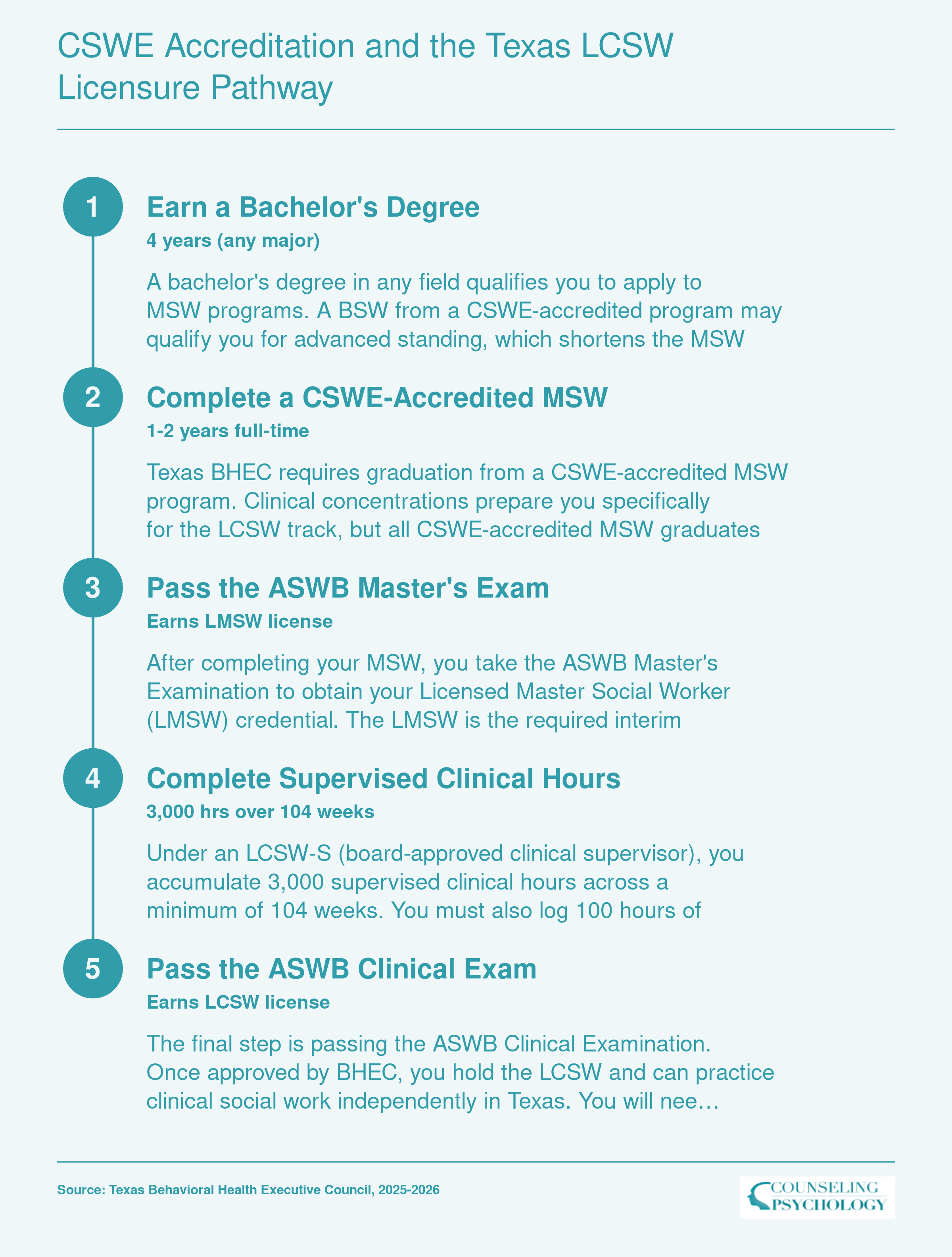
CSWE Accreditation and the Texas LCSW Licensure Pathway
Every aspiring clinical social worker in Texas follows the same credentialing ladder, and it starts with one non-negotiable requirement: your MSW must come from a CSWE-accredited program. The Texas Behavioral Health Executive Council (BHEC) will not let you sit for any social work licensure exam without that credential. Skipping this step, or enrolling in a non-accredited program, means you cannot practice as a licensed social worker in the state.
Salary and Career Outcomes for Houston MSW Graduates
Investing in an MSW comes with a straightforward tension: you are taking on debt and years of study now in exchange for career capital that pays off over time, but how that payoff unfolds depends heavily on which specialty you pursue and where you land.
What Houston-Area Social Workers Actually Earn
BLS occupational wage data for the Houston-The Woodlands-Sugar Land metro (2023) shows a wide spread depending on practice setting.1 Healthcare social workers earn the highest median in the region, at roughly $63,900 per year, with a mean closer to $65,360. Mental health and substance abuse social workers come in lower, at a median of about $51,500. Child, family, and school social workers fall in a similar range, with a metro median around $50,400. These figures are specific to the Houston MSA and should not be read as state or national benchmarks.
The implication for concentration choice is real. A clinical MSW graduate who pursues licensure as an LCSW and moves into a hospital or integrated care setting can expect to enter a wage band that runs roughly $13,000 to $15,000 higher per year than a generalist role in community services or child welfare. Over a career, that difference compounds significantly.
Program-Level Earnings Data
Program-specific earnings outcomes for the MSW programs featured in this guide are not currently reported at the program level through federal sources. That means direct comparisons between, say, a TCU graduate and an East Texas A&M graduate one or four years after completion are not yet available in a reliable, published form. Treat any earnings claims from individual programs cautiously unless they are verified through third-party sources.
Thinking About ROI and Debt
Debt loads vary considerably across the programs in this guide. Public in-state options such as East Texas A&M or Angelo State carry graduate debt medians in the $17,000 to $20,500 range for the institution as a whole. Private programs like TCU and Baylor show institutional debt medians closer to $21,500 to $23,000, though actual MSW-specific borrowing may differ.
A rough way to frame payback: a $20,000 loan balance on a standard 10-year repayment plan translates to roughly $200 per month at current federal rates. Against a starting salary of $50,000 to $54,000, that is manageable. A $45,000 debt load from a higher-cost private program requires a clearer path to the upper end of the wage distribution, which usually means clinical licensure and a healthcare or behavioral health setting, to maintain the same comfort margin.
For Houston graduates specifically, the healthcare social work sector is a genuine bright spot. The Texas Medical Center is the largest medical complex in the world, and its surrounding ecosystem of hospitals, outpatient centers, and specialty clinics creates steady demand for licensed clinical social workers. School-based social work is another stable track, though wages in that sector trend closer to the child and family median.1 Macro or policy-track graduates often find roles in nonprofit management or government agencies, where salaries vary more and advancement depends on organizational size and funding.
The clearest takeaway: if wage growth over the first five to ten years matters to you, licensure as an LCSW and placement in a healthcare or behavioral health setting is the most direct route to the upper half of Houston's social worker wage distribution.
CSWE requires a minimum of 900 field education hours for MSW students, or 400 for advanced standing BSW to MSW students. These placements at Houston hospitals, schools, and community agencies are where you develop licensure qualifying clinical skills and build the professional network that often leads to your first job after graduation.
Admissions Requirements: GPA, GRE, and What Houston MSW Programs Expect
Applying to an MSW program can follow one of two distinct paths: standard admission for those with a bachelor's degree in any field, or advanced standing for candidates who already hold a CSWE-accredited BSW. Houston-area programs offer both, with varying expectations around GPA, test scores, and supporting materials.
Standard Admission Requirements
Most Houston MSW programs have eliminated the GRE requirement. The University of Houston Graduate College of Social Work (GCSW) and University of Houston-Downtown (UHD) do not require GRE scores, and UTHealth Houston also omits this exam.123 Instead, admissions committees focus on undergraduate GPA, personal statements, references, and relevant experience.
Typical minimum GPA thresholds range from 2.75 to 3.0. UHD sets the lowest bar at 2.75, while UH GCSW requires a 3.0.1 UTHealth Houston aligns with the 3.0 benchmark. Keep in mind that institution-wide admission rates from sources like College Scorecard reflect the entire university, not individual MSW programs, which may be more selective. If you are curious about how hard it is to get into grad school more broadly, the competitiveness of these programs follows a similar pattern.
Personal statement expectations vary by length. UH GCSW asks for about three pages, while UTHealth Houston requests up to five.3 Both programs value a clear narrative connecting your experiences to social work practice. Professional references are standard: UH GCSW requires two to three letters, and UHD and UTHealth typically expect two or three as well.1
Advanced Standing: A Faster Track for BSW Holders
If you earned a CSWE-accredited BSW within the past few years, advanced standing can significantly shorten your MSW timeline. At UHD, the advanced standing track requires just 30 credits and 500 field hours, compared to 60 and 900 in the standard program.2 UH GCSW similarly waives the foundation curriculum for eligible BSW graduates, though you still complete the advanced curriculum.4 UTHealth Houston offers a 30-credit advanced standing track, while its standard track totals 62 credits.3
Admission to advanced standing runs through a separate process. Most programs require the BSW to be recent (often within five to seven years) and a higher GPA, sometimes a 3.0 or above in the BSW coursework. UHD allows part-time advanced standing, a helpful option for working professionals.2
Strengthening Your Application
A GPA below the preferred minimum does not automatically disqualify you. UH GCSW, for example, offers conditional admission for candidates who show strong potential through other components.1 Most MSW programs value social work or human services experience, even if unpaid. Volunteer hours, internships, or work in related roles can offset a lower GPA. If your numbers are borderline, emphasize the depth of your direct service experience and the clarity of your personal statement.
Application deadlines matter. UTHealth Houston's priority deadline is February 1, with a final cutoff on May 1.3 Other Houston programs operate on rolling or semester-based cycles, so check each school's website for the latest dates.
Frequently Asked Questions About Houston MSW Programs
Below are answers to questions prospective MSW students in the Houston area ask most often. Each response draws on program details, costs, and licensure requirements discussed throughout this article.