
What you’ll learn in this article…
- NYC metro school counselors earn a median salary of $77,970, well above the national median for this occupation.
- CUNY graduates typically carry roughly $10,300 to $11,000 in student debt, compared to $20,500 to $24,300 at private universities.
- New York State certification requires a master's degree, specific exams, and supervised practice before you can work in schools.
- CACREP accreditation eases license portability across states, a key consideration if you may relocate after graduation.
New York City operates the largest public school system in the United States, with over 1,800 schools and roughly 1 million students. That scale creates sustained, structural demand for school counselors, and a 272:1 student-to-counselor ratio in NYC public schools (as of 2024) underscores how far the city still falls from the 250:1 standard recommended by the American School Counselor Association.
For prospective students, the real tension is navigating a fragmented program landscape. CACREP accreditation, New York State certification requirements, cost differences between CUNY and private universities, and the choice between on-campus and online formats all affect both your training experience and your long-term career options. A 48-credit program at a CUNY school can cost a fraction of a comparable private university degree, yet both can lead to the same state certification.
The NYC metro area also ranks among the highest-paying markets in the country for school counselors, with a metro median salary of $77,970 according to BLS data, well above the national median for the occupation. That earnings premium matters when weighing debt against expected income, particularly given the meaningful gap between what CUNY and private program graduates typically borrow.
Best Master's in School Counseling Programs Near NYC
The programs below span the five boroughs, the Hudson Valley, and upstate New York, giving aspiring school counselors a range of price points, formats, and specializations. Every program on this list leads to New York State School Counselor certification, and several carry CACREP accreditation, a credential that streamlines licensure reciprocity if you ever practice outside New York. We surface tuition, median debt, and institution-level earnings so you can weigh cost against long-term return before you apply.
- Accreditation and certification alignment
- Graduate debt and net price
- Institutional graduation and retention rates
- Program format and fieldwork structure
- NYC-area relevance and placement networks
- College Scorecard graduate earnings — collegescorecard.ed.gov
- NCES-IPEDS federal institutional data — nces.ed.gov
- Independent program research
- Internal program database

CUNY Hunter College
Hunter College pairs one of the lowest net prices in the CUNY system with deep ties to New York City Department of Education schools, where most practicum and internship placements occur. The 60-credit M.S.Ed. in School Counseling requires 700 field hours across diverse borough settings and does not require the GRE, lowering barriers for working professionals already embedded in city schools. Institutional median graduate debt sits at just $11,000, making Hunter a standout value for students committed to urban K-12 counseling.
- 60-credit program with 700 required field hours
- No GRE required for admission
- Practicum sites across all five NYC boroughs
- Leads to NYS initial and professional certification
- Full-time and part-time scheduling available
- Curriculum emphasizes multicultural and urban counseling
- In-state graduate tuition approximately $11,400/year
M.S.Ed. in School Counseling — On-Campus

CUNY Brooklyn College
Brooklyn College's M.S.Ed. in School Counseling is built around a cohort model with evening classes designed for working professionals in the NYC metro area. The program requires 720 fieldwork hours in city schools and offers a bilingual school counseling specialization that directly addresses the linguistic diversity of New York City's K-12 population. At roughly $3,100 average net price and $11,000 median graduate debt, it delivers strong affordability within a social-justice-oriented curriculum.
- 60-credit cohort-based program
- 720 total fieldwork hours in NYC schools
- Bilingual school counseling specialization available
- Social justice and urban counseling focus
- Evening classes for working professionals
- Leads to NYS provisional school counselor certification
- In-state graduate tuition approximately $11,500/year
M.S.Ed. in School Counseling — On-Campus

CUNY Queens College
Queens College reports a 94% job placement rate and a 100% certification exam pass rate for its school counseling graduates, metrics that are hard to find published elsewhere. The 60-credit M.S.Ed. covers Pre-K through 12th grade and places students in both K-8 and 9-12 NYC school settings during fieldwork. Its commuter-friendly Queens location and low median graduate debt of roughly $10,300 make it especially practical for professionals already working in city or Long Island schools.
- 60-credit program covering Pre-K through grade 12
- 100% certification exam pass rate reported
- 94% job placement rate among graduates
- Fieldwork in both K-8 and 9-12 school settings
- Leads to NYS initial and professional certification
- Evening schedule supports working professionals
- Median institutional graduate debt approximately $10,300
M.S.Ed. in School Counseling — On-Campus

New York University
NYU Steinhardt offers a fully online M.A. in School Counseling (48 to 51 credits) with a dedicated bilingual school counseling track. Although the coursework is delivered remotely, NYU's field placement staff leverage extensive NYC school partnerships to arrange internships throughout the five boroughs. The program is accredited by MPCAC and leads to New York State certification. NYU's institutional median graduate debt is $20,500, and its net price of roughly $37,050 reflects the premium of a private research university, though robust financial aid packages offset sticker price for many students.
- 48 to 51 credits, fully online delivery
- MPCAC-accredited program
- Bilingual school counseling concentration available
- Internship placements arranged in NYC schools
- Full-time and part-time pacing options
- Cross-cultural counseling woven into core curriculum
- Leads to NYS school counselor certification
- Same 48-to-51-credit structure as general track
- Designed for counselors serving multilingual students
- NYC-focused case material and field sites
- Satisfies NYS bilingual extension requirements
- Flexible elective options in social justice topics
- MPCAC accreditation applies to this track
M.A. in School Counseling — Online
M.A. in Bilingual School Counseling — Online

CUNY Lehman College
Lehman College in the Bronx delivers its 60-credit Counselor Education: School Counseling program in a hybrid format, blending online coursework with on-campus sessions that accommodate working school staff across NYC. The program holds both CACREP and CAEP accreditation, a dual credential uncommon among CUNY campuses. Its urban education and social justice framework is tailored to the realities of Bronx and broader NYC schools, and the roughly $3,150 average net price keeps total cost low for in-state students.
- 60-credit hybrid program (online plus on-campus)
- CACREP and CAEP accredited
- Part-time, three-year completion timeline
- Urban education and social justice curriculum
- Leads to NYS school counselor certification
- Designed for working NYC school professionals
- 3.0 GPA required for admission
- Multicultural and anti-racist counseling emphasis
M.S.Ed. in Counselor Education: School Counseling — Hybrid

Touro University
Touro University's fully online Master's in School Counseling spans 60 credits and includes a 600-hour internship, with curriculum and certification guidance built specifically around NYSED requirements. The program targets working professionals who need schedule flexibility but still want a New York-focused credential. Touro's institutional median graduate debt is approximately $15,550, and its net price of around $29,600 places it in the mid-range for private institutions in the city.
- 60-credit fully online program
- 600-hour internship embedded in curriculum
- Structured for NYS school counselor certification
- Covers child development and high-risk behavior topics
- Average three-year completion timeline
- Flexible pacing for working professionals
- Curriculum addresses diverse urban school settings
Master's in School Counseling — Online

University of Rochester
The University of Rochester's Warner School offers a CACREP-accredited, 60-credit school counseling master's with flexible start dates in fall, spring, or summer. Students can enroll full-time or part-time, and the program leads to both initial and professional NYS certification. Scholarships targeted at New York educators help offset the private-university price tag. Rochester's campus is upstate, but its CACREP credential and NYS registration position graduates well for employment anywhere in the state, including NYC DOE schools.
- 60-credit CACREP-accredited program
- Start in any semester: fall, spring, or summer
- Full-time and part-time enrollment options
- Leads to NYS initial and professional certification
- Scholarships available for NY educators
- Internship sites include urban school settings
- Emphasizes leadership, diversity, and advocacy
- Median institutional graduate debt approximately $21,000
School Counseling Master's Degree — On-Campus

University at Buffalo
The University at Buffalo awards a combined M.A. and Advanced Certificate in School Psychology through a three-year, full-time, campus-based program. Registered with the New York State Education Department, the 61-credit curriculum blends assessment, intervention, and consultation coursework with extensive on-site field experiences. As a SUNY flagship, UB offers in-state tuition that is significantly lower than private alternatives, with institutional median graduate debt of $19,000.
- 61-credit dual-award program (MA plus Advanced Certificate)
- Three years of full-time, in-person study
- Registered with NYSED for school psychology certification
- Combines theory with practicum field experience
- In-state graduate tuition approximately $14,500/year
- $50 application fee
- SUNY flagship research university resources
School Psychology MA/Advanced Certificate — On-Campus

State University of New York at New Paltz
SUNY New Paltz sits in the Hudson Valley, within commuting or weekend-travel distance of NYC, and offers a 60-credit M.S. in School Counseling registered for NYS certification. The program can be completed full-time in two years or part-time in three, with internship sites in regional schools whose demographics overlap with downstate districts. In-state tuition of roughly $12,800 and a five-year degree-completion window give students budgetary and scheduling breathing room.
- 60-credit program registered for NYS certification
- Full-time (two-year) or part-time (three-year) options
- Five-year completion window available
- Internships in Hudson Valley school settings
- Minimum 3.0 undergraduate GPA for admission
- Crisis intervention and multicultural counseling coursework
- In-state graduate tuition approximately $12,800/year
M.S. in School Counseling — On-Campus

SUNY Oneonta
SUNY Oneonta's M.S.Ed. School Counselor (K-12) program currently requires 48 semester hours, fewer than the 60-credit standard most New York programs have adopted. The campus-based curriculum covers counseling theories, techniques, and practicum experiences, with a comprehensive exam at the end. Applicants should note that New York's credit expectations for school counselors have been trending upward, so confirming the latest requirements with the department before applying is worthwhile. In-state tuition runs about $12,500 per year.
- 48-semester-hour campus-based program
- Prepares for NYS K-12 school counselor certification
- Comprehensive exam required for completion
- Minimum 3.0 GPA and faculty interview for admission
- Nine credits in psychology or ed-psych prerequisite
- Two professional recommendations needed
- Practical counseling skills and techniques focus
School Counselor (K-12), M.S.Ed. — On-Campus
How We Ranked These NYC-Area School Counseling Programs
What factors actually separate one school counseling program from another when you're comparing costs, outcomes, and career readiness?
Our ranking combines five core factors: tuition and net price, program-level median earnings one year after graduation, median federal student debt at completion, institutional graduation rate, and delivery format availability (online, hybrid, or on-campus). Each program's placement reflects a composite view of affordability, post-graduation economic outcomes, and completion success. CACREP accreditation status is flagged in every profile but does not carry a numeric weight in the rank order. Instead, accreditation serves as an overlay: you see which programs hold the credential New York State values for initial certification, and you decide how heavily to weigh it against cost, location, and format.
Data Sources and Scope
Program-level earnings and debt figures come from the U.S. Department of Education College Scorecard, which publishes field-of-study outcomes for individual CIP codes (in this case, 13.1101, Counselor Education/School Counseling and Guidance Services). Institutional net price, tuition, and graduation rates are drawn from the Integrated Postsecondary Education Data System (IPEDS). CACREP accreditation status is verified against the Council for Accreditation of Counseling and Related Educational Programs public directory, current as of May 2026.
Limitations to Keep in Mind
Net price is an institution-wide average for full-time, first-time students receiving Title IV aid. It is not a per-student guarantee and does not account for part-time enrollment, employer tuition reimbursement, or program-specific scholarships. Graduation rates are similarly institutional, calculated for the cohort of first-time, full-time degree-seeking undergraduates; they do not isolate master's students or school counseling candidates specifically. Program earnings reflect graduates who filed federal financial aid applications and consented to data matching, so the sample may not cover every alumnus. Use these figures as benchmarks, not guarantees, and verify current pricing and aid packages directly with each admissions office.
CACREP vs. Non-CACREP Programs: Why Accreditation Matters in New York
Choosing between a CACREP-accredited program and one without that credential comes down to where you plan to work and how much flexibility you want in your career trajectory.
What CACREP Accreditation Actually Means
The Council for Accreditation of Counseling and Related Educational Programs (CACREP) sets national standards for counselor education.1 Programs that earn this accreditation meet rigorous requirements for curriculum design, faculty qualifications, and supervised clinical experience. Most notably, CACREP-accredited school counseling programs require a minimum of 600 hours of practicum and internship experience, ensuring graduates enter the field with substantial hands-on training.
Curriculum in CACREP programs aligns with standards set by the American School Counselor Association (ASCA), covering eight core areas including human growth and development, career development, and assessment. This standardization means employers and licensing boards in other states immediately recognize the training you received. If you are exploring CACREP options beyond the NYC area, our guide to CACREP accredited online school counseling programs offers a broader look at what is available nationwide.
New York's Flexible Approach to Certification
Here is the practical reality for New York: NYSED does not require CACREP accreditation for school counselor certification. The state accepts graduates from non-CACREP programs as long as those programs meet specific credit and content requirements established by the education department. This means you can earn your initial and professional certificates through programs like Brooklyn College's School Counseling M.S.Ed., which is not CACREP-accredited but remains a valid pathway to working in New York schools.3
However, if you think you might relocate, this flexibility has limits. Many states outside New York either require or strongly prefer CACREP-accredited degrees for licensure. Graduating from a non-CACREP program could mean additional coursework, extended supervision hours, or other remediation steps before you can practice elsewhere.
NYC-Area Program Landscape
The CACREP-accredited options in the NYC metro area are limited. CUNY Lehman College's Counselor Education: School Counseling M.S.Ed. holds CACREP accreditation (maintained since 2008) and requires 60 credits delivered through an online-residency format.2 Beyond Lehman, the other prominent programs in the region, including Brooklyn College's well-regarded school counseling track, operate without CACREP status.3
Practical Advantages Worth Considering
Beyond licensure portability, CACREP accreditation offers a few additional benefits:
- NBCC certification: The National Board for Certified Counselors requires graduation from a CACREP-accredited program for most of its credentials, which can enhance your professional standing.
- Employer recognition: Some school districts and private schools view CACREP credentials as a quality marker during hiring.
- Consistent training standards: You know exactly what clinical hours and curriculum you will complete, reducing guesswork about program rigor.
If your career plans center firmly on New York, a non-CACREP program can serve you well. If you value geographic flexibility or plan to pursue national certification, prioritizing CACREP accreditation makes strategic sense.
Questions to Ask Yourself
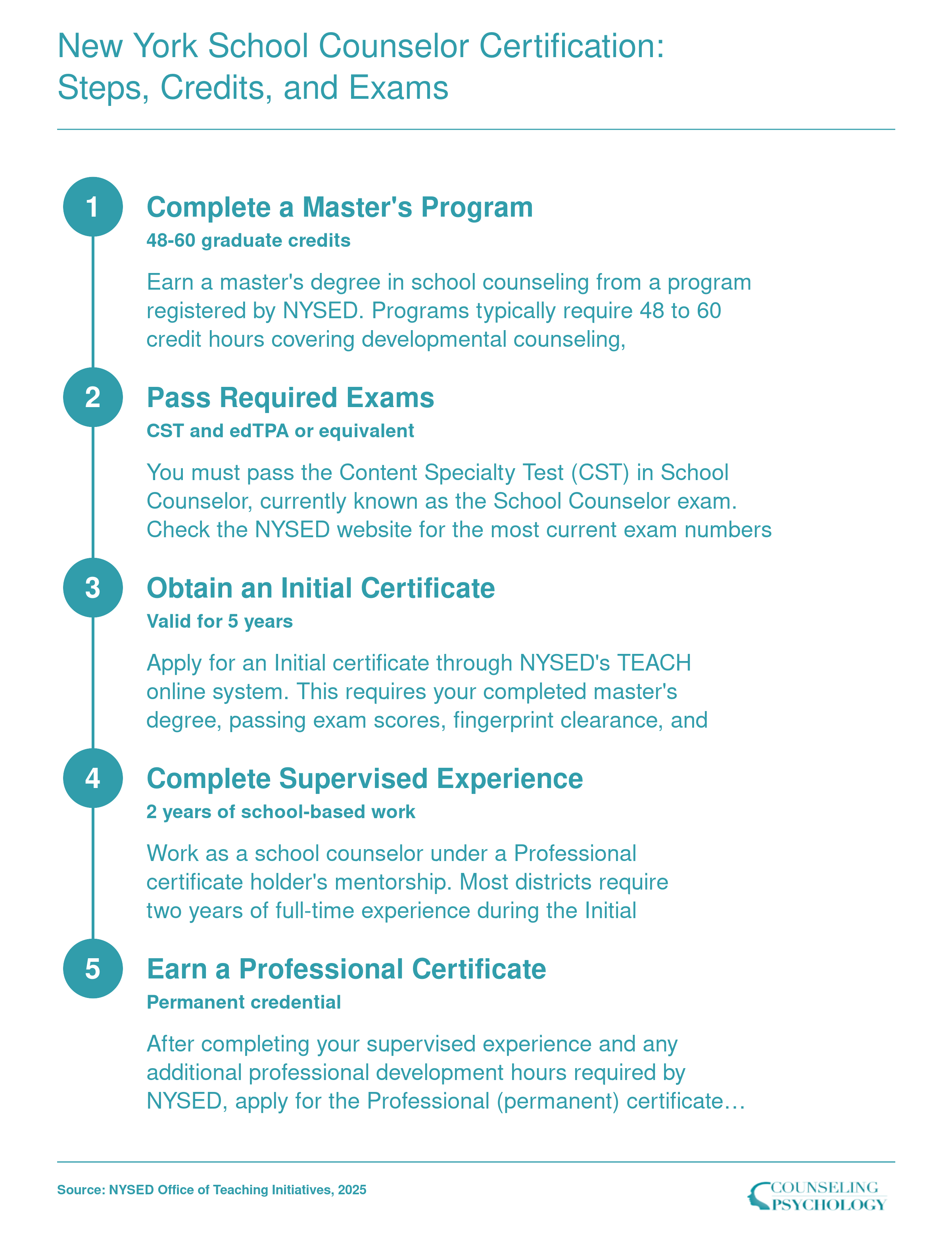
New York School Counselor Certification: Steps, Credits, and Exams
New York requires a specific sequence of education, testing, and supervised practice before you can work as a certified school counselor. The New York State Education Department (NYSED) Office of Teaching Initiatives is the definitive source for current requirements, but the pathway generally follows these steps.
Online vs. On-Campus School Counseling Programs: NYC Options Compared
Among the 15 ranked programs on this list, the majority (11) are delivered entirely on campus, two are offered online, and one uses a hybrid format that blends online coursework with in-person requirements. Regardless of delivery mode, every school counseling program in New York requires supervised practicum and internship hours in actual school settings, typically 600 to 720 hours. That means your proximity to NYC-area schools matters even if your coursework is fully online. Here is how the three formats compare across the dimensions that matter most to working adults and career changers.
| Dimension | Fully Online | On-Campus | Hybrid |
|---|---|---|---|
| Programs in our rankings | 2 (NYU, Touro University) | 11 (including Hunter College, Brooklyn College, Queens College, Fordham, Syracuse, and others) | 1 (CUNY Lehman College) |
| Schedule flexibility | Highest: coursework is asynchronous or scheduled around your availability, ideal for students working full time | Lowest: most classes meet on a fixed evening or daytime schedule at a specific location | Moderate: online lectures paired with periodic on-site sessions, offering more flexibility than a fully campus-based plan |
| Practicum and internship logistics | You still complete 600+ hours in person at a school site; NYC-area students benefit from the city's large number of placement partners, but you must coordinate placements yourself or through the program | Programs typically maintain established pipelines with local school districts, making placement coordination smoother | Similar placement support to campus programs, with the added convenience of completing didactic work remotely |
| Networking and cohort experience | Virtual cohort models and discussion boards; less organic peer interaction, though some programs host optional residencies or meetups | Strongest cohort bonding through daily classroom interaction, group projects, and shared field placements | A middle ground: you build relationships during in-person intensives while maintaining an online community between sessions |
| Typical in-state graduate tuition (annual) | Ranges from roughly $15,000 (Touro University) to about $42,700 (NYU) | CUNY campuses start near $11,400 to $11,600; private institutions like Fordham and Syracuse range from roughly $26,800 to $48,100 | About $11,600 at CUNY Lehman College, one of the most affordable options on the list |
| Best suited for | Students juggling work or family commitments who live in the NYC metro area and can arrange their own field placements | Full-time students or those who want structured schedules, strong faculty mentorship, and built-in school district connections | Working professionals in the Bronx or nearby boroughs who want partial campus engagement without committing to a fully on-site schedule |
Cost, Debt, and Earnings: The ROI of NYC School Counseling Programs
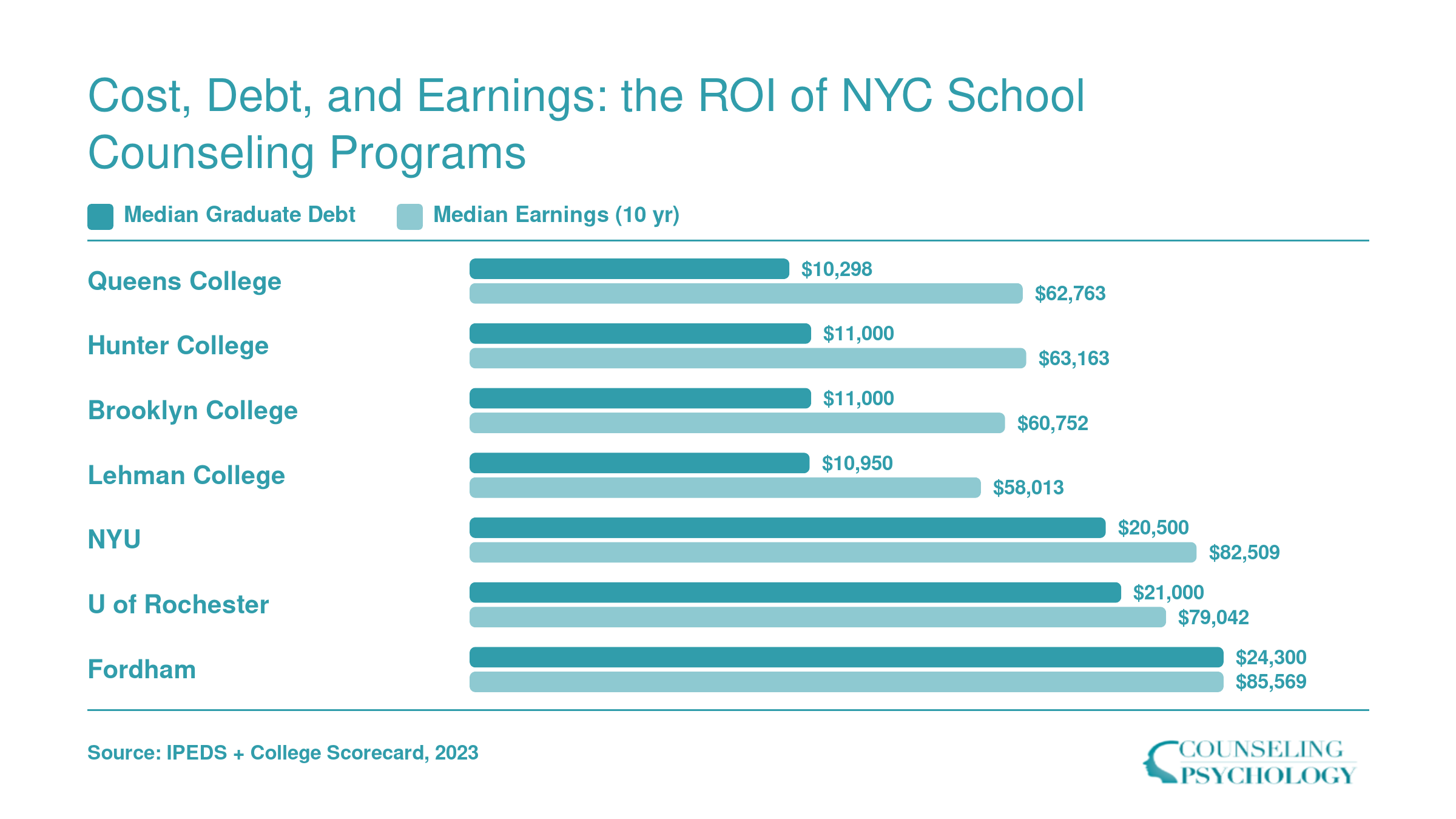
The gap between public and private tuition is dramatic, but median graduate debt tells a more nuanced story. CUNY graduates typically leave with roughly $10,300 to $11,000 in debt, while private university graduates carry $20,500 to $24,300. When you compare those debt loads against institution-level median earnings ten years out, the CUNY campuses deliver the strongest debt-to-earnings ratio, with graduates earning roughly five to six times their median debt. Private programs produce higher raw earnings but at a steeper upfront cost.
What School Counselors Earn in the NYC Metro Area
The New York-Newark-Jersey City metro area is one of the highest-paying markets in the country for educational, guidance, and career counselors. According to BLS data, the NYC metro median salary of $77,970 sits well above the national median for this occupation (roughly $61,710 nationally). With nearly 19,000 professionals employed across the metro area, the region also represents one of the largest concentrations of school counseling jobs in the United States.
| Metro Area | Total Employment | 10th Percentile | 25th Percentile | Median | 75th Percentile | 90th Percentile |
|---|---|---|---|---|---|---|
| New York-Newark-Jersey City, NY-NJ | 18,980 | N/A | $62,220 | $77,970 | $101,250 | N/A |
| Kingston, NY | 170 | N/A | $56,550 | $76,200 | $102,300 | N/A |
| Kiryas Joel-Poughkeepsie-Newburgh, NY | 680 | N/A | $57,000 | $70,330 | $96,640 | N/A |
| Syracuse, NY | 850 | N/A | $53,830 | $67,070 | $84,670 | N/A |
| Binghamton, NY | 260 | N/A | $58,050 | $66,600 | $82,080 | N/A |
| Ithaca, NY | 270 | N/A | $59,720 | $63,300 | $66,940 | N/A |
| Albany-Schenectady-Troy, NY | 1,250 | N/A | $55,150 | $62,090 | $80,730 | N/A |
| Utica-Rome, NY | 330 | N/A | $52,120 | $61,320 | $78,170 | N/A |
| Rochester, NY | 1,560 | N/A | $51,830 | $60,100 | $73,340 | N/A |
| Buffalo-Cheektowaga, NY | 1,570 | N/A | $49,860 | $59,910 | $76,100 | N/A |
Career Outlook: Demand for School Counselors in NYC
New York City is one of the strongest job markets in the country for school counselors, and the structural forces driving that demand are not going away.
National Growth, Local Urgency
The Bureau of Labor Statistics projects 4% job growth for school and career counselors nationally through 2034, with roughly 31,000 openings per year across the country.1 That baseline understates what is happening in New York specifically. The national average student-to-counselor ratio sits around 376:1, far above the American School Counselor Association's recommended cap of 250:1.2 Closing that gap requires sustained hiring, and NYC's sheer scale makes the shortfall especially visible. The DOE has posted active roles in each of the past two school years, including high school lead counselor positions and Pathways Advising Coach roles for grades 9 through 12, alongside placements in the Bronx where salaries have reached six figures.345 These are not token postings; they reflect a system actively working to staff up.
Post-pandemic mental health investment has accelerated the timeline. Federal relief funding directed toward student wellness services created a wave of new positions, and New York City's own budget commitments have extended that momentum even as federal dollars wind down.
What Employers Expect: The 80/20 Standard
Understanding how the ASCA model defines the counselor's role helps you understand what hiring principals are looking for. ASCA recommends that school counselors spend at least 80% of their time on direct and indirect student services, with no more than 20% devoted to program management and administrative duties.2 Employers increasingly screen for candidates who understand this framework and can defend their time allocation in an interview. Programs that integrate the ASCA National Model into their curriculum send graduates into the field prepared to have that conversation.
Bilingual Skills Open Doors
NYC's linguistic diversity creates a persistent demand for bilingual school counselors. Spanish and Mandarin speakers are especially sought after, but need extends across dozens of language communities. Some programs offer bilingual specialization tracks or field placements in high-needs bilingual schools. Even without a formal track, documented bilingual proficiency strengthens your application considerably in a system where many students and families communicate primarily in a language other than English.
Career Trajectory After Certification
Most new school counselors enter on a provisional certificate, complete a supervised placement, and then advance to the professional certificate. From there, the path can lead to department chair, director of guidance, or district-level student services roles. Counselors who want to deepen their expertise further may eventually pursue a doctorate in school counseling. The skills developed in a rigorous master's program (data-driven program evaluation, crisis response, college and career advising) tie directly to the competencies required at each stage of advancement.
New York City public schools reported a student-to-counselor ratio of 272:1 in 2024, according to NYC Council data. While this exceeds the American School Counselor Association's recommended 250:1 standard, it signals ongoing demand for qualified school counselors across the five boroughs.
Frequently Asked Questions About School Counseling Programs in NYC
Choosing a school counseling program in the NYC area raises practical questions about credits, certification, salary, and accreditation. Below are concise answers to the questions prospective students ask most often.
More School Counseling Programs Near New York City
Beyond the top-ranked programs, New York offers many additional school counseling and school psychology master's degrees worth considering. The following directory highlights programs from across the state, grouped by region for easier browsing.
New York City Metro Area
- M.S.Ed. in School Counseling
- School Psychology, MSEd (Bilingual specialization)
- School Psychology, MSEd
- School Counseling
- Master of Science in School Psychology
- School Counseling, M.S.
- School Counseling, M.S. (Bilingual School Counseling)
- School Counseling, M.S. (Student Behavior Management)
Hudson Valley
- Master of Arts in School Psychology
Central New York
- Master of Science in Professional School Counseling
- School Psychology MS/CAS
Western New York
- School Counselor, M.S.Ed.
- School Psychology, M.S.
- School Psychology MS
- Master of Science Degree in School Counseling
- School Psychology, M.S.
- Master of Science in Education School Counseling
- School Counseling (MSEd)
North Country
- School Psychology Master's & Certificate of Advanced Study