
What you’ll learn in this article…
- Nearly 60 percent of adults with mental illness cannot afford care.
- Federal Medicaid cuts could strip coverage from 11.8 million people.
- University training clinics offer sessions for just $5 to $50.
Nearly six in ten adults with a mental health diagnosis did not receive treatment in 2026 because they could not afford it. This is not just a failure of policy: it is a daily reality that mental health counselors confront in their practices. As session costs remain out of reach for many and insurance coverage continues to shrink, the profession's role must evolve from clinical care to systemic advocacy.
Counselors are positioned at the intersection of personal struggle and broken systems. Recognizing the economic forces that keep clients from the door is no longer optional; it is a clinical competency. The affordability crisis demands that every counselor understand how federal cuts, parity enforcement gaps, and alternative care models shape who gets help, and who gets left behind.
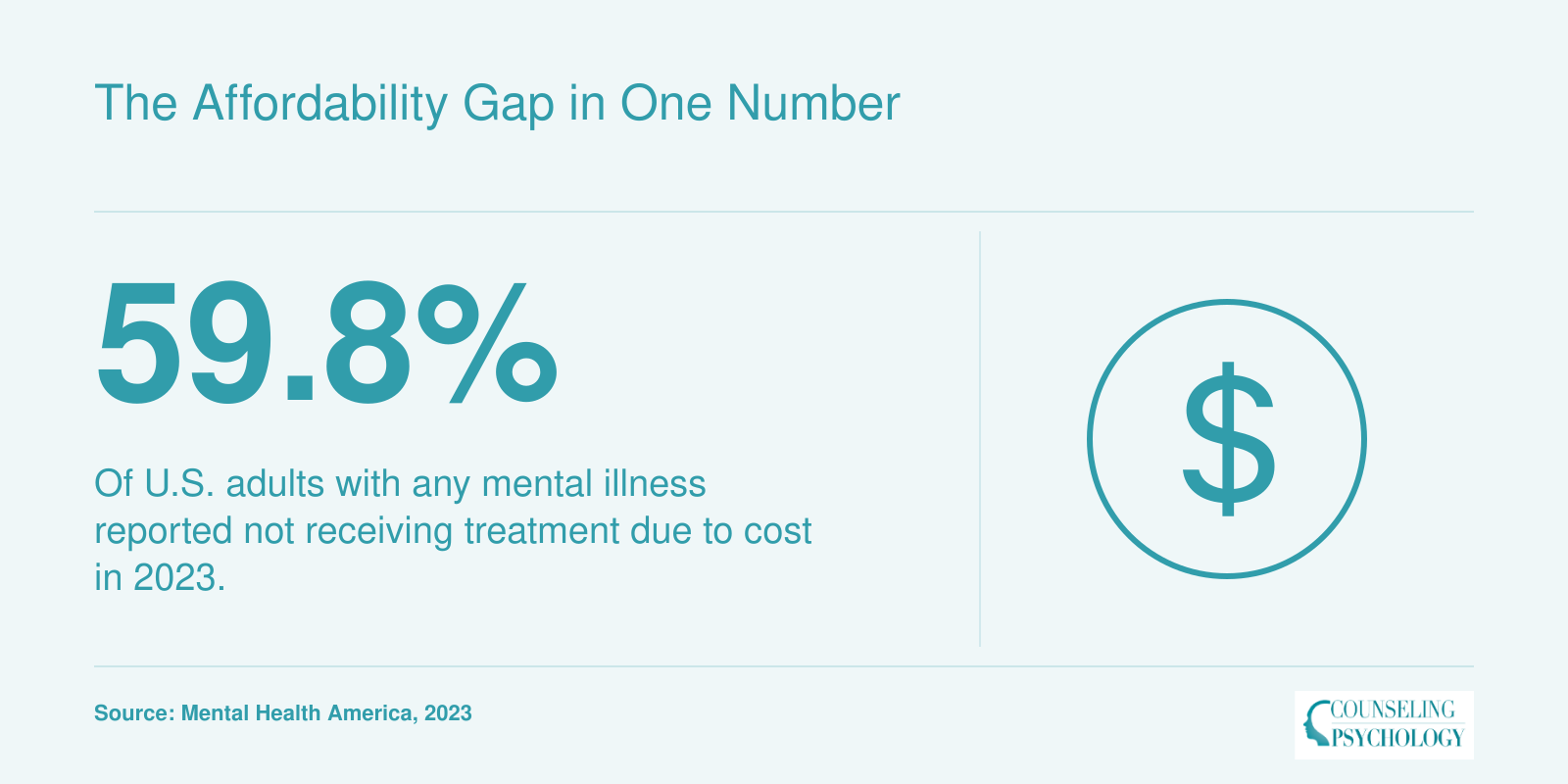
The Affordability Gap in One Number
One figure captures the scale of the mental health affordability crisis: nearly 6 in 10 adults with a mental illness could not access care because of cost. That single data point reveals a system failing millions.
Understanding the 2026 Mental Health Affordability Crisis
The mental health affordability crisis is the widening gap between the need for counseling services and what people can realistically pay. In 2026, therapy costs remain a steep barrier. For uninsured individuals, a single session typically ranges from $100 to $250, though some providers offer sliding scale fees of $40 to $80. Those with employer-sponsored or ACA marketplace plans usually pay a $20 to $60 copay, but coinsurance of 20% to 40% and high deductibles leave many with substantial out-of-pocket costs2. Medicare beneficiaries face a $283 deductible and 20% coinsurance for outpatient therapy3, while Medicare Advantage out-of-pocket maximums can reach $9,2504.
Geography also shapes cost. Major metro areas see self-pay fees as high as $150 to $3005, compared to $80 to $150 in rural regions. Insured copays vary less, but rural residents often confront a rural mental health provider shortage, with fewer in-network providers rural mental health provider shortage. These financial pressures mean that those with the greatest need, low-income families, BIPOC communities, and rural populations, are most likely to go without care. The result is a system where mental health support remains out of reach for millions, deepening existing health inequities and compounding the mental health provider shortage.
How Policy Changes Are Reshaping Access and Cost in 2026
Federal rollbacks and state-level expansions are pulling mental health policy in opposite directions in 2026. A 2025 congressional cut reduced federal Medicaid funding by 15 percent, translating to $1 trillion over a decade, forcing an estimated 11.8 million people off coverage.1 An additional 3.1 million ACA marketplace enrollees face higher premiums as enhanced subsidies expire.1 mental health parity enforcement 2026, which previously protected 150 million Americans, was effectively paused by a May 2025 announcement, while SAMHSA saw $2 billion in grants terminated.1 Yet, some states are pushing back: Illinois increased Medicaid psychiatry reimbursement and removed prior authorization for psychiatric medications2; California expanded its CARE Act3; and Rhode Island replaced $60 million in lost federal subsidies.4 These split trajectories mean millions now struggle with higher costs and reduced access, deepening the mental health workforce shortage, even as targeted state actions demonstrate alternative ways forward.
While counselors dedicate their careers to helping others, their own earnings often lag behind the cost of delivering care. The median annual wage was $59,190; the lowest 25% earned under $47,170. This financial reality underscores the need for systemic advocacy to make mental health care affordable for all.
Low-Cost and Alternative Care Models: What’s Available Now
For clients struggling with high therapy costs, a diverse ecosystem of low-cost and alternative care models now delivers quality mental health support at manageable prices. Ranging from university training clinics to online platforms built for affordability, these options remove financial barriers while maintaining professional standards. Below is an overview of what’s available and how to access these services.
University Training Clinics and Nonprofit Centers
- Cost: University training clinics charge $0-$40 per session; nonprofit counseling centers range from $0-$80.1
- Eligibility: University clinics are open to the public, while nonprofit centers typically serve low-income clients.1
- How to access: Visit university websites and search for “training clinic” or call local nonprofit centers directly. Clinics often operate out of psychology, counseling, or social work departments and provide supervised care by advanced students.
Community-Based Services
- Federally Qualified Health Centers (FQHCs): Sessions cost $0-$602, open to all regardless of income, and can be located through the HRSA online directory. These centers integrate behavioral health with primary care.
- Community Mental Health Centers (including Certified Community Behavioral Health Clinics): Costing $20-$80 per session, these centers serve residents of a specific geographic catchment area. Find one using the SAMHSA treatment locator tool. They often accept Medicaid and offer sliding-fee scales.1
Sliding-Scale and Online Options
- Sliding-scale private practices: Many therapists reserve a portion of their caseload for reduced-fee clients, charging $60-$150 per session based on self-reported income.3 Search online directories like Psychology Today and filter for sliding scale.
- Open Path Collective: This online platform connects low-income clients with therapists who offer sessions from $40-$70.3 After a one-time lifetime membership fee, clients gain access to a network of licensed professionals.
How Counselors Can Advocate for Systemic Change
Individual complaint filing helps one client, but systemic advocacy can reshape access for entire communities. Focusing on policy and partnerships, a key part of the future of counseling, multiplies a counselor's impact.
Engage in State-Level Parity Advocacy
Most parity violations go unreported because clients and providers don't know the process. Counselors can change that by mastering the complaint pathway:
- Confirm the plan type. Employer-sponsored plans fall under the U.S. Department of Labor (EBSA)1; individual and small-group plans are regulated by your state insurance department2.
- Document the violation. Gather the written denial, medical necessity criteria, and any correspondence. You have the right to request the plan's non-quantitative treatment limitation (NQTL) comparative analysis3.
- File an internal appeal. Plans must respond within strict timelines; if they uphold the denial, escalate.
- Submit a regulatory complaint. For state-regulated plans, use your state insurance department's portal (many have a mental health parity option); for EBSA complaints, contact them by phone or online form after exhausting the internal appeal12.
Template letters are available from ParityTrack and state agencies. Share these with clients.
Build Partnerships and Use Data
Local health centers and training clinics are underutilized allies in communities with the highest need for counselors. Partner with them to expand sliding-scale services, then pair that outreach with data: track denial rates, wait times, and out-of-pocket costs. When meeting legislators, these numbers turn abstract principles into urgent local problems. Illinois now requires every MH/SUD complaint to be evaluated for potential parity issues, a reform driven by provider testimony4.
Lobby for Telehealth Reimbursement Parity
Temporary telehealth flexibilities are expiring. Counselors can join state association advocacy days, submit rulemaking comments, and share stories showing how payment disparities push patients to costlier in-person care. California and Georgia have levied millions in fines against noncompliant plans, showing that enforcement follows professional advocacy5.
Questions to Ask Yourself
Real-World Advocacy Success Stories
Concrete examples where counselors and mental health professionals successfully changed policy or created programs to make care more affordable can serve as blueprints. These wins did not happen overnight; they required persistent advocacy, data, and collaboration.
Texas LPCs and LMFTs Join Medicare
After years of advocacy, Licensed Professional Counselors (LPCs) and Licensed Marriage and Family Therapists (LMFTs) in Texas gained Medicare provider eligibility effective March 1, 2024.1 This move opens mental health access for over 4 million Texas Medicare beneficiaries, allowing them to see a wider pool of licensed clinicians. The change addresses long-standing workforce shortages and aligns with federal parity goals. Measurable impact includes expanded provider directories and reduced out-of-pocket costs for seniors who previously paid privately.
Postpartum Medicaid Extension
Through the work of organizations like Texans Care, Texas secured a 12-month postpartum Medicaid extension.2 New mothers now keep health coverage, including mental health services, for a full year after childbirth instead of losing it after just two months. The policy is projected to serve tens of thousands of low-income women annually, closing a critical gap for conditions like postpartum depression. Advocates used maternal mortality data and personal stories to build legislative support.
Defending Audio-Only Telehealth
The Texas chapter of the National Association of Social Workers (NASW) is campaigning to make audio-only telehealth a permanent Medicaid feature.3 With testimony, legislative recommendations, and direct lobbying, they argue that many clients lack reliable broadband or devices. A permanent rule would protect access for rural and low-income patients. Though the effort continues, it demonstrates how adapting delivery models to real-world needs can sustain affordability.
Lessons for Counselor-Advocates
These stories share common threads. Multi-year persistence, coalition-building, and data-backed arguments are essential. Counselors can start by joining state associations, sharing client impact data, and testifying at hearings. Even local initiatives, like grant-funded training clinics, build momentum. When advocates link moral urgency to measurable outcomes, they create compelling cases for systemic change.
What Clients Can Do When They Can’t Afford Care
Navigating the cost of therapy can feel overwhelming, but numerous resources exist to make it more affordable. From sliding-scale fees to national helplines, clients can explore options that fit their budget.
Digital Therapy Vs. In-Person: What’s the Real Cost Difference?
Does online therapy actually save money compared to in-person sessions, and does the quality of care hold up?
What does online therapy cost in 2026?
- Platforms like BetterHelp and Talkspace: charge $70-$110 per week, or roughly $260-$400 per month. online therapy cost guide
- Text-only plans: can be as low as $40-$80 per week, offering a budget-friendly entry point.1
- Insurance copays: online therapy copays range from $20-$75 per session, similar to in-person rates.1
How much does traditional in-person therapy cost?
- Standard sessions: range from $100 to $250 nationally1, with metro areas like New York or Phoenix often hitting $200-$300 per session2.
- Monthly costs: without insurance, weekly in-person visits can easily surpass $600 per month3.
- Rural pricing: even smaller states feel the pinch: a session in North Dakota averages $227, and South Dakota $2014.
Does insurance cover online therapy the same way?
Telehealth parity laws now exist in all 50 states and the District of Columbia, requiring equal coverage for virtual and in-person sessions.1 In 2026, 94% of commercial plans cover online therapy,1 with average copays hovering between $28 and $30.5 This parity closes the insurance gap, but clients may still encounter variable deductibles or out-of-pocket maximums.
Are clinical outcomes really comparable?
Multiple studies confirm that online therapy is non-inferior to in-person care for conditions like anxiety and depression; a relevant clinical trial on internet-based CBT supports this. The median incremental cost-effectiveness ratio (ICER) for online therapy is -$131, meaning it often saves money while delivering similar or better outcomes, compared to -$92 for in-person care6. The incremental net benefit per patient for online therapy is $255, highlighting its financial and clinical edge7.
What hidden value does online therapy offer?
Beyond session fees, online therapy eliminates travel time, childcare, and lost wages: costs that disproportionately affect rural and low-income clients. For counselors, advocating for sustained telehealth reimbursement and clear telehealth licensure is key: it expands access without sacrificing quality, directly addressing the affordability crisis.
The Future of Mental Health Affordability: Trends and Predictions
Balancing technological innovation with cost control defines the next chapter in mental health affordability. The U.S. behavioral health market is projected to grow from $94.82 billion in 2025 to $165.38 billion by 2034, a compound annual growth rate of 6.4%.1 Tele-mental health will remain a cornerstone, with permanent reimbursement parity likely as states codify pandemic-era flexibilities. This shift could lower per-session costs and expand access while enabling counselors, including community mental health counselors, to reach underserved communities.
Value-based payment models are also gaining momentum. Instead of fee-for-service, these models tie reimbursement to patient outcomes, incentivizing integrated behavioral health programs that embed mental health services in primary care. With employer health costs reaching $18,500 per employee in 2026, up 6.5%2, integrated care is a cost-containment strategy that improves both health and financial outcomes.
Counselor advocacy is the driving force behind these changes. Legislative trends point to stronger mental health parity enforcement and expanded Medicaid coverage for counseling services over the next 2, 3 years. The staggering projected cost of mental health inequities, $1.3 trillion annually by 20403, is a call to action that policymakers cannot ignore. While systemic change is slow, convergence of technology, payment reform, and persistent advocacy offers a cautiously optimistic outlook: affordability is not yet guaranteed, but momentum is building toward a future where cost no longer blocks care.
Related Articles
Counselors serve as both clinicians and policy advocates. The affordability gap, where nearly 6 in 10 adults cannot access care due to cost, is not immutable. When counselors unite data with storytelling and legislative pressure, as seen in state-level parity wins, systemic change follows.
Choose one advocacy step this week: file a parity complaint, contact your legislator, or partner with a community clinic. Small actions compound into an affordable future.