What you’ll learn in this article…
- Chicago offers CSWE-accredited MSW programs with tuition ranging from under $400 to nearly $6,000 per credit hour.
- Advanced standing options let BSW holders complete their MSW in roughly half the typical two-year timeline.
- Illinois LCSW licensure requires a CSWE-accredited MSW plus two to three years of supervised clinical experience.
- Public Service Loan Forgiveness can eliminate remaining federal loan balances after 10 years for most social workers.
Demand for licensed social workers in Chicago outpaces supply, with Illinois projecting over 2,000 new social work positions annually through 2030. The city's dense network of hospitals, child welfare agencies, community mental health centers, and public school systems creates steady hiring pressure for MSW-prepared professionals.
Chicago-area MSW programs span a wide range of formats and price points. Tuition can run under $10,000 per year at public institutions like Northeastern Illinois University or exceed $68,000 annually at the University of Chicago. Advanced standing tracks compress the degree into 12 to 18 months for BSW holders, while clinical and macro concentrations shape very different career trajectories. Every program covered here holds CSWE accreditation, the credential that matters most for Illinois LCSW eligibility.
Best MSW Programs in Chicago: Rankings Overview
The Chicago area offers a surprisingly wide range of CSWE-accredited MSW programs, from research-intensive campus options at elite universities to flexible online and hybrid formats built around working professionals. Every school listed below holds Council on Social Work Education accreditation and prepares graduates for Illinois social work licensure. Graduation rates cited are institution-wide figures reported to IPEDS and do not reflect MSW-specific completion rates. Tuition figures are annual graduate rates from IPEDS; your actual cost will depend on credits per term, residency status, and financial aid.
- Graduate tuition and net price
- Institution-wide graduation rate
- Program format and flexibility
- Concentration and specialization breadth
- Regional field placement networks
- NCES-IPEDS federal institutional data — nces.ed.gov
- Internal program database
- Independent program research
- College Scorecard graduate earnings — collegescorecard.ed.gov

Aurora University
Aurora University fields one of the broadest MSW program menus in the Chicago region, with dedicated concentrations in Addictions, Child Welfare, Forensics, School Social Work, Trauma-Informed Practice, Military and Veteran Social Work, and more. Both traditional 60-credit and advanced standing 30-credit tracks are available online and on campus, with fall, spring, and summer start dates. Employment-based internships let current Illinois human-service employees log field hours at their own agencies, and the Addictions track specifically prepares graduates for the Illinois CADC exam alongside LCSW eligibility.
- Targets substance use intervention with Illinois CADC exam eligibility
- 60-credit traditional or 30-credit advanced standing track
- Available fully online with employment-based internships
- Coursework covers clinical techniques, bias reduction, and policy frameworks
- Partnerships with 50+ Illinois treatment sites for field placements
- Fall, spring, and summer start dates for scheduling flexibility
- Focuses on trauma-informed care and child protection systems
- Online format designed for working Illinois professionals
- Advanced standing option completes in roughly one year
- Field placements aligned with Illinois DCFS and family court settings
- Curriculum includes intervention strategies for vulnerable children and families
- CSWE-accredited with preparation for Illinois LSW and LCSW exams
- Offers tracks in forensics, gerontology, health care, leadership, and more
- On-campus and online delivery with two-year and three-year pacing
- Some tracks lead to external certifications beyond licensure
- Employment-based internships accepted across all tracks
- School social work track available for PEL-eligible preparation
- Tuition listed at $16,463 per year (IPEDS); institution-wide graduation rate of 60.3%
Master of Social Work (MSW), Addictions Concentration — Online
Master of Social Work (MSW), Child Welfare Concentration — Online
Master of Social Work (MSW), General Program — Online

Loyola University Chicago
Loyola University Chicago's online MSW stands out for its 49-credit-hour structure, one of the more compact nationally, which can reduce both cost and time to Illinois LCSW eligibility. Loyola runs three distinct program tracks: Micro Practice for clinical work, Leadership, Mezzo, and Macro Practice (LMMP) for systems-level change, and a Bilingual Spanish/English MSW with a Migration Studies concentration. All three require 1,000 internship hours and are delivered in a synchronous online format with part-time pacing, making them accessible for working professionals across the Chicago metro area.
- 49 credit hours with synchronous online delivery
- Clinical focus on assessment, diagnosis, and evidence-based intervention
- 1,000 internship hours in Chicago-area agencies and hospital systems
- Advanced standing option for BSW graduates
- Performance-based scholarships available
- Estimated total tuition of $55,370 for the full program
- Emphasizes policy analysis, advocacy, and organizational leadership
- Designed for macro-level roles in Illinois nonprofits and public agencies
- CSWE accredited with preparation for the LCSW exam
- Part-time evening format compatible with full-time employment
- 1,000 total internship hours across two placements
- Synchronous classes foster cohort engagement across Illinois
- Three-year bilingual (Spanish/English) MSW, unique in the Chicago region
- Micro Practice specialization with migration-focused coursework
- Serves Latinx, immigrant, and refugee populations in Chicagoland
- 1,000 internship hours with community partnerships in immigration services
- Advanced standing pathway available for qualified BSW holders
- Performance-based scholarships offset the $21,912 annual tuition
Master of Social Work (MSW), Micro Practice — Online
Master of Social Work (MSW), Leadership, Mezzo, and Macro Practice — Online
Master of Social Work Online Bilingual, Migration Studies — Online

Dominican University
Dominican University delivers a hybrid MSW from campuses in River Forest and Grayslake, with a fully online option available in Illinois and four neighboring Midwestern states. Six practice tracks, including Aging, Adulthood and Gerontology and Children, Youth and Family, give students room to specialize. A 1,080-hour fieldwork requirement and a 350-plus agency placement network rooted in Chicagoland agencies make hands-on preparation a program hallmark. No GRE is required, and the net price after aid ($11,745 per College Scorecard) is among the lowest on this list.
- 60 credit hours with 1,080 supervised fieldwork hours
- Six tracks: Aging, Children and Family, Global Practice, Health, and more
- Hybrid, fully online, and on-campus formats all available
- No GRE or GMAT required for admission
- International practicum option complements work with refugee populations
- Advanced standing and dual degree opportunities offered
- Specialized gerontological training, a rarity among Chicago-area MSWs
- Online option open to students in IL, IN, IA, MI, and WI
- Evidence-based interventions for senior care and behavioral health
- First-weekend residency orientation for online cohort students
- Field placements in aging services agencies across Chicagoland
- Departmental scholarships and graduate assistantships available
- Clinical emphasis on child advocacy, family systems, and intervention
- Daytime, evening, and weekend class scheduling
- 350+ agency placement sites concentrated in the Chicago metro
- Small class sizes with a 12:1 student-faculty ratio
- Two-year full-time or three-year part-time pacing
- Prepares graduates for Illinois LSW and LCSW exams
Master of Social Work — Hybrid
Master of Social Work, Aging, Adulthood and Gerontology — Hybrid
Master of Social Work, Children, Youth and Family — Hybrid

University of Chicago
The University of Chicago's Crown Family School awards a Master of Arts in Social Work, Social Policy, and Social Administration, a degree recognized as equivalent to the MSW and continuously accredited by CSWE since 1919. The program integrates direct clinical practice, policy research, and social science theory at a depth that reflects the university's research emphasis. Students choose between Clinical and Social Administration pathways, with certificate add-ons in areas like violence prevention and global social development that draw directly on Chicago's communities as a learning environment. Sticker tuition is $68,652 per year (IPEDS), though the institution-wide net price drops to $14,860 after aid.
- AM degree equivalent to MSW, CSWE accredited since 1919
- Interdisciplinary curriculum spans direct practice, policy, and research
- In-person delivery at the Crown Family School in Chicago's Hyde Park
- Advanced standing option for qualified BSW graduates
- Certificate add-ons in violence prevention and global social development
- Institution-wide graduation rate of 95.9%, 5:1 student-faculty ratio
- Research-driven approach to complex mental health and behavioral health
- Advanced training in evidence-based interventions and psychopathology
- Field placements at major Chicago academic medical centers and agencies
- Prepares graduates for Illinois LCSW with strong clinical foundation
- Combines rigorous theory with practical clinical assessment skills
- Top-ranked national program with global learning opportunities
- Focus on policy development, organizational management, and advocacy
- Field sites include Illinois government agencies and nonprofit leadership roles
- Curriculum integrates local, state, and national policy analysis
- Prepares graduates for leadership in public and nonprofit sectors
- Strong alignment with Chicago policy initiatives and research centers
- Flexible career preparation across diverse social work settings
Master of Arts in Social Work, Social Policy, and Social Administration — On-Campus
Master of Arts, Clinical Concentration — On-Campus
Master of Arts, Social Administration Concentration — On-Campus

University of Illinois Urbana-Champaign
The University of Illinois Urbana-Champaign runs both a traditional campus MSW and the iMSW, a hybrid/online program specifically designed for working Illinois professionals. Concentrations in Advanced Clinical Practice and Leadership and Social Change serve both clinical and macro career paths, and the iMSW requires no GRE. A distinctive block field placement model immerses students full-time in Illinois agencies for one or two semesters. In-state graduate tuition is $19,278 per year; out-of-state students pay $34,406 (IPEDS).
- CSWE-accredited with evidence-based mental health focus
- Campus-based with full-time and part-time enrollment options
- Block field placement for extended immersion in Illinois agencies
- Advanced standing available for BSW graduates
- Prepares for Illinois LCSW and school social work PEL endorsement
- Research-oriented curriculum with professional ethics training
- Macro concentration covering policy analysis, community organizing, advocacy
- On-campus format with part-time option for working students
- Integrates research methodologies and leadership development
- Field placements span Illinois nonprofits, schools, and public agencies
- Advanced standing pathway accelerates completion
- Strong focus on diverse populations and social justice
- Hybrid/online evening classes designed for full-time Illinois employees
- No GRE required; flexible 12- to 48-month completion timeline
- Choose Advanced Clinical or Leadership and Social Change concentration
- Block internship at Illinois sites with average class size of 25
- $620 per credit hour with multiple financial aid options
- CSWE accredited since inception with internship sites across Illinois
Master of Social Work, Advanced Clinical Practice — On-Campus
Master of Social Work, Leadership and Social Change — On-Campus
iMSW Program — Hybrid

Northeastern Illinois University
Northeastern Illinois University offers one of the most affordable MSW options in Chicago, with in-state tuition at $9,874 per year (IPEDS) and a 9:1 student-faculty ratio. The CSWE-accredited program features concentrations in Social Work Practice with Children, Youth, and Families and a School Social Work track that leads to the Illinois Professional Educator License (PEL). Late afternoon and evening scheduling caters to working Chicago-area professionals, and a trauma-informed curriculum addresses the realities of urban practice. The institution-wide graduation rate is 21.6%, reflecting NEIU's open-access mission and predominantly part-time, nontraditional student body.
- 60-credit CSWE-accredited program with two practice concentrations
- Evening class schedule built for working Chicago professionals
- Advanced standing option with 9:1 student-faculty ratio
- In-state tuition of $9,874 per year, among the lowest in the metro
- Application deadline of January 15 for fall admission
- Small classroom settings emphasizing social justice and community healing
- Trauma-informed curriculum focused on urban Chicago populations
- 480 to 600 practicum hours in direct practice settings
- Optional School Social Work specialization for PEL eligibility
- Hybrid delivery with campus and some online components
- Capstone project required for degree completion
- Advanced standing pathway for recent BSW graduates
- Leads to Illinois Professional Educator License (PEL) endorsement
- Aligned with ISBE requirements for school social work practice
- Partnerships with Chicago Public Schools and surrounding districts
- Late afternoon and evening classes for current school employees
- CSWE fully accredited, launched fall 2016
- Part-time and full-time enrollment options available
Master of Social Work — On-Campus
Master of Social Work, Children, Youth and Families — On-Campus
Master of Social Work, School Social Work — On-Campus

Chicago State University
Chicago State University's MSW emphasizes clinical practice with families and children in Chicago's urban communities, particularly on the South Side and in historically underserved neighborhoods. The CSWE-accredited program takes a strengths-based, family-centered approach and prepares graduates for advanced roles in public and nonprofit human service organizations. CSU also offers a 12-credit online Post-MSW Professional Educator License (PEL) program with a School Social Work endorsement, including placement options within Chicago Public Schools. In-state tuition is $10,294 per year (IPEDS), and the net price is $12,335 after aid.
- CSWE-accredited with clinical focus on families and children
- Strengths-based curriculum serving vulnerable urban populations
- Field practicum component in Chicago-area agencies
- Prepares graduates for Illinois LSW/LCSW and potential doctoral study
- Social policy analysis and program management coursework
- In-state tuition of $10,294 with financial aid options available
- 12-credit fully online program for current MSW holders
- Meets all ISBE requirements for school social work endorsement
- Two 300-hour field practicums in Illinois public schools
- Chicago Public Schools placement option with January 15 CPS deadline
- Asynchronous courses with some synchronous sessions
- Short-term approval pathway for districts with urgent hiring needs
Master of Social Work — On-Campus
Post-MSW Professional Educator License, School Social Work — On-Campus
How to Compare Chicago MSW Programs: Cost, Format, and Specializations
Tuition for Chicago-area MSW programs ranges dramatically, from under $400 per credit hour at public institutions to nearly $6,000 per course at elite private universities. Because rates shift every academic year, treat the figures below as a starting point. Visit each school's official tuition and fees page for the most current numbers, and use each financial aid office's net price calculator to estimate what you would actually pay after grants, scholarships, and assistantships. For accreditation verification and national tuition benchmarks, the Council on Social Work Education (CSWE) maintains a searchable directory of accredited programs. The U.S. Bureau of Labor Statistics (BLS.gov) publishes salary data for social workers nationally, which can help you weigh program cost against expected earnings. State-specific resources from organizations like the Illinois Association of School Social Workers can add further context. A practical next step: build your own comparison spreadsheet pulling per-credit cost, program format, and available specializations directly from each school's website so you can see all your options side by side.
| Program | Tuition Model | Approximate Cost (2025-2026) | Format | Notes |
|---|---|---|---|---|
| University of Chicago, Crown Family School of Social Work (AM) | Per course | $5,919 per course; approx. $53,721/yr full-time, $35,514/yr part-time | On campus | Confirm current rates on the Crown Family School tuition and fees page |
| University of Illinois Chicago, Jane Addams College of Social Work (MSW) | Banded tuition | Varies by credit-hour band; check UIC's tuition schedule for exact rates | On campus and online options | Banded model means per-credit cost decreases at higher enrollment levels; contact the financial aid office for a net price estimate |
| Chicago State University (MSW) | Per credit hour | $349/credit (in-state); $675/credit (out-of-state) | On campus | Among the most affordable options in the Chicago area; verify current rates on the CSU graduate tuition page |
| National Online MSW Programs (for comparison) | Per credit hour | Roughly $400 to $1,200/credit | Online | Wide range reflects differences in institution type and residency; useful as a benchmark when evaluating Chicago programs |
Questions to Ask Yourself
Advanced Standing MSW Programs in Chicago
An MSW opens doors to licensure and advanced practice, but two years of full-time tuition and fieldwork is a serious investment. Advanced standing lets you finish in roughly half the time if you already hold a Bachelor of Social Work. The path is faster and cheaper, but it demands a concentrated, intense schedule.
What Advanced Standing Actually Means
Advanced standing acknowledges the foundation-level coursework you completed in a CSWE-accredited BSW program.1 Instead of repeating generalist content during a two-year MSW, you enter directly into specialized, concentration-year courses. Most programs compress the remaining credits into three or four semesters, often one calendar year or a bit more. You skip the foundation field placement and move straight into advanced practicum hours.
Eligibility: Do You Qualify?
Admission is not automatic. Every program sets specific thresholds. Typically you need:
- A BSW from a CSWE-accredited program, earned within the last five to seven years. Loyola University Chicago, for instance, requires the BSW to be no older than six years.3
- A minimum cumulative GPA, often 3.0 on a 4.0 scale, in your undergraduate work.
- Strong references and a statement of purpose that reflects readiness for accelerated graduate study.
Some programs may also review your undergraduate field evaluation or require a specific grade in foundation social work courses. Always confirm exact criteria directly with each school's admissions office.
Chicago-Area Programs That Offer Advanced Standing
Several accredited programs in and around Chicago support this expedited track. Each structures it a little differently:
- University of Illinois Chicago (UIC) Jane Addams College of Social Work: Completes in one academic year with 630 field hours. Designed for BSW holders from a CSWE-accredited program.2
- Loyola University Chicago School of Social Work: Advanced standing students complete 23 credits and a 600-hour field placement. The program is available on campus and fully online, with a BSW recency limit of six years and a 3.0 GPA minimum.3
- Dominican University: Offers a 9-month advanced standing option, on campus or 100% online. Fieldwork totals 1,080 hours, reflecting Dominican's intensive practice emphasis.4
- Aurora University: Advanced standing track requires 30 semester hours, half the traditional 60. Multiple start dates and online or on-campus delivery make it one of the more flexible choices.
- University of Chicago Crown Family School: Advanced standing is available for its MA in Social Work, Social Policy, and Social Administration (equivalent to an MSW). Details on credits and field hours vary by concentration.
- Northeastern Illinois University: Provides an advanced standing pathway with evening classes, suited for working professionals.
How Accelerated Timelines Affect Field Placements
Because you skip the foundation practicum, your entire clinical or macro field experience is concentrated into the advanced year. At UIC's Jane Addams College, the 630 hours are packed into two semesters.2 Dominican's 1,080 hours in nine months demand a significant weekly commitment.4 Programs coordinate placements, but you should expect daytime hours at agencies, even in online programs, since field schedules typically require weekdays.
Employers that allow flexible scheduling or employment-based internships can help, but the pace is not relaxed.
The Financial Advantage
Cutting the program length roughly in half can cut tuition in half too. Aurora University's 30-credit advanced standing track, for example, reduces total credit costs compared to its 60-credit traditional route. Loyola's MSW program offers a similar compression at 23 credits for advanced standing students.3 Fewer credits also mean lower fees and a shorter window without full income, improving the overall return on your educational investment.
Online MSWs and Local Field Placements
If you choose an online advanced standing program, you do not need to live in Chicago to complete it. Schools like Dominican, Aurora, and Loyola coordinate local field placements for Illinois students, and sometimes for residents of neighboring states.4 A school coordinator will work with you to secure a site near your community, but you must be available during standard business hours for direct practice hours. This local arrangement makes it possible to advance your career without relocating. Students weighing related graduate options in the state may also want to explore counseling masters programs in Illinois.
Clinical vs. Macro Tracks: Choosing the Right MSW Concentration
Should you pursue direct client work or shape the systems that affect entire communities? This fundamental question defines the two primary pathways in MSW education, and your answer will determine everything from your coursework to your licensure options and long-term career trajectory.
Understanding the Clinical Track
The clinical track, sometimes called direct practice or micro social work, prepares you to work one-on-one or in small groups with individuals and families. Clinical students learn diagnostic assessment, therapeutic interventions, crisis counseling, and evidence-based treatment modalities. If your goal is becoming a Licensed Clinical Social Worker in Illinois, the clinical track is your required pathway. LCSW licensure opens doors to private practice, hospital-based mental health services, and clinical positions in community mental health centers.
Within the clinical concentration, Chicago MSW programs often offer sub-specializations that let you focus your training:
- School social work: Prepares you for K-12 settings where you address students' behavioral, emotional, and academic challenges while navigating IEP processes and family engagement.
- Substance abuse counseling: Focuses on addiction assessment, motivational interviewing, and integrating mental health treatment with recovery services.
These sub-concentrations appear across several ranked Chicago programs and can position you for specialized certifications beyond your LCSW.
Understanding the Macro Track
Macro social work takes a wider lens, focusing on community organizing, policy advocacy, program administration, and systemic change. Rather than treating individual symptoms, macro practitioners address root causes through legislative reform, nonprofit leadership, or large-scale program development. Social workers in local government settings earn a national median of $64,550 annually, while those in educational services earn $62,980, both above the overall social work median of $58,380.
Research shows that while roughly 23 percent of MSW students initially enroll in macro-focused programs, about 54 percent of those who start with macro interests ultimately graduate from clinical tracks. This shift often reflects the broader job market for clinical roles and the appeal of LCSW licensure.
Matching Your Goals to a Track
Consider where you see yourself in five to ten years:
- Clinical track suits you if: You want to provide therapy, pursue LCSW licensure, work in hospitals or private practice, or specialize in mental health, school settings, or substance abuse treatment.
- Macro track suits you if: You want to run nonprofit organizations, develop social policy, manage community programs, or advocate for systemic reform at the governmental level.
Some students pursue dual concentrations or select programs with integrated curricula that blend clinical skills with policy knowledge. Those drawn to direct therapeutic work may also want to explore clinical mental health counseling online programs as a complementary credential. Review each Chicago program's concentration offerings carefully, as availability varies. The concentration you choose shapes not just your degree, but the career path waiting on the other side.
Related Articles
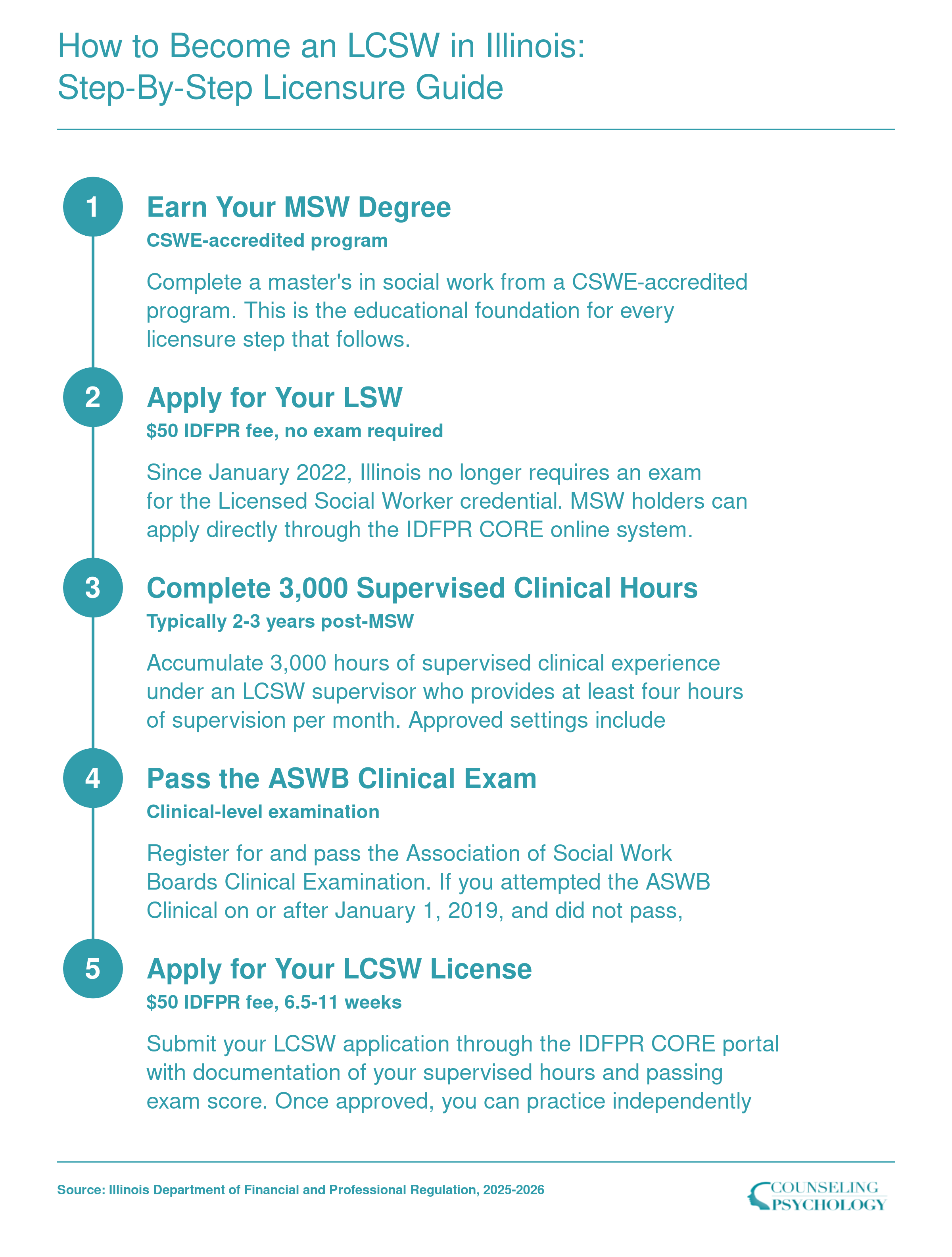
How to Become an LCSW in Illinois: Step-by-Step Licensure Guide
In Illinois, the LCSW is the credential you need for independent clinical practice and insurance billing. The path from MSW graduate to licensed clinical social worker follows a clear sequence, but plan on two to three years of post-degree supervised work before you reach the finish line. Here is what each milestone involves.
Career Outcomes and Salary Data for Chicago MSW Graduates
Career outcomes for MSW graduates come down to two questions: how quickly can you find work that pays a livable wage, and how much earning potential does the degree unlock over time? For Chicago-area programs, the answers depend heavily on your specialization, your employer, and whether you pursue clinical licensure.
Program-Level Earnings: What the Data Shows
Program-specific earnings data from federal sources (median income one year and four years after completion) is not yet published for the MSW programs covered in this guide. That means we cannot rank individual schools by graduate salary at this time. When this data becomes available, it will offer a clearer picture of which programs translate most directly into higher early-career pay. For now, regional wage data by occupation provides the most useful benchmark.
Social Worker Salaries in the Chicago Metro Area
According to the Bureau of Labor Statistics (Occupational Employment and Wages, May 2023), social workers in the Chicago-Naperville-Elgin metropolitan area earn median annual wages that vary by specialty:1
- Child, Family, and School Social Workers: $56,950 median annual wage, with roughly 7,920 employed across the metro area.
- Healthcare Social Workers: $67,490 median annual wage, with about 3,130 employed. This is the highest-paying of the three main categories.
- Mental Health and Substance Abuse Social Workers: $57,950 median annual wage, with approximately 1,300 employed.
These figures reflect all experience levels and license types within each category. The combined employment across these three specialties tops 12,000, which signals strong and sustained demand in the region. For a broader look at how these numbers compare to related helping professions, see our guide to counselor salary with masters.
The LCSW Premium
License level is arguably the single biggest lever you control when it comes to salary. An MSW holder without any license is limited in scope of practice and typically earns at the lower end of these ranges. Obtaining your Licensed Social Worker (LSW) credential opens more doors, but the Licensed Clinical Social Worker (LCSW) designation is where compensation shifts meaningfully. LCSWs can bill insurance directly, supervise other clinicians, and enter private practice, all of which push earnings well above the medians listed above. In private practice settings, experienced LCSWs in the Chicago area can earn considerably more than what agency-based roles typically pay. The Illinois LCSW pathway requires 3,000 hours of supervised clinical experience after your MSW, so factoring that timeline into your career plan matters.
Debt-to-Earnings: Keeping ROI in Focus
Graduate tuition across the programs profiled here ranges from under $10,000 per year at public institutions like Northeastern Illinois University and Chicago State University to nearly $69,000 per year at the University of Chicago (though UChicago's institutional aid significantly reduces net cost for most students). Median graduate debt for these institutions spans roughly $14,600 to $30,600.
Compare that to first-year earnings in the mid-$40,000 to high-$50,000 range for most entry-level MSW positions. If your total debt at graduation is close to or below your starting salary, you are in a manageable position, especially if you pursue Public Service Loan Forgiveness. When debt climbs well above your likely first-year income, the calculus shifts, and choosing a lower-cost program or securing scholarships becomes critical to a healthy financial outcome.
The bottom line: Chicago's social work job market is large enough to absorb new MSW graduates across multiple specialties, and salaries are solid for the region. But earning power accelerates most dramatically once you complete LCSW licensure, making the clinical track and supervised-hours planning essential parts of your career strategy from day one.
Financial Aid, Scholarships, and Loan Forgiveness for Illinois Social Workers
How can MSW students in Chicago reduce their debt burden while preparing for careers that often pay modestly compared to other graduate fields?
The good news: social work offers some of the strongest loan forgiveness pathways of any profession, and Illinois programs provide meaningful institutional support. Understanding these options before you enroll can save tens of thousands of dollars over your career.
Public Service Loan Forgiveness for Social Workers
Most MSW graduates work in settings that qualify for Public Service Loan Forgiveness. If you're employed full-time by a government agency, 501(c)(3) nonprofit, or qualifying tribal organization, you're likely eligible. The program forgives your remaining federal Direct Loan balance after 120 qualifying monthly payments, roughly ten years of employment.
To qualify, you must be enrolled in an income-driven repayment plan such as SAVE, PAYE, or IBR. These plans cap your monthly payment at a percentage of discretionary income, often resulting in lower payments early in your career when social work salaries are typically modest. The remaining balance after those 120 payments is forgiven tax-free.
For social workers earning between $50,000 and $65,000 annually, income-driven payments often run $300 to $500 per month. If your total debt exceeds $60,000, PSLF can forgive a substantial portion of your loans.
Institutional Scholarships at Chicago Programs
Chicago MSW programs offer competitive merit and need-based aid:
- Loyola University Chicago: Merit scholarships range from $10,000 to $20,000 for admitted students. The school considers FAFSA data but also accepts net price calculator estimates during the application process.1
- University of Illinois at Chicago: The Wilma and Donald R. Haerr Endowed Scholarship provides $1,000 to students maintaining a 3.0 GPA, with applications due February 28, 2026.2
- University of Illinois Urbana-Champaign: Students complete a single internal scholarship application to be considered for multiple awards. FAFSA filing is required.3
Graduate assistantships at these institutions can offset tuition significantly while providing professional experience. Positions in field education offices, research centers, and student services departments often include partial tuition waivers.
Illinois-Specific Aid and Service Programs
The Healthcare Foundation of Northern Lake County offers scholarships for social work students who commit to a two-year service obligation in the region after graduation.1 This type of service-linked funding is worth exploring if you're open to practicing in specific geographic areas or populations.
The NASW Foundation awards four national scholarships annually that Illinois students can pursue, though competition is significant.4
While the Illinois Department of Human Services has historically offered workforce incentive programs, current offerings vary by budget year. Contact IDHS directly or check with your program's financial aid office for the latest state-funded opportunities.
Building a Smart Financing Strategy
Average institutional aid varies considerably based on your financial profile, academic record, and program. Net price calculators on each school's website provide personalized estimates, but actual awards depend on your specific circumstances.
The most effective approach combines institutional scholarships, federal loans on income-driven repayment, and a career path that qualifies for PSLF. Many Chicago MSW graduates working in community mental health counselor roles, child welfare, or hospital social work find their loans substantially or fully forgiven within a decade of graduation.
Most social work graduates end up in nonprofit agencies, public health systems, or government positions, which are exactly the types of employers that qualify under Public Service Loan Forgiveness. After 10 years of qualifying payments, any remaining federal loan balance is wiped out, which means a high-sticker-price MSW program may cost far less in practice than the tuition numbers suggest.
Frequently Asked Questions About Chicago MSW Programs
Prospective students often have similar questions about MSW programs in the Chicago area, from program length and accreditation to licensure steps. Below are concise answers to the most common questions we hear.