What you’ll learn in this article…
- Austin-area psychology graduates can expect median debt between $11,000 and $18,000, with ROI varying sharply by school.
- Texas requires 3,000 supervised post-master's hours for LPC licensure, so plan beyond the bachelor's degree.
- Local demand is strong: social and human service assistants in Austin averaged $21.52 per hour in recent BLS data.
- Psychology, counseling, and social work bachelor's degrees in Texas lead to different licensure tracks and career outcomes.
Which Texas universities offer the best bachelor's degree in psychology near Austin, and what does each actually cost? That is the practical question driving most students to this page, and the answer varies more than most people expect.
Austin sits at the center of a large cluster of psychology programs stretching from San Antonio to the Dallas-Fort Worth corridor. Options range from UT Austin's flagship research department to affordable public regional campuses like Texas A&M University-Central Texas in Killeen, where in-state tuition runs under $7,400 per year, to private institutions like Rice University, where a low acceptance rate (8 percent) pairs with an average net price closer to $13,000 annually after aid.
The practical tension for most students is not finding a program; it is matching cost, format, and curriculum to a realistic post-graduation plan. A psychology bachelor's alone does not qualify you for licensure in Texas. Nearly every clinical or counseling role requires a master's degree or doctorate on top of it, and students interested in counseling pathways will eventually need to explore counseling programs in Texas at the graduate level. Choosing the right undergraduate program means thinking two or three steps ahead, not just about the next four years.
Top Psychology Bachelor's Programs Near Austin, Texas
Texas is home to a broad range of psychology programs, from elite private research universities to affordable public campuses built around transfer students and working adults. The schools below serve Austin-area students through a mix of campus, hybrid, and online-friendly formats, and each one offers a distinct path into the field. We evaluated institutional outcomes, affordability after aid, program structure, and regional relevance to help you compare options side by side.
- Graduate earnings and debt burden
- Net price after financial aid
- Graduation and retention rates
- Program format and accessibility
- Regional career relevance
- NCES-IPEDS federal institutional data — nces.ed.gov
- College Scorecard graduate earnings — collegescorecard.ed.gov
- Independent program research
- Internal program database

Rice University
Rice University pairs a highly selective admissions process (8% acceptance rate) with one of the most generous aid packages in Texas: the average net price sits at roughly $13,370 despite a sticker price above $61,000. Graduates report median earnings of about $89,718 ten years after enrollment, and the median debt at graduation is only $11,000, giving the program an unusually strong return on investment. A 6:1 student-to-faculty ratio means psychology majors work closely with faculty on research, often leveraging Houston's Texas Medical Center for applied experience in clinical and health psychology.
- 47 credit hours in the psychology major
- 120 total credits required for graduation
- Honors thesis track available for advanced students
- Faculty-led research opportunities across subfields
- Covers social, cognitive, and clinical psychology
- No transfer credits accepted for core psych courses
- Strong pipeline to Texas Medical Center placements
Bachelor of Arts in Psychology — On-Campus

Texas A & M University-College Station
Texas A&M offers both a BA and a BS in Psychology, giving students flexibility to lean toward humanities breadth or STEM depth within the same department. In-state tuition of roughly $12,995 and an 83.9% graduation rate make it one of the strongest value propositions among Texas flagships. Designated as a Hispanic-Serving Institution, A&M enrolls a diverse student body and provides well-established transfer pathways from Austin-area community colleges through the Texas Common Course Numbering System. Ten-year median earnings for graduates land near $72,097.
- 120 credit hours with foreign language requirement
- Extra humanities electives distinguish the BA track
- Core content spans clinical, cognitive, and social psych
- Emphasis on global and diversity perspectives
- Prepares students for counseling, law, or business paths
- Strong in-state alumni network for career placement
- 120 credit hours with added science requirements
- Neuroscience and clinical psychology focus areas
- Includes physical and biological science coursework
- Designed for students targeting graduate research
- Emphasizes critical thinking and problem-solving skills
- Leverages Texas A&M Health system collaborations
Bachelor of Arts in Psychology — On-Campus
Bachelor of Science in Psychology — On-Campus

Texas A&M University-Central Texas
Situated in Killeen, about an hour north of Austin, Texas A&M University-Central Texas is purpose-built for transfer and working-adult students. Its hybrid psychology program blends online coursework with on-campus sessions, and an open-admissions policy paired with a remarkably low net price of around $1,300 make it one of the most accessible options in the state. As a Hispanic-Serving Institution serving a large military-connected community near Fort Cavazos, the program gives students hands-on exposure to veteran mental health and trauma-informed care.
- Hybrid format with online and campus components
- 120 credit hours for degree completion
- Designed for upper-division transfer students
- Student research symposiums for applied experience
- Applied work with military-connected populations
- Strong financial aid and advising support
- Clear transfer pathways from Central Texas colleges
Bachelor of Science in Psychology — On-Campus

The University of Texas at Dallas
UT Dallas delivers a research-intensive BS in Psychology that leans heavily on empirical methods, lab work, and data analysis. With in-state tuition near $14,644 and a 75.7% graduation rate, the program appeals to students who want a STEM-oriented psychology experience within the UT System. Graduates earn a median of roughly $68,227 ten years out, and the North Texas location connects students to internships in cognitive neuroscience, human-computer interaction, and clinical settings across the Dallas-Fort Worth health and technology corridor.
- 120 semester credit hours required
- Rigorous empirical research methods training
- Hands-on laboratory experiences throughout
- Internship and directed research opportunities
- Covers cognitive processes and psychological assessment
- Upper-division coursework in neuroscience tracks
- Faculty research mentorship for undergraduates
Bachelor of Science in Psychology — On-Campus

University of Houston
The University of Houston's BS in Psychology balances a structured 36-credit-hour major with a senior capstone experience that places students in faculty-mentored research or community service. As a Hispanic-Serving Institution in one of the nation's most diverse cities, UH gives psychology students direct engagement with multicultural and urban mental health contexts. In-state tuition runs about $9,717, and ten-year median earnings reach approximately $62,377. Elective tracks span health psychology, industrial-organizational psychology, and more.
- 36 credit hours in the major, 21 in core courses
- Senior capstone in research or community service
- Electives in health and industrial-organizational psych
- Minimum 2.0 GPA and C grades in required courses
- Access to Texas Medical Center placements
- Multicultural practice exposure in Houston metro
- Advisor meeting required before declaring the major
Bachelor of Science in Psychology — On-Campus

University of St Thomas
The University of St. Thomas is a private Catholic institution in Houston offering a BA in Psychology grounded in liberal arts and ethical inquiry. The sticker price is $34,634, but institutional scholarships bring the average net cost to roughly $19,359. A 16:1 student-to-faculty ratio supports close mentoring, and the curriculum includes lab courses alongside electives in areas such as biopsychology and experimental psychology. As a Hispanic-Serving Institution, St. Thomas connects students with Houston-area nonprofits, schools, and counseling centers for applied fieldwork.
- 120 credit hours with 36 upper-division credits
- Lab-based courses in experimental and biopsychology
- 2.00 GPA required in psychology coursework
- Electives let students tailor to clinical or research
- Small-campus environment with values-centered mission
- Connections to Houston counseling and social services
- Prepares graduates for counseling or pastoral careers
Bachelor of Arts in Psychology — On-Campus

Texas A & M International University
Located in Laredo on the U.S.-Mexico border, Texas A&M International University offers a BA in Psychology with deep roots in bilingual, bicultural mental health practice. In-state tuition is about $7,894, and the average net price after aid drops to roughly $3,637, making it one of the most affordable options in the state. As a Hispanic-Serving Institution where 87.5% of undergraduates receive Pell Grants, TAMIU provides strong financial access. The 120-credit-hour curriculum covers cognitive, developmental, and social psychology, with elective flexibility and a required minor.
- 120 semester credit hours required
- Core courses in statistics, personality, and cognition
- Minimum 45 advanced hours for graduation
- Multiple elective tracks across psychology subfields
- Bilingual and border-region mental health exposure
- Flexible minor or elective pairing options
- Transfers accepted through Texas Common Course system
Bachelor of Arts in Psychology — On-Campus

The University of Texas at San Antonio
UTSA sits roughly 80 miles south of Austin, making it one of the closest large public alternatives for Central Texas students. The BA in Psychology spans cognitive, developmental, clinical, and social psychology, with internship and independent-study placements across San Antonio's healthcare and school systems. In-state tuition is about $9,326 and the average net price is approximately $10,836. As a Hispanic-Serving Institution, UTSA provides culturally responsive training relevant to Texas's growing bilingual communities, and transfer pathways from Austin-area community colleges are well established.
- 120 total credit hours with gateway course requirements
- Research-focused experimental psychology and lab courses
- Internship and independent study placements available
- Multiple specialization options within the major
- Interdisciplinary elective choices beyond psychology
- Exposure to military-connected populations via JBSA
- Prepares graduates for counseling or graduate study
Bachelor of Arts in Psychology — On-Campus

University of Houston-Clear Lake
University of Houston-Clear Lake is a commuter- and transfer-friendly campus in the Houston-Galveston region, and its BS in Psychology aligns with American Psychological Association undergraduate guidelines. A 15:1 student-to-faculty ratio keeps classes relatively small for a public university, and the average net price is about $15,563. As a Hispanic-Serving Institution, UHCL enrolls a diverse student body, and its location near NASA's Johnson Space Center opens unusual applied-behavior and human-factors research experiences for psychology students.
- Curriculum aligned with APA undergraduate guidelines
- Strong emphasis on research methods and statistics
- Diverse course offerings in personality and biopsych
- Admissions pathways for freshmen, transfer, and international
- Ethical standards and lifelong learning threads
- Proximity to Johnson Space Center for applied research
- Campus-based format with detailed degree planning
Bachelor of Science in Psychology — On-Campus

The University of Texas at Tyler
UT Tyler, part of the University of Texas System, offers both a BA and a BS in Psychology at in-state tuition around $9,512, with an average net price near $13,323 after aid. The program leverages partnerships with East Texas hospitals, clinics, and school systems for field experiences that expose students to rural and small-city mental health contexts. Both degree tracks feature undergraduate research, honors opportunities, and membership access to Psi Chi, the international honor society in psychology.
- Comprehensive core covering abnormal, cognitive, social psych
- Field experiences in labs and community clinics
- Undergraduate research mentored by faculty
- Honors program option for qualified students
- Electives across specialized psychology areas
- Psi Chi and APA student membership access
- BS track adds physical and life science requirements
- Two degree formats let students match career goals
- Expert faculty with real-world clinical experience
- Professional networking through department events
- Career paths span mental health, business, education
- Affordable UT System tuition for Texas residents
Bachelor of Arts in Psychology — On-Campus
Bachelor of Science in Psychology — On-Campus
Why Study Psychology Near Austin?
Mean hourly wages for social and human service assistants in the Austin-Round Rock metropolitan area reached $21.52 in the most recent BLS survey, while community health workers averaged $22.96 per hour.1 Those figures reflect steady local demand for bachelor's-level professionals who can staff crisis centers, case management teams, and outpatient clinics across Central Texas.
A Growing Network of Mental Health Employers
Austin's behavioral health landscape offers clear pipelines from classroom to career. Integral Care, the region's largest publicly funded mental health authority, employs hundreds of case managers, peer specialists, and crisis counselors, many of whom hold psychology or human services degrees. Ascension Seton's network of hospitals and outpatient centers regularly posts openings for psychiatric technicians and behavioral health associates. Austin State Hospital, one of the oldest psychiatric facilities in Texas, provides practicum placements and often hires graduates into entry-level support roles. Smaller nonprofits such as SAFE Alliance and LifeWorks expand opportunities in domestic violence intervention, youth services, and housing stability, giving undergraduates a wide menu of field experiences before graduation. Students drawn to protective services may also want to explore child abuse counselor education as a longer-term career path.
Research and Innovation Ecosystem
UT Austin's Department of Psychology operates more than 40 active research labs covering developmental science, clinical neuroscience, and community mental health. Undergraduate research assistantships let students earn course credit while contributing to peer-reviewed studies. Dell Medical School, which opened in 2016, has deepened collaboration between psychology researchers and clinical practitioners, particularly in integrated care models that pair primary care with behavioral health screening. The city's tech sector adds another dimension: digital health startups focused on teletherapy, AI-driven mental health screening, and wearable stress monitoring frequently recruit psychology majors for user experience research and data annotation roles.
Lifestyle and Cost Considerations
Compared to Houston or Dallas, Austin offers a more compact urban footprint, making it easier for students without cars to reach campus, internship sites, and part-time jobs via public transit or bike. While Austin's cost of living has risen sharply over the past decade, median rents in some surrounding communities like Round Rock and San Marcos remain lower than comparable neighborhoods in the state's larger metros. The music scene, outdoor recreation along the Greenbelt and Lady Bird Lake, and a culture that prizes individuality make the area appealing for undergraduates seeking balance between rigorous academics and quality of life. For psychology students specifically, that environment can translate into firsthand exposure to diverse populations, from tech workers navigating burnout to immigrant families seeking culturally responsive counseling. Graduates who want to deepen their clinical training can later pursue a bachelor's in counseling psychology online or move directly into a master's program.
Questions to Ask Yourself
Psychology vs. Counseling vs. Social Work Bachelor's Degrees in Texas
Choosing between a bachelor's degree in psychology, counseling, or social work in Texas depends on your long-term career goals, because each undergraduate path opens different doors to licensure and entry-level practice. The three degrees diverge sharply when it comes to immediate professional credentials, graduate-school fit, and regulated clinical roles.
What Each Bachelor's Degree Prepares You For
A BA or BS in Psychology is the broadest undergraduate foundation, covering research methods, cognition, developmental psychology, and abnormal behavior. It prepares you for a wide range of graduate programs (clinical psychology, counseling, educational psychology, industrial-organizational) and positions in human resources, case management, or research assistance. For a closer look at the opportunities available to graduates, see this overview of careers in psychology. A bachelor's in psychology alone, however, does not qualify you for any clinical license in Texas. You cannot become a Licensed Professional Counselor (LPC) or Licensed Marriage and Family Therapist (LMFT) without completing a master's or doctoral degree first.
A BA in Counseling or Human Services (sometimes labeled "pre-counseling" or "behavioral health") is less common at the bachelor's level and typically mirrors much of the psychology curriculum with electives in helping skills, crisis intervention, or community resources. Like psychology, it does not confer licensure eligibility in Texas at the bachelor's level. Both degrees serve as stepping stones to graduate training, not standalone clinical credentials. You can compare program formats and costs in our guide to counseling degrees.
A Bachelor of Social Work (BSW) from a Council on Social Work Education (CSWE)-accredited program is the exception. In Texas, BSW graduates are eligible to sit for the ASWB Bachelor's Exam and apply for the Licensed Baccalaureate Social Worker (LBSW) credential through the Texas State Board of Social Worker Examiners.1 The LBSW allows supervised practice in clinical and community settings immediately after graduation, with no postgraduate supervised hours required before licensure. This gives social work a unique entry-level credential advantage over psychology and counseling.
Graduate-School Pipelines and Texas Licensure Requirements
If you want to become an LPC in Texas, you must earn a master's or doctoral degree in counseling or a related field (60 semester hours for programs starting after September 2017, or 48 hours for earlier programs), complete a 300-hour practicum (including 100 direct client hours), accumulate 3,000 hours of supervised postgraduate experience (1,500 direct) over at least 18 months, and pass the National Counselor Examination (NCE) or National Clinical Mental Health Counseling Examination (NCMHCE) plus the Texas Jurisprudence Exam.2 A bachelor's in psychology or counseling meets the prerequisite for admission to most master's programs, but the undergraduate degree itself carries no licensure value.
For LMFT licensure, the Texas Behavioral Health Executive Council requires a master's or doctoral degree in marriage and family therapy or a related field, 3,000 hours of supervised postgraduate practice, and the Association of Marital and Family Therapy Regulatory Boards (AMFTRB) national exam plus the Texas Jurisprudence Exam.3 Students interested in this path can explore best MFT programs in Texas to find accredited options. Again, the bachelor's degree is a prerequisite for graduate study, not a credential in its own right.
Answering 'Bachelor's in Counseling vs Psychology Texas'
When students search for a bachelor's in counseling versus psychology in Texas, the practical answer is this: for clinical licensure pathways, the distinction at the undergraduate level is minimal. Both degrees require a master's or doctorate to qualify for LPC or LMFT credentials. If you want to enter supervised practice immediately after a four-year degree, choose a CSWE-accredited BSW program and pursue the LBSW. If your goal is maximum flexibility for graduate school or you plan to enter industrial, research, or non-clinical roles, a psychology bachelor's offers broader academic grounding. Counseling-focused bachelor's programs may offer earlier exposure to helping-skills coursework, but they do not accelerate your path to licensure in Texas.
Related Articles
Online and Hybrid Psychology Degrees Near Austin
For many students, the flexibility of an online or hybrid psychology degree makes balancing work, family, and education possible. Among the ranked programs near Austin, several stand out for their adaptable formats.
Flexible Options Near Austin
Three programs offer fully online bachelor's degrees in psychology: Texas State University, the University of Houston-Downtown, and the University of Texas Permian Basin. Each allows you to complete all coursework remotely, with no campus visits required. Texas State's program, for example, charges a per-credit rate of $404 and accepts up to 90 transfer credits.
Hybrid programs blend online classes with essential face-to-face components. Texas A&M University-Central Texas, Sam Houston State University, and Dallas Baptist University fall into this category. These schools give you the flexibility of virtual learning while preserving in-person opportunities for research, advising, or student organizations.
What "Hybrid" Means in Practice
In Austin-area psychology programs, a hybrid designation typically signals that most lectures and assignments are delivered online, but certain experiences require on-campus attendance. These often include laboratory sessions in experimental psychology, practicum placements, or senior capstone courses. For instance, Sam Houston State University's hybrid BS in Psychology features both online and on-campus options, while Texas A&M-Central Texas integrates research symposiums and hands-on lab work. Always confirm the specific mix with the program, as the balance can vary.
Online vs. Campus: Cost and Outcomes
Does online learning cost less? It depends. Using net price data (the amount students actually pay after grants and scholarships), some online programs are notably affordable. The University of Houston-Downtown's online psychology BS shows a net price of $10,542, though its graduation rate is 33%. Texas State University's online BA has a net price of $16,805 and a graduation rate of 55%. By contrast, the hybrid Dallas Baptist University program, a private institution, has a net price of $28,516 and a graduation rate of 57%. The lowest-cost hybrid option is Texas A&M-Central Texas, with a net price of just $1,300; however, its graduation rate is not yet published. These figures highlight that neither mode automatically guarantees lower cost. Public online or hybrid schools tend to offer the best value, but outcomes vary.
Credential Value for Graduate School
A psychology bachelor's earned online or through a hybrid format from a regionally accredited Texas university carries the same academic weight as a campus-based degree. When you apply to master's or clinical psychology doctorate programs, admissions committees focus on your GPA, research experience, and letters of recommendation, not on the delivery mode of your coursework. As long as the program meets the rigorous standards of the Southern Association of Colleges and Schools Commission on Colleges, your degree will be recognized by graduate schools nationwide.
Costs, ROI, and Financial Aid for Austin-Area Psychology Programs
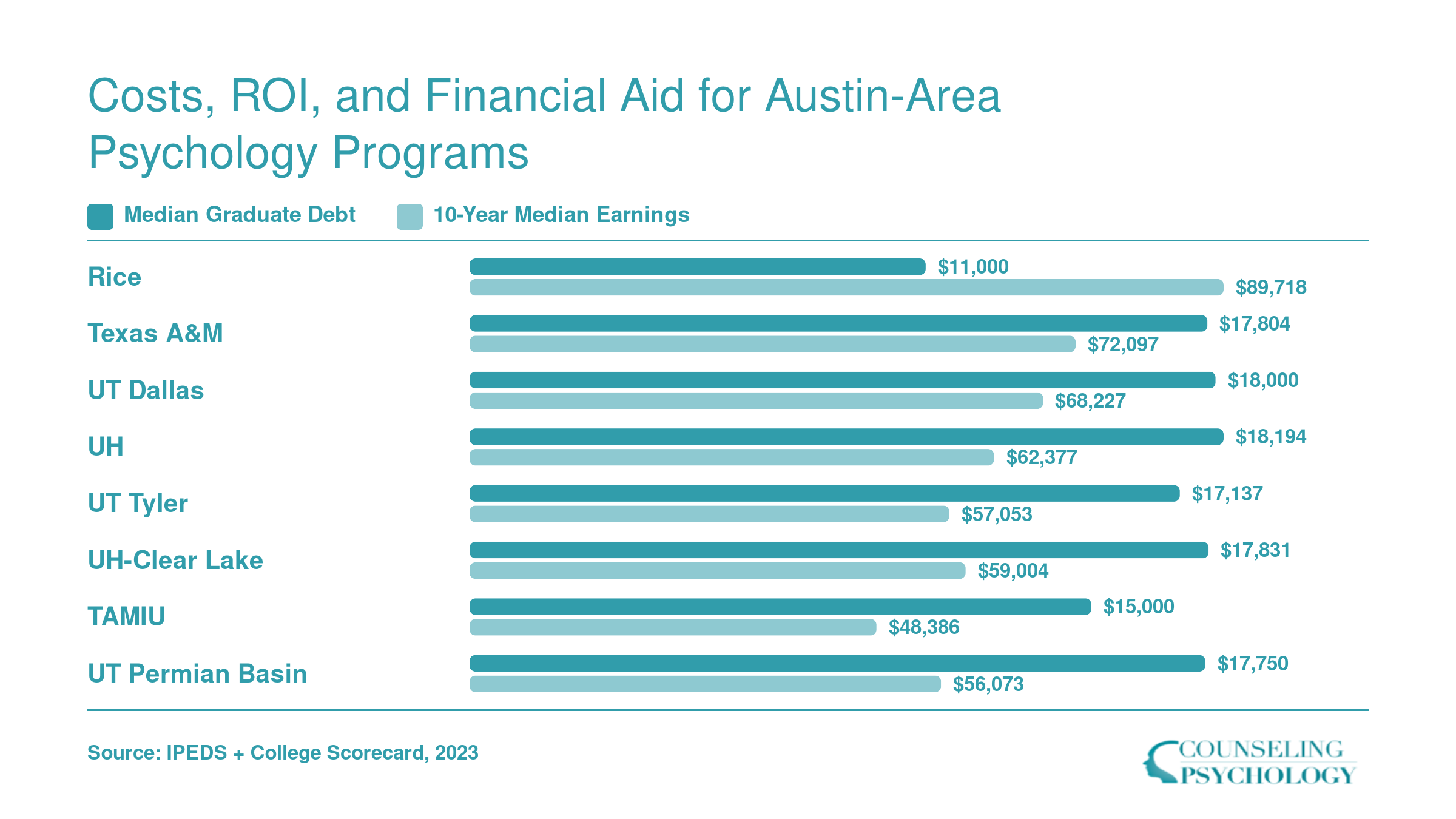
The gap between what you borrow and what you earn after graduation tells you more than sticker price alone. Across the top psychology programs near Austin, median graduate debt ranges from $11,000 at Rice University to roughly $18,000 at several public schools, yet 10-year median earnings span from about $48,400 to nearly $89,700. Rice delivers the strongest earnings-to-debt ratio (about 8.2:1) thanks to generous need-based aid that drives its net price down to $13,370, despite a $61,000 sticker tuition. For students hunting the cheapest psychology bachelor's degree in Texas, Texas A&M International University stands out at just $3,637 net price, with 87.5% of students receiving Pell Grants, a strong affordability signal. UT Permian Basin ($12,723) and UT Tyler ($13,323) also rank among the lowest net-price options. Public institutions cluster between roughly $12,700 and $21,300 in net price, while the sole private option (Rice) lands at $13,370 after aid. High Pell Grant recipient shares at schools like UH-Clear Lake (75.6%) and UT Dallas (65.8%) confirm these campuses actively serve students with significant financial need.
What Psychologists Earn in Texas: Salary Snapshot
The table below draws on Bureau of Labor Statistics (BLS) state-level data for the "Psychologists, All Other" category in Texas, presented alongside the national median for the same occupation. Keep in mind that these figures reflect earnings for professionals who typically hold a doctoral or master's degree. If you enter the workforce with only a bachelor's in psychology, your starting roles (research assistant, case manager, behavioral technician, community health worker) will generally pay well below these numbers, often in the $35,000 to $50,000 range depending on the position and employer. That reality is exactly why so many psychology graduates treat the bachelor's degree as the first step in a graduate school pipeline, a topic the next section explores in detail.
| Metric | Texas (Psychologists, All Other) | National Median (Psychologists, All Other) |
|---|---|---|
| Median Annual Wage | $81,830 | $106,420 |
| 25th Percentile | $61,740 | N/A |
| 75th Percentile | $133,240 | N/A |
| Mean Annual Wage | $96,040 | N/A |
| Estimated Employment | 2,160 | N/A |
Career Paths After a Psychology Bachelor's in Texas
Texas requires 3,000 hours of post-master's supervised experience for LPC licensure, a number that puts into perspective the long-term commitment behind many psychology careers. A bachelor's degree opens immediate doors, but the most rewarding roles often require further credentials.
Entry-Level Roles for BA/BS Psychology Graduates
Graduates with a psychology bachelor's degree qualify for several helping-profession roles across Austin and Texas. These positions offer valuable hands-on experience while you decide on a graduate school path.
- Case Manager: Coordinates services for clients in social service agencies, nonprofits, or healthcare settings. Duties include needs assessments, care planning, and connecting individuals to resources.
- Human Services Assistant: Supports social workers and psychologists by handling administrative tasks, client intake, and program logistics. Often found in government agencies and community organizations.
- Behavioral Technician (RBT): Works directly with individuals with autism or other developmental conditions under BCBA supervision. Demand is strong throughout the Austin metro area.
- Research Assistant: Assists with data collection, literature reviews, and lab management at universities like UT Austin or research institutes. Ideal for those considering a PhD.
- HR Specialist: Applies psychological principles to recruiting, employee relations, and training. Austin's tech-heavy economy fuels steady demand for HR talent.
National median wages for these roles range from about $38,000 (human services assistants) to $64,000 (HR specialists), according to the latest Bureau of Labor Statistics data. Austin's higher cost of living and competitive job market often push local starting salaries above these national figures, though exact pay depends on the employer and your prior experience.
The Graduate School Pipeline to Licensure
Earning a bachelor's in psychology is the first step toward becoming a licensed mental health professional. Texas offers several credentials, each with distinct requirements.1
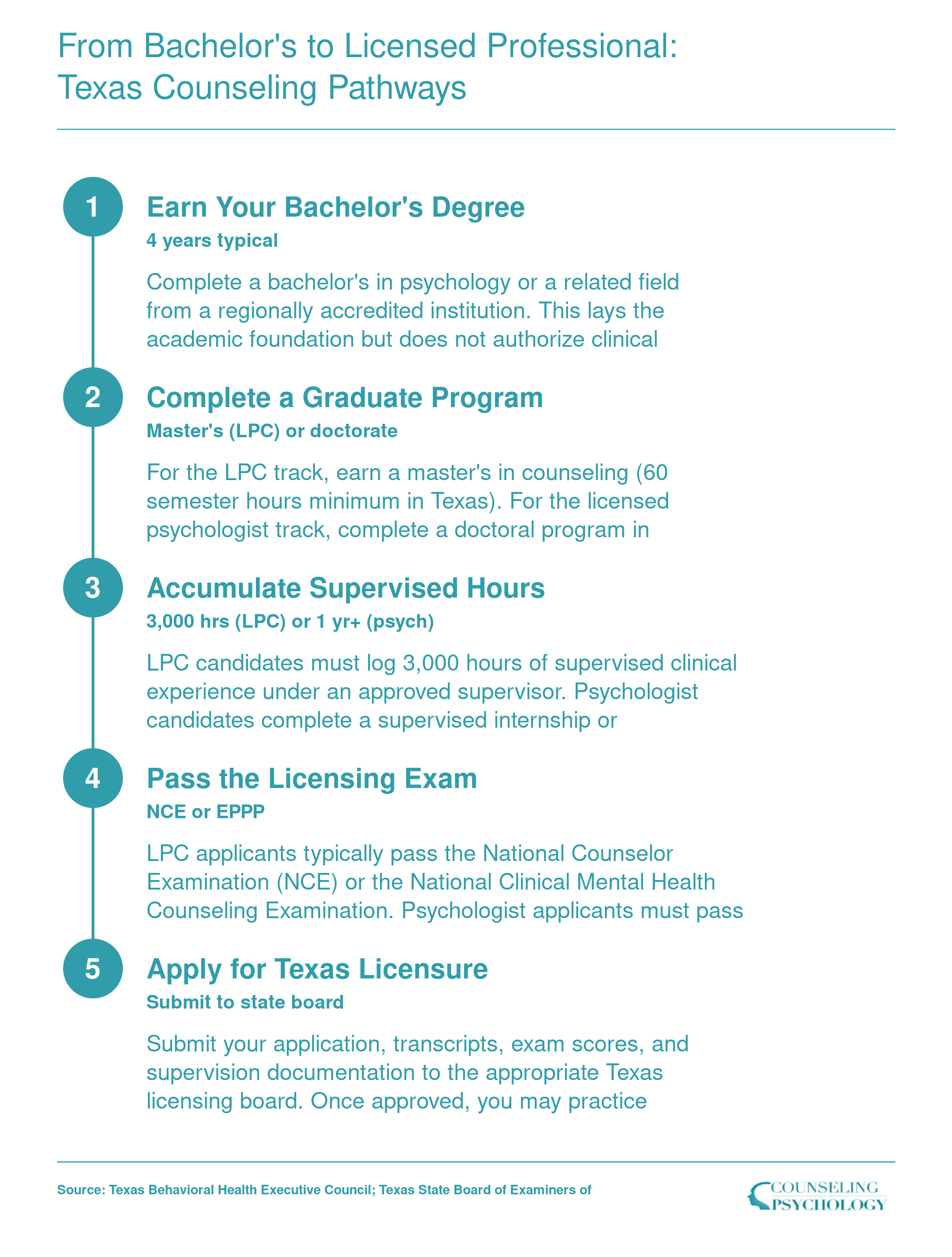
- Licensed Professional Counselor (LPC): Requires a master's in counseling or a closely related field (60 graduate semester hours), 3,000 hours of supervised post-master's practice, and passing the NCE or NCMHCE exam.
- Licensed Marriage and Family Therapist (LMFT): Calls for a master's or doctoral degree in marriage and family therapy, 3,000 hours of supervised clinical experience (at least 1,500 direct client contact), and the national MFT exam.
- Licensed Psychologist: Demands a doctoral degree (PhD or PsyD) in psychology, a 1,750-hour predoctoral internship, and 2,000 hours of postdoctoral supervised experience, plus the EPPP and a jurisprudence exam.
Each path leads to independent practice but differs in timeline, focus, and cost. For those leaning toward clinical or counseling work, pursuing a counseling master's programs online can be an efficient next step. Planning early helps avoid unnecessary detours.
Accelerated Options Near Austin
While no major Austin-area university currently advertises a formal 4+1 BA/MA track in psychology or counseling, students can still shorten their time to licensure.2 Some programs allow undergraduates to take graduate-level courses that may transfer into a master's program later. Choosing a bachelor's curriculum that aligns with your intended graduate field, such as taking counseling or clinical courses, can also reduce prerequisite gaps. If speed is a priority, explore universities elsewhere in Texas that do offer combined programs, or connect with departmental advisors to map a custom fast-track plan. Students interested in how psychology skills translate across professions should also review broader what can you do with a psychology degree options to keep their planning flexible.
From Bachelor's to Licensed Professional: Texas Counseling Pathways
A bachelor's degree in psychology is a critical first step, but it does not qualify you for independent clinical practice in Texas. Whether you pursue licensure as an LPC or as a licensed psychologist, the journey involves graduate education, supervised experience, and a licensing exam. Here is how the credentialing ladder works.
How to Choose the Right Psychology Program Near Austin
Choosing the right psychology program near Austin directly shapes your graduate school options and early career path, so treat accreditation, curriculum focus, and hands-on experience as non-negotiables.
Accreditation Is Non-Negotiable
Confirm regional accreditation from the Southern Association of Colleges and Schools Commission on Colleges (SACSCOC) before considering any program. This designation unlocks federal financial aid, smooth credit transfer, and eligibility for most master's and doctoral programs in Texas and beyond. Without it, you risk wasting time and money on a degree that won't get you into graduate school.
BA vs. BS: Which Track Fits Your Goals?
The distinction between a BA and BS often surprises students, but it matters for your next step. At a flagship like UT Austin, both degrees require 28 credit hours in psychology and a total of 120 hours for graduation, yet the BS loads up on science: 25 credit hours in natural science and math compared to a lighter distribution in the BA.1 The BS also mandates two foreign language courses, while the BA expects intermediate proficiency in a single language.1 The BA, by contrast, is the better option if you're targeting psychology graduate school, therapy, or social work, because it leaves more room for electives and research interests.
Broadly, a BS suits pre-med, pre-health, and research-heavy PhD tracks that demand quantitative rigor. A BA fits most counseling, social work, and applied psychology degree paths. Some competitive PhD programs quietly prefer BS graduates, but this varies by department. Always review your top graduate programs' prerequisite coursework.
Curriculum Focus: Research or Practice?
Look beyond the major name to the actual course sequence. Does the program emphasize research methods, statistics, and experimental design? That's ideal for a PhD or a career in academic research. A curriculum weighted toward developmental, abnormal, and clinical psychology, plus electives in mental health, better serves students who plan to enter direct practice. At UT Austin, the BA's 18 upper-division credit hours allow you to tailor the focus; some students arrange independent research for credit or join faculty labs studying child development, cognitive psychology, or addiction.2 In contrast, the BS demands more hard-science coursework, which prepares you for medical school or neuroscience PhDs.
Practicum and Field Experience Matter
Programs with embedded internships at Austin-area clinics, hospitals, or community mental health centers add immediate resume value. Even a semester-long practicum at a site like Austin State Hospital or Integral Care gives you exposure to case management, intake interviews, or behavioral observation.3 Ask directly about partnership agreements: some programs place students in labs or clinics affiliated with the university, while others require you to arrange your own placement. For online programs, check whether local practicum placement is supported; many quality programs maintain a database of Austin-area sites.
Format and Schedule Alignment
Weigh campus, hybrid, and fully online formats against your work schedule, caregiving duties, and learning style. Campus programs offer in-person research opportunities and networking; online degrees often allow asynchronous pacing. Hybrid models can offer the best of both, but verify whether the evening or weekend sections you need are actually offered. For online programs, confirm that any virtual coursework still allows access to local practicum sites, preferably in the Austin metro area, so you don't delay graduation searching for a placement.
Frequently Asked Questions About Psychology Degrees Near Austin
Prospective psychology students in the Austin area tend to ask many of the same questions about programs, costs, and career options. Below are concise, fact-based answers to the questions we hear most often.
More Psychology Programs Near Austin Worth Considering
Beyond the top-ranked programs, many other excellent psychology bachelor's degrees are available across Texas. This directory lists additional schools offering strong programs, with details on location, format, and net price to help you broaden your search.
DFW Metroplex
- Psychology
- Psychology
- General Psychology Major
- Psychology (General Psychology)
Austin Area
- Bachelor of Arts in Psychology
- Psychology (BA)
Greater Houston
- Bachelor of Science in Psychology
- B.S. in Psychology
- Psychology
San Antonio Area
- Psychology
- Bachelor of Arts in Psychology (General Psychology)
Other Texas Regions
- Psychology
- Bachelor of Science in Psychology (General Psychology)
- Bachelor of Science in Psychology
- Bachelor of Arts in Psychology
- Bachelor of Science in Psychology
- Bachelor of Arts in Psychology