What you’ll learn in this article…
- CSU campuses near Los Angeles offer the lowest tuition, while private programs like LMU carry higher costs but strong field placement networks.
- California's 777:1 student-to-school-psychologist ratio signals urgent demand and strong job prospects for new graduates.
- No fully online program in California currently meets all PPS credential requirements, though several offer hybrid formats.
- BLS data and regional figures show school psychologists in the Los Angeles area earn above the statewide median salary.
California's student-to-school-psychologist ratio sits more than 50 percent above the level recommended by the National Association of School Psychologists, and Los Angeles Unified alone employs hundreds of credentialed school psychologists while continuing to report unfilled positions. Demand is not a concern for graduates entering this field right now.
The practical tension is program selection. Within commuting distance of Los Angeles, prospective students can choose between Cal State campuses charging in-state tuition under $10,000 per year, private universities with significantly higher price tags but stronger research infrastructure, and hybrid formats that reduce on-campus days without eliminating required in-person practicum hours.
Credential requirements add another layer of complexity. California's Pupil Personnel Services credential requires a specific sequence of supervised field hours that varies by program design, and some tracks lead to the PPS only, while others position graduates for national certification or independent licensure as well. Students interested in adjacent fields like educational psychology doctoral programs should note that the PPS credential pathway is distinct. The program you choose shapes not just your training but your scope of practice after graduation.
2026 Best Master's in School Psychology Programs Near Los Angeles
California's school psychology workforce shortage makes this an excellent time to pursue a master's or specialist degree in the field, and programs across the state are responding with flexible formats and strong field placements. The schools below span the greater Los Angeles region and beyond, each offering a credential pathway recognized by the California Commission on Teacher Credentialing. Nearly every institution on this list holds Hispanic-Serving Institution (HSI) designation, reflecting the communities these future school psychologists will serve. Program-level earnings and debt data are not yet available for most of these programs, so we report institution-wide figures from College Scorecard where applicable.
- Graduate outcomes and debt levels
- Tuition affordability and net price
- Accreditation and credential alignment
- Program format and field hours
- Institutional graduation and retention rates
- Internal program database
- College Scorecard graduate earnings — collegescorecard.ed.gov
- NCES-IPEDS federal institutional data — nces.ed.gov
- Independent program research

San Diego State University
San Diego State University's four-year integrated program leads to both an Education Specialist (Ed.S.) degree and the California Pupil Personnel Services (PPS) Credential in School Psychology. The curriculum is grounded in ecosystemic approaches, multicultural consultation, and culturally affirming interventions, and it holds dual accreditation from CCTC and NASP. SDSU is an HSI with an institution-wide graduation rate of 76.4% and a median graduate debt of $15,000, making it one of the more affordable options among ranked programs.
- Four-year integrated Ed.S. degree and credential program
- Dual accreditation from CCTC and NASP
- Strong emphasis on multicultural and equity-based practice
- Ecosystemic and cross-cultural consultation training
- Faculty expertise in school-based mental health
- In-state tuition around $10,252 per year (IPEDS)
- High graduate employment rate reported by the program
- HSI institution reflecting Southern California demographics
School Psychology, Ed.S. with PPS Credential — On-Campus

San Francisco State University
San Francisco State University offers a Master of Science in Psychology with a concentration in School Psychology, structured as a comprehensive 57-unit program spanning six semesters. The program leads to both the M.S. degree and the PPS Credential, with a curriculum that stresses child assessment techniques, culturally competent practice, and supervised practicum hours. SFSU is an HSI with a net price of $12,278 and institution-wide median earnings of $68,077 ten years after enrollment. Prior hands-on experience with children and families is expected at admission.
- Comprehensive 57-unit graduate program over six semesters
- Leads to PPS Credential alongside the M.S. degree
- Emphasis on child assessment and intervention strategies
- Practicum placements in Bay Area school settings
- Cultural competency woven throughout the curriculum
- In-state tuition approximately $9,370 per year (IPEDS)
- Requires prior experience working with children and families
Master of Science in Psychology: Concentration in School Psychology — On-Campus

Loyola Marymount University
Loyola Marymount University, located in the heart of Los Angeles, delivers its School Psychology program through a three-year cohort model that yields both an M.A. in Educational Psychology and an Ed.S. The 63-unit sequence includes a 500-hour practicum and a 1,200-hour internship, and it is NASP-approved. LMU stands out for offering online and in-person options for California residents, making it the most accessible LA-based private option on this list. The university is an HSI with a 10:1 student-to-faculty ratio, though tuition is higher at $23,172 per year for graduate students.
- NASP-approved three-year cohort model
- 63 course units with online and in-person delivery
- 500-hour practicum plus 1,200-hour internship
- Estimated cost of approximately $1,632 per unit
- Social justice and evidence-based practice emphasis
- Minimum 3.0 undergraduate GPA required for admission
- California state credential eligible upon completion
School Psychology, Ed.S. with Educational Psychology, M.A. — Online

Saint Mary's College of California
Saint Mary's College of California offers a rigorous 66-unit Education Specialist (Ed.S.) in School Psychology, typically completed in three to four years. Aligned with NASP standards, the program emphasizes social justice, data-driven decision making, and holistic academic and mental health interventions for PreK-12 students. Saint Mary's is an HSI with a 10:1 student-to-faculty ratio and an institution-wide graduation rate of 70.3%. Graduates qualify for both the PPS Credential and Licensed Educational Psychologist certification.
- 66-unit advanced professional degree aligned with NASP
- Typical completion in three to four years
- Qualifies graduates for PPS Credential and LEP pathway
- Social justice orientation embedded in coursework
- Data-driven decision making and consultation focus
- Small class sizes with a 10:1 student-to-faculty ratio
- Institution-wide median graduate debt of $23,691 (Scorecard)
Education Specialist (Ed.S.) in School Psychology — On-Campus

California State University-Sacramento
Sacramento State's Master of Arts in School Psychology blends classroom instruction with extensive fieldwork and carries both NASP approval and CCTC accreditation. The program centers cultural diversity and reflective, ethical practice, preparing graduates to serve California's varied student populations. As an HSI with the lowest net price among public schools on this list ($9,338), Sac State offers strong value, and graduates carry a median debt of just $15,000. The institution-wide graduation rate is 56.3%, which reflects the broader undergraduate population rather than graduate outcomes specifically.
- NASP-approved and CCTC-accredited campus program
- Net price of $9,338, among the lowest in the ranking
- Strong cultural diversity and reflective practice focus
- Fieldwork integrated throughout the curriculum
- Prepares graduates for PPS Credential in California
- Graduates may also pursue Professional Clinical Counselor licensure
- In-state tuition approximately $9,542 per year (IPEDS)
Master of Arts in School Psychology — On-Campus

California State University-Northridge
Cal State Northridge sits in the San Fernando Valley, making it one of the most conveniently located options for LA-area students. CSUN's M.S. in School Psychology trains professionals in assessment, intervention, and data-based decision making with a strong multicultural lens. The program's net price is just $7,021, the second lowest on this list, and institution-wide median graduate debt is $13,872. CSUN is an HSI where roughly 86% of undergraduates receive Pell Grants, underscoring its commitment to access.
- Campus-based program in the heart of the San Fernando Valley
- Multicultural perspectives integrated across coursework
- Data-based decision making and intervention techniques
- Professional mentorship opportunities during training
- Net price of $7,021, second lowest among ranked programs
- In-state tuition approximately $8,982 per year (IPEDS)
- HSI with deep ties to diverse LA-area communities
School Psychology, M.S. — On-Campus

California State University-Fresno
Fresno State's Master of Science in Psychology with a School Psychology emphasis is a demanding 86-unit, three-year program that includes both practicum and internship experiences. Admission is competitive, requiring a strong GPA and GRE scores. The curriculum emphasizes a scientific problem-solving approach, cultural responsiveness, and targeted intervention strategies for children and adolescents. Fresno State is an HSI with the lowest net price on this list at $7,000, and assistantships and fellowships help offset costs further.
- 86-unit program, one of the most comprehensive listed
- Three-year full-time cohort with practicum and internship
- Competitive admission requiring GPA and GRE scores
- Scientific problem-solving and cultural responsiveness focus
- Assistantships and fellowships available for financial support
- Net price of $7,000, lowest among all ranked programs
- Prepares students for the PPS Credential in California
Master of Science in Psychology, School Psychology Emphasis — On-Campus

Fresno Pacific University
Fresno Pacific University offers a 62-unit hybrid M.A. in School Psychology paired with the PPS Credential. Small class sizes and synchronous online options give working professionals more scheduling flexibility, while embedded BCBA coursework distinguishes this program from most competitors. Faculty are current practitioners, which keeps instruction tightly connected to real-world school settings. Fresno Pacific is an HSI with a 10:1 student-to-faculty ratio, though its median graduate debt of $23,146 is higher than most CSU alternatives.
- 62-unit hybrid program with synchronous online sessions
- BCBA coursework embedded within the degree plan
- Faculty are current school psychology practitioners
- Small class sizes with a 10:1 student-to-faculty ratio
- Multiple campus locations across the Central Valley
- Christian value-centered curriculum and community
- Prepares graduates for the California PPS Credential
School Psychology, M.A. and PPS Credential — Hybrid

University of La Verne
The University of La Verne, just 30 miles east of downtown Los Angeles, offers a 64-unit M.S. in School Psychology with an embedded PPS Credential. The program trains culturally responsive professionals over roughly three years and includes 450 hours of practicum plus 1,200 hours of fieldwork. La Verne is an HSI, and the program is accredited by the California Commission on Teacher Credentialing. At an estimated $800 per unit, students should budget carefully, though institution-wide median earnings of $65,464 suggest solid long-term returns.
- 64-unit campus program, typically three years to complete
- Accredited by the California Commission on Teacher Credentialing
- 450 hours of practicum plus 1,200 hours of fieldwork
- Estimated tuition of $800 per unit
- NASP Praxis exam preparation built into the curriculum
- Multiple campus locations near Los Angeles
- HSI institution serving a diverse Inland Empire population
Master of Science in School Psychology with PPS Credential — On-Campus

Concordia University-Irvine
Concordia University Irvine's MAEd in School Psychology is a hybrid program that combines coursework with 1,200 hours of field experience, preparing graduates for K-12 careers focused on psychoeducational assessment and behavioral intervention. Accredited by the CTC, the program is competitively priced at an estimated $695 per unit. Concordia is an HSI located in Orange County, approximately an hour south of downtown LA, and requires a minimum 2.75 GPA for admission.
- Hybrid format blending campus and online coursework
- 60 units required for program completion
- 1,200 hours of supervised field experience
- Accredited by the California Commission on Teacher Credentialing
- Estimated tuition of $695 per unit
- Minimum 2.75 GPA and bachelor's degree required for admission
- Focus on psychoeducational assessment and behavioral intervention
Master of Arts in Education (MAEd): School Psychology — Hybrid

California Baptist University
California Baptist University in Riverside offers a 68-unit M.S. in School Psychology delivered through a cohort model with evening classes Monday through Thursday. The program emphasizes hands-on experience from the first semester and culminates in 1,200 hours of fieldwork. CBU's faith-integrated curriculum prioritizes ethical standards and holistic student support. The institution is an HSI, and the estimated per-unit cost is $810, with an institution-wide median graduate debt of $26,063.
- 68-unit campus program over eight semesters
- Cohort model with Monday-through-Thursday evening classes
- 1,200 hours of fieldwork required for completion
- California PPS Credential included upon graduation
- Hands-on clinical experience begins in the first semester
- Faith-integrated curriculum emphasizing ethical practice
- Estimated tuition of $810 per unit
School Psychology, M.S. — On-Campus

University of Massachusetts Global
University of Massachusetts Global (formerly Brandman) delivers its EdS in School Psychology and MA in Educational Psychology with PPSP Credential entirely online, making it a practical choice for working professionals across the LA region. The curriculum covers cognitive assessment, counseling techniques, and special education law, all while requiring California residency. A minimum 2.75 GPA is needed for admission. Note that the institution-wide graduation rate of 42.9% reflects a largely nontraditional undergraduate population and should not be read as a graduate program completion metric.
- Fully online program accessible throughout California
- Combines Ed.S. and M.A. degrees with the PPSP Credential
- Curriculum covers cognitive assessment and special education law
- Focus on mental health, behavioral interventions, and advocacy
- Requires California residency and a minimum 2.75 GPA
- Comprehensive fieldwork component with faculty support
- Ethical practice and diversity woven throughout coursework
EdS in School Psychology and MA in Educational Psychology with PPSP Credential — Online

University of California-Santa Barbara
UC Santa Barbara's M.Ed. in School Psychology follows a science-to-practice model and holds NASP candidacy status. The curriculum stresses research-based strategies, problem-solving skills, and comprehensive psychological services for students with diverse learning needs, with particular emphasis on serving underrepresented communities. UCSB boasts the highest institution-wide graduation rate (83%) and the lowest median graduate debt ($13,993) on this list. As an HSI, it combines a strong research university environment with direct community engagement. Santa Barbara is about 95 miles northwest of Los Angeles.
- Science-to-practice training model with NASP candidacy status
- Emphasis on serving diverse and underrepresented populations
- University-supervised fieldwork in local school districts
- Research-oriented curriculum aligned with national standards
- In-state tuition approximately $15,124 per year (IPEDS)
- Institution-wide median graduate debt of just $13,993
- HSI with the highest graduation rate among ranked programs (83%)
Master of Education in School Psychology — On-Campus

California State University-Chico
Chico State's Master of Arts in Psychology with an option in Applied Psychology/School Psychology is a three-year campus program that reports a 100% job placement rate for graduates. Training aligns with both NASP and CTC standards and leads to the PPS Credential. No GRE is required for admission, lowering an initial barrier for many applicants. The institution is an HSI with a net price of $14,480 and work-study opportunities are available. Chico is located in Northern California, roughly 570 miles from Los Angeles.
- Three-year comprehensive campus program
- Reports 100% job placement rate for graduates
- Accredited by both NASP and CTC
- No GRE required for admission
- Leads to the California PPS Credential
- Work-study opportunities available for enrolled students
- Five prerequisite course areas must be completed before entry
Master of Arts in Psychology: Option in Applied Psychology/School Psychology — On-Campus

California State University-East Bay
Cal State East Bay's School Psychology program is a three-year specialist-level hybrid program accredited by NASP, awarding both a Master's in Counseling Psychology and a School Psychology Credential. Its social justice and equity focus is designed to prepare practitioners for diverse Bay Area and broader California school communities. Graduates are eligible for NCSP and LEP credentials. The net price of $9,320 makes it one of the most affordable options on this list, and institution-wide median earnings reach $71,401 at ten years.
- NASP-accredited three-year hybrid specialist program
- Awards both a Master's degree and a School Psychology Credential
- Eligible for NCSP and Licensed Educational Psychologist credentials
- Social justice and equity orientation throughout coursework
- Cohort-based learning community with integrated fieldwork
- Net price of $9,320, among the lowest for ranked programs
- Counseling and therapy training integrated into the curriculum
School Psychology (Master's in Counseling Psychology and Credential) — Hybrid

California State Polytechnic University-Humboldt
Cal Poly Humboldt's School Psychology M.A. is a three-year campus program focused on comprehensive psychological interventions in California public and private schools. Students complete 540 hours of supervised practicum alongside coursework in psychoeducational assessment, preventative strategies, and interdisciplinary collaboration. The program is located in Arcata on the far Northern California coast, well outside the LA metro, but it is worth considering for students open to relocating. Institution-wide median graduate debt is $18,000, and the net price sits at $13,171.
- Three-year campus program in Arcata, Northern California
- 540 hours of supervised practicum in local schools
- Psychoeducational assessment and intervention training
- Preventative and responsive approaches to student support
- Expert faculty guidance with professional conference opportunities
- Leads to a California state credential in school psychology
- Net price of $13,171 with manageable median graduate debt
School Psychology, M.A. — On-Campus
How We Ranked These School Psychology Programs
Picking a school psychology program in Los Angeles usually means weighing two things at once: how affordable and accessible a program is right now, versus whether it will actually open the door to working in a California school district once you finish. Our ranking is built around that tension.
Data Sources Behind the Scores
We pulled program-level and institutional data from two federal sources: the U.S. Department of Education's College Scorecard and IPEDS (the Integrated Postsecondary Education Data System). These feed the cost, completion, and outcomes inputs you see referenced across the list. A few caveats worth flagging:
- Graduation rates are institution-wide, not specific to the school psychology cohort. Smaller specialist programs often retain students at higher rates than the campus average.
- Net price is an average figure after grants and scholarships across all undergraduates at the institution. It is a planning benchmark, not a personalized estimate of what your specialist degree will cost.
- Earnings data at the program level is limited for specialist (EdS) credentials, so outcomes weighting leans on broader counseling and psychology occupational data.
Why California Credential Eligibility Comes First
We filtered out general master's degree in psychology programs that do not lead to the California Pupil Personnel Services (PPS) credential in School Psychology. A master's in psychology alone will not let you work as a school psychologist in a K-12 setting here, so prestige or low cost cannot compensate for a missing credential pathway.
NASP Approval as a Quality Signal
NASP approval is not a College Scorecard field, so we cross-checked each program against the NASP Program Approval directory.1 Five programs in the LA metro hold full NASP approval at the specialist level: Azusa Pacific University, Cal State Los Angeles, Cal State Northridge, Chapman University, and Loyola Marymount University.1 Programs with NASP approval get a meaningful bump in our ranking because graduates qualify for the Nationally Certified School Psychologist (NCSP) designation, which streamlines licensure if you ever practice outside California.
Program Cost and ROI Comparison
The table below compares annual in-state tuition, median graduate debt at completion, institution-level median earnings ten years after enrollment, and a calculated ROI ratio for each school psychology program on our list. A few patterns stand out: the CSU campuses with the lowest net prices (CSU Northridge and CSU Fresno, each around $7,000) also carry the lightest debt loads, yet the highest median earnings belong to graduates of the two private institutions, Saint Mary's College and Loyola Marymount University. Program-level earnings data (such as first-year or fourth-year earnings specific to school psychology completers) are not yet available for these programs, so the earnings column reflects all master's-level completers at each institution, not exclusively school psychologists. Even at the most expensive option on this list, median debt remains under $27,000, and with ten-year median earnings ranging from roughly $48,000 to $79,000, most graduates can expect to recoup their educational investment within a few years of entering the workforce.
| School | Annual In-State Tuition | Net Price | Median Graduate Debt | Median Earnings (10 yr) | ROI Ratio |
|---|---|---|---|---|---|
| UC Santa Barbara | $15,124 | $16,109 | $13,993 | $74,915 | 5.35 |
| San Francisco State University | $9,370 | $12,278 | $15,371 | $68,077 | 4.43 |
| San Diego State University | $10,252 | $15,364 | $15,000 | $64,909 | 4.33 |
| CSU Sacramento | $9,542 | $9,338 | $15,000 | $64,876 | 4.33 |
| CSU East Bay | $9,107 | $9,320 | $16,544 | $71,401 | 4.32 |
| CSU Northridge | $8,982 | $7,021 | $13,872 | $59,115 | 4.26 |
| CSU Fresno | $8,865 | $7,000 | $14,505 | $61,244 | 4.22 |
| Loyola Marymount University | $23,172 | $48,381 | $19,500 | $78,349 | 4.02 |
| CSU Chico | $9,996 | $14,480 | $16,552 | $64,172 | 3.88 |
| Saint Mary's College of California | $38,500 | $30,378 | $23,691 | $78,812 | 3.33 |
| University of La Verne | $15,318 | $20,161 | $23,500 | $65,464 | 2.79 |
| UMass Global | $13,680 | $32,654 | $24,276 | $65,703 | 2.71 |
| Concordia University Irvine | $8,895 | $28,115 | $24,247 | $65,083 | 2.68 |
| Cal Poly Humboldt | $9,921 | $13,171 | $18,000 | $47,626 | 2.65 |
| Fresno Pacific University | $13,780 | $13,630 | $23,146 | $58,896 | 2.54 |
| California Baptist University | $15,562 | $26,285 | $26,063 | $61,504 | 2.36 |
Related Articles
Questions to Ask Yourself
PPS Credential, LEP License, and NCSP: California Credential Pathways Compared
Which credential do you need to work as a school psychologist in California? The answer depends on where you want to practice and the scope of services you plan to offer. Three distinct credentials define the professional landscape: the Pupil Personnel Services (PPS) credential, the Licensed Educational Psychologist (LEP) license, and the Nationally Certified School Psychologist (NCSP) credential. Each serves a different purpose, and understanding their differences is essential to mapping your career path. For a broader look at the education timeline, our guide on school psychologist education requirements walks through each stage from bachelor's degree to licensure.
PPS: The California K-12 Requirement
The PPS credential in School Psychology is issued by the California Commission on Teacher Credentialing (CTC) and is the mandatory authorization for any school psychologist working in a California K-12 public school.1 Without it, you cannot provide school psychology services in a school setting.
- Issuing body: California Commission on Teacher Credentialing (CTC)
- Degree requirement: Baccalaureate plus a minimum of 60 semester units of post-baccalaureate study in a CTC-approved school psychology program1
- Exam: No specific state licensure exam is required for the PPS credential (as of 2025-2026)1
- Scope of practice: Authorizes all school psychologist functions within California K-12 public schools, including assessment, counseling, consultation, and intervention
- Renewal: The preliminary PPS credential is typically valid for five years and must be upgraded to a clear credential through an induction program or equivalent professional development
Starting in January 2026, experienced out-of-state school psychologists can apply for a new Preliminary PPS credential, streamlining the pathway for those who already hold comparable credentials elsewhere.2
LEP: Expanding Beyond the School Setting
For professionals who want to practice outside the school system, the Licensed Educational Psychologist (LEP) license issued by the California Board of Behavioral Sciences (BBS) provides a broader scope. An LEP can conduct independent educational evaluations, work in private practice, consult with families and agencies, and offer services in clinical or community settings.
- Issuing body: California Board of Behavioral Sciences (BBS)
- Degree requirement: A master's or higher degree in psychology, educational psychology, school psychology, or a closely related field, plus the PPS credential or its equivalent
- Exam: LEP written examination administered by the BBS
- Supervised experience: Three years of full-time supervised experience as a school psychologist (two years for those with a doctoral degree)
- Scope of practice: Private practice, independent educational evaluations, consultation, and services beyond the K-12 system
- Renewal: LEP licenses must be renewed every two years with proof of continuing education
The LEP is not a school-based requirement; rather, it is a voluntary license that broadens career options and can increase earning potential.
NCSP: National Portability and Recognition
The Nationally Certified School Psychologist (NCSP) credential is a voluntary national certification offered by the National Association of School Psychologists (NASP). It is not a state license but signals that you have met rigorous national standards. Many states recognize the NCSP for reciprocity or streamlined licensure, making it valuable if you might relocate in the future.
- Issuing body: National Association of School Psychologists (NASP)
- Degree requirement: Completion of a NASP-approved specialist-level program (at least 60 graduate semester hours) with a 1,200-hour internship
- Exam: Passing score on the Praxis School Psychologist exam
- Scope of practice: Does not grant independent practice authority; serves as a portable national credential recognized by many state licensing boards
- Renewal: Renewed every three years through documentation of ongoing professional development
While NCSP is not required for California employment, it can strengthen applications and ease future state-to-state transitions.
How the Credentials Compare
If your goal is to work exclusively in California K-12 schools, the PPS credential is your gateway. If you want to offer services privately or in non-school settings, you will eventually need the LEP. The NCSP is a career enhancer that makes lateral moves across state lines simpler. Many California programs embed the PPS requirements directly into their coursework and fieldwork, while LEP and NCSP typically require additional post-degree steps.
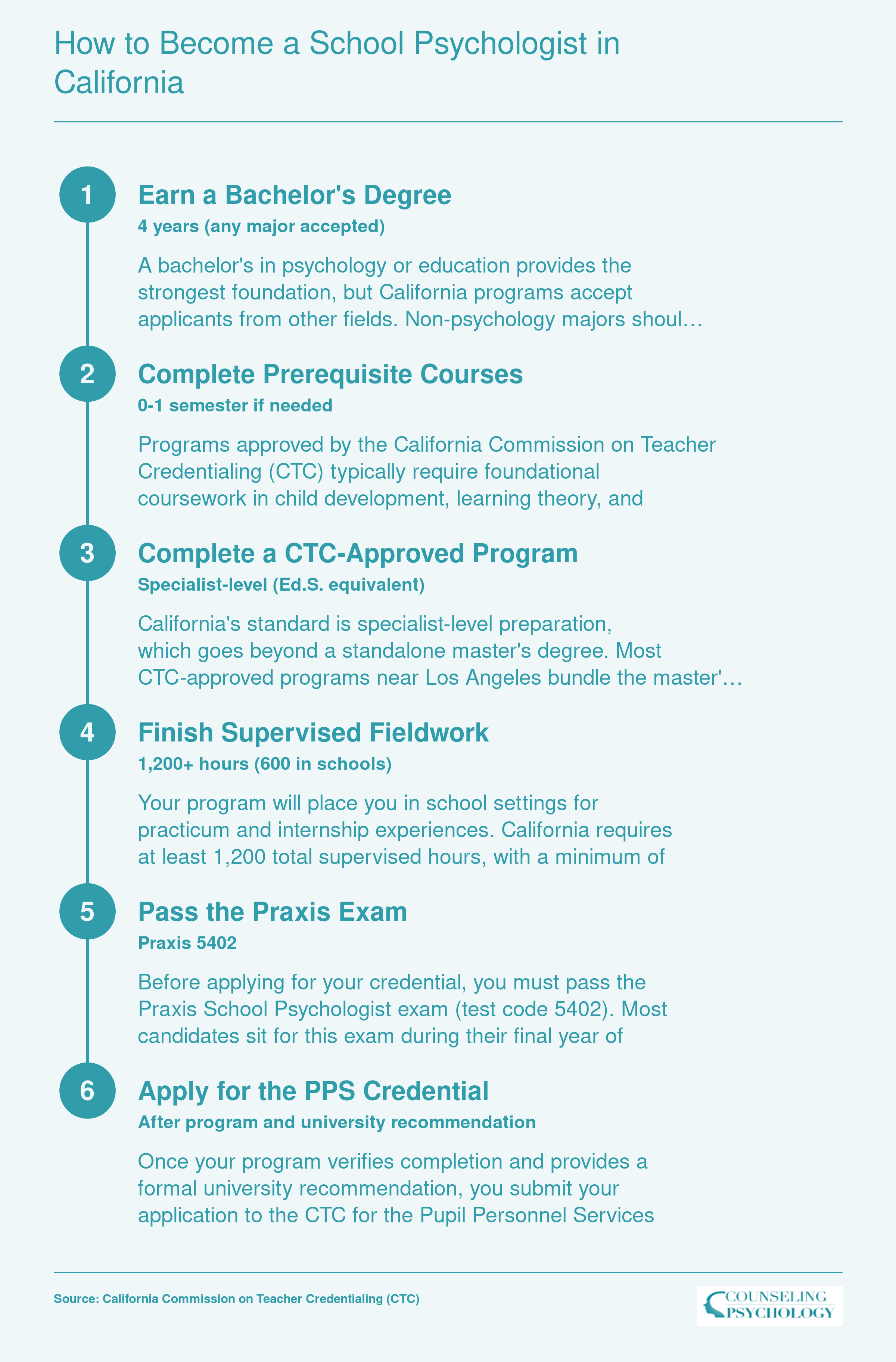
How to Become a School Psychologist in California
The path from your bachelor's degree to a Pupil Personnel Services (PPS) School Psychology Credential typically spans about three years of graduate-level work. If your undergraduate degree is outside psychology or education, expect to add roughly one semester of bridging coursework before or during your program.
Admission Requirements Across LA-Area School Psychology Programs
The steady move toward test-optional admissions has reshaped how aspiring school psychologists enter graduate training, opening doors to a wider pool of candidates while sharpening focus on academic readiness and hands-on experience.
GPA Minimums and Prerequisite Coursework
Most master's and specialist-level school psychology programs near Los Angeles expect a cumulative undergraduate GPA of at least 3.0. Competitive applicants often present stronger marks in prerequisite areas: introductory psychology, statistics, and child development are among the most common. A solid foundation in research methods can also strengthen an application, particularly at programs that emphasize data-based decision-making. If you're wondering how hard it is to get into grad school for psychology, understanding these baseline expectations is a good starting point.
- Common prerequisites: Intro to Psychology, Statistics, Child/Human Development, Research Methods.
- GPA floor: Typically 3.0, though some programs allow conditional admission with a lower GPA if other credentials are strong.
The GRE: Waived at Many LA-Area Programs
The GRE requirement has largely disappeared from school psychology admissions in the region. For fall 2026 entry, both Cal State LA's Ed.S. program and Azusa Pacific's Ed.S. program list no required admissions exam.13 While individual institutions may still consider scores if submitted, the overarching trend is toward holistic review. Applicants should verify each program's current policy, as a few may recommend or accept scores for scholarship consideration even without requiring them.
Application Timelines and Deadlines
Fall-only admission is the norm across Southern California school psychology programs, with deadlines clustered in winter and early spring. CSUN's M.S. in School Psychology, for example, sets a January 31, 2026 deadline for fall entry.2 Cal State LA and other CSU campuses generally follow similar timelines. Missing the once-per-year window typically means waiting another full year to begin coursework, so early preparation is essential.
Pathways for Career Changers
Applicants whose bachelor's degree is outside psychology need not be automatically sidelined. Several programs offer conditional admission tracks that let career changers complete foundational coursework, often in areas like child development and statistics, before beginning the core sequence. These bridging courses are sometimes available at the graduate level or through post-baccalaureate study. Candidates with backgrounds in education, social work, or related fields may find their experience valued during review, even if they lack a traditional psychology major.
Distinctive Program Requirements
LMU, Chapman University, and the various Cal State campuses each set their own prerequisite expectations. While core prerequisites overlap, details differ: some programs mandate a specific number of units in child development, others expect a lab-based statistics course, and a few may require an introductory special education or diversity course. Researching individual program websites is the only way to pin down exactly what each school asks for. Early contact with admissions coordinators can clarify how your transcript aligns with these requirements and whether any gaps can be addressed before the deadline.
California's student-to-school-psychologist ratio sat at roughly 777:1 in the 2023-24 school year, according to workforce data tracked by the National Association of School Psychologists. That's more than 50 percent above NASP's recommended ratio of 1:500, which is one reason credentialed school psychologists remain in high demand across LA-area districts.
School Psychologist Salary and Job Outlook in the Los Angeles Area
School psychology is one of the better-compensated master's-level careers in California, and the Los Angeles region sits at the higher end of that range. Before committing to a three- or four-year program, it helps to understand what graduates actually earn, how that compares to national figures, and why district salary schedules can make the real number meaningfully different from what federal wage tables show.
What School Psychologists Earn in California
The Bureau of Labor Statistics (May 2023 data) reports that school psychologists in California earn a median annual wage of $109,830, with statewide employment of about 11,150 practitioners.1 California's location quotient of 1.50 indicates the state employs school psychologists at 50% above the national average concentration, reflecting both the size of the K-12 system and the legal mandates around special education assessment.
For context, the national median for the occupation (SOC 19-3034) sits at $84,940, with national percentile wages of $59,250 (10th), $70,520 (25th), $107,400 (75th), and $131,470 (90th).1 California's median exceeds the national 75th percentile, which tells you most California practitioners out-earn three-quarters of their peers nationwide. BLS does not publish a separate Los Angeles-Long Beach-Anaheim metro breakout for this occupation at the percentile level in the public OEWS tables, so the state figure is the most reliable LA-area proxy. Treat any single-number metro estimate with caution.
How District Salary Schedules Change the Picture
Unlike many BLS occupations, California school psychologists are typically paid on certificated salary schedules negotiated district by district. LAUSD, Long Beach Unified, and large Orange County districts publish step-and-column tables that reward years of service and additional graduate units. Starting salaries in major LA-area districts commonly land in the $80,000s, with senior practitioners on the top step exceeding the BLS state median once stipends, summer extensions, and CalSTRS retirement contributions are factored in. The BLS figure captures base wages only, not the benefits package. If you are weighing the financial return of a graduate degree more broadly, you may also find it useful to consider whether a bachelor's in psychology is worth it as a foundation before investing in specialist-level training.
Demand and Placement
California has a documented, persistent shortage of credentialed school psychologists. CASP and CDE have flagged unfilled positions across urban and rural districts for years, and most NASP-aligned programs in this guide report that students receive job offers before or shortly after completing their internship. Program-level earnings data one to four years after completion is not yet published for most of the school psychology specialty programs profiled here, so the BLS occupational employment and wage data remain the cleanest benchmark for prospective students weighing tuition against expected salary.
Online and Hybrid School Psychology Programs in California
No fully online school psychology program in California currently satisfies all requirements for the Pupil Personnel Services (PPS) credential. The California Commission on Teacher Credentialing (CTC) mandates in-person practicum and internship hours that online-only tracks cannot fully replicate. However, several universities now offer hybrid formats that blend remote coursework with required on-site experiences, making the credential more accessible for working students and those outside major metro areas.
Confirming CTC Approval and Program Formats
Always start with the CTC's website for the most up-to-date list of approved school psychology programs. The commission updates its list regularly, and delivery formats (online, hybrid, in-person) are subject to change. After identifying candidate programs, visit each university's official page for explicit statements about online or hybrid delivery and CTC approval. For example, National University, UMass Global, Alliant International, and multiple Cal State campuses maintain detailed descriptions of their instructional modalities. Look for language confirming that the program qualifies graduates for the PPS credential.
Verifying Fieldwork and Internship Logistics
Even in hybrid programs, fieldwork and internship components remain critical. Because CTC requires a minimum number of supervised hours in K-12 settings, most programs arrange local placements but require students to be physically present. Contact program coordinators directly to clarify how their online or hybrid track handles these requirements. Ask specific questions: Are there intensives or residencies? How are site supervisors credentialed? Does the program assist with placement, or must students secure their own? Some programs may allow remote supervision for a portion of hours, but fully online practicum is rare.
Seeking Guidance from Professional Organizations
If fully online options seem limited, consult the California Association of School Psychologists (CASP) and the National Association of School Psychologists (NASP). These organizations offer resources on program accreditation, alternative pathways to licensure, and emerging models for distance learning. CASP in particular can provide state-specific insight on how hybrid programs align with PPS requirements. NASP also maintains a list of approved programs nationwide, which may include out-of-state options with online components, though reciprocity agreements with California vary. For a broader look at related graduate programs in the state, you may also want to explore MFT programs in California.
Frequently Asked Questions About School Psychology Programs
Below are answers to some of the most common questions prospective students ask about pursuing a master's in school psychology near Los Angeles. Where possible, these responses reference program data and salary figures discussed in earlier sections of this article.