
Key Takeaways
- CSU campuses near Los Angeles offer net prices as low as roughly $6,000, while private programs can exceed $40,000 annually.
- California requires 3,000 supervised clinical hours for both LPCC and LMFT licensure after completing your degree.
- LA metro counselor salaries vary widely by credential, with BLS data showing meaningful pay differences across specializations.
- Rankings weight graduation rates, earnings after completion, and debt levels using U.S. Department of Education data.
Los Angeles County alone holds nearly 10 million residents, and California's Board of Behavioral Sciences requires 3,000 supervised clinical hours before an LPCC or LMFT candidate can sit for licensure. That combination of enormous demand and a long credentialing runway shapes every decision a prospective counselor makes in this market.
Tuition spreads are wide: CSU campuses run roughly $6,000 to $12,000 in net annual price, while private universities across the metro can exceed $40,000. Format options are equally varied, with campus-based, hybrid, and fully online tracks built around working adults juggling practicum placements with day jobs. Students weighing programs across the state, not just in LA, can compare best counseling psychology programs California for a broader perspective.
The practical question is not whether LA has enough programs. It is which one positions you for the specific license, setting, and client population you intend to serve.
Best Counseling Psychology Programs Near Los Angeles
The greater Los Angeles region and surrounding California communities host a remarkably diverse set of counseling psychology programs. Options range from affordable public universities with deep community ties to smaller private institutions offering specialized concentrations and low student-to-faculty ratios. Whether you are drawn to clinical mental health counseling, marriage and family therapy, school counseling, or doctoral-level research, you will find programs below that align with California licensure requirements and position graduates for careers across the state's expansive mental health landscape.
- Graduate earnings and debt outcomes
- Institutional graduation and retention rates
- Program accreditation and licensure alignment
- Clinical training depth and format flexibility
- Affordability and net price
- College Scorecard graduate earnings — collegescorecard.ed.gov
- NCES-IPEDS federal institutional data — nces.ed.gov
- Independent program research
- Internal program database

California State University-Fresno
Fresno State stands out as one of the most affordable options on this list, with a net price of roughly $7,000 for in-state students. The university's counseling programs are CACREP-accredited 60-unit master's degrees that prepare graduates for LPCC, LMFT, and school counseling credentials. As a designated Hispanic-Serving Institution with a 22:1 student-to-faculty ratio, Fresno State trains culturally competent professionals ready to serve California's diverse communities.
- 60-unit CACREP-accredited program
- Prepares graduates for professional counselor credentials
- Evidence-based and culturally responsive training
- Comprehensive field experience placements included
- Minimum 3.0 GPA required for admission
- Focus on diverse mental health service populations
- 60-unit degree meeting California MFT license requirements
- CACREP accredited with National Counselor Exam eligibility
- Covers family therapy theories, couples therapy, and DSM psychopathology
- Practicum and advanced field placement options
- Multicultural and lifespan counseling coursework
- Culminating comprehensive exam or thesis required
- 48-unit campus-based program
- Aligns with Pupil Personnel Services (PPS) Credential
- Prepares graduates for K-12 school settings
- Covers diverse student populations and developmental needs
- Teaching experience is beneficial but not required
- Combines theoretical knowledge with practical focus
Master of Science in Clinical Rehabilitation and Mental Health Counseling — On-Campus
Master of Science in Marriage, Family, and Child Counseling — On-Campus
Master of Science in Counseling, School Counseling Option — On-Campus

Santa Clara University
Santa Clara University's 90-unit Master of Arts in Counseling Psychology prepares students for both LPCC and MFT licensure through multiple concentration tracks, including Correctional Psychology, Health Psychology, and Latinx Counseling. The private Jesuit institution boasts an 87.9% institution-wide graduation rate and an 11:1 student-to-faculty ratio. No GRE is required, and the program offers full-time and part-time scheduling with multiple start dates throughout the year.
- 90 quarter-unit program with 3-year timeline
- Prepares for LPCC or MFT licensure
- Emphasis on working with at-risk youth and adults
- No GRE required for admission
- Fall, Winter, Spring, and Summer start dates
- Campus-based instruction in Santa Clara
- Focuses on health promotion and disease prevention
- Social justice and multiculturalism integrated throughout
- LPCC or MFT licensure preparation
- Full-time and part-time enrollment options
- Requires 3.0 undergraduate GPA and three recommendation letters
- On-campus format with small cohort sizes
- Specialized courses in Latino Psychology
- Includes Spanish-based interviewing coursework
- Designed to serve the Latinx community effectively
- LPCC or MFT licensure qualification
- Social justice and diversity emphasis throughout
- Three letters of recommendation and statement of purpose required
Master of Arts in Counseling Psychology, Correctional Psychology — On-Campus
Master of Arts in Counseling Psychology, Health Psychology — On-Campus
Master of Arts in Counseling Psychology, Latinx Counseling — On-Campus

Pepperdine University
Pepperdine's Graduate School of Education and Psychology offers multiple pathways to the MA in Clinical Psychology with a Marriage and Family Therapy emphasis, including a fully online format and campus-based cohorts at locations in West Los Angeles, Irvine, and Calabasas. With a 12:1 student-to-faculty ratio and average class sizes of 14, students receive close mentorship. The program meets California LMFT and LPCC licensure requirements, requires no GRE, and connects students to more than 130 clinical practicum sites across the region.
- 100% online format with four annual start terms
- 62 to 68 total program units
- Meets LMFT and LPCC licensure requirements
- No GRE required for admission
- Supervised clinical experience near students' communities
- Average class size of 14 students
- Available at West Los Angeles, Irvine, and Calabasas locations
- Evening format accommodates working schedules
- 2.5 to 3 years typical completion time
- Access to 130+ clinical practicum partner sites
- Up to $10,000 in scholarship opportunities
- Cohort-based model with values-centered education
- Spanish-language coursework integrated into curriculum
- Specialized credits focused on Latinx populations
- Campus-based with evening scheduling
- Prepares for LMFT or LPCC licensure in California
- Equitable, holistic admissions process
- Cultural competence training woven throughout
MA in Clinical Psychology, Marriage and Family Therapy Emphasis (Online) — On-Campus
MA in Clinical Psychology, Marriage and Family Therapy Emphasis (Campus) — On-Campus
MA in Clinical Psychology, MFT with Latinx Communities Emphasis — Online

Chapman University
Chapman University, a private institution in Orange, California, offers campus-based master's programs in counseling with School Counseling and Professional Clinical Counseling tracks. The School Counseling track includes a Pupil Personnel Services Credential, while the clinical track prepares graduates for LPCC licensure with evening classes and 280 required trainee hours. Chapman's 81.9% institution-wide graduation rate and 12:1 student-to-faculty ratio reflect strong academic support.
- Covers preschool through high school counseling
- Earns Pupil Personnel Services Credential
- Mental health counseling and academic guidance training
- Collaborative, hands-on learning approach
- Campus-based in Orange, CA
- Prepares for K-12 student support roles
- Campus-based with evening classes available
- 280 supervised trainee hours required
- Prepares for LPCC licensure in California
- Focus on mental health crisis intervention
- Individual and systems-level counseling skills
- State and national licensing exams required post-graduation
MA in Counseling with PPS Credential in School Counseling — On-Campus
MA in Counseling, Professional Clinical Counseling Emphasis — On-Campus

San Francisco State University
San Francisco State University is a public, Hispanic-Serving Institution offering several Master of Science in Counseling concentrations, including Career Counseling, College Counseling, School Counseling, Marriage and Family Counseling, and Clinical Mental Health Counseling. All programs emphasize social justice, multicultural competence, and community partnerships. With a net price around $12,278 and CACREP accreditation, SFSU is a strong value option for students willing to study in the Bay Area while planning a career in the broader California market.
- CACREP-accredited specialization
- Social justice-oriented curriculum
- Prepares for LPCC licensure in California
- Community-driven clinical training model
- Multicultural counseling approach embedded throughout
- Campus-based format in San Francisco
- 60-unit campus-based curriculum
- Eligible for PPS Credential in school counseling
- LPCC eligibility available with additional coursework
- Fieldwork placements in diverse K-12 settings
- Multicultural competence and social justice emphasis
- Community partnerships integrated into training
- 60 units required for degree completion
- Biopsychosocial approach to client care
- Meets LPCC academic requirements in California
- Covers addiction counseling and psychopharmacology
- Evidence-based practices and crisis counseling training
- Holistic admissions process with no single cutoff
Master of Science in Counseling, Career Counseling — On-Campus
Master of Science in Counseling, School Counseling — On-Campus
Master of Science in Clinical Mental Health Counseling — On-Campus

University of the Pacific
University of the Pacific, a private institution in Stockton designated as a Hispanic-Serving Institution, offers a Doctor of Psychology (PsyD) in Counseling Psychology through a hybrid format combining online coursework with one to two days of weekly in-person sessions. The four-year program includes a guaranteed internship experience and covers counseling, assessment, ethics, and psychopharmacology. The net price of approximately $25,447 and a 13:1 student-to-faculty ratio make it a competitive doctoral option.
- Hybrid format with 1 to 2 in-person days per week
- Four-year doctoral program timeline
- Guaranteed internship experience included
- Comprehensive curriculum covering assessment and ethics
- Psychopharmacology coursework integrated
- Practicum placements in varied clinical settings
- Hispanic-Serving Institution with diverse cohorts
PsyD in Counseling Psychology — Hybrid

Saint Mary's College of California
Saint Mary's College of California, a private institution in Moraga with HSI designation, offers a Master of Arts in Counseling with tracks in General Counseling, Marriage and Family Therapy combined with Professional Clinical Counseling, and School Counseling. Programs run 2 to 3.5 years with evening and weekend scheduling to accommodate working professionals. A 10:1 student-to-faculty ratio supports close faculty mentorship, and the Bay Area location provides access to a wide practicum network.
- Dual specialization in MFT and clinical counseling
- Prepares for California LMFT and LPCC licensure
- Small class sizes with personalized mentorship
- Blends counseling theory with supervised practice
- Evening and weekend scheduling available
- Emphasizes personal growth and advocacy
- Campus-based with theory and practice integration
- Prepares for educational counseling settings
- Access to Bay Area school partnerships for fieldwork
- Close-knit cohort learning community
- Curriculum covers child development and intervention strategies
- Financial aid available for qualifying students
Master of Arts in Counseling, MFT and Professional Clinical Counseling — On-Campus
Master of Arts in Counseling, School Counseling — On-Campus

Vanguard University of Southern California
Vanguard University of Southern California is a private, faith-integrated institution in Costa Mesa with HSI designation. Its Master of Science in Clinical Psychology is available in both online and on-campus formats with 61 to 66 units and a per-unit cost of $855. The program prepares graduates for LMFT and LPCC licensure through practicum placements at more than 60 partner sites and maintains small class sizes averaging 12 students.
- Available fully online or on campus
- 61 to 66 total program units at $855 per unit
- Meets California LMFT and LPCC licensure requirements
- Practicum placements at 60+ partner sites
- Average class size of 12 students
- Completion timeline of 2 to 4 years
- Faith-integrated, Christ-centered curriculum
Master of Science in Clinical Psychology — Online

Concordia University-Irvine
Concordia University Irvine, a private institution with HSI designation, offers a Ph.D. in Counselor Education and Supervision designed for already-licensed mental health professionals. The 60-unit program is delivered primarily online with two required in-person residencies, allowing completion in an accelerated 3 to 4 years. At $795 per unit, it targets practitioners who want to move into teaching, supervision, or leadership roles in the counseling field.
- Online format with two in-person residencies
- 60 total units at $795 per unit
- Accelerated 3 to 4 year completion timeline
- 700 total fieldwork hours required
- Designed exclusively for licensed professionals
- Focuses on research, teaching, and clinical supervision
- WSCUC-accredited institution
Ph.D. in Counselor Education and Supervision — Online

Antioch University-Santa Barbara
Antioch University Santa Barbara is a small, private nonprofit with HSI designation and a notably intimate 5:1 student-to-faculty ratio. Its Master's in Clinical Psychology emphasizes social justice, critical thinking, and practical intervention strategies. Net price and graduation rate data are not currently available for this institution, so prospective students should contact the admissions office directly for the most current cost and outcome information.
- Campus-based program in Santa Barbara
- Social justice and advocacy emphasis
- Private, not-for-profit institution
- 5:1 student-to-faculty ratio
- Develops critical thinking and therapeutic skills
- Higher Learning Commission accredited
Master's in Clinical Psychology — On-Campus
How We Ranked These LA Counseling Programs
Our rankings are a practical tool, not an abstract exercise. We combine the most relevant outcome numbers from the U.S. Department of Education's College Scorecard into a single weighted score, giving more importance to the factors that directly affect a counseling student's return on investment: net price, completion rates, and actual earnings after leaving school.
What Goes Into the Rankings
The score for each school is built from four weighted pieces:
- Net Price: The average annual cost after grants and scholarships, weighted to favor affordability.
- Graduation Rate: The percentage of full-time undergraduates completing a degree, emphasizing schools where students persist.
- Post-Completion Earnings: Early-career (one-year) program-level median earnings for counseling-related fields, paired with longer-term (ten-year) institution-level earnings for all working graduates.
- Debt Outcomes: Median federal loan debt at graduation, giving preference to programs where graduates borrow less relative to their earning power.
These numbers are combined so that a school with strong earnings and low debt can still appear high even if its graduation rate is modest, while an affordable program with a high completion rate won't be penalized if earnings data is just average.
Where the Data Comes From (and What It Actually Measures)
Every data point is pulled from College Scorecard, but not all numbers describe the same group of students. The graduation rate and net price figures are institution-wide: they reflect the whole undergraduate population, not just counseling psychology majors. Earnings data is more targeted. The one-year median comes from program-level fields for mental and social health services or related categories, while the ten-year median is an institution-level metric for all federal aid recipients, covering alumni from every major, not only counseling graduates. This means the long-term earnings figure is a rough proxy; it shows whether a school's graduates, on average, do well over time, but it does not isolate counseling-specific salaries. If you are exploring related fields such as best masters in mental health counseling programs, similar data limitations apply.
What the Ranking Leaves Out
CACREP accreditation, often a make-or-break factor for licensure, is intentionally excluded from the automated ranking formula. Accreditation status is not a numeric metric, and folding it into a weighted score would obscure clear distinctions. Instead, we address CACREP and other program-specific approvals separately in the comparison table, so you can weigh that credential against cost and outcomes yourself.
Program Comparison Table: Cost, Format & Licensure Path
Choosing between a Clinical Mental Health Counseling track and a Marriage and Family Therapy emphasis represents one of the first major decisions prospective counseling students face in Los Angeles. Both pathways lead to rewarding careers, but they align with different California licenses and serve distinct client populations. Before committing tuition dollars and years of study, you need accurate information about costs, delivery formats, and which state credential each program prepares you to earn.
Building Your Own Comparison Framework
No single published table captures every Los Angeles-area counseling program with current tuition, format options, and licensure alignment in one place. Programs update their pricing and curriculum regularly, and state requirements evolve. The most reliable approach combines official directories with direct outreach.
Start at the CACREP directory (cacrep.org/directory), which lists accredited programs searchable by state and specialty area. CACREP accreditation matters because California's Board of Behavioral Sciences recognizes it for LPCC licensure, and many employers prefer graduates from accredited programs. Once you identify programs near Los Angeles, visit each institution's counseling department website to review curriculum sheets, credit-hour totals, and stated licensure tracks.
Key Data Points to Gather
When contacting admissions offices, request specifics on these factors:
- Total program cost: Ask for tuition per credit hour, total credits required, and mandatory fees. Some programs quote per-semester rates that obscure the full investment.
- Delivery format: Confirm whether the program offers fully online coursework, hybrid schedules with weekend intensives, or traditional on-campus evening classes. Working adults in LA often need flexibility.
- Licensure track alignment: Many California counseling programs prepare students for both LPCC and LMFT credentials by building overlapping coursework into the curriculum. Others focus on one track exclusively. Students weighing the MFT route specifically should also explore MFT programs in California for a broader statewide comparison. A few programs also include Pupil Personnel Services (PPS) School Counseling credential pathways.
- Practicum and internship structure: Ask whether clinical placements are arranged by the program or independently by students, and whether sites in Los Angeles County are available.
Verifying Licensure Requirements
Program websites sometimes lag behind current state regulations. The California Board of Behavioral Sciences publishes approved coursework requirements for both LPCC and LMFT applicants. Cross-reference any program's curriculum against these official lists before enrolling. For PPS School Counseling credentials, the California Commission on Teacher Credentialing maintains separate standards that differ substantially from clinical counseling tracks.
The Bureau of Labor Statistics offers salary and employment projections for counselors in California, which helps contextualize the financial return on your investment. However, BLS data reflects broad occupational categories rather than specific licensure types, so treat those figures as general benchmarks rather than guarantees tied to any single program.
Why Direct Contact Matters
Admissions counselors can clarify nuances that websites often omit. Some programs have articulation agreements with local community mental health agencies for practicum placements. Others offer tuition discounts for students employed in certain healthcare settings. If you are still exploring whether clinical mental health counseling or MFT is the right fit, reviewing online clinical mental health counseling programs can help you compare curriculum structures across delivery formats. A fifteen-minute phone call with an admissions office frequently reveals details that save thousands of dollars or months of confusion later.
Related Articles
Questions to Ask Yourself
Licensure Pathways: LPCC vs. LMFT vs. School Counselor in California
Clinical mental health practice versus school-based guidance work represents the fundamental fork in the road for aspiring counselors in California. Understanding the distinctions between the LPCC, LMFT, and PPS School Counseling credentials helps you choose the path that aligns with your professional goals and the populations you want to serve.
What Is the Difference Between an LPCC and LMFT?
One of the most common questions prospective students ask concerns the distinction between these two clinical licenses. In California, the credential is called Licensed Professional Clinical Counselor (LPCC), not LPC as in many other states. If you are curious about how the national licensed professional counselor designation compares, the California LPCC carries its own distinct requirements. Both the LPCC and the Licensed Marriage and Family Therapist (LMFT) credentials are issued by the California Board of Behavioral Sciences (BBS), and both authorize independent clinical practice.12
The core difference lies in scope and training emphasis. LPCCs focus on clinical mental health counseling across individual, group, and family contexts. LMFTs specialize in relational and systemic approaches, treating couples and families as interconnected units. Coursework for LMFT programs emphasizes family systems theory, while LPCC curricula center on diagnosis, treatment planning, and broader mental health interventions.
Education and Supervised Experience Requirements
Both licenses require substantial graduate education and post-degree supervised practice. Students exploring masters in counseling psychology California programs should confirm their chosen curriculum meets the unit counts for their intended license:
- LPCC: Master's or doctoral degree in counseling or psychotherapy totaling 60 semester units, followed by 3,000 supervised hours over a minimum of 104 weeks. Candidates must pass the California Law and Ethics Examination for LPCCs and the National Clinical Mental Health Counseling Examination (NCMHCE).1
- LMFT: Master's or doctoral degree in marriage and family therapy or a related field with specific content requirements, plus 3,000 supervised hours over 104 weeks and 150 direct client practicum hours completed during graduate training. The licensing exams include the California Law and Ethics Examination for LMFTs and the California LMFT Clinical Examination.2
PPS School Counseling Credential
The Pupil Personnel Services (PPS) School Counseling Credential follows a different regulatory pathway. Issued by the California Commission on Teacher Credentialing (CTC) rather than the BBS, this credential authorizes counseling work exclusively in K-12 public school settings.
Requirements include a bachelor's degree plus a post-baccalaureate program of at least 48 semester units, along with a supervised practicum in school settings. Candidates must satisfy the Basic Skills Requirement through their degree or by passing the CBEST. Unlike LPCC and LMFT pathways, the PPS credential does not authorize clinical diagnosis or private practice.
Typical Work Settings
Your credential determines where and how you can practice:
- LPCC: Community mental health agencies, hospitals, private practice, employee assistance programs
- LMFT: Private practice, outpatient clinics, community agencies, healthcare systems
- PPS School Counselor: Public and private K-12 schools
If you envision working with couples navigating relationship challenges, the LMFT track makes sense. If you prefer treating a broader range of mental health conditions across diverse populations, the LPCC may be your fit. For those drawn to supporting student academic and social-emotional development, the PPS credential offers a rewarding path in education settings.
How to Become a Licensed Counselor in Los Angeles
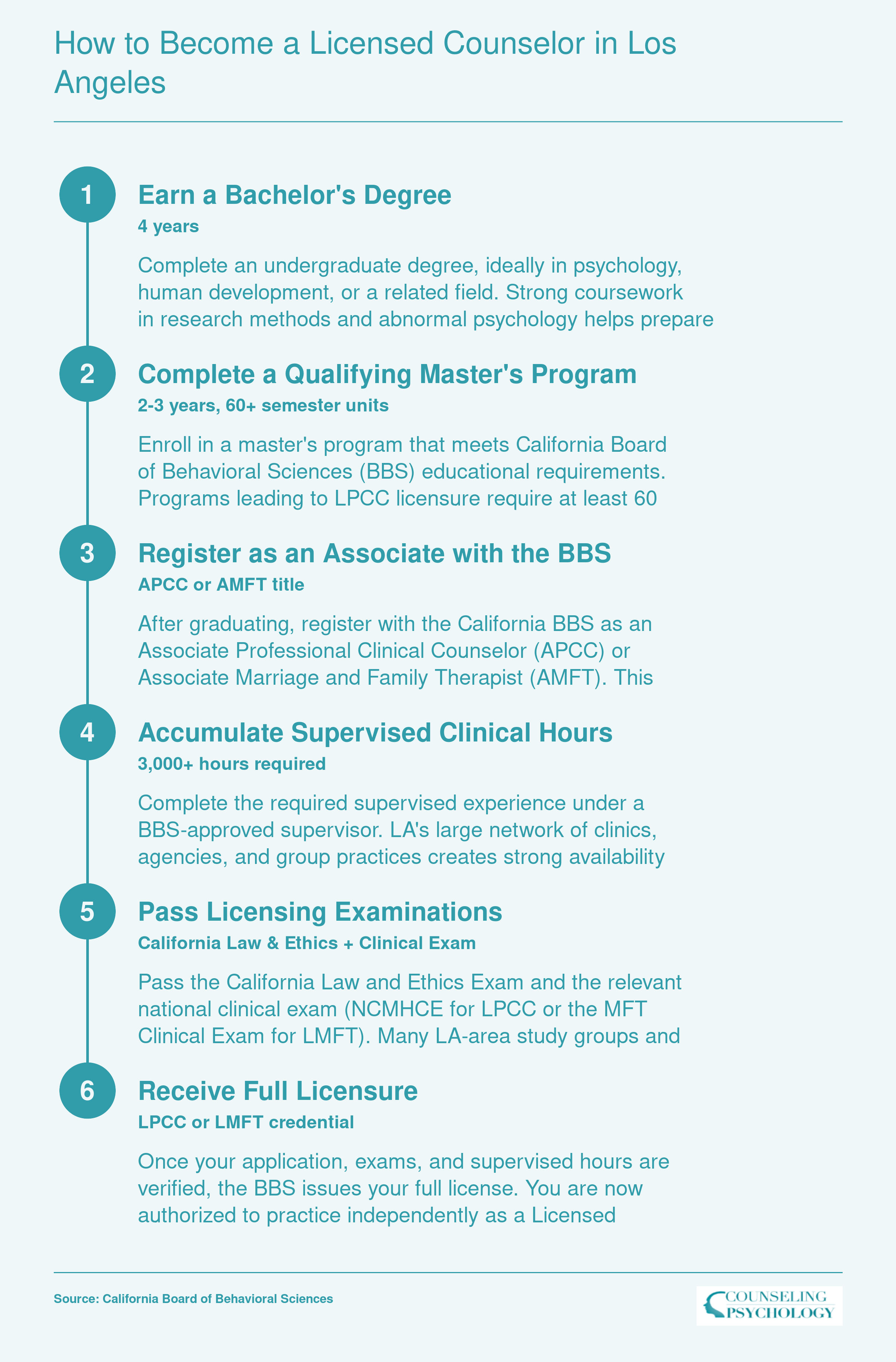
Earning your counseling license in California follows a clear, sequential path. Los Angeles offers a distinct advantage at nearly every stage: the metro area's concentration of community mental health centers, university training clinics, hospitals, and private practices means more options for practicum placements and post-degree supervised experience than almost any other region in the state.
Practicum & Clinical Training Opportunities in Los Angeles
California requires 3,000 supervised clinical hours for both LPCC and LMFT licensure, a threshold that feels far more attainable in Los Angeles than in rural counties, thanks to the region's dense network of training sites and diverse client populations. LA's practicum landscape spans VA hospitals, county-run mental health agencies, major school districts, university counseling centers, and hundreds of nonprofit clinics. For students juggling coursework and employment, the region also offers evening and weekend placements, making it feasible to complete degree requirements on a flexible schedule.
Community Mental Health and Nonprofit Clinics
Didi Hirsch Mental Health Services operates training sites across Culver City, Mid-Wilshire, Inglewood, Glendale, Van Nuys, and additional LA-area locations, hosting master's-level interns in MFT, MSW, and PCC programs through its structured Master's Level Training Program.1 Maple Counseling Center, a low-fee community clinic, accepts LMFT, LCSW, and LPCC trainees in adult therapy, adolescent therapy, and child and family therapy tracks.2 Specialty agencies bring unique populations into view: the Los Angeles LGBT Center offers master's-level counseling and social work placements focused on LGBTQ-affirming therapy, HIV-related mental health, and gender-affirming care, while immigration-focused clinics serve newly arrived families navigating trauma and acculturation.3
VA and University Counseling Centers
The VA Greater Los Angeles Healthcare System, with its main campus in West Los Angeles and satellite sites, places graduate trainees in outpatient mental health, addictions treatment, PTSD programs, and integrated primary care settings.3 UCLA Counseling & Psychological Services (CAPS) hosts interns from counseling and clinical psychology, social work, and counseling programs, offering exposure to college-age clients and short-term therapy models.
School-Based and Entertainment Industry Settings
Los Angeles Unified School District (LAUSD) partners with graduate programs to place PPS credential candidates, LMFT trainees, and LPCC students in school-based family counseling and pupil services roles across the district's 1,000-plus schools.4 Pepperdine University's Southern California Practicum Network alone lists more than 130 placement sites across the greater Los Angeles area, many catering to entertainment industry professionals, multilingual agencies serving Korean, Spanish, Armenian, and Mandarin-speaking communities, and faith-based counseling centers.3 The breadth of settings means students can tailor their clinical training to the populations and modalities they plan to pursue post-licensure. Those exploring the full range of possibilities after earning their degree may also want to review alternative careers with an MFT degree, since the clinical exposure gained in LA practicum sites opens doors well beyond traditional private practice.
What LA Counselors Actually Earn: Salary & Career Outcomes
Compensation for counseling professionals in the Los Angeles metro area varies dramatically depending on credential level and specialization. The table below draws from BLS data specific to the Los Angeles, Long Beach, Anaheim metropolitan statistical area, broken out by Standard Occupational Classification code so you can compare clinical psychologists, general counselors, and postsecondary psychology educators side by side. Keep in mind that early career earnings for graduates of the programs ranked on this page tend to cluster well below these metro medians, since BLS figures reflect the full workforce (including seasoned practitioners). Program level earnings data for many of the schools in our rankings are not yet available at the one year or ten year mark, so treat the BLS percentiles as the most reliable local benchmark for now.
| Occupation (SOC Code) | Total Employed in LA Metro | 10th Percentile | 25th Percentile | Median | 75th Percentile | 90th Percentile |
|---|---|---|---|---|---|---|
| Clinical and Counseling Psychologists (19-3033) | 3,760 | Not reported | $80,340 | $100,330 | $134,820 | Not reported |
| Counselors, All Other (21-1019) | 5,190 | Not reported | $42,760 | $45,960 | $50,330 | Not reported |
| Psychology Teachers, Postsecondary (25-1066) | 2,230 | Not reported | $65,960 | $99,130 | $137,820 | Not reported |
Is the Investment Worth It? Program Cost vs. Graduate Earnings
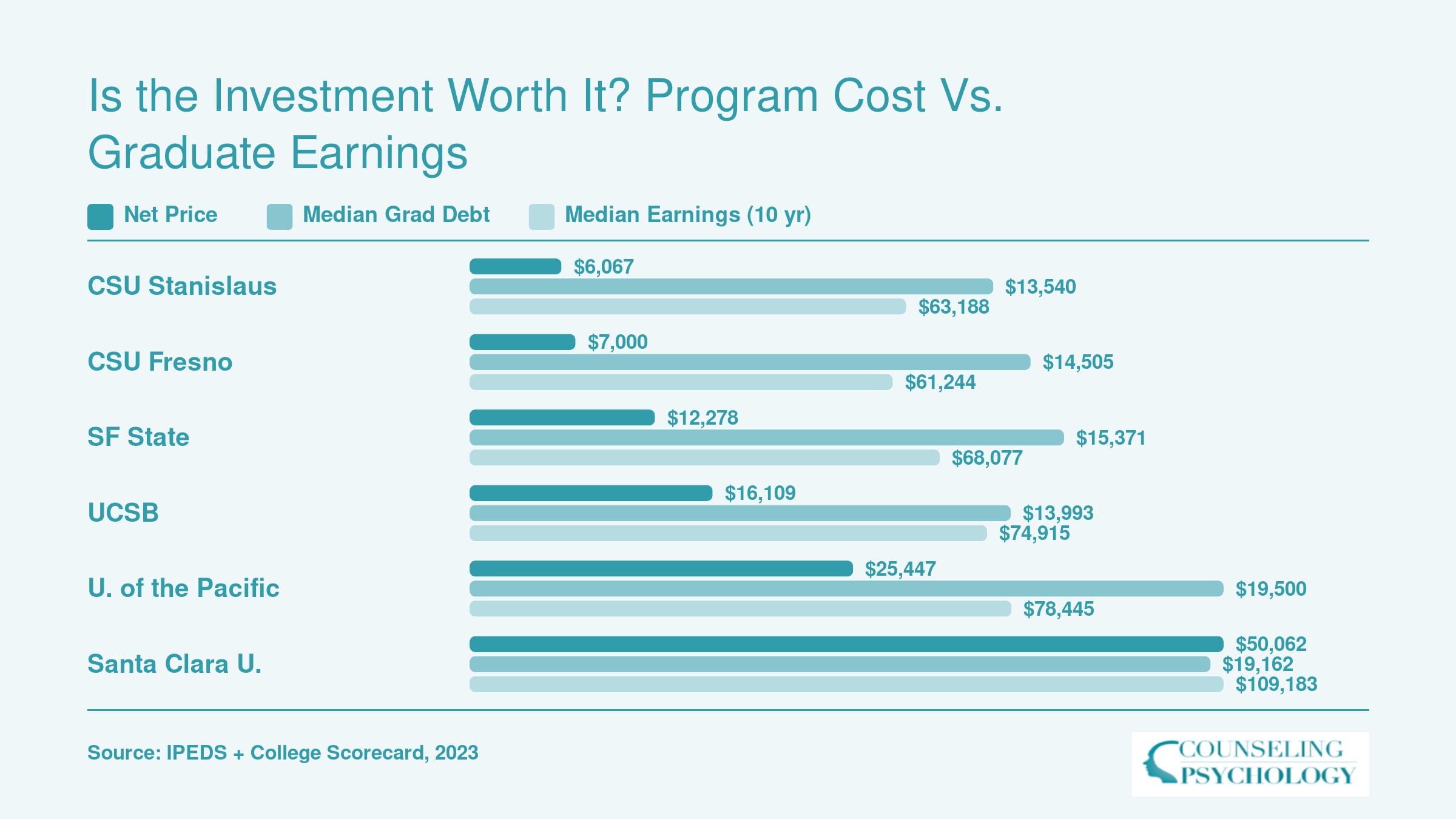
ROI varies dramatically between public and private institutions in the LA metro and broader California region. CSU campuses offer net prices as low as $6,067 to $12,278, while private universities like Santa Clara and University of the Pacific range from $25,447 to $50,062. Median graduate debt stays relatively tight across all six schools ($13,540 to $19,500), but ten-year median earnings span from $61,244 to $109,183, creating a significant gap in long-term return. Program-level earnings shortly after completion are not yet available for these counseling programs, so the institution-wide figures below offer the best current benchmark.
Many LA-area counseling programs build their schedules around working professionals, offering evening, weekend, hybrid, or fully online formats so you can keep earning while you learn. Scroll up to the program comparison table and check the Format column to quickly identify which schools match your scheduling needs.
Frequently Asked Questions About Counseling Programs in Los Angeles
Prospective students exploring counseling psychology programs near Los Angeles often have overlapping questions about licensure, cost, and which schools qualify them for practice. Below are answers to the most common questions, grounded in current California requirements and program data.
More Counseling Psychology Programs Near Los Angeles
Beyond the top-ranked programs, numerous other schools offer high-quality counseling psychology degrees in California. Explore the following programs to find additional options that fit your needs, from flexible online formats to specialized concentrations. Click through to each school's admissions page for the latest details.
Greater Los Angeles
- MA in Clinical Psychology, LGBT-Affirmative Psychology
- MA in Clinical Psychology, Applied Community Psychology
- MA in Clinical Psychology, Spiritual and Depth Psychology
- M.A. Clinical Mental Health Counseling
- M.A. Clinical Mental Health Counseling
- Bachelor of Arts in Psychology (Preparation for Advanced Study in Counseling)
- Master of Science in Counseling/Clinical Mental Health Counseling
- Master of Science in Counseling/Marriage, Family and Child Therapy
Bay Area
- Integral Counseling Psychology - On-Campus
- Integral Counseling Psychology - Hybrid
- M.A.-C.P. in Community Mental Health
- MA in Counseling Psychology
- MA in Counseling Psychology (Integral Psychology)
- MA in Counseling Psychology (Somatic and Yoga Psychology)
- Master of Science in Clinical Psychology (Marriage and Family Therapy)
- Master of Science in Clinical Psychology (Licensed Professional Clinical Counseling)
- Master of Science in Clinical Psychology (Consulting & Applied Psychology)
- Master of Arts in Counseling Psychology
- Master of Arts in Counseling (Clinical Mental Health Counseling)
Central Coast
- Counseling/Clinical Ph.D. Program (Counseling Psychology)
- Counseling Psychology - MA
Central Valley
- Psychology M.S. - Counseling Track
- Master of Arts in Counseling with Pupil Personnel Services (PPS) Credential
- Master of Arts in Counseling: Professional Clinical Counselor (PCC)
Sacramento Area
- MS in Psychology (Counseling Psychology)
San Diego Area
- Doctor of Philosophy in Psychology (Counseling Psychology)
- Master of Arts Degree in Counseling Psychology (California) (Marriage and Family Therapist Option)
- Master of Arts Degree in Counseling Psychology (California) (Combined MFT/LPCC (Licensed Professional Clinical Counselor) option)