What you’ll learn in this article…
- Virginia's 2 plus 2 community college transfer pathway can cut total psychology degree costs by nearly half.
- Net price after grants often falls thousands below published tuition at Richmond-area public universities and HBCUs.
- A psychology bachelor's functions best as a launchpad toward graduate licensure or specialized entry-level roles in human services.
- Filing the FAFSA early and applying for Virginia-specific grants maximizes state aid for psychology students near Richmond.
Richmond-area employers in healthcare, social services, and education are seeking more psychology-trained staff as behavioral health demands grow. A bachelor's in psychology from a nearby school can cost as little as $14,500 per year after grants, while some private programs exceed $30,000. That spread, with Radford University at $14,578 and Shenandoah University at $30,298, mirrors the diversity of public, private, and HBCU options within a two-hour drive. Transfer agreements with Virginia community colleges can nearly halve the total bill, making the net price after aid and expected early-career earnings the real yardsticks for affordability. Students exploring options beyond the Richmond area may also want to compare an online bachelor's degree in psychology for maximum flexibility.
Best Affordable Psychology Bachelor's Programs Near Richmond
Virginia offers a wide range of psychology bachelor's programs within reach of Richmond, from commuter-friendly public campuses to fully online options that eliminate relocation costs entirely. The programs below are ranked by an affordability-weighted score that factors in net price, graduation outcomes, and long-term earnings potential. Graduation rates listed are institution-wide figures, not program-specific, because program-level completion data is not consistently reported across all schools.
- Net price after financial aid
- Institution-wide graduation rate
- Graduate earnings and debt levels
- Program delivery and accessibility
- Institutional mission and value
- Internal program database
- Independent program research
- NCES-IPEDS federal institutional data — nces.ed.gov
- College Scorecard graduate earnings — collegescorecard.ed.gov

George Mason University
George Mason University is a large public research institution in Fairfax that grants both BA and BS options in psychology with multiple concentration tracks, including clinical, cognitive neuroscience, and forensic psychology. Its proximity to Washington, D.C. creates unusual opportunities in public policy, federal research, and applied behavioral science. Richmond-area students can complete the psychology degree entirely online, avoiding relocation costs while benefiting from a 14:1 student-to-faculty ratio equivalent and strong quantitative training. Median earnings ten years after enrollment reach $76,343, among the highest on this list.
- Available online and on campus
- Multiple concentrations including clinical and forensic
- 120 total credits required
- Research-focused curriculum with quantitative emphasis
- Honors program available for high achievers
- Strong career prep for HR, data analysis, and marketing
- Flexible delivery suits working or commuting students
Bachelor of Psychology (BS/BA) — Online

Virginia State University
Virginia State University, a public HBCU in Petersburg roughly 25 miles south of Richmond, is one of the closest campus options for students in the metro area. The BS in General Psychology emphasizes health psychology, with faculty-led research covering substance use, cognitive health, and related topics. VSU serves a high proportion of Pell Grant recipients, reflecting a strong institutional commitment to accessible education. In-state tuition sits at just over $10,000 before aid, keeping total costs among the lowest in the region.
- Campus-based program in Petersburg, VA
- Focus on health psychology research topics
- Hands-on research opportunities with faculty
- Covers developmental, social, and abnormal psychology
- Prepares graduates for diverse career paths
- 13:1 student-to-faculty ratio
Bachelor's of Science in General Psychology — On-Campus

Norfolk State University
Norfolk State University is a public HBCU that delivers its BA in Psychology in both online and in-person formats, making it accessible to Richmond students without relocating to the Norfolk area. The curriculum stands out for contemporary electives such as cyberpsychology and the psychology of racism, alongside a required senior-year internship. Nearly 79% of the student body receives Pell Grants, underscoring the university's focus on affordability for students from a range of economic backgrounds.
- Available in online and in-person formats
- 120 total credit hours required
- Senior-year internship is a degree requirement
- Cyberpsychology lab access for enrolled students
- Electives in cyberpsychology and psychology of racism
- Psi Chi Honor Society participation offered
- Average class size of 35 students
- Multiple career path preparation tracks
Bachelor of Arts in Psychology — Online

University of Virginia
The University of Virginia in Charlottesville, about 70 miles from Richmond, is the state's flagship and carries one of the highest graduation rates in Virginia at 95.6%. The BA Psychology program is built around four core pillars of psychological science and requires an advanced research methods course plus a 4000-level seminar, giving undergraduates genuine exposure to graduate-level inquiry. Median graduate debt is just $17,500, and ten-year median earnings of $86,863 rank highest among the schools listed here.
- Campus-based at UVA's Charlottesville campus
- 34 psychology credits required for the major
- Courses span four pillars of psychological science
- Advanced Research Methods course is mandatory
- 4000-level seminar capstone required
- Minimum 2.0 GPA to remain in the major
- Strong emphasis on scientific research skills
BA Psychology — On-Campus

Radford University
Radford University offers both BA and BS tracks in psychology from its campus in southwestern Virginia. The program guarantees every student a research experience before graduation and pairs that with internship placements across health, education, technology, and human services. Faculty mentorship is a core selling point, with a 14:1 student-to-faculty ratio. The net price of $14,578 is the lowest on this list, though Richmond students should factor in relocation since the program is campus-based.
- Choose between Bachelor of Arts or Bachelor of Science
- 100% of students complete research before graduating
- Internship placements in health and human services
- Close one-on-one faculty mentorship model
- Honors society participation available
- Professional development integrated into coursework
- 14:1 student-to-faculty ratio
Psychology (BA/BS) — On-Campus

Regent University
Regent University in Virginia Beach is a private Christian institution offering three distinct psychology bachelor's pathways, all available fully online. Students can pursue a general BS in Psychology, a Clinical and Counseling Psychology concentration, or a BS in Professional Studies with a psychology focus. The Christian worldview is woven throughout the curriculum, which may appeal to students seeking values-integrated education. Richmond students benefit from the online format, which keeps costs predictable regardless of location.
- Fully online and on-campus delivery options
- 120-plus total credit hours
- Christian worldview integrated into coursework
- Research methods training included
- Faculty mentorship throughout the program
- Prepares for counseling, HR, and management careers
- Concentration in clinical and counseling skills
- Available online and on campus
- Scholarship opportunities for qualifying students
- Ranked among notable online bachelor's programs
- Pathway toward graduate counseling study
- 120-plus credit hours required
- Interdisciplinary approach to psychology
- Online and campus delivery available
- Develops leadership alongside psychological knowledge
- Christian perspective woven into curriculum
- 120-plus total credit hours
B.S. in Psychology — Online
B.S. in Psychology, Clinical and Counseling Psychology — Online
B.S. in Professional Studies, Psychology — Online

William & Mary
William and Mary in Williamsburg, roughly 50 miles east of Richmond, offers both BA and BS degrees in Psychological Sciences. The BS track requires additional science coursework, giving students a stronger foundation for graduate programs in clinical or neuroscience fields. With an institution-wide graduation rate of 89.4% and a 95% first-year retention rate, William and Mary delivers some of the strongest completion outcomes in the state. Median graduate debt of $18,500 is notably low for a school with ten-year median earnings of $73,490.
- Offers both BA and BS degree options
- BS requires additional science coursework
- Campus-based in Williamsburg, VA
- Comprehensive psychology curriculum
- 12:1 student-to-faculty ratio
- 89.4% institution-wide graduation rate
- Low median graduate debt of $18,500
Psychological Sciences (BA/BS) — On-Campus

Longwood University
Longwood University in Farmville, about 65 miles southwest of Richmond, provides a campus-based BS in Psychology structured around four area tracks: developmental, industrial/organizational/social, pre-clinical/counseling, and general/experimental. Students must earn at least a C- in every psychology course, which maintains academic rigor across the cohort. The curriculum totals 45 psychology-specific credits, blending core requirements with meaningful elective flexibility.
- Campus-based program in Farmville, VA
- 26 core psychology credit hours
- 13 credits in an area of concentration
- 6 elective credits in psychology
- Covers developmental and I/O psychology tracks
- Pre-clinical and counseling pathway available
- Emphasizes research methods and ethical practice
Psychology, BS — On-Campus

Bridgewater College
Bridgewater College is a private liberal arts institution in the Shenandoah Valley that blends foundational psychology coursework with applied fields like clinical and behavioral psychology. The program places a notable emphasis on neuroscience alongside hands-on lab work, which prepares students for graduate study or entry-level research positions. Because Bridgewater is a private college, tuition is the same for all students regardless of residency, and institutional aid brings the average net price to $17,800.
- Campus-based at Bridgewater College
- Research-focused curriculum with lab components
- Covers cognition, developmental, and clinical psychology
- Neuroscience emphasis built into the program
- 13:1 student-to-faculty ratio
- Prepares for mental health and research careers
Psychology — On-Campus

Virginia Military Institute
Virginia Military Institute in Lexington is a state-supported military college offering a BS in Psychology within its distinctive residential, regimented environment. The program emphasizes ethical values, critical thinking, and information synthesis, skills that translate well into leadership roles in military, government, and private-sector settings. VMI's 9:1 student-to-faculty ratio is the smallest on this list, and institution-wide ten-year median earnings of $77,369 reflect strong post-graduation outcomes. Richmond students should note that VMI's model requires full-time on-campus residency.
- Bachelor of Science degree at a military college
- 9:1 student-to-faculty ratio, smallest on this list
- Honors in Psychology track for high achievers
- Focus on ethical values and critical thinking
- Full-time residential campus experience required
- Develops information synthesis and leadership skills
- 76.2% institution-wide graduation rate
Psychology (BS) — On-Campus
How We Ranked These Programs
Affordability drives this ranking more than any other factor. We weighted net price and financial aid metrics most heavily, examining each institution's share of students receiving Pell Grants and the average institutional aid awarded. Schools that stretch limited budgets further earned higher placement.
Financial Metrics at the Core
Net price represents what students actually pay after grants and scholarships, not the sticker price you see on a website. This figure reflects an institution-level average across all aid recipients, so your individual cost will vary based on your family's income bracket, FAFSA results, and any merit scholarships you secure. A school showing a $12,000 net price might cost you $8,000 or $18,000 depending on your circumstances.
Outcome Measures That Matter
Beyond cost, we factored in graduation rates because finishing your degree matters more than starting it. Median debt at graduation provides a reality check on whether low tuition translates to low borrowing. Where available, program-level earnings outcomes helped identify which psychology programs position graduates for stronger starting salaries, whether they enter the workforce directly or pursue best counseling masters programs to advance their credentials.
Accreditation Standards
Every institution on this list holds regional accreditation, which means your credits transfer and your degree carries weight with employers and graduate programs. You might wonder about APA accreditation, but that designation applies only to doctoral programs in clinical and counseling psychology. At the bachelor's level, regional accreditation is the relevant quality marker, and all these schools meet that standard.
Tuition and Net Price Comparison for Richmond-Area Psychology Programs
Sticker price rarely tells the full story. The net price column below reflects the average annual cost after grants and scholarships for first-time, full-time students receiving aid, drawn from federal IPEDS data. Comparing net price alongside graduation rates and median debt helps you gauge which programs deliver the strongest value for your investment.
| School | In-State Tuition | Out-of-State Tuition | Avg. Net Price | Graduation Rate | Median Debt at Graduation | Median Earnings (10 Yr) |
|---|---|---|---|---|---|---|
| Radford University | $12,548 | $25,633 | $14,578 | 48.7% | $24,000 | $53,739 |
| Norfolk State University | $10,180 | $21,682 | $15,282 | 38.5% | $29,000 | $44,666 |
| Virginia State University | $10,043 | $22,650 | $15,840 | 39.4% | $26,500 | $45,543 |
| Virginia Military Institute | $21,046 | $52,638 | $17,113 | 76.2% | $22,996 | $77,369 |
| Bridgewater College | $16,090 | $16,090 | $17,800 | 53.1% | $26,000 | $53,453 |
| George Mason University | $14,220 | $38,688 | $17,915 | 67.8% | $19,500 | $76,343 |
| Emory & Henry University | $39,000 | $39,000 | $19,061 | 56.3% | $26,332 | $47,385 |
| Longwood University | $15,740 | $27,980 | $19,066 | 61.2% | $25,000 | $52,347 |
| William & Mary | $25,734 | $51,038 | $19,096 | 89.4% | $18,500 | $73,490 |
| Virginia Wesleyan University | $37,500 | $37,500 | $19,676 | 41.6% | $27,000 | $50,074 |
| Regent University | $21,650 | $21,650 | $19,923 | 56.9% | $24,534 | $44,498 |
| University of Virginia | $23,118 | $61,591 | $21,565 | 95.6% | $17,500 | $86,863 |
| Christopher Newport University | $16,828 | $31,178 | $23,015 | 71.6% | $25,000 | $60,509 |
| Washington and Lee University | $68,045 | $68,045 | $23,781 | 93.9% | $19,500 | $94,810 |
| Roanoke College | $38,068 | $38,068 | $24,503 | 67.4% | $27,000 | $58,047 |
Questions to Ask Yourself
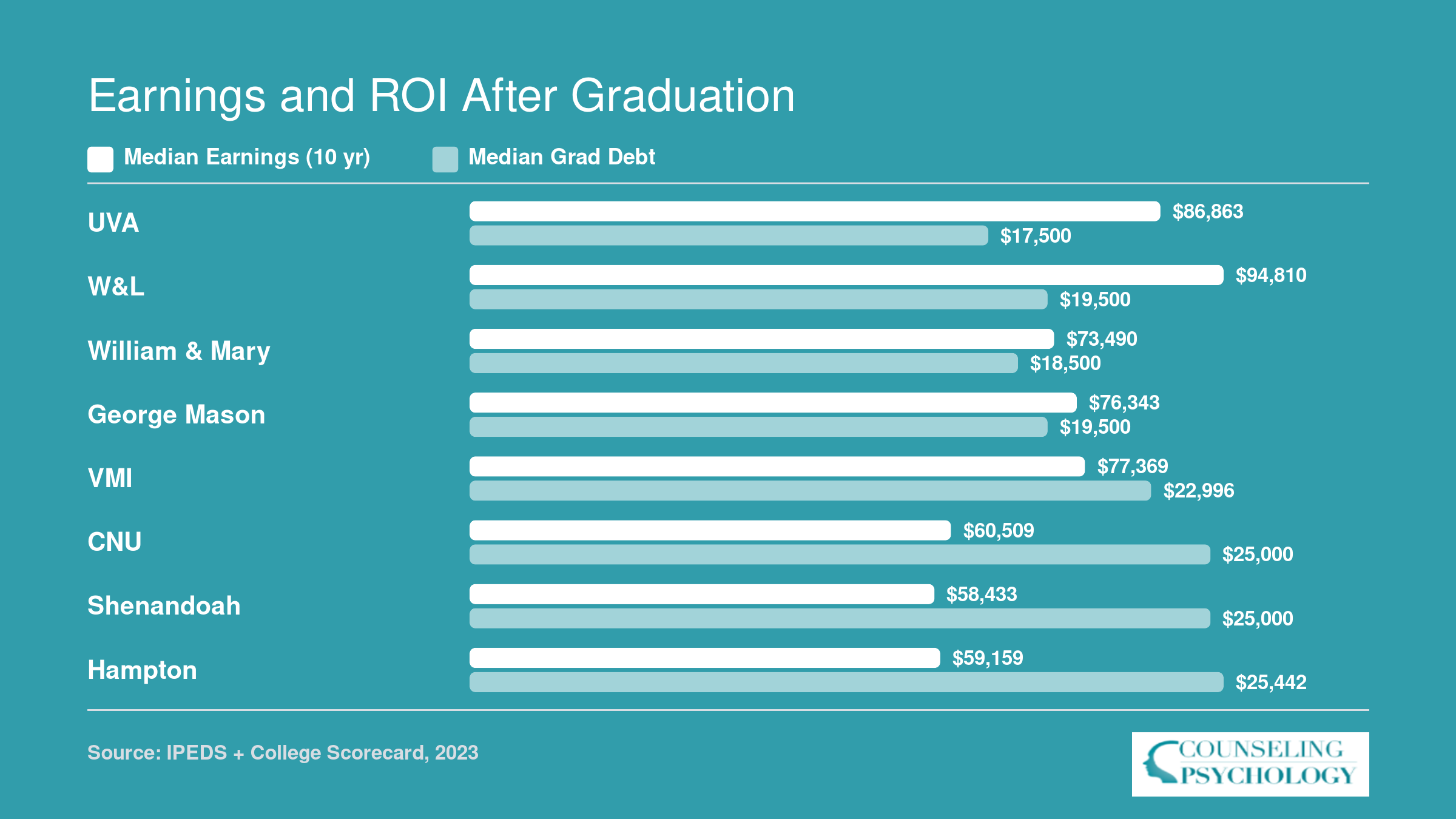
Earnings and ROI After Graduation
How do Richmond-area psychology programs stack up when you compare what graduates earn against what they borrowed? Program-level early and mid-career earnings data is not yet published for these schools, so the chart below uses institution-wide median earnings at 10 years after enrollment alongside median graduate debt. The ratio between those two figures, the earnings-to-debt ratio, tells you how many dollars of annual income each dollar of debt eventually generates. UVA and Washington & Lee lead the pack with ratios near 5:1, while schools with higher debt loads and more modest earnings settle closer to 2.3:1.
Is a Bachelor's in Psychology Worth It? Debt, Earnings, and the Full Picture
The honest answer in 2026 is that a psychology bachelor's pays off if you treat it as a launchpad, not a destination, and the labor market in Virginia continues to reward graduates who pair the degree with a clear next step. Among the Virginia programs profiled in this guide, median graduate debt clusters between roughly $17,500 (University of Virginia) and $27,000 (Roanoke College), while ten-year median earnings for alumni run from about $54,000 at Radford to $94,810 at Washington and Lee. That gap matters: a UVA graduate carrying $17,500 in debt against $86,000+ in mid-career earnings sits in a very different place than a private-college graduate carrying $25,000+ against a $58,000 salary.
What the Earnings Picture Actually Looks Like
Program-level outcomes for psychology specifically (one to four years after graduation) are not yet reported for most of these schools in federal datasets, so we are leaning on institution-wide ten-year earnings as a proxy. They suggest that the majority of graduates from these Virginia programs do clear the 150%-of-poverty threshold within a few years, but psychology majors typically earn less than business or engineering majors at the same school, so do not assume the institution-wide median equals what a psych graduate makes.
The BLS occupational data fills in the picture. In the Richmond metro, social and community service managers (SOC 11-9151) earn a mean of $103,690 a year, well above the national median of $77,030 for that role.1 Statewide, substance abuse and behavioral disorder counselors (SOC 21-1018) earn a median of $58,000, and community health workers (SOC 21-1094) earn around $51,030 nationally.2 HR specialists (SOC 13-1071) are another common landing spot for psychology grads. None of these roles require a master's, though the manager-level positions usually require several years of experience.
BA vs. BS: Does It Matter?
Most Virginia schools (UVA, William & Mary, GMU, CNU, Radford, Washington and Lee) offer both. The practical difference:
- BA in psychology: more liberal arts breadth, foreign language, often a lighter math load. Fits students heading toward HR, social services, case management, or law school.
- BS in psychology: heavier on statistics, research methods, and lab sciences. Better preparation for research-track graduate programs in clinical, cognitive, or neuroscience fields.
Employers for entry-level roles generally do not distinguish between the two. Graduate admissions committees do, especially for PhD programs. Students weighing the clinical track may want to explore bachelor's degree in clinical psychology options to see how different curricula prepare you for licensure-track graduate work.
The Stepping-Stone Reality
The clinical and counseling roles most students picture when they declare the major (therapist, licensed counselor, psychologist) require a master's or doctorate plus state licensure. A bachelor's qualifies you for support roles, paraprofessional positions, and the kinds of human-services jobs listed above. If your goal is to practice therapy, build the bachelor's around that endpoint: keep your GPA above 3.5, get research or clinical exposure, and plan for at least two more years of graduate study. For many aspiring therapists, the next credential is a counseling master's programs online degree that meets state licensing requirements.
Community College Transfer Pathways to Save on Costs
Starting at a Virginia community college is one of the most reliable ways to cut the total cost of a psychology bachelor's degree nearly in half.
The 2+2 Model: How It Works
The 2+2 pathway is straightforward in concept: spend two years completing an associate degree in psychology at a Virginia community college, then transfer with junior-year standing into a four-year university to finish the bachelor's. Done well, this approach lets you cover general education requirements and foundational psychology coursework at significantly lower cost before moving into upper-division study. Brightpoint Community College, which serves the greater Richmond area, offers an Associate of Science in Psychology designed with this trajectory in mind.1
Guaranteed Admission and Articulation Agreements
What makes this pathway especially dependable in Virginia is the statewide infrastructure behind it. The Virginia Community College System participates in guaranteed-admissions agreements with many public universities, meaning qualified transfer students are not competing for limited seats the way first-year applicants sometimes do.
Brightpoint maintains guaranteed admissions agreements with more than 35 colleges and universities.2 For students targeting Virginia Commonwealth University's Bachelor of Science in Psychology, two formal pathways exist. The standard guaranteed-admission agreement requires an associate degree and a cumulative GPA of 2.5 or better, with no grade below a C.3 A second option, the NEXT STEP VCU program, is designed for students earlier in their community college career: you can apply after completing just 12 credits, provided you have no more than 30 total college credits at the time of application, with a 2.0 GPA minimum.4 A specific Brightpoint-to-VCU Psychology transfer map outlines which courses satisfy which requirements, reducing guesswork considerably.
Virginia State University also participates in Virginia's common transfer framework, accepting standard associate of arts and associate of science degrees through the statewide articulation system. Transfer Virginia, a centralized resource maintained for this purpose, publishes transfer guides and course equivalency tools for students navigating these agreements.6
What You Actually Save
VCCS in-state tuition currently runs approximately $5,700 to $6,000 per year, or roughly $190 to $200 per credit hour.2 Two full years at that rate totals somewhere between $11,400 and $12,000 in tuition alone. Compare that to two years at a four-year institution in the Richmond area, where in-state tuition at a public university typically runs considerably higher, and the savings become concrete rather than theoretical. The exact difference depends on which school you transfer into and what financial aid you receive, but the gap is real and meaningful for students managing tight budgets.
If you are planning this route, start by reviewing the Transfer Virginia portal and the specific transfer map for your intended major at your target school. Agreements can change, and confirming current requirements directly with both institutions protects your credits and your timeline.
Financial Aid and Scholarships for Virginia Psychology Students
Sticker price rarely tells the full story, and the gap between what a school charges and what you actually pay often depends on how aggressively you pursue state grants, institutional aid, and outside scholarships. Virginia offers several programs that can shave thousands off your annual bill, and psychology students have discipline-specific funding options on top of those.
Virginia Tuition Assistance Grant (VTAG)
If you enroll full-time at an eligible private institution in Virginia, the Virginia Tuition Assistance Grant is one of the first awards to pursue.1 For the 2025-2026 academic year, in-person students receive up to $5,250, while students at Virginia HBCUs can receive up to $7,500.1 Online-only students qualify for a reduced award of $2,625 (or $3,400 for those grandfathered under earlier terms).2 The grant is not need-based, so any Virginia domiciliary resident attending a qualifying private school can apply.1 Keep in mind the annual deadline falls on September 15, and you can receive the award for a maximum of four academic years.2 Award amounts for 2026-2027 have not yet been finalized, so check with your financial aid office for updates.1 Schools like Regent University, Virginia Wesleyan University, Bridgewater College, and Emory & Henry University are private institutions where TAG can meaningfully offset tuition.
Virginia Guaranteed Assistance Program (VGAP)
For high-need students attending public colleges and universities, the Virginia Guaranteed Assistance Program covers tuition and fees, plus a book stipend, at participating state institutions. Eligibility is tied to household income thresholds and maintaining a minimum GPA. If you are considering public options such as Virginia State University, Radford University, or Longwood University, ask the financial aid office specifically about VGAP during your application process.
Virginia Student Financial Assistance Program (VSFAP)
The broader Virginia Student Financial Assistance Program distributes need-based aid to undergraduates at both public and private institutions across the state. Awards vary by school and available funding, so filing the FAFSA early is essential. Schools that serve large populations of students with financial need tend to have robust aid infrastructures. Among Virginia psychology programs, Norfolk State University and Virginia State University both report that roughly 77 to 78 percent of their undergraduates receive federal Pell Grants, a strong signal that these campuses are experienced at packaging aid for students who need it most.
Psychology-Specific Scholarships
Beyond state programs, do not overlook funding tied directly to your major. Many psychology departments maintain their own scholarship funds for declared majors, sometimes awarded based on GPA, research involvement, or community service. Ask your target department early about any internal awards.
Nationally, the American Psychological Association offers undergraduate scholarships and research awards, and Psi Chi, the international honor society in psychology, provides grants and scholarships to student members. Several Virginia programs on our list, including Norfolk State and Radford, actively support Psi Chi chapters, which can open doors to these discipline-specific funds. A bachelor's in psychology can also set the stage for graduate work in areas like community mental health counseling, so investing in financial planning now pays dividends well beyond the undergraduate years.
A practical approach: file the FAFSA as soon as possible, apply for VTAG by September 15 if you are attending a private school, confirm VGAP eligibility if you are heading to a public university, and then layer on departmental and national psychology scholarships. Stacking these sources is how students turn a seemingly expensive degree into a manageable investment.
Online vs. On-Campus Psychology Programs Near Richmond
Richmond-area psychology programs fall into three delivery categories: fully online, fully on-campus, and programs that offer both formats. Your choice affects not only daily logistics but also net price, scheduling flexibility, and the kind of learning environment you experience. Here is how the options compare across the programs in our data set.
| Factor | Online Programs | Campus-Based Programs |
|---|---|---|
| Schools in this category | George Mason University, Norfolk State University, Regent University | Virginia State University, University of Virginia, Radford University, William & Mary, Longwood University, Bridgewater College, Virginia Military Institute, Christopher Newport University, Hampton University, Emory & Henry University, Virginia Wesleyan University, Roanoke College, and others |
| Net price range (after aid) | $15,282 to $19,923 | $14,578 to $25,319 |
| Average net price | Roughly $17,707 across the three online-listed programs | Varies widely; several campus programs land between $15,000 and $21,000 |
| Scheduling flexibility | Coursework available asynchronously or in evening time slots, which suits students who work full time or have family obligations | Traditional daytime schedules are standard, though some schools with both formats offer evening and part-time options for working students |
| In-person research and labs | Limited; some online programs (e.g., Norfolk State) provide access to specialty labs like their Cyberpsychology Lab during campus visits | Direct access to faculty-mentored research, labs, and internship sites is a core advantage |
| Student-to-faculty ratio | Ranges from 15:1 (Norfolk State) to 18:1 (Regent University) | Ranges from 9:1 (Virginia Military Institute) to 15:1 at several public universities |
| Median graduate debt | $19,500 (George Mason) to $29,000 (Norfolk State) | $17,500 (University of Virginia) to $27,000 (Roanoke College, Virginia Wesleyan) |
| Median earnings 10 years after entry | $44,498 (Regent) to $76,343 (George Mason) | $44,666 (Norfolk State campus cohort equivalent) to $86,863 (University of Virginia) |
| Best fit for | Working adults, military-connected students, or anyone who needs location independence | Traditional-age students, those who want hands-on research mentorship, or students seeking a full campus experience |
Richmond students have genuine pathways to an affordable psychology degree through public universities, HBCUs, online programs, and community college transfers. Focus on net price, not published tuition, and submit your FAFSA and Virginia529 applications early to maximize state aid and institutional grants that can cut your out-of-pocket cost substantially.
Career Paths With a Bachelor's in Psychology From Richmond
A bachelor's in psychology is a generalist degree that prepares graduates for entry-level work in human services, healthcare support, business, and education, rather than for licensed clinical practice. In the Richmond metro, that translates to a handful of recognizable job titles, plus a well-worn path to graduate school for students who want to become therapists, counselors, or psychologists. For a broader look at what the field offers, explore careers in psychology at every degree level.
Common Entry-Level Roles
Most new psychology graduates in the Richmond area land in one of these roles:
- Social and human service assistant: Helps caseworkers and counselors connect clients to housing, food assistance, substance use treatment, and benefits. In the Richmond metro, the Bureau of Labor Statistics reports a median wage of about $43,960, with the bottom 10% earning around $31,620 and the top 10% near $59,590. Statewide, Virginia employs roughly 8,260 of these workers, and the role is projected to grow about 16% by 2032.
- Case manager: Often a step up from human services assistant, typically requiring a bachelor's plus some direct-service experience. Common in hospitals, community mental health agencies, and nonprofits across Richmond.
- Behavioral health technician: Works under licensed clinicians in residential, inpatient, or applied behavior analysis settings, supporting clients with mental illness, substance use disorders, or autism spectrum diagnoses.
- Community health worker: Bridges clinical care and underserved communities through outreach, education, and navigation. The national median sits around $51,030 per year.
- HR specialist or recruiter: Psychology coursework in organizational behavior, testing, and interviewing transfers cleanly into talent acquisition and employee relations roles at Richmond-area employers.
The Graduate School Launchpad
For many students, the bachelor's is step one. Clinical roles, including licensed counselor, social worker, marriage and family therapist, school psychologist, and psychologist, require a master's or doctorate. Richmond-area undergraduates frequently move into MSW programs, counseling psychology programs online, or doctoral psychology training, often after a year or two of human services work that strengthens both their application and their sense of which population they want to serve.
Frequently Asked Questions About Psychology Degrees Near Richmond
Choosing a psychology program involves weighing cost, format, career outlook, and degree type. Below are answers to the questions prospective Richmond-area students ask most often, grounded in current tuition and outcome data from Virginia institutions.
More Psychology Bachelor's Programs Near Richmond to Consider
In addition to the top-ranked programs, several other Virginia schools offer strong psychology bachelor's degrees worth exploring. These institutions provide diverse formats and locations, from the Hampton Roads coast to the Shenandoah Valley.
Hampton Roads
- Psychology
- Psychology
- Bachelor of Arts in Psychology
- Bachelor of Arts in Psychology
Southwest Virginia
- Psychology
Roanoke Area
- Psychology (Human Development, Neuroscience,)
Shenandoah Valley
- Psychology
- Psychology