What you’ll learn in this article…
- CACREP accreditation is critical for Florida LMHC licensure portability and employer eligibility across states.
- The BLS reports a median annual wage of $55,990 for mental health counselors in the Miami metro area as of 2024.
- Florida requires 60 graduate semester hours, a passing NCMHCE score, and supervised post-degree experience for LMHC licensure.
- Graduate certificates in mental health counseling do not qualify candidates for independent licensure in Florida.
Palm Beach County added more than 18,000 residents between 2020 and 2024, and its aging population, alongside rising rates of substance use and anxiety disorders, has driven steady demand for Licensed Mental Health Counselors across clinical, school, and community-based settings. Florida currently recognizes CACREP accreditation as the gold standard for streamlined licensure eligibility, but the state also licenses graduates of regionally accredited programs who meet the same 60-credit and supervised-hour thresholds. That flexibility means prospective students face a real tradeoff: CACREP programs carry clearer portability and faster licensure pathways in many states, while non-CACREP options sometimes cost less or offer scheduling advantages.
The programs within commuting distance of West Palm Beach span public universities with campus-based cohorts, private institutions offering evening schedules, and fully online formats that serve working professionals statewide. Tuition ranges from under $15,000 to more than $50,000 for the full degree, and median debt loads vary just as widely. Practicum and internship placements in Palm Beach County itself include hospital systems, community mental health centers, school districts, and private group practices, all of which require students to secure their own sites with program approval.
Best Clinical Mental Health Counseling Programs Near West Palm Beach
This list covers CACREP-accredited (or otherwise noteworthy) master's-level clinical mental health counseling programs across Florida that are either within commuting distance of West Palm Beach or accessible to Florida residents through online and hybrid formats. Because no single metro area houses dozens of CMHC programs, the geographic scope extends statewide, with the closest options highlighted first. Tuition figures and graduation rates are institution-wide data drawn from federal sources; program-level median earnings one year after completion are not yet published for any of these programs, so we flag that gap clearly in each entry. Where debt data is available, it reflects the institution-wide graduate median rather than a program-specific figure.
- CACREP accreditation status
- Institution-wide graduation rate
- Tuition and median graduate debt
- Geographic proximity to West Palm Beach
- Delivery format flexibility
- College Scorecard graduate earnings — collegescorecard.ed.gov
- Internal program database
- NCES-IPEDS federal institutional data — nces.ed.gov
- Independent program research

Florida Atlantic University
Florida Atlantic University's Boca Raton campus sits roughly 30 minutes south of downtown West Palm Beach, making it the closest public university option for Palm Beach County residents. FAU's CACREP-accredited CMHC program is also one of the most affordable in the state, with in-state graduate tuition around $6,693 per year. The university's institution-wide graduation rate is 62.6%, and its median graduate debt of approximately $17,236 keeps the cost-to-reward ratio favorable for students who plan to stay in the South Florida job market.
- CACREP-accredited master's program preparing for LMHC licensure
- In-state tuition approximately $6,693; out-of-state approximately $18,482
- Emphasizes strengths-based therapeutic counseling skills
- Supervised practicum and internship at local community sites
- Systematic developmental evaluation of student competence
- Focus on intrapsychic and interpersonal dynamics
- Strong local clinical network across Palm Beach and Broward counties
Clinical Mental Health Counseling — On-Campus

University of Florida
The University of Florida offers a dual M.Ed./Ed.S. pathway in Mental Health Counseling that totals 72 credit hours, one of the more rigorous programs on this list. UF's 91.1% institution-wide graduation rate is the highest among all ranked schools, and its median graduate debt of $15,000 is among the lowest. While the Gainesville campus is about a three-hour drive from West Palm Beach, the program's statewide reputation and relatively low cost make it worth serious consideration for students willing to relocate.
- Dual M.Ed. and Ed.S. degree totaling 72 credit hours
- CACREP standards met; prepares for Florida LMHC licensure
- In-state tuition approximately $12,737; out-of-state approximately $30,130
- Median institution-wide graduate debt around $15,000
- Coursework covers trauma counseling, substance abuse, and community settings
- Eligible for NCE and membership in ACA and AMHCA
- Cultural competence and couple/family specialization built into curriculum
Mental Health Counseling (M.Ed./Ed.S.) — On-Campus

Florida International University
Florida International University in Miami offers an M.S. in Clinical Mental Health Counseling with hybrid and flexible delivery options, making it more practical for West Palm Beach students who can manage an occasional commute south. FIU's in-state tuition of roughly $11,334 and median graduate debt near $16,500 represent solid value. The institution-wide graduation rate stands at 74.4%, and the program emphasizes cross-cultural counseling and lifespan intervention strategies.
- CACREP-accredited program with cross-cultural counseling focus
- In-state tuition approximately $11,334; out-of-state approximately $24,439
- Median institution-wide graduate debt around $16,500
- Hybrid delivery options available for distance learners
- Training in psychopathology, group counseling, and diagnostic skills
- Prepares students for national certification and state licensure
- Emphasizes diverse populations across the lifespan
MS in Clinical Mental Health Counseling — On-Campus

Florida State University
Florida State University's combined M.S./Ed.S. program in Clinical Mental Health Counseling runs 60 credit hours across five full semesters. The program is fully CACREP-accredited and currently waives the GRE through Fall 2026, which lowers one barrier for applicants statewide. FSU's institution-wide graduation rate is 85.6%, and median graduate debt sits around $18,000. The Tallahassee campus is a longer drive from West Palm Beach, but in-state tuition near $10,553 keeps costs competitive.
- CACREP-accredited 60-credit-hour dual degree program
- In-state tuition approximately $10,553; out-of-state approximately $26,707
- GRE requirement currently waived through Fall 2026
- Median institution-wide graduate debt around $18,000
- Hands-on training across hospitals, community agencies, and rehab centers
- Fall-only admission with minimum 3.0 GPA requirement
- Five consecutive semesters of coursework, practica, and internship
Clinical Mental Health Counseling (M.S./Ed.S.) — On-Campus

University of South Florida
The University of South Florida houses its CMHC track within a broader Clinical Rehabilitation and Mental Health Counseling master's program. Students choose from three concentrations: Clinical Mental Health Counseling, Clinical Rehabilitation Counseling, or Addictions and Substance Abuse Counseling. The 60-credit program is CACREP-accredited through 2032 and prepares graduates for both LMHC and CRC credentials. In-state tuition is approximately $10,428, and median institution-wide graduate debt is about $17,988.
- CACREP accredited through 2032; 60 credit hours required
- In-state tuition approximately $10,428; out-of-state approximately $21,126
- Prepares for both LMHC and CRC credentials
- Completable in two to three years
- Ranked among the top 50 rehabilitation counseling programs nationally
- Institution-wide graduation rate of 76.8%
- Same 60-credit CACREP-accredited framework as the CMHC track
- Substance abuse-specific coursework and supervised placement
- 71% CRC exam pass rate reported by the department
- Diverse employment settings including VA hospitals and community agencies
- Prepares for licensure alongside addiction-focused credentials
- Available on the Tampa campus with in-person delivery
Clinical Rehabilitation and Mental Health Counseling, Clinical Mental Health Counseling Concentration — On-Campus
Clinical Rehabilitation and Mental Health Counseling, Addictions and Substance Abuse Counseling Concentration — On-Campus

University of Central Florida
UCF's Counselor Education M.A. with a Clinical Mental Health Counseling track requires 63 credit hours and blends on-campus instruction with field-based clinical experiences at the UCF Community Counseling and Research Center. The program is CACREP-accredited and the Orlando campus is about two and a half hours north of West Palm Beach. UCF's in-state tuition of roughly $8,872 is among the lowest on this list, and median institution-wide graduate debt is approximately $18,190.
- CACREP-accredited 63-credit-hour master's program
- In-state tuition approximately $8,872; out-of-state approximately $28,657
- Clinical training at the UCF Community Counseling and Research Center
- Practicum and internship integrated into the curriculum
- Serves a diverse clientele across multiple community settings
- Meets Florida LMHC licensure requirements
- Institution-wide graduation rate of 78%
Counselor Education (MA), Clinical Mental Health Counseling Track — On-Campus

University of North Florida
The University of North Florida delivers a 60-credit M.S. in Clinical Mental Health Counseling built on a cohort learning model with small class sizes. A standout feature is the 1,000 required field-experience hours, well above many peer programs. UNF's CACREP accreditation is current, and in-state tuition runs about $10,364. Median institution-wide graduate debt is approximately $15,531. The Jacksonville campus is a significant distance from West Palm Beach, so this option is best suited for students open to relocating.
- CACREP-accredited with 1,000 required field-experience hours
- In-state tuition approximately $10,364; out-of-state approximately $21,930
- Cohort-based learning model with small class sizes
- 60-credit-hour curriculum meeting Florida LMHC requirements
- Median institution-wide graduate debt around $15,531
- Direct faculty mentorship throughout the program
- Institution-wide graduation rate of 69.2%
Clinical Mental Health Counseling (M.S.) — On-Campus

University of Miami
The University of Miami's Master's in Mental Health Counseling is MPCAC-accredited rather than CACREP-accredited, a distinction worth noting for licensure portability across states. Located in Coral Gables, the program is about 75 minutes south of West Palm Beach. UM's tuition is $46,870 (same for in-state and out-of-state), making it the most expensive public-facing option on this list, but its 83.7% institution-wide graduation rate and $75,328 median earnings at ten years after entry reflect strong institutional outcomes. Median graduate debt is $17,500.
- MPCAC-accredited (not CACREP); verify licensure portability by state
- Tuition approximately $46,870 regardless of residency
- Median institution-wide graduate debt around $17,500
- Science-practitioner training model with culturally responsive curriculum
- Evidence-based treatment approaches and diagnostic skills
- Institution-wide graduation rate of 83.7%
- 11:1 student-to-faculty ratio for close mentorship
Master's in Mental Health Counseling — On-Campus

Jacksonville University
Jacksonville University offers a hybrid M.S. in Clinical Mental Health Counseling with a Marriage and Family Counseling concentration, making it one of the few programs on this list that prepares graduates for both LMHC and LMFT licensure in Florida. The CACREP-accredited program requires 800 clinical field-experience hours and follows a cohort model with weekly in-person sessions in Jacksonville. Tuition is approximately $21,818, and median institution-wide graduate debt is about $22,000.
- CACREP-accredited hybrid format with weekly in-person classes
- Tuition approximately $21,818 (same for all students)
- Prepares for both LMHC and LMFT licensure in Florida
- 800-hour clinical field experience requirement
- Cohort learning model designed for working professionals
- Median institution-wide graduate debt around $22,000
- Two-year, 60-credit-hour curriculum
- 11:1 student-to-faculty ratio
MS in Clinical Mental Health Counseling, Marriage and Family Counseling Concentration — Hybrid

Rollins College
Rollins College in Winter Park offers a 61-credit-hour M.A. in Clinical Mental Health Counseling grounded in multiculturalism and social justice. Students choose between a Family and Relationship Therapy concentration or an Applied Neuroscience concentration, and can complete the degree in three or four years. The GRE is not required for admission. Tuition is approximately $22,742, though median institution-wide graduate debt is about $25,500, the highest among the ranked schools. The institution-wide graduation rate is 75%.
- 61-credit-hour cohort-based program; no GRE required
- Tuition approximately $22,742 (same for all students)
- Multiculturalism and social justice framework throughout curriculum
- Two semester-long internships plus 100 hours of social justice fieldwork
- Master Therapist Series seminars with national experts
- Prepares for Florida LMHC or LMFT licensure
- Same 61-credit cohort structure as the Family and Relationship track
- Applied Neuroscience concentration integrates brain-behavior science
- Three-year or four-year completion tracks for flexibility
- No GRE required for admission
- Median institution-wide graduate debt around $25,500
- Prepares for mental health licensure in Florida
MA in Clinical Mental Health Counseling, Family and Relationship Therapy Concentration — On-Campus
MA in Clinical Mental Health Counseling, Applied Neuroscience Concentration — On-Campus
How We Ranked These CMHC Programs
A program ranking is only as useful as the data behind it. Rather than relying on reputation alone, we built this list using publicly available federal datasets, verified accreditation records, and a consistent scoring framework applied to every school. We apply a similar methodology across our coverage of the best clinical mental health counseling programs nationwide.
Data Sources and Snapshot Year
Two primary federal resources anchor the analysis. The U.S. Department of Education's College Scorecard supplies program-level median earnings and median debt figures for graduates, drawn from the most recently available cohort data (typically reflecting outcomes one and two years after completion). The Integrated Postsecondary Education Data System (IPEDS) provides institution-wide graduation rates and average net price, which accounts for grants and scholarships that reduce sticker-price tuition. The data vintage for most metrics in this article reflects the 2023, 2024 reporting cycle, the latest available as of spring 2026.
How the Scores Were Weighted
Each program's composite score reflects a weighted combination of four factors:
- Net price: Lower average out-of-pocket cost improves a program's standing, since affordability matters enormously for graduate students.
- Graduation rate: Although this metric is measured at the institution level rather than the program level, it signals the broader support environment a school provides.
- Program-level earnings and debt: Where the Scorecard reports median earnings and median debt for a specific counseling program, those figures carry significant weight. Higher earnings relative to debt indicate a stronger return on investment.
- Delivery format availability: Programs offering both on-campus and online or hybrid tracks received a modest boost, reflecting the scheduling flexibility many working students need.
Important Limitations
No ranking captures the full picture. Graduation rates describe the institution as a whole, not any single master's program within it. Average net price is exactly that, an average, and your individual cost will depend on financial aid, residency status, and enrollment intensity. Not every program reports program-level earnings to the Scorecard; where those figures are unavailable, the composite score leans more heavily on the remaining factors.
The Role of CACREP Accreditation
Beyond the quantitative scoring, we independently verified each program's accreditation status with the Council for Accreditation of Counseling and Related Educational Programs. CACREP accreditation was not folded into the numerical formula but was treated as a separate editorial quality signal. Programs holding current CACREP accreditation are noted in the individual listings, and this status informed the editorial commentary accompanying each entry. For students planning to pursue Florida LMHC licensure, attending a CACREP-accredited program can simplify the credential application process and satisfy educational requirements without additional course-by-course evaluations.
Cost Comparison and Return on Investment for West Palm Beach CMHC Programs
Tuition alone does not tell the full story. The table below sorts each program by institution-level net price (lowest first) and includes an ROI ratio that compares median earnings ten years after enrollment to median graduate debt. In a field where starting salaries are moderate, keeping debt low relative to future earnings is critical. Generally, an ROI ratio above 3.0 signals a solid return: graduates are earning at least three times their median debt within a decade. A ratio below 2.0 should prompt careful thought about whether the debt load is sustainable on a counselor's salary. Note the wide spread between the least and most expensive options here. The net price at the University of Florida is roughly half that of Florida A&M, and the single private institution on this list, Bethune-Cookman University, carries the highest median debt at $31,000 with the lowest ROI ratio. Keep in mind that net price figures are institution-level averages drawn from federal data; your actual cost will vary based on financial aid, residency status, and enrollment intensity.
| School | In-State Tuition | Out-of-State Tuition | Net Price (Approx.) | Median Graduate Debt | Median Earnings (10 yr) | ROI Ratio |
|---|---|---|---|---|---|---|
| University of Florida | $12,737 | $30,130 | $6,541 | $15,000 | $71,588 | 4.77 |
| Florida Atlantic University | $6,693 | $18,482 | $8,752 | $17,236 | $56,746 | 3.29 |
| Florida International University | $11,334 | $24,439 | $9,288 | $16,500 | $60,249 | 3.65 |
| University of South Florida | $10,428 | $21,126 | $9,812 | $17,988 | $57,743 | 3.21 |
| University of North Florida | $10,364 | $21,930 | $10,154 | $15,531 | $56,343 | 3.63 |
| University of Central Florida | $8,872 | $28,657 | $10,411 | $18,190 | $58,308 | 3.21 |
| Florida State University | $10,553 | $26,707 | $11,297 | $18,000 | $61,675 | 3.43 |
| Bethune-Cookman University | $14,100 | $14,100 | $12,030 | $31,000 | $38,518 | 1.24 |
| Florida Gulf Coast University | $8,961 | $31,216 | $12,568 | $17,622 | $54,560 | 3.10 |
| Florida A&M University | $9,876 | $24,669 | $13,739 | $23,548 | $44,349 | 1.88 |
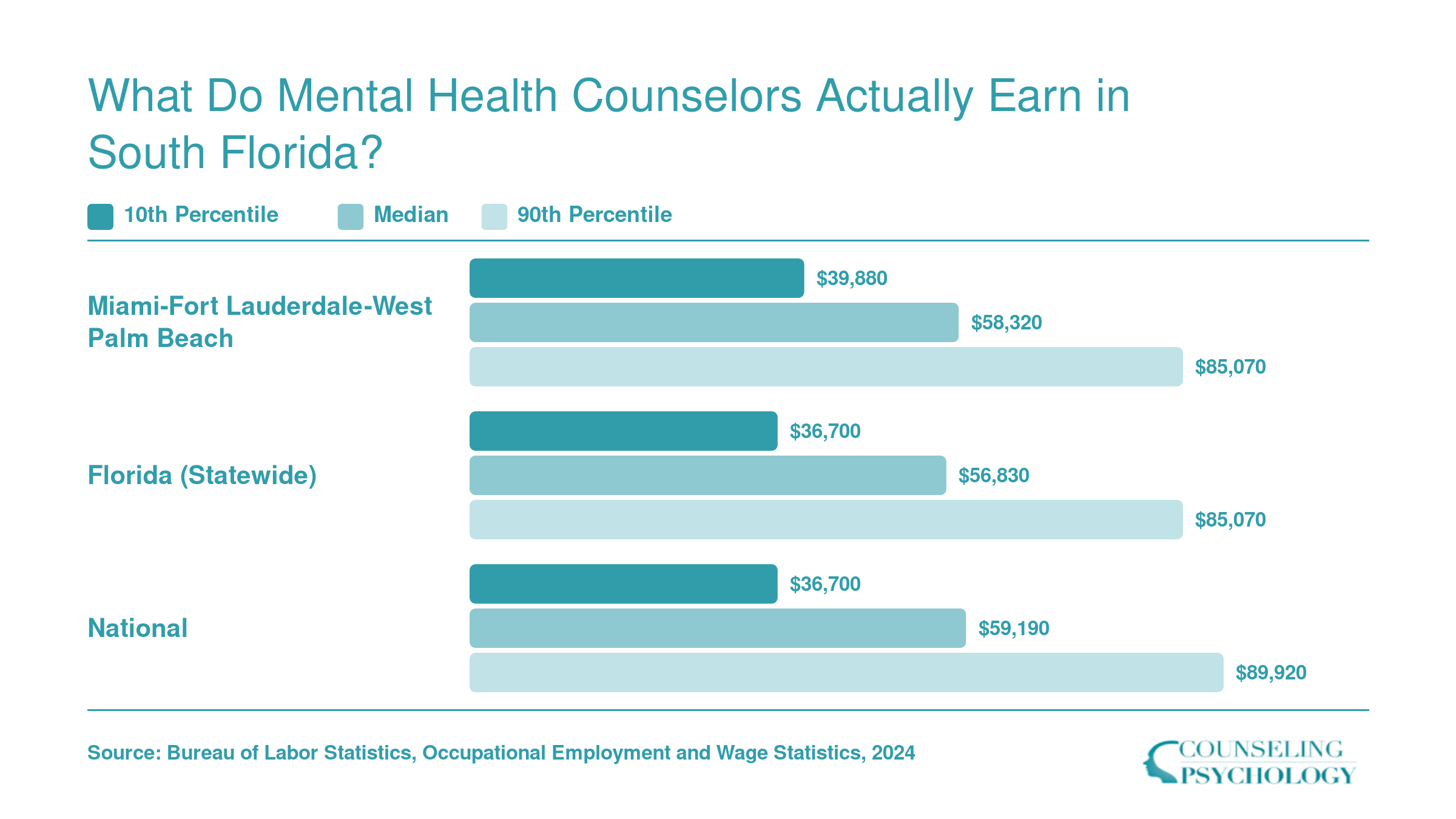
What Do Mental Health Counselors Actually Earn in South Florida?
Salary potential is a practical concern for anyone weighing the cost of a master's degree. The Bureau of Labor Statistics tracks wages for substance abuse, behavioral disorder, and mental health counselors (SOC 21-1018) at the metro, state, and national levels. Below is a snapshot of how the Miami-Fort Lauderdale-West Palm Beach metro area compares. For the most granular percentile data, visit the BLS Occupational Employment and Wage Statistics page at bls.gov/oes, filter by this metro area, and explore 10th through 90th percentile breakdowns. Alumni salary surveys published by FAU, FIU, and UM can also add context, and the Florida Counseling Association offers regional networking insights from local practitioners.
CACREP Accreditation: What It Is and Why It Matters for Your CMHC Degree
Choosing between a CACREP-accredited program and one that simply carries regional institutional accreditation is one of the most consequential decisions you will make during your CMHC search. The downstream effects on licensure, career mobility, and employer eligibility are significant.
What CACREP Accreditation Actually Means
CACREP, the Council for Accreditation of Counseling and Related Educational Programs, is the specialized programmatic accreditor for counseling graduate programs. Where regional accreditation (such as SACSCOC in the Southeast) evaluates an entire institution, CACREP zooms in on the counseling program itself: its curriculum, faculty qualifications, clinical training structure, and student outcomes. A university can hold full regional accreditation while its counseling program lacks CACREP recognition, and that gap matters more than many applicants realize. For a deeper look at how this programmatic standard compares with psychology's accrediting body, see our guide on CACREP vs. APA accreditation.
CACREP released updated 2024 Standards that took effect on July 1, 2024, replacing the previous 2016 edition.1 Programs have a 24-month transition window to align with the new requirements.2 The updated standards continue to require clinical mental health counseling programs to cover both a core counseling curriculum and the specialty area standards outlined in Section 5-C, along with a minimum of 100 practicum hours and 600 internship hours under qualified supervision.3
Why CACREP Matters for Florida LMHC Licensure
Florida requires 60 semester hours from a program that meets state-defined curriculum standards in order to qualify for Licensed Mental Health Counselor (LMHC) status. Programs holding CACREP accreditation automatically satisfy that curriculum framework, which simplifies the application review.4 Graduates of non-CACREP programs can still pursue licensure, but they may face additional scrutiny from the Florida Board to verify that each coursework requirement has been met, a process that can delay your timeline.
Beyond state licensure, CACREP accreditation commonly serves as a benchmark for TRICARE provider credentialing, which is relevant if you plan to work with military service members or their families at installations connected to the broader South Florida military community.5 Starting January 1, 2027, graduation from a CACREP-accredited program will also be required to earn the National Certified Counselor (NCC) credential.5
Portability and Employer Preferences
If you ever plan to relocate or practice across state lines, CACREP accreditation improves your license portability.6 Many states treat it as a preferred or streamlined standard when evaluating out-of-state applicants. That said, it does not automatically guarantee reciprocity; each state maintains its own licensing rules, and you will still need to verify requirements in any new jurisdiction.
Employers in South Florida, particularly community mental health centers, hospital systems, and group practices, frequently list CACREP graduation as a preferred or required qualification in job postings. Even where it is not a strict prerequisite, hiring managers view it as a reliable signal that your training met a consistent national standard. Students exploring broader online clinical mental health counseling programs will find that CACREP status is one of the first filters worth applying.
The Practical Takeaway
A regionally accredited program that is not CACREP-accredited can still produce competent counselors, but the practical friction increases at almost every career checkpoint: licensure paperwork, credentialing applications, interstate moves, and employer screening. For students weighing CMHC programs near West Palm Beach, confirming a program's current CACREP status before committing is one of the simplest ways to protect your investment of time and tuition.
Related Articles
Questions to Ask Yourself
Practicum and Internship Opportunities in the West Palm Beach Area
Practicum and internship are the supervised clinical hours you log seeing real clients, under a licensed supervisor, before you can graduate from a CMHC master's program. They're the bridge between the classroom and independent practice, and where you actually learn to counsel.
The CACREP Hour Requirements
CACREP-accredited clinical mental health counseling programs require a minimum of 100 practicum hours (at least 40 of which must be direct client contact) followed by a 600-hour internship (at least 240 hours of direct client contact). That's 700 supervised hours total before you walk across the stage. Practicum usually happens in your second year, with internship spanning the final two semesters.
Most programs have a field placement coordinator who maintains relationships with local sites and helps match students based on population interest (children, addictions, trauma, couples) and logistics. You're typically expected to interview at sites the way you would for a job. If you're still exploring what psychology internships look like across the field, it helps to understand how competitive these placements can be.
Where West Palm Beach Students Land
Palm Beach County has a relatively dense clinical infrastructure for a metro of its size, which works in students' favor. Common placement types include:
- Hospital-based behavioral health: Inpatient psychiatric and outpatient counseling units at systems like HCA Florida JFK North Hospital, Delray Medical Center, and St. Mary's Medical Center have historically taken graduate counseling trainees.
- Community mental health centers: The Faulk Center for Counseling in Palm Beach County actively utilizes graduate students, doctoral interns, and licensed clinicians, making it a recognized training site.1 County-level agencies including Palm Beach County Youth Services also host trainees, though their formal internship program is geared toward doctoral-level psychology.2
- School districts and private practice group homes: The Palm Beach County School District places counseling trainees in school-based mental health roles, and several private group practices accept master's-level interns.
- VA and federal sites: The West Palm Beach VA Medical Center is a major regional employer of mental health clinicians, though VA placements are competitive and often prioritize doctoral trainees.
The Local Advantage
South University's West Palm Beach campus runs its Clinical Mental Health Counseling MA with placements coordinated within the regional provider network.3 That kind of established pipeline matters: site supervisors who already know a program's curriculum are more willing to take its students, and local sites convert interns to paid hires far more often than they hire strangers. Students exploring masters in mental health counseling Florida options should weigh this carefully. Fully online students from out-of-state programs have to build those relationships from scratch, which is one of the underappreciated trade-offs of distance learning in this field.
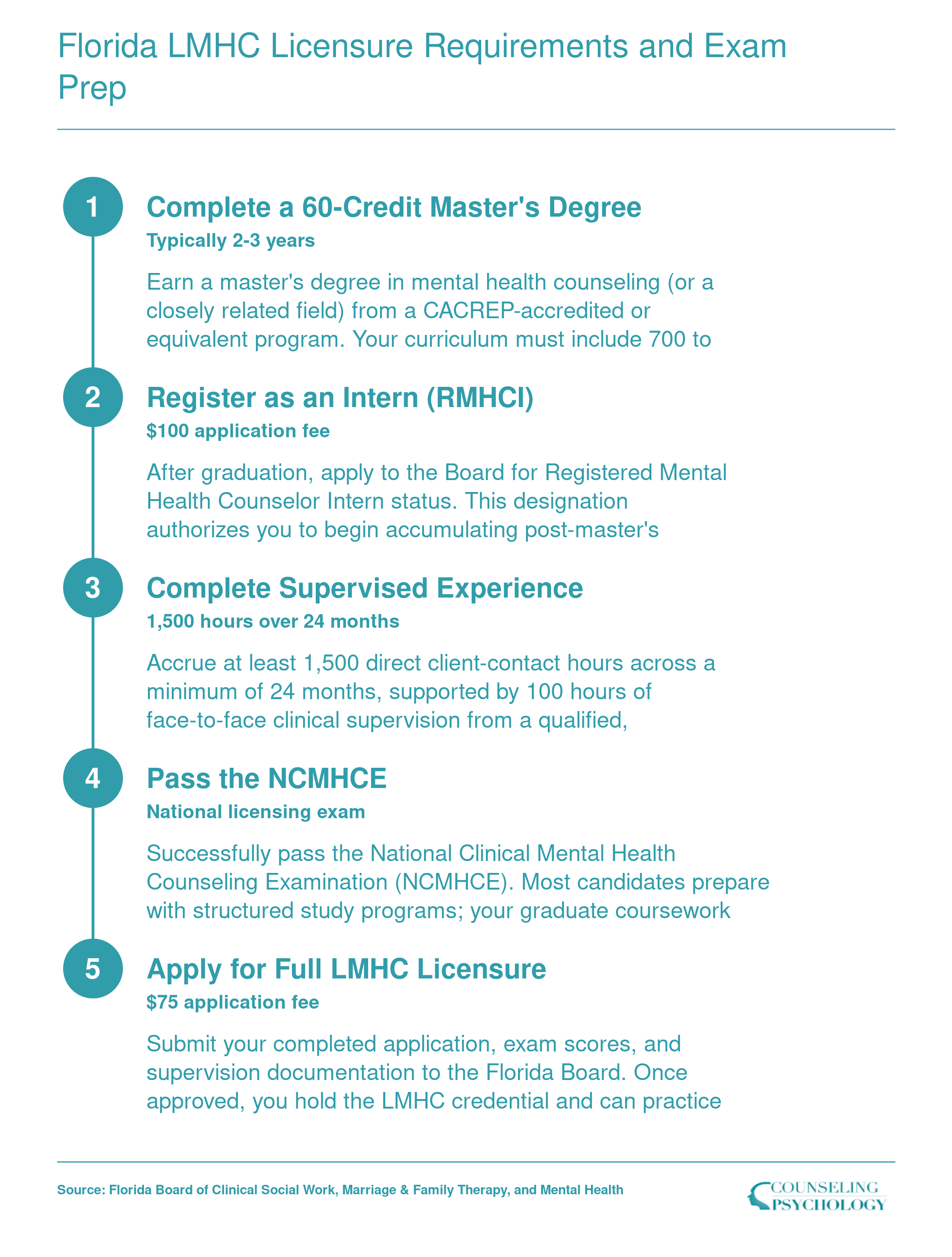
Florida LMHC Licensure Requirements and Exam Prep
Earning your Licensed Mental Health Counselor (LMHC) credential in Florida follows a clearly defined path overseen by the Florida Board of Clinical Social Work, Marriage & Family Therapy, and Mental Health Counseling. No significant legislative changes to these requirements have taken effect for the 2025 or 2026 cycles, so the steps below reflect the current rule set. Understanding each milestone before you enroll in a CMHC program helps you plan your timeline and avoid surprises.
Online vs. On-Campus CMHC Options in South Florida
Choosing between online and on-campus delivery is one of the most consequential decisions you will make when selecting a clinical mental health counseling program. Most of the ranked programs near West Palm Beach are campus-based, but Jacksonville University offers a hybrid format that blends weekly in-person sessions with remote coursework. That middle ground is worth a close look, especially if you are balancing a job or family obligations alongside graduate study.
Pros
- Online programs offer scheduling flexibility that lets working professionals complete coursework on evenings and weekends without relocating.
- Tuition for online CMHC degrees is often lower overall, and you eliminate commuting and parking costs entirely.
- An online format opens access to CACREP-accredited programs across the country, not just those within driving distance of West Palm Beach.
- On-campus programs like those at FAU and FIU come with established practicum site networks across South Florida, streamlining clinical placement.
- Cohort-based, in-person models (offered at schools such as UNF and Rollins College) build strong peer bonds and professional connections organically.
- Direct, face-to-face faculty mentorship on campus accelerates skill development in areas like group facilitation and clinical assessment.
- Hybrid options, such as Jacksonville University's format, combine the convenience of remote learning with structured weekly meetings for hands-on training.
Cons
- Even fully online students must secure local practicum and internship sites, which can be challenging without a school's regional partnerships.
- Online learners miss out on spontaneous hallway conversations, study groups, and networking events that form naturally in a campus setting.
- Self-directed time management is essential online; without a fixed class schedule, coursework can easily fall behind during busy clinical rotations.
- Fixed daytime class schedules at traditional campus programs can conflict with full-time or part-time employment.
- On-campus attendance at schools outside the immediate West Palm Beach area (Gainesville, Tampa, Tallahassee) means significant commuting or relocation costs on top of tuition.
- Private campus programs like the University of Miami carry considerably higher tuition, which may not be offset by proportionally higher earnings after graduation.
Graduate Certificate Options in Mental Health Counseling Near West Palm Beach
For many prospective students, the real tension here is time versus outcome: a graduate certificate is faster and often cheaper than a full master's degree, but in Florida it rarely gets you where you want to go if licensure is the goal.
What a Graduate Certificate Is (and Is Not)
A graduate certificate in mental health counseling typically consists of a focused set of graduate-level courses, usually somewhere between 12 and 18 credit hours. Unlike a full master's in clinical mental health counseling, a certificate on its own does not satisfy the educational requirements for Licensed Mental Health Counselor (LMHC) licensure in Florida. The Florida Board of Clinical Social Work, Marriage and Family Therapy, and Mental Health Counseling requires a master's degree in a qualifying counseling field, along with specific coursework and supervised clinical hours.1 A standalone certificate does not check those boxes.
Who Certificate Programs Actually Serve
That said, graduate certificates do have real value for the right candidate:
- Career explorers: Someone considering a pivot into counseling can sample graduate-level coursework before committing to a two- or three-year master's program.
- Licensed professionals adding a specialty: A social worker or school counselor who already holds a qualifying master's degree might pursue a certificate to expand their clinical focus.
- Stackable credit pathways: Some certificate programs allow credits to count toward a full master's if the student later decides to continue.
Programs Worth Knowing About
Two programs stand out in the research for Florida residents. National Louis University offers a Mental Health Counseling Graduate Certificate delivered in online and blended formats.2 Notably, it requires an existing master's degree in a counseling-related field and is designed with Florida's LMHC educational requirements in mind, making it a post-master's option for professionals who need to fill specific coursework gaps.
Florida Gulf Coast University offers a Transition to Mental Health Counseling certificate aimed at those who already hold a master's in community or school counseling and want to meet the competency areas required for mental health practice. A minimum 3.0 GPA is required for admission.3
Neither of these is a substitute for a CACREP-accredited master's program if you are starting from scratch.4 For students in the West Palm Beach area without an existing graduate degree in counseling, programs at clinical psychology programs in Florida institutions such as Palm Beach Atlantic University, Keiser University, and South University's West Palm Beach campus remain the standard path to licensure-eligible credentials.
The Bottom Line
If you already hold a qualifying master's degree and need targeted coursework to meet Florida's LMHC requirements, a graduate certificate can be a practical and efficient bridge. If you are newer to the field, investing in a full CACREP-accredited master's program is the more straightforward route to licensure.
Frequently Asked Questions About CMHC Programs in West Palm Beach
Choosing a clinical mental health counseling program involves weighing cost, format, accreditation, and career outcomes. Below are answers to some of the most common questions prospective students ask when exploring CMHC programs near West Palm Beach, Florida.
More Clinical Mental Health Counseling Programs to Consider
Beyond our top-ranked programs, the following schools offer additional CMHC options across Florida, ranging from hybrid and online to on-campus formats. Each program provides a pathway to licensure and a career in mental health counseling.
North Florida
- Clinical Mental Health Counseling Program
Central Florida
- Clinical Mental Health Counseling
- Master of Science in Counseling (Clinical Mental Health)
- Master of Science in Counseling (Clinical Mental Health Counseling)
- Master of Science in Professional Counseling (Clinical Mental Health Counseling)
Southwest Florida
- Transition to Mental Health Counseling Certificate
South Florida
- Master of Science in Clinical Mental Health Counseling
- Master of Science in Clinical Mental Health Counseling (Crisis and Trauma Counseling)
- Master of Science in Clinical Mental Health Counseling (Marriage and Family Studies)
- Master of Science in Clinical Mental Health Counseling
- Master of Science in Clinical Mental Health Counseling (Crisis, Resilience and First Responder Trauma)
- Master of Science in Counseling (Clinical Mental Health Counseling)
- Master of Science in Counseling (Clinical Mental Health Counseling)
- Master of Science in Counseling (Clinical Mental Health Counseling)