What you’ll learn in this article…
- Washington resident tuition at public CACREP programs can run less than half the nonresident rate, saving thousands over a 60-credit degree.
- Hidden costs like liability insurance, background checks, and practicum fees can add several thousand dollars beyond published tuition.
- CACREP accreditation is essential for licensure portability if you ever plan to practice outside Washington state.
- State-specific aid programs and graduate assistantships can significantly reduce or even eliminate out-of-pocket tuition costs.
Public versus private tuition is the sharpest dividing line in graduate counseling education near Seattle. Western Washington University's in-state program-level tuition runs roughly $13,878, while private programs in the same region can top $41,000 before fees and clinical placement costs.
Demand for licensed mental health counselors in Washington is growing, and the Seattle metro sits at the center of that expansion. But the cost of a master's degree, typically the minimum credential for licensure as an LMHC in Washington, stops many qualified candidates before they start. Across the seven programs ranked here, annual tuition ranges from under $14,000 to more than $41,000, and net price after aid shifts that picture considerably for students who apply strategically.
Accreditation status, clinical hour requirements, and realistic time-to-completion all affect the true cost of any program. A lower sticker price means little if the program adds a third year of coursework or lacks the CACREP accreditation that smooths licensure applications in Washington and elsewhere. For students weighing their long-term prospects, understanding the mental health counselor career landscape can help frame whether the investment pays off.
Best Affordable Clinical Mental Health Counseling Master's Programs Near Seattle
These degree programs prepare graduates to sit for licensure as mental health counselors in Washington while keeping tuition costs below the national average for professional counseling degrees. Each combines supervised clinical training, coursework aligned with state requirements, and a curriculum rooted in evidence-based therapy approaches. The programs listed here meet Washington's 90-quarter or 60-semester credit minimum for associate-level licensure and include the supervised practicum and internship hours required by the Washington State Department of Health. For a broader look at options statewide, explore masters in counseling Washington state rankings.
Seattle University
Seattle University offers a CACREP-accredited Master of Arts in Counseling with a Clinical Mental Health Counseling specialization. The program requires 90 quarter credits delivered in a cohort model over three years, including 100 hours of practicum and 600 hours of internship. Tuition for the 2025-2026 academic year stands at approximately $950 per credit, bringing total program cost to around $85,500 before fees and books. The curriculum aligns with Washington LMHCA education requirements, covering psychopathology, appraisal, career development, group counseling, and multicultural issues. Verify current accreditation status on the CACREP directory before applying.
Antioch University Seattle
Antioch University Seattle holds CACREP accreditation for its Master of Arts in Clinical Mental Health Counseling, a 90-quarter-credit program designed for working professionals. Evening and weekend class schedules accommodate students employed full time. Tuition runs approximately $750 per credit, totaling around $67,500 for the degree. The program includes 100-hour practicum and 600-hour internship placements in community mental health centers, hospitals, and private practices throughout the Seattle metro area. Students complete coursework in crisis intervention, trauma-informed care, substance abuse counseling, and couples and family systems. Confirm the program's alignment with current Washington licensure standards by reviewing the Department of Health's education requirements page.
City University of Seattle
City University of Seattle delivers a CACREP-accredited Master of Counseling with a Clinical Mental Health specialization in an accelerated hybrid format. The 90-quarter-credit program blends online asynchronous coursework with required face-to-face intensives for skills training and clinical preparation. Tuition is approximately $695 per credit, bringing total cost to roughly $62,550. Students interested in the accelerated format may also want to compare accelerated online masters in counseling options. Practicum and internship placements can be arranged near students' home locations within Washington, expanding access for candidates outside the immediate Seattle area. The program satisfies Washington's supervised experience and didactic requirements, but prospective students should contact admissions advisors directly to confirm any recent updates to state licensure rules.
Central Washington University
Central Washington University's Master of Science in Mental Health Counseling holds CACREP accreditation and operates from its SeaTac campus in addition to the Ellensburg main campus. The 90-quarter-credit program costs approximately $440 per credit for Washington residents and $925 for nonresidents, making it one of the lowest-cost options for in-state students at around $39,600 total tuition. The curriculum meets Washington LMHCA education prerequisites, including supervised clinical hours, diagnosis and treatment planning, ethics, and group facilitation. Students complete 700 total clinical hours across practicum and internship. Check the CACREP website to verify the accreditation period and any conditions tied to the program's status.
Western Washington University
Western Washington University offers a CACREP-accredited Master of Science in Clinical Mental Health Counseling on its Bellingham campus, approximately 90 miles north of Seattle. The 90-quarter-credit program charges around $475 per credit for residents and $1,050 for nonresidents, totaling roughly $42,750 for in-state candidates. Coursework covers evidence-based treatment modalities, psychopharmacology for counselors, professional orientation, and legal and ethical issues in counseling practice. Students complete 100 practicum hours and 600 internship hours in approved clinical settings. Review the program's website for prerequisite coursework, application timelines, and confirmation that the degree satisfies Washington's LMHCA educational requirements before applying. Those comparing programs nationally can also review our guide to the best masters in mental health counseling programs.
How We Ranked These Programs
Rising tuition across graduate counseling programs has made affordability a central concern for students, and ranking methodologies need to reflect that shift rather than defaulting to prestige signals.
This list was built with one priority in mind: helping you find a clinical mental health counseling master's degree near Seattle that costs less without sacrificing quality. The weighting reflects that goal. Affordability metrics carry more influence than any other category, so a well-resourced program at a prestigious institution will rank lower if its out-of-pocket cost is substantially higher.
Key Factors in the Ranking
Several data points feed into each program's position on this list:
- Net price after financial aid: This is the single most influential factor. It represents a sector-conditional average of what students actually pay after grants and scholarships are applied, drawn from federal reporting data. It is not a personalized quote; your individual cost will depend on your income bracket, residency status, and aid eligibility. Think of it as a useful benchmark, not a binding number.
- Published tuition rates: Both resident and nonresident figures were considered, since many readers may be relocating to the Seattle area or commuting from nearby states.
- Graduation rate: Because program-specific completion rates are not publicly reported, institution-wide graduation rates serve as a proxy. A school that graduates a high share of its overall student body tends to offer stronger academic support infrastructure, which matters in a demanding 60-credit counseling curriculum.
- Program format availability: Schools offering online, hybrid, or evening options received a modest boost, since flexibility can reduce indirect costs like commuting and lost wages.
- Scorecard-derived outcomes: Federal data on post-graduation earnings and employment were factored in where available. Not every program has published outcome figures yet, so this metric carries less weight than cost indicators.
What This Ranking Does Not Measure
This is not a prestige ranking. Factors like faculty research output, national reputation surveys, and selectivity are not part of the formula. CACREP accreditation status is noted in individual program profiles because it directly affects your licensure pathway, but it does not add or subtract ranking points. The goal is straightforward: surface programs where your dollar stretches furthest while still preparing you for licensure as a mental health counselor in Washington State.
What to Look for in an Affordable Counseling Program
Accreditation, licensure alignment, and total cost transparency matter more than sticker price when you're choosing a counseling master's. A cheap program that doesn't get you licensed (or takes an extra year to finish) isn't actually affordable.
Accreditation: CACREP Should Be Your Default
Washington does not legally require CACREP accreditation for LMHC licensure.1 The state accepts degrees from institutions accredited by bodies recognized by CHEA or the USDE, provided the coursework covers at least seven required content areas. So technically, a non-CACREP program can work.
In practice, CACREP is still the safer choice. CACREP graduates get streamlined credit toward supervised experience (500 hours of supervised practicum/internship and 50 hours of direct supervision are built into the curriculum standard), and most other states require or strongly prefer CACREP for license portability.3 If you ever move out of Washington, a non-CACREP degree can mean retroactive coursework, extra exams, or denied applications. Employers, especially hospital systems and group practices, also tend to filter resumes by CACREP status. For a broader look at how CACREP standing factors into program quality nationwide, see our guide to the best clinical mental health counseling programs.
Washington LMHC Requirements Your Program Must Support
To become a fully licensed LMHC in Washington, you need a minimum of 60 graduate credits, a supervised practicum and internship (with at least 600 hours under certain pathways), and after graduation, 3,000 hours of supervised experience over at least 36 months, including 1,200 direct counseling hours and 100 supervision hours at a 1:80 ratio.13 You'll also sit for the NCE or NCMHCE.4 Verify that the program's credit count, content areas, and clinical hour structure map cleanly to these thresholds. Ask the program coordinator directly: "Does your curriculum meet Washington DOH requirements for LMHC?" A good answer is specific, not vague reassurance.
The 'Affordable on Paper' Trap
Per-credit tuition is only part of the cost. Before you commit, add up:
- Practicum and internship fees: Often $300 to $1,500 per term, separate from tuition.
- Professional liability insurance: Required during clinical placements, typically $35 to $200 annually for students.
- Background checks and fingerprinting: $50 to $150, sometimes repeated for different sites.
- Supervision costs: Some sites charge for clinical supervision; post-graduate supervision toward your LMHC almost always costs $50 to $150 per hour out of pocket.
- Textbooks, testing software, and exam prep: Budget $1,500 to $3,000 across the program.
Pacing and Time-to-Completion
A part-time program that stretches a 60-credit degree across four years instead of two doubles your living expenses, even if per-credit cost stays low. Run the math on total cost of attendance, not just tuition. Ask whether the program offers a defined part-time track with predictable course sequencing, and whether evening, weekend, or asynchronous options exist if you plan to keep working. The cheapest credit hour is the one you actually finish on schedule.
CACREP accreditation is the single biggest factor for licensure portability. If you might ever practice outside Washington, a CACREP program protects your credential in nearly every state, ensuring your degree meets board requirements nationwide and simplifying reciprocity applications down the road.
True Cost Breakdown: Tuition, Fees, and Hidden Expenses
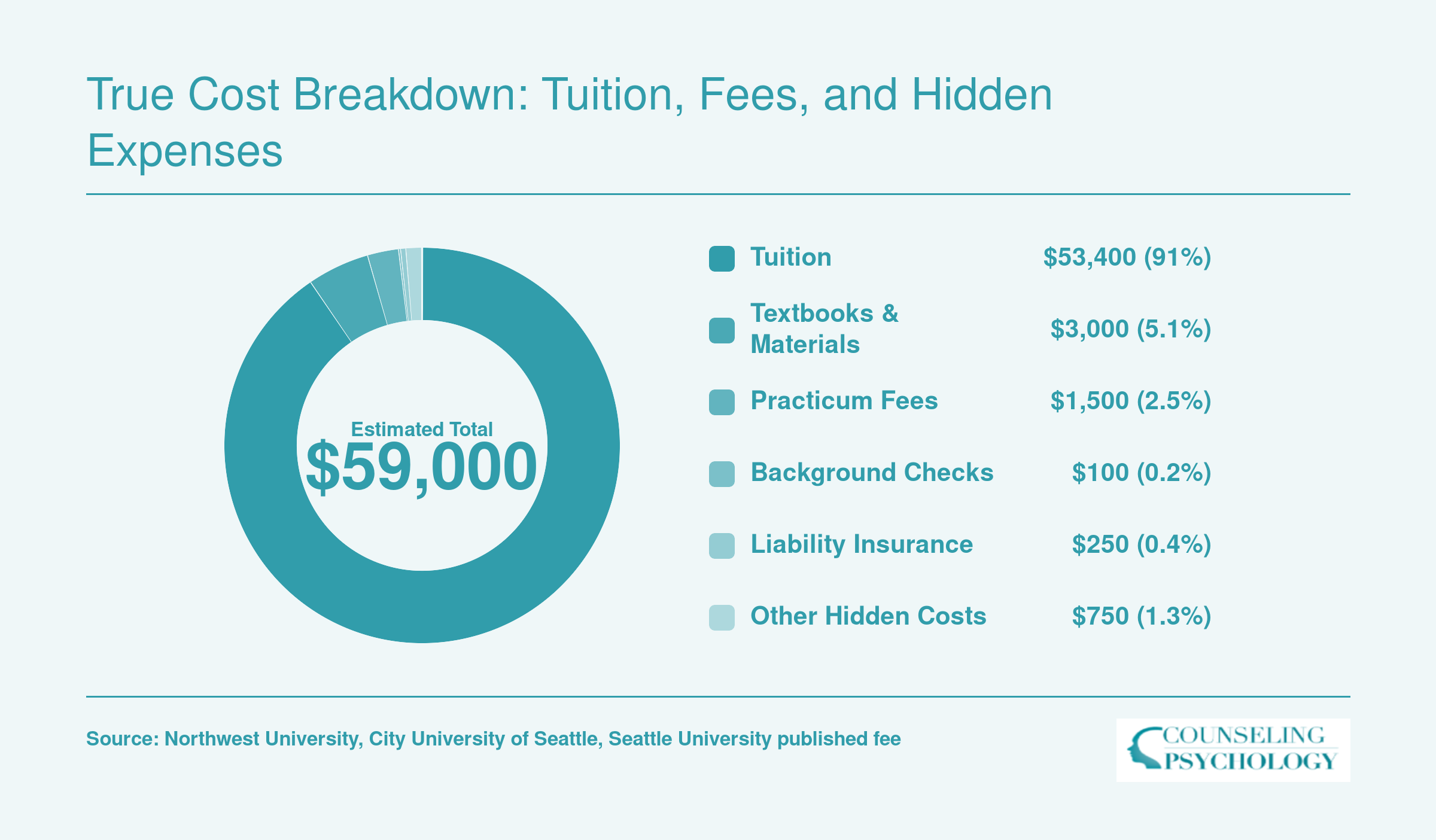
Sticker tuition is only part of what you will actually pay for a clinical mental health counseling master's degree near Seattle. Background checks, liability insurance, practicum placement fees, and textbooks can add thousands of dollars to the final bill. The donut below uses midpoint estimates drawn from published fee schedules at Seattle-area programs to show how these costs stack up across a typical 60-credit program.
Resident vs. Nonresident Tuition at Washington Public Universities
Washington's two public universities with CACREP-accredited clinical mental health counseling master's programs offer dramatically different price tags depending on residency status. The table below compares 2025-26 per-credit rates and estimated total program costs for resident and nonresident students. Note that the Western University Exchange (WUE) tuition discount does not apply to graduate-level counseling programs at these institutions, so out-of-state students should plan for the full nonresident rate unless they can establish Washington residency before enrolling.
| University | Credits Required | Per-Credit Rate (Resident) | Per-Credit Rate (Nonresident) | Est. Total Cost (Resident) | Est. Total Cost (Nonresident) | CACREP Accredited |
|---|---|---|---|---|---|---|
| Eastern Washington University | 93 | $426 | $939 | $39,618 | $87,327 | Yes |
| Western Washington University | 91 | $450 | $872 | $40,950 | $79,352 | Yes |
Online, Hybrid, and On-Campus Options Compared
Most clinical mental health counseling programs near Seattle are delivered on campus, though a handful blend online coursework with in-person requirements. One critical reality applies across every format: even programs marketed as 'fully online' still require hundreds of supervised practicum and internship hours at an approved site. You will need to arrange face-to-face clinical placements regardless of how your lectures are delivered.
| Factor | On-Campus | Hybrid (Online + In-Person) | Online with Required On-Site Components |
|---|---|---|---|
| Programs in this ranking | Western Washington University, Northwest University (main campus), Saint Martin's University, Seattle University, Gonzaga University, University of Puget Sound | Saint Martin's University offers flexible evening and online coursework within its campus-based program; Seattle University lists both in-person and online delivery options | Northwest University Center for Online and Extended Education (listed tuition approximately $15,364 per year) |
| Typical cost range (annual in-state or standard tuition) | $13,878 (Western Washington University, in-state) to $41,422 (University of Puget Sound) | Varies by school; tuition generally mirrors the campus rate at the same institution | $15,364 per year at Northwest University's online center, though the net price after aid can differ significantly from sticker tuition |
| Flexibility for working students | Most programs hold classes during set daytime or evening blocks. Northwest University and Saint Martin's schedule evening sessions (6 to 10 p.m.), which helps if you work during the day. | Lets you complete some didactic coursework on your own schedule while attending periodic campus sessions. Good middle ground for part-time workers. | Greatest scheduling freedom for lectures and readings. Still requires coordinating practicum hours around your work schedule, which can be 20+ hours per week during internship semesters. |
| Clinical placement logistics | Schools typically maintain local site partnerships. Seattle-area programs (Seattle University, Northwest University) can tap the metro area's large network of agencies and clinics. | Same institutional placement support as on-campus, though students attending remotely part of the time may need to be more proactive about securing a site near home. | You are usually responsible for identifying and proposing your own practicum site, which the program then approves. Living outside the Seattle metro may limit access to pre-established partnerships. |
| Networking and mentorship | Daily interaction with cohort peers and faculty. Student-to-faculty ratios range from 9:1 (Northwest University) to 18:1 (Western Washington University), directly affecting mentorship access. | Periodic campus intensives create networking windows, though relationships can be harder to sustain between visits. | Northwest University's online center reports a 27:1 student-to-faculty ratio, the highest among ranked programs. Building professional connections requires more intentional effort through virtual office hours and professional associations. |
Questions to Ask Yourself
Strategies to Lower Your Education Costs
Graduate school costs are rising faster than inflation, but Washington students have access to funding mechanisms that can reduce or eliminate tuition burdens entirely. Many prospective counseling students overlook state-specific aid programs and institutional assistantships that make the difference between graduating with manageable debt and entering the workforce under financial strain.
Graduate Assistantships and Tuition Waivers
Several Washington universities offer graduate assistantship positions that combine monthly stipends with partial or full tuition waivers. These roles typically involve 10 to 20 hours of weekly work in counseling centers, research labs, academic departments, or community partnerships. At some institutions, a half-time assistantship covers the entire cost of in-state tuition plus a living stipend, effectively bringing your net program cost to near zero. Assistantship openings are competitive and often filled during the initial admissions cycle, so inquire early and submit your application by priority deadlines.
Washington State Scholarships and Loan Repayment
The Behavioral Health Conditional Scholarship, administered by the Washington Student Achievement Council, provides substantial support to graduate students in clinical mental health counseling programs.1 For the 2025-2026 academic year, standard two- to three-year programs qualify for up to $41,000, while advanced-standing or one-year tracks receive up to $15,500.1 Recipients commit to three to five years of service in an underserved community or behavioral health shortage area in Washington after graduation. The scholarship is need-based and requires filing a FAFSA or WASFA each year. Note that the application for 2026-27 awards has already closed, so prospective students should plan to apply during the next cycle.1
The Washington Health Professional Loan Repayment Program offers additional post-graduation relief. Eligible mental health counselors working full-time in shortage areas can receive assistance paying down educational debt after they begin practice. Federal programs also play a role: the National Health Service Corps Loan Repayment Program supports mental health counselors serving in Health Professional Shortage Areas, with awards that can reach tens of thousands of dollars over multi-year commitments. Separately, the NBCC Foundation offers scholarships and fellowships for counseling students, including the Military Scholarship, the Rural Scholarship, and the Minority Fellowship Program for master's-level mental health counseling students.2
Employer Tuition Reimbursement
If you already work in a community mental health agency, hospital system, or health center, ask about tuition assistance benefits. Organizations like Kaiser Permanente, MultiCare Health System, and Federally Qualified Health Centers frequently offer reimbursement for employees pursuing advanced degrees in behavioral health. Some programs cover a fixed dollar amount per year, while others reimburse a percentage of tuition. These benefits often require a service commitment, but they allow you to earn income while completing your degree and graduate with significantly less debt. For graduates who go on to serve underserved populations, the career path of a community mental health counselor often aligns naturally with these service-based funding arrangements.
Federal Aid and Loan Strategy
File your FAFSA as soon as the window opens in October, even if your program does not start until the following fall. Doing so maximizes your eligibility for federal subsidized loans, which do not accrue interest while you are enrolled at least half-time. Understand the difference between subsidized and unsubsidized loans and accept subsidized funds first. After graduation, if you work for a nonprofit agency or government employer, you may qualify for Public Service Loan Forgiveness. Under PSLF, borrowers who make 120 qualifying monthly payments while employed full-time in public service can have their remaining federal loan balance forgiven. Income-driven repayment plans can keep your monthly payments affordable based on your counselor salary, making PSLF a realistic path for many counselors entering community-based practice.
Earnings and Career Outcomes After Graduation
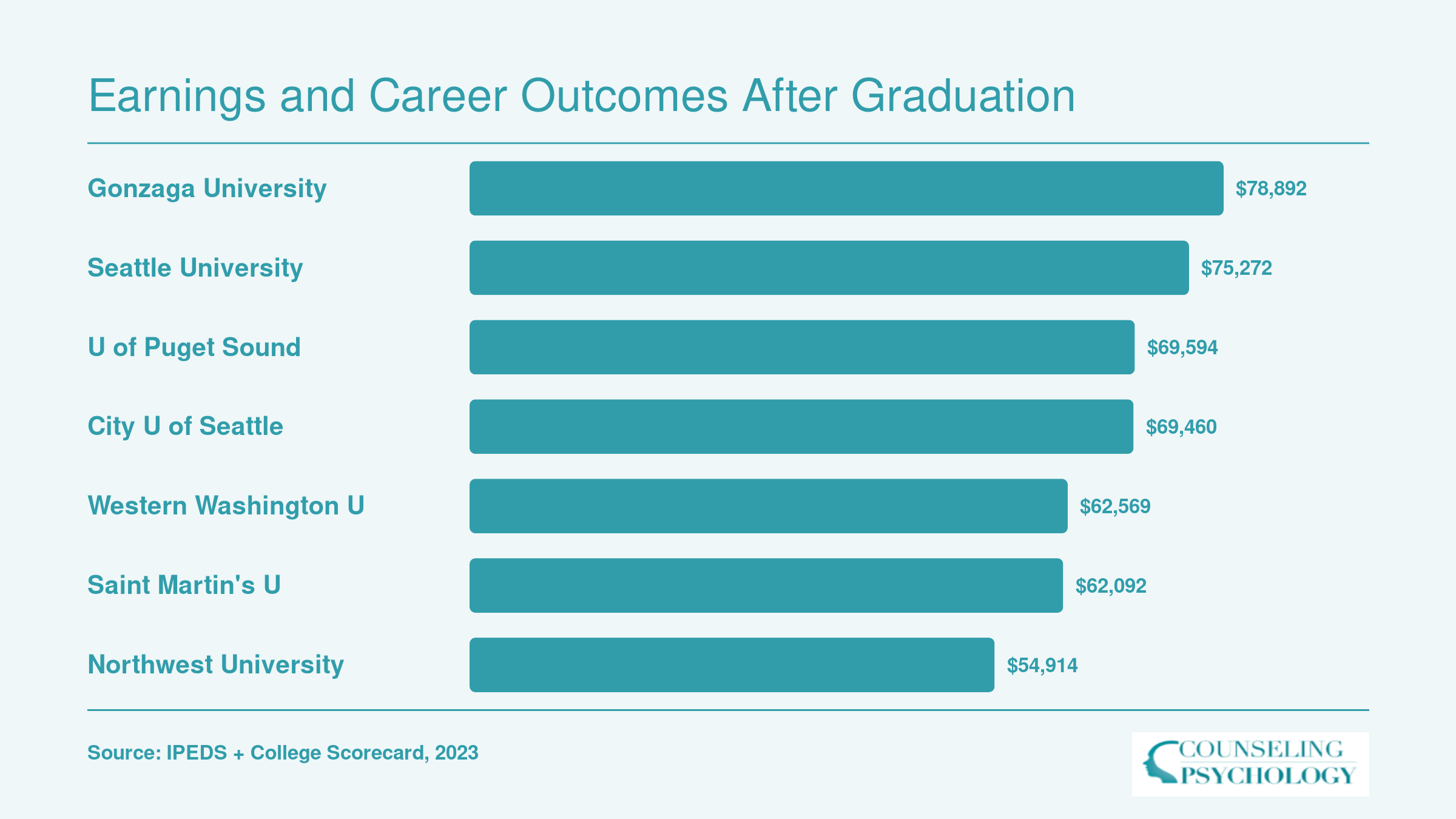
Program-level early-career earnings data (one year and four years after completion) are not yet published for the clinical mental health counseling master's programs ranked here. However, institution-wide median earnings ten years after enrollment offer a useful proxy for long-term return on investment. For local context, the BLS reports that mental health counselors in the Seattle-Tacoma-Bellevue metro area earned a median annual wage of $70,100 as of May 2023, well above the national median for the occupation.
Frequently Asked Questions
Below are answers to the questions prospective counseling students in Washington ask most often. Where possible, each answer ties back to program data and cost figures discussed earlier in this article.