
What you’ll learn in this article…
- Most experimental psychologists need a PhD, and the full path from bachelor's to independent researcher takes 8 to 12 years.
- BLS projects 6% job growth for non-clinical psychologists from 2024 to 2034, faster than the national average.
- Fewer than half of experimental psychology PhDs work in academia; the majority land roles in industry or government.
- Licensure is typically unnecessary unless you plan to offer clinical services or use the title psychologist with clients.
Experimental psychology covers a wide range of scientific questions, from how humans perceive color and form memories to how they learn new skills and make decisions under uncertainty. It is grounded entirely in the scientific method: controlled studies, measurable variables, replicable results. The field draws on cognitive neuroscience, behavioral science, and psychophysics, and its practitioners work in university labs, technology companies, federal agencies, and pharmaceutical research divisions.
The key distinction from clinical or counseling psychology is straightforward: experimental psychologists study behavior and mental processes rather than treat them. No therapy sessions, no patient caseloads. The credential path reflects that difference, typically requiring 8 to 12 years of education culminating in a PhD, and most states do not require a license for researchers who never provide clinical services.
For prospective students, the practical tension is real. Doctoral programs are highly competitive, funding timelines are long, and the academic job market for research faculty has contracted over the past decade. At the same time, demand outside academia, particularly in user research, behavioral economics, and data-driven policy, has expanded meaningfully, reshaping where most experimental psychology PhDs actually build their careers.
What Is an Experimental Psychologist?
The National Institutes of Health alone funds billions of dollars in behavioral and psychological research each year, and experimental psychologists are among the scientists driving that work.
A Science-First Definition
Experimental psychology is the branch of the field built around controlled experimentation. Rather than diagnosing or treating individuals, experimental psychologists design and conduct studies to understand how people think, perceive, feel, learn, and behave. The scientific method is not just a tool here; it is the entire foundation. Variables are isolated, conditions are manipulated, data are collected systematically, and conclusions are drawn only when the evidence supports them. The questions these researchers ask span a wide range: How does working memory break down under stress? What neural pathways underlie fear conditioning? How do visual cues shape decision-making?
How It Differs from Clinical and Counseling Psychology
This is a distinction worth spelling out clearly, because the titles can blur in casual conversation. Clinical, counseling, and school psychologists work directly with clients or students, providing assessment, therapy, and intervention. Experimental psychologists generate the knowledge that informs those practices. They are producers of research, not providers of care. That does not make the work any less consequential; much of what practitioners know about anxiety, trauma, cognition, and human development traces back to experimental research conducted in labs and universities over decades. For a broader look at the range of roles available, explore careers in psychology.
Where Experimental Psychologists Work
The image of an experimental psychologist in a university lab is accurate but incomplete. Today the degree opens doors to a broader set of environments:
- Academic and research institutions: Universities, medical schools, and independent research centers remain the most common employers.
- Government agencies: The NIH, the Department of Defense, and agencies like DARPA fund substantial behavioral and cognitive research programs.
- Technology and consumer industries: Companies focused on user experience, human-computer interaction, and product development increasingly hire researchers with experimental training.
- Pharmaceutical and biotech firms: Drug development pipelines depend on behavioral endpoints, making experimental psychologists valuable contributors to clinical trial design.
Credentials and Career Shape
The large majority of people working as experimental psychologists hold a PhD. The doctoral degree is the standard credential for independent research, faculty positions, and senior roles in industry labs. That said, master's-level graduates do find footing in applied research support roles, and a bachelor's degree in the field provides solid preparation for graduate study or research-adjacent positions. The PhD pipeline is increasingly feeding industry rather than academia alone, a shift that has widened the practical appeal of experimental training considerably.
What Does an Experimental Psychologist Do?
The work of an experimental psychologist rarely fits a single job description. Whether the setting is a university lab, a tech company, or a federal agency, the core activity is the same: designing rigorous tests of human behavior and drawing defensible conclusions from the data.1 What changes is the question being asked and the pace at which answers are needed.
Designing Studies
Before any data collection begins, experimental psychologists invest significant time in the conceptual groundwork. That means developing a testable hypothesis, choosing an appropriate design (such as a randomized controlled trial, a within-subjects comparison, or a longitudinal study), and writing the protocols required for ethical approval through an Institutional Review Board. Participant recruitment strategies, sample size calculations, and stimulus materials all take shape at this stage.
When the work involves neuroscience questions, researchers may layer in neuroimaging protocols or eye-tracking setups. In digital and product contexts, A/B testing frameworks serve a similar hypothesis-testing function, comparing two variants under controlled conditions.
Running Experiments and Collecting Data
Once a study is approved, the day-to-day looks like managing sessions, calibrating equipment, and keeping procedures consistent across participants. Software platforms do much of the heavy lifting here. Academic researchers commonly build stimulus delivery tasks in PsychoPy, E-Prime, or OpenSesame, while government researchers working on human performance under stress might use driving or flight simulators alongside those same tools.2 Industry UX researchers often rely on platforms like UserTesting, UserZoom, or dscout to observe participants remotely, and they use Qualtrics or similar survey tools to capture structured feedback.3
Analyzing and Reporting Results
Data analysis is where the methodology really shows. R and Python are the go-to languages across all three settings for statistical modeling and visualization. SPSS, SAS, and JASP appear frequently depending on the institution and the depth of statistical analysis required. MATLAB remains common in labs doing signal processing or neuroimaging work.
What gets produced from that analysis depends entirely on context. Academic experimental psychologists write journal articles and apply for grant funding, while also teaching courses and mentoring graduate students.1 A UX researcher at a tech firm packages findings into an insights deck and feeds design recommendations directly into a product sprint. A government researcher might deliver a technical report or policy brief that informs safety standards or training protocols.2 By contrast, a clinical psychologist typically focuses on diagnosis and treatment rather than controlled experimentation.
The shared thread across all three settings is the scientific method, applied rigorously to questions about how people think, perceive, decide, and behave.
Steps to Become an Experimental Psychologist
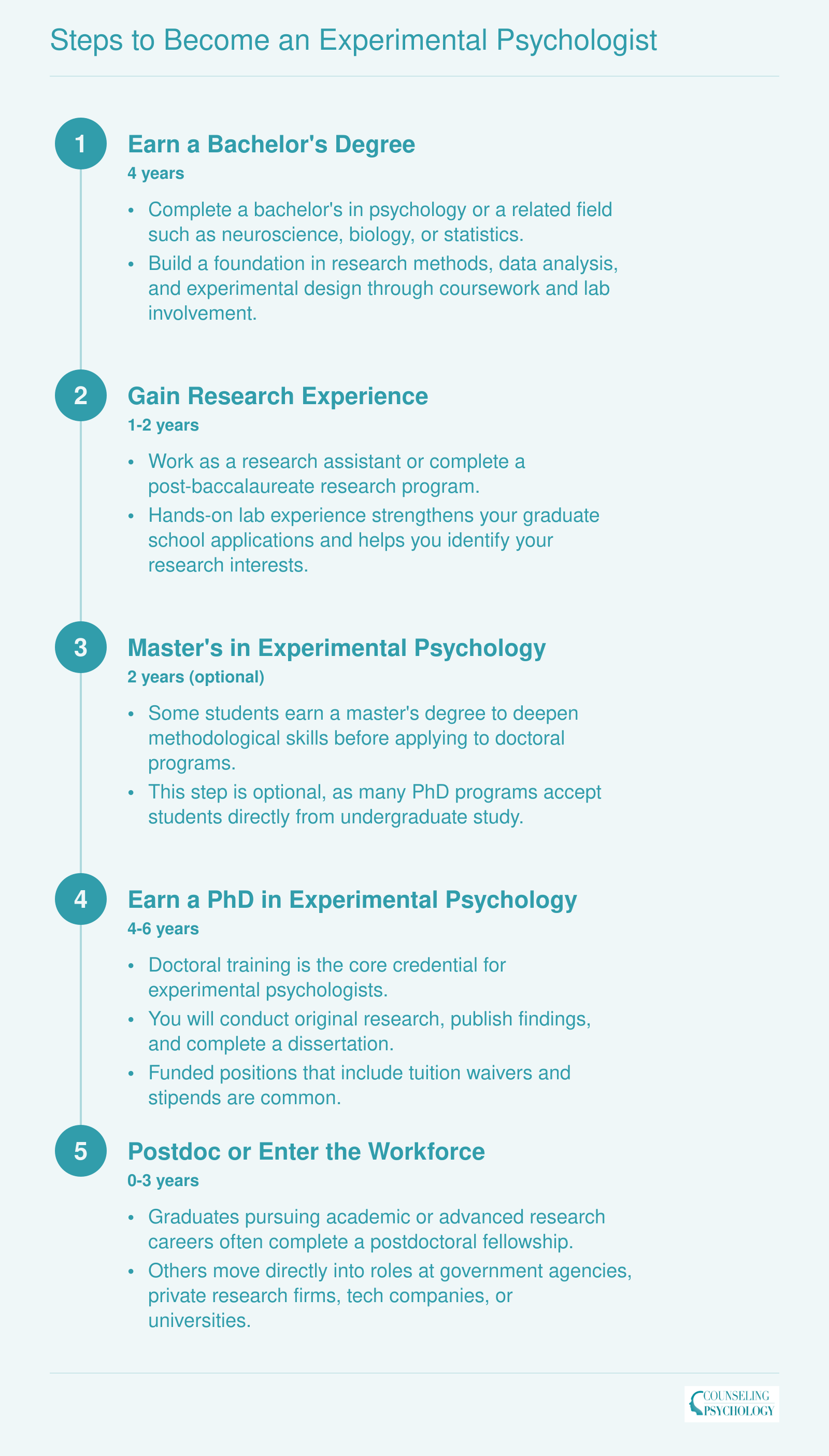
The path to becoming an experimental psychologist follows a structured credentialing ladder that typically spans 8 to 12 years from your first day of college to working as an independent researcher. One important detail: the master's degree step is optional. Many strong undergraduates enter PhD programs directly, shaving up to two years off the total timeline. The route you choose depends on your research readiness, funding opportunities, and career goals.
Experimental Psychology Education Requirements
A bachelor's degree in psychology is the typical starting point, but a standalone master's opens alternate routes for career changers and those targeting industry roles before committing to a PhD. Understanding when to pursue each credential, and which programs will actually fund your doctoral work, can save years and tens of thousands of dollars.
Bachelor's Degree: Building the Research Foundation
Most experimental psychologists begin with a bachelor's in psychology, but admission committees also welcome applicants from biology, neuroscience, or cognitive science backgrounds, provided you complete the right electives. Competitive undergraduates take multiple statistics courses (descriptive, inferential, and multivariate methods), experimental design, research methods with lab components, and at least one semester assisting faculty on active research projects. Washington State University's experimental psychology PhD, for example, expects 18 credits in psychology or related areas before you apply.1 If your major lacks a lab-science component, add coursework in biology or chemistry; many experimental tracks study perception, cognition, or neuroscience, and fluency in biological systems strengthens your application.
Master's Degree: When It Makes Sense and When to Skip
A standalone master's serves three audiences: career changers who need foundational coursework, applicants strengthening a thin undergraduate record, and professionals targeting applied industry roles (user research, data science, product analytics) who do not plan to pursue a doctorate. Many experimental psychology PhDs admit directly from bachelor's programs and include master's-level coursework in the first two years, so a separate MA or MS can add time and cost without improving your admission odds. Skip the standalone master's if your undergraduate GPA sits above 3.5, you have substantial research experience, and faculty at target programs confirm your fit. Pursue the master's if your GPA hovers near 3.0, your research portfolio is thin, or you are switching from an unrelated field and need proof of competence in statistics and experimental design.
PhD Admission Requirements: GPA, GRE, and Research Experience
Competitive PhD applicants typically hold a 3.5 or higher GPA; Washington State and Northwestern both report average admitted GPAs of 3.5, while minimum thresholds often sit at 3.0.15 The GRE is rapidly disappearing: Washington State no longer requires it1, Wayne State made it optional (except in industrial-organizational tracks)2, the University of Chicago recommends but does not mandate scores3, and UC Merced dropped the exam entirely for Fall 2026 admission.4 Research experience, however, remains non-negotiable. Washington State expects substantial involvement in faculty projects, including co-authored conference presentations, publications, or grant applications.1 Most programs require three letters of recommendation from faculty who can speak to your research capabilities, a writing sample (often a research paper or thesis chapter), and a statement of purpose that articulates a clear match with faculty interests. If English is not your first language, expect TOEFL minimums around 80 to 90 iBT or IELTS 7.0.23
Funding: Stipends, Tuition Waivers, and Red Flags
Most reputable experimental psychology PhD programs cover tuition and provide an annual stipend, typically ranging from $20,000 to $35,000 per year. Wayne State, for instance, offers full funding with a $20,000 stipend, tuition scholarship, and health insurance.2 These packages usually require 15 to 20 hours per week of teaching or research assistantship duties. An unfunded PhD offer in experimental psychology is a red flag; it signals either a cash-strapped program with weak faculty productivity or a terminal-master's program disguised as a doctorate. If a program cannot fund you, it is unlikely to provide the mentorship, lab resources, or professional network you need to launch a competitive career.
Experimental Psychology Degree Options: BA Vs. MA Vs. PHD
Choosing a degree level is essentially choosing which doors will open for you. Each tier in experimental psychology comes with distinct trade-offs around time, cost, career access, and earning potential, so the right choice depends on where you want to land professionally.
The Bachelor's Degree: A Starting Point, Not a Ceiling
A four-year BA or BS in experimental psychology equips graduates for entry-level roles in research settings, data analysis, human resources, behavioral consulting, and case management.1 Salary expectations at this level generally fall between $40,000 and $70,000, depending on the employer and region.1 Online and hybrid bachelor's programs are widely available, making this the most flexible option in terms of scheduling. The ceiling on advancement, however, is real. Most research positions with independent responsibility require a graduate degree.
The Master's Degree: The Practical Sweet Spot for Industry
The master's level is where the cost-to-opportunity ratio often looks most favorable for students drawn to applied work. MA and MS graduates move into roles such as research associate, UX researcher, lab manager, human-factors specialist, program evaluator, and community-college instructor, with typical salaries running from $50,000 to $95,000.1 The growth of UX research and behavioral product design in particular has created genuine demand for master's-prepared candidates. Online and hybrid MS options have expanded considerably, including programs in experimental psychology, general psychology, and behavioral science. Students exploring broader online master's in psychology programs will find many of these options listed alongside traditional on-campus offerings.
The honest answer to the question many students ask: is a master's enough? For an academic research career or independent laboratory work, no. For the majority of industry, government, and applied research roles, yes, it is often sufficient and increasingly competitive.
The PhD: The Standard for Research Leadership
The PhD remains the terminal degree in experimental psychology and the credential expected for tenure-track faculty positions, senior research scientist roles, and behavioral science leadership in government or industry.1 The salary ceiling is highest at this level, with ranges spanning roughly $55,000 at the postdoctoral stage up to $150,000 or more in senior industry or government positions. The trade-off is time: doctoral programs typically run five to seven years, and almost all require substantial on-campus residency. Fully online PhD programs in experimental psychology are not a realistic option because hands-on laboratory work is central to the training.
The American Psychological Association's guidance on education and training in experimental psychology underscores that doctoral preparation is designed specifically for those pursuing research-intensive careers, while acknowledging that master's-level training has grown in relevance for applied professional paths. The projected 6% growth in psychologist employment nationally between 2023 and 2033 reflects demand across all three levels, though the shape of that demand differs considerably by degree.2
Questions to Ask Yourself
Licensure and Certification for Experimental Psychologists
Most experimental psychologists work without a state license because they do not provide clinical services, diagnose patients, or hold themselves out as "psychologists" to the general public. If your career path leads you to pure research in academia, government labs, or private industry settings where you do not deliver psychological services directly to individuals for a fee, you typically fall under exemptions carved into most state psychology practice acts. Those exemptions allow you to conduct studies, publish findings, teach, and consult within organizational contexts without meeting the licensing requirements that apply to clinical psychologist professionals, counseling psychologists, and school psychologists.
When Licensure Is Required
The picture changes when you step outside those protected categories. If you plan to offer consulting or assessment services directly to the public for compensation, or if you want to use the title "psychologist" on business cards, websites, or published reports, many states will require a doctoral degree in psychology, completion of supervised postdoctoral hours (often 1,500 to 4,000 hours depending on jurisdiction), and passage of the Examination for Professional Practice in Psychology (EPPP). Even if your work is entirely experimental and non-clinical, broad title-protection laws in certain states make licensure the only legal route to calling yourself a psychologist.
A few states have particularly stringent rules. For example, California, Illinois, and New York enforce title protection that applies to virtually anyone using "psychologist" in a professional capacity, even in corporate or research roles, unless you hold a state-issued license or work under an academic or government exemption.2 Before accepting a private-sector position or launching an independent consultancy, confirm your state's stance with the psychology licensing board to avoid inadvertent violations.
Voluntary Certifications
Because ABPP (the American Board of Professional Psychology) does not currently offer a specialty designation for experimental or research psychology, experimental psychologists who seek board certification typically pursue credentials aligned with applied domains where they later specialize. ABPP's existing specialties cover clinical neuropsychology, forensic psychologist qualifications, organizational and business consulting, and several other practice areas, each requiring APA-accredited doctoral training, active state licensure, postdoctoral experience, practice samples, and an oral examination.
For experimental psychologists working in human factors, usability, or cognitive ergonomics, the Board of Certification in Professional Ergonomics (BCPE) offers the Certified Professional Ergonomist (CPE) credential. BCPE certification is not a psychology license, but it signals specialized competence in applying experimental methods to real-world interface design, workplace safety, and human-machine interaction. Eligibility typically requires a combination of formal education in psychology, engineering, or related disciplines plus documented professional practice. Certification through BCPE can strengthen your candidacy for applied-research roles in aerospace, automotive, healthcare, and defense sectors where usability and human performance are critical.
Practical Guidance
If you intend to stay in academic or government research, monitor state law but do not rush to obtain licensure. If you plan to consult privately, test human subjects for commercial clients, or market your services under the psychologist title, begin the EPPP and supervised-hours pathway early, ideally during your postdoctoral fellowship. The timeline from doctoral conferral to full licensure can stretch 18 to 36 months, and some employers will not extend job offers without proof of eligibility.
Experimental Psychologist Salary: National Overview
Because the Bureau of Labor Statistics does not track experimental psychologists as a standalone occupation, the closest proxy is the "Psychologists, All Other" category (SOC 19-3039), which captures research-oriented and non-clinical psychology roles. The figures below reflect national wage estimates and give a practical sense of where experimental psychologists fall on the earnings spectrum. Keep in mind that actual compensation varies by employer type, geographic location, and years of experience.
| Wage Percentile | Annual Salary |
|---|---|
| 25th Percentile | $73,820 |
| Median (50th Percentile) | $117,580 |
| Mean (Average) | $111,340 |
| 75th Percentile | $145,200 |
Highest-Paying States for Experimental Psychologists
Geography plays a significant role in experimental psychology compensation. The BLS tracks these professionals under the "Psychologists, All Other" category (19-3039), which captures many experimental psychologists working outside clinical or school settings. Below are the ten highest-paying states ranked by median annual wage. Keep in mind that states with higher medians often have a higher cost of living, so weigh these figures against local expenses before making a relocation decision.
| State | Median Annual Wage | 25th Percentile | 75th Percentile | Estimated Employment |
|---|---|---|---|---|
| California | $147,650 | $78,310 | $169,330 | 1,780 |
| Oklahoma | $147,010 | $103,330 | $161,350 | N/A |
| Nevada | $144,390 | $131,250 | $153,890 | 100 |
| Nebraska | $137,990 | $93,790 | $163,880 | 50 |
| North Carolina | $137,130 | $90,440 | $157,190 | 480 |
| South Carolina | $135,950 | $115,090 | $152,960 | 140 |
| Tennessee | $135,570 | $103,790 | $148,120 | 240 |
| Alabama | $134,370 | $114,670 | $150,010 | 100 |
| Kansas | $133,540 | $108,510 | $152,960 | 110 |
| Connecticut | $132,040 | $92,180 | $141,730 | 170 |
Experimental Psychology Job Outlook and Growth Projections
A 6% growth rate for psychologists (all other) between 2024 and 2034 places experimental psychology squarely in the "faster than average" category, according to the Bureau of Labor Statistics.1 That translates to roughly 11,800 net new positions over the decade, with about 12,900 total openings projected annually once retirements and career transitions are factored in.1 The numbers may look modest compared to large healthcare occupations, but they tell an important story: experimental psychology is a small yet steadily expanding field with demand coming from directions that barely existed a decade ago.
Where Demand Is Growing
Three sectors stand out as engines of job creation for experimental psychologists in the mid-2020s.
- Technology and UX research: Major tech companies and startups alike are hiring behavioral researchers and user-experience scientists to design products grounded in how people actually think, decide, and interact. These roles draw heavily on the experimental method training that defines the discipline.
- Government behavioral science units: Federal and state agencies have expanded "nudge" teams and evidence-based policy divisions that rely on controlled experimentation to improve public programs, from tax compliance to public health messaging.
- Healthcare and evidence-based protocol development: Hospital systems and managed-care organizations increasingly invest in professionals who can design and analyze clinical trials, develop treatment protocols, and evaluate intervention outcomes using rigorous experimental frameworks.
These sectors complement the traditional academic pipeline rather than replace it, which means overall opportunity is broadening even as university tenure-track lines remain competitive.
PhD vs. MA in the Current Job Market
Honesty matters here. A doctoral degree still opens the widest set of doors, particularly for faculty positions, principal-investigator roles at research institutes, and senior scientist titles in government labs.2 If your goal is to lead original research programs or teach at the university level, a PhD is effectively non-negotiable.
That said, the landscape for master's-level graduates has shifted noticeably. Industry employers in UX research, market analytics, and healthcare quality improvement are often more interested in strong methodological skills and portfolio work than in a specific terminal degree. Many job postings in these areas list a master's in experimental psychology, cognitive science, or a related field as sufficient. Graduates who pair their MA with practical experience in statistical software, programming languages like R or Python, and applied research projects can be genuinely competitive for these roles.
The takeaway is that your degree level should align with where you want to land. A PhD remains the gold standard for academia and high-level research leadership, while an MA can be a faster, more cost-effective path into a growing number of applied industry positions. Neither path is inherently better; they serve different career architectures.
Career Paths With an Experimental Psychology Degree
One of the most common misconceptions about experimental psychology is that it leads only to academic research positions. In reality, the rigorous training in research design, statistical analysis, and human behavior opens doors across industries that many students never consider when they start their programs. Better yet, most of these career paths do not require clinical licensure, meaning you can move directly from your degree program into the workforce.
Academia and University Research
The traditional path remains viable for those drawn to teaching and scholarship. PhD holders can pursue tenure-track professorships, where responsibilities include conducting original research, mentoring graduate students, and teaching courses in cognition, perception, or learning. Research scientist positions at major universities offer another route, focusing primarily on grant-funded investigations without the teaching load. At the entry level, BA and MA graduates often work as lab managers or research coordinators, running studies and supervising undergraduate research assistants before advancing to doctoral programs.
UX and User Research
Tech companies have become major employers of experimental psychologists, recognizing that expertise in human cognition translates directly to product development. Google, Meta, and Amazon actively recruit for titles like UX Researcher, Quantitative UX Researcher, and Design Researcher.1 These roles apply experimental methods to understand how people interact with digital products, informing everything from app interfaces to search algorithms. National salary ranges for UX researchers typically fall between $85,000 and $185,000, with compensation scaling based on experience and company size.2 PhD holders often lead research teams, while MA graduates frequently serve as individual contributors on applied projects.
Government Research Positions
Federal agencies offer stable, well-funded opportunities for experimental psychologists interested in public-impact research. The National Institutes of Health (NIH) employs Research Psychologists and Behavioral Scientists working on health-related cognition studies. The Department of Defense (DoD) hires Cognitive Scientists to investigate topics like decision-making under stress, training optimization, and human-machine teaming.3 These positions typically require at least a master's degree, with senior scientist and principal investigator roles reserved for PhD holders.
Data Science and Analytics
The quantitative training central to experimental psychology programs translates directly into data science careers. Graduates work as Data Scientists, Product Analysts, Behavioral Data Scientists, and Research Analysts at tech companies, healthcare organizations, and consulting firms.4 The work involves designing experiments, analyzing large behavioral datasets, and translating findings into business recommendations. Salaries in this track generally range from $75,000 to $190,000 nationally, depending on industry and seniority.2 While some employers prefer candidates with additional programming credentials, the statistical foundation from a psychology PhD often proves more difficult to teach than coding skills.
Human Factors Engineering
Aerospace and defense companies hire experimental psychologists as Human Factors Engineers, Human Systems Integration Engineers, Cognitive Engineers, and Usability Engineers. Boeing, Lockheed Martin, Northrop Grumman, Raytheon, and L3Harris all maintain human factors teams that design interfaces for cockpits, control rooms, and complex equipment.3 The work applies principles of attention, perception, and workload management to prevent errors in high-stakes environments. Healthcare systems and automotive manufacturers also employ human factors specialists to improve medical device usability and vehicle safety systems. Salaries typically range from $85,000 to $160,000 nationally.2
How Degree Level Shapes Your Trajectory
Your terminal degree significantly affects which positions you can access. BA-level graduates typically begin as research coordinators, lab managers, or junior analysts, building experience before pursuing graduate study. MA holders often work as applied researchers, mid-level UX researchers, or human factors specialists. PhD recipients qualify for principal investigator roles, senior scientist positions, and leadership tracks across all five sectors. If your goal involves directing research programs or securing independent funding, plan for doctoral training from the outset.
Fewer than half of experimental psychology PhDs end up in traditional academic positions. The majority now work in industry, government, or applied research settings, from tech companies optimizing user experience to federal agencies analyzing behavioral data. The rigorous training in research design, statistics, and data interpretation transfers remarkably well across sectors, making this degree one of the most versatile in the psychological sciences.
Frequently Asked Questions About Experimental Psychology
Experimental psychology attracts students who are curious about research methods, human cognition, and behavior. Below are answers to some of the most common questions prospective students ask before committing to this career path.
Specializations in Experimental Psychology
Experimental psychology is a broad field, but most professionals eventually focus their research within a defined specialization. These concentrations reflect distinct areas of inquiry, each relying on controlled scientific methods to study behavior, cognition, or biological processes.1 Choosing a specialization shapes the types of research questions you pursue, the labs you work in, and the career paths available to you after earning your degree.
Cognitive Psychology
Cognitive psychology centers on the mental processes that drive how people think, learn, and interact with information. Researchers in this area study memory, perception, attention, language processing, and problem-solving.1 If you are drawn to questions about how the brain organizes knowledge or why certain errors in reasoning persist across populations, cognitive psychology offers a rich foundation. It is one of the most popular concentrations within experimental psychology programs and connects directly to applied fields like user experience research and educational assessment. Those interested in credentials can explore cognitive psychology certificate programs online as a focused entry point into the field.
Social Psychology
Social psychology examines how the presence, expectations, and behavior of other people influence an individual's thoughts and actions.2 Experimental social psychologists design studies that test hypotheses about conformity, prejudice, persuasion, group dynamics, and prosocial behavior. This specialization suits those interested in how context and culture shape decision-making.
Developmental Psychology
Developmental psychology investigates how behavior, cognition, and personality change across the lifespan.1 While much of the research focuses on childhood and adolescence, a growing body of work addresses aging and cognitive change in later life. Professionals in this area often work in university labs, pediatric research centers, or policy organizations focused on child welfare.
Behavioral Neuroscience
Behavioral neuroscience, sometimes called biological psychology, explores the neural and physiological systems that underlie behavior.2 Researchers study brain structures, neurotransmitter systems, hormonal influences, and genetic factors. This specialization typically requires strong training in biology and neuroscience methods alongside psychology coursework. Graduates frequently move into pharmaceutical research, academic neuroscience labs, or clinical trial settings.
Psychophysics
Psychophysics is a more specialized concentration that investigates the relationship between physical stimuli and sensory experience.2 Researchers design experiments to measure how people perceive changes in light, sound, pressure, or taste. It is a smaller niche compared to the other specializations listed here, but it has practical applications in areas like product design, acoustics, and vision science.
Each of these specializations uses the same core experimental methods, including hypothesis testing, controlled experiments, and statistical analysis. The difference lies in the questions being asked and the populations being studied. When evaluating experimental psychology degree programs, look closely at which concentrations are supported by active faculty researchers, because the depth of mentorship available in your chosen specialization can significantly shape your graduate experience and career trajectory.
Explore Careers
- Become a Behavior Interventionist
- BCaBA
- BCBA
- Biogerontologist
- Child Psychologist
- Clinical Psychologist
- Cognitive Neuroscientist
- Cognitive Psychologist
- Comparative Psychologist
- Consumer Psychologist
- Counseling Psychologist
- Criminal Psychologist
- Cultural Psychologist
- Forensic Psychologist
- Air Force Psychologist
- Applied Psychologist
- Army Psychologist
- Educational Psychologist
- Engineering Psychologist
- Environmental Psychologist
- Navy Psychologist
- Neurologist
- Neuropsychologist
- Personnel Psychologist
- Physiatrist
- Police Psychologist
- Positive Psychologist
- Psychiatrist
- Psychological Anthropologist
- Psychometrician
- Registered Behavior Technician (RBT)
- Rehabilitation Psychologist
- School Psychologist
- Social Psychologist
- Spiritual Psychologist
- Sports Psychologist