
What you’ll learn in this article…
- Oregon requires 1,900 supervised clinical hours over at least 36 months before full LMFT licensure.
- Both COAMFTE and CACREP accredited programs can satisfy Oregon LMFT degree requirements when planned carefully.
- BLS projects national MFT employment will grow roughly 15 percent through 2033, and Oregon faces acute workforce shortages.
- Four of the six Oregon MFT programs profiled for 2026 use a hybrid format combining online coursework with in-person components.
Oregon has only six regionally accredited institutions offering MFT master's programs, a concentration that forces prospective students to weigh location, format, and cost more carefully than peers in larger states. Rural counties across central and eastern Oregon remain federally designated Mental Health Professional Shortage Areas, creating strong demand for licensed marriage and family therapists willing to practice outside Portland and Eugene. Programs here range from fully campus-based cohorts to hybrid formats that blend online coursework with intensive weekend residencies.
Accreditation type, tuition differences of $15,000 or more between institutions, and the 1,900 hours of post-degree supervised experience required for full licensure all factor into which program makes practical sense. Oregon's LMFT median salary sits below the national figure for the field, a gap worth understanding before committing to a graduate investment.
Top MFT Programs in Oregon for 2026
To surface the strongest MFT programs in Oregon for 2026, we weighed each school's cost efficiency, graduate outcomes, and delivery flexibility, drawing on federal College Scorecard data, IPEDS institutional metrics, and independent program research. Oregon is home to a small but distinctive set of MFT pathways, including two of the state's only COAMFTE-accredited options, several CACREP-accredited dual-licensure tracks, and programs built specifically around rural health and bilingual practice. Below, each program is profiled so you can compare what matters most: accreditation, format, specialization options, and return on investment.
- Cost efficiency and net price
- Graduate earnings and debt levels
- Delivery format flexibility
- Accreditation and licensure alignment
- Concentration and specialization options
- College Scorecard graduate earnings — collegescorecard.ed.gov
- Internal program database
- NCES-IPEDS federal institutional data — nces.ed.gov
- Independent program research

University of Oregon
The University of Oregon's Couples and Family Therapy program is one of only two COAMFTE-accredited MFT pathways in the state, offering a 90-credit Master of Science through a hybrid delivery model based in Eugene. Students complete 350 direct client contact hours at the Center for Healthy Relationships and community externship sites across Oregon. The program also features a Spanish Language Specialization designed for bilingual clinicians serving Oregon's growing Latino/a communities. In-state graduate tuition runs approximately $19,474 per year, with a school-wide median graduate debt of about $20,139.
- COAMFTE-accredited 90-credit Master of Science
- Hybrid format with fall-only cohort admission
- Spanish Language Specialization available for bilingual students
- Clinical training at the Center for Healthy Relationships
- 350 direct client contact hours required
- Small cohorts of 22 to 24 students admitted annually
- No GRE or MAT required for admission
- Meets all Oregon LMFT educational requirements
Couples and Family Therapy, M.S. — Hybrid

Lewis & Clark College
Lewis & Clark College in Portland delivers a 60-credit MA in Marriage, Couple, and Family Therapy that stands out for its breadth of elective concentrations, including addictions treatment, sex therapy, and ecopsychology. As the other COAMFTE-accredited MFT program in Oregon, Lewis & Clark pairs a social justice curriculum with a cohort model available in three-year full-time or four-year part-time tracks. The school-wide graduation rate sits at about 75%, among the highest of any Oregon institution on this list, and the institution-wide median graduate debt is roughly $19,500.
- COAMFTE-accredited 60-credit Master of Arts
- In-person cohort model on the Portland campus
- Concentrations in addictions, sex therapy, and ecopsychology
- Three-year full-time or four-year part-time schedule
- Strength-based and social justice therapeutic framework
- Clinical internship integrated into the curriculum
- Student-to-faculty ratio of 12:1
Marriage, Couple, and Family Therapy, M.A. — On-Campus

Oregon Institute of Technology
Oregon Institute of Technology offers an M.S. in Marriage and Family Therapy with a clear focus on rural mental health and integrated behavioral healthcare, making it especially relevant for students planning to serve Oregon's underserved communities. The hybrid program blends online coursework with videoconferencing and in-person sessions, and it takes roughly 2.75 years to complete. Three named concentrations set it apart: Medical Family Therapy, Substance Use Disorder Treatment, and Integrated Behavioral Healthcare. In-state tuition is approximately $22,470 per year, with an average net price of about $15,706, one of the lowest among Oregon MFT options.
- Hybrid delivery with evening, weekend, and online options
- Medical Family Therapy concentration available
- Substance Use Disorder Treatment concentration available
- Integrated Behavioral Healthcare concentration available
- Emphasis on rural mental health and trauma-informed care
- Year-long practicum embedded in Oregon clinical settings
- Fall-only admission with annual cohort entry
- Net price among the lowest for Oregon MFT programs
Marriage and Family Therapy, M.S. — Hybrid

George Fox University
George Fox University's Marriage, Couple and Family Counseling master's program is CACREP-accredited and structured to prepare graduates for dual licensure as both an LPC and LMFT in Oregon. The 64-credit curriculum integrates faith-based perspectives within a systemic counseling framework, and students can choose between fully online synchronous or hybrid synchronous tracks, both of which include residency experiences at the Newberg or Portland Center campuses. Total estimated tuition is about $52,864 across three years, with a school-wide median graduate debt of roughly $24,250.
- CACREP-accredited 64-credit program
- Prepares for dual LPC and LMFT licensure in Oregon
- Online synchronous and hybrid synchronous tracks available
- 700 hours of supervised clinical internship required
- Day, evening, and weekend class options for working adults
- Faith and learning integration throughout curriculum
- Three-year and four-year completion timelines offered
Marriage, Couple and Family Counseling, M.A. — Hybrid

Portland State University
Portland State University offers a 90-credit Marriage, Couple, and Family Counseling master's program anchored in the Portland metro area. The CACREP-accredited program uses a cohort model with primarily evening classes, and students complete clinical hours at PSU's Community Counseling Clinic and with local agency partners. Estimated resident cost is approximately $56,350 for the full program, and PSU's net price of about $9,552 is the lowest on this list, a meaningful advantage for budget-conscious Oregon residents. The school-wide graduation rate is roughly 53%, so prospective students should weigh cost savings against institutional support resources.
- CACREP-accredited 90-credit master's program
- Prepares for both LPC and LMFT licensure in Oregon
- In-person evening cohort model in Portland
- Clinical training at PSU Community Counseling Clinic
- Internships of 20 to 30 hours per week with community partners
- Lowest net price among Oregon MFT programs listed
- Multicultural counseling coursework included
Marriage, Couple, and Family Counseling, M.A. — Hybrid

Western Seminary
Western Seminary in Portland offers two MFT-related master's tracks: a 73-credit MA in Marital and Family Therapy and a 71-credit MA in Counseling with a Marriage, Couple, and Family Counseling focus. Both are designed for students who want to integrate a Christian worldview with clinical training, and the curriculum is structured to meet Oregon LMFT and LPCC requirements as well as California BBS standards. Classes meet on weeknights and Saturdays with some distance options, making the schedule workable for employed adults. Limited federal outcome data is available for this institution, so prospective students should contact the school directly for current tuition, financial aid, and graduation metrics.
- 73-credit MA designed for Oregon LMFT licensure
- Christian worldview integrated into clinical training
- 325 clinical hours including 225 direct client contact
- Weeknight and Saturday class schedule
- Also structured to meet California BBS requirements
- Three semesters of practicum required
- 71-credit MA with marriage, couple, and family focus
- Prepares for LPCC licensure in addition to LMFT
- 700 total clinical hours with 280 direct client contact
- Some online course options available
- Comprehensive exam required for completion
- Personal counseling hours required as part of training
Master of Arts in Marital and Family Therapy — On-Campus
Master of Arts in Counseling: Marriage, Couple, and Family Counseling — On-Campus
Oregon MFT Programs at a Glance: Tuition, Format & Outcomes
The table below compares key cost, format, and institutional data for MFT programs offered at Oregon schools. Tuition figures reflect graduate program rates reported to IPEDS. Note that program-level earnings and employment outcomes are not yet available for these MFT programs, so the median earnings column shows institution-wide figures reported ten years after enrollment. Net price reflects the average cost after financial aid for the institution overall.
| School | Location | Format | Graduate Tuition (In-State) | Graduate Tuition (Out-of-State) | Accreditation | Credits Required | Net Price (Avg.) | Median Earnings (Institution-Wide, 10 Yr) | Student-to-Faculty Ratio |
|---|---|---|---|---|---|---|---|---|---|
| Portland State University | Portland, OR | Hybrid | $17,745 | $23,334 | CACREP | 90 | $9,552 | $57,906 | 17:1 |
| Oregon Institute of Technology | Klamath Falls, OR | Hybrid | $22,470 | $36,164 | N/A | N/A | $15,706 | $72,273 | 17:1 |
| University of Oregon | Eugene, OR | Hybrid | $19,474 | $33,379 | COAMFTE | 90 | $22,182 | $61,324 | 19:1 |
| George Fox University | Newberg, OR | Hybrid | $15,920 | $15,920 | CACREP | 64 semester hours | $31,679 | $59,761 | 17:1 |
| Lewis & Clark College | Portland, OR | Campus | $19,800 | $19,800 | N/A | 60 semester hours | $36,013 | $62,205 | 12:1 |
Questions to Ask Yourself
COAMFTE vs. CACREP: Which Accreditation Matters for Oregon LMFT Licensure?
Choosing between a COAMFTE-accredited program and a CACREP-accredited program involves weighing depth of MFT-specific training against broader counseling preparation. Both paths can lead to Oregon licensure if you understand what each requires.
How Oregon Recognizes Both Accreditations
Under OAR 833-050, the Oregon Board of Licensed Professional Counselors and Therapists (OBLPCT) pre-approves two categories of graduate programs for LMFT licensure: those accredited by COAMFTE (Commission on Accreditation for Marriage and Family Therapy Education) and those holding CACREP accreditation with a marital and family therapy specialty. Either credential streamlines your application because the board accepts these programs without requiring a detailed curriculum review.
If your degree comes from a regionally accredited institution that lacks COAMFTE or CACREP MFT accreditation, Oregon still offers a pathway. However, you must submit official transcripts alongside a completed graduate degree standards form, and the board will evaluate whether your coursework meets all content requirements: human development, family studies, MFT theory, assessment, treatment, diagnosis (a minimum of two semester or three quarter credits), research, ethics, and at least 600 practicum hours. This extra documentation step adds time and uncertainty to your application.
Curriculum Differences: Systems Theory vs. Broader Counseling
COAMFTE programs are built around systems theory and relational approaches from day one. Every required course, clinical rotation, and supervision hour centers on treating individuals within the context of their family and relationship systems. Students graduate with intensive preparation for couple and family work, often completing practicum experiences in settings that emphasize relational dynamics.
CACREP-accredited programs, by contrast, train students across multiple counseling modalities. A CACREP program with an MFT specialization track will include the relational coursework Oregon requires, but foundational classes often cover individual counseling, career development, and group therapy before students narrow their focus. For some students, this breadth is an advantage, particularly those exploring how to become a mental health counselor alongside MFT practice. For others who know they want to work exclusively as marriage and family therapists, the MFT-focused curriculum of a COAMFTE program offers deeper immersion.
Considering Interstate Licensure
If you may eventually relocate or pursue telehealth clients across state lines, accreditation choice matters beyond Oregon. COAMFTE accreditation is more universally recognized for MFT licensure reciprocity because it is the specialty accreditor for marriage and family therapy education. Many states accept COAMFTE credentials without additional coursework verification.
CACREP graduates seeking licensure in other states may face extra documentation requirements. Some licensing boards outside Oregon do not automatically recognize CACREP MFT tracks as equivalent to COAMFTE training, which can mean transcript evaluations, supplemental coursework, or delays. For a broader overview of what the LMFT career path entails, see our guide on how to become a marriage and family therapist. If geographic flexibility is part of your long-term career plan, factoring accreditation into your program decision now can save significant effort later.
Hybrid and Online MFT Programs Available to Oregon Students
Can you actually earn an Oregon-eligible MFT degree without relocating to Portland or Eugene? For most students, yes, though "online" rarely means fully remote from start to finish. Of the six Oregon programs profiled in this guide, four use a hybrid format and two are primarily campus-based.
How Each Ranked Program Delivers Coursework
- University of Oregon (Eugene): Hybrid. The Couples and Family Therapy M.S. blends coursework with in-person clinical training, including live therapy observations at the Center for Healthy Relationships.
- Lewis & Clark College (Portland): Campus-based. The Marriage, Couple, and Family Therapy M.A. meets in person with a cohort model.
- Oregon Institute of Technology (Klamath Falls): Hybrid. Built for working students and those serving rural communities, with an explicit rural mental health focus.
- George Fox University (Newberg): Hybrid, with both online synchronous and hybrid synchronous tracks plus required residency experiences.
- Portland State University (Portland): Hybrid in classification, but classes meet in person on campus, mostly in the evenings, with daytime clinical training.
- Western Seminary (Portland): Campus-based, with some distance education options available.
In practice, "hybrid" in Oregon usually means most didactic coursework runs online (often synchronously, on a fixed weekly schedule) while practicum, supervision, and some intensives happen in person. Students exploring MFT programs near Portland will notice this pattern across nearly every program in the metro area.
Can You Complete Practicum Hours Remotely?
No, and you shouldn't want to. Practicum and internship hours, typically 300 to 700 supervised hours depending on the program, must be completed at an approved clinical site under a qualified supervisor. The good news: placements are arranged locally. A student in Bend or Medford enrolled in a Portland-based hybrid program will generally complete hours at a community agency, clinic, or private practice near home, not on campus.
Out-of-State Online Programs: Verify Before You Enroll
Oregon residents can also consider COAMFTE-accredited online programs headquartered outside the state. Before enrolling, confirm two things directly with the Oregon Board of Licensed Professional Counselors and Therapists (OBLPCT): that the program's curriculum meets Oregon's degree requirements, and that the school can support an Oregon-based field placement with an Oregon-qualified supervisor. This is especially worth checking for students in rural Oregon, where hybrid and online options can mean the difference between pursuing the credential and not.
Related Articles
Oregon LMFT Licensure: Steps From Degree to Independent Practice
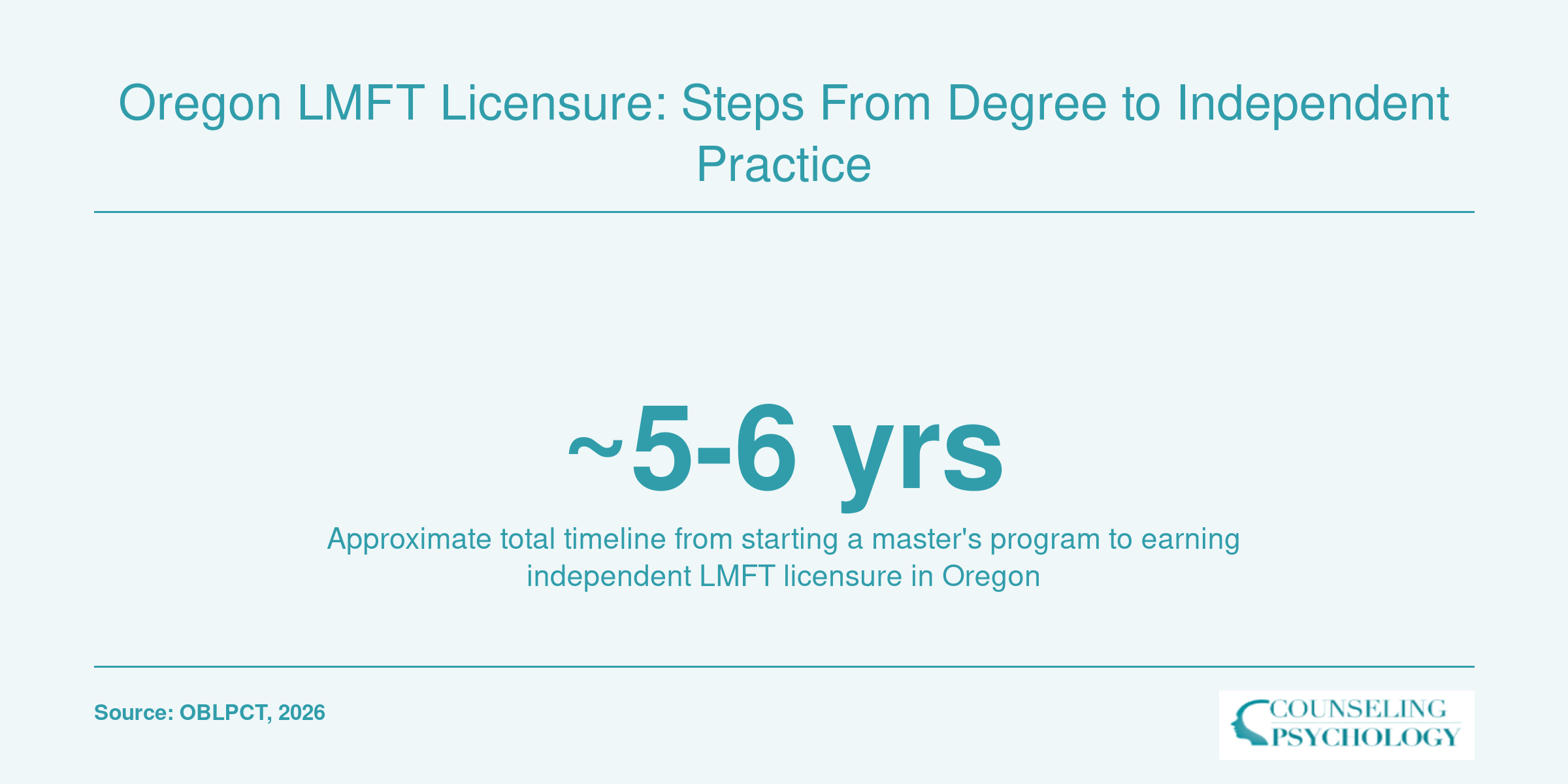
Becoming a fully licensed Marriage and Family Therapist in Oregon involves a structured sequence overseen by the Oregon Board of Licensed Professional Counselors and Therapists (OBLPCT). After completing a qualifying master's or doctoral degree, candidates must accumulate 1,900 supervised clinical hours (up to 400 of which may be earned before graduation), pass both the AMFTRB National Competency Exam and the Oregon Law and Rules Exam, and then apply for full LMFT licensure. From program start to independent practice, most candidates should expect the process to take roughly five to six years: two to three years for the degree plus a minimum of 36 months of post-degree supervised experience.
The Full Path to Becoming an LMFT in Oregon
How many hours of supervised experience does Oregon actually require after the master's degree, and what counts toward them? The short answer: 1,900 hours of direct client contact over a minimum of 36 months, with at least 750 of those hours spent working with couples and families. Here is how the full path unfolds.
Step 1: Earn a Qualifying Master's Degree
The foundation is a master's or doctoral degree in marriage and family therapy (or a closely related field) from a regionally accredited institution. Oregon's Board of Licensed Professional Counselors and Therapists (OBLPCT) expects coursework across the core MFT content areas: systemic and relational theory, human development across the lifespan, psychopathology and diagnosis, research methods, professional ethics and Oregon law, and supervised clinical practicum. Most COAMFTE-accredited programs build in roughly 700 practicum hours, including about 280 direct client contact hours, which can shorten the post-degree phase. Up to 400 pre-degree client contact hours can be applied toward the post-graduate total.
Step 2: Register as an LMFT Associate
Before seeing clients in a post-degree capacity, graduates register with OBLPCT as an LMFT Associate. Registration includes a fingerprint-based background check and an approved supervision contract. As an Associate, you can provide therapy independently of a degree program, diagnose, and bill under your supervisor, but you cannot practice without an active supervisor of record or represent yourself as a fully licensed LMFT.
Step 3: Complete Supervised Clinical Experience
The 1,900 direct client contact hours must accumulate over at least 36 months. For a deeper look at what counts across jurisdictions, see our guide to LMFT supervision hours. Supervision requirements scale with caseload:
- Lighter caseloads (under 46 client hours/month): 2 hours of supervision per month across at least 2 sessions.
- Heavier caseloads (46+ client hours/month): 3 hours of supervision per month.
- Format mix: At least 50% of supervision must be individual (or dyadic), and at least 25% must be in person. Group supervision is capped at 6 supervisees per group.
Supervisors must have at least 3 years of post-licensure experience and documented systemic training.
Step 4: Pass Both Required Exams
Candidates must pass the National MFT Examination administered by the AMFTRB and the Oregon Law and Rules Exam. Once both are passed and hours are approved, full LMFT licensure is granted and renews biennially with 40 continuing education hours, including required content in ethics (6 hours), cultural competency (4 hours), and suicide risk assessment (2 hours).
MFT Salary in Oregon: How LMFT Pay Compares to LPC and MSW
Choosing between an MFT, LPC, or MSW credential involves weighing more than just coursework preferences. Your long-term earning potential, job availability, and scope of practice all factor into the decision, and Oregon's compensation landscape offers some useful benchmarks for comparison.
Oregon LMFT Earnings Overview
Marriage and family therapists in Oregon earn a median annual wage of $79,890, according to the Bureau of Labor Statistics. This figure places Oregon LMFTs above the national median for the profession and reflects strong demand for systemic, family-focused clinical work across the state.
The wage range for Oregon MFTs spans considerably depending on experience, setting, and specialization:
- Entry-level (10th percentile): $59,770 annually
- Median: $79,890 annually
- Top earners (90th percentile): $137,950 annually
These figures suggest that LMFTs who develop niche expertise, build private practices, or move into supervisory roles can achieve six-figure compensation within the state.
How LPC and MSW Salaries Compare
Licensed professional counselors and social workers serve overlapping but distinct populations. In Oregon, mental health counselors (the category most closely aligned with LPCs) and clinical social workers both represent alternative pathways into the mental health workforce. Students exploring these alternatives can compare counseling programs in Oregon to evaluate how different credential tracks align with their career goals.
While Oregon-specific data for these credentials fluctuates year to year, national trends show that MFTs, LPCs, and clinical social workers often earn within similar ranges at the median level. The differences become more pronounced at the extremes. MFTs with specialized training in couples counselor roles, trauma-informed family work, or intensive outpatient settings frequently command higher rates in private practice than generalist counselors.
Social workers, particularly those in healthcare or administrative roles, may see different salary trajectories based on agency versus private sector employment. Oregon's robust community mental health infrastructure employs significant numbers of all three credential types, though MFTs remain a smaller share of the overall workforce.
Factors That Influence LMFT Pay in Oregon
Several variables shape where you land within the $59,770 to $137,950 range:
- Practice setting: Private practice typically offers higher hourly rates than agency work, though it requires building a client base and managing overhead costs.
- Geographic location: Portland-metro positions often pay more than rural placements, though cost-of-living adjustments narrow the effective difference.
- Specialization: LMFTs trained in evidence-based modalities for couples, eating disorders, or complex family trauma can charge premium rates.
- Supervision status: Independently licensed therapists earn more than associates still accruing supervised hours.
Oregon's LMFT compensation reflects both the state's investment in mental health services and the specialized training MFT programs provide. For students weighing credential pathways, these salary benchmarks offer a concrete starting point for long-term financial planning.
As of late 2025, more than 1.3 million Oregonians live in federally designated Mental Health Professional Shortage Areas, and the state needs an estimated 68 additional mental health practitioners to close the gap. This workforce shortage underscores the strong career outlook for new LMFTs entering practice across Oregon.
Specializations and Concentrations at Oregon MFT Programs
Some Oregon MFT programs build specialization directly into the curriculum, while others leave it to you to craft a focus through electives and certificate add-ons. Knowing which model a program uses can shape both your training experience and your career trajectory after graduation.
Formal Concentrations Across Oregon Programs
Among the ranked programs, Oregon Institute of Technology stands out for offering three distinct concentrations: Medical Family Therapy, Substance Use Disorder Treatment, and Integrated Behavioral Healthcare. These tracks prepare graduates for specific agency and healthcare settings where demand is high, particularly in rural and underserved communities. Lewis & Clark College lists an Addictions Treatment concentration within its MA in Marriage, Couple, and Family Therapy, which aligns well with Oregon's ongoing need for clinicians trained in co-occurring mental health and substance use disorders.
The University of Oregon offers a Spanish Language Specialization option within its Couples and Family Therapy program, a valuable credential for therapists who want to serve Oregon's growing Spanish-speaking population.
Programs Without Formal Concentrations
George Fox University, Portland State University, and Western Seminary do not list named concentrations in the same way. That does not mean students lack options. George Fox, for example, prepares students for dual LPC and LMFT licensure (learn more about becoming a licensed professional counselor), and its curriculum integrates faith and spirituality. Western Seminary includes coursework in child and adolescent therapy, human sexuality, and psychopharmacology, giving students exposure to multiple specialty areas even without a formal track. Portland State emphasizes multicultural counseling and community-based clinical training.
If a program does not advertise concentrations, ask the admissions team how elective courses, practicum site selection, and certificate add-ons can help you build a specialty. The clinical internship placement alone can function as de facto specialization when chosen strategically.
The Pacific Northwest Differentiator
Oregon's natural landscape has given rise to ecopsychology and wilderness therapy approaches that are harder to find in programs elsewhere. While not every ranked program formalizes this into a concentration, the Pacific Northwest clinical community offers practicum sites and continuing education opportunities in nature-based therapeutic modalities. Students drawn to this niche should explore whether a program's externship network includes wilderness therapy organizations or ecotherapy practitioners.
Why Specialization Matters for Your Career
Niche training can meaningfully affect your earning potential and professional identity. Therapists with focused expertise in areas like medical family therapy, addictions, or sex therapy often command higher private-practice fees and face less competition for specialized agency roles. Even if your program does not hand you a named concentration, the combination of targeted electives, a well-chosen practicum, and post-licensure continuing education can position you as a specialist. The key is to start thinking about your clinical focus early, ideally during the application process, so you can evaluate whether a program's resources align with the career you want to build.
MFT Job Outlook and Workforce Demand in Oregon
Oregon's job market for marriage and family therapists is poised for robust growth over the next decade, driven by both national trends and state-specific mental health priorities. The Bureau of Labor Statistics projects that employment of marriage and family therapists nationwide will grow 13 percent from 2024 to 2034, a pace classified as much faster than average for all occupations. This translates to approximately 7,700 annual job openings nationally, reflecting both new positions and replacements for therapists who retire or leave the field. For Oregon MFT graduates, these figures signal strong demand, but state-level factors amplify the opportunity even further.
Oregon's Behavioral Health Workforce Crisis
Oregon has made expanding mental health access a legislative and policy priority in recent years, yet the state continues to face significant shortages of licensed providers. The Oregon Health Authority's Behavioral Health Workforce Initiative and the expansion of the 988 crisis line infrastructure have underscored the urgency of building capacity, particularly outside the Portland metro area. Health Resources and Services Administration (HRSA) shortage designations identify large swaths of rural and frontier Oregon as underserved, where residents often wait weeks or months for an appointment with a licensed therapist. If you are asking whether Oregon has good mental health services, the honest answer is that access has improved through policy investments, but gaps remain acute in many counties. For new LMFTs willing to serve these communities, demand is exceptionally high.
Telehealth Expands Where You Can Practice
The statewide expansion of telehealth reimbursement and licensure portability has reshaped how Oregon therapists deliver care. LMFTs can now maintain a practice base in Portland, Eugene, or Bend while serving clients in remote counties, making rural service viable without relocation. This flexibility has proven especially valuable for therapists specializing in couples work or trauma-informed care, where in-person options may be sparse. State regulations now allow Oregon-licensed therapists to provide synchronous video services to clients anywhere in the state, broadening both your potential caseload and your impact.
What the Demand Means for Your Career
For graduates entering the field in 2026 and beyond, these converging trends translate into strong job security, diverse practice settings, and leverage in negotiating salaries and benefits. Community mental health centers, integrated primary care clinics, school-based programs, and private practices are all actively recruiting LMFTs. If you are weighing the broader landscape of careers in counseling, the MFT credential positions you especially well in Oregon's current market. Complete a COAMFTE-accredited program and pursue supervised hours strategically, and you will enter a labor market where your credentials are in high demand.