
What you’ll learn in this article…
- Annual in-state tuition for certificate programs near Little Rock ranges from roughly $7,322 to $17,188.
- Arkansas requires a qualifying master's degree before a post-master's certificate can count toward LPC licensure.
- Even fully online programs mandate supervised clinical hours at approved Little Rock area practicum sites.
- The national median annual wage for mental health counselors reached $59,190 in 2024, per BLS data.
Two paths now lead into Arkansas counseling licensure: a full master's degree in clinical mental health counseling, or a post-master's graduate certificate layered onto an existing degree. The difference is not trivial. A 60-credit master's prepares you from the ground up and unlocks licensure eligibility directly, while a 15- to 21-credit certificate assumes you already hold a qualifying graduate degree and are filling specific gaps in coursework or clinical hours required by the Arkansas Board of Examiners in Counseling.
Demand for licensed professional counselors has climbed steadily across Arkansas, driven by Medicaid expansion, school-based mental health initiatives, and heightened awareness of behavioral health needs. Hospitals, community mental health centers, and private practices in Little Rock, Conway, and surrounding counties actively recruit LPCs, yet many candidates face credentialing delays when their existing degrees do not align precisely with Arkansas's 60-credit coursework rule. That mismatch is where post-master's certificates have become tactically useful.
Programs near Little Rock range from campus-intensive formats at Henderson State University and the University of Central Arkansas to fully online options at Southern Arkansas University and the University of Arkansas at Little Rock. Tuition for these certificates starts below $7,500 and climbs to just under $18,000, a fraction of full master's-level investment. Many are designed for working counselors holding provisional licenses or out-of-state credentials who need Arkansas-specific content without repeating a full degree. Candidates exploring MFT programs in Arkansas as a related pathway will find that the same affordability trend holds across the state's graduate counseling landscape.
Best Cost-Effective Clinical Mental Health Counseling Certificate Programs Near Little Rock
Arkansas offers a surprisingly broad set of clinical mental health counseling programs, from focused graduate certificates to full master's degrees, many of them priced well below the national average for graduate education. The programs below are ranked by affordability using net price data so Little Rock residents can quickly compare realistic out-of-pocket costs. Note that most of these are master's-level programs rather than standalone certificates; only one institution currently offers a dedicated graduate certificate in clinical mental health counseling.
- Net price after financial aid
- Program format and flexibility
- Arkansas licensure alignment
- Institution-wide graduation rate
- Clinical training depth
- Independent program research
- Internal program database
- College Scorecard graduate earnings — collegescorecard.ed.gov
- NCES-IPEDS federal institutional data — nces.ed.gov

Arkansas State University
Arkansas State University stands out as the only school on this list offering a standalone Graduate Certificate in Clinical Mental Health Counseling, making it uniquely cost-effective for professionals who already hold a graduate degree but need additional coursework for Arkansas licensure or clinical specialization. The 15-credit-hour certificate is purpose-built to fill gaps between prior graduate training and Arkansas Board of Examiners requirements, and prior coursework not counted toward a previous degree may be applied with advisor approval. A-State's strong retention rate and accessible admissions give working counselors a practical, focused path to upgrade their credentials without repeating a full master's program.
- 15 credit hours built around Arkansas licensure gaps
- Designed for holders of a graduate counseling degree
- Prior uncounted coursework may transfer with approval
- Campus-based learning at the Jonesboro campus
- Curriculum drawn from the Mental Health Counseling track
- Admission tied to Ed.S. degree criteria in Psychology and Counseling
- Flexible scheduling for working professionals
Graduate Certificate in Clinical Mental Health Counseling — On-Campus

Arkansas Tech University
Arkansas Tech University pairs one of the lowest net prices among Arkansas public schools with a 60-hour hybrid master's program explicitly structured to satisfy every Arkansas Board of Examiners requirement for Licensed Associate Counselor and, ultimately, Licensed Professional Counselor status. Students choose between a Clinical Mental Health track and a Rehabilitation Counseling track, the latter preparing them for the Certified Rehabilitation Counselor exam. Evening course scheduling and 700 hours of mentored clinical experience make this a strong option for Little Rock area residents willing to commute to Russellville or take advantage of the hybrid format. The university also extends in-state tuition rates to students from bordering states.
- 60-hour hybrid program with evening course options
- 700 hours of professionally mentored practicum and internship
- Meets all Arkansas Board requirements for LAC and LPC
- Second track available in Rehabilitation Counseling
- In-state tuition extended to border-state residents
- Graduate assistantships and financial aid available
- Licensure exam preparation integrated into curriculum
- Social justice and advocacy skills emphasized
Master's in Counseling, Clinical Mental Health Concentration — Hybrid

University of Central Arkansas
Located just 30 minutes north of Little Rock in Conway, the University of Central Arkansas delivers a campus-based 60-semester-hour M.S. in Mental Health Counseling that prepares graduates for private practice, community agencies, and hospital settings across the state. The program is tightly aligned with Arkansas licensure standards and includes a full-semester internship. A 15-to-1 student-faculty ratio supports close mentoring during clinical training. While it carries a higher net price than A-State or ATU, UCA's proximity to Little Rock and solid median graduate earnings make it a practical investment for Central Arkansas residents.
- 60 semester hours of licensure-aligned coursework
- Full-semester internship in clinical settings
- Campus-based program in Conway, near Little Rock
- GRE scores and personal statement required for admission
- February 1 application deadline
- Training in counseling theories and ethical standards
- Prepares graduates for private practice or agency roles
Mental Health Counseling (M.S.) — On-Campus

Southern Arkansas University
Southern Arkansas University's fully online M.S. in Clinical and Mental Health Counseling removes geographic barriers entirely, making it one of the most accessible options for Little Rock students who cannot relocate. The program emphasizes evidence-based practices and clinical competence across diverse populations. Beginning Fall 2026, SAU is transitioning to a cohort enrollment model, meaning new students will progress through a structured sequence together, which can improve accountability and time to completion. With a relatively low median graduate debt load and a net price under $15,000, SAU offers solid value for budget-conscious learners.
- Fully online format, no relocation needed
- New cohort enrollment model launching Fall 2026
- Structured course sequence for predictable scheduling
- Evidence-based therapeutic approach training
- Designed to meet Arkansas licensure requirements
- Comprehensive mental health assessment curriculum
- Accessible for working professionals statewide
Master of Science in Clinical and Mental Health Counseling — Online
University of Central Arkansas
Located just 30 minutes north of Little Rock in Conway, the University of Central Arkansas delivers a campus-based 60-semester-hour M.S. in Mental Health Counseling that prepares graduates for private practice, community agencies, and hospital settings across the state. The program is tightly aligned with Arkansas licensure standards and includes a full-semester internship. A 15-to-1 student-faculty ratio supports close mentoring during clinical training. While it carries a higher net price than A-State or ATU, UCA's proximity to Little Rock and solid median graduate earnings make it a practical investment for Central Arkansas residents.
- 60 semester hours of licensure-aligned coursework
- Full-semester internship in clinical settings
- Campus-based program in Conway, near Little Rock
- GRE scores and personal statement required for admission
- February 1 application deadline
- Training in counseling theories and ethical standards
- Prepares graduates for private practice or agency roles
Mental Health Counseling (M.S.) — On-Campus

University of Arkansas at Little Rock
As the only institution on this list physically located in Little Rock, UA Little Rock offers the clearest geographic advantage for local students, especially when it comes to securing practicum and internship placements at Central Arkansas mental health agencies. The 60-credit-hour M.A. in Counseling is delivered entirely online, giving students flexibility without sacrificing access to local clinical sites. The curriculum emphasizes ethical practice, human rights, and professionalism. A 13-to-1 student-faculty ratio supports individualized attention, though the institution-wide graduation rate is lower than some peers on this list.
- 60 credit hours delivered fully online
- Based in Little Rock for local practicum access
- Prepares for LPC and clinical mental health licensure
- Required practicum and internship components
- Emphasis on ethical practice and human rights
- 13-to-1 student-faculty ratio
- Designed for careers in agencies, hospitals, and private practice
Master of Arts in Counseling, Clinical Mental Health Counseling — Online

University of Arkansas
The University of Arkansas in Fayetteville brings the highest institution-wide graduation rate on this list (70.5%) and CACREP-accredited programming across multiple degree levels. The M.S. in Counseling with a Clinical Mental Health Counseling concentration prepares graduates for collegiate, community, governmental, and private agency settings, and the campus also houses a Ph.D. in Counselor Education and Supervision for those who eventually want to teach or supervise. For Little Rock residents, Fayetteville is roughly a three-hour drive, so this is best suited to students willing to relocate or commute periodically. In-state tuition is higher than other public options on this list.
- CACREP-accredited campus-based program
- Prepares for Arkansas LPC licensure
- Covers individual and group counseling techniques
- Cultural responsiveness and ethical practice emphasized
- Assessment, testing, and treatment planning training
- Vertical pathway to Ph.D. in Counselor Education available
- Housed in the same Counselor Education unit
- Campus-based at Fayetteville
- Three concentration options within the broader program
- Aligned with Arkansas licensure standards
- Focus on evidence-based interventions
- Comprehensive counseling skills training
- Nationally accredited doctoral program
- Prepares for leadership, teaching, and supervision roles
- Focus on equity and diversity in counselor education
- Campus-based at Fayetteville
- Comprehensive research and program evaluation curriculum
Master of Science in Counseling, Clinical Mental Health Counseling — On-Campus
Graduate Certificate in Mental Health Counseling — On-Campus
Doctor of Philosophy in Counselor Education and Supervision — On-Campus

John Brown University
John Brown University's CACREP-accredited M.S. in Counseling integrates a Christ-centered perspective with rigorous clinical training. At $600 per credit hour for 60 credits, students can estimate total tuition around $36,000, though the institution's net price of roughly $20,400 reflects available aid. A hybrid format mixes online coursework with in-person components, and the program boasts a 100% clinical placement rate. No GRE is required for admission, lowering a common barrier for career changers. JBU's 71.8% institution-wide graduation rate is the highest among private schools on this list.
- 60 credit hours in hybrid online and in-person format
- CACREP accredited (in-person track)
- No GRE requirement for admission
- 100% clinical placement rate reported
- $600 per credit hour tuition structure
- Christ-centered counseling philosophy
- Multiple concentration options available
- Prepares for LPC licensure in Arkansas
Master of Science in Counseling, Clinical Mental Health Counseling — Hybrid

Harding University
Harding University in Searcy, about an hour northeast of Little Rock, offers a 60-hour CACREP-accredited M.S. in Clinical Mental Health Counseling grounded in Christian values and real-world application. The hybrid delivery model blends campus sessions with flexible components, and students complete both practicum and internship hours as part of the curriculum. An Ed.S. in Counseling is also available for those who want to continue beyond the master's level. The 13-to-1 student-faculty ratio supports personalized mentoring, and the 86% retention rate signals strong student satisfaction.
- CACREP-accredited 60-credit-hour program
- Hybrid format with campus and flexible components
- Christian values integrated throughout curriculum
- Practicum and internship experiences included
- Ed.S. in Counseling available for further study
- 13-to-1 student-faculty ratio
- Technology-assisted counseling elective offered
- Prepares for LPC licensure in Arkansas
M.S. in Clinical Mental Health Counseling — On-Campus

Ouachita Baptist University
Ouachita Baptist University's M.A. in Counseling with a Clinical Mental Health Counseling concentration uses a low-residency model: four on-campus intensives supplemented by online and synchronous coursework. At 63 credit hours, it is slightly longer than most 60-hour programs, and the university lists an estimated total program cost of approximately $36,733, offering transparency that helps students plan. A 3.0 GPA is required for admission, but no prior psychology experience is necessary. The program aligns with CACREP standards and integrates a biblical worldview, making it a fit for students who value faith-informed training.
- 63-credit low-residency hybrid program
- Four on-campus intensives plus online coursework
- Total estimated program cost around $36,733
- 3.0 GPA required, no prior psych experience needed
- Aligns with CACREP standards
- Biblical worldview integrated into clinical training
- Prepares for LPC licensure in Arkansas
- Synchronous and asynchronous class options
Master of Arts in Counseling, Clinical Mental Health Counseling — Hybrid

Henderson State University
Henderson State University's CACREP-accredited M.S. in Clinical Mental Health Counseling is a 60-semester-hour campus program in Arkadelphia that emphasizes cultural competence and diverse population service. Graduates are prepared for both Arkansas LPC licensure and National Certified Counselor recognition. The program also positions students for doctoral study if they choose to advance further. Henderson State has the lowest sticker-price tuition among public schools on this list, but its net price is the highest in that group, reflecting differences in institutional aid distribution. The 14-to-1 student-faculty ratio supports close faculty interaction.
- 60-semester-hour CACREP-accredited program
- Campus-based at Arkadelphia
- Cultural competence training central to curriculum
- Prepares for LPC licensure and NCC credential
- Doctoral study readiness built into outcomes
- 14-to-1 student-faculty ratio
- Covers human behavior, development, and treatment modalities
Master of Science in Clinical Mental Health Counseling — On-Campus
Certificate vs. Master's Degree: Which Path Is Right for You?
More students are entering the counseling field with a patchwork of credentials, and understanding what each credential actually does for your career is more important than ever. In Arkansas, the distinction between a graduate certificate and a master's degree is not just academic; it carries real consequences for licensure eligibility.
What the Two Paths Look Like
A graduate certificate in mental health counseling typically runs six to eighteen months, covers a focused set of clinical courses, and costs considerably less than a full degree program. A master's degree, by contrast, takes two to three years, requires supervised practicum and internship hours, and covers the full breadth of counseling theory, diagnosis, ethics, and multicultural practice.
Here is how the two options compare across the dimensions that matter most:
- Time to completion: Certificates often finish in one to two semesters. Master's programs typically require two to three years of full-time study.
- Cost: Certificate programs carry lower tuition overall, though per-credit costs vary. Master's programs represent a larger financial commitment.
- Licensure eligibility: In Arkansas, a standalone graduate certificate in clinical mental health counseling does not satisfy the education requirement for Licensed Professional Counselor (LPC) licensure.1 A master's degree in counseling or a related field is the baseline the Arkansas Board of Examiners in Counseling requires.
- Career flexibility: A master's degree opens the door to independent licensure and a wider range of employment settings. A certificate alone limits those options significantly in this state.
- Depth of clinical training: Master's programs include supervised practicum and internship components that build hands-on competency. Certificates vary widely in how much clinical experience they incorporate.
- Admissions prerequisites: Graduate certificates in this field typically require an applicant to already hold a master's degree.1 They are designed as post-master's specializations, not as entry points into the profession.
Who Each Path Serves
The graduate certificate makes the most sense for someone who already holds a master's in counseling or a closely related field and wants to sharpen expertise in a specific area, such as trauma, addiction counseling certificate online programs, or clinical mental health. The University of Arkansas, for example, positions its certificate as a post-master's credential.1
The master's degree is the right starting point for career changers coming from outside the field, individuals who want to pursue LPC licensure in Arkansas, and anyone planning to work in a clinical role without an existing graduate credential.
If you are still exploring whether counseling is the right fit before committing to a full degree, some community college or continuing education programs offer introductory coursework that can help you gauge your interest without the cost of a graduate program. Those options, however, are distinct from the counseling certificate programs discussed throughout this article.
Questions to Ask Yourself
How Much Do These Certificate Programs Cost?
One of the most common questions prospective students ask is: how much does a counseling degree or certificate cost? Across the programs near Little Rock featured here, annual in-state tuition ranges from roughly $7,322 to $17,188, while median graduate debt spans $18,750 to $26,500. Keep in mind that the net price figures below are institution-wide averages drawn from federal data, not program-specific totals. Your actual out-of-pocket cost will depend on your financial aid package, residency status, and whether you enroll full or part time. Program-level earnings and debt data are not yet available for these specific certificate and counseling tracks, so the median debt column reflects each school's overall graduate borrowers.
| Institution | In-State Tuition | Out-of-State Tuition | Avg. Net Price | Median Graduate Debt | Sector |
|---|---|---|---|---|---|
| Arkansas State University | $7,322 | $13,028 | $12,366 | $20,500 | Public |
| Arkansas Tech University | $7,670 | $7,670 | $12,970 | $21,000 | Public |
| Southern Arkansas University | $7,380 | $10,656 | $14,027 | $18,750 | Public |
| University of Central Arkansas | $7,446 | $12,985 | $16,511 | $20,346 | Public |
| University of Arkansas at Little Rock | $7,915 | $15,547 | $17,248 | $22,000 | Public |
| University of Arkansas | $12,470 | $30,892 | $18,209 | $21,500 | Public |
| Henderson State University | $7,497 | $9,855 | $23,405 | $19,500 | Public |
| John Brown University | $14,880 | $14,880 | $20,397 | $21,250 | Private |
| Harding University | $14,572 | $14,572 | $22,130 | $26,500 | Private |
| Ouachita Baptist University | $17,188 | $17,188 | $22,409 | $21,050 | Private |
Related Articles
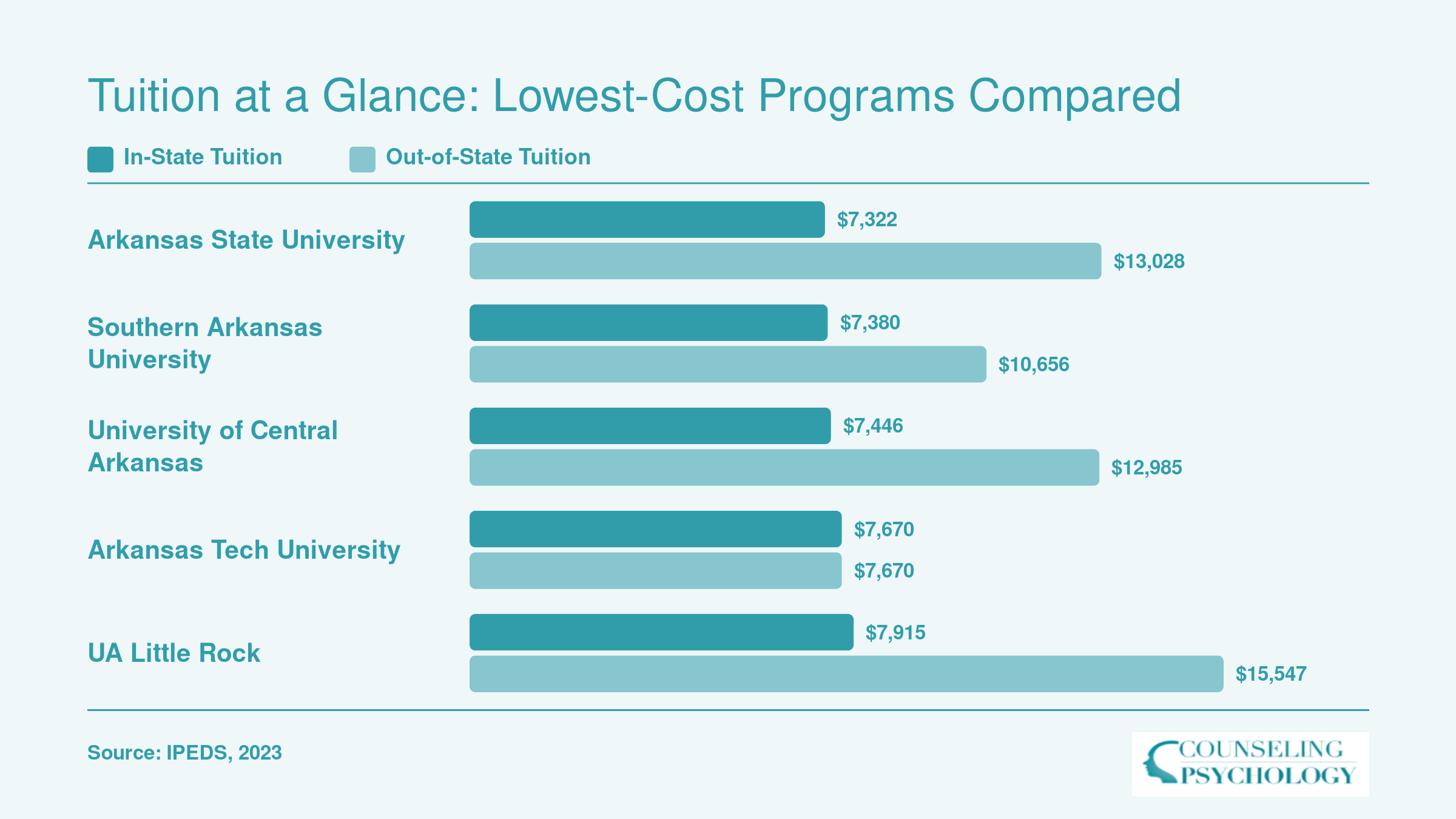
Tuition at a Glance: Lowest-Cost Programs Compared
These five Arkansas public institutions offer the most affordable graduate-level tuition for clinical mental health counseling programs near Little Rock. Keep in mind that net price after financial aid, scholarships, and assistantships may be significantly lower than the sticker figures shown here.
Arkansas Licensure Pathway: From Certificate to LPC
Graduate certificates in clinical mental health counseling now serve two distinct roles in the Arkansas licensure landscape: some extend a master's-prepared counselor's credentials into a specialized clinical track, while others attempt to fill in coursework gaps for candidates whose degrees fall short of board requirements. Understanding which type you're pursuing determines whether the certificate moves you closer to licensure or simply enhances an already qualifying credential.
Education: Master's Degree and Credit Requirements
The Arkansas Board of Examiners in Counseling requires a master's or higher degree in counseling or a closely related field, totaling at least 60 graduate semester hours, for Licensed Professional Counselor (LPC) status.1 A stand-alone certificate program does not replace this foundational degree. However, if your master's was earned in a related discipline like social work, psychology, or marriage and family therapy but fell short of the 60-credit threshold or lacked required counseling coursework (diagnosis, ethics, group counseling, or career development, for example), a post-master's clinical mental health counseling certificate can supplement your transcript.2 Before enrolling, verify with the Board that the specific courses in the certificate program address your particular coursework deficiencies.
Practicum and Internship Hours
During your qualifying master's program or post-master's certificate, you must complete 100 practicum hours and 600 internship hours (both counting toward the 9-credit practicum and internship requirement). These hours provide direct client contact under supervision and must meet the Board's standards for setting, supervision ratio, and documentation. Many post-master's certificate programs near Little Rock integrate these clinical placements into the curriculum, but confirm ahead of enrollment that the hours will satisfy Arkansas standards, not just the university's internal benchmarks.
Supervised Post-Degree Experience
After earning your 60-credit degree, you must accrue 3,000 hours of supervised professional experience over a minimum of three years. This phase typically involves working in a clinical setting under a board-approved licensed supervisor who provides one hour of face-to-face supervision for every 20 hours of client contact. Accumulating fewer than 20 client-contact hours per week extends your timeline; the Board enforces a six-month minimum duration to prevent rushed credential stacking. If you are still exploring the broader career path, our guide on how to become a mental health counselor offers a helpful overview of the steps involved.
Examination
Once your supervised hours are logged and verified, you sit for one of the National Board for Certified Counselors (NBCC) exams: the National Counselor Examination (NCE) or the National Clinical Mental Health Counselor Examination (NCMHCE). Some candidates also face an oral component administered by the state Board. Passing scores, combined with completed coursework and clinical hours, unlock LPC licensure and full independent practice authority in Arkansas.
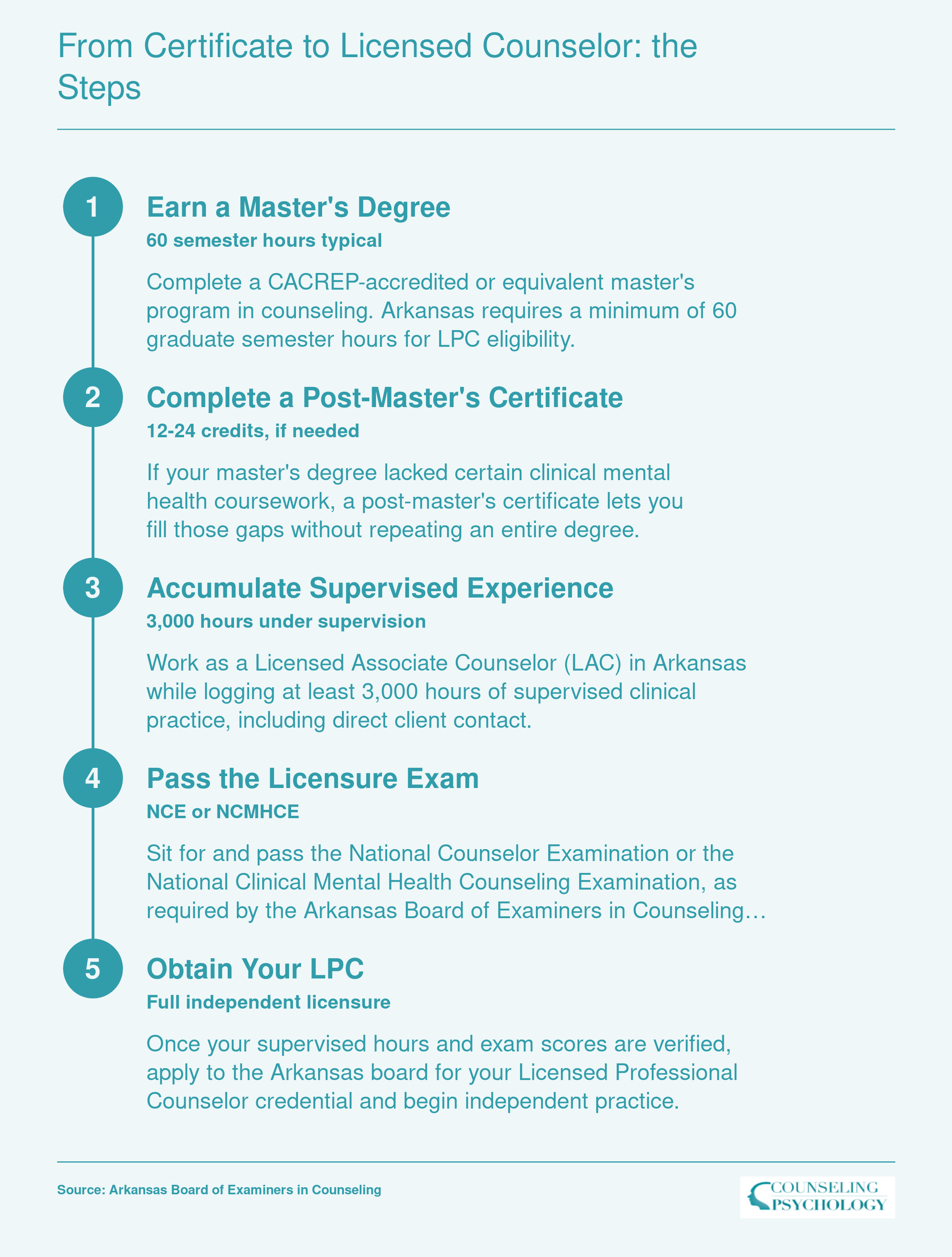
From Certificate to Licensed Counselor: The Steps
This credentialing ladder assumes you already hold a qualifying master's degree in counseling or a closely related field and are using a post-master's certificate to fill content gaps or meet specific coursework requirements for Arkansas licensure.
Curriculum and Clinical Hours: What to Expect
A post-master's certificate is not a mini master's degree, and it is not a quick CEU bundle either. It sits between the two, designed to fill specific gaps for counselors who already hold a counseling master's programs online but need additional coursework or clinical hours to qualify for licensure in Arkansas or another state.
Credit Hours and Core Coursework
Most post-master's clinical mental health counseling certificates run 9 to 15 credit hours.1 Johns Hopkins University requires 15 credits2, Eastern Michigan University 133, and West Chester University and the University of Tennessee at Chattanooga both land at 12.4 Antioch University builds an individualized plan in the 9 to 15 credit range based on what each applicant already completed at the master's level.1
Expect coursework drawn from the CACREP clinical mental health core:
- Psychopathology and Diagnosis and Treatment of Mental Disorders (a near-universal requirement)5
- Counseling theories and techniques
- Crisis and trauma intervention
- Professional ethics and legal issues
- Group counseling and multicultural counseling
Clinical Hours and Fieldwork
This is where certificate programs vary the most. Some programs are coursework-only because the student already logged practicum hours during their master's. Others build in supervised fieldwork. Troy University requires a 100-hour practicum plus a 300-hour internship.6 Johns Hopkins goes further with 600 internship hours.2 Across the field, clinical hour requirements range roughly from 100 to 600 hours, and completion timelines stretch from 12 to 36 months depending on pacing.
Specialization Tracks
Common focus areas include trauma-informed care, addiction counseling, and child and adolescent counseling.4 These tracks usually add two or three targeted electives rather than a separate credential.
Practicum Sites Near Little Rock
Online and hybrid certificates still require in-person clinical hours. Students in central Arkansas typically arrange placements at community mental health centers, UAMS-affiliated clinics, substance use treatment agencies, or school-based behavioral health programs. The host program approves the site and supervisor in advance, so prospective students exploring masters in clinical mental health counseling in the state should confirm placement support before enrolling.
Even fully online clinical mental health counseling certificate programs require supervised clinical hours at an approved local site. In the Little Rock area, community mental health centers, hospitals, and private practices often serve as practicum placements, making it easier to fulfill requirements without relocating.
Admission Requirements and Application Tips
Getting into a post-master's certificate program is generally more straightforward than a traditional master's application, but overlooking a single requirement can stall your enrollment by a full semester. Knowing exactly what each program expects will help you avoid delays and start closing licensure gaps sooner.
Typical Prerequisites
Most clinical mental health counseling certificate programs near Little Rock require the following baseline qualifications:
- Completed master's degree: You will need a master's in counseling, psychology, social work, or a closely related field from a regionally accredited institution. Arkansas State University, for example, accepts applicants with a relevant master's in counseling or psychology, while Adler Graduate School specifies a master's in counseling or a related discipline.12
- Minimum GPA of 3.0: This threshold is consistent across virtually every post-master's certificate program, both in Arkansas and nationally.3 If your graduate GPA falls slightly below 3.0, some programs allow conditional admission with supporting materials such as strong professional references or relevant clinical experience.
- Professional references: Two to three letters from supervisors, faculty, or licensed clinicians who can speak to your counseling competence and professional conduct are standard.
- No standardized test scores: Nationally, post-master's certificate programs in clinical mental health counseling have not required the GRE or any other entrance exam during the 2024 to 2026 admission cycles.3
Background Checks and Insurance
Before you begin any clinical placement, expect additional clearance steps. Both the University of Central Arkansas and Adler Graduate School require criminal background checks.42 Arkansas State University folds this into its Ed.S. admission criteria, which certificate applicants must also satisfy.1 Many programs additionally require proof of professional liability insurance before you set foot in a practicum site. Policies covering student clinicians are relatively affordable and often available through professional organizations like the American Counseling Association.
Practical Application Tips
A few deliberate moves during the application process can make a meaningful difference:
- Request transcripts early. Graduate transcript processing can take several weeks, especially if your master's institution requires a written request. Start this at least six weeks before the application deadline.
- Write a focused professional statement. Admissions committees want to see that you understand which specific coursework or clinical hours you still need for licensure. Tie your goals directly to the program's curriculum rather than writing a generic essay about your passion for helping others.
- Verify licensure alignment. Before submitting an application, cross-reference the certificate program's course offerings with the Arkansas Board of Examiners in Counseling requirements. Confirm that the credits you plan to earn will actually fill the gaps standing between you and your Licensed Professional Counselor credential.
A Note on Selectivity
Admission selectivity varies widely by institution. At the institution level, Arkansas State University's overall admissions rate sits around 82%, while the University of Central Arkansas admits roughly 89% of applicants. These figures reflect undergraduate and general graduate admissions rather than certificate-specific acceptance rates, but they signal that neither school is highly restrictive at the institutional level. Certificate programs tend to be smaller and more targeted, so meeting the stated prerequisites typically positions you well for acceptance. If your master's degree was in a related field such as marriage and family therapy, be sure to confirm that the program considers your discipline eligible before applying.
Career Outcomes and Earnings After a Counseling Certificate
The national median annual wage for mental health counselors stood at $59,190 in 2024, with top earners surpassing $98,000.1 While the most recent program-level earnings data for the certificate programs ranked here is not yet published, the overall institutional median earnings of all alumni at these schools range from roughly $41,766 to $58,191 ten years after enrollment, a useful benchmark of long-term earning potential in the region.
Arkansas Salary Snapshot
Arkansas posts a state median of $49,990, reflecting the lower cost of living compared to national figures. Within the state, the bottom 10% of counselors earn around $31,600, while the top 10% exceed $102,400.2 National demand only strengthens the outlook: the Bureau of Labor Statistics projects 17% job growth for mental health counselors through 2034, translating to over 48,000 annual openings nationwide.1
Counselor vs. Therapist: Who Earns More?
The terms "counselor" and "therapist" overlap heavily, but earnings differ by license type. Licensed Professional Counselors (LPCs) and Licensed Marriage and Family Therapists (LMFTs) typically earn comparable median salaries in the $50,000 to $60,000 range, though location and experience cause wide variation. Clinical psychologists command higher medians, often above $80,000, while psychiatrists, who attend medical school, can earn over $200,000. For a deeper breakdown by degree level and specialty, see our counselor salary guide. For those holding a clinical mental health counseling certificate and pursuing LPC licensure, the earning path is solidly middle-class and grows with experience and specialization.
Arkansas Workforce Demand
Arkansas mirrors the national trend of a mental health workforce shortage, particularly in rural areas. State agencies have designated mental health professions as high-need, and many counties report limited access to licensed counselors. This demand creates strong job security for certificate holders who complete their supervised hours and pass the National Counselor Examination. Employers range from community mental health centers and substance abuse clinics to private group practices and telehealth platforms, with the latter expanding reach to underserved populations across the state.
Frequently Asked Questions
Below are answers to the most common questions prospective students ask about clinical mental health counseling certificate programs near Little Rock, Arkansas. Each response reflects current Arkansas licensure rules and program details as of 2026.