
What you’ll learn in this article…
- Most programs require only 12 to 24 credit hours, costing a fraction of a full master's degree.
- CACREP accredited coursework carries more weight with state licensing boards than regionally accredited credits alone.
- Certificate credits can fill specific gaps needed for LPC licensure, but state requirements vary significantly.
- The BLS projects strong demand for counseling professionals, favoring graduates with focused, specialized credentials.
Demand for licensed counselors is rising sharply: the Bureau of Labor Statistics projects employment of substance abuse, behavioral disorder, and mental health counselors to grow 18 percent through 2033, well above the average for all occupations. For career changers without a counseling background and for post-master's clinicians who need additional coursework to meet state licensure requirements, an online graduate certificate offers a direct, lower-cost alternative to enrolling in a second full counseling degree program.
A graduate certificate in counseling typically runs 12 to 24 credit hours, covers a defined skill set or specialization, and can often be completed in one to two years while working. That compares to 48 to 60 credit hours for a full master's in counseling. The shorter format matters financially and practically, but it also creates a real credential tension: not every certificate aligns with state licensure boards, and not every program carries the accreditation status that licensing bodies recognize.
Best Online Graduate Certificate in Counseling Programs
The following online graduate certificate in counseling programs are ordered by a composite quality score that accounts for institutional graduation rates, net price, and program outcomes. This is not a cheapest or highest-earning list; it reflects a balanced view of value and academic quality across schools that offer counseling certificates with online or hybrid delivery. Note that graduation rates cited below are institution-wide figures reported to IPEDS, not specific to any individual certificate program.
- Institutional graduation rate
- Net price after aid
- Program delivery and format
- Graduate debt levels
- Overall outcome indicators
- NCES-IPEDS federal institutional data — nces.ed.gov
- College Scorecard graduate earnings — collegescorecard.ed.gov
- Internal program database
- Independent program research

University of Florida
The University of Florida pairs a flagship public university reputation with a focused online Graduate Certificate in Addiction and Recovery housed within its College of Medicine. The program is designed around Florida's Certified Addiction Professional (CAP) and Certified Addiction Counselor (CAC) credential requirements, and coursework is taught by practicing addiction clinicians from the UF Health system. With a net price of roughly $6,541 and an institution-wide graduation rate of 91.1%, UF offers strong academic credibility at a comparatively low cost. The certificate also functions as a stackable credential for students considering further graduate study in mental health counseling, social work, or medicine.
- Fully online, 18 credit hours at $590 per credit
- One-year completion timeline with flexible pacing
- Aligned with Florida CAP and CAC exam requirements
- Covers neurobiology of addiction and professional ethics
- Stackable into health-related graduate programs
- No residency requirement
- Taught by UF Health practicing addiction clinicians
Graduate Certificate in Addiction and Recovery — Online

University of Georgia
The University of Georgia offers an online Graduate Certificate in Substance Use Counseling built to satisfy the educational standards for Georgia's Certified Advanced Alcohol and Drug Counselor (CAADC) credential. A multidisciplinary faculty drawn from counseling, social work, psychology, and public health co-teaches the 12-semester-hour curriculum, giving students a broad, interprofessional view of addiction care. The school's institution-wide graduation rate stands at 89.7%, and the net price averages $13,936. This certificate is specifically structured as an add-on specialization for professionals who already hold or are completing a clinical graduate degree that is license-eligible in Georgia.
- Fully online, 12 semester hours
- Maps to Georgia CAADC educational standards
- Multidisciplinary faculty across counseling and public health
- Evidence-based treatment and trauma assessment coursework
- Designed for students with existing clinical graduate degrees
- Flexible scheduling for working professionals
Graduate Certificate in Substance Use Counseling — Online

University of South Florida
The University of South Florida's Graduate Certificate in Marriage and Family Therapy is a 15-credit-hour hybrid program designed for mental health professionals who want systemic therapy training without committing to a full MFT degree. Rooted in relational and systemic models aligned with Florida MFT practice standards, the certificate is intentionally supplemental, pairing six required credits with nine elective credits to let students tailor their focus. USF leverages Tampa Bay area clinical agencies for applied assignments, giving Florida-based professionals localized practice connections. The institution-wide graduation rate is 76.8%, with a net price of about $9,812.
- Hybrid delivery: online courses plus local clinical components
- 15 credit hours (6 required, 9 elective)
- Grounded in systemic and relational therapy models
- Designed for counselors, social workers, and psychologists
- Leverages Tampa Bay clinical agencies for applied work
- Does not independently qualify for MFT licensure
- Experienced faculty with clinical expertise
Graduate Certificate in Marriage and Family Therapy — Hybrid

Manna University
Manna University offers an online Graduate Certificate in Christian Counseling built around the integration of biblical theology and psychological principles. This non-clinical, 24-credit-hour program is designed for church leaders, missionaries, and parachurch workers already active in pastoral care or discipleship roles. Small cohort sizes and direct mentoring by faculty who are both practicing counselors and pastors distinguish the program's applied ministry approach. All certificate credits transfer fully into Manna's Christian counseling master's degrees, making it a clear pipeline for students who plan to continue their education.
- Fully online, 24 credit hours at $335 per credit
- Two-year completion timeline with flexible pacing
- Non-clinical focus on biblical and psychological integration
- Full credit transfer into Manna's master's programs
- Small cohorts with direct faculty mentoring
- Covers counseling theory, ethics, and crisis intervention
- Scholarships available; no licensure provided
Graduate Certificate in Christian Counseling — Online

Northwestern University
Northwestern University's counseling offering is an online Master of Science in Marriage and Family Therapy, one of the few programs with COAMFTE accreditation in a fully online format. The program's Integrative Systemic Therapy (IST) model, developed at The Family Institute at Northwestern, anchors all coursework and clinical training. Clinical placements are arranged in students' home states with dedicated placement staff, and state-specific licensure advising helps students map coursework onto their own licensing board requirements. The institution-wide graduation rate is 95.1%, and the 6:1 student-to-faculty ratio supports small, interactive class sessions capped at 15 students.
- Fully online with live class sessions, 24 to 36 months
- COAMFTE accredited program
- 400 hours of clinical fieldwork in student's home state
- Maximum 15 students per class section
- No GRE required for admission
- State-specific licensure advising provided
- Based on proprietary Integrative Systemic Therapy model
Master of Science in Marriage and Family Therapy — Online

Arizona State University
Arizona State University's online Graduate Certificate in Addiction and Substance-Use Related Disorders is a 21-credit-hour program aligned with Arizona Board of Behavioral Health Examiners requirements for substance abuse counseling credentials. The curriculum was recently updated to incorporate current evidence on medication-assisted treatment and co-occurring disorders, reflecting evolving state and national practice trends. ASU's integration with its Center for Applied Behavioral Health Policy adds a systems-level, public-health orientation that distinguishes the program from purely clinical certificates. The institution-wide graduation rate is 68%, with a net price around $14,967.
- Fully online, 21 credit hours
- Meets Arizona licensure requirements for substance abuse counseling
- Covers psychopharmacology, multicultural issues, and ethics
- Updated curriculum includes medication-assisted treatment
- Minimum 3.00 GPA and bachelor's or master's degree required
- Integrates public health policy perspectives
- Evidence-based intervention focus
Graduate Certificate in Addiction and Substance-Use Related Disorders — Online

Southeastern Baptist Theological Seminary
Southeastern Baptist Theological Seminary offers a 12-credit-hour Certificate in Biblical Counseling that is explicitly ministry-oriented rather than clinically licensed. The program is tailored for bi-vocational pastors, lay counselors, and church leaders, with condensed course formats designed around church ministry calendars. Coursework covers counseling for emotions, trauma, marital issues, and parenting, and aligns with Association of Certified Biblical Counselors (ACBC) training expectations. All 12 credits are fully stackable into several SEBTS master's degrees, including the Master of Arts in Christian Counseling.
- Online and on-campus options, 12 credit hours at $300 per credit
- Flexible scheduling designed around ministry calendars
- Covers trauma, marital, and parenting counseling
- Credits transfer fully into SEBTS master's programs
- Aligned with ACBC training expectations
- Biblical foundation focus for church settings
Certificate in Biblical Counseling — Online

University of Southern California
The University of Southern California houses two distinct online counseling credentials through its Rossier School of Education. The MS in Marriage and Family Therapy is a 60-unit, California BBS-approved program with a social justice and advocacy orientation, while the Post-Master's Certificate in School Counseling is a 20-unit path to the California Pupil Personnel Services (PPS) credential. Both programs coordinate fieldwork primarily within California and are tightly integrated with state-specific credentialing requirements. USC's institution-wide graduation rate is 91.8%, and competitive scholarships for the MFT program range from $15,000 to $30,000.
- Online and on-campus, 60 units over 24 months
- Approved by California Board of Behavioral Sciences
- Cohort-based model with $2,354 per unit cost
- 92% clinical exam pass rate among graduates
- California-focused fieldwork placements
- Scholarships of $15,000 to $30,000 available
- Fully online, 20 units over 12 months
- Prepares for California PPS School Counseling credential
- $2,244 per unit cost
- Focus on college readiness and restorative justice
- Trauma-informed practice emphasis
- Aligned with ASCA National Model standards
Master of Science in Marriage and Family Therapy — Online
School Counseling Post-Master's Certificate — Online

Indiana University-Bloomington
Indiana University-Bloomington's Certificate in Alcohol and Drug Counseling is an 18-credit-hour hybrid program restricted to Indiana residents, combining online coursework with an on-campus practicum in Indiana-based addiction treatment settings. The curriculum is specifically aligned with Indiana's Licensed Addiction Counselor (LAC) and Licensed Clinical Addiction Counselor (LCAC) educational requirements, making it uniquely state-focused. Students can embed the certificate alongside IU's counseling and mental health graduate programs, creating an integrated pathway for state-aligned addiction counseling preparation. The institution-wide graduation rate is 80.2%, with a net price of about $16,264.
- Hybrid delivery, 18 credit hours
- Restricted to Indiana residents
- Aligned with Indiana LAC and LCAC licensure requirements
- Includes practicum in Indiana treatment settings
- Minimum 3.00 GPA required, no GRE
- Focus on 12 core functions of addiction counseling
- Can be embedded alongside IU graduate programs
Certificate in Alcohol and Drug Counseling — Hybrid

The College of New Jersey
The College of New Jersey offers an online Post-Master's Certificate in Clinical Mental Health Counseling designed to help graduates bridge the gap to New Jersey's 60-credit LPC educational requirement. The 15-credit program includes individual transcript review and a course-by-course gap analysis against NJ LPC standards, ensuring each student's plan of study covers required areas such as psychopathology, ethics, and substance abuse counseling. Online delivery features a mix of synchronous and asynchronous formats with simulation-based skills training redesigned for high-interaction virtual learning. At $686 per credit with rolling admissions and no GRE, the program is especially suited for NJ school counselors, MFTs, or out-of-state master's graduates seeking NJ LPC eligibility.
- Fully online, 15 credits at $686 per credit
- Designed to meet NJ's 60-credit LPC requirement
- Individual transcript review and gap analysis provided
- Mix of synchronous and asynchronous delivery
- No GRE required with rolling admissions
- Covers psychopathology, ethics, addiction, and trauma
- Simulation-based counseling skills training online
Clinical Mental Health Counseling Post-Master's Certificate — Online
What Is a Graduate Certificate in Counseling?
A graduate certificate in counseling is a focused academic credential that teaches specific counseling skills and knowledge, typically in 12 to 24 credit hours, without requiring you to complete a full master's or doctoral degree. Think of it as a purposeful on-ramp or add-on to a counseling career: concentrated, faster to finish, and priced well below a full graduate program.
How It Differs from a Master's Degree
A master's in counseling programs online generally runs 48 to 60 credit hours, spans two to three years, and covers the broad competency base required for independent licensure. A graduate certificate covers a narrower slice of that terrain. The shorter scope keeps costs lower and the timeline compressed, often six months to one year of part-time study. Many programs are designed to be stackable, meaning the credits you earn can count toward a full degree if you later decide to pursue one. That flexibility makes a certificate a lower-risk way to test the field before making a larger commitment.
Who Pursues These Programs
Three groups tend to gravitate toward graduate certificates in counseling:
- Career changers: Professionals moving into counseling from another field who want foundational skills before committing to a full degree, or who need specific coursework to qualify for licensure in a new state.
- Post-master's specialists: Licensed counselors who already hold a master's degree and want to add a specialization, such as substance use counseling, trauma, or school counseling, or who need targeted coursework to close a licensure gap.
- Working professionals in adjacent roles: Social workers, educators, healthcare staff, and HR professionals who want structured counseling knowledge to strengthen their current practice without changing careers entirely.
For those exploring how the profession works more broadly, our guide on how to become a counselor covers the full licensure pathway.
Can You Complete a Counseling Certificate Online?
Yes, and in 2026 online delivery is the dominant format for these programs. Most graduate certificates in counseling are available fully online or in a hybrid format, with required in-person clinical hours completed in your local community. That structure makes it realistic for working adults to continue their jobs while earning the credential. The learning experience has matured considerably, and many reputable programs now offer the same faculty and curriculum online as they do on campus. If you already know you want to specialize, options like an online graduate certificate in addiction counseling let you target a niche from the start.
Types of Counseling Graduate Certificate Specializations
Broad generalist training versus focused specialty preparation: that contrast defines the most important decision you will face when choosing a graduate counseling certificate. A general counseling certificate builds foundational skills that transfer across settings, while a specialized certificate positions you for a specific licensure pathway, client population, or work environment. Understanding the differences before you enroll can save you significant time and money.
Clinical Mental Health and Addiction Counseling
Clinical mental health counseling certificates are among the most common offerings and align directly with Licensed Professional Counselor (LPC) pathways in most states. If you already hold a master's degree in counseling or a closely related field, a certificate in this area can help you complete coursework gaps required for licensure eligibility.
Addiction and substance abuse counseling certificates prepare graduates for roles in treatment centers, community health organizations, and correctional settings. Many states maintain separate credentialing pathways for substance abuse counselors, so this specialization can open doors that a general mental health certificate does not. If you are exploring this track, learning how to become a substance abuse counselor can help you map out the full credential timeline.
Marriage and Family Therapy
Certificates focused on marriage and family therapy (MFT) are built around systemic, relational approaches to treatment. Graduates typically pursue licensure as a Licensed Marriage and Family Therapist (LMFT), which is a distinct credential from LPC in nearly every state. If MFT licensure is your goal, confirm that the certificate program's coursework satisfies your state's supervised hours and content requirements before enrolling.
School Counseling
School counseling certificates follow a different regulatory track entirely. Rather than aligning with mental health licensure boards, they connect to state departments of education, which issue school counselor credentials or endorsements. For a full overview of the pathway, see our guide on how to become a school counselor. Requirements vary considerably by state, so verify that the program maps to your state's specific credentialing standards.
Pastoral and Counseling Psychology
Pastoral or faith-based counseling certificates integrate theological training with counseling theory, and they appeal to professionals working in religious communities, chaplaincy roles, or faith-affiliated nonprofits. Those drawn to deeper academic study in this area may want to explore a doctorate in biblical counseling. Counseling psychology certificates tend to be more research-oriented and are suited to individuals pursuing doctoral study or roles in academic and research settings.
No matter which specialization interests you, the practical advice is straightforward: identify the licensure credential you want to hold, look up your state's requirements for that credential, and then choose a certificate program whose curriculum directly addresses those requirements. Specialization is only as valuable as its fit with your specific career destination.
Related Articles
How a Counseling Certificate Can Help You Meet Licensure Requirements
The hardest question for many certificate shoppers is not which program to pick, but whether the credits will actually move them closer to a Licensed Professional Counselor (LPC) credential in their state. A graduate certificate can be a precision tool for closing a credit-hour gap, or it can be 18 wasted credits that a licensing board refuses to count. The difference comes down to what your state board accepts, what content areas the certificate covers, and what kind of certificate it is in the first place.
The LPC Credit-Hour Landscape
Most state LPC boards now require 60 semester hours of graduate counseling coursework, a standard that has tightened considerably as boards align with CACREP's 2026 expectations.1 Career changers coming from a 36-hour or 48-hour master's, or from a non-CACREP program missing specific content areas, often find themselves 12 to 24 credits short. A graduate certificate in counseling, typically 15 to 24 credits, is one of the cleanest ways to fill that deficit, provided the coursework maps to the content areas your board requires (human growth and development, group counseling, assessment, research methods, and so on). If you are still weighing degree options before the certificate stage, exploring online licensed professional clinical counseling programs can help you understand how master's curricula align with these requirements.
Not All Certificates Are Built for Licensure
Three categories of certificates often get lumped together, and they are not interchangeable:
- LPC-pathway certificates: Designed to deliver missing CACREP-aligned content for clinical mental health licensure.
- School counseling endorsement certificates: Lead to a state Department of Education credential, not LPC licensure.
- Specialty endorsement certificates: Trauma, addictions, play therapy. Useful for professional development or post-licensure specialization, but rarely satisfy core LPC credit-hour requirements.
CACREP does not formally accredit certificate programs. However, certificates housed within a CACREP-accredited department, taught by the same faculty, typically carry far more weight with licensing boards than freestanding offerings. If you are specifically targeting an LPC-pathway certificate, our roundup of counseling certificate programs compares options designed for that purpose.
Verify Before You Enroll
Every state board has its own transcript review process, and several (Illinois and Pennsylvania, for example) require a minimum of 30 semester hours earned at a single institution, which can complicate a stacked degree-plus-certificate strategy.2 Email your state board with the specific program's course list before you put down a deposit.
State-by-State LPC Credit Requirements
| State | Graduate Hours Required for LPC | Accepts Certificate Credits? | CACREP Notes |
|---|---|---|---|
| Texas | 60 | Yes, with limits | Aligning with 2026 standards |
| California | 60 | Yes, with strict BBS review | Aligning with 2026 standards |
| New York | 60 | Yes, with content rules | Aligning with 2026 standards |
| Florida | 60 | Yes, in practice with limits | Aligning with 2026 standards |
| Ohio | 60 | Yes, structured review | Aligning with 2026 standards |
| Illinois | 60 | Yes, but 30 hours minimum at one institution | Aligning with 2026 standards |
| Pennsylvania | 60 | Yes, but 30 hours minimum at one institution | Aligning with 2026 standards |
| Georgia | 60 | Yes, but core must come from the degree | Aligning with 2026 standards |
| Virginia | 60 | Yes, with detailed course mapping | Aligning with 2026 standards |
| Michigan | 60 | Yes | Transitioning to 2026 alignment |
| Colorado | 60 | Yes, but coursework must be coherent | Aligning with 2026 standards |
The trend is toward a uniform 60-hour standard and easier portability between states, which is good news for anyone using a certificate to round out a transcript that was acceptable a decade ago but no longer clears the bar.1
Accreditation: CACREP vs. Regional and Why It Matters
Institutional accreditation vs. program-level accreditation: both matter when you evaluate a counseling certificate, but they work at different levels and are easy to conflate. Understanding the distinction can save you from enrolling in a program whose credits go nowhere.
CACREP Accredits Degrees, Not Certificates
A common misconception is that CACREP accredits graduate certificate programs in counseling. It does not. As of 2026, CACREP accredits master's and doctoral degree programs in counseling and its specialties, covering more than 969 accredited programs nationwide.1 Standalone graduate certificates fall entirely outside CACREP's accreditation scope. No certificate program carries a CACREP seal, because CACREP simply does not issue one for certificates.2
When a program describes itself as "CACREP-aligned," that phrase means the coursework is structured to follow CACREP content standards, even though the certificate itself has no accreditation status from CACREP. That alignment can still be meaningful, particularly if you plan to eventually pursue licensure or a full counseling master's programs online, but it is not the same as accreditation.
Regional Accreditation Is the Non-Negotiable Baseline
Before anything else, confirm that the institution offering the certificate holds regional accreditation from a recognized accreditor.2 Without that baseline, your credits may not transfer to a licensed master's program, and some state licensing boards will not recognize coursework completed at an unaccredited institution. Regional accreditation is the minimum credential to verify.
The Strongest Quality Signal: A CACREP-Accredited Department
Once regional accreditation is confirmed, the next best quality indicator is whether the certificate is housed within a counseling department that also holds a CACREP-accredited master's program.3 When that is the case, the faculty, curriculum frameworks, and clinical training standards are already shaped by CACREP requirements, even if the certificate itself sits outside that accreditation umbrella.
Look for these markers when comparing programs:
- Institutional accreditation: Verify the parent university holds regional accreditation.
- Departmental CACREP status: Check whether the same department offers a CACREP-accredited master's in counseling.
- Licensure alignment: Confirm the certificate curriculum maps to your state's licensure requirements.3
- Supervised practicum: Strong programs include a clinical component, not coursework alone.
These four criteria together give you a much clearer picture of quality than any marketing language about being "CACREP-aligned" on its own.
Cost and ROI of a Graduate Certificate in Counseling
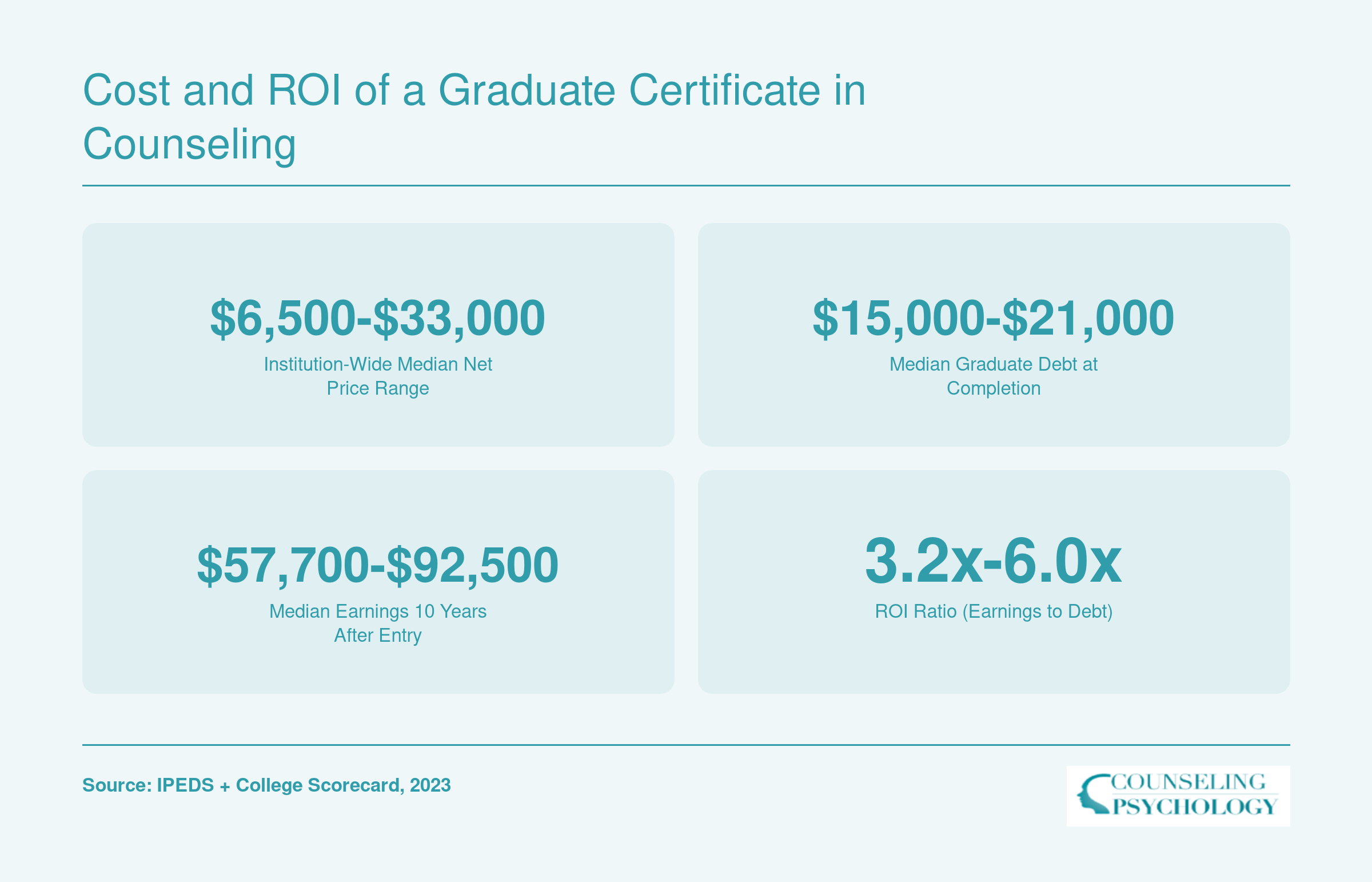
Graduate certificates in counseling deliver targeted credentials at a fraction of the cost of a full master's degree. Across the programs ranked on counselingpsychology.org, the institution-wide average net price (which reflects overall financial aid patterns, not certificate-specific tuition) ranges from roughly $6,500 at public flagships to about $33,000 at private research universities. Median graduate debt at these schools clusters between $15,000 and $21,000, well below the $50,000 or more that many master's-level counseling students carry. Because certificate programs require fewer credits and less time, graduates can re-enter the workforce faster and begin recouping their investment sooner. The figures below offer an at-a-glance snapshot of the financial picture. Note that net price is an institution-wide average reported by IPEDS, not a program-specific figure.
Tuition and Debt Comparison: Most Affordable Counseling Certificate Programs
Affordability varies widely across graduate certificate in counseling programs, and the sticker price only tells part of the story. The table below compares annual tuition rates, average net price after aid, and median graduate debt for ten of the most affordable options. Note that net price and debt figures reflect institution-wide averages reported to federal databases, not certificate-specific costs.
| School | State | In-State Tuition | Out-of-State Tuition | Avg. Net Price | Median Graduate Debt | Median Earnings (10 yr) |
|---|---|---|---|---|---|---|
| University of Florida | FL | $12,737 | $30,130 | $6,541 | $15,000 | $71,588 |
| University of South Florida | FL | $10,428 | $21,126 | $9,812 | $17,988 | $57,743 |
| University of Nevada, Las Vegas | NV | $7,413 | $25,555 | $10,359 | $19,450 | $55,037 |
| Indiana University, Indianapolis | IN | $11,180 | $28,964 | $11,668 | $20,000 | $55,198 |
| Saint Mary's University of Minnesota | MN | $12,474 | $12,474 | $11,704 | $21,500 | $58,170 |
| Southeastern Baptist Theological Seminary | NC | $6,516 | $6,516 | $13,090 | N/A | N/A |
| University of Georgia | GA | $11,002 | $29,774 | $13,936 | $18,500 | $68,726 |
| Northern Arizona University | AZ | $13,023 | $19,306 | $14,158 | $19,000 | $54,384 |
| University of Wisconsin, Whitewater | WI | $10,543 | $21,603 | $14,158 | $23,188 | $55,356 |
| Arizona State University | AZ | $13,587 | $27,521 | $14,967 | $19,500 | $62,668 |
Admissions Requirements and What to Expect
Most online graduate certificate programs in counseling require a minimum GPA of 3.0 on your prior graduate degree, though some programs set the bar at 2.75 and others at 3.25 depending on the institution and specialization. Knowing exactly where a program draws that line before you apply saves time and prevents surprises.
Degree Prerequisites and Career Changers
The majority of programs require an earned master's degree, but many do not require that degree to be in counseling. Programs frequently accept applicants who hold a graduate degree in education, social work, psychology, public health, or a related human services field. Some programs explicitly state in their admissions materials that they are designed for career changers or professionals expanding into counseling from adjacent disciplines. When you are reviewing a program, look for language in the admissions or requirements section that confirms whether your background qualifies, and contact the admissions coordinator directly if the language is ambiguous.
Typical supporting materials include official transcripts, a personal statement or statement of purpose, two or three professional or academic letters of recommendation, and a current resume. Some programs add a brief interview, either by phone or video, before making a final decision.
Credit Hours and Program Length
Most graduate certificates in counseling run between 12 and 18 credit hours, which translates to roughly two to four semesters of part-time enrollment for working professionals. The exact count varies by specialization: a post-master's trauma certificate might span 12 credits, while a school counseling add-on designed to meet state licensure prerequisites could require the full 18. Review the curriculum outline on the program page to confirm the credit total before applying.
Practicum and Field Experience
Not all certificate programs include a supervised field experience component, but some do, particularly those tied to licensure preparation. If a program requires a practicum or internship, you will generally need to secure a placement site in your area and confirm that a qualified supervisor is available. Contact the program coordinator early to understand the site approval process, and separately consult your state licensing board to verify whether supervised hours earned during a certificate program count toward your licensure clock. For those pursuing full licensure, our guide on how to become a licensed professional counselor outlines the complete process.
Finding Reliable Information
For broader industry context, the Bureau of Labor Statistics at BLS.gov publishes occupational outlooks and wage data for counseling roles. The Council for Accreditation of Counseling and Related Educational Programs lists accredited programs and their standards, and the American Counseling Association offers guidance on professional requirements and career pathways. Cross-referencing these sources with individual program pages gives you the most accurate picture before you commit.
What Can You Do With a Graduate Certificate in Counseling?
The demand for counseling professionals continues to outpace supply in nearly every specialty area, creating favorable conditions for those entering the field with focused credentials. A graduate certificate in counseling can qualify you for entry-level counseling roles, help you meet state licensure requirements for credentials like the Licensed Professional Counselor (LPC) or school counseling certification, or add a marketable specialization to an existing counseling career.
Career Paths and Earning Potential
Graduates of counseling certificate programs pursue several distinct counseling careers, each with its own compensation profile and growth outlook:
- Substance abuse, behavioral disorder, and mental health counselors: The Bureau of Labor Statistics reports a national median annual wage of $59,190 for this combined occupation category, with projected job growth of 18 percent from 2022 to 2032.12 This growth rate far exceeds the average for all occupations, driven by expanded insurance coverage for mental health services and increased recognition of substance use disorders as treatable conditions.
- School and career counselors: These professionals work primarily in K-12 settings and higher education, guiding students through academic planning, college applications, and career exploration.
- Marriage and family therapists: Specialists in relationship dynamics and family systems often work in private practice, community mental health centers, or integrated healthcare settings.
- Rehabilitation counselors: These practitioners help individuals with physical, mental, developmental, or emotional disabilities achieve personal and vocational goals.
Program-level earnings data for recent certificate completers is not yet available for most counseling certificate programs, making direct comparisons between specific credentials difficult. However, industry salary surveys from sources like TherapyDen and the Addictions Training Institute suggest that counselors with specialized credentials often command higher starting wages than generalists, particularly in high-demand areas like addiction treatment.4
Understanding the Limitations
A graduate certificate alone typically does not qualify someone for independent licensure as a counselor in most states. State licensing boards generally require a master's degree in counseling or a closely related field, supervised clinical hours (often 2,000 to 4,000 hours), and passage of a national examination.
Certificates function most effectively in three scenarios: filling specific coursework gaps for professionals seeking licensure, adding a specialty area (such as addiction counseling or trauma treatment) to an existing counseling credential, or providing foundational training for those exploring the field before committing to a full degree program. If your goal is independent practice as a licensed counselor, plan to pair your certificate work with a qualifying master's degree.
How We Ranked These Online Counseling Certificate Programs
Our ranking is built to spotlight online graduate certificate programs that deliver the best combination of affordability, strong student outcomes, and career flexibility.
Data Sources and Weighting
We drew from two core federal datasets: the College Scorecard for earnings, debt, and graduation rates, and IPEDS for tuition and institutional characteristics. The analysis started by filtering for programs offered online or in hybrid format, then applied a multi-factor composite score.
- Cost and outcomes carried the most weight: Net price and median earnings after completion were top-tier factors. Lower debt levels and higher earnings significantly improved a program's position.
- Online delivery earned a modest boost: A weighted preference recognized the flexibility of online and hybrid formats, which many working students need.
- Accreditation and graduation rates: Institutional accreditation and, where relevant, programmatic accreditation like CACREP were weighted. Graduation rates (institution-wide) served as a proxy for student support and institutional rigor, though they are not program-specific.
Limitations of the Data
Transparency about data boundaries is critical. - Graduation rates are for the entire institution, not the certificate track. - Net price is an average across all aided undergraduates and may differ from your actual cost. - Earnings and debt outcomes reflect all completers at the credential level (e.g., post-baccalaureate certificates), not solely counseling specialties. They can be influenced by regional salaries or prior work experience. - College Scorecard data often lags a few years, so recent labor-market shifts may not yet appear.
We encourage using these rankings as a starting point, not the final word. If you are weighing a certificate against a full degree, our guide to counseling doctoral programs can help you compare credential levels. Verify current details directly with each school and consider how your personal financial situation and career goals align with the program.
Frequently Asked Questions About Counseling Graduate Certificates
Graduate certificates in counseling raise practical questions about career value, format, and how they fit into the broader licensure landscape. Below are answers to the questions prospective students ask most often, drawn from the program details and industry context covered earlier in this guide.
More Online Counseling Certificate Programs to Consider
If our top-ranked programs didn't quite fit your needs, or if you're looking for a specialization or geographic preference, this directory of additional schools offers more options. Each entry includes key details to help you explore further. These programs were evaluated using the same methodology but fell outside the top 10.
- Post-Master's Certificate in School Counseling
- Mental Health Counseling Advanced Certificate
- Certificate of Graduate Study in Drug and Addiction Studies
- Master of Arts in Clinical Mental Health Counseling
- Culturally-Centered Addictions Research Training
- Certificate in Marriage, Family, and Couples Counseling
- Advanced Studies Certificate in Clinical Mental Health Counseling
- Graduate Certificate in Biblical Counseling
- Certified Alcohol and Drug Counselor
- Graduate Certificate in Treating Substance Use Disorders
- Graduate Certificate in School Counseling
- Advanced Graduate Certificate in Addiction Studies
- Graduate Certificate School Counseling for Educators
- Graduate Certificate School Counseling for Educators (Educators Track)
- Graduate Certificate School Counseling for Educators (Re-Specialization Track)
- Mental Health Counseling Graduate Certificate
- Drug and Alcohol Counseling Certificate
- Substance Use Disorders