What you’ll learn in this article…
- New Jersey's most affordable counseling master's programs have institution-wide average net prices starting well below many private alternatives.
- CACREP-accredited programs across the state prepare graduates for both LPC licensure and school counseling certification.
- Monmouth University is the only CACREP-accredited NJ program with a dedicated Child and Adolescent Counseling concentration.
- New Jersey counseling salaries generally exceed national medians, supporting strong return on investment for most graduates.
New Jersey's licensed professional counselor workforce is projected to grow much faster than average through 2032, driven by expanding mental health services in schools, hospitals, and private practice. The state's 60-credit LPC pathway and CACREP accreditation expectation raise the stakes: program selection directly shapes licensure eligibility and long-term earning power. Public universities like New Jersey City University and Stockton University offer tuition below $18,000, while private counterparts such as Fairleigh Dickinson University provide hybrid delivery and report 100% job placement for clinical mental health counseling graduates. Median graduate debt across these programs ranges from $18,500 to $27,000, and state-level median wages for counselors sit above the national figure in nearly every specialty. Students weighing a counseling doctoral program after their master's will also find that CACREP-accredited New Jersey programs position them well for that transition. For New Jersey students, the financial math favors in-state public options with built-in clinical placements.
Top Master's in Counseling Programs in New Jersey, 2026 Rankings
New Jersey offers a strong mix of public and private institutions with master's-level counseling programs, many of which hold CACREP accreditation and prepare graduates for LPC licensure or school counseling certification. The programs below span clinical mental health counseling, school counseling, addiction counseling, and rehabilitation counseling, with delivery formats ranging from fully online to hybrid. Graduation rates listed are institution-wide figures and do not reflect program-specific completion rates.
- Accreditation and licensure alignment
- Net price and affordability
- Institutional graduation and retention rates
- Program format and flexibility
- Graduate earnings outcomes
- Independent program research
- NCES-IPEDS federal institutional data — nces.ed.gov
- Internal program database
- College Scorecard graduate earnings — collegescorecard.ed.gov

New Jersey City University
New Jersey City University in Jersey City delivers a CACREP-accredited M.A. in Counseling with a School Counseling option, built around a 60-credit hybrid curriculum that prepares graduates for K-12 school counselor certification. The program emphasizes multicultural counseling, career development, and advocacy, with admission requiring a 3.0 GPA, a goals essay, two recommendation letters, and an interview. With an average net price of roughly $16,053 and a 13-to-1 student-to-faculty ratio, NJCU is one of the most affordable paths to a counseling career in the state.
- CACREP-accredited 60-credit hybrid program
- Prepares for New Jersey K-12 school counselor certification
- Covers counseling theories, multicultural counseling, and career development
- Emphasizes ethical behavior, self-awareness, and student advocacy
- Requires 3.0 GPA, goals essay, two recommendations, and interview
- Hybrid format blends on-campus and online coursework
M.A. in Counseling, School Counseling Option — Hybrid

Montclair State University
Montclair State University pairs a graduate-level Certified Alcohol and Drug Counselor certificate with the option to pursue an M.A. in Counseling concurrently, making it a practical choice for students interested in substance abuse treatment. The hybrid format meets New Jersey's CADC educational requirements, and graduates can work across clinics, outpatient centers, and community agencies. Montclair's institution-wide graduation rate of 64.7% and net price near $15,566 reflect solid value among public universities in the state.
- Hybrid format satisfies New Jersey CADC certification requirements
- Option to pursue M.A. in Counseling concurrently
- Prepares graduates for work in clinics and outpatient facilities
- Covers evidence-based substance abuse intervention strategies
- Blends online instruction with campus-based learning
- Projected 22% job growth in the addiction counseling field
Certified Alcohol and Drug Counselor Certificate — Hybrid

Stockton University
Stockton University's M.A. in Counseling with a Clinical Mental Health Counseling concentration is a 60-credit hybrid program that reports a 94% degree completion rate and a 92% licensure pass rate. Students complete a 100-hour practicum plus two 300-hour internships, gaining extensive supervised clinical experience. Classes are held at Stockton's Hammonton, NJ location, and the program carries CACREP accreditation, positioning graduates for LPC licensure and national certification.
- CACREP-accredited 60-credit hybrid program
- Reported 92% licensure exam pass rate
- 100-hour practicum plus two 300-hour internships included
- Classes held at Stockton's Hammonton, NJ site
- Full-time enrollment required; no GRE mentioned
- Graduates qualify for LPC licensure and national certification
- Covers ethical practices and diverse therapeutic approaches
M.A. in Counseling, Clinical Mental Health Counseling Concentration — Hybrid

Saint Peter's University
Saint Peter's University, a Jesuit institution in Jersey City, offers a 48-credit M.A. in Education with a School Counseling specialization through a hybrid format of evening, online, and in-person courses. The program prepares graduates for New Jersey State certification as school counselors and covers crisis intervention, multicultural counseling, and career counseling. With a net price of approximately $12,199 and a 12-to-1 student-to-faculty ratio, Saint Peter's is among the most affordable private options for school counseling in the state.
- 48-credit hybrid program with evening and online options
- Prepares for New Jersey school counselor certification
- Covers crisis intervention and multicultural counseling
- Includes career counseling and psychological foundations coursework
- Flexible scheduling designed for working professionals
- 12-to-1 student-to-faculty ratio for personalized support
- No prerequisite counseling experience required
M.A. in Education: School Counseling — Hybrid

The College of New Jersey
The College of New Jersey holds the highest institution-wide graduation rate on this list at 85.9% and offers both a CACREP-accredited M.A. in School Counseling (hybrid, 60 credits) and an online Post-Master's Certificate in Clinical Mental Health Counseling (15 credits). The school counseling track includes a unique global summer course option in Portugal, while the post-master's certificate targets graduates who already hold a counseling M.A. and need additional coursework for licensure. TCNJ's selective admissions (62.3% acceptance rate) and strong median graduate earnings reflect the institution's academic rigor.
- CACREP-accredited 60-credit hybrid program
- Prepares for New Jersey school counseling certification
- Global summer course option in Portugal
- Online and in-person learning components
- Experiential learning approach with supervised practice
- Open to international students
- 15-credit fully online program for M.A. holders
- Covers psychopathology, addiction counseling, and trauma
- Mix of synchronous and asynchronous coursework
- No GRE required; rolling admissions available
- Discounted tuition rate of $686 per credit
- Designed for professionals pursuing licensure
M.A. in School Counseling — Hybrid
Post-Master's Certificate in Clinical Mental Health Counseling — Online

Seton Hall University
Seton Hall University's fully online M.A. in School Counseling is a 48-credit program approved by the New Jersey Department of Education and accredited by CAEP. The curriculum trains socially conscious counselors for diverse K-12 settings, with coursework in developmental counseling strategies, prevention, and early intervention. While Seton Hall's sticker price is higher than many public alternatives, the program's 100% online format eliminates commuting costs and appeals to students who need maximum scheduling flexibility.
- 48-credit fully online program
- Approved by New Jersey Department of Education
- CAEP-accredited with rigorous standards
- No prerequisite counseling experience needed
- Prepares K-12 school counselors for diverse settings
- Focuses on prevention, early identification, and intervention
- Developmental counseling strategies emphasized
- Preferred 3.0 GPA for admission
M.A. in School Counseling (Online) — Online

Monmouth University
Monmouth University's 60-credit M.S.Ed. in School Counseling is CACREP-accredited and delivered in a hybrid format with evening classes, making it practical for working adults. The program meets New Jersey's requirements for both school counseling certification and LPC licensure, and it includes a dedicated placement coordinator to help students secure internship sites. Monmouth's emphasis on social justice, diversity, and small class sizes, paired with a 12-to-1 student-to-faculty ratio, creates a supportive environment for aspiring P-12 school counselors.
- CACREP-accredited 60-credit hybrid program
- Meets NJ school counseling certification and LPC licensure requirements
- Dedicated placement coordinator for internship support
- Evening classes designed for working adult learners
- Small class sizes with experienced faculty
- Social justice and diversity emphasis throughout curriculum
- July 15 application deadline for fall enrollment
M.S.Ed. in School Counseling — Hybrid

Rutgers University-Camden
Rutgers University-Camden houses multiple counseling pathways, including a CACREP-accredited Ed.M. with Certification in School Counseling, an M.S. in Rehabilitation Counseling with a Clinical Mental Health Counseling track, and an Addiction Counselor Training certificate. The school counseling program is a 60-credit hybrid offering focused on equity and inclusion for preschool through grade 12 settings. The clinical mental health track also carries CACREP accreditation and does not require the GRE, while the ACT certificate prepares students for dual LCADC and LCSW licensure.
- CACREP-accredited 60-credit hybrid program
- Prepares for preschool through grade 12 counseling
- Focus on equity and inclusion in schools
- Supervised practicum and financial aid available
- Standard Certificate awarded upon completion
- Practical field experiences integrated into coursework
- CACREP-accredited 60-credit hybrid program
- No GRE required for admission
- Two- or three-year completion options available
- Supervised clinical experiences included
- Community-based counseling approach emphasized
- High employment demand for graduates
- Hybrid format with online and in-person components
- Prepares for dual LCADC and LCSW licensure
- Covers all five CADC/LCADC certification domains
- Includes supervised practicum in approved agencies
- Focus on evidence-based addiction interventions
- Designed for MSW students and post-graduate clinicians
Ed.M. with Certification in School Counseling — Hybrid
M.S. in Rehabilitation Counseling, Clinical Mental Health Counseling Track — Hybrid
Addiction Counselor Training (ACT) Certificate — Hybrid

Rutgers University-Newark
Rutgers University-Newark mirrors many of the counseling offerings found across Rutgers campuses, featuring a CACREP-accredited M.S. in Rehabilitation Counseling with a Clinical Mental Health Counseling track and the Addiction Counselor Training certificate. The clinical mental health track is available online, offering full- or part-time study without a GRE requirement. Newark's urban location provides access to diverse practicum and internship sites, and the institution's 84% retention rate signals strong student support services.
- CACREP-accredited 60-credit online program
- Full-time or part-time enrollment options
- No GRE required for admission
- Supervised clinical experience included
- High employment demand for clinical mental health counselors
- Diverse career placement opportunities in urban settings
- Hybrid format with six-course curriculum
- Prepares for LCADC and LCSW dual licensure
- Includes CCGC certification training component
- Supervised practicum in DMHAS-approved agencies
- Focus on cultural competence and evidence-based practice
- Meets New Jersey educational requirements for LCADC
M.S. in Rehabilitation Counseling, Clinical Mental Health Counseling Track — Online
Addiction Counselor Training (ACT) Certificate — Hybrid

Rutgers University
Rutgers University's New Brunswick campus offers the broadest set of counseling credentials in this ranking: a CACREP-accredited Ed.M. with Certification in School Counseling, the M.S. in Rehabilitation Counseling with a Clinical Mental Health Counseling track, and the Addiction Counselor Training certificate. The institution's 83.6% graduation rate and 93% retention rate are the strongest among New Jersey public universities on this list. The clinical mental health track is available online, and the school counseling Ed.M. follows a hybrid model with a multicultural competence focus.
- CACREP-accredited 60-credit hybrid program
- Prepares for preschool through grade 12 school counseling
- Focus on multicultural competence
- Supervised practicum included in the curriculum
- Standard Certificate awarded upon completion
- Financial aid available for eligible students
- CACREP-accredited 60-credit program with online option
- Full-time or part-time study available
- Two- or three-year completion timeline
- Supervised clinical experience at multiple campus locations
- No GRE required for admission
- Strong employment demand for graduates
- Hybrid program covering all LCADC education domains
- Competitive application with spring and fall admission cycles
- Supervised practicum hours included
- Self-help meeting attendance required
- Financial aid available for eligible students
- Dual credential preparation for behavioral health careers
Ed.M. with Certification in School Counseling — Hybrid
M.S. in Rehabilitation Counseling, Clinical Mental Health Counseling Track — Online
Addiction Counselor Training (ACT) Certificate — Hybrid

Fairleigh Dickinson University-Metropolitan Campus
Fairleigh Dickinson University's Metropolitan Campus in Teaneck offers a CACREP-accredited 60-credit M.A. in Clinical Mental Health Counseling built on a practitioner/researcher model with a full-time cohort structure. The program reports a 100% job placement rate and includes three semesters of supervised clinical training. Unique coursework in psychopharmacology and specialized counseling topics sets it apart, and admission does not require the GRE. Although FDU's tuition is higher at $19,068, the average net price drops to about $15,404 after aid.
- CACREP-accredited 60-credit hybrid program
- Reported 100% job placement rate for graduates
- Full-time cohort learning model
- Three semesters of supervised clinical training
- No GRE required; 3.0 minimum undergraduate GPA
- Meets New Jersey LPC licensure requirements
- Includes coursework in psychopharmacology
- Multicultural counseling emphasis throughout curriculum
M.A. in Clinical Mental Health Counseling — Hybrid
How to Choose a Counseling Master's Program in New Jersey
Choosing a counseling master's program means weighing accreditation, specialization fit, delivery format, and true cost against your career timeline and professional goals. New Jersey offers more than a dozen programs with varying structures, so understanding what distinguishes them helps you invest wisely in your future practice.
Accreditation: CACREP and MPCAC
The Council for Accreditation of Counseling and Related Educational Programs (CACREP) serves as the gold standard for counseling education. New Jersey's licensing board accepts CACREP-accredited programs as meeting educational requirements for the Licensed Professional Counselor (LPC) credential, and these programs also transfer seamlessly if you relocate to another state. In 2025-2026, fourteen New Jersey institutions hold CACREP accreditation for clinical mental health or school counseling tracks, including Caldwell University, Fairleigh Dickinson University, Georgian Court University, Kean University, Monmouth University, Montclair State University, New Jersey City University, Rider University, Rowan University, Stockton University, The College of New Jersey, William Paterson University, and Rutgers University's rehabilitation counseling specialization.234
The Masters in Psychology and Counseling Accreditation Council (MPCAC) provides an alternative pathway. Felician University and William Paterson University offer MPCAC-accredited counseling psychology programs, though both currently hold probationary status.5 MPCAC graduates may still qualify for New Jersey licensure, but should verify that their coursework meets all state requirements and understand that interstate portability can be more complicated than with CACREP credentials.
Matching Specialization to Career Goals
Most New Jersey programs offer clinical mental health counseling as their primary track, preparing graduates for community mental health centers, private practice, and hospital settings. If you want to work in K-12 schools, look specifically for school counseling tracks, which include different practicum requirements and lead to school counselor certification rather than clinical licensure. For a broader look at how counseling master's programs online compare nationally, it is worth reviewing options beyond a single state. Several programs also offer child and adolescent concentrations within clinical mental health tracks for those drawn to younger populations but preferring clinical rather than educational settings.
Format Considerations: Online vs. On-Campus
Online programs offer scheduling flexibility for working adults, but on-campus cohorts often provide stronger networking opportunities and easier access to supervised practicum sites within New Jersey communities. Hybrid models split the difference. Consider your learning style, work obligations, and whether you already have professional connections in the mental health field. Students without existing clinical contacts often benefit from the placement support that traditional on-campus programs provide.
Understanding True Program Cost
Sticker tuition tells only part of the story. Use each program's net price calculator to estimate your actual cost after grants, scholarships, and assistantships. Public institutions like Rowan, Stockton, and William Paterson typically offer lower base tuition for New Jersey residents, but a generous scholarship at a private school can shift the equation. Compare total out-of-pocket costs rather than published rates.
Program Length and Credit Requirements
Most New Jersey counseling master's programs require 60 graduate credits to meet state licensure standards. Full-time students typically complete coursework in two to three years, while part-time students should plan for three to four years. Those interested in eventually pursuing a counseling doctoral program should also weigh whether a given master's program facilitates that transition. Factor in practicum and internship hours, which add scheduling demands beyond classroom time.
Questions to Ask Yourself
Online vs. On-Campus Counseling Programs in New Jersey
Choosing between online and on-campus formats is one of the first decisions you will face when selecting a counseling master's program in New Jersey. Both delivery modes can lead to the same credential and the same licensure pathway. CACREP does not distinguish between online and on-campus programs, so your degree carries equal weight regardless of format. The real differences come down to lifestyle fit, cost, and how you build clinical skills and professional connections. Keep in mind that every format, whether fully online or traditional, requires you to complete in-person practicum and internship hours to meet New Jersey licensure requirements.
Pros
- Online programs offer scheduling flexibility that allows working students to balance coursework with employment and family responsibilities.
- Studying online opens access to CACREP-accredited programs nationwide, not just those located within New Jersey.
- Online tuition and total costs are often lower because you eliminate commuting expenses and may qualify for reduced tuition rates.
- On-campus programs make it easier to coordinate practicum and internship placements at established New Jersey clinical sites.
- Face-to-face instruction supports hands-on clinical skill development through live role-plays, group counseling practice, and immediate faculty feedback.
- Attending classes in person helps you build a stronger local professional network with classmates and supervisors who practice in New Jersey.
Cons
- Online students must independently arrange local practicum and internship sites in New Jersey, which can be time-consuming and competitive.
- Virtual formats may limit spontaneous peer interaction and make it harder to practice nuanced clinical techniques like reading body language.
- On-campus programs typically require a fixed class schedule, creating challenges for students who work full time or have caregiving obligations.
- In-person attendance often increases total costs when factoring in commuting, parking, and the opportunity cost of a rigid weekly schedule.
Most Affordable Counseling Master's Programs in New Jersey
The table below ranks New Jersey counseling programs by net price, from lowest to highest. Net price shown is an institution-wide average after financial aid and does not reflect individual program costs, so your actual out-of-pocket expense will vary based on your aid package, residency, and enrollment status. Students at schools with high shares of Pell Grant recipients (such as Saint Peter's University and New Jersey City University, both near 80%) may find strong institutional aid pipelines. Beyond grants, consider graduate assistantships, federal student loans at graduate rates, and employer tuition reimbursement programs to further reduce your total investment.
| Rank | School | In-State Tuition (per Year) | Out-of-State Tuition (per Year) | Avg. Net Price (Institution-Wide) | Format |
|---|---|---|---|---|---|
| 1 | Saint Peter's University | $16,035 | $16,035 | $12,199 | Hybrid |
| 2 | Fairleigh Dickinson University, Metropolitan Campus | $19,068 | $19,068 | $15,404 | Hybrid |
| 3 | Montclair State University | $16,056 | $16,056 | $15,566 | Hybrid |
| 4 | New Jersey City University | $15,499 | $15,499 | $16,053 | Hybrid |
| 5 | Rutgers University, Camden | $23,428 | $36,772 | $18,745 | Hybrid |
Related Articles
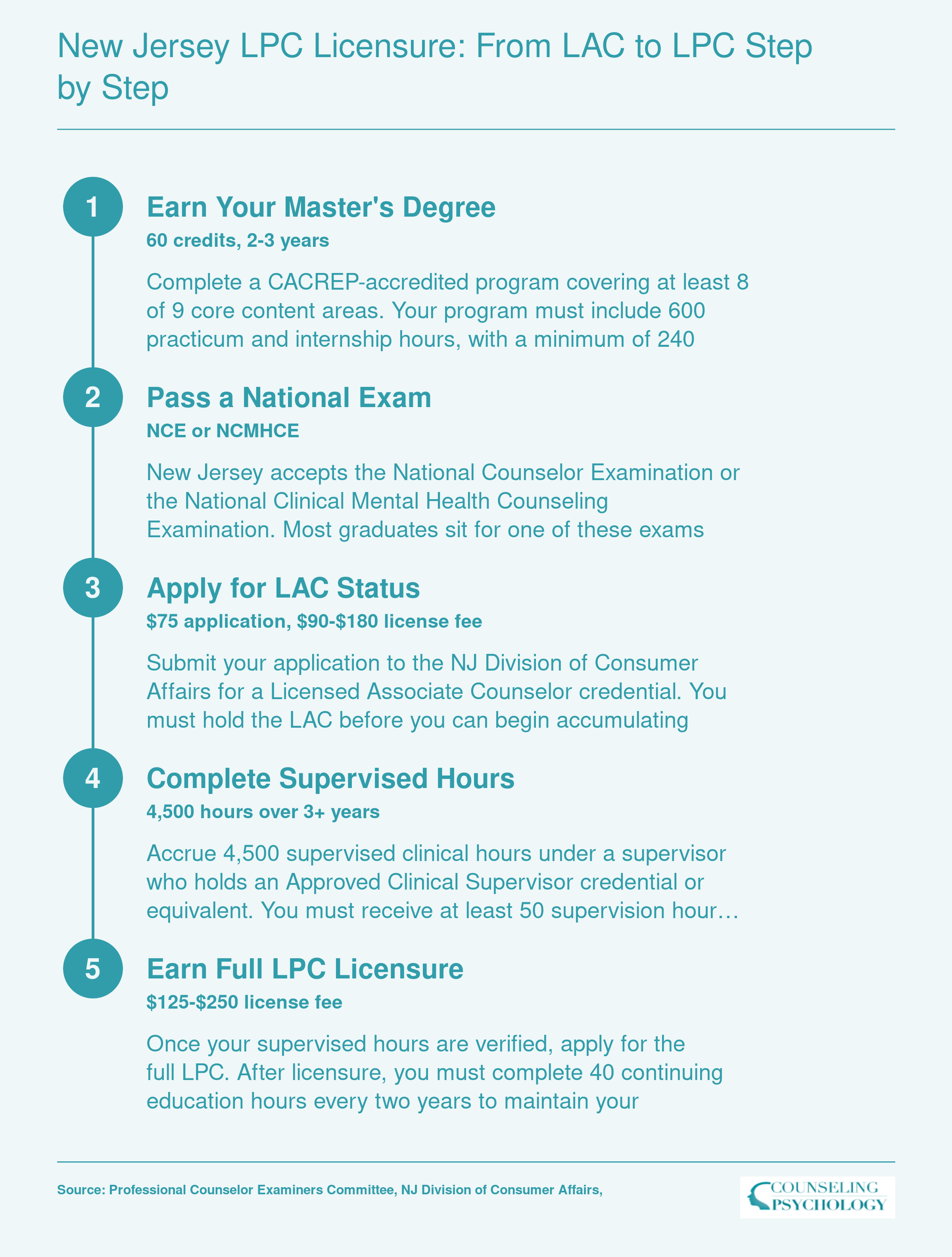
New Jersey LPC Licensure: From LAC to LPC Step by Step
Becoming a Licensed Professional Counselor in New Jersey is a multi-year process overseen by the Professional Counselor Examiners Committee. Understanding each milestone, from your master's degree through full licensure, helps you plan your timeline and budget realistically. Most candidates complete the entire path in roughly five to seven years.
Child and Adolescent Counseling Specializations in New Jersey
Monmouth University stands as the only CACREP-accredited program in New Jersey offering a dedicated Child and Adolescent Counseling concentration within its 60-credit M.S. in Clinical Mental Health Counseling.1 This distinction matters for students who know they want to work with younger populations and seek specialized training from day one.
Monmouth's Play Therapy Pathway
Monmouth's concentration includes three play therapy courses: Advanced Theory in Play Therapy, Advanced Techniques in Play Therapy, and Play Therapy for Children at Risk.1 This coursework directly feeds into the Registered Play Therapist credential from the Association for Play Therapy, which requires 150 contact hours of play therapy training and 350 hours of supervised play therapy after graduation. The program's 100 practicum hours and 700 internship hours, placed through partnerships with over 100 clinical sites, give students opportunities to log supervised client contact in child-focused settings.
Students pursuing the RPT credential should plan for post-master's supervision, as the 350 supervised play therapy hours typically extend beyond degree completion. However, starting with a concentration that emphasizes play therapy principles shortens the overall timeline. For a broader look at career paths in this space, see our guide on how to become a child counselor.
Other New Jersey Options
Felician University offers a required course in Child and Adolescent Counseling within its M.A. in Counseling Psychology, though the program does not include a full concentration or play therapy sequence.2 Students should note that Felician's MPCAC accreditation was placed on probation in 2026, which may affect licensure reciprocity in some states.2
The College of New Jersey's CACREP-aligned Clinical Mental Health Counseling program does not currently offer a child specialty track, though students can seek child-focused practicum placements through their own initiative.3
For students open to online learning, Capella University offers an MS in Clinical Mental Health Counseling with a Child and Adolescent Counseling specialization.4 This option provides flexibility for working professionals but requires students to secure their own local practicum and internship sites in New Jersey.
Post-Master's Credentials to Consider
Beyond the RPT, counselors working with young clients can pursue the National Certified Counselor credential with child and adolescent specialty recognition through NBCC. The Certified Child and Adolescent Trauma Professional credential offers another pathway for counselors focusing on childhood trauma counseling with younger populations.
Most competing guides overlook child counseling specializations entirely. For prospective students drawn to working with children and teens, evaluating a program's specific coursework, practicum partnerships with schools or pediatric settings, and alignment with play therapy certification requirements should drive the decision.
Counseling Salaries and ROI in New Jersey
New Jersey offers competitive compensation for counseling professionals, with wages generally running above national medians across most counseling occupations. The table below draws on BLS state-level data for New Jersey (May 2023) and national wage percentiles (May 2024) where state-specific breakdowns are not separately published. Keep in mind that BLS figures reflect all experience levels in the workforce, while program-level earnings data from federal sources (when available) typically capture early-career wages at one or four years after completion, which will naturally be lower. The New York-Newark-Jersey City metro area, which spans into northern New Jersey, reports a mean annual wage of $71,180 for substance abuse, behavioral disorder, and mental health counselors, making it one of the highest-paying metro regions for this occupation in the state.
| Occupation (NJ) | SOC Code | Total Employment (NJ) | 25th Percentile Wage | Median Annual Wage | 75th Percentile Wage | Mean Annual Wage |
|---|---|---|---|---|---|---|
| Substance Abuse, Behavioral Disorder, and Mental Health Counselors | 21-1018 | 14,640 | $51,170 | $64,710 | $84,690 | $75,900 |
| Educational, Guidance, and Career Counselors and Advisors | 21-1012 | 7,590 | $64,900 | $77,940 | $99,180 | $82,460 |
| Marriage and Family Therapists | 21-1013 | 3,940 | $77,380 | $89,030 | $97,670 | $91,980 |
| Health Specialties Teachers, Postsecondary | 25-1071 | 2,870 | $77,100 | $104,760 | $138,860 | $122,530 |
Is a Master's in Counseling Worth It in New Jersey?
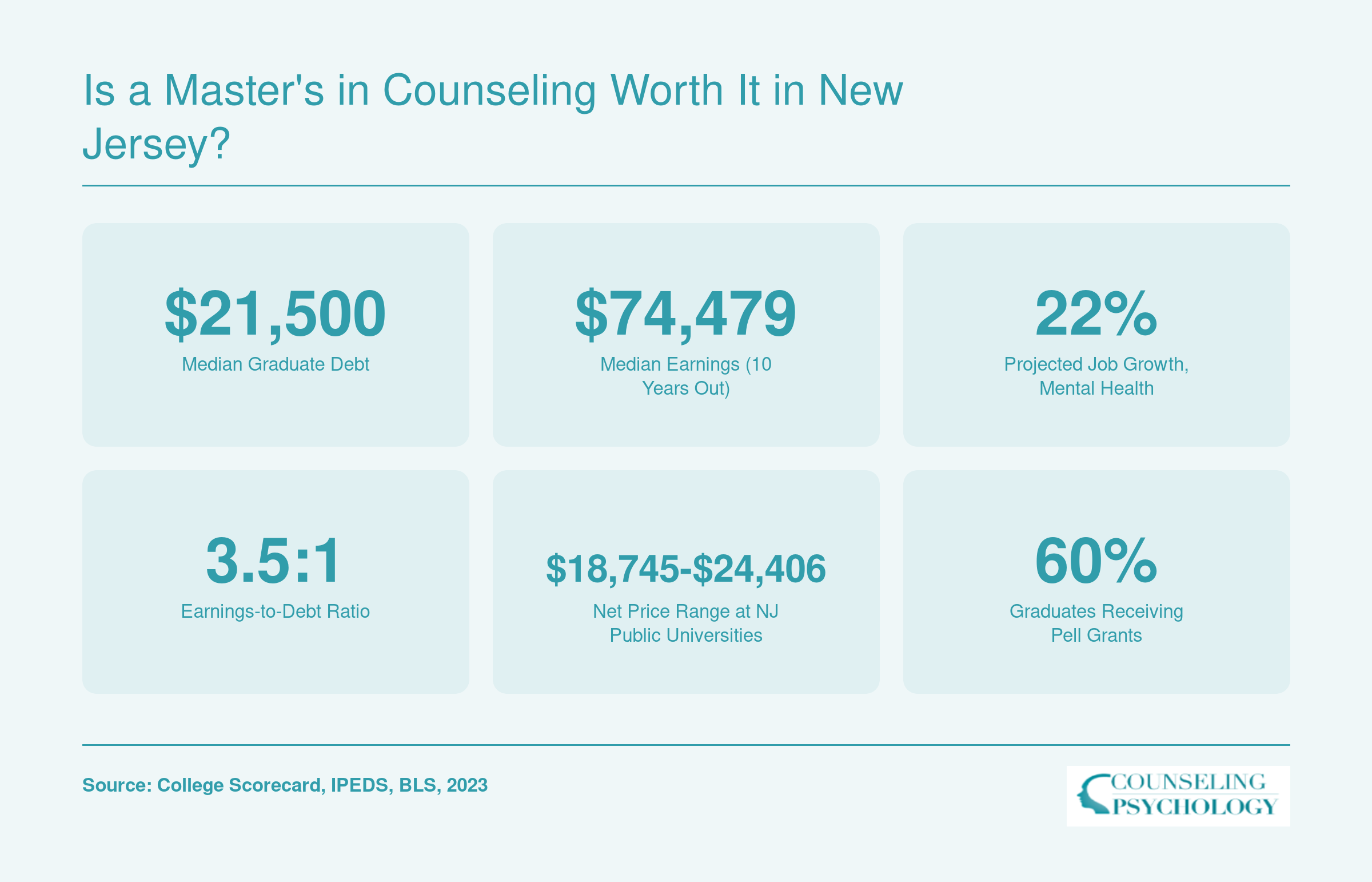
For most graduates, the numbers point to a strong return on investment. New Jersey's high demand for mental health professionals, combined with manageable graduate debt levels and competitive salaries, makes a counseling master's degree a sound financial decision for career changers and recent graduates alike.
Frequently Asked Questions About Counseling Programs in NJ
Choosing the right counseling master's program in New Jersey means weighing factors like specialization, accreditation, cost, and format. Below are answers to the questions prospective students ask most often, drawn from current program data and state licensure requirements.