LMFT Supervision Hours: Your Complete Guide to Requirements & Finding a Supervisor
State-by-state breakdowns, individual vs. group hour ratios, and practical tips for navigating your supervised experience.
By Tara Moretti, LMHCReviewed by CounselingPsychology.org TeamUpdated May 22, 202610+ min read
Key Takeaways
Most states require 100 to 200 hours of direct supervision contact within 2,000 to 4,000 total post-degree clinical hours.
Full-time associates typically complete supervised experience in two to three years, while part-time timelines stretch to four or five.
By 2026 the majority of states permit tele-supervision, though most still mandate some in-person sessions or impose specific technology requirements.
The BLS reports a median annual wage near $58,510 for marriage and family therapists, with top earners exceeding $82,000.
For most aspiring marriage and family therapists, supervised clinical hours represent the single longest stretch between diploma and license, often spanning two to four years of post-degree work. The requirements are also among the most inconsistent across state lines: California mandates 3,000 hours of supervised experience while New York requires 1,500. Individual supervision ratios, group supervision caps, and acceptable modalities like tele-supervision differ just as sharply. If you are still sorting out how the MFT vs LMFT distinction applies to your career stage, that context is worth reviewing before diving into the specifics.
Getting the details wrong can mean lost hours, delayed exam eligibility, or the need to repeat work under a different supervisor. State boards are not forgiving about technicalities, and the financial cost of extended timelines is real for associates earning entry-level wages.
Why Supervised Hours Are Required for LMFT Licensure
Earning a graduate degree in marriage and family therapy gives you a strong theoretical foundation, but theory alone does not prepare you to sit across from a couple in crisis or a family navigating trauma. Supervised clinical hours exist to close that gap, and understanding exactly why they are required will help you approach them with the right mindset.
Bridging Theory and Independent Practice
Supervision serves a clear clinical purpose: it places a developing therapist under the guidance of an experienced clinician who can evaluate case conceptualization, flag ethical blind spots, and model sound decision-making in real time. This mentorship protects clients while accelerating your growth as a practitioner. Regulatory boards view supervised experience as the single most important safeguard between a new graduate and unsupervised contact with vulnerable populations.
A Universal, Non-Negotiable Requirement
Every U.S. state and the District of Columbia requires a defined period of supervised clinical experience before granting an LMFT license. This is not a recommendation or a best practice; it is a legal prerequisite. Hours you accumulate without an approved supervisor on record with your state board will almost certainly not count toward licensure, no matter how clinically valuable the work may have been. Verifying your supervisor's qualifications before you begin logging hours is one of the most important steps you can take early in the process.
Supervision Is Not the Same as Having a Boss
A common misconception is that any clinical employment under a licensed professional counts as supervision. It does not. Supervision is a formal evaluative relationship with structured goals, documented sessions, and direct accountability for your clinical work. Your supervisor reviews your cases, observes or listens to sessions (live or recorded), and provides written evaluations. Simply reporting to a licensed therapist in an agency hierarchy, without that dedicated evaluative structure, does not satisfy board requirements. For a deeper look at what this relationship involves, see our guide on navigating mentorship and supervision in your therapy education.
Who Sets the Standards
Two layers of authority shape supervision requirements. State licensing boards define how many hours you need, what ratio of individual to group supervision is acceptable, and who qualifies as an approved supervisor in that jurisdiction. The American Association for Marriage and Family Therapy (AAMFT) also maintains its own Approved Supervisor designation, which reflects advanced training in supervisory methods and is widely recognized across the field. However, holding the AAMFT designation is not universally required by every state. Some states accept it in lieu of their own supervisor criteria, while others have independent qualification standards. If you encounter unfamiliar credential abbreviations during your research, our counseling licensure acronyms reference can help. Checking your specific state board's rules is essential to ensure the supervision you receive will be accepted when you apply for licensure.
How Many Supervision Hours Are Required? Individual vs. Group Breakdowns
One of the most common points of confusion for aspiring LMFTs is the difference between total supervised experience hours and the actual supervision contact hours embedded within them. These are not the same thing, and understanding how they break down, particularly the distinction between individual and group supervision, is essential to staying on track toward licensure.
Individual vs. Group Supervision: What's the Difference?
Individual supervision (sometimes called triadic supervision when a second supervisee is present) involves one-on-one meetings with a licensed supervisor to review cases, discuss clinical decision-making, and receive feedback on your therapeutic work. Group supervision gathers a small cohort, typically two to eight supervisees, under the guidance of a single supervisor.
Licensing boards draw a clear line between these formats because individual supervision provides more focused, personalized feedback. A supervisor can dig deeper into your specific cases, challenge your clinical reasoning, and tailor guidance to your developmental stage. Group supervision has its own strengths, including exposure to diverse case presentations and peer learning, but boards generally consider individual hours more rigorous. That is why most states require a minimum proportion of your supervision to be individual or triadic.
California as the Anchor Example
California's Board of Behavioral Sciences (BBS) sets requirements that illustrate this structure well. To qualify for LMFT licensure, you need a total of 3,000 hours of supervised experience, accumulated over a minimum of 104 weeks.1 However, not all 3,000 of those hours are spent in a supervision room. The vast majority are direct client contact and other qualifying professional activities.
The actual supervision contact hours are governed by ratio and frequency rules:2
Supervision unit defined: One hour of individual or triadic supervision, or two hours of group supervision, counts as one "unit" of supervision.
Minimum frequency for trainees: At least one unit of supervision per week in each setting where you practice, with a supervision-to-client-contact ratio of 1:5.
Weekly cap for AMFTs: Associate MFTs may credit up to six hours of supervision per week toward licensure.
Additional supervision trigger for AMFTs: For every ten hours of client contact beyond the base threshold in a given week, you must receive an additional hour of individual or triadic supervision (or two hours of group) during that same week.
Individual supervision minimum: At least 52 of your 104 required weeks must include individual or triadic supervision.1
When you do the math, the roughly 52 weeks of required individual or triadic supervision translate to a minimum of about 52 individual supervision contact hours over the course of your experience, though most candidates accumulate more depending on their caseload pace. The total number of supervision contact hours you need is far smaller than 3,000, and this is where candidates frequently miscalculate.
The General Principle Across States
While specific numbers vary, most states follow a similar logic: individual supervision hours carry more weight, and boards set a floor for how many must be individual rather than group. Some states cap the percentage of total supervision that group hours can satisfy (often at 50 percent or less), while others specify a required ratio of individual-to-group. The rationale is consistent: one-on-one clinical oversight is the backbone of competency development, and group formats supplement rather than replace it.
If you are comparing requirements across states, focus on three numbers: total supervised experience hours, minimum individual supervision contact hours, and any caps on group supervision. These three data points will give you the clearest picture of what a state actually demands. For broader context on how mentorship and supervision shape clinical training, those dynamics apply across licensure types.
A Common Mistake to Avoid
Do not confuse the 3,000-hour total supervised experience requirement in California (or similar totals in other states) with 3,000 hours of sitting in supervision. The 3,000 hours encompass direct client contact, clinical documentation, treatment planning, and other qualifying activities, all performed under the umbrella of a supervisory relationship.3 The subset of actual face-to-face supervision meetings is much smaller. Misunderstanding this distinction can lead to unrealistic timelines or, worse, to logging hours incorrectly, which can delay your licensure application.
Supervision requirements for marriage and family therapist licensure vary significantly from state to state. The total number of post-degree clinical hours, the ratio of individual to group supervision, the frequency at which you must meet with your supervisor, and whether pre-degree trainee hours count toward licensure all differ depending on where you plan to practice. Understanding these differences is especially important if you are considering relocating or pursuing licensure in more than one jurisdiction.
How Requirements Differ Across States
States set their own rules through licensing boards, which means there is no single national standard for LMFT supervision. The differences can add months or even years to your timeline if you move from a state with lighter requirements to one that demands more hours or stricter supervision ratios. Key variables include:
Total post-degree clinical hours: Some states require as few as 1,500 supervised client-contact hours, while others require 3,000 or more.
Individual supervision minimums: Most states mandate a certain number of individual (one-on-one) supervision hours, though the exact threshold varies.
Group supervision caps: Many states allow group supervision to count toward your total, but typically cap the percentage or total number of hours that can come from group sessions.
Supervision frequency: States often specify a minimum meeting cadence, such as one hour of supervision for every set number of direct client-contact hours, or at least one hour per week.
Pre-degree trainee hours: Some jurisdictions accept hours accumulated during your graduate practicum or internship (usually with a cap), while others require all hours to be completed after you earn your degree.
California as a Reference Point
California is one of the most commonly cited examples because it has one of the highest post-degree supervised experience requirements in the country, at 3,000 total clinical hours.1 The state allows group supervision to count toward the total, and the required supervision frequency is one hour of supervision for every ten client-contact hours, or a minimum of one hour per week.1 California also accepts a limited number of pre-degree trainee hours, giving students a head start on accumulating experience while still enrolled in their graduate program.1 These rules are set and enforced by the California Board of Behavioral Sciences.
Because California's threshold is relatively high, candidates who complete their hours there often find the transition to other states more straightforward, though the reverse is not always true. Compensation expectations also shift by location; reviewing counselor salary by state data can help you weigh where to begin your career.
What to Watch For When Comparing States
Before committing to a supervision plan, take time to verify the current regulations from the licensing board in your target state. Board rules can change between legislative sessions, and relying on outdated information can result in hours that do not transfer or do not count. A few practical considerations:
If you plan to practice in a state other than where you earned your degree, confirm whether that state accepts out-of-state supervised hours and under what conditions.
Check whether your state distinguishes between direct client-contact hours and indirect hours (such as documentation, case consultation, and treatment planning), because supervision ratios sometimes apply only to direct hours.
Ask whether tele-supervision is permitted. A growing number of states have adopted or expanded rules allowing remote supervision sessions, which can widen your options for finding a qualified supervisor.
When researching graduate programs across states, knowing how to evaluate online counseling or psychology programs can also help you choose a program whose practicum structure aligns with your target state's supervision rules. For the most reliable and current details, consult the regulatory board website in each state where you intend to seek licensure. The requirements discussed throughout this guide reflect rules as of 2026, but boards do update their standards periodically.
Questions to Ask Yourself
Are you planning to get licensed in the same state where you earned your degree, or might you relocate?
Supervision hour requirements, approved supervisor credentials, and acceptable client contact types vary significantly by state. If relocation is even a possibility, confirm that hours accrued in one state will transfer to your target state before you begin logging them.
Do you learn best through one-on-one feedback or through group discussion with peers?
Most states require a minimum number of individual supervision hours but allow a portion to be completed in group settings. Knowing your learning preference early helps you build a supervision plan that satisfies ratio rules and supports your clinical growth.
Can your current or planned work schedule accommodate the weekly supervision sessions your state requires?
Some states mandate a specific number of supervision contacts per week or per accumulation period. Falling behind on supervision frequency can mean that otherwise valid client contact hours do not count toward licensure.
Do you have access to a qualified supervisor locally, or will you need to rely on tele-supervision?
Not every state permits remote supervision, and those that do often cap the percentage or impose additional documentation requirements. Sorting this out early prevents gaps in your supervision timeline.
How Long Does Supervised Experience Actually Take?
The short answer: most associates working full-time finish their supervised experience in roughly two to three years after earning their master's degree. If you are working part-time or juggling other commitments, expect a timeline closer to four or five years. Several variables determine exactly where you fall in that range.
Pre-Degree Hours Can Shorten the Clock
Not every hour has to come after graduation. California, for example, allows MFT trainees to accumulate up to 1,300 supervised hours while still enrolled in their master's program, provided they have completed at least 12 semester units (or 18 quarter units) and are in a practicum placement.1 Of those 1,300 hours, up to 750 can be direct counseling and up to 550 can be non-clinical experience. That is a meaningful head start: a trainee who maximizes pre-degree hours enters the post-graduation period needing only 1,700 of the total 3,000 required hours, potentially shaving a full year off the timeline. Not every state is this generous, so checking your own board's rules on pre-degree credit is essential.
Factors That Extend the Timeline
Several practical realities can push your completion date further out:
Weekly hour caps: California caps countable experience at 40 hours per week, meaning you cannot simply log 60-hour weeks to finish faster.1 Texas sets its cap at 50 hours per week, offering slightly more flexibility.2
Part-time caseloads: If your clinical position only generates 15 to 20 client-contact hours per week, building up to the required direct clinical minimums (1,750 in California, 1,500 in Texas) takes considerably longer.
Employment gaps: Transitions between agencies, relocations, or periods without a qualified supervisor all create dead time that does not count toward your total.
Supervisor availability: In rural or underserved areas, finding a supervisor who meets your state's qualifications can itself delay progress by months.
A Practical California Example
Consider a California associate marriage and family therapist (AMFT) hired full-time at a community mental health counselor setting. With a steady caseload and consistent weekly supervision at the required one-hour-per-ten-hours-of-experience ratio, this person can realistically reach 3,000 total hours in about two years.1 Now picture the same clinician working 20 hours per week in a private practice setting, where scheduling fluctuates and no-shows reduce direct client contact. Under those conditions, reaching the same 3,000-hour threshold often takes four years or more, and the 500-hour requirement for work with couples, families, and children may be especially hard to meet without intentional caseload planning.
The Bottom Line on Timing
Your actual timeline depends on the interplay of state rules, employment setting, and personal circumstances. Building a realistic plan before you start, one that accounts for weekly caps, direct-client-hour minimums, and supervisor logistics, keeps expectations grounded and helps you avoid unpleasant surprises midway through the process.
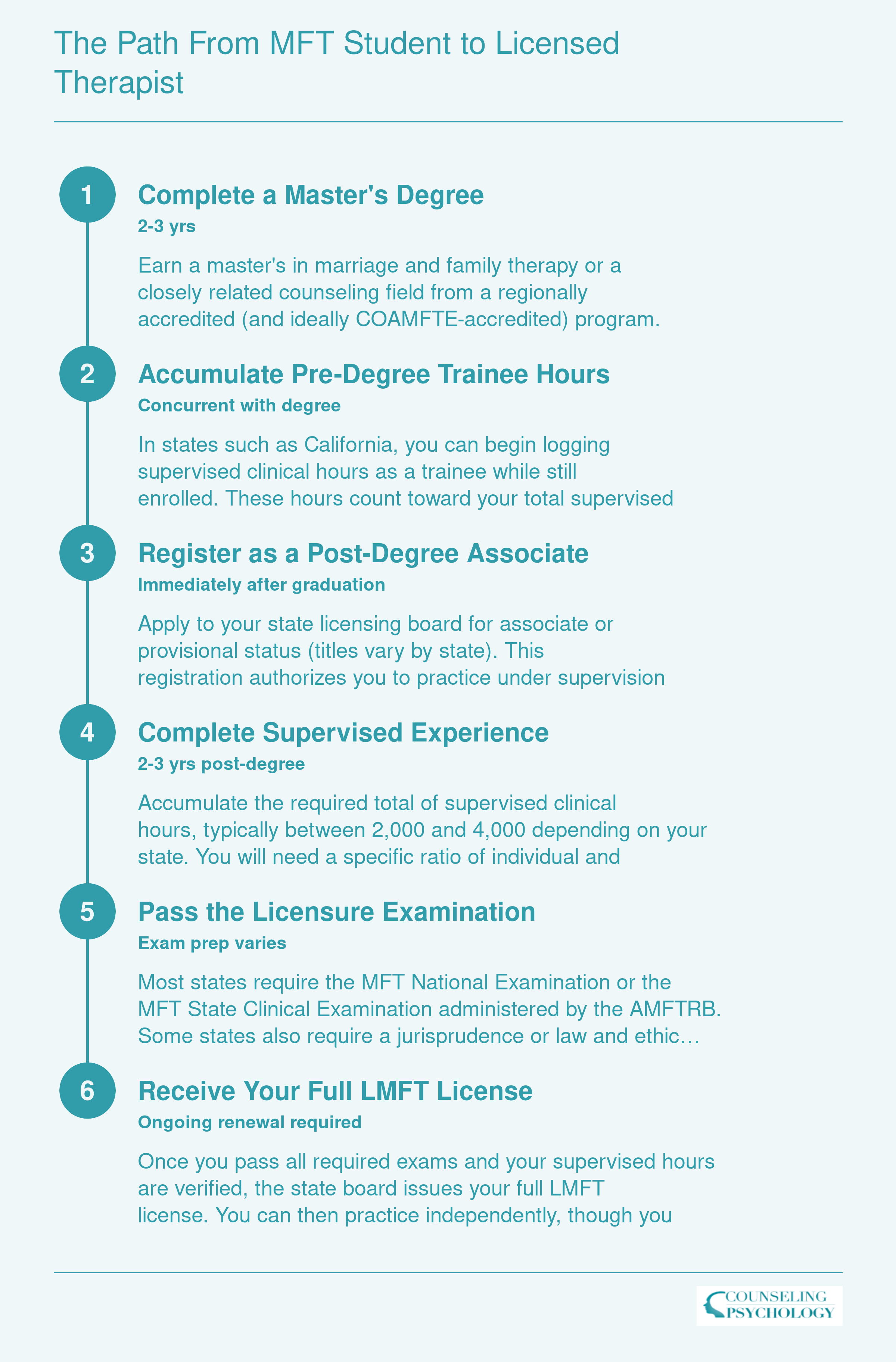
The Path from MFT Student to Licensed Therapist
Earning your LMFT license is a multi-stage process that typically spans 4 to 6 years after you begin graduate coursework. Understanding the full sequence helps you plan ahead and avoid surprises at each credentialing checkpoint.
What Does a Supervisor Actually Do? Roles, Responsibilities, and Models
A clinical supervisor is far more than a signature on your hours log. This person shapes your clinical identity, ensures client safety, and helps you bridge the gap between graduate coursework and independent practice. Understanding the supervisor's actual role, and the regulations that define it, will help you get far more out of the experience.
Core Responsibilities of an LMFT Supervisor
At a minimum, a qualified supervisor is expected to:
Evaluate clinical competence: Assess your case conceptualization, treatment planning, ethical decision-making, and therapeutic interventions on an ongoing basis.
Protect client welfare: Review your caseload to ensure clients receive appropriate, ethical care and intervene when risk factors arise.
Facilitate professional development: Help you develop a theoretical orientation, strengthen multicultural competence, and prepare for licensure exams.
Document and verify hours: Maintain accurate records of your supervision sessions and attest that your experience meets state requirements.
Supervisors also carry vicarious liability for the clinical work you perform under their license, which is one reason states impose strict requirements on who can serve in this role.
Supervision Models and Modalities
Most states recognize a combination of individual and group supervision, but the specific modalities a supervisor must use vary. Some states require supervisors to incorporate direct observation of clinical sessions, whether through live observation behind a one-way mirror, co-therapy, or video review of recorded sessions. Other jurisdictions accept case consultation alone. The AAMFT's Approved Supervisor designation promotes a model that blends didactic instruction, live or recorded case review, and collaborative feedback.
Your supervisor may draw on established models such as the Discrimination Model (which shifts focus among intervention skills, conceptualization, and personalization depending on your needs) or Systemic Supervision (which mirrors MFT theory by examining relational dynamics within the supervisory relationship itself).
How to Verify What Your State Requires
Regulations around supervisor-to-supervisee ratios, required modalities, and weekly hour caps differ significantly from state to state. The path to getting a counseling license involves understanding these nuances early. To find authoritative answers:
Visit the California Board of Behavioral Sciences (BBS) website for detailed supervision ratio limits and modality rules.
Check the Texas Health and Human Services Commission (HHSC) licensing page for its specific supervision regulations.
Review the Florida Board of Clinical Social Work, Marriage and Family Therapy, and Mental Health Counseling page under the Division of Medical Quality Assurance (MQA).
Look up Minnesota's Board of Behavioral Health and Therapy (BBHT) and New York's Office of Mental Health (OMH) for their respective guidelines.
Consult the AAMFT website for national best-practice standards and links to state-specific supervision resources.
University MFT program websites are another reliable source; many best online MFT programs publish fieldwork manuals that outline current state supervision requirements in plain language. If anything remains unclear after checking these resources, contact your state licensing board directly by phone or email. Board staff can provide definitive answers on ratio caps, acceptable modalities, and documentation expectations. Getting clarity early prevents costly surprises when you submit your licensure application.
How to Become a Qualified LMFT Supervisor
If you have been practicing as a licensed marriage and family therapist for a few years and want to give back to the profession, becoming a clinical supervisor is a natural next step. The path is not identical everywhere, though. Each state sets its own eligibility thresholds, training requirements, and renewal obligations, so the first thing to do is check your licensing board's current rules.
General Eligibility Requirements
Across most states, you will need to meet a few core criteria before you can supervise pre-licensed clinicians:
Active LMFT license in good standing: No disciplinary actions or restrictions that would disqualify you.
Post-licensure clinical experience: Ranges from two to five years depending on the state.
Completion of a supervisor training course: Hours vary widely, from a brief workshop to a multi-week program.
Ongoing continuing education: Some states require supervision-specific CE credits at each renewal cycle.
How Requirements Differ by State
The variation from state to state is significant. Here is how five of the most commonly searched states compare.
California requires just two years of post-licensure experience and a 15-hour supervision training course.1 Supervisors must then complete six hours of supervision-focused continuing education every two-year renewal period. The California Board of Behavioral Sciences publishes detailed guidance on approved training providers.1
Texas asks for three years of post-licensure practice and a more substantial 40-hour supervisor training program.2 Once qualified, there is no separate supervisor CE mandate; the qualification is treated as a one-time credential.2
Florida sets one of the higher experience bars at five years of post-licensure practice.3 The required training course runs 12 to 16 hours, and supervisors must complete four hours of supervisor training every six years to maintain their status.3
Minnesota requires three years of experience plus 30 to 45 hours of supervisor-specific training.4 Supervision CE is required for renewal, though the exact amount is set on a case-by-case basis.
New York takes the most streamlined approach.4 Three years of post-licensure experience qualifies you, and the state does not mandate a specific supervisor training course. LMFTs renew with the standard 36 hours of CE every three years, with no separate supervisor CE layer.
The Role of the AAMFT Approved Supervisor Designation
The American Association for Marriage and Family Therapy offers a nationally recognized Approved Supervisor credential. California, Texas, Florida, and Minnesota all accept this designation as meeting (or exceeding) their state training requirements. New York does not require it, but holding the credential can still bolster your professional profile and make you more attractive to supervisees shopping for qualified mentors.
Practical Tips for Getting Started
If you are considering this path, start by confirming your eligibility with your state board and identifying an approved training program well in advance. Some courses fill up quickly, and many are now offered in both in-person and online formats. Keep meticulous records of your training hours and certificates; boards can request documentation at any point during the application or renewal process.
Becoming a supervisor carries real responsibility. You are shaping the clinical judgment of future therapists and, by extension, the quality of care their clients receive. Approach it with the seriousness it deserves, and it can be one of the most rewarding chapters of your career.
How to Find and Choose a Qualified LMFT Supervisor
Finding the right supervisor is one of the most consequential decisions you will make during your path to licensure. A strong supervisory relationship accelerates clinical growth, while a poor fit can stall your progress and even compromise client care. Approach this search with the same rigor you would bring to choosing a graduate program.
Where to Search for Supervisors
Start with these concrete resources:
AAMFT Approved Supervisor Directory: The American Association for Marriage and Family Therapy maintains a searchable database of clinicians who hold the Approved Supervisor designation, a nationally recognized credential.
State licensing board databases: Most boards publish lists of individuals approved to provide supervision in that state. This is the fastest way to confirm someone holds the required credential.
University alumni networks: Your graduate program's faculty and career services office often maintain referral lists and can connect you with graduates who now supervise.
Professional listservs and associations: State and regional MFT associations frequently host forums, job boards, and supervision matching services.
Employer-provided supervision: If you work at a community mental health agency, hospital, or group practice, supervision may already be built into your employment arrangement, often at no additional cost.
Criteria for Evaluating a Potential Supervisor
Before you commit, assess each candidate against these standards:
Active supervisor credential: Verify directly with your state board that the clinician's supervisor status is current. Supervision hours logged under someone who has lapsed may not count toward licensure.
Supervision model and theoretical orientation: Ask how they structure sessions. Do they use a developmental model, a competency-based framework, or something else? Make sure their clinical orientation aligns with or constructively challenges your own.
Logistics: Clarify the cost per session, whether they offer individual sessions, group sessions, or both, and whether in-person or remote options are available. Scheduling flexibility matters, especially if you are juggling agency work with a small private caseload.
Caseload capacity: A supervisor who is already managing too many supervisees will have limited bandwidth for your cases. Ask how many people they currently supervise and how much turnaround time you can expect for urgent consultations.
Understanding Typical Costs
In agency settings, supervision is almost always included as part of your employment, meaning no out-of-pocket expense. If you are accruing hours in a private practice setting or need to arrange your own supervision independently, expect to pay between $50 and $150 per session, depending on your region and the supervisor's experience level. Group supervision sessions tend to cost less per person than individual meetings, so many supervisees use a combination of both to manage expenses.
Interview Before You Commit
Treat the selection process like a professional interview, on both sides. If you want a deeper look at what the mentorship dynamic involves, our guide on what MFT students can expect from mentorship and supervision offers helpful context. Speak with at least two or three potential supervisors before making a decision. During those conversations, ask about their approach to feedback, how they handle supervisee-client crises, and what they expect from you between sessions.
Once you choose a supervisor, put everything in writing. A formal supervision agreement or contract should outline the frequency and format of sessions, fees, confidentiality expectations, evaluation procedures, and the process for resolving disagreements or ending the relationship. This document protects both parties and sets clear expectations from day one.
Did You Know?
The cheapest or most convenient supervisor is not always the best fit. The clinical habits you develop during supervision shape the therapist you will be for the next 30 years of your career. Prioritize a supervisor whose theoretical orientation, client population expertise, and feedback style align with your professional goals, even if that means a longer search or a higher cost.
Tele-Supervision: Which States Allow Remote Supervision and Under What Rules
The shift toward remote clinical supervision accelerated during the pandemic, and by 2026 most states have formalized their stance. If you are planning to accumulate supervised hours via video, you need to understand the specific rules in your licensing state, because they vary in meaningful ways.
The Baseline: All Eight Major States Now Permit Tele-Supervision
As of 2026, California, Texas, Florida, Minnesota, New York, Colorado, Ohio, and Illinois all allow tele-supervision for MFT candidates.1 None of these states prohibit it outright. However, "permitted" does not mean "unrestricted." Each state attaches conditions around technology, documentation, and sometimes the proportion of hours that must still happen face to face.
Across the board, one rule is nearly universal: phone-only supervision does not count. Every state reviewed requires real-time, two-way audiovisual communication, which means you need a webcam-enabled device and a reliable internet connection. Audio-only calls are either excluded entirely or sharply limited.
Technology and Privacy Requirements
Every state expects the platform you use to be HIPAA-compliant. Beyond that, some jurisdictions layer on additional privacy standards:
California: Requires a HIPAA-compliant platform with real-time audiovisual capability. A written supervision agreement must be in place before sessions begin.
New York: Demands compliance with both HIPAA and New York-specific privacy regulations, making platform selection slightly more restrictive.
Ohio: Requires HIPAA compliance plus adherence to Ohio privacy law, with all sessions conducted on encrypted platforms.
Illinois: Supervision must meet both HIPAA standards and Illinois telehealth statutes, with sessions conducted through real-time interactive technology.
Colorado: Emphasizes data security and requires documented informed consent from the supervisee before tele-supervision begins.
Florida adds another layer by requiring supervisors to complete training specific to providing supervision remotely, so verify that your prospective supervisor has met that requirement before signing an agreement.1
Caps, In-Person Requirements, and Flexibility
Some states are more flexible than others when it comes to how much supervision can occur remotely:
California does not impose a numeric cap on tele-supervision hours, giving supervisees and supervisors wide latitude.
Illinois similarly avoids strict caps, though live (synchronous) supervision is required for at least a portion of hours.
Texas treats live video as equivalent to face-to-face, but caps may apply depending on board interpretation, so check the most current guidance from the Texas Behavioral Health Executive Council.
Colorado and Ohio generally expect some in-person contact during the supervision relationship, even if the majority of sessions happen via video.
Minnesota treats live video as face-to-face supervision, though phone-only sessions are limited.
Pandemic-Era Waivers: What Stayed and What Expired
Many states issued emergency waivers between 2020 and 2022 that temporarily relaxed tele-supervision rules. By 2026, these temporary allowances have either been codified into permanent regulation or rescinded.1 New York, for example, relied on emergency waivers during the pandemic but has since tightened its framework, with some numerical limitations still under clarification. The practical takeaway is that you should not assume a pandemic-era flexibility still applies. Verify current rules directly with your state licensing board.
Practical Tips for Making Tele-Supervision Work
Tele-supervision has made it significantly easier to find qualified supervisors, especially for candidates in rural areas or states with the highest need for counselors. To make the most of it, keep these guidelines in mind:
Confirm your supervisor is approved to provide tele-supervision in your state before your first session.
Use a dedicated, private space for sessions, just as you would for a therapy client, to protect confidentiality.
Keep thorough documentation of each session, including the platform used, the date, and topics covered.
If your state expects a portion of hours to be completed in person, plan those early so you are not scrambling at the end of your supervision period.
Just make sure you understand the rules before you start logging hours, because hours completed on non-compliant technology or without proper documentation may not count toward licensure.
What Marriage and Family Therapists Earn After Licensure
After investing years in graduate education and supervised clinical experience, earning your LMFT license opens the door to a meaningful career with solid compensation. According to the most recent data from the Bureau of Labor Statistics, marriage and family therapists across the country earn a range of salaries influenced by geography, experience level, and practice setting. The table below highlights the highest paying states for MFTs. Keep in mind that BLS figures reflect all licensed MFTs at every career stage, so early career salaries shortly after licensure may fall below these medians.
State
Median Annual Salary
25th Percentile
75th Percentile
Estimated Employment
New Jersey
$89,030
$77,380
$97,670
3,940
Utah
$81,170
$63,220
$102,810
1,980
Virginia
$80,670
$54,010
$95,120
910
Oregon
$79,890
$65,400
$137,950
1,080
Connecticut
$76,930
$59,000
$138,610
390
Minnesota
$72,370
$59,720
$82,870
3,780
Frequently Asked Questions About LMFT Supervision Hours
Supervision requirements can feel overwhelming, especially when rules vary by state and the stakes of a paperwork error are high. Below are answers to the questions prospective and current MFT associates ask most often, drawn from current board guidelines and field experience.
How many individual supervision hours are required for MFT licensure in California?
California requires a minimum of 104 weeks of supervised experience. Within that period, associates must receive at least one hour of individual supervision per week for every five hours of direct client contact. Group supervision can supplement but never fully replace individual hours. The California Board of Behavioral Sciences spells out these ratios in detail, so confirm the latest requirements directly with the BBS before you begin accruing hours.
What is the difference between MFT trainee hours and associate MFT (AMFT) hours?
MFT trainee hours are earned while you are still enrolled in your master's program, typically during practicum or fieldwork placements. Associate MFT (AMFT) hours are earned after you graduate and register with the state board as an associate. Both categories count toward licensure in California, but the proportion allowed from each category and the supervision ratios that apply can differ. Keep separate logs for each phase to avoid documentation problems.
Can I count supervision hours from before I completed my master's degree?
In most states, yes, as long as the hours were earned through a board-approved practicum or internship while you were enrolled in a qualifying program. In California, hours gained as an MFT trainee under a qualified supervisor do count. However, you must have a supervision agreement on file and meet all documentation standards. Hours earned outside an approved academic program or without a licensed supervisor are typically rejected.
How do I document my supervision hours, and what should a supervision log include?
A compliant supervision log should record the session date, duration, type (individual or group), modality (in person or remote), supervisor and supervisee identifying information, practice site, relevant client demographics or case details, topics discussed, and the supervisor's signature or attestation. Common reasons boards reject hours include missing signatures, insufficient detail, and supervision agreements filed more than 60 days after supervision began. Use a consistent template from your first session to prevent gaps.
Does AAMFT Approved Supervisor status transfer automatically across states?
No. AAMFT Approved Supervisor designation does not automatically transfer from one state to another. Some state boards recognize the credential and may streamline their approval process for holders, but others require a separate state-level supervisor application regardless. For example, Texas requires supervisors to apply directly to the Texas Behavioral Health Executive Council and hold the LMFT-S credential. Always verify with the destination state's board before assuming portability.
Can my employer also serve as my clinical supervisor?
In many states, yes, your employer can serve as your clinical supervisor, provided they hold the appropriate supervisor credential and meet all board requirements. However, this dual relationship requires careful boundaries. Some boards impose additional stipulations, such as Arizona's requirement that supervisors in private practice settings maintain a specified ratio of supervision to direct client hours and conduct site visits at defined intervals. Clarify your state's rules before entering this arrangement.
What happens if my supervisor loses their license or moves mid-supervision?
If your supervisor becomes unavailable, you should stop accruing hours immediately and notify your state board. Hours logged under an unqualified or unlicensed supervisor will almost certainly be rejected. Secure a new qualified supervisor as quickly as possible and execute a new supervision agreement within your state's required timeframe. In California, that agreement must be filed within 60 days of starting with the new supervisor. Document the transition thoroughly in your log to protect the hours you have already earned.
Three actions separate associates who move efficiently toward licensure from those who lose months to avoidable setbacks. First, verify your state's exact hour requirements, including the split between individual and group supervision, before your first client session. Second, start interviewing potential supervisors early, ideally during your final semester of graduate school, so you can begin accruing hours without a gap. Third, keep meticulous documentation from day one; a missing log sheet discovered two years later can delay your application significantly.
Visit your state licensing board's website this week to confirm the most current regulations, then begin building a concrete supervision plan. Once your hours are complete, preparing for the LMFT exam is the next milestone. The path to your LMFT is long, but every well-documented hour brings you closer.