
Key Takeaways
- BACB-approved coursework is essential: without a verified course sequence your ABA degree will not qualify you for BCaBA certification.
- BLS projects 16% job growth for substance abuse and behavioral disorder counselors nationally through 2032, well above average.
- Public in-state ABA programs on this list carry net prices roughly half those of comparable private institutions.
- A bachelor's in ABA prepares you for the BCaBA credential, while the BCBA requires a separate master's degree.
The expanding need for applied behavior analysis (ABA) services has made certified professionals increasingly valuable across healthcare and education settings. Online bachelor's programs in ABA now offer flexible entry into this field, with net prices across the ranked schools on this page spanning from under $8,000 to more than $40,000 per year. The following sections break down tuition realities, certification requirements, and job market data so you can match a program to your timeline and finances. Graduates who complete a BACB-verified course sequence can sit for the BCaBA exam, a credential that typically raises starting pay substantially, which is why program accreditation matters more than sticker price. If you are still weighing whether this field fits your goals, our overview of whether applied behavior analysis is a good major can help you decide.
Best Online Bachelor's in Applied Behavior Analysis Programs
Which online bachelor's in ABA programs are actually verified for BCaBA eligibility, and how do you tell the good ones from the rest?
That question matters more than most prospective students realize. A bachelor's degree in applied behavior analysis is not automatically a credential that qualifies you to sit for the Board Certified Assistant Behavior Analyst (BCaBA) exam. The curriculum has to be structured in a very specific way, verified by recognized bodies, and aligned with the Behavior Analyst Certification Board's (BACB) current task list. Getting this right before you enroll can save you years of remediation later.
Start With the Official Verification Sources
Two organizations should anchor your research before you ever fill out an application.
The first is the Association for Behavior Analysis International (ABAI). ABAI maintains a list of programs that have earned either accredited status or a Verified Course Sequence (VCS) designation at the bachelor's level. A VCS signals that an independent review panel confirmed the curriculum covers the foundational content areas of behavior analysis in sufficient depth. You can search the ABAI website directly to see which programs currently hold this status, and you should do this lookup yourself rather than relying on a program's marketing copy, because accreditation and VCS status can change.
The second source is the BACB itself. The BACB publishes a current list of approved course sequences on its official website, and this list is what determines whether your coursework will count toward BCaBA exam eligibility. These two lists overlap substantially, but they are not identical, so checking both gives you the most complete picture.
What to Look for on Program Pages
Once you have identified programs that appear on those verified lists, dig into each school's program page with specific questions in mind:
- Accreditation: Is the institution regionally accredited, and does the program itself carry ABAI accreditation or a current VCS designation?
- Course alignment: Does the program explicitly list which courses map to the BACB's task list, or does it reference a specific course sequence number that appears on the BACB's published list?
- Supervised fieldwork: BCaBA eligibility requires documented supervised experience hours. Confirm whether the program builds those hours into its structure or leaves you to arrange them independently.
- Transfer and articulation: If you plan to pursue a master's degree afterward, ask whether the program has articulation agreements with graduate programs that have BACB-approved sequences.
Cross-Reference With BLS Data and Placement Outcomes
The Bureau of Labor Statistics (BLS.gov) publishes wage and employment data for related occupations that can help you put expected salaries in context. Keep in mind that national figures reflect broad occupational categories, and state-level figures, where available, can differ considerably. Use BLS data as a baseline for understanding the field's direction, not as a guarantee of what any specific job will pay.
For program-level outcomes, look at what each school actually reports: graduation rates, job placement rates, and whether graduates are sitting for and passing the BCaBA exam. Some programs publish this data prominently. Others do not, which is itself informative.
Contact Advisors Before You Apply
No amount of website research fully replaces a direct conversation. Call or email each program's admissions or academic advisor and ask a pointed question: does this program's course sequence currently appear on the BACB's approved list, and what is the sequence number? A program that cannot answer that question clearly or that hedges the answer is one you should evaluate carefully.
Also ask what happens if the BACB updates its task list during your enrollment. Reputable programs will have a plan for how they handle curriculum revisions so that students who started under one set of requirements are not left with incomplete eligibility when requirements shift.
Taking these verification steps before you commit to a program protects your investment of time and money, and puts you in the strongest possible position to pursue BCaBA certification and, eventually, the BCBA credential.
What Is a Bachelor's in Applied Behavior Analysis?
A bachelor's degree in applied behavior analysis (ABA) is a specialized undergraduate program that trains students to design, implement, and evaluate behavior-change interventions grounded in the principles of learning and reinforcement. These programs equip graduates with the scientific and practical tools to support individuals with developmental disabilities, autism spectrum disorder, behavioral challenges, and other learning needs across educational, clinical, and community settings.
Standalone Majors vs. ABA Concentrations
Universities structure ABA bachelor's programs in two main ways. Some offer a standalone ABA or behavior analysis major, with an entire curriculum dedicated to behavioral science, measurement, intervention techniques, and professional ethics. Others house ABA as a concentration or track within a psychology or education department, allowing students to complete a general psychology or special education degree while fulfilling a focused sequence of ABA coursework. Both pathways can satisfy the academic requirements for certification, but standalone programs often offer deeper immersion in behavior-analytic research methods and applied practice.
Core Coursework and Practicum Experience
Whether standalone or embedded, ABA bachelor's programs share a common core. Students study behavioral principles such as reinforcement, extinction, stimulus control, and generalization. Coursework typically includes single-subject research design, which teaches students to evaluate interventions with individual clients rather than group averages. Ethics modules cover the Behavior Analyst Certification Board (BACB) ethical code, client dignity, and professional boundaries. Most programs require a supervised practicum where undergraduates log fieldwork hours implementing behavior plans under the guidance of a certified supervisor. These practicum hours form the foundation for later certification applications.
Bachelor's Qualifies for BCaBA, Not BCBA
A bachelor's in ABA prepares graduates to sit for the Board Certified Assistant Behavior Analyst (BCaBA) exam, an entry-level credential that allows supervised practice. The BCaBA credential requires specific coursework, supervised fieldwork hours, and passage of the national exam. A bachelor's degree does not, however, meet the academic threshold for Board Certified Behavior Analyst (BCBA) certification, which requires a master's degree and additional supervised experience. For students aiming to become independent practitioners with BCBA credentials, the bachelor's serves as a critical stepping stone.
ABAI Accreditation and BACB-Approved Course Sequences
Two quality markers matter when evaluating ABA bachelor's programs. ABAI accreditation, granted by the Association for Behavior Analysis International, signals that an entire program meets rigorous standards for curriculum, faculty credentials, and student outcomes. BACB-approved course sequences verify that specific coursework aligns with the BACB's task list and exam content. A program can hold ABAI accreditation, offer a BACB-approved sequence, both, or neither. Students planning to pursue certification should prioritize programs that offer at least the BACB-approved sequence, ensuring their coursework will count toward BCaBA and future BCBA eligibility.
Questions to Ask Yourself
How Much Does a Bachelor's in ABA Cost?
Tuition for a bachelor's in applied behavior analysis varies dramatically depending on whether you attend a public university as an in-state student or enroll at a private institution. Among the public schools on this list, net prices after financial aid range from roughly $7,770 to $23,805, while private institutions cluster between $14,258 and $40,045. Two programs stand out for value: Florida International University and the University of West Florida both carry median graduate debt near $16,500, paired with median earnings of $49,000 to $60,000 ten years after enrollment, yielding some of the strongest debt-to-earnings ratios in this group.
| School | In-State Tuition | Out-of-State Tuition | Net Price After Aid | Median Graduate Debt | Median Earnings (10 yr) |
|---|---|---|---|---|---|
| Purdue University Global | $10,101 | $14,412 | $7,770 | $26,078 | $36,596 |
| Florida International University | $6,565 | $18,964 | $9,288 | $16,500 | $60,249 |
| University of West Florida | $5,776 | $18,658 | $9,364 | $16,624 | $49,137 |
| UNH College of Professional Studies Online | $7,724 | $9,284 | $10,864 | $26,814 | $66,479 |
| William Carey University | $15,480 | $15,480 | $14,258 | $20,832 | $43,087 |
| Central Methodist University (CGES) | $7,500 | $7,500 | $14,601 | $17,619 | $48,991 |
| Ball State University | $11,082 | $29,630 | $14,940 | $23,250 | $51,833 |
| Mississippi State University | $10,202 | $27,637 | $17,595 | $22,142 | $51,513 |
| Capella University | $14,400 | $14,400 | $17,956 | $14,968 | $42,189 |
| Aurora University | $29,170 | $29,170 | $18,838 | $20,318 | $58,709 |
| Central Methodist University (CLAS) | $28,620 | $28,620 | $22,766 | $17,619 | $48,991 |
| University of New Hampshire | $19,202 | $39,852 | $23,805 | $26,814 | $66,479 |
| New England College | $27,474 | $27,474 | $26,972 | $26,000 | $42,092 |
| Felician University | $39,300 | $39,300 | $40,045 | $25,000 | $57,602 |
Related Articles
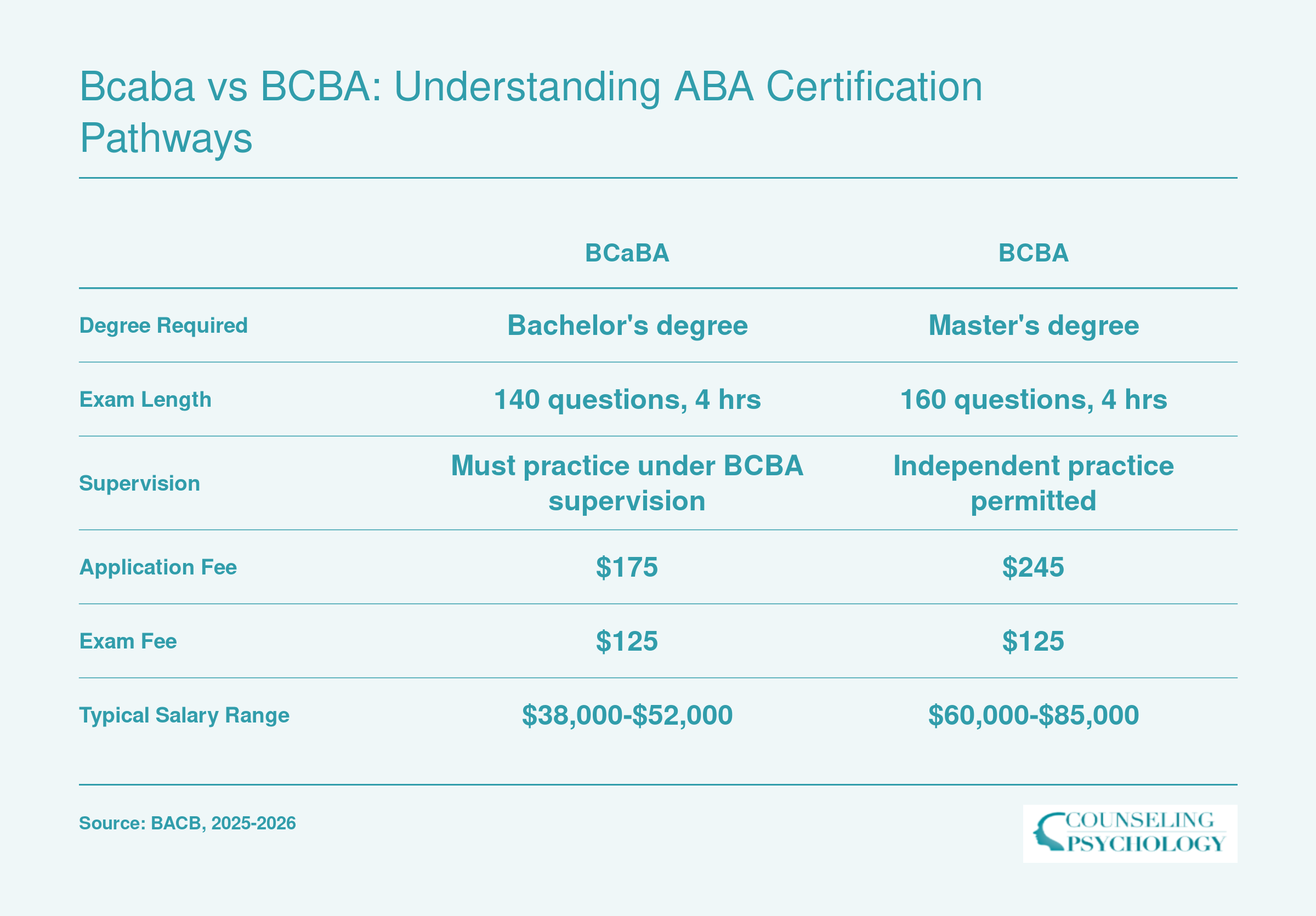
BCaBA vs BCBA: Understanding ABA Certification Pathways
Earning a bachelor's in applied behavior analysis positions you for the Board Certified Assistant Behavior Analyst (BCaBA) credential, not the BCBA. Understanding the differences between these two BACB certifications helps you plan your education timeline and budget realistically. Note that as of January 1, 2026, the BACB requires a coursework attestation form for both pathways.
From Bachelor's to BCBA: Graduate Pathway Alignment
Earning your bachelor's in applied behavior analysis is often just the first step toward BCBA certification. The graduate program you eventually attend, and how smoothly you transition into it, can significantly affect both your timeline and total educational costs. Choosing an undergraduate program with clear graduate pathway alignment is a strategic decision worth making early.
Accelerated and 4+1 Pathways Save Time and Money
Several universities have designed their bachelor's programs to feed directly into affiliated master's programs through formal articulation agreements or accelerated pathways. These arrangements allow students to begin graduate coursework during their senior year, potentially shaving a full year off the traditional timeline.
Saint Louis University, for example, offers a Bachelor's to M.S. in Applied Behavior Analysis accelerated program where students can complete up to 15 graduate credits during their senior year.1 Purdue University's Accelerated MSEd in Applied Behavior Analysis similarly prepares students for the BCBA exam through an integrated pathway.2 At the University of North Florida, accelerated bachelor's to master's pathways combine 120 undergraduate credits with 36 graduate credits for a total of 156 credits across both degrees.4 Buffalo State offers 4+1 accelerated pathways where students meeting a 3.0 GPA requirement can take up to 9 graduate credits during their senior year.3
These programs reduce redundancy, keep tuition costs lower over the full educational journey, and maintain momentum toward certification.
Course Sequence and Fieldwork Transferability
Before committing to an undergraduate program, verify whether its BACB-approved course sequence will carry over to your intended master's program or require supplementation. Some graduate programs accept verified coursework from accredited bachelor's programs, while others mandate specific courses regardless of prior preparation.
Fieldwork hours present a separate consideration. Strong undergraduate practicum experiences can count toward BCaBA fieldwork requirements. However, these hours do not transfer to BCBA supervised experience requirements. The BCBA pathway requires its own distinct accumulation of supervised fieldwork hours at the graduate level. Purdue Global's B.S. in Psychology with an Applied Behavior Analysis concentration, for instance, explicitly notes that its fieldwork eligibility applies to BCaBA certification only, with hours valid only after completing the first qualifying course.5
Think Long-Term ROI
Selecting a bachelor's program with graduate alignment built in can save you both semesters of additional schooling and thousands of dollars in tuition. Before enrolling, ask admissions representatives about articulation agreements, whether coursework transfers to partner programs, and how fieldwork requirements differ between BCaBA and BCBA tracks.
Career Outlook and Salaries for ABA Bachelor's Graduates
A bachelor's in ABA opens immediate doors in behavioral health, but many graduates weigh whether to enter the workforce directly or pursue the BCBA credential for higher pay. Understanding the earnings landscape and job demand can clarify that decision.
Earnings for ABA Bachelor's Graduates
Program-specific early-career earnings for ABA bachelor's completers are not yet available from federal scorecard data. However, institutional-level median earnings 10 years after entry for schools offering ABA bachelor's programs range from about $36,600 to $66,500 nationally. While these figures represent all students at each institution, not just ABA majors, they suggest a broad earning spectrum tied to school choice and career path. Graduates taking roles as Registered Behavior Technicians (RBTs) or Board Certified Assistant Behavior Analysts (BCaBAs) typically fall toward the lower end of that range, while those who advance to BCBA or move into related counseling or behavioral health management can earn significantly more.
How Bachelor's-Level Roles Compare to BCBA Salaries
The BLS does not publish a separate wage series for behavior analysts, but the broader category of substance abuse, behavioral disorder, and mental health counselors (SOC 21-1018) provides a useful benchmark.1 In 2024, the national median annual wage for these counselors was $59,190, with the lowest 10% earning under $39,090 and the top 10% above $98,210.2 Projected job growth from 2023 to 2033 is 18%, much faster than the average for all occupations. These figures, however, tend to reflect master's-level practitioners. Entry-level ABA technicians with a bachelor's degree typically earn less, with salaries often in the $35,000 to $45,000 range initially. The gap between bachelor-level roles and a full BCBA can be $20,000 or more annually, a strong incentive for many to continue their education. For a broader look at compensation across related fields, see our guide to counselor salary by degree and specialty.
Job Growth and Demand
Demand for behavior analysis services continues to rise, driven by increased autism awareness and insurance coverage for ABA therapy.3 The BLS does not project for "behavior analyst" specifically, but the 18% growth rate for substance abuse and behavioral disorder counselors signals robust expansion in related mental health fields.2 This suggests steady opportunities for ABA bachelor's graduates in schools, autism clinics, in-home programs, and residential treatment facilities. Many employers in these settings actively seek RBTs and BCaBAs, and a bachelor's degree is the typical first step.
Common Work Settings
- Autism clinics and therapy centers: Provide one-on-one ABA therapy under BCBA supervision.
- Public and private schools: Support students with behavioral challenges as paraprofessionals or behavior specialists.
- In-home and community-based services: Deliver therapy in natural environments for children and adults with developmental disabilities.
- Residential facilities: Work with individuals requiring intensive behavioral support, often as part of a treatment team.
Progression to BCBA typically requires a master's degree and supervised experience, but the bachelor's pathway lays the groundwork for that career and offers immediate, meaningful employment in a high-need field.
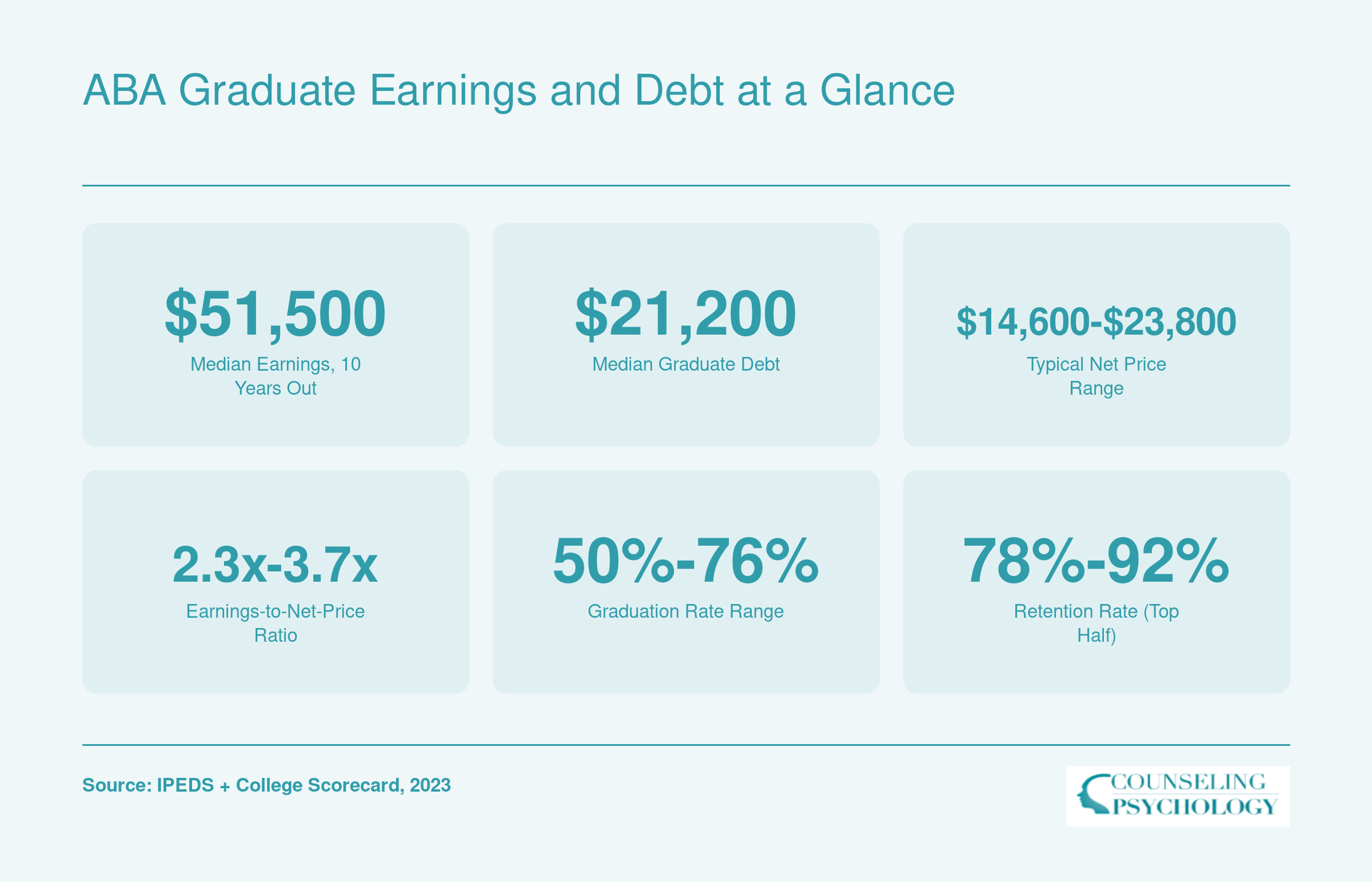
ABA Graduate Earnings and Debt at a Glance
These figures reflect institution-level medians across the ABA bachelor's programs ranked on counselingpsychology.org. Because program-level earnings and employment outcomes are not yet published for most of these programs, the numbers below draw on broader institutional data from the College Scorecard. Compare them against the tuition and net-price figures in the cost table above to gauge overall return on investment.
How to Choose the Right ABA Bachelor's Program
ABAI Verified Course Sequence and BACB-approved coursework are not the same credential, and confusing them can derail your BCaBA timeline before you even apply. Most reputable undergraduate ABA programs hold one or both, but you should verify directly rather than trust marketing copy.
Verify Accreditation and Course Sequence
The Association for Behavior Analysis International (ABAI) maintains a public directory of Verified Course Sequences (VCS) at the bachelor's level. A VCS designation means the coursework satisfies the BACB's content requirements for BCaBA exam eligibility. Ball State, Mississippi State, and both Central Methodist campuses explicitly advertise ABAI verification; Capella notes alignment with the BACB 6th edition task list. Always cross-check the program name and degree level against the ABAI directory and the BACB's own resources before enrolling. Regional institutional accreditation (e.g., Higher Learning Commission) matters too, but it certifies the school, not the ABA curriculum.
Online, Campus, or Hybrid
Most of the programs in this ranking are fully online, including FIU, Purdue Global, Ball State, Capella, UWF, and both UNH offerings. Mississippi State and Felician run hybrid formats with on-site components. Online learners need to plan for one logistical reality: supervised fieldwork cannot be done through a webcam. You will arrange your own local placement at an ABA clinic, school district, or human services agency, and your university's field coordinator will vet the site and assign a qualified supervisor.
Fieldwork Hours and Structure
Under the current BACB standards (in effect since 2022), BCaBA candidates need 1,300 supervised fieldwork hours, with at least 5% supervision in standard fieldwork or 10% in concentrated fieldwork, a minimum of 4 to 6 supervisor contacts per month, and at least 50% one-to-one supervision.1 Hours are capped at 130 per month through 2026 (rising to 160 in 2027) with a 20-hour monthly minimum, and the full 1,300 must be completed within 5 years.2 Programs structure this differently: some embed practicum hours into required courses, others treat fieldwork as a stand-alone capstone, and a few use a hybrid model. Ask how many hours are bundled into the degree versus what you must accumulate post-graduation.
Transfer Credits and Specializations
If you already hold college credit, transfer policies vary widely: Capella and UNH accept up to 90 to 120 credits, while smaller private institutions cap transfers more tightly. Specialization tracks are a tie-breaker once accreditation and cost are settled. Ball State concentrates on autism spectrum disorder, Felician pairs ABA with autism studies, and Purdue Global offers a business foundations track that hints at organizational behavior management. Other common concentrations include developmental disabilities, school-based ABA, and child and adolescent behavior. Students exploring broader behavioral health pathways may also want to review online counseling degree programs for complementary credentials.
Not every degree with applied behavior analysis in its title qualifies you for certification. Before enrolling, confirm the program includes a BACB-approved course sequence. Without this verification, you could complete your entire degree only to discover you cannot sit for the BCaBA exam, wasting years of study and tuition dollars.
Admissions Requirements for ABA Bachelor's Programs
Admissions standards for ABA bachelor's programs are shifting from rigid thresholds toward a more holistic view of student readiness. Most programs require a high school diploma or equivalent and a minimum GPA, but the bar varies widely.1 A handful of competitive programs, like Florida International University (54.7% admission rate) and Central Methodist University's College of Liberal Arts and Sciences (56.9%), accept just over half of applicants, often expecting a GPA of 2.5 or higher alongside strong performance in psychology prerequisites. More accessible options, such as New England College (92.1%) or Ball State University (85.5%), admit the majority of qualified applicants with a GPA of 2.0 or above.
Common Coursework Expectations
While prerequisite requirements are program-specific, many ABA bachelor's degrees expect or strongly recommend foundational psychology courses. A background in introductory psychology, statistics, and research methods provides a critical launchpad.2 Some programs, like those at the University of West Florida, specify prerequisite GPA minimums for admission to the behavior analysis track. Where a student lacks these courses, bridge options or integrated sequences are often available.
Test-Optional and Open-Admission Pathways
Standardized test requirements have largely disappeared from ABA bachelor's admissions.1 Nearly all ranked programs are test-optional, and several large online providers, including Purdue University Global, Capella University, and the University of New Hampshire College of Professional Studies Online, do not report admission rates, suggesting open or near-open enrollment. These institutions prioritize prior college credit and professional experience over entrance exams, lowering the barrier for adult learners and career changers.
Navigating Transfer Credits
Given the popularity of ABA as a second-entry point after community college or a general psychology start, transfer policies matter.3 Generous credit acceptance is common: the University of New Hampshire allows up to 90 transfer credits, and Capella University permits up to 120. However, core ABA coursework often must be completed through the degree-granting institution to meet Verified Course Sequence standards. Students should compare how programs apply transferred credits to major, concentration, and elective buckets, as this can shorten time to graduation substantially.
Online Program Entry Points
Online ABA bachelor's programs frequently feature rolling admissions with multiple start dates each year. Florida International University, for example, offers several entry points annually, while many others follow a quarterly or accelerated term structure. This flexibility lets students begin coursework when it fits their schedule, rather than waiting for a fall-only intake, making it easier to balance work, family, and education.
Frequently Asked Questions About ABA Bachelor's Degrees
Choosing a bachelor's in applied behavior analysis raises practical questions about cost, credentials, and career value. Below are straightforward answers to the questions prospective ABA students ask most often.