
What you’ll learn in this article…
- Applied psychology programs emphasize workforce skills like organizational behavior and data analysis over pure theory.
- Of the 24 programs evaluated for 2026, 18 are offered fully online and 6 use a hybrid format.
- Regional accreditation is the single most important credential to verify before enrolling in any program.
- BLS projects strong demand in human services and organizational roles accessible with a bachelor's in applied psychology.
Employers in healthcare, corporate HR, social services, and education have steadily expanded hiring for roles that require behavioral science skills without requiring a licensed clinician. That demand has pushed applied psychology squarely into one of the faster-growing corners of undergraduate education. The programs ranked here carry net prices ranging from roughly $11,700 to $25,200 per year after aid, and nearly all are delivered fully online or in a hybrid format.
The practical tension most students face is not finding a program but choosing between cost, format, and outcomes with incomplete information. Program-level earnings data for applied psychology completers is not yet available through federal sources, so comparisons rely on institutional graduation rates, debt loads, and transfer-credit policies.
One distinction worth internalizing early: a bachelor's in applied psychology does not confer any clinical license. Roles in counseling, therapy, or case management that require independent practice always demand graduate credentials and supervised hours on top of the undergraduate foundation.
Best Online Bachelor's in Applied Psychology Programs
The programs below represent our top picks for 2026, selected after weighing affordability, graduate outcomes, program flexibility, and curriculum quality. All graduation rates cited are institution-wide figures reported to the federal government; they do not reflect a single major. Where program-level earnings data is not yet available, we note the institution's overall median earnings for context.
- Graduate earnings and debt outcomes
- Net price and affordability
- Institutional graduation and retention rates
- Program format and flexibility
- Curriculum depth and field experience
- College Scorecard graduate earnings — collegescorecard.ed.gov
- Internal program database
- Independent program research
- NCES-IPEDS federal institutional data — nces.ed.gov

SUNY College of Technology at Canton
SUNY Canton delivers a B.S. in Applied Psychology through a hybrid format that blends online coursework with on-campus opportunities, making it especially workable for students in northern New York and beyond. The curriculum pairs crisis intervention training and evidence-based practice coursework with two standout extras: real-world field placements and an optional Addiction Treatment Certificate that can qualify graduates for the CASAC-T credential. With a net price around $15,268 and institution-wide median earnings of roughly $47,860 a decade after enrollment, the school offers a solid return for a public-college price tag.
- Hybrid delivery with online and on-campus options
- Optional Addiction Treatment Certificate for CASAC-T eligibility
- Field experience embedded in the curriculum
- Coursework in crisis intervention and legal standards
- Net price approximately $15,268 (in-state students)
- 18:1 student-to-faculty ratio
- Median graduate debt of $20,000
B.S. in Applied Psychology — Hybrid

Vermont State University
Vermont State University's Applied Psychology and Human Services bachelor's degree stands out for its emphasis on social justice and systemic analysis, backed by two mandatory field placements that give students direct agency or nonprofit experience before graduation. The university reports an 80% job placement rate within two months of completion. At a net price of about $18,212 and a median graduate debt of just $15,000, the lowest debt figure on this list, it offers a cost-effective path for students who plan to enter social services quickly or bridge into a master's program.
- Two required field placements in community settings
- Hybrid format with online and on-campus components
- Reported 80% placement rate within two months of graduation
- Curriculum centered on social justice and systemic analysis
- Median graduate debt of $15,000, lowest among ranked programs
- 13:1 student-to-faculty ratio
- Bridge pathway to a master's degree
- Institution-wide graduation rate of 47.2%
B.S. in Applied Psychology and Human Services — Hybrid

Oregon Institute of Technology
Oregon Tech's fully online B.S. in Applied Psychology follows APA curricular guidelines and covers developmental, social, and counseling psychology through a skills-based framework. Students can tailor their studies via elective tracks and complete an externship for hands-on professional experience. The institution reports median earnings of about $72,273 ten years after enrollment, among the highest on this list, partly reflecting Oregon Tech's broader STEM reputation. Net price sits near $15,706 for in-state students.
- 100% online delivery with no campus visits required
- Curriculum aligned with APA guidelines
- Externship program for supervised professional experience
- Personalized elective tracks across psychology subfields
- Net price approximately $15,706 for in-state students
- Institution-wide median earnings of $72,273 at ten years
- Institution-wide graduation rate of 53.8%
B.S. in Applied Psychology — Online

Ottawa University-Online
Ottawa University's online B.A. in Applied Psychology draws on a scientific research curriculum that spans clinical psychology, neurosciences, and criminal psychology. The 7:1 student-to-faculty ratio is the second-lowest in this ranking, offering unusually close access to instructors. Graduates move into roles in child protective services, law enforcement support, and clinical case management, or continue to graduate school. Tuition is a flat $13,296 regardless of residency, and institutional median earnings reach about $55,552 at the ten-year mark.
- Fully online with flat tuition of $13,296 for all students
- 7:1 student-to-faculty ratio
- Covers clinical, neuroscience, and criminal psychology
- Accredited by the Higher Learning Commission
- Experiential learning integrated into coursework
- Prepares graduates for graduate study or direct career entry
- Median graduate debt of $21,500
Bachelor of Arts in Applied Psychology — Online

City University of Seattle
City University of Seattle's B.A. in Applied Psychology is built for working adults who want to finish a degree on an accelerated timeline, with completion possible in as few as three years. The 5:1 student-to-faculty ratio is the lowest in this ranking, and the curriculum spans psychological theories, ethics, and neuropsychology with a focus on practical applications. Institution-wide median earnings of roughly $69,460 at ten years post-enrollment place CityU among the higher-earning schools on this list. Program-level earnings are not yet available.
- 100% online program at $495 per credit
- Completable in as few as three years
- 5:1 student-to-faculty ratio, smallest in ranking
- Covers ethics, neuropsychology, and applied theories
- Prepares for human services careers or advanced study
- 180 total credits required
- General education prerequisites can be completed in-program
Bachelor of Arts in Applied Psychology — Online

Saint Mary's University of Minnesota
Saint Mary's University of Minnesota offers a fully online B.S. in Applied Psychology built around APA guidelines, targeting students who already hold at least 30 credits. Up to 90 credits can transfer in, which shortens the timeline considerably for community college graduates or career changers. At $440 per credit and a net price of about $11,704 after aid, it is the most affordable private school on this list. Institution-wide graduation sits at 66%, the highest among the private institutions ranked here.
- Fully online with flexible start dates throughout the year
- Accepts up to 90 transfer credits
- Net price approximately $11,704 after institutional aid
- $440 per credit tuition rate
- Curriculum follows APA guidelines
- Emphasis on ethical standards and scientific reasoning
- Institution-wide graduation rate of 66%
- Requires minimum 30 prior credits for admission
B.S. in Applied Psychology — Online

University of Mount Olive
The University of Mount Olive's 100% online B.A. in Applied Psychology is tailored for adult learners juggling work and family. The program reports a 100% graduate-school acceptance rate for its completers, a notable point for students who view the bachelor's as a stepping stone to licensure-track master's programs. Net price lands at roughly $18,853, and institution-wide median earnings are about $47,139 ten years after enrollment, so prospective students should weigh debt carefully since median graduate debt is approximately $27,209.
- 100% online with scheduling flexibility for working adults
- Reports 100% graduate school acceptance for completers
- Curriculum blends theory with practical application
- Networking and real-life experience emphasized
- Institution-wide graduation rate of 51.8%
- Net price approximately $18,853 after aid
- Median graduate debt around $27,209
Bachelor of Arts in Applied Psychology — Online

University of Massachusetts-Amherst
UMass Amherst offers an online Interdisciplinary Studies bachelor's with a concentration in Applied Psychology, available in two tracks: Educational and Social Psychology or Abnormal Psychology. Students can transfer up to 105 credits, making this an appealing completion option for community college graduates. The program blends asynchronous online classes with the academic weight of a flagship public research university. Institution-wide median earnings hit roughly $71,631 at ten years, and the university's 83.3% graduation rate is the highest on this list.
- Concentration options: Educational/Social Psychology or Abnormal Psychology
- 100% online with asynchronous course delivery
- Accepts up to 105 transfer credits
- Flagship research university academic resources
- Institution-wide graduation rate of 83.3%, highest in ranking
- Institution-wide median earnings of approximately $71,631 at ten years
- Net price around $22,383 for in-state students
- Employer partnership tuition discounts may apply
Interdisciplinary Studies with a Focus in Applied Psychology — Online

Judson University
Judson University blends a liberal arts identity with career-focused applied psychology training delivered in a hybrid format. The curriculum integrates Christian perspectives alongside coursework in critical thinking, cultural competence, and ethical practice, culminating in a capstone experience. A 10:1 student-to-faculty ratio supports close mentorship. Institution-wide median earnings reach about $56,313 at the ten-year mark, and the 59.9% graduation rate is solid among the private schools on this list.
- Hybrid format with online and on-campus components
- 46 credit hours in the major
- Capstone learning experience required
- Integrates Christian perspectives with applied coursework
- Emphasis on cultural competence and ethics
- 10:1 student-to-faculty ratio
- Net price approximately $18,558 after aid
Applied Psychology — Hybrid

Franklin University
Franklin University's B.S. in Psychology emphasizes practical applications across forensic, industrial-organizational, and sports psychology domains, all delivered 100% online. A tuition guarantee locks the per-credit rate from day one, an appealing feature for budget-conscious adult learners. Students can transfer up to 90 credits and choose from three focus areas and 6- or 12-week course formats. The institution-wide graduation rate of 11.1% is low, though this reflects a largely part-time, working-adult student body rather than academic rigor concerns. Median earnings reach approximately $51,892 at ten years.
- 100% online with 6-week and 12-week course options
- $398 per credit with tuition rate guarantee
- Up to 90 transfer credits accepted
- Three focus-area tracks available
- Capstone research or practicum option
- 120 total credits for degree completion
- Designed for completion in approximately 21 months
B.S. in Applied Psychology — Online
How We Ranked These Applied Psychology Programs
Choosing a program often comes down to a familiar tension: the most affordable option is not always the most flexible, and the most convenient online format does not always come with the strongest outcomes. This ranking tries to surface programs where cost, flexibility, and results overlap, rather than forcing you to sacrifice one for another.
What the Rankings Weigh
Net price and financial aid generosity carry the heaviest weight here. Tuition sticker prices can be misleading, so the ranking centers on what students typically pay after grants and aid, not the posted rate. Programs that keep actual costs low for undergraduates score higher than programs with impressive reputations but punishing net costs.
Beyond price, the ranking factors in:
- Graduation rates: Drawn from federal IPEDS and College Scorecard data at the institution level. A school where most students finish is a meaningful signal, even if it does not tell you the completion rate for applied psychology specifically.
- Earnings after graduation: Program-level earnings data from College Scorecard, including both shorter-term and longer-term post-completion medians, show what graduates of a given program typically earn, not just graduates of the institution overall.
- Online availability: Programs with fully online or hybrid options score higher on flexibility, which matters for working adults and students outside major metro areas.
A Note on Data Limitations
Graduation rates in this ranking reflect institution-wide figures, not program-specific ones. A school with a strong overall completion rate may still have variation across individual majors, and the reverse is also true. Where program-level completion data becomes available, the methodology will be updated. Transparency about this limitation is intentional: several competing rankings present institutional metrics as though they describe specific programs, and that conflation can mislead prospective students.
Why Methodology Transparency Matters
Many ranking lists in this space do not disclose how they score or weight programs. That makes it impossible to tell whether a list reflects genuine student outcomes or simply mirrors institutional prestige and marketing budgets. The criteria here are spelled out so you can decide how much weight each factor deserves for your own situation. If earnings matter most to you, lean on that data. If keeping debt low is the priority, the net-price figures are your starting point.
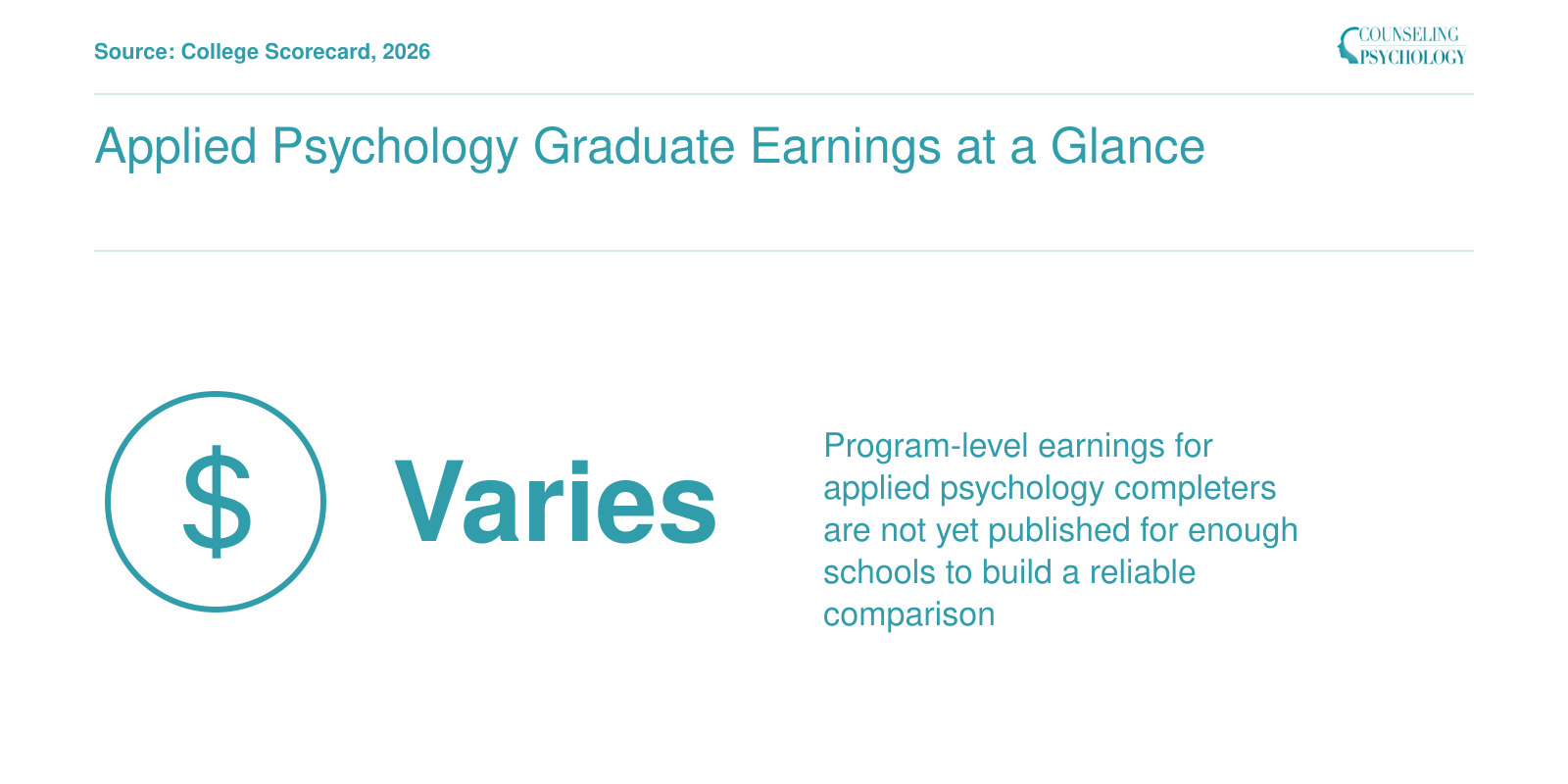
Applied Psychology Graduate Earnings at a Glance
We intended to present a grouped bar chart comparing median first-year earnings across the top applied psychology programs. However, the College Scorecard has not yet released program-level earnings data for a sufficient number of bachelor's in applied psychology completers. Once updated figures become available, this section will feature a school-by-school earnings comparison. In the meantime, the career outcomes section below discusses broader salary benchmarks drawn from BLS occupational data.
What Is Applied Psychology and How Does It Differ From General Psychology?
Theory-focused exploration or practical workforce readiness: that is the core divide between general psychology and applied psychology bachelor's programs.1 Both paths share foundational coursework in introductory psychology, research methods, statistics, developmental psychology, and social psychology. The split emerges when students ask whether they want to study human behavior primarily through research and theory or through direct application to workplace challenges, health promotion, and organizational settings.
Defining Applied Psychology
Applied psychology uses established psychological principles to solve real-world problems across industries and community settings.2 Rather than concentrating on laboratory experiments or theoretical models, applied psychology bachelor's programs train students in skills such as group facilitation, conflict resolution, program evaluation, and behavioral intervention design. Curricula typically include courses in applied social psychology, health psychology, industrial-organizational psychology, and community psychology. Fieldwork placements in HR departments, nonprofits, health promotion agencies, or social service organizations are common, giving students hands-on experience before graduation.2
How General Psychology Differs
General psychology degrees, available as either a B.A. or B.S., emphasize broad theoretical study and the scientific foundations of the discipline.3 Students take extensive coursework in experimental design, cognitive psychology, biological bases of behavior, and advanced statistics. A B.S. in psychology leans more heavily on quantitative methods and natural sciences, while a B.A. in psychology allows for more humanities and social science electives.3 Fieldwork is optional in most general psychology programs, and career paths often include research assistant roles, case management positions, human services work, or stepping stones into graduate study in clinical, counseling, or experimental psychology. Students who pursue those graduate pathways may eventually explore an online master's in psychology to deepen their expertise.
Clinical Psychology at the Bachelor's Level
Some universities offer a bachelor's track labeled clinical psychology, though true clinical practice requires graduate training.4 These undergraduate tracks prepare students for graduate admission by emphasizing abnormal psychology, theories of counseling, introduction to clinical psychology, and fieldwork in mental health settings such as residential treatment programs or psychiatric facilities. Graduates often work as psychiatric technicians, residential counselors, or case managers before pursuing a master's or doctorate for full licensure.
Common Specialization Tracks in Applied Psychology
Applied psychology programs frequently allow students to concentrate in:
- Organizational psychology: workplace behavior, leadership, employee selection and training
- Health psychology: chronic disease management, health behavior change, wellness promotion
- Forensic psychology: criminal behavior, juvenile justice, courtroom consulting
- Educational psychology: learning theory application, school-based interventions, instructional design
These specializations sharpen students' focus and improve alignment with specific career sectors. Students drawn to the organizational track, for example, may eventually pursue a career as an industrial organizational psychologist.
Which Is Better: B.A. Psychology or B.A. Applied Psychology?
The answer depends on your career timeline and goals. Applied psychology is better for students who want immediate workforce relevance and plan to enter fields such as HR, social services, health promotion, or program coordination directly after graduation.2 General psychology is better for those targeting graduate school in clinical, counseling, or experimental psychology, or for students who value flexibility and want to explore the discipline's breadth before committing to a specialization. Neither degree is objectively superior; alignment with your intended next step determines fit.
Related Articles
Questions to Ask Yourself
What Can You Do With a Bachelor's in Applied Psychology?
A bachelor's in applied psychology opens real doors, but the honest question prospective students should ask is: which doors, and how wide? The degree supports entry into several well-paying, growing fields without additional graduate study. For roles involving independent clinical practice or licensure as a counselor or psychologist, a master's or doctorate is required, no exceptions. Knowing that boundary upfront helps you plan rather than discover it mid-career.
Jobs You Can Pursue Directly
Applied psychology graduates are competitive candidates for a range of roles across business, human services, and behavioral health. Many of these overlap with broader careers in psychology that reward practical, data-informed skills:
- Human resources specialist: Screening candidates, supporting employee relations, and administering benefits. The Bureau of Labor Statistics reports a 2024 national median annual wage of $72,910 for this occupation, with 6% projected job growth through 2034, faster than average.1 A bachelor's degree meets the standard entry requirement.
- Market research analyst: Designing surveys, interpreting consumer behavior data, and translating psychological insights into business strategy. This occupation has seen strong demand growth as organizations invest more heavily in behavioral data.
- Training and development specialist: Creating workplace learning programs and coaching employees on performance. The behavioral and instructional design skills built in applied psychology coursework translate directly here.
- Case manager: Coordinating services for clients in healthcare, social services, or nonprofit settings. This is one of the more accessible paths for new graduates who want client-facing work without yet having a graduate degree.
- Behavioral technician: Working under the supervision of a licensed behavior analyst to implement treatment plans, often in autism services or school-based settings. This role typically requires only a bachelor's and brief certification.
- Social and community service manager: Overseeing programs that support vulnerable populations. Entry-level program coordinator roles often lead here with experience.
Is the Degree Worth It?
For graduates entering fields like HR and market research, the earning potential is solid. Schools appearing among the top applied psychology programs by graduate earnings show median alumni wages in the high $60,000 to low $70,000 range roughly ten years after enrollment. That aligns closely with the national BLS median for HR specialists and is consistent with market research analyst wages as well, suggesting the degree holds up in salary terms for graduates who pursue those paths deliberately.
The ceiling at the bachelor's level is real, though. Roles such as licensed professional counselor, licensed clinical social worker, or clinical psychologist all require supervised graduate-level training and state licensure. If those titles are your goal, treat the bachelor's as the foundation it is: essential, but not the finish line.
Online vs On-Campus Applied Psychology Degrees
Most of the applied psychology programs in our rankings are delivered fully online or in a hybrid format. Of the 24 programs we evaluated, 18 are offered entirely online, 6 use a hybrid model blending online coursework with some on-campus requirements, and none are exclusively on-campus. That distribution reflects a broader shift: employer perception of online bachelor's degrees from regionally accredited institutions is now generally neutral to positive, with hiring managers increasingly treating them as equivalent to traditional credentials. The key differences between formats come down to logistics, cost, and how you prefer to learn.
| Dimension | Fully Online | On-Campus or Hybrid |
|---|---|---|
| Flexibility | Asynchronous coursework lets you study on your own schedule, ideal for working adults, parents, and career changers. Many programs offer accelerated terms (5 to 8 weeks). | Fixed class schedules with some evening or weekend options. Hybrid programs add online modules but still require periodic in-person attendance. |
| Average Net Price | Net prices among the online programs in our rankings range from roughly $10,900 (UNH College of Professional Studies Online) to over $36,000 (Loyola University Chicago, Concordia University Wisconsin). Public online options like Oregon Tech and SUNY Canton cluster near $15,000 to $16,000. | Hybrid programs at private institutions such as Regis University (approximately $18,400 net) and Elmhurst University (approximately $24,200 net) tend to land in a similar or slightly higher range once campus fees are included. |
| Practicum and Internship Access | Students arrange field placements locally, which can be an advantage if you already work in a human services setting. Programs like Oregon Tech and Franklin University build externship or practicum options into the online curriculum. | On-campus and hybrid programs often maintain established agency partnerships nearby. Vermont State University, for example, includes two supervised field placements, and Judson University integrates field experience into its hybrid structure. |
| Peer Networking | Discussion boards, group projects, and virtual study sessions are the primary channels. Cohort models (Elms College uses one) can strengthen connections, but organic social interaction is limited. | In-person seminars and campus events create natural networking opportunities. Smaller hybrid programs like Regis University (11:1 student-to-faculty ratio) and Judson University (10:1) offer more direct faculty mentorship. |
| Typical Student Profile | Working professionals, military-connected students, and adult learners completing a degree. Many ranked programs accept 75 to 90 transfer credits, accommodating community college graduates. | Traditional-age students and local adult learners who value face-to-face interaction. Hybrid formats at schools like SUNY Canton and Loyola University Chicago also attract students transitioning from associate degree programs. |
Most Affordable Online Applied Psychology Programs
Sticker tuition can be misleading, especially for online learners who often qualify for institutional aid, federal grants, or employer tuition benefits. Net price, the average annual cost after all grants and scholarships are applied, gives a far more accurate picture of what you will actually pay. The five programs below represent the lowest net prices among the applied psychology bachelor's degrees in our dataset. Program-level earnings data is not yet available for these programs, so the earnings column reflects the institution-wide median at 10 years after enrollment.
| School | Net Price | Graduation Rate | 10-Year Median Earnings (Institution-Wide) |
|---|---|---|---|
| University of New Hampshire at Manchester | $9,992 | 50% | $66,479 |
| UNH College of Professional Studies Online | $10,864 | 29.5% | $66,479 |
| Saint Mary's University of Minnesota | $11,704 | 66% | $58,170 |
| SUNY College of Technology at Canton | $15,268 | 38.5% | $47,860 |
| Oregon Institute of Technology | $15,706 | 53.8% | $72,273 |
Admissions Requirements and How to Choose a Program
Most bachelor's in applied psychology programs now accept transfer students and working adults alongside traditional freshmen, which means admissions criteria have broadened considerably. To understand what any given school requires, start with the program's official website under 'Admissions' or 'How to Apply.' Requirements vary widely by institution, and only the official source will clarify whether your transcript, test scores, or prior experience align with their expectations.
Typical Admissions Components
Online and on-campus applied psychology bachelor's programs commonly ask for a high school diploma or GED, official transcripts, and a minimum cumulative GPA (often 2.5 to 3.0 for first-year applicants, slightly higher for transfers). Many programs have adopted test-optional or test-flexible policies, meaning SAT or ACT scores are no longer required. Check each school's current policy, as the landscape shifted dramatically after 2020 and continues to evolve.
Some schools require prerequisite courses in statistics, research methods, or introductory psychology before admission or during the first year. Transfer applicants should review the school's articulation agreements or credit equivalency tables to see how many credits will carry over. If you hold an associate degree in a related field, you may satisfy all lower-division requirements, cutting time and cost.
How to Gather Accurate Information
Trusted education guides and ranking publishers produce curated comparison tables that list GPA cutoffs, test policies, and prerequisite expectations side by side. These aggregators save hours of web searching and help you narrow your shortlist quickly. For personalized guidance on transfer credits, prerequisite waivers, or portfolio submissions, contact admissions offices directly. Staff can explain how your background matches their criteria and whether you qualify for advanced standing or course substitutions.
Ensuring Career Alignment
Before you commit, cross-reference program requirements with BLS.gov and your state's professional licensing board. If you plan to pursue graduate training for licensure as a marriage and family therapist, clinical social worker, or licensed professional counselor, verify that your bachelor's curriculum includes the foundational courses (abnormal psychology, developmental psychology, counseling techniques) that graduate programs expect. Students interested in couple and family therapy, for example, should understand LMFT supervision hours and how early coursework supports that path. For those leaning toward clinical counseling tracks, exploring the best masters in mental health counseling programs can help you reverse-engineer the right undergraduate plan. An applied psychology degree is flexible, but not all programs emphasize clinical or therapeutic content equally. Matching your undergraduate curriculum to your long-term career goal saves both time and tuition dollars later.
Accreditation and Licensure Considerations
Regional accreditation is the single most important credential to verify before enrolling in any bachelor's in applied psychology program, and overlooking it can cost you years of progress.
Why Regional Accreditation Is the Baseline
Six recognized regional accrediting bodies (HLC, SACSCOC, MSCHE, NECHE, NWCCU, and WSCUC) evaluate colleges and universities across the United States. A degree from a regionally accredited institution ensures three things:
- Credit transferability: Other accredited schools will accept your coursework if you decide to transfer or pursue a graduate degree.
- Employer recognition: Hiring managers in HR, community services, and government agencies routinely screen for degrees from accredited institutions.
- Graduate school eligibility: Master's and doctoral programs in counseling, psychology, and social work almost universally require applicants to hold an undergraduate degree from a regionally accredited school.
If a program lacks regional accreditation, treat that as a dealbreaker.
APA Accreditation Does Not Apply at the Bachelor's Level
This trips up a lot of prospective students. The American Psychological Association accredits doctoral programs and selected master's programs, not undergraduate degrees.2 No bachelor's in applied psychology carries APA accreditation because it simply does not exist at that level. Many strong programs do align their curricula with APA Undergraduate Guidelines, which helps prepare students for graduate study, but that alignment is not the same as programmatic accreditation.3 Regional accreditation of the institution is what matters for a bachelor's degree.
The Licensure Gap You Need to Understand
A bachelor's in applied psychology does not qualify you for licensure as a psychologist, licensed professional counselor (LPC), licensed marriage and family therapist (LMFT), board certified behavior analyst, or school psychologist. Every one of those credentials requires graduate education:
- Licensed psychologist roles require a doctorate, passage of the EPPP exam, and one to two years of supervised experience.
- LPC licensure requires a master's degree (typically 48 to 60 or more credit hours), plus 2,000 to 3,000 hours of supervised clinical work. Programs accredited by CACREP are strongly preferred, and students interested in that route can explore licensed professional counselor online degree options.
- LMFT and BCBA credentials each require at least a master's degree.
A smaller number of positions, such as substance abuse counseling roles, psychological technician, or qualified mental health professional, can be filled with a bachelor's degree in psychology or a behavioral science field. These roles involve direct client support but do not carry the same independent practice authority that a license provides.
Do You Need a Master's After a Bachelor's in Applied Psychology?
The honest answer depends on the career you want. If your goal is any form of licensed clinical practice, yes, graduate school is not optional. But many applied roles in organizational development, human resources, workforce training, program evaluation, and community outreach hire candidates with a bachelor's degree and relevant experience. Those positions value the research literacy, data analysis skills, and understanding of human behavior that an applied psychology curriculum delivers, without requiring a graduate credential. Knowing which path you are aiming for before you enroll helps you choose the right program and avoid unnecessary surprises later.
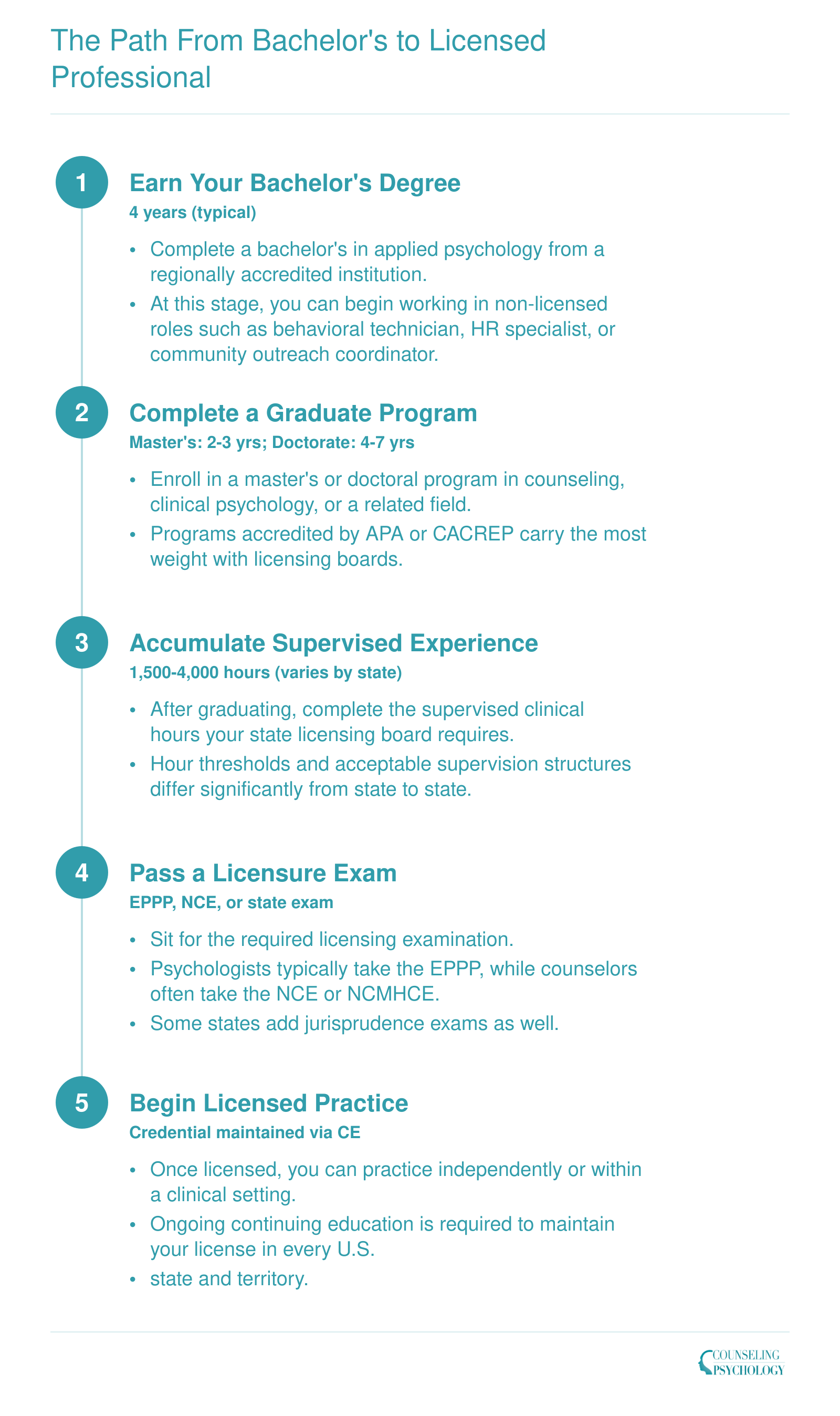
The Path From Bachelor's to Licensed Professional
Not every applied psychology graduate needs to climb the full credentialing ladder. Many enter the workforce right after earning their bachelor's degree, taking roles in human services, research assistance, case management, or organizational development. The complete sequence below is required only for licensed clinical or counseling positions.
Frequently Asked Questions About Applied Psychology Bachelor's Degrees
Choosing the right degree path raises plenty of practical questions. Below are answers to the topics prospective applied psychology students ask about most often, from program structure to career payoff.
More Online Applied Psychology Programs to Consider
If the top-ranked programs don't quite fit your budget or schedule, explore these additional online applied psychology bachelor's degrees. Each offers unique concentrations and flexible formats to help you reach your career goals.
- Applied Psychology
- Applied Psychology
- Applied Psychology
- Bachelor of Science in Applied Psychology
- Bachelor of Arts in Applied Psychology
- Applied Psychology
- Applied Psychology (Applied Behavior Analysis)
- Applied Psychology (Counseling Foundations)
- Applied Psychology (Organizational Psychology)
- Applied Psychology (Clinical Psychology)
- Applied Psychology (Child Advocacy)
- Applied Psychology
- Applied Psychology (Addictions Studies)
- Applied Psychology (Organizational Psychology)
- Applied Psychology
- Applied Psychology
- Applied Psychology (Applied Behavior Analysis)
- Applied Psychology (Wellness and Prevention)
- Applied Psychology BA (Organizational Track)
- Applied Psychology BA (Counseling Track)
- Applied Psychology