What you’ll learn in this article…
- California's most affordable psychology programs have net prices under $10,000 per year after grants and scholarships.
- Most top California psychology programs no longer require GRE scores for master's or doctoral admissions.
- Online psychology degrees can satisfy California licensure requirements, but only if the program holds regional accreditation and its practicum hours count toward supervised professional experience.
- California psychology graduates consistently earn above the national median, with doctoral holders seeing the strongest long-term salary trajectories.
Which California psychology programs deliver the best value for tuition, and do online options actually prepare graduates for licensure?
California hosts over 100 psychology program listings across 29 ranked schools, spanning bachelor's completion tracks, master's degrees, graduate certificates, and doctoral programs. Tuition ranges from under $10,000 at CSU campuses to over $35,000 at private institutions, making cost a defining variable. Online and hybrid formats now dominate program offerings, though not every delivery method satisfies the California Board of Psychology's supervised experience requirements.
The state's psychology workforce is expanding faster than the national average, yet career ROI varies sharply by degree level and specialization. Program-level earnings data remain limited for many schools, making informed comparison more difficult than it should be.
How We Ranked California Psychology Schools
Choosing a psychology program in California means weighing cost against flexibility, prestige against practical fit, and short-term affordability against long-term earning power. The rankings on this page are designed to make that tradeoff legible rather than leave you guessing.
What the Numbers Measure
Four core factors shape every position on this list:
- Net price: What students actually pay after grants and scholarships, not the sticker price listed in a brochure.
- Graduation rate: The share of enrolled students who complete their degree, used as a proxy for institutional support and student success.
- Post-completion earnings: Reported at one, two, and four years after graduation, drawn from federal data, to capture both near-term job placement and longer-horizon salary growth.
- Debt-to-earnings ratio: Median graduate debt measured against ten-year earnings, so you can see whether a diploma is likely to pay for itself.
Two filters are active on this page by default: programs are screened for affordability and for online or hybrid delivery. Schools that clear both filters are ranked; those that do not are listed separately at the bottom of the page.
Where the Data Comes From and What It Cannot Tell You
Graduation rates here reflect institution-wide completion, not outcomes for psychology majors specifically. A school with an 80 percent overall graduation rate may perform differently within its psychology department. Keep that in mind when comparing schools that sit close together on the list.
Net price figures are sector-conditional averages. For undergraduate programs, the figure reflects the average aid package offered to full-time, first-time students at a given price band. For graduate programs, tuition is reported separately for in-state and out-of-state enrollment rather than collapsed into a single average, because the difference is substantial at many California public institutions.
Program-level earnings come from the College Scorecard and represent completers from a specific credential, not the institution overall. Where those figures are not yet published for a given program, the entry says so plainly. Return on investment is calculated by comparing ten-year projected earnings against median debt at graduation, giving you a straightforward signal: does the credential cover its cost within a reasonable timeframe. If you are weighing advanced credentials, our overview of clinical psychology doctorate programs can help you benchmark costs and outcomes at the graduate level.
No ranking captures everything that matters to you personally. Use these numbers as a starting point, then dig into curriculum, clinical placement availability, and licensure pass rates before making a final call.
Top 10 Best Psychology Programs in California
California's psychology landscape spans every degree level and specialization imaginable, from forensic master's programs at research universities to fully online doctorates built for working professionals. The ten schools below were selected using a composite of affordability, graduate outcomes, and program quality indicators. Each one offers something distinct, whether that is a rock-bottom net price, an unusually flexible online format, or a curriculum tightly aligned with California licensure requirements.
- Graduate earnings and debt levels
- Net price and financial aid access
- Graduation and retention rates
- Program format and flexibility
- California licensure alignment
- Internal program database
- College Scorecard graduate earnings — collegescorecard.ed.gov
- NCES-IPEDS federal institutional data — nces.ed.gov
- Independent program research

University of California-Irvine
UC Irvine pairs the research prestige of a top-tier public university with a hybrid Master of Legal and Forensic Psychology that blends psychology, law, and criminology. With median earnings of $80,735 ten years after enrollment and median graduate debt of just $15,000, graduates enjoy one of the strongest return-on-investment profiles on this list. The curriculum draws on California legal system case studies, preparing students for careers in state courts, corrections, and public policy agencies.
- Interdisciplinary program spanning Psychological Science and Criminology departments
- Hybrid format with mostly online coursework and limited campus sessions
- Integrates California court, corrections, and policy case studies
- Designed for careers in research, government, and public service
- Federal financial aid eligible as a self-supporting professional program
- Part-time friendly scheduling for working California professionals
Master of Legal and Forensic Psychology — Hybrid

California State University-San Marcos
Cal State San Marcos delivers a fully online, BACB-approved Applied Behavior Analysis Certificate through the affordable CSU system. At a net price of roughly $10,229 and with two certification tracks (21 units for BCBA, 18 units for BCaBA), it is one of the most budget-friendly paths to board certification in California. Cohort-style, sequential 8-week courses keep scheduling predictable for practitioners already working in schools or regional centers.
- Fully online, BACB-approved coursework in sequential 8-week courses
- Two tracks: 21 units for BCBA candidates, 18 units for BCaBA candidates
- CSU-system pricing keeps per-unit costs well below private competitors
- Cohort model ensures predictable progression through the curriculum
- Tailored for professionals in California schools, clinics, and regional centers
- Graduate or bachelor's degree required depending on certification track
Applied Behavior Analysis Certificate of Advanced Study — Online

California Institute of Integral Studies
CIIS in San Francisco stands out for breadth: an online B.S. completion in Psychology, two distinct master's tracks in counseling psychology (including one approved for California LPCC and LMFT licensure), and an M.A. in Applied Psychology with a Mandarin-speaking focus. Its social-justice orientation and integration of Western and non-Western perspectives reflect the Bay Area's diverse communities. Fixed-tuition options and scholarships help offset private-school pricing.
- Online degree-completion program for students with 54+ transferable units
- Social justice curriculum blending neurobiology, cognition, and trauma studies
- Asynchronous classes with one 3-day in-person intensive per semester
- Accelerated bachelor's-to-master's pathway available
- Scholarships and fixed-tuition rate option to manage costs
- Prepares graduates for helping professions, education, and human resources
- Fully online, asynchronous two-year master's program
- Mandarin-speaking community focus addresses California multilingual workforce needs
- Emphasis on personal growth, diversity, and career impact
- Strong writing skills expected; flexible curriculum design
- 66-unit hybrid master's meeting California BBS requirements for LPCC
- Spring cohort start with online weekends and in-person retreats in San Francisco
- Year-long practicum with field placement support
- Covers multicultural counseling, trauma studies, and Gestalt therapy
- Prepares for both MFT and LPCC licensure pathways in California
- Personal psychotherapy requirement integrated into training
- Hybrid format focusing on social justice and systemic oppression
- Prepares for MFT and LPCC licensure in California
- Clinical practicum and personal therapy required
- Admissions require bachelor's degree and 3.0 GPA
Bachelor of Science in Psychology — Online
M.A. in Applied Psychology — Online
Integral Counseling Psychology (Hybrid) — Hybrid
M.A. in Community Mental Health — Online

Touro University Worldwide
Touro University Worldwide is a California-based nonprofit offering an unusually wide menu of 100% online psychology programs, from a forensic psychology bachelor's to master's degrees in I/O psychology, health psychology, child development, and addiction counseling. With flat-rate tuition, no residency requirement, and the ability to transfer up to 90 credits at the bachelor's level, TUW consistently appears on affordability lists. A 10:1 student-to-faculty ratio keeps class interactions personal despite the online format.
- 100% online with no residency; transfer up to 90 credits
- 8-week course sessions with six annual start dates
- Covers criminal behavior, psychological assessments, and legal system dynamics
- Prepares graduates for advanced study or entry-level forensic careers
- Nonprofit, WSCUC-accredited institution based in California
- Online format with flexible scheduling for working students
- Focuses on cross-cultural workplace issues and organizational improvement
- Foundation for graduate study in I/O psychology
- 36-credit online master's completable in as little as one year
- Five concentrations: forensic, health, child and adolescent development, general, and I/O
- No GRE required; $500 per credit; transfer up to 9 credits
- Eight-week sessions with six start dates per year
- Scholar-practitioner faculty with real-world experience
- WSCUC-accredited, suitable for pre-doctoral preparation
- 36-credit online program with Community Criminal Issues or Sex Offender Issues concentrations
- No GRE required; completable in one year full-time
- Career-focused curriculum preparing for doctoral work or forensic careers
- Eight-week course blocks with six annual start dates
- Three concentrations: Coaching and Consulting, HR Management, Occupational Health Psychology
- 36-credit, 12-course sequence aligned with professional psychology standards
- 100% online with flexible scheduling for working professionals
- Develops skills in team leadership, organizational behavior, and workplace improvement
- 60-hour program designed for two-year completion
- CACREP-aligned curriculum meeting California requirements
- Clinical internships included for hands-on training
- Prepares students for licensure as professional counselors
Bachelor of Arts in Psychology, Forensic Psychology Concentration — Online
Bachelor of Arts in Psychology, Industrial/Organizational Psychology Concentration — Online
Master of Arts in Psychology — Online
Master of Science in Forensic Psychology — Online
Master of Arts in Industrial and Organizational Psychology — Online
Master of Arts in Counseling, Addiction Counseling Concentration — Online

The Chicago School at San Diego
The Chicago School at San Diego leverages a small 11:1 student-to-faculty ratio and deep connections to Southern California's legal and corporate sectors. Its hybrid M.A. in Forensic Psychology is explicitly structured for California LPC licensure, requiring 700 hours of clinical training in local courts, correctional facilities, and community agencies. A fully online M.A. in Industrial and Organizational Psychology rounds out the offerings for students targeting corporate or consulting roles.
- Hybrid format with online coursework and San Diego campus sessions
- Designed to meet California LPC educational requirements
- 700 hours of clinical training in local legal and community settings
- Full-time completion in two years; part-time option in three to four years
- Admissions require 3.0 GPA and one undergraduate statistics or research course
- Covers ethics, human development, and forensic psychology applications
- 100% online master's focused on workplace assessment and performance management
- Prepares for HR, consulting, and talent management roles
- Covers organizational development, change management, and employee selection
- Available through the San Diego campus with online delivery
- Financial aid options available for qualified students
M.A. Forensic Psychology: Professional Counselor Licensure — Hybrid
M.A. Industrial and Organizational Psychology — Online

Los Angeles Pacific University
Los Angeles Pacific University offers a compact, fully online M.A. in Psychology with three concentration tracks: Industrial/Organizational, Developmental, and General Psychology. At $680 per credit and only 36 units, the total program cost is roughly $24,480, making it one of the most transparent and affordable private master's options in California. A bachelor's program in Applied Psychology with a Clinical Psychology concentration adds an undergraduate pipeline for students who want to stay at one institution.
- 36-unit online program at $680 per credit (approx. $24,480 total)
- Three concentrations: Industrial/Organizational, Developmental, General Psychology
- Integrates professional ethics, cultural diversity, and statistical analysis
- Designed as preparation for doctoral studies or applied careers
- Flexible format built for working professionals across California
- Online format with 45 major units at $515 per credit
- Focus on counseling techniques, social psychology, and ethical behavior
- Christian worldview integration throughout the curriculum
- Prepares students for mental health careers and graduate study
Master of Arts in Psychology — Online
Bachelor of Arts in Applied Psychology, Clinical Psychology Concentration — Online

Southern California Seminary
Southern California Seminary's Doctor of Psychology (PsyD) with an Educational Psychology emphasis is a hybrid, faith-based doctorate offered at comparatively modest tuition. With a 9:1 student-to-faculty ratio, students receive close mentorship through 54 to 69 units of coursework, a dissertation, and an oral defense. This is a non-licensure program, best suited for individuals pursuing advanced psychology skills within ministry, church counseling, or private Christian school settings.
- Hybrid format blending online coursework with on-campus sessions in El Cajon
- 54 to 69 units required; includes dissertation and oral defense
- Biblical integration woven throughout the curriculum
- Non-licensure program; suited for ministry, counseling, and institutional roles
- Minimum 3.0 GPA required for admission
- 9:1 student-to-faculty ratio ensures close faculty mentorship
Doctor of Psychology (PsyD), Educational Psychology Emphasis — Hybrid

Fresno Pacific University
Fresno Pacific University serves California's Central Valley with hybrid psychology programs spanning a bachelor's completion in General Psychology, an M.A. in School Psychology with a PPS Credential, an M.A. in Applied Behavior Analysis verified by ABAI, and a dual School Psychology/School Counseling credential. At a net price of about $13,630, it is one of the most affordable private options on the list. Local internship partnerships with Central Valley school districts and community agencies add practical value.
- Hybrid program with face-to-face or fully online options; meets once per week
- 50 to 53 units; average 24-month completion in cohorts of 12 to 22 students
- Internship and research project opportunities in the Central Valley
- 2.75 GPA required; financial aid available
- North Fresno and Visalia campus locations reduce relocation costs
- 62-unit hybrid program aligned with California CTC standards
- Embedded BCBA coursework alongside school psychology training
- Small class sizes with current practitioners as faculty
- Synchronous online options plus on-campus sessions
- Prepares for the California Pupil Personnel Services credential
- 32-unit hybrid program verified by ABAI for BCBA exam preparation
- Evening classes designed for working professionals in the Central Valley
- Covers ethics, assessment, and intervention strategies
- Starts in Fall and Spring; financial aid options available
- 90-unit dual credential program with 1,200-hour internship
- Three-year full-time completion; blended online and on-campus format
- Approximately $770 per unit; minimum 3.0 GPA required
- Earns two Pupil Personnel Services credentials simultaneously
Psychology, B.A. — Hybrid
School Psychology, M.A. and PPS Credential — Hybrid
Master of Arts in Applied Behavior Analysis — Hybrid
School Psychology/School Counseling Dual Program, M.A. — Hybrid

Alliant International University-San Diego
Alliant International University's San Diego campus offers a 33-unit online M.A. in Organizational Psychology completable in as few as 12 months, plus an online PsyD in Educational Psychology built for already-licensed school psychologists. With median graduate debt of only $12,878, the lowest on this list, Alliant delivers strong value for graduate students. A 9:1 student-to-faculty ratio and eight-week terms with evening and weekend options keep the programs accessible for working Californians.
- 33-unit online program; one-year full-time or two-year part-time completion
- Eight-week terms starting in January and August
- Focus on leadership development, talent management, and diversity initiatives
- Evening and weekend courses accommodate working professionals
- Financial aid and scholarship opportunities available
- Applied projects often based in students' California workplaces
- 50-unit online PsyD for licensed school psychologists
- School Psychology track with PsyD project and three signature assignments
- Coursework in child neuropsychology, psychopharmacology, and supervision
- Focuses on leadership and program evaluation in California K-12 settings
- Social justice and multicultural counseling emphasis
Master of Arts in Organizational Psychology — Online
Doctor of Psychology in Educational Psychology — Online

National University
National University in San Diego fields one of the widest online psychology catalogs in California: bachelor's through doctoral programs spanning sport psychology, forensic psychology, counseling psychology, health psychology, school psychology, applied behavior analysis, and more. No-application-fee admissions, weekly start dates, and generous transfer credit policies make it especially accessible for California community college graduates and military-connected students. Median earnings of $67,548 ten years post-enrollment reflect the breadth of career paths graduates pursue.
- 36-credit, 100% online program completable in 18 to 21 months
- Aligns with AASP certification standards; optional fieldwork included
- No application fee, essays, or entrance exams; transfer up to 12 credits
- FastForward pathway to PhD in Sport and Performance Psychology
- Online or in-person; completable in roughly 40 months
- Transfer-friendly for California community college students
- Covers motor learning, biomechanics, exercise physiology, and counseling techniques
- Year-round enrollment with no application fee
- Online program with MFT and combined MFT/LPCC concentration options
- 22-month average completion; practicum training included
- Designed to meet California licensure requirements
- Culturally competent, trauma-informed curriculum
- 30-credit online program; 16 months to complete
- Concentrations in General Forensic Psychology or Threat Assessment and Management
- Doctoral faculty mentorship with one-to-one engagement
- Weekly starts and no scheduled lecture hours
- Hybrid program aligned with CTC and NASP standards
- 94.5 quarter units with practicum and internship
- Social justice and equity focus; no GRE required
- Cohort starts in August and May
- 60-credit online doctoral program with multiple specializations
- Concentrations include Counseling Psychology, Health Psychology, Sport and Performance Psychology, and General Psychology
- Estimated 46 to 48 months to complete; dissertation required
- Weekly course starts with personalized doctoral faculty mentorship
Master of Science in Sport Psychology — Online
Bachelor of Arts in Sport Psychology — Online
Master of Arts in Counseling Psychology (California) — Online
Master of Science in Forensic Psychology — Online
Master of Science in School Psychology with PPS Credential — Hybrid
PhD in Psychology — Online
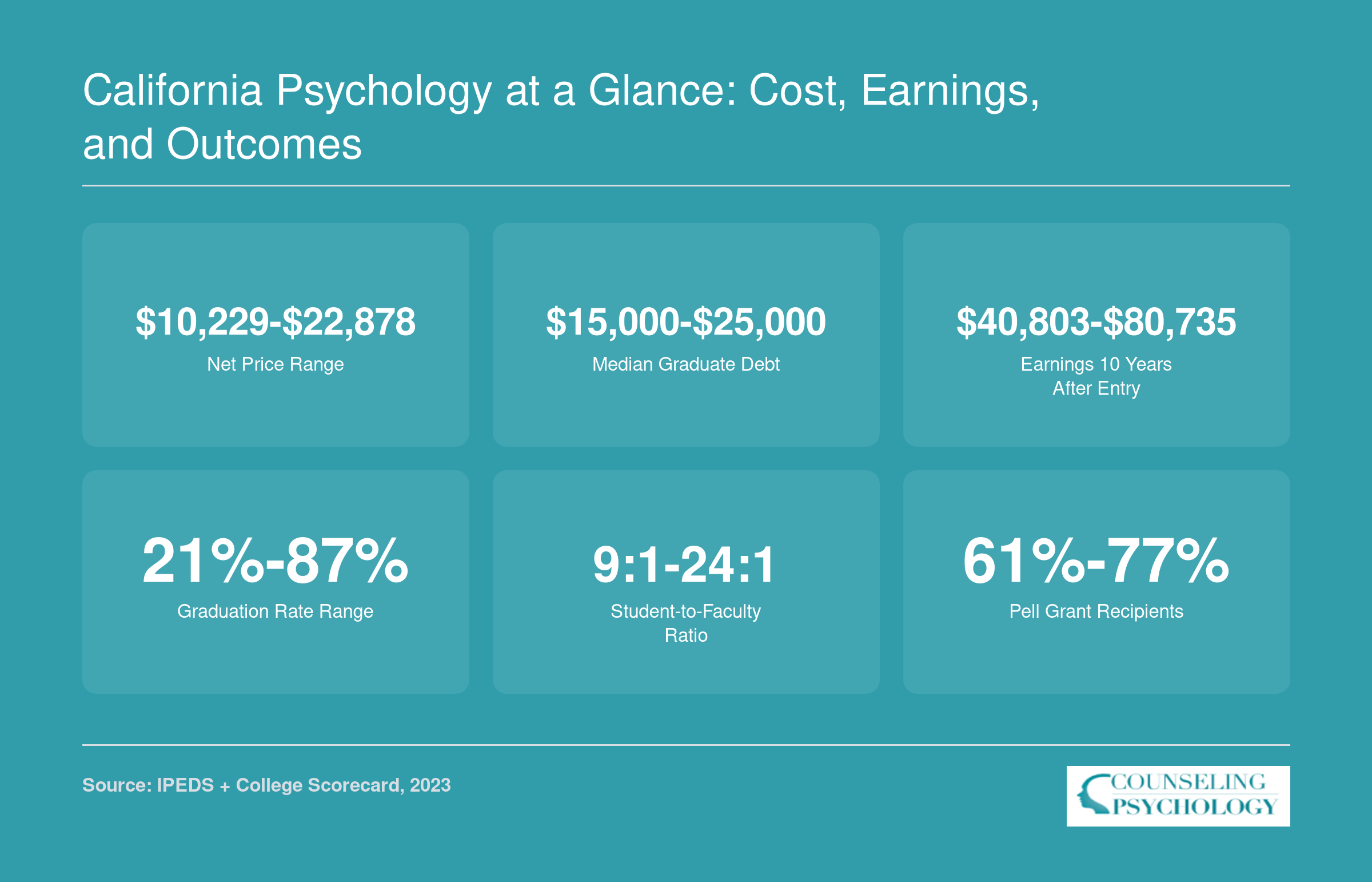
California Psychology at a Glance: Cost, Earnings, and Outcomes
Before exploring individual programs, here is a snapshot of key metrics across the California psychology schools in our 2026 rankings. These figures reflect institution-level data and can help you quickly gauge what to expect in terms of cost, debt, earnings, and completion rates.
Most Affordable Psychology Programs in California
The table below ranks California psychology programs by net price, which reflects the average annual cost after grants and scholarships are applied. Net price is the single best apples-to-apples comparison across public and private institutions, but keep in mind that it represents an institutional average. Your individual aid package may be higher or lower depending on your financial profile, enrollment status, and merit awards. Program-level monthly repayment estimates are not yet available for these programs, so we have included the median debt at graduation to help you gauge long-term cost. As a general reference, a graduate who borrows $13,540 would face roughly $155 per month on a standard 10-year repayment plan, while $25,000 in debt translates to about $288 per month.
| School | Sector | In-State Tuition | Out-of-State Tuition | Net Price (Avg.) | Median Debt at Graduation | Median Earnings (10 Yr) | Graduation Rate |
|---|---|---|---|---|---|---|---|
| California State University, Stanislaus | Public | $9,766 | $19,846 | $6,067 | $13,540 | $63,188 | 53.4% |
| California State University, East Bay | Public | $9,107 | $19,187 | $9,320 | $16,544 | $71,401 | 48.0% |
| California State University, San Marcos | Public | $9,606 | $19,686 | $10,229 | $17,350 | $62,908 | 54.6% |
| Fresno Pacific University | Private | $36,660 | $36,660 | $13,630 | $23,146 | $58,896 | 50.0% |
| University of California, Irvine | Public | $14,827 | $29,929 | $14,251 | $15,000 | $80,735 | 86.9% |
| University of California, Santa Barbara | Public | $15,124 | $30,226 | $16,109 | $13,993 | $74,915 | 83.0% |
| Touro University Worldwide | Private | $14,640 | $14,640 | $19,058 | $25,000 | $40,803 | 28.6% |
| Vanguard University of Southern California | Private | $41,700 | $41,700 | $21,241 | $22,000 | $59,541 | 56.8% |
| Azusa Pacific University | Private | $17,015 | $17,015 | $22,212 | $23,219 | $66,677 | 61.8% |
| Los Angeles Pacific University | Private | $12,240 | $12,240 | $22,677 | $18,750 | N/A | 21.1% |
Questions to Ask Yourself
Best Online Psychology Programs in California
Online and hybrid psychology programs in California span bachelor's completion tracks, master's degrees, graduate certificates, and doctoral options. Fully online bachelor's degrees in psychology are available at schools like California Institute of Integral Studies, Touro University Worldwide, University of Massachusetts Global, California Baptist University, and The Chicago School at Los Angeles. At the graduate level, online master's programs include Clinical Mental Health Counseling (University of Phoenix-California, The Chicago School at Anaheim), Applied Psychology (University of Southern California), Industrial-Organizational Psychology (Alliant International, Los Angeles Pacific University), General Psychology (Palo Alto University), and Sport Psychology (National University). Graduate certificates, such as the Applied Behavior Analysis sequences at UC Santa Barbara and CSU San Marcos, offer targeted online training for working professionals. Hybrid doctoral programs, like the PsyD in Counseling Psychology at University of the Pacific, combine online coursework with in-person clinical training. Students interested in research-oriented doctoral work may also explore applied psychology phd programs that accept online learners.
Flexibility for Working Professionals in California
California's high-cost metro areas make commuting a significant burden. Online programs remove the need for regular physical presence, allowing students in Los Angeles, the Bay Area, and San Diego to balance coursework with job and family obligations. Many online courses run asynchronously or in the evenings, fitting around full-time work schedules. Programs like National University's Sport Psychology master's feature 8-week terms and year-round starts, while University of Massachusetts Global's bachelor's in psychology accepts transfer credits generously, making it ideal for career changers building on prior college credits.
Licensure Considerations and In-Person Requirements
Asynchronous coursework does not eliminate all in-person obligations. Licensure tracks for clinical psychology, school psychology, and counseling typically require supervised practicum hours completed at approved sites. The California Board of Behavioral Sciences mandates face-to-face clinical training for LPCC and LMFT licensure, even if didactic courses are online. Students pursuing LMFT credentials should review marriage and family therapy master's programs to understand how supervised hours integrate with online coursework. Hybrid programs like those at Simpson University and Notre Dame de Namur University explicitly schedule evening classes and local fieldwork placements to meet these rules. Always verify that an online program's field placement structure aligns with California licensure regulations before enrolling.
Earnings Potential for Online Graduates
Program-level earnings data for online psychology graduates is still emerging, but broader institutional outcomes offer reassurance. Many of the schools listed here report strong median earnings across their degree programs; for instance, University of Southern California and Alliant International show alumni earning well above national averages for psychology fields. Online graduates access the same career networks and professional development resources as on-campus students, and the flexible format can accelerate entry into the workforce or enable lateral moves into higher-paying roles. As licensure milestones are met, earnings trajectories for online and residential graduates converge significantly.
Psychology Degree Levels and Specializations Available in California
Choosing the right degree level is one of the most consequential decisions you will make in a psychology career. Each tier opens distinct professional doors, carries different costs, and produces different earning trajectories. Below is a side-by-side look at bachelor's, master's, and doctoral psychology programs offered across California's ranked schools, along with the specializations you can pursue at each level.
| Dimension | Bachelor's Programs | Master's Programs | Doctoral Programs |
|---|---|---|---|
| Typical Net Price Range (Annual) | Roughly $10,200 (CSU San Marcos) to $28,100 (Concordia University Irvine) at ranked schools | Roughly $12,200 (Los Angeles Pacific) to $71,500 (USC) in listed tuition; many fall in the $15,000 to $25,000 range | Roughly $19,100 (Southern California Seminary) to $55,500 (University of the Pacific) in listed tuition |
| Institution-Level Median Earnings, 10 Years After Entry | $40,800 (Touro University Worldwide) to $87,400 (Golden Gate University), with several schools in the $55,000 to $66,000 range | $48,800 (CIIS) to $92,500 (USC), with many clustered near $57,000 to $67,000 | $39,600 (Southern California Seminary) to $78,400 (University of the Pacific); note these are institution-wide figures, not program-specific |
| Typical Time to Completion | 4 years full time; some completion programs can be finished in 16 to 24 months for transfer students | 1 to 3 years depending on unit requirements (33 to 68 units across ranked programs) | 4 to 6 years, including dissertation and supervised clinical hours |
| Specializations Available at Ranked Schools | General psychology, forensic psychology, sport and performance psychology | Forensic psychology, counseling psychology, clinical mental health counseling, industrial/organizational psychology, school psychology, applied behavior analysis, sport psychology, applied psychology | Clinical psychology, counseling psychology, educational psychology |
| California Licensure Pathways | A bachelor's alone does not qualify you for independent licensure in California. Graduates typically work in paraprofessional roles or continue to graduate school. | The master's degree is the standard entry point for LMFT (Licensed Marriage and Family Therapist) and LPCC (Licensed Professional Clinical Counselor) credentials through the California Board of Behavioral Sciences. Several ranked programs, including The Chicago School, Notre Dame de Namur, and Simpson University, are explicitly designed to meet those requirements. | A doctorate (PhD or PsyD) is required to become a Licensed Psychologist in California. Candidates must complete supervised professional experience and pass the EPPP. School psychology credentials can be earned at the Ed.S. or master's level. |
| Career Pathways | Human services case aide, research assistant, behavioral health technician, community outreach coordinator | Licensed counselor (LMFT, LPCC), school psychologist, organizational development specialist, behavior analyst (BCBA), sport psychology consultant | Licensed psychologist (clinical or counseling), professor or researcher, forensic evaluator, program director in clinical settings |
| Who This Level Fits Best | Students exploring the field, those planning to continue to graduate study, or people seeking entry-level positions in social services | Career changers and professionals who want to practice therapy or counseling, work in schools, or move into organizational consulting without committing to a doctoral timeline | Students committed to independent clinical practice as a psychologist, academic research, or advanced leadership roles that require the highest credential |
Career Outcomes and Earning Potential for California Psychology Graduates
California's psychology workforce continues to expand against a backdrop of rising demand for mental health services, and that growth translates into earning potential that outpaces most other states. Understanding what graduates actually earn, both in their first years out and at mid-career, helps you weigh the true value of any program on your shortlist.
What Program-Level Earnings Data Can (and Cannot) Tell You
Program-level earnings figures, which track what graduates earn one, two, and four years after completing a credential, are among the most useful tools for comparing schools side by side. For the California psychology programs in our rankings, however, these detailed earnings trajectories are not yet available at the program level for most schools. That means we cannot currently confirm exactly how graduates of a specific program fare in their first few post-graduation years.
What we can evaluate is each institution's broader graduate outcomes. Median earnings ten years after enrollment at the top-ranked schools range from roughly $67,500 at National University up to about $92,500 at USC, giving a useful long-term signal. Employment and poverty-threshold data for individual psychology programs are also not reported for most of the schools listed here, so readers should treat institution-wide figures as directional rather than program-specific.
California Salaries for Psychologists: BLS Data
Occupation-level data paints a clearer mid-career picture. According to the Bureau of Labor Statistics (May 2023 OEWS), the California-specific median annual wage for clinical and counseling psychologists was $114,520, well above the national median of $96,100 for the same occupation. The California mean annual wage reached $132,410, reflecting the state's higher cost of living and strong institutional demand.2 Total employment for clinical and counseling psychologists in California stood at 11,840 positions.2 Psychologists in other specialty areas averaged $134,360 in mean annual wages statewide.3
Nationally, the BLS projects 11.2% job growth for clinical and counseling psychologists between 2024 and 2034, roughly double the average for all occupations.4 California's large population and expanding telehealth infrastructure position the state to capture a meaningful share of that growth. Graduates interested in corporate or organizational settings may also want to explore the path to becoming an industrial organizational psychologist, a specialty that is growing alongside traditional clinical roles.
Return on Investment: Debt vs. Earnings
Because tuition varies dramatically across California programs, return on investment matters as much as raw salary. Using the ratio of long-term earnings to median graduate debt, several programs stand out:
- UC Irvine (Forensic Psychology, M.A.): An ROI ratio above 5.3 on a median debt of $15,000 makes this one of the strongest values in the state.
- UC Santa Barbara (Applied Behavior Analysis Certificate): A similarly high ROI ratio near 5.4, aided by median debt under $14,000.
- USC (Applied Psychology, M.S.): Despite higher sticker-price tuition, median debt of $18,000 pairs with strong institutional earnings for an ROI ratio above 5.1.
- Cal State East Bay (School Psychology, M.S.): Median debt around $16,500 and an ROI ratio above 4.3 reflect the CSU system's affordability advantage.
On the other end of the spectrum, programs at National University and Golden Gate University carry ROI ratios closer to 2.7 to 2.9, driven partly by higher median debt relative to institutional earnings. That does not make these programs poor choices, but it does mean financing strategy matters more.
Practical Takeaways
When evaluating career outcomes for any California psychology program, keep a few things in mind:
- Degree level matters enormously. Doctoral-level psychologists command the highest salaries, but master's-level professionals in school psychology and applied behavior analysis also earn competitive wages in California.
- California pays more, but costs more. A $114,520 median sounds strong, but housing in Los Angeles, San Francisco, and San Diego can absorb a significant share. Factor cost of living into any salary comparison.
- Program-specific earnings data remains limited. Until more granular reporting becomes available, supplement program research with BLS occupation data and alumni employment surveys when schools publish them.
The bottom line: California psychology graduates who choose accredited programs, manage debt carefully, and pursue licensure are well positioned in one of the country's strongest job markets for the profession.
California Psychology Licensure Requirements
Becoming a licensed psychologist in California is a multi-year process overseen by the Board of Psychology (BPC). The pathway below outlines each milestone from doctoral enrollment through full licensure. Master's-level graduates who want to practice therapy can pursue LMFT or LPCC licensure through the Board of Behavioral Sciences (BBS) instead.
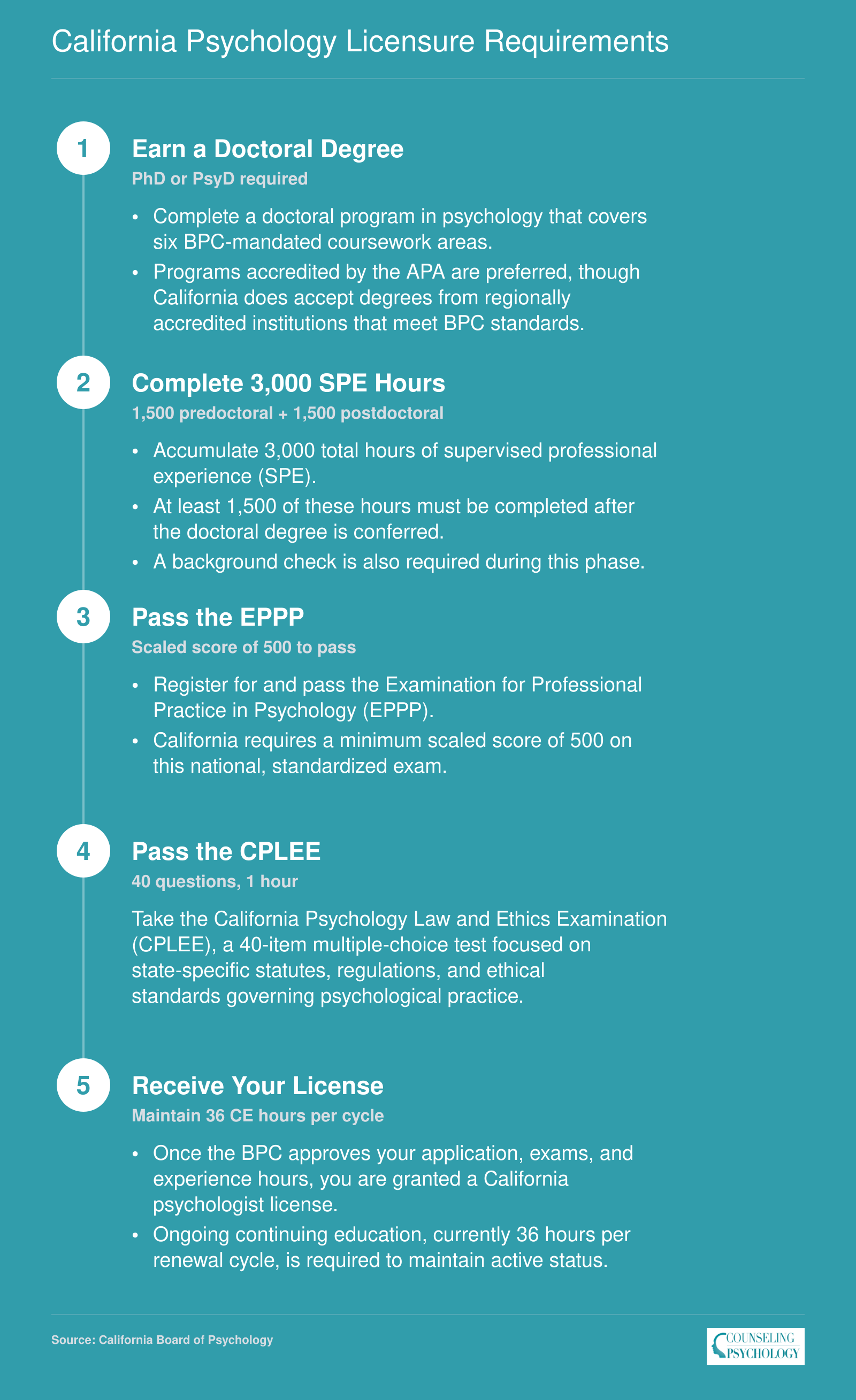
Many online psychology programs seem convenient, but not all satisfy California's licensure practicum requirements. Before enrolling, verify the program holds regional accreditation and that its supervised hours count toward your supervised professional experience (SPE). Also confirm directly with the California Board of Psychology (BPC) or the Board of Behavioral Sciences (BBS) that the program is approved, especially for out-of-state options. Without this due diligence, your degree might not qualify for licensure.
Admissions Requirements and GRE Policies at Top California Psychology Programs
Nationally, only 3% of psychology master's programs and 6% of doctoral programs required GRE scores in the 2023-2024 cycle, down from 9% and 13% the prior year.1 This steep decline mirrors the landscape in California, where most top psychology programs have moved away from the GRE.
GRE Policies at Top California Programs
For the 2025-2026 admissions cycle, several prominent institutions have dropped the GRE entirely. USC's psychology graduate programs no longer accept GRE scores, and Pepperdine's psychology master's programs have also eliminated the requirement.2 UC Davis, which offers only a PhD in psychology, does not require the GRE.3 Among UC campuses, Berkeley, UCLA, Irvine, and Santa Barbara all list the GRE as optional.2 No top California psychology doctoral program mandates it; the choice rests with the applicant. This shift reflects a broader recognition that standardized tests are not always strong predictors of success in graduate psychology studies.
Common Admissions Factors Beyond Test Scores
With the GRE fading, programs place greater weight on other components. Academic readiness is typically assessed through a minimum GPA, often 3.0, though competitive applicants exceed this. Prerequisite coursework in statistics, research methods, or foundational psychology may be required; at The Chicago School's forensic psychology master's, for example, one undergraduate statistics or research course is mandatory. A personal statement or admissions essay allows you to articulate your goals, relevant experience, and fit with the program. Letters of recommendation, usually two or three, provide third-party endorsement of your abilities. Hands-on experience, such as volunteering, research assistantships, or clinical exposure, can also distinguish an application.
Understanding Admissions Selectivity
When evaluating your chances, you may encounter an institution's overall admissions rate on federal data tools. This figure is not program-specific; it represents the share of undergraduate applicants admitted to the entire institution, not the psychology department. Use it only as a rough indicator of general selectivity. For instance, UC Irvine's 28.6% institutional admit rate signals a highly competitive environment, while Cal State San Marcos, with a 95.1% rate, suggests a more open door. Programs with lower institutional selectivity may offer more accessible entry points for career-changers or those with less traditional academic backgrounds.
Practical Tips for Applicants
If standardized tests are a hurdle, target programs with test-optional or no-GRE policies; the list in California is long. Strengthen areas within your control: craft a compelling personal statement that links your experiences to your career ambitions, secure recommendations from mentors who know your work well, and address any GPA gaps through post-baccalaureate coursework or strong recent grades. For highly competitive programs, consider applying to masters in clinical psychology programs first as a stepping stone to doctoral work, especially if your undergraduate profile is still developing.
Frequently Asked Questions About California Psychology Programs
Choosing a psychology program in California involves weighing transfer options, delivery formats, accreditation, and how employers view your degree. Below are answers to some of the most common questions prospective students ask when navigating these decisions.
More California Psychology Programs to Consider
Beyond our top 10 rankings, California offers many additional psychology programs worth exploring. Below is a directory of more schools, organized by region, with details on degree levels, formats, and distinctive features.
Bay Area
- Psychology, BA
- Industrial-Organizational Psychology, MA
- Global PhD in Psychology
- Graduate Certificate in Industrial-Organizational Psychology
- Master of Science in Clinical Psychology (Marriage and Family Therapy)
- Master of Science in Clinical Psychology (Licensed Professional Clinical Counseling)
- Master of Science in Clinical Psychology (Consulting & Applied Psychology)
- Master of Science in Psychology (Generalist)
- MS in Psychology (Forensic Psychology)
- Master of Science in Psychology (Forensic Psychology)
- Master of Science in Psychology (Technology and Mental Health)
Greater Los Angeles
- Bachelor of Arts in Psychology (General Psychology Concentration)
- Bachelor of Arts in Psychology (Child Psychology)
- Bachelor of Arts in Psychology (Industrial/Organizational)
- EdS in School Psychology and MA in Educational Psychology with PPSP Credential
- Master of Arts in Professional Clinical Counseling
- MA in Educational Psychology
- Applied Behavior Analysis (ABA) Graduate Certificate
- EdS in School Psychology
- Bachelor of Arts in Psychology (Preparation for Advanced Study in Counseling)
- Master's in Education, Autism
- BA in Psychology
- MS in Industrial and Organizational Psychology
- Master of Science (MS) in Clinical Psychology
- M.A. Clinical Mental Health Counseling
- MS in Organizational Psychology
- B.A. Psychology
- Ph.D. Business Psychology (Industrial and Organizational Track)
- Ed.D. Educational Psychology and Technology (Higher Education Learning and Technology, K-12 Education Learning and Technology, Instructional Design)
- M.S. Applied Behavior Analysis
- Industrial and Organizational Psychology Certificate
- Post-Master's Certificate in Applied Behavior Analysis
- M.S. Clinical Psychopharmacology
- M.A. Applied Psychology
- M.A. Forensic Psychology (Non-Licensure Track)
- M.S. Clinical Psychopharmacology (Illinois Prescriptive Authority Preparation Track)
- M.S. Clinical Psychopharmacology (Coursework Only Track)
- M.A. Applied Psychology (Applied Behavior Analysis)
- M.A. Applied Psychology (Child and Adolescent Psychology)
- M.A. Clinical Mental Health Counseling
- Master of Arts in Education (MAEd): School Psychology
- Ph.D. Counselor Education & Supervision
- Master of Science in Applied Psychology
Inland Empire
- Sport and Performance Psychology, BS
- Master of Science in Industrial and Organizational Psychology
- Master of Science in Counseling/Clinical Mental Health Counseling
- Master of Science in Counseling/Marriage, Family and Child Therapy
- Master of Science in Industrial-Organizational Psychology
- Bachelor of Science in Industrial-Organizational Psychology
Central Valley
- PsyD in Counseling Psychology
- Master of Arts in Counseling with Pupil Personnel Services (PPS) Credential
- Master of Arts in Counseling: Professional Clinical Counselor (PCC)
Northern California
- Master of Arts in Counseling Psychology