
What you’ll learn in this article…
- Most online health psychology graduate certificates require 12 to 18 credit hours and take roughly two to four semesters to complete.
- This credential does not lead to independent licensure as a psychologist, but it strengthens roles in wellness coaching, public health, and behavioral medicine.
- Tuition ranges widely across programs, so comparing institution-level median graduate debt alongside sticker price gives a clearer picture of real cost.
- The BLS reports a national median salary of $117,580 for Psychologists (All Other), though certificate holders typically fill adjacent, non-doctoral roles.
Behavioral health integration in primary care has moved from a policy aspiration to a clinical standard: the Health Resources and Services Administration now funds hundreds of integrated care sites where psychologists and health educators work directly alongside physicians managing diabetes, cardiovascular disease, and chronic pain. That structural shift is driving demand for professionals who understand the psychology of illness, adherence, and behavior change, without requiring a full doctoral credential.
A graduate certificate in health psychology typically runs 12 to 18 credit hours and can be completed in one to two years. It appeals to three distinct groups: career changers entering behavioral health from public health or nursing, licensed clinicians adding a specialty to an existing practice, and students building a research foundation before applying to doctoral programs. Those exploring related stackable credentials may also want to compare applied psychology certificate programs.
The practical tension most applicants face is credential clarity. A certificate is not a license, and it does not qualify holders for independent clinical practice. Understanding exactly what roles and salary bands the credential realistically supports is the more useful starting question.
Best Online Health Psychology Graduate Certificate Programs
The programs below were selected for their online or hybrid accessibility and ranked using a composite quality score that weighs institutional outcomes, cost efficiency, and completion metrics rather than any single factor. Because health psychology spans addiction, behavioral health, positive psychology, and applied behavior analysis, the certificates here reflect that breadth. Tuition, graduation rates, and median earnings figures are institution-wide from federal data sources and should not be read as program-specific outcomes. Program-level earnings are not yet available for these certificates.
Details
- Independent program research
- NCES-IPEDS federal institutional data — nces.ed.gov
- Internal program database
- College Scorecard graduate earnings — collegescorecard.ed.gov

Harvard University
Harvard Extension School's Positive Psychology and Well-Being Graduate Certificate is the closest thematic match to health psychology on this list, applying research-based strategies to mental and physical health improvement. The four-course, fully online program costs $13,760 total with no formal application, and credits can stack into several Harvard Extension master's degrees. The university posts a 97.6% institution-wide graduation rate and a median graduate debt of $14,000, pairing elite outcomes with a relatively contained price tag for a certificate.
- Four online courses, completable in 8 months to 3 years
- $13,760 total tuition, no differential for out-of-state students
- No formal application required, open enrollment
- Stackable into Harvard Extension master's programs
- Covers research-based strategies for mental and physical health
- Minimum B grade required in each course
- Summer and fall start terms available
Positive Psychology and Well-Being Graduate Certificate — Online

University of Florida
The University of Florida's Graduate Certificate in Addiction and Recovery targets professionals across healthcare, counseling, education, and criminal justice who work with substance use disorders. At 18 credits, the fully online program can be completed in one year and meets educational requirements for addiction counselor certifications. UF's 91.1% institution-wide graduation rate and $15,000 median graduate debt make it a strong value pick among public research universities, and courses can apply toward related UF master's degrees.
- 18-credit fully online certificate, completable in one year
- In-state tuition: $12,737; out-of-state: $30,130 (institution-wide)
- Meets educational requirements for addiction counselor certifications
- Non-degree option lets students sample courses before committing
- Covers addiction neuroscience, treatment methods, and policy
- Interprofessional curriculum spans healthcare, justice, and education
- Credits may apply toward related UF master's programs
Addiction and Recovery Graduate Certificate — Online

University of Virginia
The University of Virginia's fully online Certificate in Applied Behavioral Analysis prepares educators and clinicians for BCBA or BCaBA certification through a BACB-approved course sequence. UVA's 95.6% institution-wide graduation rate and $17,500 median graduate debt reflect strong institutional outcomes. No GRE is required, and flexible pacing (one to seven semesters) accommodates working professionals across Virginia and the Mid-Atlantic region.
- Fully online, BACB-approved course sequence
- Flexible pacing from 1 to 7 semesters
- No GRE required for admission
- In-state tuition: $23,526; out-of-state: $37,628 (institution-wide)
- Prepares for both BCBA and BCaBA examinations
- Covers functional behavioral assessment and treatment planning
- Aligned with Virginia DOE positive behavior support priorities
Certificate in Applied Behavioral Analysis — Online

Vanderbilt University
Vanderbilt's Online Post-Master's Certificate in Applied Behavior Analysis is designed for professionals who already hold a master's degree and want advanced ABA training. The program leverages Vanderbilt Kennedy Center research and Tennessee-based clinical partnerships, with a growing emphasis on leadership, supervision of RBTs, and navigating insurance and Medicaid systems. The university's 93.5% institution-wide graduation rate and $14,000 median graduate debt underscore its strong outcomes profile.
- Fully online, requires a related master's degree for admission
- Focuses on leadership, supervision, and ethical ABA practices
- Integrated with Vanderbilt Kennedy Center research resources
- Covers intervention strategies for healthcare and school settings
- Financial aid options available
- Prepares graduates for advanced BCBA practice roles
Online Post-Master's Certificate in Applied Behavior Analysis — Online

CUNY Hunter College
CUNY Hunter College's Advanced Certificate in Applied Behavior Analysis is a 27-credit hybrid program that prepares students for both BCBA certification and New York State licensure as a Licensed Behavior Analyst. With an institution-wide median graduate debt of just $11,000 and a net price of $2,984, it is one of the most affordable options on this list. Practicum partnerships with NYC Department of Education schools and community agencies give students hands-on experience in diverse, high-need settings.
- 27-credit hybrid program with supervised practicum
- Prepares for BCBA certification and NY State LBA licensure
- In-state tuition: $11,398; out-of-state: $20,828 (institution-wide)
- Practicum placements in NYC schools and community agencies
- Nationally recognized, BACB-aligned curriculum
- $11,000 median graduate debt (institution-wide)
- Curriculum covers ethical codes and advanced behavior interventions
Advanced Certificate in Applied Behavior Analysis — Hybrid

Florida International University
Florida International University's hybrid Graduate Certificate in Applied Behavior Analysis blends online coursework with campus-based learning over 12 months. The seven-course, 21-credit program is a BACB-verified course sequence with a listed total cost of $12,453. FIU's location in Miami provides access to practicum sites through the Center for Children and Families and local autism clinics, with particular emphasis on serving bilingual and culturally diverse communities in South Florida.
- Hybrid format: online coursework plus campus sessions
- 12-month, 21-credit BACB-verified course sequence
- $12,453 total estimated program cost
- Spring admission only
- Minimum 3.0 GPA required from prior graduate study
- Practicum access through Miami-area autism and behavioral clinics
- Emphasis on bilingual and culturally competent ABA practice
Graduate Certificate in Applied Behavior Analysis — Hybrid

University of Central Florida
The University of Central Florida offers two relevant online graduate certificates: one in Applied Behavior Analysis (18 credits, BACB-aligned) and another in Autism Spectrum Disorders (12 credits, tied to the Florida DOE ASD endorsement). Both fully online programs serve Florida's K-12 educators and behavior specialists, and UCF's partnership with Project ASD strengthens statewide practicum and employment networks. Institution-wide in-state tuition sits at $8,872, among the lowest on this list.
- 18-credit fully online program
- Meets BACB coursework requirements
- Prepares for National Board Certification in behavior analysis
- Aligned with Florida ESE regulations for K-12 settings
- Covers advanced behavior analysis, ethics, and supervision
- Designed for Education and Psychology professionals
- 12-credit fully online certificate
- Approved for Florida DOE Autism Endorsement
- Field-based components completed in student's own school
- Connected to Project ASD, a state-funded workforce initiative
- Covers ASD assessment, diagnosis, and teaching strategies
- Credits may apply toward further UCF graduate study
Applied Behavior Analysis Graduate Certificate — Online
Autism Spectrum Disorders Graduate Certificate — Online

University of Oklahoma-Norman Campus
The University of Oklahoma's Applied Behavior Analysis Graduate Certificate is a fully online, synchronous program with a seven-course BACB-verified sequence. It targets professionals working in autism and developmental disability services, with particular relevance for Oklahoma's early-intervention and public school systems. Institution-wide in-state tuition is $9,353, though the university notes that federal financial aid is not available for certificate-only students.
- Fully online, 100% synchronous distance learning
- BACB-verified course sequence of seven courses
- Admission requires A or B in first two ABA courses
- In-state tuition: $9,353; out-of-state: $26,142 (institution-wide)
- Serves Oklahoma autism and developmental disability workforce
- No federal financial aid for certificate-only students
- Prepares students for the BCBA examination
Applied Behavior Analysis Graduate Certificate — Online

Auburn University
Auburn University's Graduate Certificate in Intervention for Students with Autism and Developmental Disabilities is a 15-credit-hour program available online and on campus. Designed for special education teachers and related professionals, the curriculum emphasizes evidence-based practices aligned with Alabama State Department of Education initiatives. Auburn also offers a verified ABA course sequence within its College of Education, letting students build complementary expertise.
- 15 credit hours, available online or on campus
- Focuses on evidence-based practices for autism and DD
- Aligned with Alabama DOE improvement initiatives
- In-state tuition: $12,890; out-of-state: $33,986 (institution-wide)
- Designed for special education and human service professionals
- Verified ABA course sequence available through same college
Graduate Certificate in Intervention for Students with Autism and Developmental Disabilities — Online

University of South Florida
The University of South Florida's fully online Graduate Certificate in Autism Spectrum Disorder trains educators and school psychologists in ASD assessment, diagnosis, and positive behavior support. Completable in one to two years, the program connects to USF Health's broader autism and neurodevelopmental research in the Tampa Bay area. Institution-wide in-state tuition of $10,428 and a median graduate debt of $17,988 keep costs moderate.
- Fully online program, completable in 1 to 2 years
- Focuses on ASD assessment, diagnosis, and teaching strategies
- Emphasizes technology and positive behavior support
- In-state tuition: $10,428; out-of-state: $21,126 (institution-wide)
- Credits may transfer toward further USF graduate study
- Connected to Tampa Bay-area autism research initiatives
Graduate Certificate in Autism Spectrum Disorder — Online
What Is a Health Psychology Graduate Certificate?
Post-baccalaureate certificates and post-master's certificates both carry the "graduate" label, but they serve different audiences and build on distinct educational foundations. Understanding which type you're enrolling in matters for career planning, admissions, and realistic expectations about what the credential unlocks.
Defining the Credential
A health psychology graduate certificate is a focused, compact credential, typically comprising 12 to 18 graduate credits, that builds competency at the intersection of psychology and physical health. It is not a degree and does not replace a master's or doctoral program. Instead, it serves as a supplement: a way to add specialized training in biopsychosocial models of health and illness, health behavior change, chronic disease management, and research methods relevant to health outcomes.1 Most programs are designed for students who already hold a bachelor's degree in psychology, public health, or a related field, or for professionals with a master's or doctoral degree who want to deepen their expertise in health psychology without committing to a full degree program.
What It Is Not
Three distinctions matter. First, a graduate certificate is not a full master's or doctoral program. Master's degrees in health psychology typically require 30 to 48 credits and two years of study; doctoral programs demand four to seven years and prepare graduates for independent licensure as psychologists.1 Second, graduate certificates differ from non-credit professional development certificates or continuing education units. Graduate certificates carry academic credit, appear on transcripts, and follow the same admissions and grading standards as degree programs. Third, certificates in health psychology are not the same as clinical psychology certificate programs, which focus on assessment and psychotherapy and often align with licensure-track training.
The Licensure Question
A graduate certificate in health psychology alone does not qualify holders for independent clinical licensure as a psychologist in any U.S. state. Licensure as a psychologist requires a doctoral degree in psychology, supervised clinical experience (typically 1,500 to 4,000 hours depending on the state), and passing scores on the Examination for Professional Practice in Psychology and state-specific exams.1 Even a master's degree in psychology does not confer the psychologist title in most states. The certificate does, however, qualify holders for career advancement in health-services roles, doctoral program preparation, and employer-valued credentialing in hospitals, public health agencies, wellness programs, and research settings.
Competency Standards and Training Tracks
Quality programs align with the Society for Health Psychology (APA Division 38) competency guidelines, which emphasize biopsychosocial foundations of health and illness, health behavior theory, assessment and intervention strategies, cultural and individual diversity in health contexts, and ethical practice.2 Programs may be offered as standalone post-bachelor's certificates or as embedded certificates earned alongside a doctoral or master's degree. Standalone certificates serve working professionals or bachelor's holders seeking a career pivot; embedded certificates allow degree candidates to document specialty training in health psychology on their transcript without extending their program timeline.3
Questions to Ask Yourself
Are you pursuing this certificate to complement an existing clinical degree, pivot into a new career, or as a stepping stone toward a doctorate?
Does your current employer or target employer recognize a health psychology credential for promotion, role expansion, or specialized assignments?
Are you prepared to earn a non-licensure credential, or do you actually need a full degree program that leads to clinical practice?
What Can You Do With a Health Psychology Certificate?
A health psychology graduate certificate opens doors without requiring you to become a licensed psychologist. That distinction matters: most of the roles that value this credential sit in a middle ground where specialized training in behavior, chronic illness, and wellness programming is exactly what employers want, but clinical licensure is not on the job posting.
Job Titles That Align With This Credential
The certificate works best as an add-on to an existing bachelor's or master's in psychology, social work, public health, or a related field. Employers across healthcare and wellness settings actively seek candidates with focused training in health behavior, and a graduate certificate signals that depth without the multi-year commitment of a full degree. For a broader look at the landscape, our overview of careers in psychology maps out how specialized credentials fit into common career trajectories.
Concrete titles where the certificate adds real value include:
- Health educator: Develops and delivers programs targeting chronic disease prevention, nutrition, and lifestyle change. The Bureau of Labor Statistics (BLS) reports a 2024 national median annual wage of $63,000 for health education specialists, with roughly 7,900 job openings projected per year through 2034.1
- Community health worker: Connects underserved populations to services, often within hospital systems or public health departments. BLS data puts the 2024 national median annual wage at $51,030, with 11% projected growth through 2034, well above the average for all occupations.2
- Patient navigator: Guides patients through complex care systems, coordinating appointments, resources, and follow-up, particularly in oncology and chronic disease programs.
- Behavioral health coordinator: Integrates behavioral health screening and support into primary care or community clinic settings.
- Wellness program manager: Designs and oversees employer-sponsored wellness initiatives, a growing role in corporate HR and benefits departments.
- Research associate in health behavior labs: Supports faculty and principal investigators at university research centers or pharmaceutical companies studying adherence, quality of life, and health outcomes.
- Chronic disease self-management facilitator: Runs evidence-based programs, often through nonprofits or hospital outreach, teaching patients to manage conditions like diabetes, COPD, or heart disease.
Sectors That Hire These Roles
Hospitals and integrated health systems remain the largest employers, followed by public health departments, federally qualified health centers, and nonprofit community organizations. Corporate wellness is a faster-growing slice of the market, with health tech and pharmaceutical companies adding health behavior roles tied to patient engagement and digital therapeutics. University research centers round out the picture for those drawn to applied psychology careers rather than direct service.
The Licensure Reality
None of the roles above requires licensure as a psychologist. That is not a limitation so much as a clarification about scope. A health psychology certificate signals that you understand biopsychosocial models, health behavior theories, and intervention design. Paired with relevant field experience, it positions you as a stronger candidate than someone with a general psychology background and no specialized training.
If your goal is independent clinical practice or the title of licensed psychologist, a certificate alone will not get you there. That path requires a doctoral degree and supervised clinical hours. However, for the broad range of program coordination, education, navigation, and research roles described here, the certificate carries genuine weight.
How This Differs From a Positive Psychology Certificate
Positive psychology certificates also lead to wellness, coaching, and corporate roles, and there is meaningful overlap in topics like resilience and behavior change. The practical difference is orientation: positive psychology programs tend to center on flourishing, strengths, and coaching frameworks, while health psychology programs are more rooted in medical settings, chronic illness, and clinical research contexts. If your interest is hospital-based work, public health, or chronic disease management, the health psychology framing is the stronger fit.
Health Psychology Salary Outlook
The Bureau of Labor Statistics (BLS) reports national wage data for Psychologists, All Other, a broad category covering fully credentialed psychologists who hold doctoral degrees and state licensure. The national median salary for this group is $117,580, reflecting the earning power of professionals at the top of the credentialing ladder. Certificate holders who work in adjacent, non-psychologist roles (health educators, behavioral health coordinators, wellness program managers) will typically earn in a lower band, which is why the career outcomes section above names those specific positions and their corresponding salary ranges.
| Wage Percentile | Annual Salary (National) |
|---|---|
| 25th Percentile | $73,820 |
| Median (50th Percentile) | $117,580 |
| 75th Percentile | $145,200 |
| Mean (Average) | $111,340 |
Cost and ROI: How Health Psychology Certificates Compare
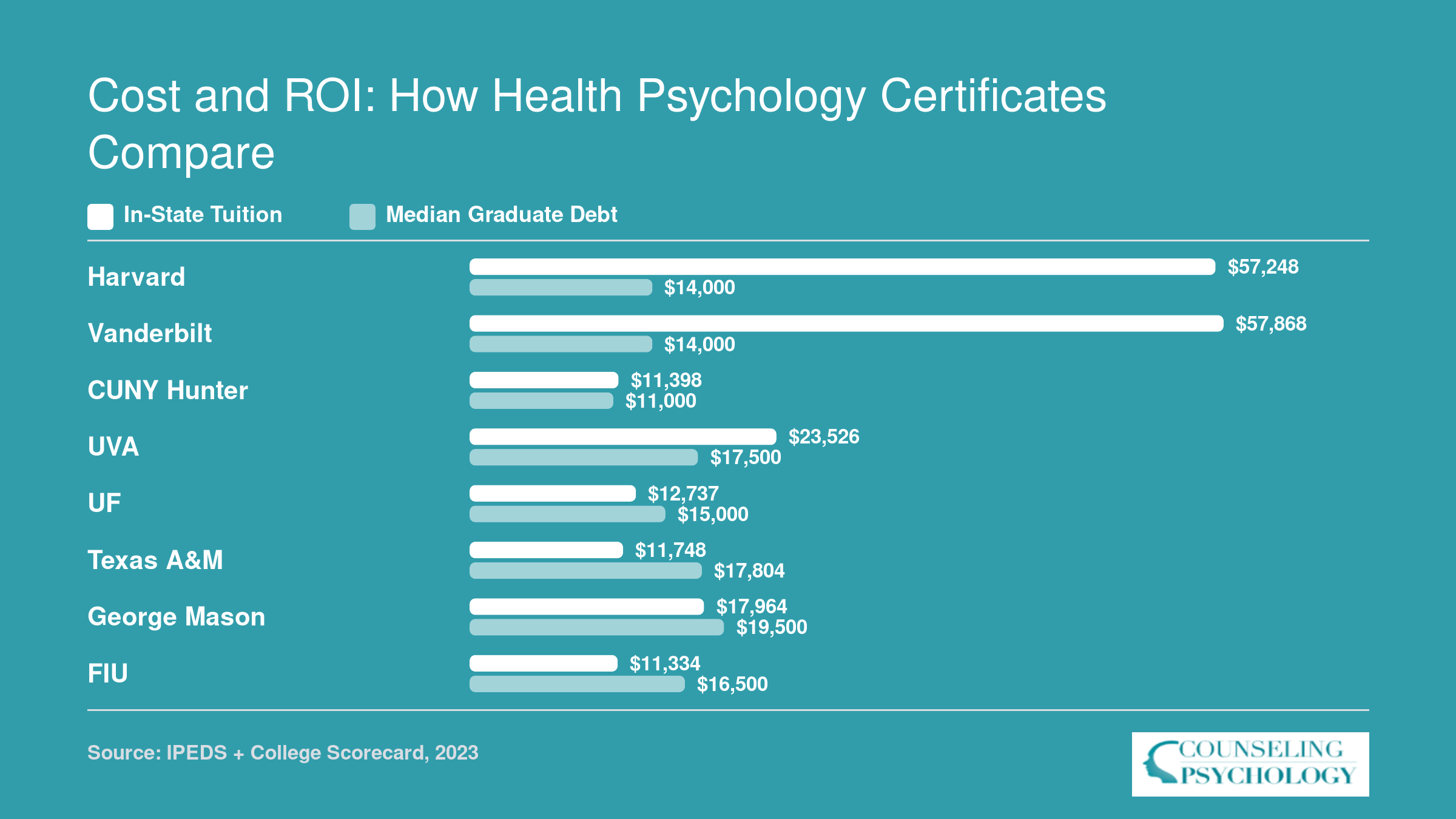
Tuition varies dramatically across these graduate certificate programs, but so does the institution-wide median debt graduates carry. The chart below pairs in-state graduate tuition with median graduate debt reported through the College Scorecard. Keep in mind that net price figures are institution-wide averages across all levels and programs, not certificate-specific costs. Program-level post-completion earnings are not yet available for these certificates, so we use median graduate debt as the ROI anchor: a lower debt-to-tuition ratio signals that aid and shorter credit requirements keep out-of-pocket costs down.
Curriculum and Coursework to Expect
Standalone post-bachelor's certificates and those embedded in doctoral programs share many of the same course titles, but they differ significantly in depth, prerequisite knowledge, and elective flexibility. Understanding what each path covers will help you gauge whether a given program matches your current training and career goals.
Core Courses You Will See Across Programs
Most online health psychology graduate certificates require four to six courses totaling 12 to 18 credits. While specific titles vary by institution, the following subjects appear again and again:
- Health behavior change theories: Models like the Health Belief Model, Transtheoretical Model, and Social Cognitive Theory form the conceptual backbone of nearly every program.
- Psychophysiology: Courses exploring how physiological processes interact with psychological states, including stress reactivity and neuroendocrine pathways.
- Stress and coping: An examination of appraisal frameworks, resilience factors, and evidence-based coping interventions.
- Behavioral medicine: Applied coursework covering chronic disease management, pain psychology, adherence to medical regimens, and patient-provider communication.
- Research methods in behavioral health: Required across virtually all programs, this course builds competency in study design, outcome measurement, and data interpretation specific to health contexts.2
- Health disparities: Analysis of how socioeconomic status, race, geography, and cultural determinants shape health outcomes, a topic increasingly central to program curricula.
Tulane University, for example, sequences two health psychology courses alongside a dedicated research methods course in its 15-credit certificate.3 The University of Connecticut keeps things tighter at 12 credits, while Northcentral University's post-master's certificate expands to 18 credits and assumes deeper prior training.4
Applied Components and Capstone Experiences
A formal practicum or capstone is not universally required, but many programs embed an applied final project or case study into the last course.4 These components ask students to design an intervention, analyze real-world health data, or develop a behavior-change protocol for a specific population. If hands-on experience matters to your career trajectory, look closely at whether the program offers this kind of culminating project or simply ends with traditional coursework. For a broader look at what health psychologists do day to day, understanding these applied skills in context can sharpen your program search.
Competencies Aligned With APA Division 38
Programs that reference Division 38 (Society for Health Psychology) guidelines tend to organize learning outcomes around three pillars: fluency in the biopsychosocial model, demonstrated skill in evidence-based behavior change techniques, and the ability to collaborate across disciplines such as medicine, public health, and social work. Even certificates that do not explicitly cite Division 38 usually touch on these competencies through course content.
How Standalone and Doctoral-Embedded Certificates Differ
Standalone certificates designed for working professionals typically assume a bachelor's or master's degree in psychology but do not require doctoral-level coursework as a prerequisite. They lean on a structure of one to two core courses plus two to four electives drawn from categories like health promotion, chronic illness, occupational health, and advanced methods.2 Students often have room to tailor electives toward a specialty.
Certificates embedded within doctoral programs, by contrast, assume familiarity with advanced statistics and clinical theory. Elective flexibility may be limited because the certificate courses double as required doctoral coursework. The readings are denser, the assessment expectations are higher, and the assumption is that students already operate within a research or clinical framework. If you hold a bachelor's degree and are new to graduate-level psychology, a standalone certificate will be the more practical entry point.
How Long Does It Take to Earn a Health Psychology Certificate?
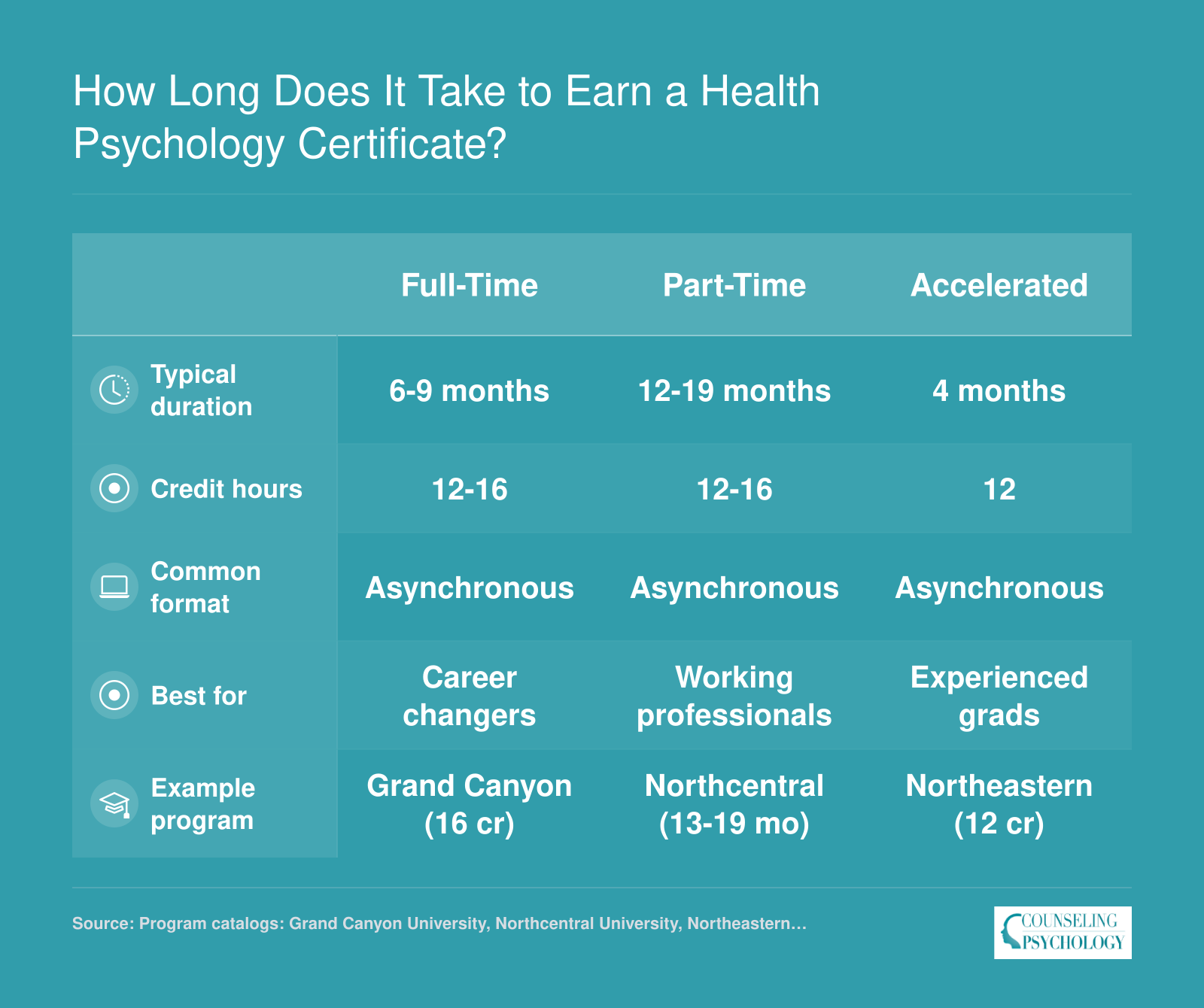
Most online health psychology graduate certificates require 12 to 18 credit hours, though some programs fall slightly outside that range. Because these certificates target working professionals, part-time enrollment is the default at many schools. Asynchronous coursework is common, letting students complete readings and assignments on their own schedule, while a few programs use synchronous sessions for seminars or group discussions. The timeline below reflects real program structures across several institutions.
Admissions Requirements and Who Should Apply
Who actually qualifies for a health psychology graduate certificate, and do you need a psychology degree to get in?
The answer depends heavily on which program you choose, but the landscape is more accessible than many applicants assume.
Degree and GPA Baselines
Most standalone certificate programs require a bachelor's degree, and a cumulative GPA of 3.0 is the common floor. Grand Canyon University sets its minimum at 2.8, with a pathway to 2.5 for applicants who submit GRE scores.2 Not every program demands a psychology-specific undergraduate background: Northeastern University's Applied Psychology Graduate Certificate accepts applicants from any bachelor's field, which opens the door for nurses, public health professionals, and social workers who want to add psychological theory to their toolkit without starting over.3
Some programs are structured exclusively for students already in graduate school. The University of Connecticut certificate is limited to current UConn graduate students4, and the University of Kansas program requires applicants to be enrolled in a KU graduate degree program.5 Northcentral University sits at the other end of the spectrum, requiring a master's degree or higher for admission.6 Knowing which category a program falls into before you apply saves a lot of wasted effort.
GRE and Application Materials
One meaningful differentiator between certificate programs and master's or doctoral admissions is the GRE. Most health psychology certificate programs do not require it, and Grand Canyon University explicitly offers a GRE waiver.2 If test anxiety or time constraints have held you back from graduate study in the past, certificates are worth a second look.
Typical application packages include:
- Transcripts: Official records from all prior institutions
- Personal or purpose statement: A narrative explaining your goals and how health psychology fits your career direction
- CV or resume: Professional and academic history
- Letters of recommendation: Some programs ask for one or two professional or academic references; others, like Northcentral University, do not list references as a requirement6
The University of Kansas keeps its requirements minimal for enrolled students, asking mainly for a degree progress report and a faculty support letter.5
Who These Programs Are Built For
Four groups tend to benefit most from a health psychology certificate. Career changers from nursing, public health, or social work use it to add psychological frameworks to clinical or community health roles. Practicing clinicians, including licensed counselors and therapists, pursue it to sharpen their work with medically complex clients; those interested in similar stackable credentials might also explore an addiction counseling graduate certificate. Current graduate students in adjacent fields earn it as a concurrent credential that broadens their dissertation or job market profile. And professionals considering a counseling doctoral program sometimes use the certificate as a structured way to build academic standing and referees before committing to a full PhD application.
Frequently Asked Questions About Health Psychology Certificates
Health psychology certificates attract a wide range of applicants, from early-career professionals to seasoned clinicians looking to specialize. Below are answers to the questions prospective students ask most often, grounded in current credentialing standards and program data.
- What is the highest mental health certification?
- Board Certification through the American Board of Professional Psychology (ABPP) is widely regarded as the highest credential in the mental health field. It is a peer-reviewed specialty certification that requires a doctoral degree and active licensure. ABPP diplomate status is recognized by hospitals, licensing jurisdictions, and employers as evidence of advanced competence in a defined specialty area, including health psychology.
- Is a health psychology certificate worth it without licensure?
- Yes, for many professionals. A health psychology certificate is a training credential that deepens expertise in health behavior, illness prevention, and behavioral medicine. It benefits nurses, public health workers, social workers, and educators who apply psychological principles in their existing roles without practicing as licensed psychologists. Employers in integrated care and wellness settings increasingly value specialized knowledge, even when the holder is not independently licensed.
- What can you do with a graduate certificate in psychology?
- A graduate certificate in psychology can open doors to roles in behavioral health coordination, patient education, corporate wellness, health coaching, and research support. It also strengthens applications to master's or doctoral programs. In health care settings, certificate holders often work alongside licensed providers, contributing expertise in behavior change, chronic disease management, and psychosocial aspects of medical care.
- How long does it take to earn a health psychology graduate certificate?
- Most online health psychology graduate certificates require 12 to 18 credit hours, which full-time students typically complete in two to three semesters. Part-time learners may finish in 12 to 18 months. Accelerated formats with shorter terms can shorten the timeline further. The exact duration depends on course load, term structure, and whether the program allows year-round enrollment.
- What is the difference between a health psychology certificate and a certificate in clinical psychology?
- Health psychology certificates focus on health behavior, illness prevention, adjustment to medical conditions, and behavioral medicine. Clinical psychology certificates center on assessment, diagnosis, psychotherapy, and treatment of mental disorders. In practice, health psychology credentials prepare you for integrated care and wellness settings, while clinical psychology credentials align more closely with traditional mental health practice and psychotherapy environments.
- Are online health psychology certificates respected by employers?
- Employer perception is generally positive when the certificate comes from a regionally accredited, recognized institution. Hiring managers in health care and behavioral medicine settings evaluate the quality of the program and its curriculum rather than the delivery format. The shift toward online graduate education across most disciplines has further normalized these credentials, making format alone a non-issue for most employers.
- Can a health psychology certificate count toward a master's or doctoral degree?
- Credit transfer policies vary by institution and are evaluated on a case-by-case basis. Many universities design their certificate programs so that coursework can apply toward a related master's or doctoral degree at the same school. If you plan to continue your education, confirm transfer eligibility before enrolling. Ask the admissions office for a written policy and check whether course content aligns with degree requirements at your target program.
More Online Health Psychology Certificate Programs to Consider
Beyond the top-ranked programs, many other universities offer strong online graduate certificates in health psychology and related fields. The following directory presents additional options worth exploring, listed in alphabetical order by school name. Each entry highlights distinctive features such as specialization areas, tuition, or unique program formats.
- Online Positive Psychology Graduate Certificate
- Applied Behavior Analysis Certificate of Advanced Study
- Applied Behavior Analysis Graduate Certificate
- Teaching Students with Autism Spectrum Disorder Graduate Certificate
- Culturally-Centered Addictions Research Training
- Autism Spectrum Disorders Certificate
- Applied Behavior Analysis Graduate Credit Certificate Program
- Educating Individuals with Autism Postbaccalaureate Credit Certificate
- Applied Behavior Analysis Certificate
- Applied Behavior Analysis Certificate (Autism Spectrum Disorder)
- Graduate Certificate in Autism
- Graduate Certificate in Applied Behavior Analysis
- Graduate Certificate in Applied Behavior Analysis
- Graduate Certificate in Autism Spectrum Disorder
- Graduate Certificate in Applied Behavior Analysis
- Graduate Certificate in Autism and Applied Behavior Analysis
- Graduate Certificate in Applied Behavior Analysis
- Graduate Certificate in Applied Behavior Analysis
- Positive Psychology
- Graduate Certificate in Applied Behavior Analysis
- Applied Behavior Analysis Graduate Certificate
- Autism Specialist - Online Graduate Certificate