
What you’ll learn in this article…
- Becoming a board-certified neuropsychologist typically requires 10 to 13 years of post-secondary education and training.
- A clinical psychology PhD or PsyD with a neuropsychology concentration is required for licensure, while a neuroscience PhD alone is not sufficient.
- Doctoral coursework can be partially completed online, but practica, internships, and the two-year postdoctoral fellowship must be completed in person.
- BLS groups neuropsychologists under clinical and counseling psychologists nationally, so dedicated salary data for the specialty is limited.
Can you earn a neuropsychology degree entirely online and still become board-eligible? For the doctoral level, the answer in 2026 is no: the supervised clinical hours required for licensure happen face-to-face. Online and hybrid offerings are growing, however, at the bachelor's and master's levels, and a small number of doctoral programs now deliver core coursework online while students complete in-person residencies and practica.
The demand for neuropsychologists is climbing as an aging population drives the need for dementia assessment, traumatic brain injury evaluation, and pediatric neurodevelopmental testing. But the training pipeline remains one of the longest in mental health, 10 to 13 years after high school, and the hands-on nature of neuropsychological assessment means fully remote pathways are not yet feasible for doctoral preparation.
Best Online Neuropsychology Programs
Neuropsychology is a highly specialized field that bridges clinical psychology and neuroscience, requiring advanced graduate training typically at the doctoral level. While fully online neuropsychology degrees are rare due to the clinical and laboratory components involved, several universities offer hybrid or primarily online programs with neuropsychology concentrations, coursework, or specialization tracks. The following programs represent the strongest options for students seeking flexible pathways into this demanding discipline, ranked by program quality, institutional reputation, and accessibility.
- Independent program research
- U.S. Department of Education College Scorecard (collegescorecard.ed.gov)
- National Center for Education Statistics (NCES-IPEDS) (nces.ed.gov)
University of Florida
The University of Florida is a top-tier public research university with a renowned psychology department that includes faculty specializing in clinical and cognitive neuroscience. UF boasts a 91% graduation rate, 97% retention rate, and graduates report median earnings of $71,588 at ten years. The university offers online graduate psychology coursework and has strong clinical training partnerships across Florida's healthcare systems.
- Faculty with active research in cognitive and clinical neuroscience
- Access to UF Health Shands Hospital for clinical training
- In-state tuition of $6,381/yr; out-of-state $28,659/yr
- 91% graduation rate and 97% first-year retention
- Median graduate debt of just $15,000
- Strong alumni network across academic and clinical settings
- APA-accredited clinical psychology doctoral program on campus
Online Graduate Psychology with Neuropsychology Emphasis — Hybrid
Fielding Graduate University
Fielding Graduate University stands out as one of the few institutions offering a dedicated neuropsychology specialization within a distance-learning doctoral psychology program. The university's Neuropsychology Specialization Training Program is specifically designed for working professionals seeking advanced clinical competency. Fielding's distributed learning model combines online coursework with intensive in-person sessions and supervised clinical practica.
- One of few dedicated neuropsychology specializations online
- Designed for mid-career professionals and practicing clinicians
- Combines distance coursework with intensive residency sessions
- Covers assessment, brain-behavior relationships, and rehab
- Supervised clinical practicum in neuropsychological assessment
- Aligned with Houston Conference training guidelines
- Faculty are board-certified neuropsychologists
Neuropsychology Specialization Training Program (PhD/PsyD) — Hybrid
Nova Southeastern University
Nova Southeastern University offers one of the most established clinical psychology doctoral programs with neuropsychology concentration options in a hybrid format. The College of Psychology houses dedicated neuropsychology faculty and clinical training sites. NSU's flexible scheduling and online coursework components make it accessible to students balancing professional obligations, with median graduate earnings of $59,209.
- Dedicated neuropsychology concentration within PsyD program
- Hybrid format with online courses and on-site intensives
- Access to NSU Psychology Services Center for clinical hours
- Tuition of $38,700/yr with financial aid available
- Faculty active in neuropsychological research and practice
- Training in pediatric and adult neuropsychological assessment
- 73% acceptance rate supports broader access to the field
PsyD in Clinical Psychology with Neuropsychology Concentration — Hybrid
University of North Dakota
The University of North Dakota offers highly affordable graduate psychology programs with online and hybrid delivery options, including coursework relevant to neuropsychology. UND's competitive out-of-state tuition of $15,570 makes it one of the most budget-friendly options for distance learners nationwide. The university has a strong tradition of training clinical psychologists who go on to work in healthcare and neuropsychological assessment settings.
- Among the most affordable graduate psychology programs nationally
- Out-of-state tuition of only $15,570/yr
- Median graduate earnings of $63,552 at ten years
- Strong clinical psychology faculty with neuroscience expertise
- Flexible online format suitable for working professionals
- Median debt of $22,057 is below national averages
- Pathway to doctoral programs with neuropsychology focus
Online MS in Psychology with Neuropsychology Coursework — Online
Carlos Albizu University
Carlos Albizu University specializes exclusively in psychology and related behavioral sciences, offering doctoral programs with neuropsychology training components. The university is notable for its commitment to multicultural and bilingual clinical training, making it ideal for students planning to serve diverse populations. CAU's hybrid PsyD program integrates online learning with clinical training in neuropsychological assessment.
- Psychology-focused institution with deep clinical resources
- Emphasis on bilingual and multicultural neuropsych assessment
- Hybrid doctoral format blending online and clinical components
- Training in culturally responsive neuropsychological evaluation
- Small cohort sizes allow personalized faculty mentorship
- Located in Miami with access to diverse clinical populations
- Prepares graduates for board certification in neuropsychology
PsyD in Clinical Psychology with Neuropsychology Track — Hybrid
Drexel University
Drexel University offers robust online graduate programs in psychology through its College of Arts and Sciences, with coursework touching on neuropsychological principles. Graduates report the highest median earnings in this ranking at $84,648 at ten years. Drexel's co-op model and Philadelphia-area clinical partnerships provide students with real-world neuropsychology exposure alongside online coursework.
- Graduates report median earnings of $84,648 at ten years
- Strong neuroscience and clinical psychology faculty
- Philadelphia offers numerous clinical practicum opportunities
- 78% graduation rate with 90% retention
- Co-op experiential learning model enhances clinical readiness
- Online coursework covers brain-behavior relationships
- Pathway to doctoral study in clinical neuropsychology
MS in Psychology (Online) with Neuroscience Coursework — Online
Pepperdine University
Pepperdine University's Graduate School of Education and Psychology offers hybrid and online psychology programs with opportunities to explore neuropsychological topics. With an 83% graduation rate and median earnings of $82,939 at ten years, Pepperdine graduates are well-positioned for advanced careers. The university's clinical training sites throughout Southern California provide supervised experience in assessment and neurocognitive evaluation.
- 83% graduation rate and 87% first-year retention
- Median graduate earnings of $82,939 at ten years
- Access to clinical sites across Southern California
- Coursework covers cognitive and neuropsychological assessment
- Small class sizes with individualized mentorship
- Strong foundation for doctoral neuropsychology programs
- Respected nationally for graduate psychology training
MA in Psychology (Online/Hybrid) — Hybrid
Michigan State University
Michigan State University is a leading research institution with a psychology department that includes faculty specializing in cognitive neuroscience and neuropsychology. MSU offers select online graduate psychology courses and hybrid programs that allow students to engage with neuroscience content remotely. With an 81% graduation rate and median earnings of $67,253, MSU provides strong value for aspiring neuropsychologists.
- R1 research university with top-tier neuroscience facilities
- 81% graduation rate and 91% retention rate
- Median graduate earnings of $67,253 at ten years
- Faculty expertise in cognitive and clinical neuroscience
- Opportunities for research in brain imaging and assessment
- In-state tuition of $16,458/yr for Michigan residents
- Strong pipeline to clinical neuropsychology doctoral programs
Online Graduate Courses in Psychology and Neuroscience — Hybrid
University of Arizona
The University of Arizona offers online graduate psychology programs with neuroscience and cognitive science coursework relevant to neuropsychology. UA's affordability for in-state students and growing online program portfolio make it an accessible entry point into the field. Graduates report median earnings of $59,979 at ten years, and the university's research centers provide opportunities in brain and cognitive sciences.
- Affordable in-state tuition of $13,926/yr
- 86% acceptance rate supports broad student access
- Median graduate debt of $19,620 is below average
- Cognitive science and neuroscience research centers on campus
- Online delivery allows flexibility for working students
- Median earnings of $59,979 at ten years post-graduation
- Gateway to doctoral programs in clinical neuropsychology
Online MS in Psychology with Cognitive/Neural Emphasis — Online
University of Oregon
The University of Oregon offers online graduate psychology options with connections to its strong cognitive neuroscience research programs. UO's Department of Psychology features faculty with expertise in brain-behavior relationships and developmental neuropsychology. With median earnings of $61,324 at ten years and a well-regarded psychology department, UO provides a solid foundation for students exploring neuropsychology pathways.
- Nationally recognized cognitive neuroscience research faculty
- In-state tuition of $16,137/yr for Oregon residents
- 72% graduation rate with 86% retention
- Median graduate debt of $20,139
- Access to UO Brain Development Lab resources
- Online format supports flexible study scheduling
- Strong preparation for advanced neuropsychology training
Online Graduate Psychology Coursework — Online
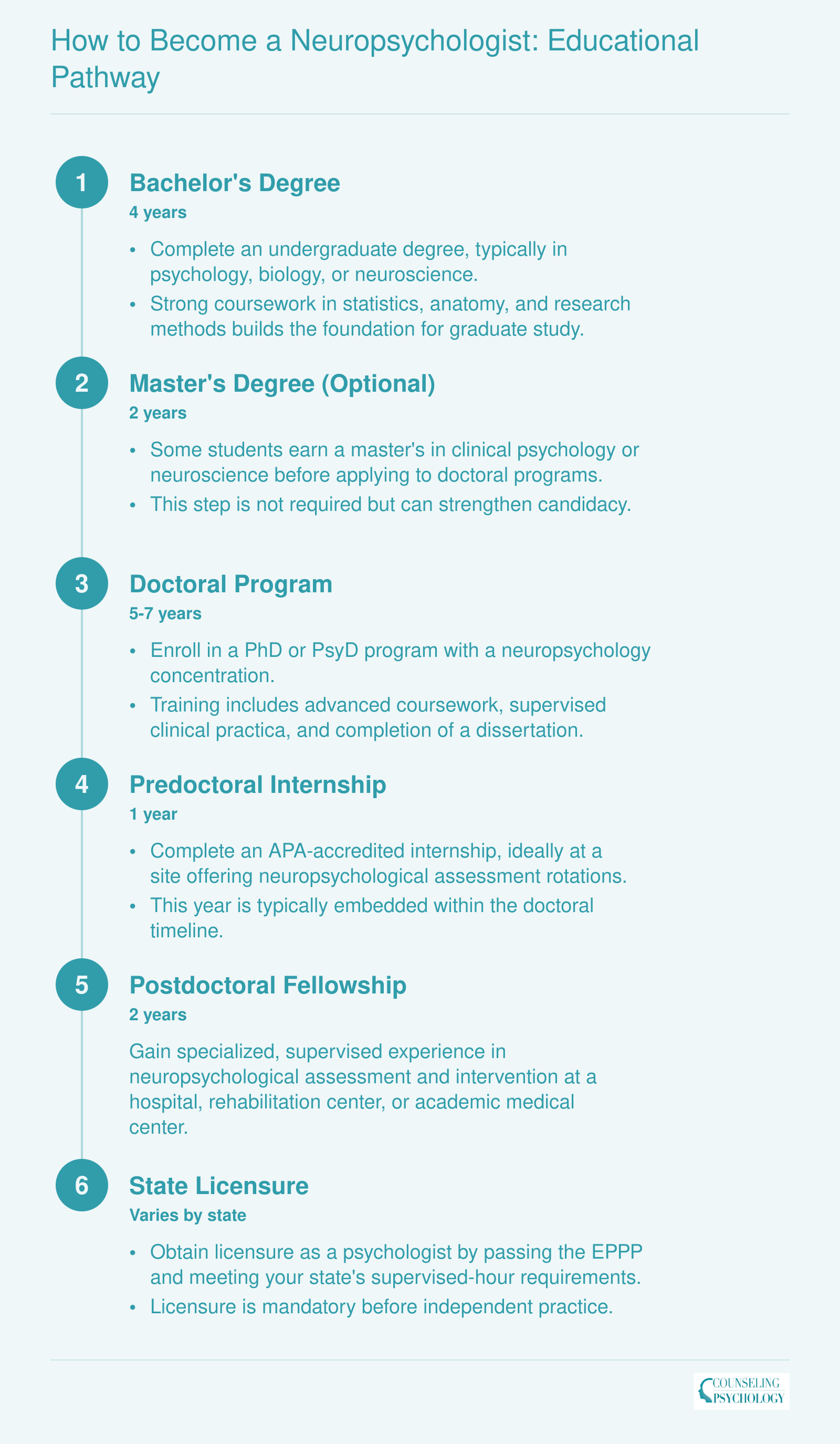
How to Become a Neuropsychologist: Educational Pathway
Becoming a neuropsychologist requires one of the longest training pipelines in the mental health professions. From your first undergraduate course to board certification, expect a commitment of 10 to 13 years after high school. A doctoral degree (PhD or PsyD) is required; there is no shortcut to the neuropsychologist title.
Online Neuropsychology Degrees by Level: Bachelor's, Master's, and Doctoral
The path to becoming a neuropsychologist spans multiple degree levels, each with distinct purposes and varying online availability. Understanding what each tier offers helps you plan a realistic educational timeline.
Bachelor's Level: Building the Foundation
No standalone "neuropsychology bachelor's degree" exists at most universities. Instead, aspiring neuropsychologists typically complete a BS in Psychology or a BS in Neuroscience, selecting electives in biopsychology, cognitive neuroscience, neuroanatomy, and research methods. Online bachelor's programs in psychology are widely available and can adequately prepare you for graduate study, provided you supplement coursework with research experience or laboratory opportunities when possible.
This undergraduate degree is foundational, not terminal. You cannot practice neuropsychology with only a bachelor's degree, but strong undergraduate preparation in statistics, biology, and psychological assessment positions you competitively for graduate admissions.
Master's Level: A Stepping Stone with Limitations
Online and hybrid master's programs in clinical psychology or related fields exist, though programs explicitly labeled "neuropsychology" at this level are uncommon. A master's degree can serve two purposes:
- Terminal master's: Prepares graduates for limited assessment roles under licensed supervision, research assistant positions, or related healthcare work. These programs do not qualify graduates for independent clinical licensure as neuropsychologists.
- Doctoral-track master's: Functions as preparation for PhD or PsyD programs, sometimes allowing transfer of credits toward doctoral study.
Online master's programs in this space may teach neuropsychological assessment fundamentals, but graduates should understand they cannot independently administer and interpret neuropsychological batteries without doctoral-level training and licensure.
Doctoral Level: Where Clinical Training Demands In-Person Hours
Doctoral programs represent the true gateway to neuropsychology practice, and the distinction between degree types matters significantly.
- PhD programs emphasize research alongside clinical training. They are more commonly funded through assistantships or fellowships, reducing student debt. Strong programs like Fordham University's PhD in Clinical Psychology with a Clinical Neuropsychology Major Area of Study require dedicated neuropsychology coursework and multiple clinical externships.3
- PsyD programs prioritize clinical practice over research production. These programs typically cost more out of pocket and may offer less funding, but they can prepare graduates effectively for assessment-heavy clinical roles.
- Neuroscience PhD programs train researchers in brain-behavior relationships but do not qualify graduates for clinical licensure as neuropsychologists. If patient care is your goal, a neuroscience doctorate alone will not get you there.
Programs like Howard University's PhD in Psychology with a Specialization in Neuropsychology demonstrate that dedicated neuropsychology tracks exist, though they remain primarily on-campus.2 Some hybrid doctoral programs in clinical psychology, such as Fielding Graduate University's APA-accredited PhD, deliver coursework through distributed formats but do not currently offer neuropsychology-specific tracks.1
The Reality of Online Doctoral Options
Fully online doctoral programs in neuropsychology are extremely rare. APA accreditation requirements mandate substantial supervised clinical hours that cannot be completed remotely.4 No APA-accredited clinical psychology doctoral program with a neuropsychology track currently operates in a fully online format. Hybrid programs may reduce time on campus for didactic coursework, but expect significant in-person commitments for practica, externships, and internship training regardless of how the program markets itself. For a broader look at the educational and licensing steps involved, see our guide on how to become a neuropsychologist.
PHD Vs. Psyd Vs. Neuroscience PHD for Neuropsychology Careers
Choosing the wrong doctoral track is the single most consequential mistake prospective neuropsychologists make, because not every doctorate leads to clinical licensure.
PhD in Clinical Psychology (Neuropsychology Concentration)
The clinical psychology PhD is the most established route into neuropsychological practice. Programs typically run five to seven years and balance rigorous research training with supervised clinical hours. Many APA-accredited clinical psychology doctorate programs offer funded positions, meaning tuition waivers and modest stipends in exchange for research or teaching assistantships. Graduates are eligible to pursue clinical licensure as psychologists, complete a postdoctoral fellowship in neuropsychology, and meet the training criteria outlined by the Houston Conference guidelines. Career paths span hospital-based assessment, academic faculty positions, and independent research.
The tradeoff is time. The research demands are substantial, and students who prefer direct patient care over dissertation work sometimes find the balance frustrating.
PsyD in Clinical Psychology (Neuropsychology Concentration)
The PsyD was designed for practitioners, and that emphasis shows throughout the curriculum. Clinical hours accumulate faster, and the dissertation requirement is typically replaced by a practice-oriented doctoral project. Neuropsychology is a common specialty area within PsyD programs, and graduates qualify for the same licensure pathway as PhD holders.
The practical concern is funding. PsyD programs award fewer assistantships than PhD programs, and tuition at many schools runs significantly higher. Students should calculate total debt load carefully before enrolling, particularly at programs without APA accreditation.
PhD in Neuroscience: A Critical Distinction
A neuroscience PhD prepares graduates to conduct brain-behavior research in laboratory and academic settings.2 It does not include the supervised clinical training hours required for psychology licensure. Someone holding a neuroscience PhD cannot legally practice as a clinical neuropsychologist, administer neuropsychological assessments to patients, or bill for clinical services in any state.
This distinction matters more than it may appear. Neuroscience PhD graduates pursue cognitive neuroscience careers as research scientists, postdoctoral researchers, and academic faculty, roles that are valuable and intellectually demanding. They simply are not the same career as clinical neuropsychology.
Comparing the Three Paths
- Clinical PhD: Research and clinical training, frequent funding, longer timeline, licensure eligible, suits academia and hospital-based practice.
- Clinical PsyD: Practice-focused, less funding available, shorter research component, licensure eligible, suited to direct clinical service.
- Neuroscience PhD: Research-only training, no clinical licensure pathway, best fit for laboratory science and academic research careers.
If your goal is to assess and treat patients with neurological conditions, either the clinical PhD or PsyD gets you there. If your goal is to study brain function in a lab, the neuroscience PhD is the right choice. Conflating the two early in the decision process costs applicants years.
Related Articles
Section content unavailable.
Neuropsychology Program Curriculum and Clinical Training Requirements
Doctoral neuropsychology programs blend rigorous coursework with extensive supervised clinical experience. Understanding what you'll study and the training milestones you'll need to meet helps clarify why fully online pathways remain rare at the doctorate level.
Core Doctoral Coursework
Typical doctoral curricula in neuropsychology cover several foundational domains. You'll take courses in clinical neuroanatomy to understand brain structure and function, neuropsychological assessment to learn standardized test batteries (Wechsler scales, Halstead-Reitan, Luria-Nebraska, and others), and psychopharmacology to grasp how medications affect cognition and behavior. Cognitive rehabilitation trains you to design interventions for memory, attention, and executive-function deficits. You'll also study psychopathology to differentiate neurological from psychiatric conditions, statistics and research methods to conduct empirical studies, and professional ethics specific to assessment and diagnosis. Programs accredited by the American Psychological Association often require additional seminars in cultural diversity, lifespan development, and history and systems of psychology.
Clinical Training Hours and Milestones
Doctoral students accumulate practicum hours under licensed supervision throughout their coursework, typically 600 to 1,500 hours or more depending on the program and state licensure requirements. These practica occur in hospital neuropsychology clinics, rehabilitation centers, or outpatient settings where you administer assessments, score protocols, write integrated reports, and participate in interdisciplinary rounds.
After coursework and comprehensive exams, you'll complete a predoctoral internship, usually one year full time (or two years half time) in an APA-accredited or APPIC-member site. Internships include rotations in neuropsychology, adult psychotherapy, child assessment, or other specialties. Following the doctorate, a two-year postdoctoral fellowship focused on neuropsychological assessment and differential diagnosis is standard before you can apply for board certification through the American Board of Clinical Neuropsychology or the American Board of Professional Neuropsychology.
Why Doctoral Programs Require In-Person Training
APA accreditation standards mandate face-to-face supervision, direct patient contact, and on-site collaboration with neurologists, neurosurgeons, and rehabilitation psychologists. Scoring many neuropsychological tests requires observing subtle motor behaviors, gauging effort, and tracking real-time response patterns that cannot be replicated through video or asynchronous platforms. As a result, fully online doctoral programs in clinical neuropsychology do not currently meet accreditation criteria, though hybrid models may offer some didactic courses online.
Subspecialty Training Tracks
Many programs and fellowships offer concentrated tracks:
- Pediatric neuropsychology: Assessment of developmental disorders, learning disabilities, and acquired brain injuries in children.
- Geriatric and dementia assessment: Differential diagnosis of Alzheimer's disease, vascular dementia, and normal aging.
- Forensic neuropsychology: Evaluations for personal injury, criminal competency, and disability claims.
- Rehabilitation neuropsychology: Interventions in inpatient and outpatient settings to restore or compensate for lost cognitive functions.
Choosing a subspecialty early can guide your practicum placements and fellowship applications. Those drawn to forensic work, for example, should review forensic psychologist requirements to understand how that career path intersects with neuropsychological training.
Questions to Ask Yourself
Am I prepared to complete in-person clinical practica and internships even if my coursework is fully online?
Do I have realistic access to clinical training sites near where I live?
Am I targeting a research-focused career or direct clinical practice, and does that shape how much online flexibility I actually need?
Can I stay self-directed and organized without a traditional on-campus cohort structure?
Accreditation and Licensure Requirements for Neuropsychologists
What credentials do you actually need to practice neuropsychology, and how long does the full credentialing process take from doctoral program to board certification?
The path is more layered than most students expect. Neuropsychology sits within clinical psychology for credentialing purposes, so the gatekeeping mechanisms (accreditation, licensure, board certification) all flow through psychology's broader regulatory structure. Here is how each layer works.
APA Accreditation and Program Selection
There is no standalone "neuropsychology accreditation." The American Psychological Association accredits doctoral programs in clinical psychology, counseling psychology, and school psychology, not in neuropsychology as a separate specialty. If you plan to pursue licensure and eventually work as a neuropsychologist, enrolling in an APA-accredited clinical psychology program is effectively a prerequisite. APA accreditation matters because licensure-eligible predoctoral internships and postdoctoral residencies almost universally require graduation from an accredited program.
At the master's level, the Masters in Psychology and Counseling Accreditation Council (MPCAC) accredits some relevant programs, but a master's degree alone does not qualify someone for psychologist licensure or the neuropsychologist title. A master's in neuropsychology or a related area can serve as a foundation before pursuing a doctorate.
State Licensure as a Psychologist
Every U.S. state requires a doctoral degree in psychology and passage of the Examination for Professional Practice in Psychology (EPPP) to earn a psychologist license.1 Beyond the EPPP, most states mandate a substantial period of supervised clinical experience. Nationally, supervised hour requirements typically fall within a range of 3,000 to 6,000 hours, though exact thresholds vary by jurisdiction.1 Some states also administer a jurisprudence exam covering local laws and ethics. For a broader look at the psychologist education pathway, including degree types and general licensing steps, our overview covers the full sequence.
Because licensure requirements differ, students should verify hour thresholds and any supplemental exams for the state where they intend to practice. The supervised hours typically include both predoctoral internship hours and postdoctoral residency hours.
ABCN Board Certification: The Four-Step Process
After earning licensure, neuropsychologists can pursue board certification through the American Board of Clinical Neuropsychology (ABCN), a specialty board under the American Board of Professional Psychology (ABPP).2 Board certification is not legally required to use the neuropsychologist title in most states, but it is increasingly expected by hospitals, academic medical centers, and insurance panels. In competitive job markets, it can be a deciding factor in hiring.
The ABCN pathway involves four sequential steps:3
- Credential review: Candidates submit documentation of their doctoral degree, licensure, and completion of a postdoctoral residency where at least 50 percent of training focused on clinical neuropsychology under the supervision of a board-certified clinical neuropsychologist.4 The ABPP evaluates whether the candidate's training and experience meet specialty requirements.
- Written examination: Candidates sit for a 150-minute exam covering neuropsychological assessment, brain-behavior relationships, neuropathology, and professional ethics.5 The exam is offered four times per year, and candidates may attempt it up to three times.5 Historical pass rates for the written exam have ranged from roughly 65 to 80 percent.6
- Practice sample submission: Candidates submit detailed work samples from their clinical neuropsychology practice, typically case reports demonstrating assessment, interpretation, and diagnostic reasoning.
- Oral examination: A panel of board-certified neuropsychologists reviews the practice samples and conducts an oral exam. This stage has maintained a pass rate of at least 80 percent, reflecting the fact that most candidates who reach this point are well prepared.6
Candidates have up to seven years from the start of their candidacy to complete all four steps.5 Meeting each requirement in sequence takes deliberate planning, especially for early-career clinicians juggling a new caseload with exam preparation.
Why the Full Pathway Matters
The cumulative timeline from doctoral enrollment through board certification often spans a decade or more. Understanding this at the outset helps students set realistic expectations and select programs that align with their long-term goals. An APA-accredited doctoral program with strong neuropsychology mentorship and practicum placements positions graduates well for competitive internships and residencies, which in turn set the stage for ABCN certification.
For a detailed comparison of doctoral program structures, the breakdown of PhD versus PsyD versus neuroscience PhD options elsewhere in this article addresses how each degree type maps onto this credentialing pipeline.
Neuropsychology Vs. Clinical Psychology, Neuroscience, and Cognitive Psychology
Prospective students often struggle to distinguish neuropsychology from related fields, especially clinical psychology, neuroscience, and cognitive psychology. These disciplines overlap in subject matter but diverge sharply in training, daily practice, and career outcomes. Understanding these differences is essential before committing to a doctoral program.
Neuropsychology vs. Clinical Psychology
Neuropsychology is a subspecialty within clinical psychology, not a separate profession. Both neuropsychologists and clinical psychologists earn doctoral degrees (PhD or PsyD) in clinical psychology and must become licensed psychologists. The distinction lies in scope and method.
Clinical psychologists work across a broad range of settings and interventions: psychotherapy, diagnosis of mental health disorders, treatment planning, and evidence-based modalities such as cognitive-behavioral therapy or psychodynamic approaches. Their training covers psychopathology, assessment, and therapy across diverse populations.
Neuropsychologists, by contrast, specialize in brain-behavior relationships. They rely heavily on standardized neuropsychological test batteries to assess cognitive functioning in patients with traumatic brain injury, stroke, dementia, epilepsy, or neurodevelopmental disorders. Their work focuses on identifying patterns of cognitive strengths and deficits, diagnosing neurological conditions, and guiding rehabilitation or educational planning. While some neuropsychologists conduct therapy, most spend the majority of their time administering and interpreting tests. Board certification through the American Board of Clinical Neuropsychology (ABCN) requires additional postdoctoral fellowship training beyond licensure.
Neuropsychology vs. Neuroscience
Neuroscience is a research discipline, not a clinical practice. Neuroscientists study the nervous system at cellular, molecular, and systems levels, often using animal models, imaging techniques, or electrophysiology. Training typically culminates in a neuroscience PhD, with careers in academic research, pharmaceutical development, or biotech. Students drawn to this path can explore what it takes to become a cognitive neuroscientist in more detail.
Neuropsychology, on the other hand, is a clinical application of brain science. Neuropsychologists work directly with patients, translating research on brain function into assessment and intervention. A neuroscience PhD does not lead to licensure or clinical practice; a clinical psychology doctorate with neuropsychology specialization does.
Neuropsychology vs. Cognitive Psychology
Cognitive psychology studies mental processes such as memory, attention, perception, and language in research settings, often with healthy participants. Cognitive psychologists typically pursue experimental PhDs and work in academic or industry research, designing studies to understand how people think and learn.
Neuropsychology applies similar constructs in clinical contexts, assessing how brain injury or disease disrupts cognitive processes. While cognitive psychology informs neuropsychological theory, the two fields require different training paths and lead to different careers.
Neuropsychologist Salary and Career Outlook
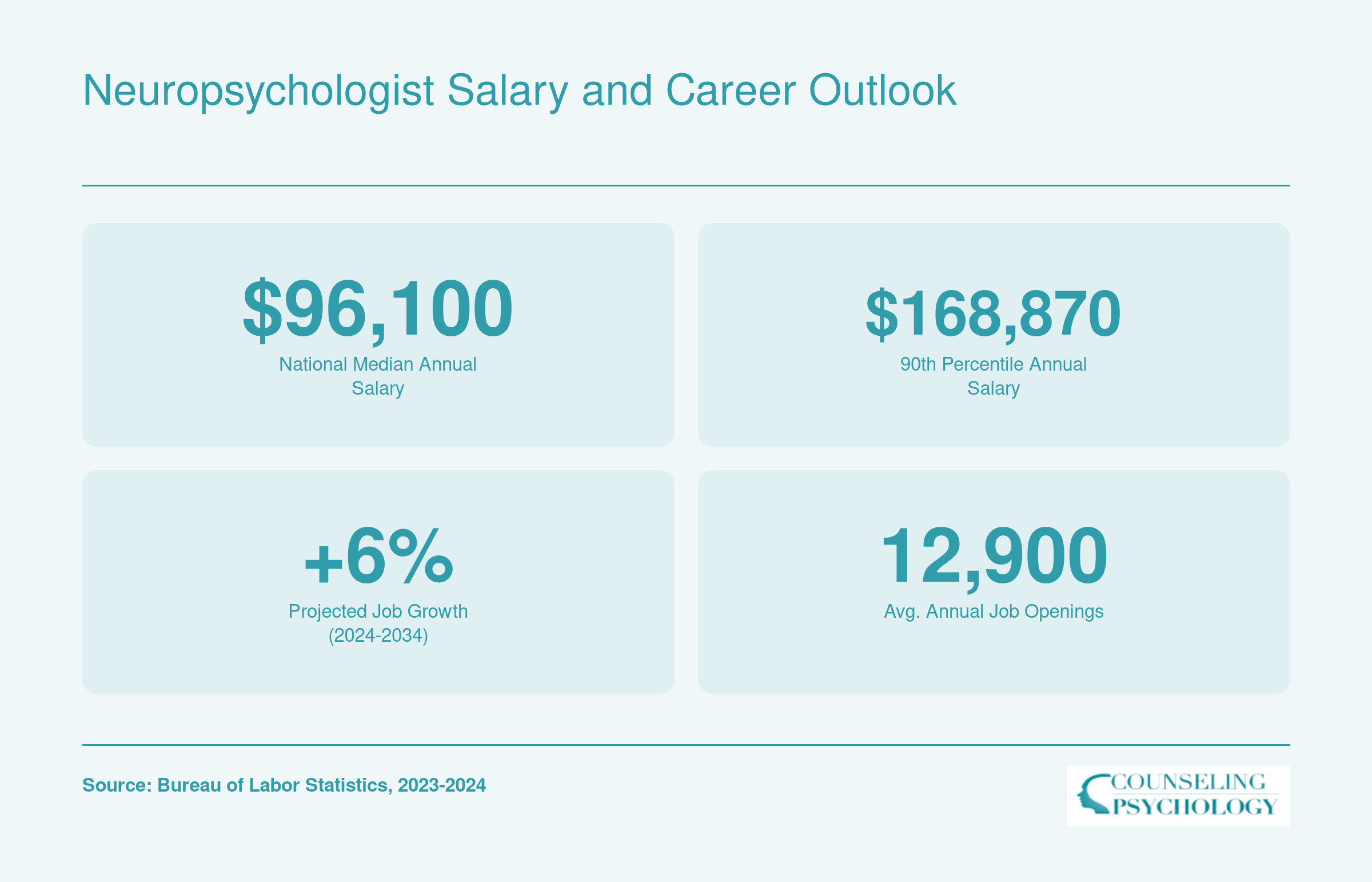
The Bureau of Labor Statistics does not report neuropsychologist salaries as a standalone category, so the figures below reflect the broader clinical and counseling psychologists group (SOC 19-3033) at the national level. Neuropsychologists working in hospital or medical center settings often earn above these medians, and board-certified neuropsychologists (ABCN) in metropolitan medical centers tend to command the highest salaries in the field. APA and AACN workforce surveys suggest additional premiums for forensic and specialized hospital roles, though published figures vary by survey year.
Online and hybrid coursework is expanding at every degree level, but the supervised practica, internships, and two-year postdoctoral fellowship that define neuropsychology still happen face-to-face in clinics and hospitals. When comparing programs, weigh the strength of the clinical placement network and faculty connections as heavily as the flexibility of the online format.
How to Choose the Right Neuropsychology Program
Choosing a neuropsychology program is less about ranking and more about matching a program's structure, funding model, and training opportunities to your specific career goals.
Start with Salary and Employment Data
Before committing to any program, get grounded in realistic earnings expectations. The Bureau of Labor Statistics (BLS.gov) publishes wage and employment data for psychologists broadly, including clinical and research roles that neuropsychologists typically occupy. Because neuropsychology is not broken out as a separate occupational category by the BLS, you will need to look at the data for psychologists overall and factor in the additional years of postdoctoral training the field requires. Postdoctoral fellows in neuropsychology generally earn salaries set by NIH or institutional pay scales, which are publicly available and worth reviewing before you calculate the full cost-to-income timeline of doctoral training.
Compare Costs and Funding Directly Through Programs
Tuition and fee structures vary widely across doctoral programs, and published figures can go stale quickly. PhD programs in clinical neuropsychology frequently offer stipends and tuition waivers in exchange for research or teaching assistantship work. PsyD programs, which tend to follow a practitioner-focused model, are more often tuition-driven and less likely to provide full funding packages. That distinction has real financial consequences over a five-to-seven year degree. If you are still weighing broader online doctoral programs in psychology, comparing funding models across program types is an essential early step.
Do not rely solely on aggregate cost comparisons. Contact admissions offices directly and ask specifically about:
- Stipend amounts: What is the current annual stipend for funded students?
- Tuition coverage: Is tuition fully waived, partially covered, or separate from stipend?
- Funding duration: How many years of guaranteed funding does the program offer?
- Fee obligations: Are student fees included or billed on top of any waiver?
Check APPIC Match Rates and Talk to Training Directors
For doctoral programs leading to clinical licensure, internship placement is a critical outcome metric. The Association of Psychology Postdoctoral and Internship Centers (appic.org) publishes match rate data for APA-accredited programs. Programs with strong neuropsychology training tracks often have placement histories worth asking about directly. Reach out to current training directors for program-specific match data, since aggregate numbers do not always reflect a program's performance within specialized tracks.
Use Professional Associations as a Research Layer
Organizations such as the American Psychological Association (APA), the International Neuropsychological Society (INS), and the National Academy of Neuropsychology (NAN) maintain member directories, published training guidelines, and archived reports that can help you evaluate program quality and scope. These resources are especially useful when assessing whether a program aligns with Houston Conference guidelines, which remain the field's benchmark for specialty training in clinical neuropsychology.
Frequently Asked Questions About Online Neuropsychology Programs
Below are answers to the questions prospective students ask most often about pursuing neuropsychology training online. Each answer draws on the accreditation, salary, and career data discussed throughout this article.
- Can you get a neuropsychology degree fully online?
- You can complete most or all of the coursework for a neuropsychology degree online, especially at the master's level. However, no doctoral program in clinical neuropsychology is 100 percent online. APA accredited programs require supervised clinical practica, a predoctoral internship, and a postdoctoral fellowship, all of which must be completed in person at approved training sites. Expect a hybrid format that pairs online lectures with on-site clinical hours.
- How long does it take to become a neuropsychologist?
- The full timeline typically spans 10 to 13 years after high school. That includes four years for a bachelor's degree, five to seven years for a doctoral program (PhD or PsyD), a one-year predoctoral internship, and a two-year postdoctoral fellowship in neuropsychology. Students who enter a doctoral program with a relevant master's degree may shorten the doctoral phase slightly, but the postdoctoral training requirement remains the same.
- What degree do you need to be a neuropsychologist?
- A doctoral degree, either a PhD or a PsyD in clinical psychology with a neuropsychology concentration, is the standard requirement. After earning the doctorate, you must complete a two-year postdoctoral fellowship focused on neuropsychological assessment and intervention. State licensure as a psychologist is also necessary. While a master's degree can open doors to related roles such as psychometrist, independent practice as a neuropsychologist requires the doctoral credential.
- Are neuropsychology programs APA accredited?
- APA accredits doctoral programs in clinical psychology, counseling psychology, and school psychology, not neuropsychology as a standalone specialty. Programs that train neuropsychologists are typically housed within APA accredited clinical psychology departments and offer a neuropsychology track or concentration. When evaluating programs, confirm the doctoral program itself holds APA accreditation, then verify that it provides dedicated neuropsychology coursework and practicum placements.
- How much do neuropsychologists make?
- According to BLS data, clinical and counseling psychologists (the broader category that includes neuropsychologists) earned a national median salary of roughly $96,100 as of May 2024. Neuropsychologists who hold ABCN board certification and work in hospital or private practice settings often earn above that median. Compensation varies significantly by state, metropolitan area, and practice setting, with academic positions generally paying less than private clinical roles.
- What is the difference between a neuropsychologist and a clinical psychologist?
- Both hold doctoral degrees and state licensure, but their focus areas differ. Clinical psychologists diagnose and treat a broad range of mental health conditions using psychotherapy and assessment. Neuropsychologists specialize in how brain structure and function relate to cognition and behavior, relying heavily on standardized neuropsychological test batteries. They often work with patients who have traumatic brain injuries, neurodegenerative diseases, or epilepsy, and their evaluations inform surgical planning, rehabilitation, and disability determinations.
- Is ABCN board certification required to practice neuropsychology?
- ABCN board certification through the American Board of Clinical Neuropsychology is not legally required in any state. However, it is widely regarded as the professional gold standard and is increasingly expected by hospitals, forensic settings, and insurance panels. Earning the credential involves passing a written examination, submitting work samples, and completing an oral exam. Many employers and referral sources treat ABCN certification as a practical prerequisite, even if licensure alone permits practice.
Explore Programs
Related Programs
- Best Climate Psychology
- Best Online Applied Behavior Analysis
- Best Online Applied Psychology Degree
- Best Online Associate Degrees in Psychology for
- Best Online Autism Spectrum Disorders
- Best Online Bachelor's in Psychology
- Best Online Child Psychology Degree
- Best Online Clinical Psychology Programs for
- Best Online Cognitive Psychology Degree
- Best Online Counseling Psychology Programs for
- Best Online Developmental Psychology
- Best Online Educational Psychology Degrees
- Best Online Forensic Psychology Degree
- Best Online Graduate Certificate in Psychology
- Best Online Health Psychology Programs for
- Best Online Human Factors Psychology
- Best Online I/O Psychology
- Best Online International Psychology
- Best Online Master's in Psychology Programs for
- Best Online Ph.D. in Psychology
- Best Online Positive Psychology Programs for
- Best Online Psychopharmacology Programs for
- Best Online PsyD Programs for
- Best Online School Psychology
- Best Online Social Psychology Programs for
- Best Online Sports Psychology Programs in
- Engineering Psychology Degrees
- Online Geropsychology