
What you’ll learn in this article…
- Accelerated online psychology Ph.D. tracks can cut completion time to roughly three to four years for students with a master's degree.
- Very few fully online doctoral psychology programs hold APA accreditation as of 2026, making format verification essential.
- Tuition across ranked programs varies widely, with public institutions offering significantly lower net prices than private alternatives.
- Licensed clinical practice and industrial-organizational roles deliver the strongest long-term salary premiums for doctorate holders.
Demand for doctoral-level psychologists is rising. The Bureau of Labor Statistics projects employment of psychologists to grow faster than average through the early 2030s, and many state licensing boards require a doctorate before a candidate can sit for a clinical licensure exam at all. For working professionals, relocating to attend a traditional residential program is often not feasible, which is where online and hybrid doctoral formats have carved out real utility.
This ranked list covers 29 regionally accredited programs offering online or hybrid Ph.D. and related doctoral degrees in psychology and closely adjacent fields. Programs vary considerably by cost, specialization, and accreditation status. Tuition ranges from under $10,000 at public institutions like Wichita State University to more than $55,000 at private schools, and that spread has direct implications for long-term debt. Students weighing options across the broader landscape of psychology degree programs will find this ranking a useful starting point.
Accreditation status is the single most consequential variable for students aiming at licensed clinical or counseling practice. APA accreditation remains rare among online-delivered programs, and several states will not accept a degree from a non-APA-accredited program as qualifying for licensure, regardless of institutional reputation.
Best Online Ph.D. in Psychology Programs
The following programs were selected from regionally accredited institutions offering online or hybrid doctoral degrees in psychology and related fields. Each school is ranked by a composite that factors in online delivery format alongside institutional quality indicators, not by any single metric such as cost or earnings alone. Program-level earnings data is not yet available for most of these doctorates, so we highlight institution-wide outcomes and net price to help you compare.
- Online or hybrid delivery format
- Institutional graduation and retention rates
- Net price and student debt levels
- Graduate earnings outcomes
- Student-to-faculty ratio
- NCES-IPEDS federal institutional data — nces.ed.gov
- Internal program database
- Independent program research
- College Scorecard graduate earnings — collegescorecard.ed.gov

George Mason University
George Mason University is a large public research institution in Fairfax, Virginia, that draws heavily from the Washington, D.C., metro workforce. Its School of Education houses a hybrid PhD in Education with an Educational Psychology specialization, giving working professionals in the DMV region the flexibility to maintain careers while pursuing doctoral research. The university posts a 67.8% graduation rate and a net price of roughly $17,915, making it one of the more affordable options on this list for in-state students.
- Hybrid format blends online coursework with on-campus sessions
- Personalized, interdisciplinary study plans
- Includes practical internships alongside coursework
- Students may draw electives from other Mason units
- Research methodologies and cognition emphasis
- Master's degree and relevant experience required
- Financial aid and assistantships available
PhD in Education, Educational Psychology Specialization — Hybrid

University of the Pacific
University of the Pacific is a private institution in Stockton, California, offering a four-year hybrid PsyD in Counseling Psychology. The program combines online learning with one to two days per week on campus and provides guaranteed internship placements across Northern California healthcare and mental health systems. With a 69% graduation rate and an 13:1 student-to-faculty ratio, Pacific delivers a relatively intimate doctoral experience, though its net price of about $25,447 reflects its private tuition structure.
- Hybrid format with 1-2 in-person days per week
- Four-year doctoral program timeline
- Guaranteed internship experience included
- Comprehensive clinical training across diverse settings
- Expert practitioner faculty
- Prepares graduates for California psychology licensure
- High projected job growth in counseling fields
PsyD in Counseling Psychology — Hybrid

University of Memphis
The University of Memphis is a public research university offering a fully online PhD in Educational Psychology and Research. The program requires 54 credit hours plus a dissertation and is structured for both full-time and part-time students. At a net price near $12,397, Memphis represents one of the lowest-cost doctoral options on this ranking, though its institution-wide graduation rate of 50.9% is below average. Graduate assistantship funding is available, often tied to faculty-led research projects in West Tennessee school systems.
- Available fully online or face-to-face
- 54 credit hours plus dissertation required
- Part-time and full-time enrollment options
- Assistantship funding opportunities available
- Faculty research apprenticeship model
- Customizable elective coursework
- Fall and spring admission cycles
- No state residency requirement for online students
PhD in Educational Psychology and Research — Online

Regent University
Regent University is a private, faith-based institution in Virginia Beach offering a fully online PhD in Counseling and Psychological Studies with an Industrial-Organizational concentration. The 51-credit-hour program integrates a Christian worldview with applied organizational psychology and includes 150 hours of field experience. Net price sits around $19,923, and the university posts a 56.9% graduation rate. Prospective students should note this degree targets consulting, faculty, and ministry roles rather than clinical licensure as a psychologist.
- 100% online doctoral program
- 51 total credit hours required
- 150 hours of field experience included
- Christian worldview integrated throughout curriculum
- Focus on workplace behavior and leadership effectiveness
- Prepares for consulting, teaching, and organizational roles
- Does not lead to clinical psychology licensure
PhD in Counseling & Psychological Studies, Industrial-Organizational Concentration — Online

Wichita State University
Wichita State University, a public institution in Kansas, offers a Doctorate in Educational Leadership with an Educational Psychology track in a hybrid format. Designed for mid-career educators, the 55-credit-hour program can be completed in approximately three years and does not require GRE scores. With a net price near $13,194, it is among the most affordable options here. The hybrid schedule allows Kansas and regional professionals to attend limited in-person sessions while completing most work online.
- Hybrid delivery with mostly online coursework
- 55 total graduate hours required
- Three-year completion design
- No GRE required for admission
- Customizable interdisciplinary emphasis areas
- Dissertation required
- Mentorship and collaborative learning model
- Advanced research methodology training
Doctorate in Educational Leadership, Educational Psychology Track — Hybrid

Liberty University
Liberty University, a large private Christian institution in Lynchburg, Virginia, offers two fully online PhD tracks in Psychology: Industrial/Organizational and Developmental. Both require 60 credit hours delivered in eight-week course blocks, and neither requires standardized test scores for admission. Liberty allows transfer of up to 50% of credits, which can shorten time to completion. Net price is higher at roughly $29,357, but military discounts may reduce costs. These degrees prepare graduates for research, teaching, and consulting, not clinical licensure.
- 100% online with optional campus intensives
- 60 total credit hours
- Eight-week accelerated course format
- No standardized testing for admission
- Transfer up to 50% of credits
- Biblical perspective woven into curriculum
- Career paths include consulting and academia
- Military tuition discounts available
- 100% online delivery
- 60 credit hours required
- Eight-week course blocks
- Transfer up to 50% of prior credits
- No standardized testing needed
- Focus on lifespan developmental processes
- Optional on-campus intensive sessions
- Competitive tuition with military discounts
PhD in Psychology, Industrial/Organizational Psychology — Online
PhD in Psychology, Developmental Psychology — Online

Western Michigan University
Western Michigan University is a public institution in Kalamazoo known for its deep roots in behavior analysis and organizational behavior management. The hybrid PhD in Industrial Organizational Behavior Management combines 30 credit hours of coursework with 12 dissertation hours, emphasizing applied performance improvement and consulting. WMU's net price is approximately $15,273, and its broader behavior analysis ecosystem supports students who may also hold or pursue BCBA credentials. The 16:1 student-to-faculty ratio provides solid access to research mentorship.
- Hybrid format with on-campus and online components
- 30 credit hours of coursework plus 12 dissertation hours
- Strong focus on organizational performance improvement
- Prepares for consulting, teaching, and research careers
- Minimum 3.0 GPA required for admission
- Integrates behavior analysis with I/O psychology
- Comprehensive research training included
PhD in Industrial Organizational Behavior Management — On-Campus

Simmons University
Simmons University is a private institution in Boston offering a fully remote 48-credit PhD in Behavior Analysis. The program targets working behavior analysts who already hold a master's degree and professional certification, making it one of the more specialized options on this list. Graduates often pursue the BCBA-D credential. Simmons boasts the highest graduation rate in this ranking at 72.3% and a 9:1 student-to-faculty ratio, though its net price of about $25,265 reflects its private institution status.
- Fully remote online program
- 48 credit hours required
- Focus on experimental research skills
- Faculty collaboration on active research projects
- Supports pursuit of BCBA-D credential
- Requires master's degree and current certification
- Flexible scheduling for working professionals
- Geographically diverse cohort model
PhD in Behavior Analysis — Online

Chaminade University of Honolulu
Chaminade University of Honolulu is a small private institution offering a 100% online EdD in Educational Psychology with two concentrations: Mental Health Counseling and School Psychology. Both tracks require 60 credit hours and a 600-hour internship, with completion possible in about 36 months. The Mental Health Counseling concentration specifically prepares graduates for the Hawaii DCCA Mental Health license, making it particularly relevant for students planning to practice in Hawaii and the Pacific region. Net price is approximately $28,856.
- 100% online with asynchronous and synchronous sessions
- 60 credit hours required
- Completable in approximately 36 months
- 600-hour internship included
- Prepares for Hawaii DCCA Mental Health license
- Emphasis on culturally responsive practice
- Dissertation required
- Master's degree required for admission
- 100% online delivery
- 60 total credit hours
- 36-month completion timeline
- Dissertation included
- Concentration in school psychology practice
- Evidence-based and culturally responsive focus
- Prepares for educational roles in Pacific communities
- Master's degree and transcripts required
EdD in Educational Psychology, Mental Health Counseling Concentration — Online
EdD in Educational Psychology, School Psychology Concentration — Online

Carlow University
Carlow University is a small private institution in Pittsburgh offering an APA-accredited Doctoral Program in Counseling Psychology with a social justice concentration. The hybrid format allows working professionals in Pennsylvania and nearby states to complete coursework online while fulfilling in-person practicum and residency requirements in the Pittsburgh area. The program spans 93 credit hours and approximately 48 months. Carlow's net price is around $20,786, and it posts a 59.9% graduation rate with a 12:1 student-to-faculty ratio.
- APA-accredited doctoral program
- Hybrid learning format with online coursework
- 93 total credit hours
- Approximately 48 months to complete
- Practitioner-scholar training model
- Extensive practicum at multiple Western PA sites
- International study opportunities available
- Dedicated faculty mentorship throughout
Doctoral Program in Counseling Psychology, Social Justice Concentration — Hybrid
How We Ranked These Programs
Choosing where to invest four to seven years of doctoral study means balancing program quality against practical constraints like cost, format flexibility, and career outcomes. Transparent methodology helps you weigh those factors without guessing what makes one program stand out over another.
Online Delivery as the Starting Filter
Every program in this ranking first had to offer a predominantly online format, allowing working professionals and geographically constrained students to complete coursework remotely. Programs requiring full-time, on-campus attendance were excluded regardless of other strengths.
Institutional Quality Signals
Once a program cleared the online-delivery threshold, we evaluated institutional markers drawn from federal data sources:
- Graduation rate: This figure reflects the institution's overall completion rate, not the specific doctoral program. It signals whether a school supports students through to degree completion, though psychology Ph.D. cohorts may differ from the broader student body.
- Net price: We used sector-conditional averages, meaning the typical out-of-pocket cost for students at similar institution types. This provides a useful benchmark but may not capture the exact cost of a doctoral program, which often involves different fee structures than undergraduate degrees.
Program-Level Earnings and Debt Data
The College Scorecard now publishes earnings and debt figures at the program level for many institutions, offering a more granular picture than institution-wide averages alone. Where available, we incorporated median earnings one year after completion and median debt at graduation for psychology doctoral programs specifically. When program-level data is not yet published for a particular school, we note that limitation rather than substitute institutional averages. If you are comparing options across subfields, our guide to clinical psychology doctorate programs applies a similar data-driven approach.
Why This Matters for Your Search
Most competing rankings on the first page of search results either omit methodology entirely or rely on reputation surveys that tell you little about student outcomes. By showing exactly which data points inform our list, you can adjust the weight you give each factor based on your own priorities. A program with modest institutional graduation rates but strong program-level salary data might suit a mid-career professional differently than it would a recent bachelor's graduate. Students exploring related doctoral paths, such as counseling doctoral programs, will find comparable transparency useful when evaluating those options.
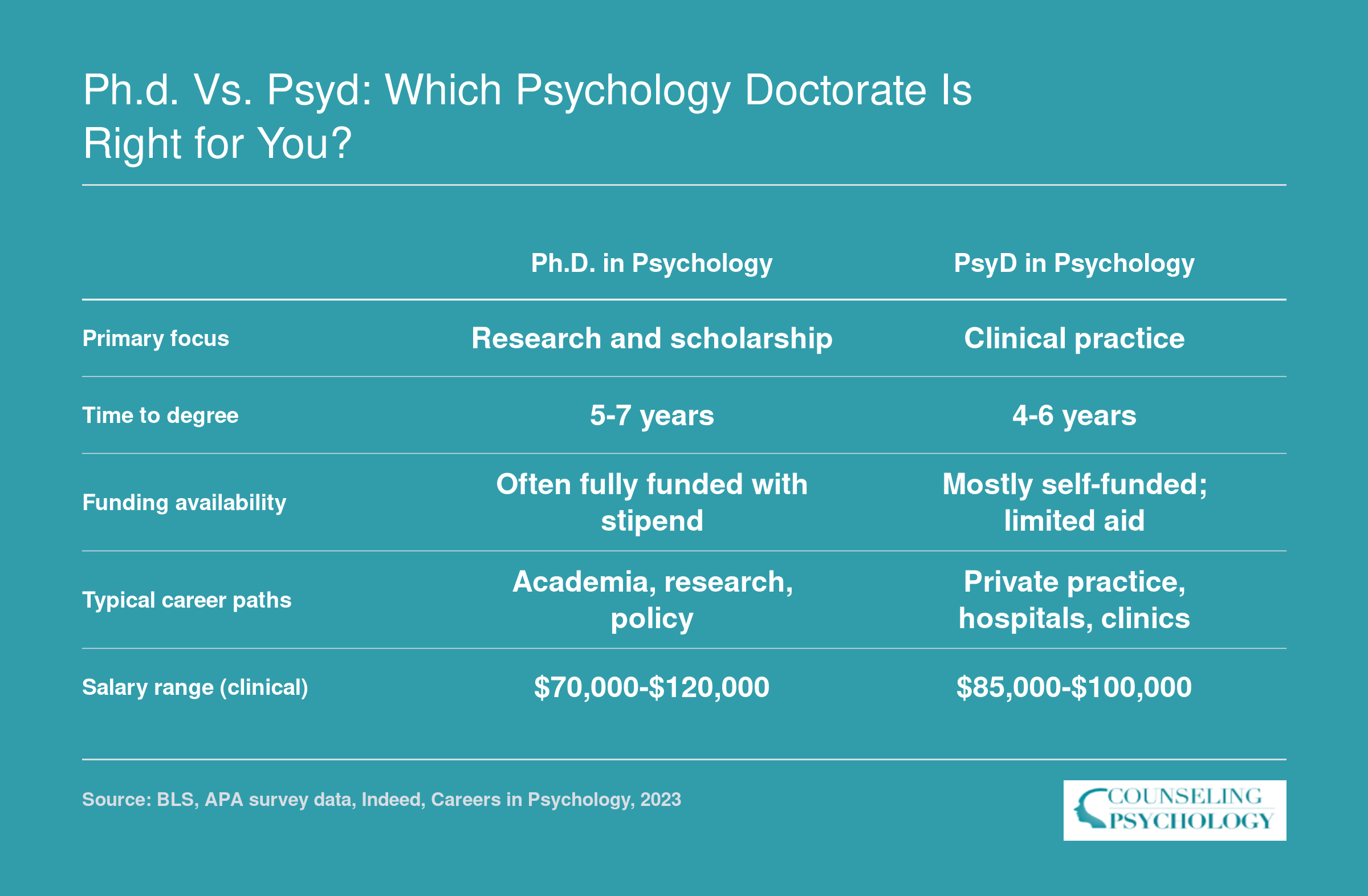
Ph.D. vs. PsyD: Which Psychology Doctorate Is Right for You?
Choosing between a Ph.D. and a PsyD comes down to your career goals, tolerance for debt, and how much time you want to spend in research versus clinical training. Ph.D. programs emphasize research methodology and are far more likely to offer full tuition waivers with stipends, while PsyD programs prioritize applied clinical skills but typically require substantial out-of-pocket investment. Who gets paid more? It depends on the path: Ph.D. holders in academic or research faculty roles and PsyD holders in direct clinical practice follow different salary trajectories, so neither degree uniformly "wins" on earnings.
Questions to Ask Yourself
How Much Does an Online Psychology Ph.D. Cost?
The total cost of an online psychology Ph.D. depends on the institution, your residency status, and whether you receive any form of financial support. Across the programs ranked on counselingpsychology.org, tuition and net price figures vary widely, so understanding the full range is essential before committing to a multi-year doctoral investment.
Tuition and Net Price Ranges
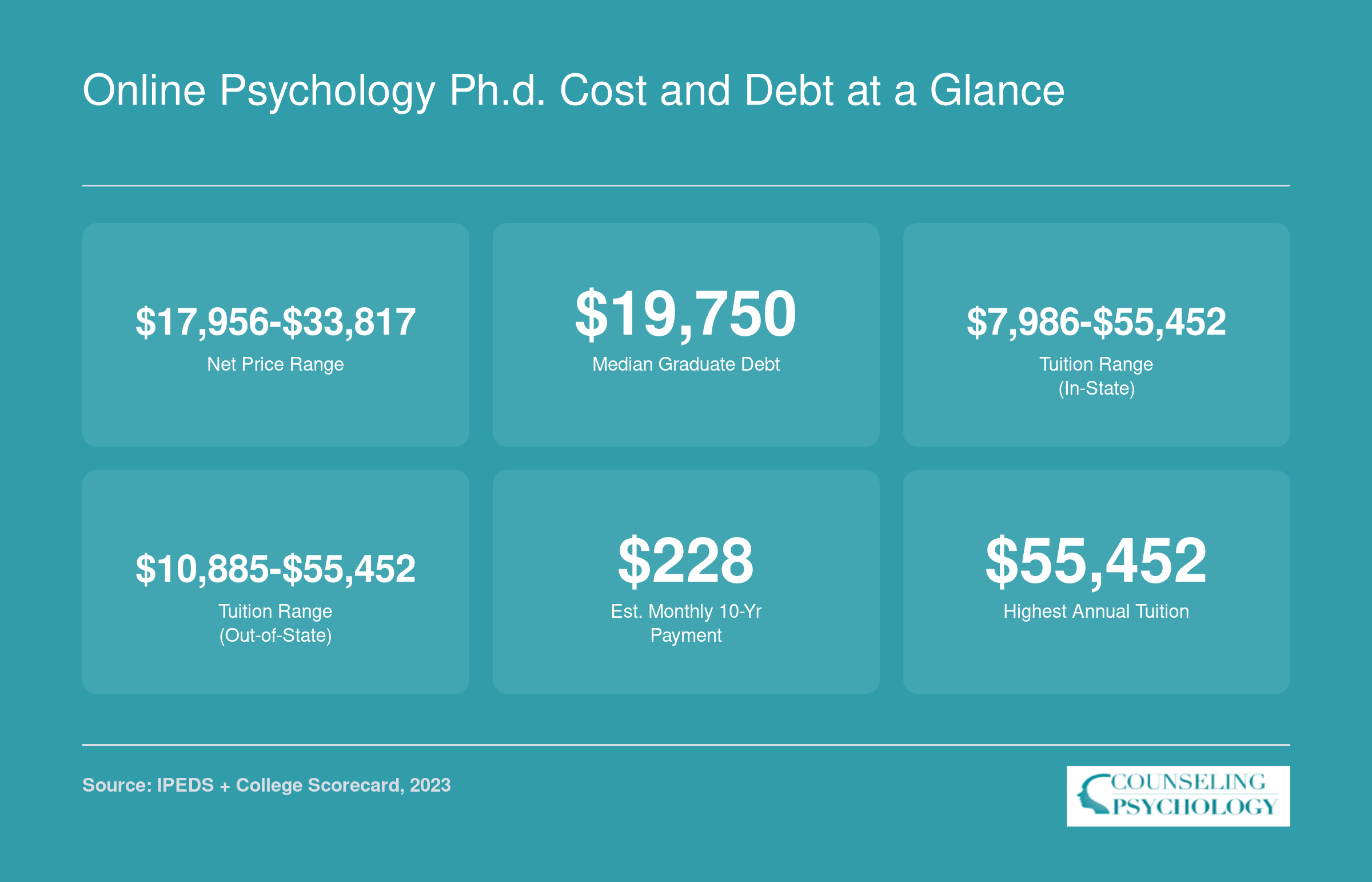
Among the ranked programs, annual graduate tuition for in-state students starts as low as roughly $7,990 at Wichita State University and climbs to over $20,100 at Western Michigan University. Out-of-state rates shift the picture considerably: George Mason University, for example, charges around $17,960 in-state but roughly $40,310 out-of-state. Private institutions like Bay Path University and Regent University charge a flat rate regardless of residency, with graduate tuition near $15,160 and $17,870 per year, respectively.
The institution-wide net price (what a typical student actually pays after grants and scholarships) ranges from about $12,400 at the University of Memphis to roughly $19,920 at Regent University among the top-ranked options. Keep in mind that this net price reflects an institution-wide average across all degree levels and student profiles. Your actual cost will depend on your specific program, enrollment intensity, and the financial aid package you receive.
What Does Debt Look Like at Graduation?
Program-level median debt and monthly repayment figures are not yet reported for most of these online psychology doctorates, which is common for newer or smaller programs in federal data releases. However, institution-wide median graduate debt offers a rough anchor. Across these schools, that figure ranges from around $14,970 at Capella University to about $26,190 at Western Michigan University. Doctoral students who borrow at the higher end of that spectrum and enter a standard 10-year repayment plan should expect monthly payments in the range of roughly $170 to $300, depending on their interest rate and total balance.
Funding, Stipends, and the Online Tradeoff
Traditional on-campus psychology Ph.D. programs frequently offer full funding packages that include tuition waivers and annual stipends. At top research universities, these packages can be substantial. USC's psychology doctoral program, for instance, provides a $42,436 annual stipend for five years.1 NYU Steinhardt offers $34,883 per year over the same period.2 Even mid-tier public universities fund admitted doctoral cohorts: the University of Minnesota guarantees five years of support with graduate assistant pay of $28.94 per hour3, and UC Berkeley covers its doctoral students for five full years as well.4 If you are exploring related forensic psychology doctorate tracks, similar funding structures apply at many residential programs.
Online and hybrid programs rarely match this level of support. Most do not employ doctoral students as teaching or research assistants in the same way residential programs do, because the campus-based infrastructure that creates those roles simply does not exist in a distance format. Some hybrid programs (Oregon State and George Mason, for example) may offer limited assistantship opportunities during on-campus residency components, but these are not guaranteed and are typically less generous than what fully residential cohorts receive.
This gap matters. A fully funded on-campus Ph.D. can cost a student almost nothing out of pocket, while an online doctorate at the same institution might require the student to cover most or all tuition through loans. As a practical matter, if you are weighing an online program against a funded residential offer, calculate the total five-to-seven-year cost difference, not just annual tuition.
Reducing Your Out-of-Pocket Cost
A few strategies can lower the price tag:
- Employer tuition benefits: Many working professionals pursuing online doctorates tap employer reimbursement programs that cover several thousand dollars per year.
- In-state residency: Public universities with hybrid formats sometimes allow online students to qualify for in-state rates, cutting annual tuition by thousands.
- Institutional scholarships: Capella University, for instance, advertises scholarship awards up to $5,000, and other schools offer merit-based aid at the doctoral level.
- Federal loans and grants: Doctoral students qualify for Direct Unsubsidized Loans (up to $20,500 per year) and Grad PLUS loans, though borrowing should be weighed carefully against expected post-graduation earnings.
The bottom line: online psychology Ph.D. programs are a viable path, but they typically require more personal financial investment than their funded on-campus counterparts. Build a realistic multi-year budget before you apply.
Online Psychology Ph.D. Cost and Debt at a Glance
Before comparing individual schools, these aggregate figures from our ranked programs give you a realistic picture of what an online or hybrid psychology doctorate costs and what graduates typically owe. Tuition swings widely depending on whether you attend a public university at in-state rates or a private institution, so mapping out your total investment early is essential.
Career Outcomes and Salary Expectations
Choosing an online psychology PhD means weighing years of delayed earnings against the substantial long-term salary premium that a doctorate can unlock. The investment pays off most clearly for graduates who pursue licensed clinical practice, academic research, or high-demand industrial-organizational roles, but the path to those outcomes is shaped heavily by accreditation, supervised hours, and the specific career track you choose.
Psychologist Job Growth and Earnings at a Glance
The Bureau of Labor Statistics projects about 11,800 to 12,900 openings each year for clinical, counseling, and school psychologists through 2034, with a combined workforce of over 204,000.1 Job growth for this broad group sits at 6%, but that average conceals a powerful trend: clinical and counseling psychologists alone are expected to grow by 11.2% over the same decade, driven by greater demand for mental health services.2 Industrial-organizational psychologists command the highest pay in the field, with a national median salary of $139,280 and a top decile above $210,000, as organizations invest heavily in talent analytics and workplace effectiveness.3
- Clinical, counseling, and school psychologists: National median $94,310; 10th percentile $54,860 / 90th percentile $157,330.
- Industrial-organizational psychologists: National median $139,280; 10th percentile $71,470 / 90th percentile $210,030.
- All psychologists (aggregate): National median $92,740; mean annual wage $106,850; overall employment 192,300.
These figures reflect broad national averages. Salaries vary sharply by setting and location; for instance, school psychologists typically earn a median of $84,940, while those in government or private consulting frequently push into the six-figure range.3
Earnings Trajectory After Graduation
Program-specific earnings data, the kind that shows exactly what graduates earn one or four years after completion, is not yet published for the online doctoral programs in this ranking. That gap is common for smaller or newer online doctorates, but broader institutional data still paints a helpful picture. Across the schools featured here, federal data shows that former students who received aid earn a median income between roughly $57,000 and $87,000 a decade after entering the institution. While this is not a direct measure of doctoral outcomes, it suggests that graduates from these schools land in a solid earning bracket as their careers mature. A later College Scorecard metric, the share of graduates earning above 150% of the federal poverty line, offers another yardstick of financial stability. Although that figure is not reported for these specific programs, nationally, psychology doctorate holders overwhelmingly clear that threshold within a few years of entering the workforce.
Career Pathways with an Online Psychology PhD
An online PhD in psychology opens doors far beyond the therapy office. Common roles include:
- Licensed clinical or counseling psychologist: Requires state licensure, an APA-accredited program (or equivalent), and roughly 3,000 supervised hours. Most graduates work in private practice, hospitals, or community mental health centers.
- Academic researcher and professor: Universities and research institutes hire PhDs to design studies, teach graduate students, and publish in peer-reviewed journals. Online programs with strong research dissertations prepare candidates for these roles.
- Industrial-organizational practitioner: I-O psychologists leverage data to improve hiring systems, employee engagement, and leadership pipelines inside corporations and consultancies.
- Government and policy advisor: Federal agencies like the VA, NIH, and CDC employ research psychologists to shape public health initiatives, while state governments need school psychologists and program evaluators.
- Leadership in educational settings: With a concentration in educational psychology, graduates lead assessment teams, design curriculum, or direct student support services in K-12 and higher ed.
Students drawn to the corporate side of the field can learn more about the industrial organizational psychologist career path, which blends behavioral science with business strategy.
The Licensure Factor
Licensure is the single biggest career gatekeeper for clinical and counseling psychology PhDs, and it has direct consequences for online graduates. Most states require a degree from an APA-accredited program (not all online doctorates meet that standard), plus a year-long internship and a passing score on the EPPP. Without licensure, you cannot practice independently or bill insurance. That means online students must carefully verify that their program's accreditation and clinical placement resources align with the state where they intend to practice. For a broader look at the steps involved, our guide on how to become a psychologist breaks down the full education-to-licensure timeline. While non-clinical tracks (research, consulting, I-O) bypass this hurdle, the highest-growth clinical roles demand it. The payoff for clearing that bar is clear: clinical and counseling psychology is adding jobs at more than double the rate of the broader psychology category, and the top 10% of earners in the field take home over $157,000 per year.2
As of 2026, very few fully online doctoral psychology programs hold APA accreditation. Most APA-accredited programs require in-person practica and internships. APA accreditation is critical for licensure as a clinical or counseling psychologist, so verify your target state's licensing board requirements before enrolling in any program that lacks this credential.
Can You Get a Ph.D. in Psychology Fully Online?
The doctoral psychology landscape is shifting as more universities offer online and hybrid programs, yet full online APA accreditation remains elusive. Several accredited institutions now provide pathways to a Ph.D. in psychology through distance learning, but the distinction between fully online and hybrid delivery is critical, especially for those pursuing clinical or counseling licensure.
The Online vs. Hybrid Distinction
Fully online Ph.D. programs in psychology do exist, but they typically concentrate in areas like general psychology, developmental psychology, or industrial-organizational psychology, fields where in-person clinical training is not central. For clinical, counseling, or school psychology, however, the picture changes. These practice-oriented specializations require supervised practica, internships, or residencies that demand face-to-face contact with clients. As a result, most programs in these areas are hybrid rather than entirely virtual, blending online coursework with intensive on-ground clinical training components.
A prominent example is Fielding Graduate University, which offers the only APA-accredited distributed learning Ph.D. in clinical psychology.2 Its model combines online seminars with periodic in-person residencies and local clinical placements, ensuring students meet the profession's rigorous training benchmarks. Other programs may advertise online doctorates but often require occasional campus visits or immersion experiences, making the term "fully online" somewhat misleading for licensure-track students.
Accreditation: APA vs. Regional and Licensure Impact
Accreditation holds the key to licensure eligibility. The American Psychological Association (APA) accredits doctoral programs in clinical, counseling, and school psychology, but its standards currently mandate substantial in-person training. As of 2026, the APA does not accredit any fully online doctoral program; it does, however, accredit hybrid programs that integrate in-person components with online instruction. Fielding's program exemplifies this approach.
Regional accreditation, granted by bodies like the Higher Learning Commission, ensures institutional quality but does not substitute for programmatic APA recognition. Most state licensing boards for psychologists require or strongly prefer an APA-accredited doctorate. While a few states may accept graduates of non-APA programs on a case-by-case basis, often involving additional supervised hours or examinations, the path is significantly narrower. For instance, Fielding's program is not currently recognized for licensure in Oklahoma, highlighting how state-specific rules can affect even APA-accredited hybrid graduates.2
- APA Accreditation: Required or preferred for licensure in most states; guarantees that the program meets uniform training standards.
- Regional Accreditation: Covers the institution as a whole; alone, it may not satisfy state licensure requirements for psychologists.
Students considering an online psychology Ph.D. must clarify their career goals. If the aim is general research or teaching in non-clinical settings, a regionally accredited program may suffice. If state licensure as a psychologist is the goal, an APA-accredited program, even if hybrid, is the safest route. Those interested in counseling phd programs should pay especially close attention to whether their target school holds both regional and APA accreditation.
How Long Does an Online PhD in Psychology Take?
Time to completion varies by program structure, specialization, and a student's pace. Most online or hybrid doctoral programs in psychology span between 48 and 72 months (4 to 6 years). Programs with heavier clinical requirements, such as Fielding's, typically take 60 to 72 months.2 These timelines account for coursework, comprehensive exams, dissertation research, and the required clinical internship.
Factors that influence duration:
- Full-time vs. part-time enrollment: Many online programs cater to working professionals, allowing part-time study that extends the timeline.
- Transfer credits: Students with a relevant master's degree may receive advanced standing, shaving off a year or more of coursework.
- Accelerated options: Some programs offer intensive schedules or allow up to 30 transfer credits, as Springfield College does, potentially reducing the total length by about 12 months.
Accelerated Paths and Transfer Credits
True accelerated doctoral options in clinical or counseling psychology are rare, particularly among APA-accredited programs.4 The intensive clinical training hours mandated by accreditation bodies make it difficult to meaningfully compress the curriculum. However, some institutions do provide ways to shorten the path. Springfield College, for example, may accept up to 30 transfer credits for prior graduate work, which can cut approximately one year from the degree. Such accelerated tracks are more common in non-clinical specializations or in regionally accredited programs that do not seek APA recognition.
Prospective students should verify that any accelerated or transfer-friendly program still meets the licensure requirements in their intended state. A shorter path that bypasses essential clinical hours or lacks APA accreditation can ultimately delay or block licensure.
Admission Requirements and Tips for Competitive Applicants
Most online psychology doctoral programs require a minimum undergraduate GPA between 3.0 and 3.5, though some accept lower GPAs with strong compensatory factors. Saybrook University's psychology doctoral program, for example, sets a 3.0 minimum GPA and requires a master's degree for entry.1 Texas A&M recommends a 3.5 GPA for its PhD in Psychological & Brain Sciences and has temporarily waived GRE requirements for Fall 2026, while the University of Illinois requires at least 15 hours of undergraduate psychology coursework.26 These baseline requirements provide a starting point, but the reality of doctoral admissions is far more nuanced.
Standard Application Components
Beyond GPA thresholds, most programs ask for a package of materials that collectively demonstrate readiness for doctoral study. Letters of recommendation typically come from academic advisors or research supervisors who can speak to your potential for independent scholarship. Personal statements should articulate your research interests, career goals, and alignment with the program's strengths. Research experience stands out as a near-universal requirement: Harvard, Texas A&M, and the University of Maryland all explicitly list research background as expected preparation, while the University of Maryland also values relevant work experience for applied psychology tracks.427
The Shifting Landscape of GRE Requirements
The GRE requirement is in flux across psychology doctoral programs. Harvard still requires the GRE General Test4, the University of Chicago lists it as optional but recommended3, and UC Berkeley has suspended the requirement for Fall 2026.5 Texas A&M joined the test-optional movement by waiving GRE scores for the same cycle.2 Notably, none of the programs in our research require the Psychology Subject GRE, which was once a common gatekeeping tool. If you're applying to multiple programs, check current policies on each institution's website rather than relying on outdated listings.
Understanding Selectivity and 'Easiest' Programs
Prospective students often ask which psychology doctoral programs are easiest to get into. If you're wondering how hard it is to get into grad school for psychology, institution-wide admissions rates provide some context: Wichita State University reports a 94% overall acceptance rate, Liberty University 99%, and Chaminade University of Honolulu 91%, compared to Regent University's more selective 38%. However, these figures reflect the entire university, not individual doctoral programs. Psychology PhD cohorts are typically small and highly competitive even at universities with high undergraduate acceptance rates. The University of Maryland's program description notes it admits only a small number of outstanding students each year, underscoring that selectivity at the doctoral level differs sharply from institutional averages.7
Programs with larger cohort sizes may accept more applicants numerically, but the distinction between "easier to get into" and "easier to complete" is critical. Online doctoral programs still demand the same rigor, research productivity, and time commitment as campus-based counterparts.
Actionable Strategies for Competitive Applicants
- Build substantive research experience: Volunteer in faculty labs, assist with data collection, or pursue a post-baccalaureate research position. Programs value applicants who understand the rhythm of academic inquiry.
- Tailor your statement of purpose: Generic essays rarely succeed. Reference specific faculty members, research labs, or programmatic strengths that align with your interests.
- Contact potential advisors before applying: A brief email introducing your background and asking if the faculty member is accepting students demonstrates initiative and helps you gauge fit.
- Secure strong letters from research supervisors: A detailed letter from someone who supervised your thesis or independent study carries more weight than a generic reference from a professor who taught you in a large lecture.
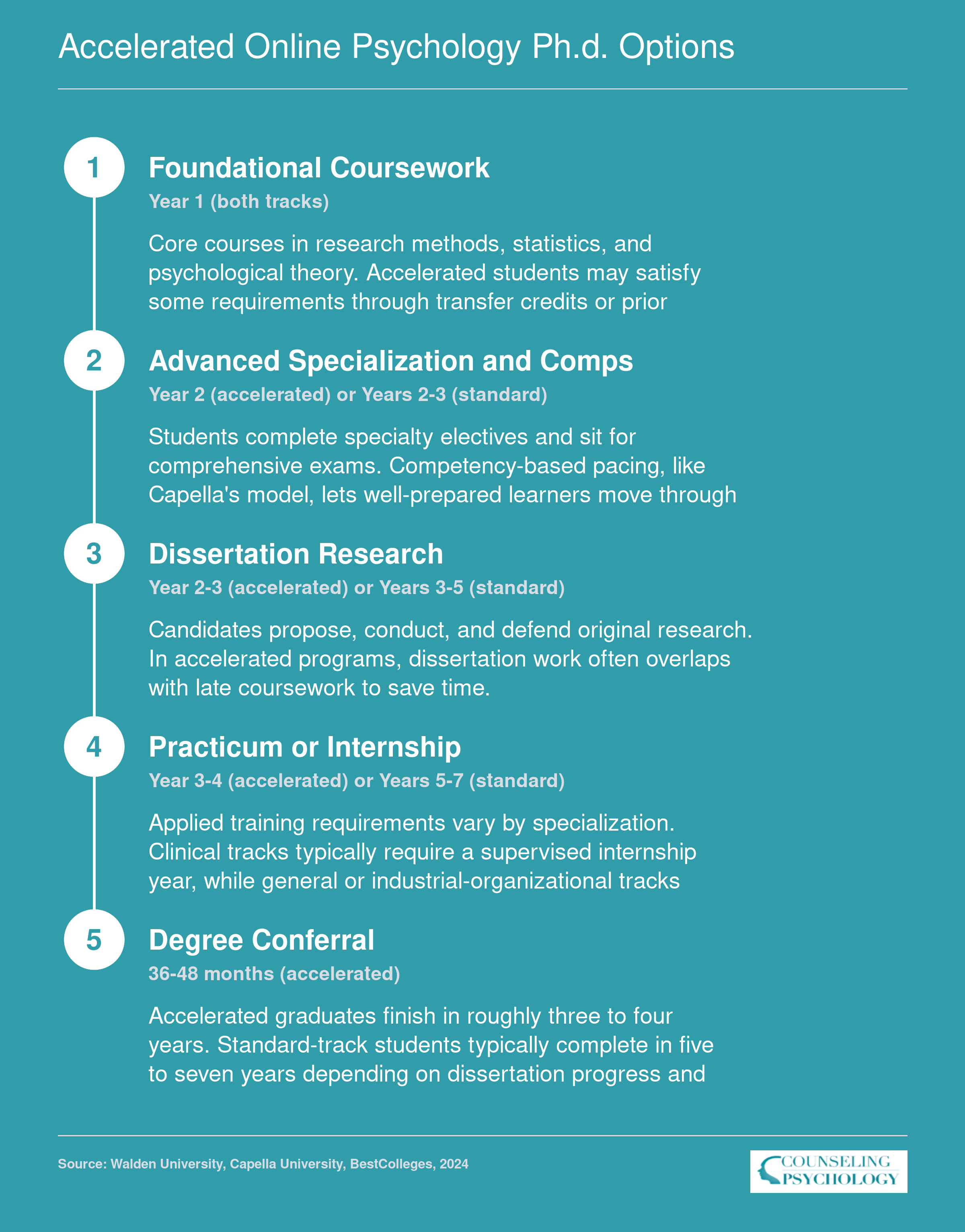
Accelerated Online Psychology Ph.D. Options
Most traditional psychology doctorates take five to seven years to complete. Accelerated online tracks, especially those designed for students who already hold a master's degree or who can transfer substantial graduate credit, can compress that timeline to roughly three to four years. Programs such as Walden University's fast-track Ph.D. in Psychology (which accepts up to 53 transfer credits) and Capella University's competency-based Ph.D. in General Psychology are among the options built for experienced learners. Keep in mind that no fully online clinical psychology doctorate currently holds APA accreditation, so weigh speed against your licensure goals.
Frequently Asked Questions About Online Psychology Ph.D. Programs
Prospective doctoral students tend to ask many of the same questions before committing to an online psychology Ph.D. The answers below draw on the data and insights covered throughout this article, so treat them as quick reference points rather than a substitute for the fuller discussion in each section.
More Accredited Online Psychology Ph.D. Programs to Consider
Beyond our top 10, these additional programs offer diverse specializations and flexible formats for doctoral study in psychology. Each school provides unique opportunities for advanced research and professional development.
- PhD in Psychology, General Psychology
- PhD in Psychology, Educational Psychology
- PhD in Developmental Psychology
- Health Science Doctorate (Behavior Analysis)
- PhD Specialization in Sport and Performance Psychology
- PhD-PSY in General Psychology
- Doctor of Philosophy in Psychology (Counseling Psychology)
- PhD in Psychology – specialization Health Psychology
- PhD in Industrial/Organizational Psychology
- Ph.D. Counselor Education & Supervision
- Counseling & Psychology: Transformative Leadership, Education, & Applied Research
- Counselor Education & Supervision, PhD
- Doctor of Philosophy in Applied Behavior Analysis
- Doctor of Psychology in Educational Psychology
- Doctor of Philosophy in Counseling (Marital, Couple, and Family Counseling/Therapy)
- Doctor of Education in Educational Psychology
- Ph.D. Business Psychology (Industrial and Organizational Track)
- Doctorate in Counseling Psychology
- Global PhD in Psychology
- PhD in Applied Behavior Analysis (Autism Intervention)
Explore Programs
- Best Online Applied Behavior Analysis
- Best Online Applied Psychology Degree
- Best Online Associate Degrees in Psychology
- Best Online Autism Spectrum Disorders
- Best Online Bachelor's in Psychology
- Best Online Child Psychology Degree
- Best Online Clinical Psychology
- Best Online Cognitive Psychology Degree
- Best Online Counseling Psychology
- Best Online Developmental Psychology
- Best Online Educational Psychology Degrees
- Best Online Forensic Psychology Degree
- Best Online Graduate Certificate in Psychology
- Best Online Health Psychology
- Best Online I/O Psychology
- Best Online International Psychology
- Best Online Master's in Psychology
- Best Online Neuropsychology
- Best Online Positive Psychology
- Best Online Psychopharmacology Programs for
- Best Online PsyD
- Best Online School Psychology
- Best Online Social Psychology
- Best Online Sports Psychology
- Engineering Psychology Degrees
- Online Geropsychology