
What you’ll learn in this article…
- Most online sports psychology certificates range from 12 to 18.7 credits and can be completed in six months to two years.
- Not every certificate covers all eight AASP knowledge areas required for CMPC eligibility, so verify alignment before enrolling.
- Programs under 16 credits typically do not qualify for federal financial aid, though employer tuition reimbursement and GI Bill benefits may apply.
- BLS national median pay for Psychologists, All Other reflects doctoral or licensed professionals, not certificate holders alone.
The Certified Mental Performance Consultant (CMPC) credential requires 400 mentored hours, a graduate degree, and coverage of eight AASP knowledge areas before a candidate can sit for the exam. That coursework requirement is precisely where online graduate certificates in sports psychology enter the pipeline. Demand for mental performance professionals has grown across athletics, military resilience programs, and corporate wellness, but the academic routes into the field remain fragmented.
As of 2026, 28 ranked online programs exist, and they vary widely in cost, CMPC alignment, and stackability toward a master's degree. Some certificates cover all eight AASP domains in 12 credits; others require supplemental coursework. Tuition spans from under $5,000 to more than $15,000, and not all certificates qualify for federal financial aid.
The sections below map which programs align with CMPC eligibility, compare cost and credit loads, outline admissions requirements, and examine career outcomes for certificate holders who do not yet hold a full graduate degree or professional license.
Best Online Graduate Certificates in Sports Psychology
The programs below are ordered using a composite that rewards online delivery alongside institutional quality indicators such as graduation rates, retention, and post-graduation earnings. This is not a ranking of the cheapest or fastest options; instead, it blends delivery flexibility with school-level outcomes to help you weigh overall value. Because dedicated online graduate certificates in sports psychology remain relatively rare, several entries on this list offer closely aligned credentials in applied behavior analysis, positive psychology, or autism-related specializations that share foundational coursework with sport and performance psychology. Where a school also houses a distinct sport psychology certificate, that program is highlighted. Institution-wide graduation rates appear throughout as a contextual quality signal; they reflect the university as a whole, not a single certificate program.
- Online delivery availability
- Institution-wide graduation rate
- Post-graduation median earnings
- Student retention signals
- Program relevance to topic
- College Scorecard graduate earnings — collegescorecard.ed.gov
- NCES-IPEDS federal institutional data — nces.ed.gov
- Independent program research
- Internal program database

University of Florida
The University of Florida stands out on this list because it offers a fully online Graduate Certificate in Sport Psychology and Elite Human Performance through its College of Health and Human Performance, one of the few certificates that directly targets sport and performance psychology at the graduate level. The 12-credit certificate covers motivation, cognition, emotion, group dynamics, and skill acquisition in high-pressure performance domains such as athletics, military operations, and medical settings. Coursework can be stacked into UF's online M.S. in Applied Physiology and Kinesiology, giving students a clear pathway from certificate to full graduate degree. The university posts a 91.1% institution-wide graduation rate and a 98% retention rate, both among the strongest in this group.
- 12-credit fully online certificate in sport and performance psychology
- Covers motivation, cognition, emotion, and group dynamics
- Designed for coaches, trainers, and performance professionals
- Courses stackable into UF's online M.S. in Applied Physiology
- Emphasizes high-pressure domains: athletics, military, medicine
- Completable in roughly two to three semesters
- In-state tuition: $12,737; out-of-state: $30,130 (institutional rate)
- 18-credit online certificate in substance use disorders
- Completable in approximately one year
- Meets educational requirements for addiction counselor certifications
- Non-degree sampling option available before full admission
- Curriculum spans treatment methods and addiction neuroscience
- Suited to social workers, counselors, nurses, and physicians
Sport Psychology and Elite Human Performance Graduate Certificate — On-Campus
Addiction and Recovery Graduate Certificate — Online

Harvard University
Harvard Extension School's Positive Psychology and Well-Being Graduate Certificate is delivered entirely online and requires just four courses, with a flexible completion window of eight months to three years. Total tuition runs $13,760, and no formal application is required, lowering the barrier to entry significantly. While the certificate is not branded as a sport psychology credential, its focus on resilience, optimal functioning, motivation, and flourishing overlaps meaningfully with mental performance concepts used in sport settings. Credits can be stacked into Harvard Extension master's programs in Industrial Organizational Psychology or Psychology. The institution posts a 97.6% graduation rate, the highest among all schools in this group.
- Four fully online courses required
- Total tuition of $13,760 for the complete certificate
- No formal application needed to enroll
- Flexible 8-month to 3-year completion window
- Stackable into Harvard Extension master's degrees
- Covers resilience, motivation, and optimal human functioning
- Minimum B grade required in each course
- Summer and fall start terms available
Positive Psychology and Well-Being Graduate Certificate — Online

Florida International University
Florida International University offers a hybrid Graduate Certificate in Applied Behavior Analysis that blends online coursework with campus-based components across a 12-month timeline. The seven-course, 21-credit program is priced at approximately $12,453 and prepares graduates for Board Certified Behavior Analyst certification. While ABA is not sport psychology per se, behavior-analytic principles are increasingly applied in coaching, athlete habit formation, and performance shaping. FIU's institutional graduation rate stands at 74.4%, with a 92% retention rate. Applicants need a baccalaureate degree and a minimum 3.0 GPA in their last two years of undergraduate work; spring admission only.
- 21-credit hybrid program completed in 12 months
- Approximately $12,453 total program cost
- Seven courses covering ABA concepts and ethical codes
- Prepares students for BCBA certification exam
- Requires bachelor's degree with 3.0 GPA minimum
- Spring-only admission cycle
- In-state tuition: $11,334; out-of-state: $24,439 (institutional rate)
Graduate Certificate in Applied Behavior Analysis — Hybrid

University of Central Florida
The University of Central Florida delivers its Applied Behavior Analysis Graduate Certificate fully online, requiring 18 credit hours and meeting Behavior Analyst Certification Board coursework standards. The curriculum addresses advanced behavior analysis, ethics, and supervision, and is housed within UCF's Special Education program. UCF also offers a separate online Autism Spectrum Disorders certificate (12 credits) that is state-approved for an ASD endorsement. Neither certificate is marketed as sport psychology, though the behavioral assessment and intervention skills taught are transferable to performance settings. UCF's institution-wide graduation rate is 78%, with an in-state tuition rate of $8,872.
- 18 credit hours delivered fully online
- Meets BACB coursework requirements
- Covers advanced behavior analysis and ethics
- Prepares for National Board Certification in ABA
- Designed for education and psychology students
- No direct certification provided by UCF itself
- 12-credit fully online certificate
- State-approved for ASD endorsement in Florida
- Field-based practical assignments in students' own schools
- Flexible for working professionals
- Can be completed standalone or within a master's program
- No campus visits required
Applied Behavior Analysis Graduate Certificate — Online
Autism Spectrum Disorders Graduate Certificate — Online

CUNY Hunter College
CUNY Hunter College's Advanced Certificate in Applied Behavior Analysis is a 27-credit program that combines online components with on-campus requirements in New York City. The certificate is designed to satisfy both BCBA certification and New York State licensure prerequisites, making it one of the more comprehensive ABA credentials on this list. Hunter's net price of $2,984 is the lowest in this group, and the median graduate debt of $11,000 is also notably low. While the program has no sport psychology track, behavior-analytic skills in assessment and intervention planning translate to athletic performance and coaching contexts. The institution-wide graduation rate is 56.9%.
- 27-credit program with hybrid delivery
- Prepares for BCBA certification and NY State licensure
- Supervised practicum experiences included
- Nationally recognized ABA curriculum
- In-state tuition: $11,398; out-of-state: $20,828
- Net price among the lowest in this ranking at $2,984
- Located in New York City with access to diverse practicum sites
Advanced Certificate in Applied Behavior Analysis — Hybrid

University of Virginia
The University of Virginia offers a fully online Certificate in Applied Behavioral Analysis approved by the Behavior Analyst Certification Board. The program allows flexible part-time completion across one to seven semesters and does not require the GRE, making it accessible to working professionals. Coursework focuses on conducting behavioral assessments, writing treatment plans, and applying ethical standards. UVA's institution-wide graduation rate of 95.6% and 98% retention rate are among the highest on this list. The certificate does not include sport-specific coursework, but its emphasis on practical behavior-change skills can complement a sport performance practice.
- Fully online with part-time study options
- Completable in one to seven semesters
- No GRE required for admission
- Approved BACB verified course sequence
- Prepares for BCBA or BCaBA exams
- Covers ethics, supervision, and behavioral assessment
- In-state tuition: $23,526; out-of-state: $37,628
Certificate in Applied Behavioral Analysis — Online

University of Oklahoma-Norman Campus
The University of Oklahoma's Applied Behavior Analysis Graduate Certificate is a 100% synchronous online program built around a seven-course sequence verified by the Behavior Analyst Certification Board. The certificate emphasizes autism and developmental disabilities and prepares graduates for the BCBA examination. Admission hinges on earning an A or B in the first two ABA sequence courses, which effectively serves as both a prerequisite and a performance gate. One important caveat: financial aid is not available for certificate-only students. OU's institution-wide graduation rate is 75.3%, with in-state tuition at $9,353.
- Seven-course sequence, fully synchronous online
- Verified by the Behavior Analyst Certification Board
- Focuses on autism and developmental disabilities
- Requires A or B in first two ABA courses for admission
- No financial aid for certificate-only students
- Prepares for BCBA examination
- In-state tuition: $9,353; out-of-state: $26,142
Applied Behavior Analysis Graduate Certificate — Online

Auburn University
Auburn University's Graduate Certificate in Intervention for Students with Autism and Developmental Disabilities is a 15-credit-hour program available online and on campus. Designed for special education teachers and professionals in human service fields, the curriculum centers on evidence-based practices that improve educational outcomes for students with developmental challenges. Auburn's 82% institution-wide graduation rate and 95% retention rate reflect strong institutional quality. There is no sport psychology component in this certificate, though behavioral intervention principles can be relevant in adaptive sport and inclusive athletic programming contexts.
- 15-credit-hour program with online and on-campus options
- Evidence-based practices for autism and developmental disabilities
- Geared toward special education professionals
- Addresses critical educational needs in Alabama and beyond
- Part of Auburn's College of Education
- In-state tuition: $12,890; out-of-state: $33,986
- Institutional net price: $24,323
Graduate Certificate in Intervention for Students with Autism and Developmental Disabilities — Online

University of South Florida
The University of South Florida offers a fully online Graduate Certificate in Autism Spectrum Disorder focused on assessment, diagnosis, and innovative teaching strategies for educators. The program emphasizes technology integration and positive behavior support, and it can typically be completed in one to two years. Credits may be applicable toward further graduate study at USF. While the certificate does not cover sport psychology directly, its focus on behavioral assessment and intervention design builds a skill set transferable to performance-enhancement contexts. USF's in-state tuition of $10,428 and net price of $9,812 place it on the affordable end of this list.
- Fully online format
- Covers ASD assessment, diagnosis, and teaching strategies
- Emphasizes technology use and positive behavior support
- Completable in one to two years
- Credits may transfer toward graduate degrees at USF
- In-state tuition: $10,428; out-of-state: $21,126
Graduate Certificate in Autism Spectrum Disorder — Online

Vanderbilt University
Vanderbilt University's Online Post-Master's Certificate in Applied Behavior Analysis targets professionals who already hold a master's degree and want advanced ABA training. The fully online format suits working adults, and the curriculum covers key ABA principles, ethical practices, and intervention strategies. Vanderbilt's institution-wide graduation rate of 93.5% is among the highest in the country, and its median graduate debt of $14,000 is lower than many public universities in this group. The certificate does not include sport psychology content, but its leadership-oriented approach to behavior analysis can extend to coaching and organizational performance settings.
- Fully online, designed for working professionals
- Requires a master's degree in a related field
- Covers ABA principles, ethics, and intervention strategies
- Prepares graduates for leadership roles in ABA
- Financial aid options available
- Tuition: $57,868 (single rate, private institution)
- Institution-wide graduation rate: 93.5%
Online Post-Master's Certificate in Applied Behavior Analysis — Online
What Is an Online Sports Psychology Graduate Certificate?
How does a graduate certificate in sports psychology differ from a master's degree, and what does it actually qualify you to do? It's the most common question we hear from coaches and counselors weighing this credential, and the answer matters because the terminology in this field is genuinely confusing.
The Academic Credential, Defined
A graduate certificate is a focused, post-baccalaureate academic credential awarded by a university, typically running 12 to 18 credits (roughly four to six courses). It sits below a master's degree in scope but above undergraduate coursework in rigor. You'll need a bachelor's degree to enroll, and you'll receive an official transcript and certificate from the granting institution upon completion.
Unlike a full master's program (usually 30 to 60 credits), a certificate skips electives, comprehensive exams, and thesis requirements. It concentrates instead on a defined slice of content: motivation, performance anxiety, team dynamics, mental skills training, and applied interventions for athletes.
Who Enrolls in These Programs
The typical student is already working in an adjacent field and wants targeted knowledge without the time and tuition commitment of a second degree. That includes:
- Coaches at the high school, collegiate, or club level adding mental performance tools to their toolkit
- Athletic trainers and strength coaches expanding into psychological aspects of recovery and performance
- Licensed counselors and therapists who want to work with athlete clients
- Career changers exploring whether a full master's in sport psychology fits before they commit
Certificate vs. Certification: Not the Same Thing
This distinction trips up almost everyone new to the field. A graduate certificate is academic, issued by a university. A professional certification, like the Certified Mental Performance Consultant (CMPC) from the Association for Applied Sport Psychology, the Mental Game Coaching Professional (MGCP), or the Board Certified Sport Psychologist (BCSP), is issued by a credentialing body and signals competency to practice. The CMPC requires a master's or doctorate in sport science, psychology, or a related field, plus 400 mentored hours and a national exam.1 Notably, holding the CMPC does not authorize the title "sport psychologist," which requires separate state licensure.2 A graduate certificate alone does not make you a CMPC, though it can contribute coursework toward the eight required knowledge areas.3
For those considering the longer path toward full licensure, resources on how to become a sports psychologist outline the additional steps involved.
Stackability and Delivery Format
Many universities design certificates to stack: the 12 to 18 credits you earn can transfer directly into a related master's program at the same institution if you decide to continue. That hedge is part of the appeal.
Delivery is overwhelmingly online, with most programs running fully asynchronous coursework so working professionals can complete assignments on their own schedule. Some include synchronous discussion sessions or case-study seminars. Practica and supervised fieldwork are sometimes built in, particularly at programs aligned with CMPC eligibility, but most certificates remain coursework-only.4
Graduate Certificate vs. Professional Certification in Sports Psychology
The decision between a graduate certificate and professional certification in sports psychology often hinges on a tradeoff: academic coursework that integrates with a degree program versus a standalone credential designed for immediate professional credibility.
Occupational Data from the Bureau of Labor Statistics
The Bureau of Labor Statistics (BLS) does not track sports psychologists as a separate occupation. Instead, relevant roles fall under broad categories such as "Psychologists, All Other" or "Clinical, Counseling, and School Psychologists." National median salary figures are available for these groups, but the data does not distinguish between individuals who hold a graduate certificate and those who have obtained the Certified Mental Performance Consultant (CMPC) credential. Because the BLS does not isolate the effects of specific credentials, salary comparisons tied solely to certification status are not possible using publicly available federal data. When exploring career outcomes, interpret BLS figures as broad occupational benchmarks rather than precise indicators of credential value.
The CMPC: A Professional Certification Standard
The Association for Applied Sport Psychology (AASP) offers the CMPC, which remains the primary professional certification in the field. Candidates must complete a defined set of graduate-level coursework, accrue supervised mentored experience, and pass a standardized exam. AASP surveys indicate that employers in collegiate athletics, private practice, and military settings increasingly view the CMPC as a mark of competency for mental performance consulting roles. While hard data on hiring advantages is limited, anecdotal evidence from the organization suggests that certified practitioners may stand out in competitive applicant pools, particularly where the CMPC aligns with job descriptions.
What Graduate Certificates Offer
Online graduate certificates in sports psychology provide academic credit that often transfers into related master's programs or satisfies prerequisites for doctoral study. Many programs align with AASP knowledge areas, serving as a stepping stone toward CMPC eligibility. For students considering broader graduate options, exploring applied psychology masters programs can help clarify how certificate credits may apply. Alumni outcomes can vary widely by institution, so prospective students are encouraged to contact admissions offices directly to request completion rates, enrollment trends, and career placement reports. Some universities maintain dashboards or downloadable summaries, though data on post-certificate employment is not always publicly reported.
Research on Employer Perceptions
Academic databases such as PsycINFO and SPORTDiscus contain a modest body of research on employer perceptions of sports psychology credentials. A handful of studies published in the Journal of Sport & Exercise Psychology and similar outlets suggest that hiring managers value a combination of formal education and recognized certification, but no large-scale study directly compares the impact of a graduate certificate with that of the CMPC. Until more robust employer-perception research emerges, the decision between these paths may rest on individual career goals and the specific requirements of target roles. Students who want a wider view of the discipline can review different types of psychology degrees to see how sports psychology fits within the broader academic landscape. The cost, credits, and duration table elsewhere in this article breaks down the financial and time commitments of certificate programs.
Questions to Ask Yourself
CMPC Eligibility: Which Online Certificates Cover AASP Knowledge Areas?
A graduate certificate that covers all eight AASP knowledge areas gives you a smooth path toward CMPC eligibility, while one with gaps means extra coursework or delayed certification. Not every program is designed to align with the Certified Mental Performance Consultant credential, so understanding the requirements before you enroll saves time and tuition dollars.
The Eight Knowledge Areas and Degree Requirement
The Association for Applied Sport Psychology defines eight required knowledge areas.1 These include sport psychology, professional ethics, research methods, psychopathology, and others spanning the biological, cognitive, and social bases of behavior. Five of those areas (K1, K2, K5, K6, and K8) must be earned at the graduate level.1 A master's or doctoral degree is mandatory; the CMPC is not available with only a certificate. Degrees from fields like business, education, occupational therapy, or sport management are not accepted, so candidates must hold a graduate degree in a closely aligned discipline.
Mentored Experience and the CMPC Exam
Even if a certificate covers all eight knowledge areas, candidates still need 400 hours of mentored experience, including at least 200 hours of direct client contact, a minimum of 150 hours of support activities, and 50 hours of mentorship.1 The mentoring relationship must be supervised by an AASP-approved mentor from the organization's official Registry. An additional 100 hours of competitive sport experience are required, separate from the mentored hours. Once the education and experience components are complete, applicants take the CMPC exam, an NCCA-accredited test that must be finished within six months of authorization.2
Mapping Your Certificate to the AASP Checklist
No online graduate certificate carries formal AASP pre-approval.1 That means you must do your own cross-referencing. Download the current coursework checklist from the AASP website and compare every knowledge area to your program's course catalog. Some certificates explicitly state alignment; for example, the Sport and Performance Psychology Certificate from Dominican University was designed to map onto AASP requirements.3 If a certificate lacks a key area, you can often fill the gap through electives or a standalone course from another institution, but confirming that with an academic advisor ahead of time is essential. Students exploring broader certificate programs in psychology may find additional elective options that satisfy missing knowledge areas.
Where Certificate Programs Often Fit, and Where Gaps Appear
Programs housed in kinesiology or counseling departments tend to align well because they incorporate sport-specific electives and mental health coursework by design. Certificates from psychology departments may cover research methods and ethics thoroughly but miss applied sport science areas. Conversely, a program focused purely on exercise science might offer little on professional ethics or psychopathology. Before committing, request syllabi for courses that correspond to the remaining AASP areas and verify that any required lab or practicum satisfies the mentored experience criteria. For the most current mentored-experience guidelines and exam details, reach out to AASP directly or visit their certification page, as requirements can shift between review cycles.
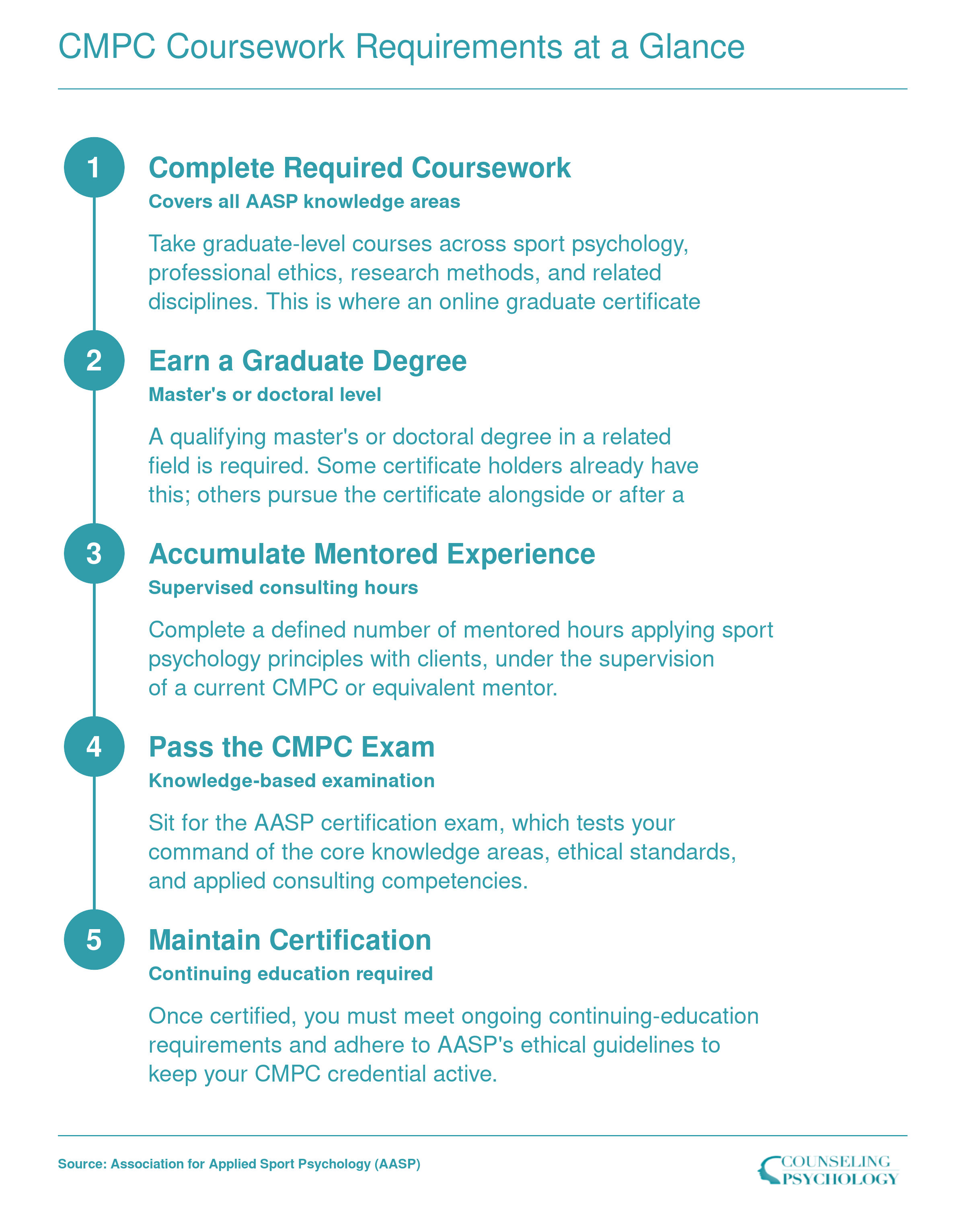
CMPC Coursework Requirements at a Glance
The Certified Mental Performance Consultant (CMPC) credential from the Association for Applied Sport Psychology (AASP) follows a structured pathway. An online graduate certificate in sports psychology slots into the very first phase, helping you satisfy required coursework before you move on to advanced training and examination.
Cost, Credits, and Duration: How Online Sports Psychology Certificates Compare
Online graduate certificates in sports psychology typically range from 12 to 18.7 credits, with full-time students finishing in as few as six months and part-time students stretching to about two years. Because most of these certificates fall under 16 credits, they generally do not qualify for federal financial aid (Title IV). However, many employers will reimburse tuition for job-related certificate programs at accredited institutions, so check your company's professional development policy before paying out of pocket.
| Program | Credits | Delivery Mode | Approximate Duration |
|---|---|---|---|
| A.T. Still University, Exercise and Sport Psychology Graduate Certificate | 12 | Online | 6 to 12 months (full-time) |
| Miami University, Sport Psychology Graduate Certificate | 12 | Campus-based | 6 to 12 months (full-time) |
| Seton Hall University, Sport and Exercise Psychology Certificate | 15 | Online (check with school) | 12 to 24 months (part-time) |
| University of Wisconsin, Milwaukee, Sport and Performance Psychology Graduate Certificate | 15 | Online (check with school) | 36 to 48 months (part-time alongside degree) |
| CalSouthern, Certificate in Sport Psychology | 18 | Online | 12 months |
| University of Western States, Applied Sport Psychology Graduate Certificate | 18.7 | Online | 9 months |
Admissions Requirements for Sports Psychology Certificates
Graduate certificates in sports psychology have become one of the more accessible entry points into the field precisely because their admissions bars are lower than those of full master's or doctoral programs. That accessibility is deliberate, but it does not mean every program treats applicants the same way. Understanding what is required before you apply can save weeks of back-and-forth with admissions offices.
Degree and GPA Expectations
Virtually every program requires a completed bachelor's degree. Some, like the University of Western States Applied Sport Psychology certificate, accept applicants from any undergraduate major, while others prefer coursework in psychology, kinesiology, or a related discipline.2 Minimum GPA thresholds typically fall between 2.75 and 3.0. Both the University of Western States and the University of Wisconsin, Milwaukee list a 2.75 cumulative GPA as their floor.3 Programs with a 3.0 minimum tend to be housed in departments that also offer master's degrees and apply the same threshold across both tracks.
GRE Scores and Standardized Testing
Most online sports psychology certificate programs do not require GRE scores for admission. This is a meaningful distinction from master's-level programs in the same departments, which sometimes still ask for standardized test results. If reducing admissions friction is a priority for you, the certificate route removes one of the more time-consuming and expensive hurdles.
Bridge Pathways for Non-Psychology Majors
Programs such as Seton Hall's Sport and Exercise Psychology certificate explicitly accept students without a psychology background.4 When prerequisite knowledge gaps exist, some schools handle them through bridge coursework: introductory psychology, statistics, or research methods courses that you can complete alongside your certificate classes rather than before enrollment. The University of Wisconsin, Milwaukee takes an individualized approach, conducting a transcript review and then building a tailored plan of study that may include foundational coursework if your academic history warrants it.3 For students exploring broader credential options in the field, clinical psychology certificate programs follow a similar admissions model.
Additional Requirements
Beyond transcripts and a GPA check, expect a few other items on your application checklist:
- Professional references: Two or three letters are standard, typically from academic or professional contacts who can speak to your readiness for graduate-level work.
- Background checks: Some institutions, including the University of Western States, require a criminal background check as a condition of enrollment.2
- Professional experience: A smaller number of programs ask for evidence of relevant work, such as coaching, counseling, or athletic training, particularly when the certificate is designed for working professionals.
Formal Application vs. Non-Degree Enrollment
Not every certificate requires you to go through a full graduate admissions process. Some universities allow non-degree enrollment, meaning you register for courses individually without a formal acceptance letter. Others treat the certificate as a distinct credential with its own application, essays, and deadlines. The distinction matters: non-degree students may not qualify for federal financial aid, and credits earned without formal admission are not always guaranteed to transfer later. Before you start coursework, confirm which enrollment pathway your target program uses and what the downstream implications are for funding and credit portability.
Most graduate certificates require fewer than 16 credits and thus do not qualify for federal financial aid. Always verify Title IV eligibility with your program before enrolling. Employer tuition reimbursement and military benefits, such as the GI Bill, are often more dependable funding sources for these short credentials, so explore them early to avoid gaps.
Career Outcomes and Salary for Sports Psychology Certificate Holders
A graduate certificate in sports psychology is best understood as a career enhancer, not a standalone clinical credential. It sharpens a specific skill set and opens doors to applied roles, but the salary landscape depends heavily on what you pair it with and which professional path you pursue.
What a Certificate Qualifies You to Do
With a graduate certificate alone, you can work in applied, non-clinical roles where mental performance coaching overlaps with athletics, fitness, and organizational wellness. Common job titles include:
- Mental performance consultant: Works directly with athletes and teams on goal-setting, visualization, focus, and competition anxiety.
- Sport psychology consultant: Provides mental skills training in private practice, collegiate athletics, or sport organizations.
- Athletic counselor: Supports student-athletes through academic and performance transitions, often within university athletic departments.
- Wellness coordinator: Designs holistic programs that integrate mental skills training with physical health initiatives.
- Strength and conditioning mental skills coach: Embeds psychological techniques into physical training regimens.
What a certificate does not qualify you to do is practice as a licensed psychologist. That requires a doctoral degree, supervised clinical hours, and state licensure. If your goal is to diagnose or treat clinical conditions, the certificate is a stepping stone, not a destination.
Salary Data: What the Numbers Actually Show
Program-level earnings data for these specific sports psychology certificates are not yet available through federal reporting. Because these programs are relatively small and new to the graduate certificate landscape, outcomes have not been published at the program level. That means we have to look at broader occupational benchmarks to frame realistic expectations.
The BLS reports a national median annual wage of $117,750 for the "Psychologists, All Other" category (May 2023 data), but that figure reflects doctoral-level professionals in a range of psychology subspecialties.1 Certificate holders working in applied, non-clinical roles will typically earn less. The 10th percentile for that same occupation sits at $47,450 nationally, and the 25th percentile reaches $76,550, which likely better approximates the range for consultants who hold a master's degree plus a certificate rather than a doctorate.1
For roles that lean more toward coaching and athletic performance, BLS data for fitness trainers and coaching positions tends to report considerably lower medians, often in the $40,000 to $55,000 range nationally. Mental performance consultants in private practice may earn more, but income varies widely based on client base, geographic market, and reputation.
The BLS projects 6% job growth for psychologists overall from 2024 to 2034, with roughly 12,900 annual openings anticipated across all psychology occupations.2 That growth signals steady demand, though much of it favors candidates with advanced degrees and licensure.
Certificate Holders vs. Master's Degree Holders
Federal outcome data do not yet allow a clean side-by-side comparison of certificate and master's degree completers in sports psychology specifically. In practice, many certificate students already hold a master's degree and are adding the credential to pivot into sport-specific work or to meet CMPC eligibility requirements. For those individuals, the certificate functions as a specialization layer on top of an existing graduate education, not as a replacement for one.
If you hold only a bachelor's degree, some certificate programs will still admit you, but your earning potential and job options will be narrower than someone who pairs the certificate with a master's in counseling, kinesiology, or clinical psychology. Employers in collegiate and professional sports increasingly expect at least a master's degree for consultant roles, and earning a CMPC credential (which itself requires graduate coursework and mentored experience) signals a level of professional training that a certificate alone does not. For a broader look at the profession's requirements, see our guide on how to become a sport psychologist.
Realistic Expectations
The honest picture: a sports psychology certificate can meaningfully boost your marketability and open applied roles that would otherwise be out of reach. It is especially valuable for coaches, athletic trainers, counselors, and exercise science professionals who want to add mental performance skills to their toolkit. Those already working in counseling careers may find the certificate particularly useful for expanding into sport-specific consulting. But a certificate is not a shortcut to the salary levels associated with doctoral-level psychology practice. Treat it as one piece of a longer professional development strategy, and the return on investment becomes much clearer.
Salary Snapshot: Psychologists, All Other, National Data
The Bureau of Labor Statistics groups many sports psychology practitioners under the "Psychologists, All Other" category (SOC 19-3039). Because sports psychologists often hold licensure or advanced credentials beyond a graduate certificate, the figures below reflect the broader occupational category at the national level rather than certificate holders specifically. Actual earnings vary based on licensure status, employer type, geographic region, and years of experience.
| Metric | National Figure |
|---|---|
| Total Employment | 17,790 |
| Mean Annual Wage | $111,340 |
| 25th Percentile | $73,820 |
| Median Annual Wage | $117,580 |
| 75th Percentile | $145,200 |
Frequently Asked Questions About Online Sports Psychology Certificates
Prospective students often have practical questions about how online sports psychology certificates fit into longer academic and professional plans. The answers below address the most common concerns, from credit transfer to in-person requirements to career outlook resources.
Additional Online Sports Psychology Certificate Programs to Consider
Beyond the top-rated programs, many other universities offer online graduate certificates that can help you specialize in sports psychology or related fields. The following list includes additional options worth exploring, organized alphabetically for easy browsing.
- Online Positive Psychology Graduate Certificate
- Applied Behavior Analysis Certificate of Advanced Study
- Applied Behavior Analysis Graduate Certificate
- Teaching Students with Autism Spectrum Disorder Graduate Certificate
- Culturally-Centered Addictions Research Training
- Autism Spectrum Disorders Certificate
- Applied Behavior Analysis Graduate Credit Certificate Program
- Educating Individuals with Autism Postbaccalaureate Credit Certificate
- Applied Behavior Analysis Certificate
- Applied Behavior Analysis Certificate (Autism Spectrum Disorder)
- Graduate Certificate in Autism
- Graduate Certificate in Applied Behavior Analysis
- Graduate Certificate in Applied Behavior Analysis
- Graduate Certificate in Autism Spectrum Disorder
- Graduate Certificate in Applied Behavior Analysis
- Graduate Certificate in Autism and Applied Behavior Analysis
- Graduate Certificate in Applied Behavior Analysis
- Graduate Certificate in Applied Behavior Analysis
- Positive Psychology
- Graduate Certificate in Applied Behavior Analysis
- Applied Behavior Analysis Graduate Certificate
- Autism Specialist - Online Graduate Certificate