
What you’ll learn in this article…
- A master's or doctoral clinical degree is required before any DBT-specific training can begin.
- The DBT-Linehan Board of Certification offers two tiers: individual clinician and comprehensive program.
- BLS projects roughly 18% employment growth this decade for mental health counselors, well above average.
- State licensure as a therapist is legally separate from, and must precede, specialized DBT certification.
Demand for clinicians trained in dialectical behavior therapy has outpaced the pipeline of certified practitioners, making formal recognition by the DBT-Linehan Board of Certification a distinguishing factor in hiring and reimbursement. A dialectical behavioral therapist is a licensed mental health professional, typically a psychologist, social worker, or counselor, who has completed intensive DBT training grounded in Marsha Linehan's evidence-based framework.
The modality targets chronic emotion dysregulation, most commonly in borderline personality disorder, but extends to self-harm, suicide prevention concerns, eating disorders, and substance use. DBT integrates acceptance-based strategies with skills training in mindfulness, distress tolerance, emotion regulation, and interpersonal effectiveness.
Practitioners navigate a dual hurdle: state licensure to practice independently and a rigorous certification process through the Linehan Board. The split between clinicians who use some DBT techniques and those holding official certification affects insurance panels, hiring, and access to high-acuity referrals.
Education Requirements for DBT Therapists
There is no standalone "DBT degree" offered by any accredited university. Dialectical behavior therapy expertise is built on top of a clinical graduate degree, which means your educational foundation must come first and DBT-specific training follows after you have earned your credentials.
The Degree Pathway
The route to practicing DBT follows a familiar clinical trajectory:
- Bachelor's degree (4 years): A BA or BS in psychology, social work, sociology, or a related behavioral science field. This stage builds your grounding in human development, research methods, and abnormal psychology.
- Master's degree (2 to 3 years): This is the critical credential. Most states require at least a master's degree for independent clinical licensure, and that licensure is a prerequisite before you can pursue formal DBT certification. The most common master's degrees held by practicing DBT therapists are the Master of Social Work (MSW), the MA or MS in Clinical Mental Health Counseling, and graduate degrees in marriage and family therapy.
- Optional doctorate: A PsyD or PhD in clinical psychology is not required to practice DBT, but some therapists pursue doctoral training for research roles, academic positions, or broader clinical authority. Doctoral programs typically add three to five years beyond the master's level.
Which Master's Degrees Are Most Common?
DBT therapists come from several clinical disciplines. The MSW is especially prevalent because social work programs emphasize evidence-based practice frameworks and supervised fieldwork from the start. Clinical mental health counseling programs are another well-traveled path, and many graduates go on to become a licensed professional counselor before adding DBT specialization. For those who want to combine research with practice, doctoral programs in counseling psychology offer that opportunity. What matters most is that your degree leads to a license allowing you to provide psychotherapy independently in your state.
Why DBT Training Comes After Your Degree
Universities may include a module or elective on dialectical behavior therapy within a broader clinical curriculum, but comprehensive DBT training is a postgraduate pursuit. Programs like the ones offered through Behavioral Tech (founded by DBT creator Marsha Linehan) and other recognized training organizations expect participants to already hold a clinical degree and, ideally, some supervised clinical experience. You will learn the full DBT model, including individual therapy protocols, skills training groups, phone coaching, and consultation team participation, only after your foundational education is complete.
Typical Timeline
From the first day of your bachelor's program to the point where you are eligible for DBT certification through the DBT-Linehan Board of Certification, expect a timeline of roughly six to eight years. That breaks down to four years for your undergraduate degree, two to three years for your master's, a period of accruing post-degree supervised clinical hours (requirements vary by license type and state), and then the intensive DBT training itself. Some clinicians move faster by completing accelerated programs or beginning DBT-informed work during their supervised hours, but the overall arc remains consistent: clinical degree first, DBT specialization second.
How to Get DBT Certification: The Linehan Board Pathway
Practicing DBT informally versus earning a formal credential: that distinction matters more than many clinicians expect when it comes to referrals, employer recognition, and positioning within specialized treatment networks.
The Two Certification Tiers
The DBT-Linehan Board of Certification (DBT-LBC) is widely regarded as the gold standard for demonstrating fidelity to Marsha Linehan's treatment model.1 It offers two distinct credentials. The Individual Clinician certification is the pathway most practitioners pursue first, confirming that a single provider meets the board's training, clinical experience, and competency standards. The Program certification applies to treatment programs as a whole, verifying that an entire clinical team delivers DBT according to the model's comprehensive structure. This section focuses on the clinician pathway, since that is typically the starting point.
What the Clinician Certification Requires
To qualify, you must already hold a full mental health license in your discipline.2 From there, the board requires:
- Training hours: At least 40 hours of didactic DBT-specific instruction.3 Many clinicians fulfill this through Behavioral Tech Institute's intensive training sequence, which typically spans a 10-day foundational course followed by a 10-day advanced course. Costs for each part run roughly $2,500 to $4,000, depending on format and year.
- Consultation team participation: You must be an active member of a DBT consultation team for a minimum of 12 consecutive months at the time of application.3 This ongoing peer consultation structure is a core element of the DBT model, not an optional add-on.
- Clinical experience: You need to have completed DBT treatment with at least three clients using the full model.2
- Mindfulness training: Demonstrated mindfulness practice is required, reflecting Linehan's emphasis on therapist personal development alongside clinical skill.3
- Recorded sessions: Three consecutive individual DBT sessions, recorded and submitted for review, form a central part of the competency evaluation.2
The written examination is administered through Pearson VUE.4 If you do not pass on the first attempt, you must wait four months before retesting. A second failure means a 12-month waiting period. The video review component carries similar retake windows: six months after a first failure, 12 months after a second.5
Costs, Timeline, and Renewal
Beyond training costs, budget for application fees and, if needed, retake fees. Annual renewal requires 15 hours of continuing education over a two-year cycle, with at least 8 of those hours specifically focused on DBT. Passing the exam itself counts for 8 CE hours in the renewal cycle.5
Realistically, from the start of foundational training to holding the credential, most clinicians spend two to three years. That window accounts for completing both training intensives, logging 12-plus months on a consultation team, accumulating the required clinical cases, and navigating the application and exam process.
Can You Practice DBT Without Certification?
Yes. Any fully licensed mental health clinician can use DBT techniques with clients. There is no legal requirement to hold the DBT-LBC credential in order to deliver DBT-informed care. However, the credential signals something specific: that you have been evaluated against Linehan's model by an independent board, not just that you attended a workshop or read the manual. For clinicians who want referrals from DBT-focused programs, participation in certain insurance panels, or positions at specialized treatment centers, the certification can meaningfully influence how your qualifications are perceived. It also signals to clients with complex presentations, such as borderline personality disorder or chronic suicidality, that your training goes beyond the introductory level.
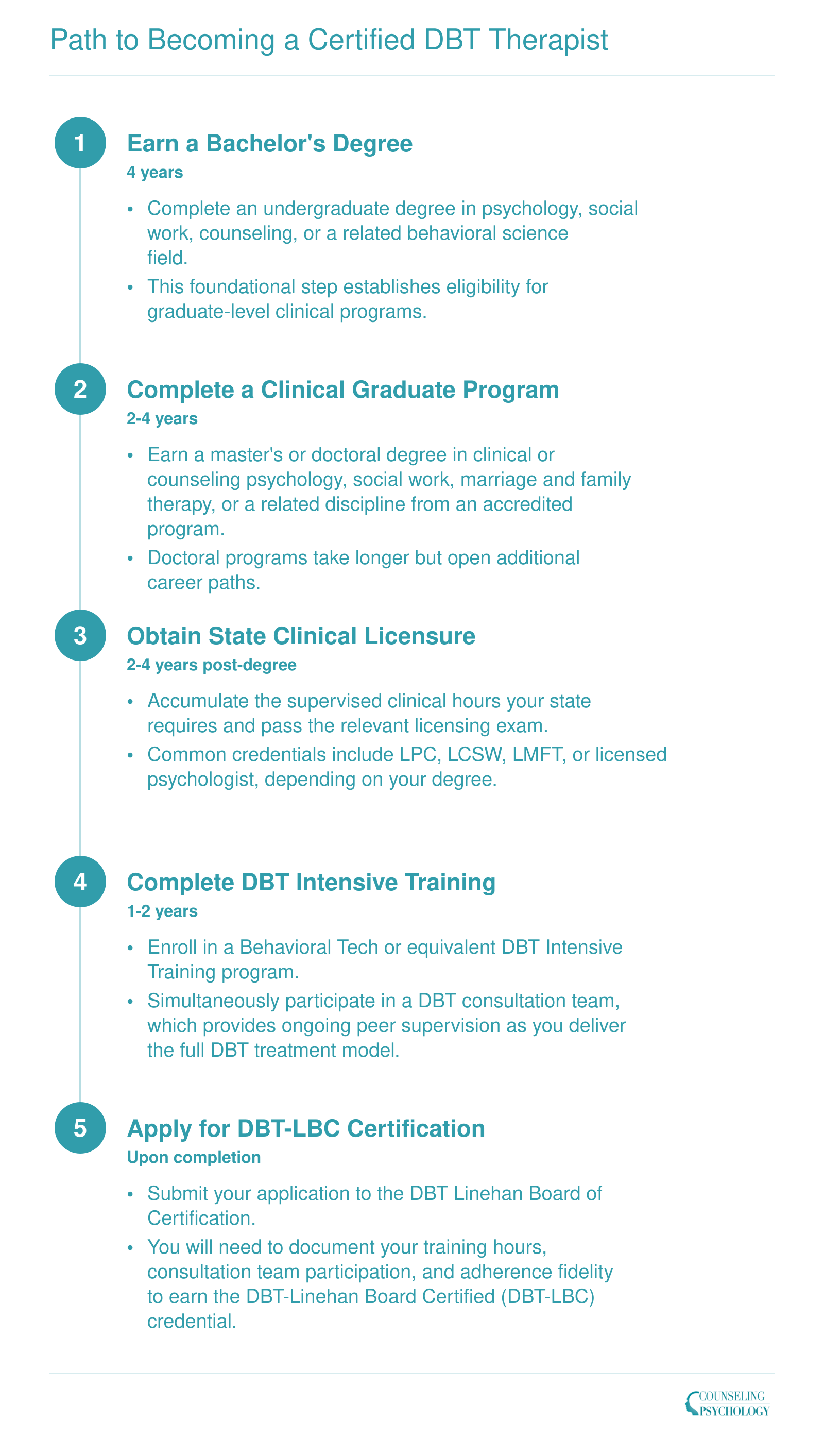
Path to Becoming a Certified DBT Therapist
Becoming a certified dialectical behavioral therapist is a multistep process that builds clinical expertise over time. Here is the typical credentialing ladder with realistic timeframes at each stage.
Top DBT Training Programs and Courses
Picking a DBT training program usually comes down to a tradeoff between depth and convenience: the intensive, certification-aligned trainings run thousands of dollars and demand weeks of your calendar, while shorter online courses cost far less but won't, on their own, qualify you for board certification. Knowing which bucket you need is half the decision.
Major Providers Worth Investigating
A handful of training organizations dominate the DBT landscape, and each has a distinct flavor. Rather than list outdated prices or schedules here (offerings shift every few months), go directly to each provider's site for current details:
- Behavioral Tech / Linehan Institute: Founded by Marsha Linehan herself, this is the closest you'll get to the source. They offer the well-known DBT Intensive Training, foundational courses, and online modules. Their trainings are widely accepted on the DBT-LBC pathway.
- Portland DBT Institute: Offers intensives, foundational trainings, and consultation team support. Generally well regarded by clinicians pursuing certification.
- Psychwire: Hosts online DBT courses taught by Linehan and other senior trainers. Lower price point and self-paced format, useful for foundational learning, but verify how each course maps to certification requirements.
- PESI: Broad continuing-education provider with DBT workshops and certificate programs. Convenient for CE hours; check carefully whether a given PESI course satisfies DBT-LBC training criteria before assuming it does.
How to Vet a Program Before You Pay
First, cross-check any program against the DBT-Linehan Board of Certification's official list of accepted training pathways. The board publishes which intensives and foundational trainings count toward eligibility, and not every course marketed as "DBT training" qualifies. Understanding counseling licensure acronyms can also help you decode the credentials each program claims to support.
Second, look beyond the marketing copy. Search r/DBT, LinkedIn DBT clinician groups, and listservs for firsthand reviews. Clinicians who recently completed a given intensive will tell you whether the consultation component was substantive or perfunctory, whether the trainers were responsive, and whether the post-training support held up.
Finally, email or call the program administrator with specific questions: What's the current cost? Is there a hybrid option? Exactly which DBT-LBC requirement does this training fulfill? Published web pages lag behind reality, and a five-minute phone call can save you from enrolling in something that won't actually move you toward certification.
Questions to Ask Yourself
Licensure and State Requirements for DBT Therapists
State licensure is the legal credential that authorizes you to provide therapy to clients, and it is separate from any specialized DBT certification. Before you can call yourself a therapist of any kind, you must hold an active license issued by your state's professional board. DBT certification, by contrast, is a voluntary specialty credential that demonstrates advanced competence in dialectical behavioral therapy but does not substitute for licensure.
Base Clinical Licensure: The Legal Foundation
Every state requires mental health professionals to hold a license before providing clinical services. The specific license depends on your graduate training:
- Licensed Professional Counselor (LPC): Requires a master's in counseling plus supervised hours and the National Counselor Examination (NCE).
- Licensed Clinical Social Worker (LCSW): Requires an MSW, supervised clinical experience, and an ASWB clinical exam.
- Licensed Marriage and Family Therapist (LMFT): Requires a master's in MFT or a related field, supervised hours, and a licensing exam.
- Licensed Psychologist: Requires a doctoral degree, supervised practice, and the Examination for Professional Practice in Psychology (EPPP).
Supervised hour requirements typically range from 2,000 to 4,000 hours completed after your master's degree, though exact thresholds vary by state. Most states also mandate continuing education units (CEUs) for license renewal, often 20 to 40 hours every two years. If you are pursuing the doctoral route, our guide on how to become a psychologist covers degree and licensing steps in detail.
Where DBT Certification Fits In
Most states do not regulate the term "DBT therapist." Anyone with a clinical license could technically claim to offer DBT, regardless of their actual training. The DBT-Linehan Board of Certification fills this gap by establishing a voluntary, self-regulatory standard. Earning the DBT-LBC credential signals to employers, insurance panels, and clients that you have met rigorous training benchmarks and adhere to the treatment model as developed by Marsha Linehan.
Employers in behavioral health settings increasingly list DBT certification as preferred or required for positions involving clients with borderline personality disorder, chronic suicidality, or emotion dysregulation. While not legally mandated, the credential distinguishes you in a competitive hiring landscape.
Verify Your State's Specific Requirements
Licensure rules differ significantly across jurisdictions. Some states require specific coursework (ethics, psychopharmacology, or human sexuality), while others accept broader degree categories. Before mapping your career path, check with your state licensing board for the precise hour count, approved supervisors, and exam requirements. For a broader look at the field, our overview of careers in psychology can help you compare related roles and salary expectations.
DBT Therapist Salary: National Overview
Because DBT is a specialized modality rather than a standalone occupational category, government agencies do not track DBT therapist wages separately. The figures below draw on salary aggregator estimates for DBT therapist roles alongside Bureau of Labor Statistics (BLS) data for the broader counselor category that most closely aligns with this work. Actual earnings vary based on licensure type, certification status, clinical setting, and years of experience.
| Role or Category | Source | Mean Annual Wage | Typical Salary Range |
|---|---|---|---|
| DBT Therapist (national estimate) | Salary.com (2024, 2025) | $56,570 | $48,508 to $64,922 |
| Primary DBT Therapist and Therapy Team Lead (national estimate) | Glassdoor (2024, 2025) | $97,024 | Not reported |
| Substance Abuse, Behavioral Disorder, and Mental Health Counselors (national, all settings) | BLS (May 2024) | $65,100 | $47,170 (25th percentile) to $76,230 (75th percentile) |
Highest-Paying States for Mental Health Counselors
Because the BLS does not track DBT therapists as a separate occupation, state salary data comes from the broader category of Substance Abuse, Behavioral Disorder, and Mental Health Counselors (SOC 21-1018). The table below ranks the ten highest-paying states by median annual wage. Keep in mind that DBT specialists with board certification may command higher compensation than these medians suggest, particularly in private practice or hospital settings.
| State | Total Employment | Median Annual Wage | 25th Percentile | 75th Percentile | Mean Annual Wage |
|---|---|---|---|---|---|
| Alaska | 1,060 | $79,220 | $63,690 | $96,940 | $88,870 |
| New Mexico | 2,070 | $70,770 | $55,060 | $80,840 | $71,010 |
| Oregon | 6,410 | $69,660 | $56,290 | $84,970 | $72,860 |
| North Dakota | 1,180 | $66,450 | $50,810 | $75,120 | $68,220 |
| District of Columbia | 980 | $66,140 | $47,980 | $83,040 | $71,200 |
| Utah | 4,720 | $65,920 | $42,210 | $94,630 | $71,890 |
| Idaho | 2,130 | $65,240 | $48,570 | $78,100 | $65,290 |
| New Jersey | 14,640 | $64,710 | $51,170 | $84,690 | $75,900 |
| Nebraska | 1,980 | $64,410 | $46,900 | $81,210 | $66,690 |
| Washington | 13,150 | $64,220 | $52,070 | $80,440 | $70,230 |
The Bureau of Labor Statistics projects that employment for substance abuse, behavioral disorder, and mental health counselors will grow by roughly 18% over the current decade, a rate much faster than the average for all occupations. For therapists trained in specialized modalities like DBT, that surge in demand can translate into strong job security and expanding career options.
Where Do DBT Therapists Work?
DBT-trained clinicians practice across a wider range of settings than most therapists realize, and the demand for this specialization continues to pull practitioners into environments that barely existed a decade ago.
Traditional Clinical Settings
The most established employers of DBT therapists include:
- Private practice: Solo and group practices represent the largest share of DBT providers. Therapists who hold the DBT-Linehan Board of Certification (DBT-LBC) credential often set session rates between $150 and $250 or more, a notable premium over generalist therapists. Comprehensive DBT programs that include skills groups, phone coaching, and consultation teams can command even higher rates.
- Community mental health centers: These agencies serve high-acuity populations where DBT was originally designed to help, including individuals with borderline personality disorder, chronic suicidality, and self-harm behaviors.
- Inpatient psychiatric units: Acute stabilization programs increasingly incorporate DBT skills modules, creating roles for therapists who can facilitate groups and train nursing staff in validation and distress tolerance techniques.
- Substance abuse treatment facilities: Because DBT addresses emotion dysregulation at the root of many addictive behaviors, residential and outpatient substance use programs actively recruit DBT-certified clinicians.
- VA hospitals: The Department of Veterans Affairs operates DBT programs at numerous medical centers, making it one of the largest institutional employers of DBT therapists in the country.
- University counseling centers: College mental health teams use DBT skills groups to address rising rates of self-harm and emotional dysregulation among students.
Telehealth and Remote Delivery
The telehealth expansion that accelerated during the pandemic has become a permanent fixture. DBT-certified therapists now routinely deliver both individual sessions and skills groups through virtual platforms, which removes geographic barriers and allows practitioners in rural or underserved areas to build full caseloads. For clinicians in private practice, telehealth also means the ability to serve clients across state lines where interstate licensure compacts apply.
Emerging Demand Areas
Three sectors are generating new openings at a pace worth noting:
- Juvenile justice systems: Facilities serving adolescents with complex behavioral needs are adopting DBT as a structured alternative to purely punitive models.
- K-12 schools: DBT STEPS-A, a school-based adaptation of the skills curriculum, is gaining traction in districts looking for evidence-based approaches to adolescent mental health. Therapists and school counselors trained in this model fill a growing niche.
- Integrated primary care: Behavioral health consultants embedded in medical practices use brief DBT interventions for patients whose emotional dysregulation complicates chronic disease management. Clinicians drawn to this intersection of physical and mental health may also want to explore the path to becoming a health psychologist.
Community mental health roles that focus on individuals with chronic suicidality often overlap with crisis intervention specialist positions, so clinicians with DBT training hold a competitive edge in both tracks. Whether you prefer the autonomy of private practice or the structure of an institutional role, DBT certification opens doors that a general therapy license alone does not. The combination of clinical versatility and demonstrated outcomes keeps employer interest high across virtually every corner of the mental health system. To understand how specialization affects earning potential, review current data on counselor salary by degree and specialty.
DBT Vs. CBT: Key Differences for Practitioners
Both DBT and CBT fall under the broader cognitive-behavioral umbrella, but from a practitioner standpoint, they diverge sharply in training demands, delivery structure, and day-to-day clinical workflow. If you are deciding which modality to build a career around, or whether to pursue dual competency, the practical distinctions below matter as much as the theoretical ones.
| Dimension | DBT | CBT |
|---|---|---|
| Core Philosophical Framework | Rooted in dialectics and acceptance; integrates Zen mindfulness alongside behavioral analysis to balance change with validation | Grounded in cognitive restructuring and behavioral change; draws on Socratic questioning and Stoic philosophical traditions |
| Training Investment | High: typically requires intensive, multi-day foundational training plus ongoing team commitment to deliver adherent treatment | Variable: ranges from short workshops to multi-year certification tracks; many clinicians integrate CBT techniques after graduate coursework alone |
| Certification Pathway | Centralized through the DBT Linehan Board of Certification (DBT-LBC), which credentials both individual clinicians and full programs | Decentralized: Beck Institute certification, the Academy of Cognitive and Behavioral Therapies (A-CBT), and various regional bodies all offer credentials; many practitioners work without formal CBT certification |
| Required Treatment Components | Multi-modal by design: individual therapy, skills group, between-session phone coaching, and a weekly therapist consultation team | Primarily individual therapy; group formats are optional and there is no mandated phone coaching or consultation team requirement |
| Primary Target Populations | Chronic suicidality, borderline personality disorder, severe emotion dysregulation, and other high-risk behavioral patterns | Depression, anxiety disorders, OCD, PTSD, insomnia, and a broad range of symptom-specific presentations |
| Session Structure | Sessions follow a strict target hierarchy (life-threatening behaviors first), use diary cards for tracking, and rely on chain analysis and strong validation | Sessions use collaborative agenda setting, homework review, and structured cognitive restructuring; treatment is typically time-limited and goal-oriented |
| Solo Practice Feasibility | Challenging for solo practitioners because adherent DBT requires a full program structure, including a consultation team of fellow DBT clinicians | Highly adaptable for solo practice; a single clinician can deliver evidence-based CBT across multiple levels of care without a mandated team |
Frequently Asked Questions About Becoming a DBT Therapist
Prospective DBT therapists often share the same set of practical questions about training timelines, credentials, and career payoff. Below are direct answers grounded in current DBT-Linehan Board of Certification (DBT-LBC) requirements and industry data as of 2026.