
Key Takeaways
- BLS projects 17 percent job growth for substance abuse counselors from 2024 to 2034, yielding roughly 48,300 annual openings.
- The national median salary for these counselors is approximately $53,710, with top metros paying significantly more.
- Nearly half of all states offer peer-based roles requiring only a high school diploma and documented lived experience.
- Licensure rules vary dramatically by state, so confirming your state's education, exam, and supervised-hour requirements is critical.
Peer support specialist versus licensed clinical counselor: these two roles sit at opposite ends of the substance abuse counseling spectrum, and the field genuinely needs both right now. The Bureau of Labor Statistics projects 17 percent job growth for substance abuse, behavioral disorder, and mental health counselors through 2034, a rate more than double the average for all occupations. That growth is being driven by expanded insurance coverage for addiction treatment, ongoing overdose mortality, and a documented shortage of credentialed providers in rural and underserved communities.
The practical tension for most people entering the field is not motivation but credential strategy. A high school diploma can qualify you for peer recovery roles in nearly half of U.S. states, while a master's degree opens the door to independent licensure, higher wages, and clinical supervision responsibilities. The salary spread between those endpoints is significant, and so is the time investment. Those weighing the clinical side of the field may also find it useful to compare addiction counseling vs addiction psychology before committing to one track.
What matters most before committing to a program is understanding that state licensing boards, not employers or schools, ultimately define what you are legally permitted to do. Credential portability is inconsistent, and a certification earned in one state may carry little weight if you relocate.
What Does a Substance Abuse Counselor Do?
Substance abuse counselors work directly with individuals and groups to address addiction and related mental health challenges. Their primary role is to help clients identify the underlying causes of substance use, develop coping strategies, and build a stable, substance-free life. While the work is deeply clinical, it is also collaborative, involving coordination with families, medical providers, and community resources to support long-term recovery.
Core Responsibilities
A substance abuse counselor's daily tasks blend assessment, therapy, and care coordination. Exact duties vary by setting and client population, but the following responsibilities are common across the field:
- Intake assessments: Counselors evaluate new clients to determine the severity of substance use, screen for co-occurring mental health conditions, and gather personal history. This foundation shapes the entire treatment plan.
- Individual and group therapy sessions: Using evidence-based approaches such as cognitive behavioral therapy (CBT) or motivational interviewing, counselors lead one-on-one and group sessions. Group work is especially prevalent, providing peer support and accountability.
- Treatment planning: Counselors create structured, individualized plans that set recovery goals, identify triggers, and outline coping skills. Plans are revisited and adjusted as the client progresses.
- Crisis intervention: When clients face relapse, overdose risk, or severe emotional distress, counselors step in to de-escalate, ensure safety, and connect them with emergency services if needed.
- Case management and referrals: Recovery rarely happens in isolation. Counselors link clients to housing assistance, job training, medical care, and legal aid, and coordinate with probation officers when the client is court-involved.
For a closer look at how these responsibilities play out hour by hour, see our profile on a day in the life of a substance abuse counselor.
Where Substance Abuse Counselors Work
The work setting significantly shapes the counselor's day. In an outpatient clinic, sessions are scheduled, clients return home between appointments, and the counselor manages a caseload with moderate autonomy. Residential treatment centers offer more wraparound care: counselors here often facilitate daily groups and collaborate closely with on-site medical and psychiatric staff. In hospitals, counselors may work in detox units or emergency departments, providing rapid assessments and discharge referrals. Correctional facilities demand a structured, security-conscious approach, often blending counseling with re-entry planning. Community health centers frequently serve underinsured populations, requiring the counselor to wear many hats and navigate complex social determinants of health.
Scope of Practice and Limitations
Substance abuse counselors specialize in addiction and co-occurring disorders, but their ability to diagnose or prescribe is limited. In most states, independent diagnosis of mental health conditions is reserved for licensed psychologists, psychiatrists, or advanced practice nurses. Counselors can identify symptoms and refer for formal evaluation, but they work under the clinical supervision of a higher-credentialed professional. Prescribing medication is never within the scope of a substance abuse counselor. Understanding these boundaries is essential, as counselors often serve as the first point of contact for clients with untreated depression, anxiety, or trauma. If you are weighing how clinical responsibilities differ between roles, our comparison of addiction counseling vs addiction psychology is a useful starting point.
Entry-Level Pathways
New substance abuse counselors typically begin their careers in outpatient settings or as part of a supervised treatment team within a larger facility. This structure provides mentorship while they accumulate the supervised clinical hours required for full licensure. In many states, entry-level counselors may hold a provisional certification and can deliver services while working toward independent practice. These roles offer practical experience with diverse clients and allow counselors to specialize further in areas like adolescent treatment, opioid recovery, or trauma-informed care.
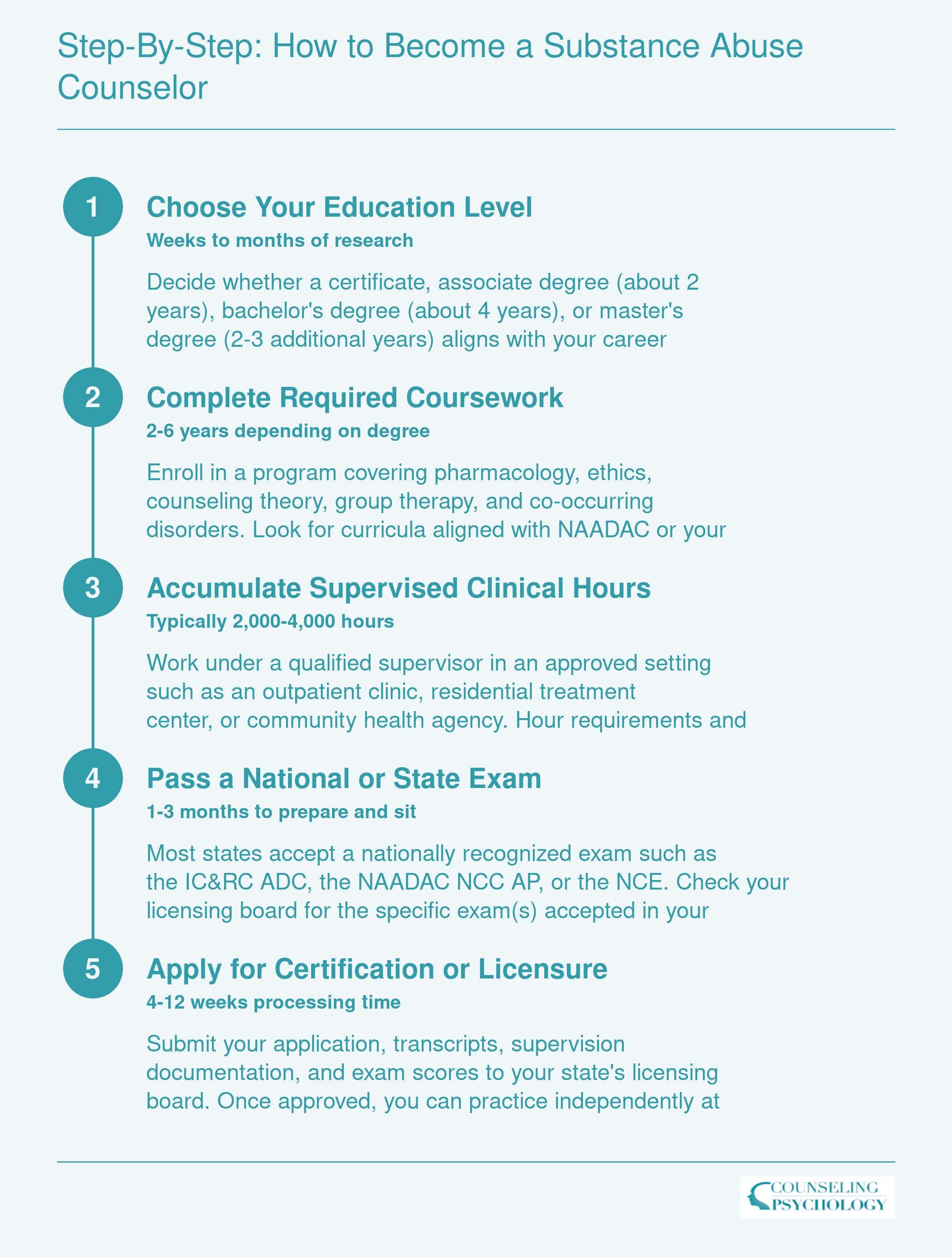
Step-by-Step: How to Become a Substance Abuse Counselor
The path to practicing as a substance abuse counselor follows a clear sequence, but the total timeline depends on the education level you choose and your state's supervised-experience requirements. From start to independent practice, expect roughly 2 years for a certificate or associate route up to 6-8 years for a master's-level full licensure track.
Education Requirements by Credential Level
State licensing boards set the minimum education for substance abuse counselors, creating four distinct credential levels that range from a certificate to a doctorate. Your career goals and where you intend to work will determine exactly where you need to land on that ladder.
Certificate and Associate Degree: Entry-Level Credentials
Some states allow individuals to enter the field with a certificate or an associate degree in addiction studies, human services, or a related field. These programs typically take one to two years and prepare you for roles such as substance abuse technician, recovery support specialist, or certified addiction counselor. Curricula cover foundational topics like counseling techniques, ethics, and the pharmacology of addiction. While these credentials can get you started, they often come with restrictions: you may need to work under supervision, your scope of practice may be limited, and not all states recognize this level for independent counseling.
Bachelor's Degree: The Foundation for Certification in Many States
A bachelor's degree significantly expands your opportunities. Many states certify substance abuse counselors at the bachelor's level, allowing you to provide direct client care without the immediate oversight required at the associate level. Common degrees include a B.S. in Human Services, a B.A. in Psychology, or a specialized bachelor's degree in addiction counseling. Programs at this level deepen your understanding of assessment, treatment planning, and co-occurring disorders. In states like California or Texas, a bachelor's degree combined with supervised experience can qualify you for full certification as a substance abuse counselor. This tier also serves as a pathway into master's programs later.
Master's Degree: Required for Independent Licensure
To achieve independent licensure as a substance abuse counselor in most states, you need a master's degree in a behavioral health field. Degrees such as an M.A. in Addiction Counseling, an M.S. in Clinical Mental Health Counseling with a concentration in substance abuse, or a Master of Social Work (MSW) with an addictions focus are common. A master's program typically spans two to three years and includes advanced coursework in diagnosis, evidence-based interventions, and clinical supervision, along with a practicum and internship. After graduation, you complete a period of supervised clinical experience (often 2,000 to 4,000 hours) and pass a licensure exam. With a master's, you can practice independently, diagnose mental health conditions, and often bill insurance directly.
Doctorate: Academic and Research Roles
A doctoral degree, either a Ph.D. in Counselor Education, a Psy.D., or a D.S.W., is rarely needed for clinical practice but becomes essential if you aim to teach at the university level, conduct research, or advance into high-level administrative positions. These programs emphasize research methodology, clinical supervision, and policy. Graduates often shape the future of the field by training new counselors and developing evidence-based treatment approaches.
State Variability: No Single Path
Which degree you must have depends heavily on state regulations. For example, New York requires a master's degree for any Licensed Mental Health Counselor practicing substance abuse work, while states like Arizona offer a Licensed Substance Abuse Technician credential with an associate degree. Always check with your state's specific licensing board before committing to a program. For a broader look at how different counseling degrees map to various career paths, see our overview.
Degree Titles and Accreditation to Look For
When selecting a program, look for aligned degree titles: - B.S. in Human Services: Offers a broad foundation in social service delivery. - B.A. in Psychology: Emphasizes the science behind behavior and mental processes. - M.A. in Addiction Counseling: Specialized training in substance use disorder treatment. - M.S. in Clinical Mental Health Counseling: Often includes a concentration in alcohol and drug counseling.
Accreditation by the Council for Accreditation of Counseling and Related Educational Programs (CACREP) is increasingly preferred or required by state boards. CACREP ensures the program meets rigorous standards and streamlines the licensure process. When researching online addiction counseling degrees, verify they hold this recognition, as some states restrict licensure to graduates of CACREP-accredited master's programs.
Certification vs. Licensure: Key Differences Explained
Two distinct credential types govern substance abuse counseling practice: certification and licensure. Understanding how they differ is essential before you choose a career pathway, because they carry different legal weight, different portability, and different implications for where and how you can work.1
What Certification Actually Means
Certification is a voluntary credential awarded by a professional or credentialing body, not a government agency.1 Organizations such as NAADAC (the Association for Addiction Professionals) and the International Certification and Reciprocity Consortium (IC&RC) issue certifications that signal specialized competence to employers and clients. Common certification titles include the Certified Alcohol Counselor (CAC), Certified Alcohol and Drug Counselor (CADC), and the Credentialed Alcoholism and Substance Abuse Counselor (CASAC). For a full breakdown of what these abbreviations mean, see our guide to counseling licensure acronyms.
Because certification originates outside state government, it does not grant legal authority to practice independently.1 What it does provide is national or sometimes international portability, which matters if you plan to relocate. A certifying body can revoke your credential for ethical violations, but it cannot prevent you from holding other employment the way a state board can.
Supervised-hour requirements for certifications typically fall between 2,000 and 4,000 hours, depending on the specific credential and the issuing organization's standards.
What Licensure Actually Means
Licensure is issued by a state government licensing board and defined by state statute.1 It grants the legal authority to practice, often independently, within that state. Common licensure titles in addiction counseling include the Licensed Clinical Alcohol and Drug Counselor (LCADC) and the Licensed Addiction Counselor (LAC). Many counselors also hold broader licenses such as the Licensed Professional Counselor (LPC) or Licensed Clinical Social Worker (LCSW) with an addiction specialization. If the LPC track interests you, our resource on how to become a licensed professional counselor covers that pathway in detail.
Licensure is state-specific, meaning it does not automatically transfer if you move.1 Post-degree supervised clinical hour requirements for licensure tend to run higher than those for certification, often 3,000 to 4,000 hours or more depending on the state and license type.
The Major National Exams
Several national exams map to these credentials:
- IC&RC ADC Exam: A 150-question, computer-based multiple-choice exam with a three-hour time limit and a passing score of 500 on a scaled score system.23 It underpins IC&RC-affiliated credentials across many states.
- NAADAC NCC AP Exam: The National Certified Counselor in Addiction Practice exam, administered through NAADAC for counselors seeking national addiction certification.
- NCE and NCMHCE: The National Counselor Examination and the National Clinical Mental Health Counseling Examination are used primarily for LPC-track licensure rather than addiction-specific certification, but counselors pursuing an LPC with an addiction specialization will encounter one or both of these exams depending on their state's requirements.
Eligibility differs across these exams. The IC&RC ADC and NAADAC pathways are designed for counselors focused specifically on addiction work, with eligibility built around supervised hours and addiction-focused education. The NCE and NCMHCE require graduate-level clinical training and are tied to broader counseling licensure frameworks.
Knowing which exam your target credential requires, and which supervised-hour threshold you need to reach first, is the most practical way to map out your timeline before you even enroll in a program.
Questions to Ask Yourself
State-by-State Licensure Requirements for Substance Abuse Counselors
Licensure requirements for substance abuse counselors vary dramatically from state to state, making state-specific research the single most important step in planning your career path. Each state sets its own minimum education level, supervised clinical hours, and exam requirements, and those standards can range from a high school diploma with certification to a master's degree with thousands of supervised hours. Understanding the credential landscape in your state determines which academic programs qualify you for licensure, how long you will spend in supervised practice, and which exams you must pass.
Start With Federal and National Resources
The U.S. Bureau of Labor Statistics Occupational Outlook Handbook for substance abuse, behavioral disorder, and mental health counselors provides a general overview of the profession and links to state-specific licensing boards. While the BLS does not publish detailed licensure requirements, its state-by-state resource directory points you to the correct regulatory agency in each jurisdiction. From there, visit your state's health or professional licensing department website for the most current requirements. Licensure details change frequently as states update statutes, add new credential tiers, or modify supervised hour requirements, so relying on outdated summaries or third-party aggregators can lead to significant planning errors.
National Certifications and State Acceptance
Two major national certifications serve as baseline credentials in many states: NAADAC's National Certified Addiction Counselor, Level I and II (NCAC I, NCAC II), and NBCC's Master Addictions Counselor (MAC). Some states accept these national certifications in lieu of a state-specific exam or as a pathway to expedited licensure, while others require their own credentialing process regardless of national credentials. Always verify acceptance with your state board before enrolling in a certification program. A few states require national certification as a prerequisite for state licensure, creating a two-step credentialing process.
State-Specific Credential Structures
In California, the licensed credential is Certified Alcohol and Drug Counselor (CADC), which requires an associate degree, 6,000 hours of supervised experience, and passage of a state-approved exam. New York uses the Credentialed Alcoholism and Substance Abuse Counselor (CASAC) system, with multiple tiers: CASAC-T (trainee), CASAC (standard), and CASAC-Advanced, each tied to different education and supervision thresholds. Texas offers the Licensed Chemical Dependency Counselor (LCDC) credential, requiring a bachelor's degree, 4,000 supervised hours, and passage of the IC&RC ADC exam. Florida licenses as a Certified Addiction Professional (CAP), demanding a master's degree and 2,000 supervised hours. Illinois requires a Certified Alcohol and Other Drug Abuse Counselor (CADC) credential, while Pennsylvania uses Licensed Alcohol and Drug Counselor (LADC) with tiered levels.
Leverage Academic Program Resources
Academic programs in addiction counseling maintain updated lists of state requirements because their accreditation and program outcomes depend on graduates achieving licensure. Reach out to admissions or program directors at CACREP-accredited counseling programs or state-specific addiction studies programs to request current licensure pathways. If you are considering shorter credentials to get started, an online graduate certificate in addiction counseling can fulfill education requirements in several states. Faculty advisors can clarify whether a program's curriculum meets your state's education standards and whether supervised practicum hours count toward licensure requirements. For those exploring broader counseling careers alongside addiction specialization, understanding how to become a counselor at the general level can help you compare credential pathways. This step can save months of post-graduation confusion when you discover that your degree does not satisfy your state board's criteria.
Can You Become a Substance Abuse Counselor Without a Degree?
Nearly half of all states now recognize formal peer-based roles that require only a high school diploma, reflecting growing acknowledgment of lived experience as a clinical asset.1 While a bachelor's or master's degree remains the standard pathway to full licensure, three entry-level positions offer a foothold in the field for candidates without college credentials: peer support specialist, substance abuse technician, and recovery coach.
Peer Support Specialist
Peer support specialists draw on their own recovery experience to guide clients through treatment and early sobriety. As of 2026, 47 states maintain a formal Certified Peer Specialist (CPS) credential.1 Requirements typically include a high school diploma or GED, 30 to 80 hours of training, and one to three years of sustained personal recovery. Hourly pay ranges from $15 to $24 (approximately $30,000 to $45,000 annually).1 Because the role hinges on shared lived experience rather than clinical theory, peer specialists occupy a unique space in multidisciplinary treatment teams, offering hope and modeling recovery in ways that degreed counselors cannot.
Substance Abuse Technician
Substance abuse technicians, also called behavioral health technicians, assist clinical staff with monitoring, documentation, and milieu management in residential or outpatient settings. Nineteen states recognize a Substance Use Disorder Technician credential that does not require college coursework.1 A high school diploma or GED suffices, though some employers prefer an associate degree or relevant certificate. Pay typically falls between $16 and $22 per hour ($32,000 to $45,000 annually).2 Technicians perform intake interviews, conduct urinalysis testing, track client attendance, and enforce facility rules, but they do not develop treatment plans or deliver clinical interventions independently.
Recovery Coach
Recovery coaches provide ongoing community support outside formal treatment settings, helping clients navigate housing, employment, legal systems, and social networks. Most training programs require 30 to 60 hours of coursework and a high school diploma.1 Compensation ranges from $16 to $25 per hour ($33,000 to $50,000 annually). Unlike peer specialists, recovery coaches are not always required to have personal recovery experience, though many do. The role emphasizes practical problem-solving and system navigation rather than clinical skill.
Limitations and Advancement
These positions offer a legitimate on-ramp into the field, but they come with real constraints. Pay ceilings are low, scope of practice is narrow, and advancement into licensed counselor roles invariably requires further education. Some states, including Texas and Ohio, maintain robust peer certification pathways; others mandate at least an associate degree for any client-facing addiction work. Candidates seeking full clinical autonomy and competitive salaries will eventually need to pursue a bachelor's degree in counseling or master's degree and meet supervised-experience requirements. For a deeper look at the licensed counselor track, see our guide on how to become a substance abuse counselor. For individuals with lived experience who want to contribute immediately, however, these roles provide meaningful work and a foundation for long-term career growth.
Substance Abuse Counselor Salary: National Overview and Top-Paying States
According to the Bureau of Labor Statistics, the national median annual wage for substance abuse, behavioral disorder, and mental health counselors (SOC 21-1018) was approximately $53,710 as of the most recent data release, with the middle 50% of earners falling between roughly $38,560 (25th percentile) and $72,580 (75th percentile). These figures provide a useful baseline, but actual pay varies significantly depending on your credential level (certificate vs. associate vs. master's degree), the clinical setting you work in (hospital, residential facility, private practice, government agency), and whether you practice in a high-cost metro area. The table below highlights states where substance abuse counselors tend to earn the most, though keep in mind that higher salaries in places like New Jersey or California often reflect a higher local cost of living.
| Rank | State | Median Annual Salary | Notable Factors |
|---|---|---|---|
| 1 | New Jersey | $64,050 | High demand in urban treatment centers; state licensure requirements favor credentialed counselors |
| 2 | California | $61,660 | Large population drives employer competition; cost of living is above average |
| 3 | Connecticut | $60,690 | Strong behavioral health funding and insurance mandates |
| 4 | Washington | $58,590 | Growing opioid treatment infrastructure in metro and rural areas |
| 5 | Massachusetts | $57,310 | Concentration of teaching hospitals and integrated care models |
| 6 | Colorado | $56,760 | Expanding Medicaid coverage for behavioral health services |
| 7 | New York | $56,460 | Large workforce; salaries highest in New York City metro area |
| 8 | Maryland | $55,230 | Proximity to federal agencies and strong public health networks |
| 9 | Oregon | $54,830 | Statewide initiatives addressing substance use disorder |
| 10 | Virginia | $54,210 | Military and veteran treatment programs supplement demand |
The Bureau of Labor Statistics projects 17 percent job growth for substance abuse, behavioral disorder, and mental health counselors between 2024 and 2034, far outpacing the average for all occupations. That pace translates to roughly 48,300 openings each year, driven by expanded insurance coverage and rising demand for addiction treatment services.
Job Outlook and Demand for Substance Abuse Counselors
Few behavioral health careers match the projected expansion of substance abuse counseling over the next decade. The Bureau of Labor Statistics forecasts a 17 percent increase in employment for substance abuse, behavioral disorder, and mental health counselors from 2024 to 2034, adding 81,100 new positions to a workforce that already numbers 483,500.1 That growth rate is more than five times the national average for all occupations, which hovers near 3 percent.2 With 48,300 annual openings expected, largely due to retirements and the sheer demand for services, the field offers a level of opportunity that few other professions can promise.
What's Fueling the Demand
A prolonged public health emergency, fueled by opioids, fentanyl, and stimulant abuse, continues to strain communities. Over 108,000 drug-related deaths were recorded in 2022, and each spike in overdoses intensifies the call for skilled counselors who can deliver evidence-based interventions.2 Meanwhile, the Mental Health Parity and Addiction Equity Act requires insurers to cover addiction treatment on par with medical and surgical care. As enforcement ramps up and more states adopt parity compliance measures, funding flows into substance use disorder programs, creating jobs at every level of care. The rapid expansion of telehealth, accelerated by permanent regulatory changes, has also unlocked new service delivery models. Remote counseling allows providers to reach clients in home settings, reduce no-show rates, and extend the reach of urban-based treatment centers into previously underserved areas.
Emerging Practice Niches
- Medication-assisted treatment (MAT) counseling: This high-demand specialty combines behavioral therapy with FDA-approved medications, requiring counselors who understand both clinical and regulatory aspects of addiction pharmacotherapy.
- Integrated primary care and behavioral health settings: Medical clinics increasingly hire counselors to screen for substance use disorders during routine visits, bridging the gap between physical and mental health.
- Adolescent substance use programs: Schools, juvenile justice systems, and community organizations are expanding early intervention services for teenagers at risk of developing lifelong addiction patterns.
Where the Jobs Are
Workforce shortages are acute in rural areas and underserved communities, where counselor-to-patient ratios often fall far below recommended levels. Many state agencies and nonprofits offer loan repayment incentives to attract new graduates to these high-need regions. The strong demand extends across the broader mental health counselor career landscape as well. For counselors willing to work outside the major metropolitan corridors, hiring prospects are especially strong, often with faster paths to full licensure and supervisory roles. Those interested in exploring the full range of options can review various counseling careers to find the right fit.
Do State Licensing Boards Accept Online Addiction Counseling Programs?
Fully online master's programs and hybrid formats that combine online coursework with in-person practicum requirements are treated differently by state licensing boards. Even among fully online programs, acceptance depends heavily on accreditation and how supervised clinical hours are structured. The short answer: many states do accept online degrees, but the details matter, and they change.
Policies Vary and Change Often
State licensing boards set their own rules for addiction and substance abuse counselor credentials, and those rules are revised regularly as telehealth, distance education, and reciprocity agreements evolve. A program that qualified a graduate in Ohio last year may not satisfy a new requirement in Texas this year. Treat any general guidance you read, including this section, as a starting point rather than a final answer. Confirm directly with the board in the state where you intend to practice before you enroll.
Where to Verify Before You Enroll
A few authoritative sources will save you time:
- State licensing board websites: The single most important source. Look for the specific addiction or substance abuse counselor credential page and read the education and supervised experience requirements line by line.
- Bureau of Labor Statistics (BLS.gov): Useful for a national overview of licensing expectations and how the occupation is structured across states.
- CACREP (cacrep.org): Lists accredited counseling programs, including those offered online. CACREP accreditation is recognized by many boards and can simplify approval, though it is not universally required for addiction counseling specifically.
- The program's own website: Reputable online programs publish state authorization disclosures showing which states they are approved to operate in and which licenses graduates can pursue. Look for language about in-person residencies, practicum placement, and any states explicitly excluded.
Call the Board Directly
When in doubt, contact the licensing board by phone or email. Ask two specific questions: does the board accept fully online degrees for your target credential, and does CACREP accreditation (or another recognized accreditor) affect approval? If you are still exploring your options, a graduate certificate in counseling can be a lower-risk way to test the waters before committing to a full degree. A short call now prevents a costly mismatch later.
Frequently Asked Questions About Substance Abuse Counseling Careers
Below are some of the most common questions prospective substance abuse counselors ask when exploring this career path. Each answer provides a concise starting point, though specific requirements can vary by state and employer.