
Key Takeaways
- Net prices range from $12,278 at San Francisco State to over $50,000 at top private institutions.
- PhD programs emphasize original research, while applied master's degrees focus on organizational and community settings.
- All 2026 ranked programs are primarily on campus, though several offer hybrid or limited online coursework.
- Social psychology differs from clinical psychology by studying group influence on behavior rather than diagnosing disorders.
Social psychology has moved from academic specialty to applied necessity. Behavioral science teams at federal agencies, content moderation units at major tech platforms, and polarization research centers at think tanks all draw heavily from social-psychology-trained graduates. Demand follows the headlines: misinformation, group conflict, algorithmic influence, public health messaging.
The programs profiled here span undergraduate study through doctoral training, with master's options at institutions like Purdue, Ohio State, and Loyola University Chicago sitting at the center of the analysis. Net prices range from roughly $12,000 at San Francisco State to over $36,000 at Loyola, and median debt at graduation runs from about $11,000 to $24,000 depending on the school. Graduates enter careers in psychology that stretch well beyond academia, including UX research, policy analysis, and organizational consulting.
Fit, funding, and faculty research alignment matter more than brand recognition at this degree level.
Best Social Psychology Programs Ranked for 2026
The programs below represent some of the strongest social psychology training options in the country, spanning master's and doctoral levels at both public and private institutions. Each entry highlights what sets the program apart, from affordability and research depth to applied community partnerships, so you can match your goals and budget to the right fit.
- Institutional graduation and retention rates
- Net price and financial value
- Program research focus and depth
- Faculty mentorship and student ratio
- Career and doctoral placement strength
- NCES-IPEDS federal institutional data — nces.ed.gov
- Internal program database
- Independent program research
- College Scorecard graduate earnings — collegescorecard.ed.gov

Brigham Young University
Brigham Young University pairs one of the lowest net prices on this list ($15,564) with strong institutional outcomes: an 81% graduation rate, 91% retention, and median earnings of $75,790 ten years after enrollment. The Applied Social Psychology Emphasis blends research training with real-world consulting in health, legal, and organizational domains, drawing on Intermountain West community partnerships and faculty clusters in moral education and family research.
- Campus-based program at BYU's Provo campus
- Covers health psychology, legal consulting, and organizational development
- Includes both research methodology and teaching training
- Faculty research spans moral education, family dynamics, and community interventions
- Dissertation research opportunities integrated into the curriculum
- Core and elective courses balance theory with practical skill building
Applied Social Psychology Emphasis (Master's) — On-Campus

Purdue University
Purdue's social psychology doctoral track stands out for its early and intensive research immersion, pairing students with world-renowned faculty from day one of a roughly five-year program. A 14:1 student-to-faculty ratio, an 83% graduation rate, and broad access to interdisciplinary centers such as the Purdue Policy Research Institute make it a strong launchpad for academic and consulting careers. Admitted doctoral students typically receive full tuition coverage plus a stipend regardless of residency.
- Five-year doctoral program with master's earned along the way
- Formal training in advanced statistical and data science methods
- Fellowships and assistantships typically cover full tuition and living costs
- Cross-area collaboration with Industrial-Organizational and Clinical programs
- Access to campus survey facilities and Midwest community samples
- Faculty specializations include social cognition, influence, and relationships
Social Psychology (Master's, en route to PhD) — On-Campus

Ohio State University
Ohio State's social psychology program benefits from the resources of a top-tier research university: a 16:1 student-to-faculty ratio, an 87.7% graduation rate (highest on this list), and deep ties to interdisciplinary institutes in decision sciences, political psychology, and public health. Students gain access to large participant pools and online panels that support ambitious, large-sample experimental work. Recent DEI initiatives add structured mentoring for students researching intergroup relations and bias.
- Campus-based program embedded in a top-ranked psychology department
- Coursework in social cognition, attitudes and persuasion, and research methods
- Teaching opportunities and lab seminars develop professional skills
- Interdisciplinary co-advising with Decision Sciences Collaborative faculty
- Structured diversity and inclusion support for graduate researchers
- Strong placement record for academic and professional positions
Social Psychology (Master's) — On-Campus

University of Missouri
The University of Missouri's MA in Psychology with an Emphasis in Social/Personality Psychology is designed as an integrated step toward a PhD rather than a terminal degree, giving students immediate access to high-level research labs and faculty mentorship. The 30-credit-hour curriculum includes 11 hours of statistics training and a thesis with oral defense, producing graduates well prepared for competitive doctoral programs. Connections to Missouri's Center for Addiction Research and Engagement open doors for social-personality projects in health behavior.
- 30 credit hours including thesis and comprehensive oral exam
- 11 hours of statistics coursework with upgraded R-based training
- Embedded in the Social/Personality PhD pipeline, not a terminal MA
- Faculty mentorship from admission with personalized research paths
- Opportunities in addiction, health behavior, and substance-use research
- 9 hours of distribution courses broaden psychological foundations
MA in Psychology, Social/Personality Psychology Emphasis (Master's) — On-Campus

Loyola University Chicago
Loyola University Chicago's MA in Applied Social Psychology is explicitly built around social justice, program evaluation, and community-based research in one of America's most diverse cities. The two-year program requires an empirical thesis and offers structured training in mixed methods and participatory approaches. Chicago-area partnerships with nonprofits, schools, and health organizations provide real field placements where students tackle prejudice, health behavior, and policy questions firsthand. At a 13:1 student-to-faculty ratio, mentorship is close and consistent.
- Two-year campus program with full-time or part-time enrollment
- Empirical thesis required, emphasizing original applied research
- Structured training in program evaluation and community-based methods
- Field placements with Chicago nonprofits, schools, and advocacy groups
- Strengthened statistics and mixed-methods requirements in recent updates
- Prepares graduates for NGO, government, consulting, and PhD pathways
MA in Applied Social Psychology (Master's) — On-Campus

San Francisco State University
San Francisco State University offers the lowest net price on this list at $12,278, making its MA in Psychological Science with a Social, Personality, and Affective Science concentration a standout for budget-conscious applicants. The Bay Area's remarkable demographic diversity fuels research on culture, immigration, social class, and stigma. Faculty emphasize culturally informed social psychology, and graduates have a strong record of placement into PhD programs nationally.
- Two-year research-focused program requiring an original master's thesis
- Advanced training in quantitative methods and statistical analysis
- Faculty research centers on culture, inequality, emotion, and intergroup relations
- Uses Bay Area's diverse population for field and community studies
- Strong track record placing graduates into social psychology PhD programs
- Lowest net price among ranked programs at $12,278
MA in Psychological Science, Social, Personality, and Affective Science (Master's) — On-Campus

Kansas State University
Kansas State University's doctoral program in Social/Personality Psychology trains scholar-researchers over roughly five years, with close faculty mentorship and multi-method training that spans lab experiments, surveys, and experience sampling. K-State's rural and small-town setting gives students access to underrepresented research populations, including agricultural communities and regional schools. Graduate assistantships typically cover tuition and provide a stipend, keeping out-of-pocket costs low regardless of residency.
- Approximately five-year PhD with master's earned en route
- Multi-method training: lab experiments, surveys, experience sampling
- Faculty research spans attitudes toward science, health, and rural social issues
- Expanded quantitative training including SEM and multilevel modeling
- Assistantships generally cover tuition plus stipend for admitted students
- Flexible academic pathways with opportunities for publication early
Social/Personality Psychology (Doctoral) — On-Campus

University of Massachusetts-Amherst
UMass Amherst houses two distinct master's tracks under its Psychological and Brain Sciences department: a Social Psychology concentration and a highly specialized Psychology of Peace and Violence program, one of the few peace-focused tracks in any U.S. psychology department. Both emphasize research and teaching, with financial support through assistantships and tuition waivers. The Peace and Violence track includes a three-credit internship often placed with NGOs, government agencies, or international organizations focused on conflict resolution and human rights.
- Campus-based program exploring individuals in social environments
- Financial support via teaching and research assistantships
- Faculty specialization in intergroup conflict and social change
- Admission requires strong research experience and faculty alignment
- Institutional commitment to diversity and anti-racism in research
- 83.3% institutional graduation rate with 92% first-year retention
- Rare peace-and-violence specialization within a psychology department
- Three-credit internship with NGOs, government, or international organizations
- Research focus on collective violence, genocide prevention, and restorative justice
- Tuition waivers and assistantship funding available
- Strong pipeline into policy-oriented and PhD positions
- Admission deadline typically December 1
MS in Psychological and Brain Sciences, Social Psychology (Master's) — On-Campus
MS in Psychological and Brain Sciences, Psychology of Peace and Violence (Master's) — On-Campus

University of Northern Iowa
The University of Northern Iowa's MA in Psychology with a Social Psychology emphasis is a research-oriented, thesis-required program that explicitly prepares students for PhD-level study. At 42 to 43 semester hours (including 15 hours of 6000-level coursework), the curriculum is more rigorous than many comparable master's programs. UNI's smaller campus fosters close mentoring, and faculty regularly involve MA students in grant-funded projects and conference presentations, giving applicants a competitive portfolio for doctoral admissions.
- 42-43 semester hours with a required thesis
- Minimum 15 hours of advanced 6000-level coursework
- Intensive training in research methodology and empirical analysis
- Faculty involve students in grants and conference presentations
- Regional participant pools for field and survey research
- Net price of $15,901 with in-state tuition at $11,602
MA in Psychology, Social Psychology Emphasis (Master's) — On-Campus

Miami University
Miami University of Ohio's MA in Social Psychology zeroes in on health and well-being through the lens of social connections, identities, and relationships. A 16:1 student-to-faculty ratio supports collaborative research apprenticeships and graduate seminars. The program includes structured teaching experiences, and its campus setting in Oxford, Ohio, provides a focused academic environment. An 80% graduation rate and 90% retention rate reflect strong institutional support.
- Concentration on health, well-being, and social relationships
- Research apprenticeships paired with faculty mentors
- Graduate seminars in core social psychology topics
- Teaching experience integrated into the program
- Low student-to-faculty ratio supports close collaboration
- Campus-based program with 80% institutional graduation rate
MA in Social Psychology (Master's) — On-Campus

Illinois State University
Illinois State University's social psychology concentration sits within an Industrial/Organizational-Social Psychology graduate sequence, giving students a distinctive blend of social-psychological theory and organizational application. The two-year, campus-based program follows a scientist-practitioner model, preparing graduates for research, academia, and organizational consulting. With in-state tuition under $10,218 and an out-of-state rate of just $13,062, it is among the most affordable options on this list.
- Two-year campus-based program with scientist-practitioner model
- Blends social psychology theory with organizational applications
- Bachelor's degree in psychology or related field required for admission
- Prepares graduates for research, academia, and consulting roles
- In-state tuition under $10,218 with modest out-of-state rates
- Focus on psychological methodology applied to group and individual challenges
Industrial/Organizational-Social Psychology, Social Psychology Concentration (Master's) — On-Campus
How We Ranked These Social Psychology Programs
Ranking a social psychology program means looking past brand recognition and asking a simpler question: does this degree pay off for the people who actually finish it? To answer that, we built our list around publicly reported outcomes data rather than reputation surveys, peer voting, or marketing claims. The result is a ranking grounded in what graduates actually experience.
The Data Behind the Rankings
We pulled program-level earnings from the U.S. Department of Education's College Scorecard, which reports median earnings for graduates of specific degree programs identified by CIP code (the federal classification system for academic programs). Where program-level earnings were available for social psychology and closely related social-science specializations, we used them directly. For cost, debt, and completion, we relied on the most current Scorecard release covering net price, median student debt, and graduation rates. We apply a similar outcomes-driven approach across our other rankings, including our list of the best online master's in psychology programs.
One honest caveat: graduation rates in our dataset are reported at the institution level, not the program level. A university with a strong social psychology department may still carry a lower campus-wide completion rate because of unrelated undergraduate trends. We flag this where it matters.
How We Weighted the Factors
Four factors carried the most weight: cost efficiency (net price relative to earnings), post-graduation earnings, debt burden after completion, and institutional graduation rates. Net price figures are sector-conditional averages, meaning they reflect what students in a similar income bracket typically pay rather than sticker tuition.
Why Some Familiar Names Are Missing
A few well-regarded programs did not make the cut, not because they lack quality but because their reporting data was incomplete, suppressed for privacy reasons, or filed under a CIP code that did not cleanly match social psychology. When the numbers were not there, we left the program off rather than guess.
What Social Psychology Graduates Earn: A Snapshot
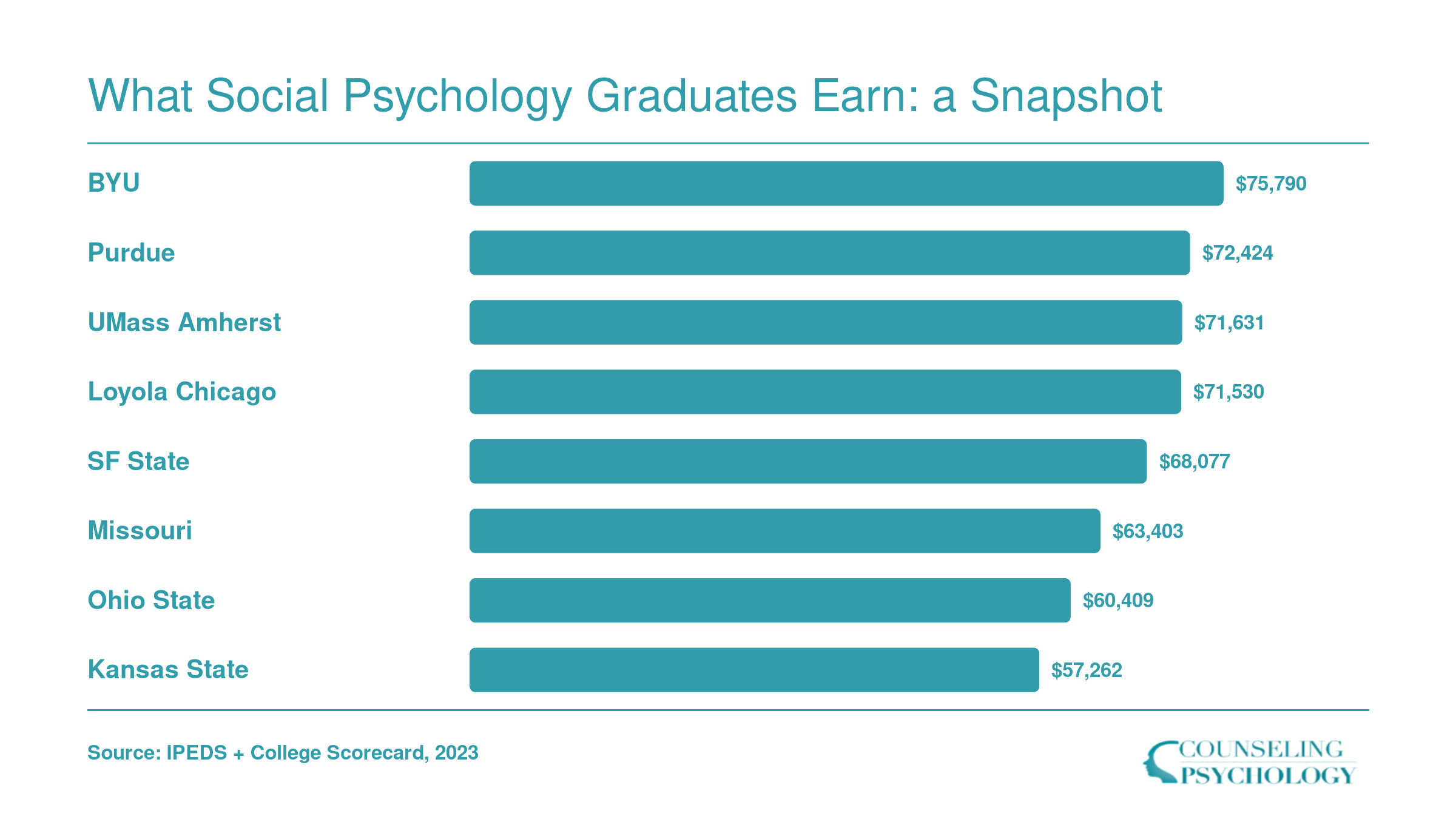
Program-level earnings data (median wages at one year and four years after completion) are not yet published for these social psychology programs. Instead, the chart below shows institution-wide median earnings ten years after enrollment, drawn from College Scorecard data. These figures reflect all graduates of each university, not just social psychology completers, so treat them as a broad benchmark rather than a program-specific salary guarantee.
Social Psychology Programs by Degree Level
Which degree level in social psychology will get you where you want to go?
The answer depends on whether you see yourself conducting original research, applying psychological principles in organizational settings, or building a foundation for more advanced study. The programs featured in our rankings span multiple tiers, and understanding what each level prepares you to do can save years of misaligned effort.
Bachelor's Level: Building the Foundation
Undergraduate programs in social psychology provide essential grounding in research methods, statistics, and core theories about how people influence one another. A bachelor's degree typically leads to entry-level positions in human resources, market research, nonprofit program coordination, or research assistant roles in academic labs. Most graduates at this level find that the bachelor's functions as a launching pad rather than a terminal credential. If you want to design studies, lead interventions, or hold the title of social psychologist, graduate training is the standard path forward.
Master's Level: Applied Practice and Industry Careers
The master's tier is where you will find the majority of programs on our list. Schools like Brigham Young University, Loyola University Chicago, and San Francisco State University offer applied social psychology concentrations that prepare graduates for careers outside academia. Typical landing spots include:
- Organizational development: Consulting firms and corporate HR departments hire master's-level graduates to improve workplace culture and team dynamics.
- User experience research: Tech companies value training in social cognition and survey methodology.
- Policy analysis: Government agencies and think tanks recruit graduates who can translate behavioral science into actionable recommendations.
Programs such as the MA in Applied Social Psychology at Loyola or the Psychological Science concentration at San Francisco State emphasize thesis research, quantitative analysis, and faculty mentorship. Closely related options, such as applied psychology masters programs, can also prepare graduates for similar roles. For many professionals, the master's degree is the terminal credential, meaning it is designed to be your final academic degree before entering the workforce.
Doctoral Level: Research Training and Academic Careers
PhD programs in social psychology at institutions like Purdue University, Ohio State University, and Kansas State University train students to become independent researchers. Doctoral training typically spans five to six years and includes original dissertation research, teaching experience, and opportunities for peer-reviewed publication. These programs form the primary pipeline to tenure-track faculty positions, research scientist roles at federal agencies, and senior consulting positions that require advanced methodological expertise.
One critical financial detail sets doctoral programs apart: most social psychology PhD programs are fully funded. Students receive tuition waivers plus stipends through teaching or research assistantships, which means you can complete a doctorate without accumulating graduate school debt. The next section on program costs and financial aid breaks down how this funding works and what to expect at each degree level.
Questions to Ask Yourself
Social Psychology Program Costs and Financial Aid
Costs across these ranked social psychology programs vary dramatically. At the low end, San Francisco State University posts a net price of $12,278 with a median graduate debt of just $15,371, while Loyola University Chicago, a private institution, carries a net price of $36,079 and median debt of $24,157. Among public universities, the steepest out-of-state markups appear at Ohio State University (in-state tuition of $13,901 versus $42,740 for out-of-state students) and Miami University ($16,751 versus $37,791). For doctoral candidates, the financial picture often improves significantly. Most social psychology PhD programs at research universities offer full tuition remission and guaranteed funding for five years. Stipends range from roughly $21,600 at the University of South Florida to $42,436 at the University of Southern California, with the University of Minnesota paying graduate assistants a minimum of $28.94 per hour and guaranteeing summer funding as well. The University of Denver provides a stipend of $26,539 alongside tuition remission valued at $41,232. These packages can substantially offset or eliminate the sticker prices shown below.
| School | In-State Tuition | Out-of-State Tuition | Net Price | Median Graduate Debt |
|---|---|---|---|---|
| San Francisco State University | $9,370 | $19,450 | $12,278 | $15,371 |
| Purdue University | $9,992 | $28,794 | $14,600 | $19,500 |
| Brigham Young University | $8,416 | $8,416 | $15,564 | $11,069 |
| University of Northern Iowa | $11,602 | $23,304 | $15,901 | $19,691 |
| Ohio State University | $13,901 | $42,740 | $17,339 | $19,976 |
| Illinois State University | $10,218 | $13,062 | $19,398 | $20,482 |
| Kansas State University | $12,089 | $25,824 | $19,406 | $21,250 |
| University of Missouri | $13,681 | $32,581 | $20,268 | $20,500 |
| University of Massachusetts Amherst | $17,410 | $35,726 | $22,383 | $22,763 |
| Miami University | $16,751 | $37,791 | $28,384 | $23,000 |
| Loyola University Chicago | $21,912 | $21,912 | $36,079 | $24,157 |
Career Outcomes and Earnings After Graduation
Career outcomes for social psychology graduates vary widely based on degree level, specialization, and career path, but the field offers robust opportunities for those who complete rigorous training. Understanding the earnings potential and employment landscape helps prospective students set realistic expectations and plan their educational investments.
Institutional Earnings Data: The Program-Level View
Program-level earnings data from the College Scorecard show considerable variation across institutions. Among the schools in our ranking, graduates from Brigham Young University's applied social psychology program report median earnings of $75,790 ten years after entry, reflecting strong placement in applied research, consulting, and organizational roles. Purdue University and University of Massachusetts-Amherst graduates earn around $72,424 and $71,631 respectively at the same milestone, underscoring the value of research-intensive training.
On the lower end, Miami University and University of Northern Iowa graduates report median ten-year earnings of approximately $55,076 and $55,177. These differences often reflect regional labor markets, program emphasis (academic preparation versus applied skills), and the share of graduates pursuing further doctoral training rather than immediate employment.
National Salary Benchmarks for Psychologists
According to the Bureau of Labor Statistics, psychologists categorized under "All Other Psychologists" (SOC 19-3039) earned a national median annual wage of $117,750 in 2023.1 The 10th percentile earned $47,450, while the 90th percentile reached $157,420, illustrating the field's wide earnings spectrum.1 The broader category of all psychologists shows a median of $94,310 as of 2024, with a projected job growth rate of 6 percent through 2034.2
Top-paying industries for psychologists include local government (mean $123,570) and educational support services (mean $111,820).3 Social psychologists working in applied research, UX consulting, and organizational development often command salaries at the higher end of these ranges, especially in metropolitan areas and tech-driven sectors.
PhD vs. PsyD: Earnings and Career Trajectories
Social psychology PhDs and PsyDs follow different career arcs, and earnings reflect those paths. Social psychology PhDs typically pursue academic appointments, research positions, and applied science roles in industry. Published data from the American Psychological Association and industry surveys indicate that PhD holders in research-intensive roles often earn salaries in the $80,000 to $120,000 range early in their careers, with senior faculty and principal investigators exceeding $140,000.
PsyD graduates, by contrast, focus on clinical practice. Clinical and counseling psychologists earned a national median of $96,100 in 2023. While PsyDs rarely specialize in social psychology per se, understanding this distinction matters: social psychology programs overwhelmingly grant PhDs aimed at research careers, not clinical licensure. Students seeking clinical practice should pursue clinical psychology doctorate programs instead.
Concrete Career Paths and Salary Ranges
Social psychology graduates enter diverse roles, each with distinct compensation profiles:
- Academia and research: Assistant professors in psychology at research universities typically start between $70,000 and $90,000, with tenured faculty at R1 institutions earning $100,000 to $160,000 or more. Postdoctoral researchers earn $50,000 to $65,000.
- User experience (UX) research: UX researchers at major tech firms and product companies earn $90,000 to $140,000, with senior roles and total compensation packages (including equity) exceeding $180,000 in high-cost markets.
- Organizational consulting: Management consultants and organizational development specialists with social psychology backgrounds earn $75,000 to $130,000, depending on firm size and client base. Independent consultants with established practices can command higher fees.
- Policy analysis and program evaluation: Policy analysts in government agencies, think tanks, and NGOs earn $65,000 to $95,000, with senior roles reaching $110,000 to $130,000.
- Market research and consumer insights: Market research analysts earn a median of approximately $68,000 nationally, with experienced researchers in consumer behavior and brand strategy earning $85,000 to $120,000.
Graduates interested in organizational roles may also want to explore industrial organizational psychology graduate programs, which share significant methodological overlap with social psychology. These ranges reflect national averages; geographic location, employer type, and individual negotiation significantly influence actual offers. Graduates should research regional salary norms and industry-specific compensation structures as they plan their career transitions.
Over 3.6 million psychology degree holders were employed in the U.S. in 2023, according to the Bureau of Labor Statistics. That’s a workforce stretching far beyond clinical settings, reflecting the broad applicability of psychological training.
Online vs. On-Campus Social Psychology Programs
Deciding between an online and on-campus format is one of the most practical choices you will make when selecting a social psychology program. Every program in our 2026 rankings, including Purdue University, Ohio State University, BYU, Loyola University Chicago, UMass Amherst, and the rest, is delivered on campus. That pattern is not a coincidence: social psychology's emphasis on laboratory research and faculty collaboration makes in-person instruction the dominant model, especially at the doctoral level. Still, a growing number of applied master's programs in related fields are moving online, so it is worth weighing both formats honestly.
Pros
- Online programs offer schedule flexibility that lets working professionals earn an applied master's degree without relocating.
- Tuition for online programs is often lower because students avoid campus fees, housing costs, and commuting expenses.
- Asynchronous coursework allows students to balance family responsibilities or full-time employment alongside graduate study.
- On-campus programs provide direct access to research labs, which is essential for PhD training and publishable scholarship.
- In-person cohorts build stronger professional networks through daily interaction with peers, faculty, and visiting scholars.
- Campus-based students benefit from regular faculty mentorship, including informal advising that shapes research agendas and career direction.
- On-campus graduates tend to have stronger placement outcomes for academic and research positions after completing doctoral work.
Cons
- Online social psychology programs remain rare at the doctoral level, limiting options for students who need remote access to PhD training.
- Campus-based programs typically require full-time residency, which can be difficult for students who cannot leave jobs or relocate.
- Online learners may miss out on spontaneous lab collaborations and the kind of hands-on experimental work that defines the discipline.
- On-campus tuition, especially at out-of-state rates, can be significantly higher; for example, Ohio State's out-of-state graduate tuition tops $42,000 per year.
- Students in online programs sometimes report feeling isolated from their cohort, which can reduce motivation and professional development.
How to Choose the Right Social Psychology Program
Choosing a social psychology graduate program isn't simply about chasing the highest-ranked name. The real decision hinges on a different priority: finding the faculty mentor and research environment that align with your intellectual goals. While prestige can open doors, your day-to-day satisfaction and career trajectory depend far more on the match between your interests and the ongoing work in a lab.
Look Beyond Rankings: The Primacy of Research Fit
The single most important criterion for doctoral selection is how well your research interests mesh with those of a potential advisor. Unlike some professional fields where curriculum matters most, a social psychology PhD is an apprenticeship. You will spend years collaborating on studies, analyzing data, and writing papers under one faculty member's guidance. That relationship defines your experience. Before applying, download recent publications from professors you admire and read them carefully. Reach out with thoughtful questions. Use program websites to identify whether labs are actively recruiting students. A program at the top of a rankings list is meaningless if no one there studies what excites you.
Finding the Right Specialization
Social psychology spans distinct subfields, and programs typically develop concentrated strengths in a few areas. Knowing which specialty you want to pursue helps narrow the list. Social cognition programs, which explore how people process social information, are prominent at places like Yale University and Ohio State University. Intergroup relations and prejudice researchers cluster at institutions such as the University of California, Los Angeles, and the University of Michigan. Political psychology scholars often gravitate toward Stanford University or New York University. If your focus is health behavior (examining how social factors influence wellness), look for programs that partner with medical centers and schools of public health; exploring health psychology programs can also help you identify relevant faculty. Identifying two or three programs that excel in your chosen niche ensures you will be surrounded by scholars who share your passion.
Navigating Admissions: The GRE-Optional Era and What Matters
Gone are the days when a high GRE score was a ticket to a top program. According to the American Psychological Association, only about 7 to 8 percent of social psychology doctoral programs require the GRE verbal and quantitative sections, and just 6 percent demand the writing test.1 Another 11 to 13 percent of programs recommend it.1 In practice, many elite universities have moved away from testing entirely. Stanford University, the University of Michigan, and the University of Wisconsin-Madison no longer accept GRE scores.2 Others, including Northwestern University, the University of Pennsylvania, and the University of California, Berkeley, list it as optional.2 Admissions committees now place heavier weight on research experience, letters of recommendation, and a compelling statement of purpose.1 A strong GPA is still expected, often above 3.5 in competitive pools, but it is your ability to articulate a research idea and document hands-on lab work that sets you apart.
Is 25 Too Late? (And Other Age Concerns)
No. And if you have spent a few years working, volunteering, or completing a master's degree in psychology, you are in good company. The median age of incoming doctoral students in psychology sits in the late 20s. Many successful social psychologists entered their PhD programs after career changes or time away from higher education. Programs value maturity, clarity of purpose, and life experience. A nontraditional timeline can actually strengthen your application by demonstrating commitment and a realistic understanding of the field.
Accreditation: What Actually Counts
Students often assume that APA accreditation applies to all psychology doctoral programs, but it is designated specifically for clinical, counseling, and school psychology. Social psychology, as a research-focused discipline, falls outside that scope. Instead, the essential accreditation marker is institutional: regional accreditation from one of the agencies recognized by the U.S. Department of Education. This ensures that your degree is legitimate and that credits can transfer. Verify a university's regional accreditation status before you apply.
Social Psychology vs. Clinical Psychology: Key Differences
Social psychology and clinical psychology sit on opposite ends of the psychology spectrum, even though both study human behavior. Social psychologists examine how groups, cultures, and situations shape thinking and action, while clinical psychologists diagnose and treat mental health disorders in individual patients. If you are weighing graduate programs, understanding these differences will save you from entering the wrong training track.
Research Focus and Study Populations
Social psychology programs train you to design experiments that test how people respond to peer pressure, authority, stereotypes, persuasion, and intergroup conflict. You will spend more time in labs running controlled studies than in therapy rooms. Clinical psychology programs, by contrast, prepare you to assess symptoms, deliver evidence-based psychotherapy, and manage treatment plans for clients with depression, anxiety, trauma, personality disorders, and psychotic conditions.1 The research in clinical programs often centers on intervention efficacy rather than social influence mechanisms.
Licensure and Accreditation Requirements
Social psychology doctoral programs do not lead to clinical licensure. You cannot legally practice psychotherapy or bill insurance as a psychologist with a social psychology PhD.2 Clinical psychology programs, however, are designed explicitly for licensure. Most states require graduation from an APA-accredited doctoral program, 2,000 to 6,000 supervised clinical hours (across internship and postdoctoral residency), and passing scores on the Examination for Professional Practice in Psychology.2 For social psychology students, APA accreditation is irrelevant because the degree does not qualify you to sit for licensure exams.
Degree Types and Program Structure
Social psychology follows a single degree model: the research PhD, typically completed in five to six years.3 Clinical psychology offers two pathways. The PhD follows a scientist-practitioner model, balancing research training with clinical skills, and usually takes five to seven years. The PsyD is practice-focused, emphasizes clinical competency over dissertation research, and also spans five to seven years but often carries higher tuition because fewer PsyD programs offer full funding.1 Exploring the full range of different types of psychology degrees can help you understand where each pathway fits within the broader discipline.
Career Paths and Employment Settings
With a social psychology PhD, you will likely pursue academic appointments, postdoctoral fellowships, or applied roles in user experience research, consumer insights, policy analysis, or organizational consulting. Those drawn to laboratory-based work may also find overlap with experimental psychology roles. Licensure is not part of the career equation. Clinical psychology graduates, holding either a PhD or PsyD, commonly work as licensed psychologists in hospitals, private practice, community mental health centers, university counseling centers, or Veterans Affairs facilities. Some clinical PhDs also hold faculty positions and run treatment-outcome labs.
Funding Models and Financial Implications
Most reputable social psychology PhD programs offer funded packages that cover tuition and provide an annual stipend in exchange for research or teaching assistantships. Clinical PhD programs often extend similar funding arrangements, especially at research universities. PsyD programs, by contrast, frequently operate on a tuition-driven model with limited assistantships, leaving many graduates with six-figure debt.1
Overlap and Hybrid Specialties
Health psychology and community psychology represent areas where social and clinical training intersect. Health psychologists may study how social norms influence smoking cessation or design community interventions to reduce cardiovascular risk, drawing on both traditions. Students interested in this crossover should explore doctorate in health psychology options early. Community psychologists often blend program evaluation, advocacy, and prevention work that does not require clinical licensure but benefits from understanding both group dynamics and individual pathology. If your interests lie in these boundary zones, clarify early whether your target programs expect you to pursue licensure or remain on the research track.
Frequently Asked Questions About Social Psychology Programs
Prospective students often have overlapping questions about cost, career value, and program structure when exploring social psychology. Below are answers to the most common queries, drawn from current program data and professional benchmarks.