What you’ll learn in this article…
- Several accredited programs near San Diego report average net prices well below their published tuition, making child psychology degrees more accessible than sticker prices suggest.
- California licenses child therapists through two separate boards depending on whether you hold a master's or doctoral degree.
- Earning a doctoral-level psychologist license in California typically takes nine to twelve years of combined education and supervised practice.
- San Diego practicum sites like Rady Children's Hospital give local students a competitive edge in clinical training.
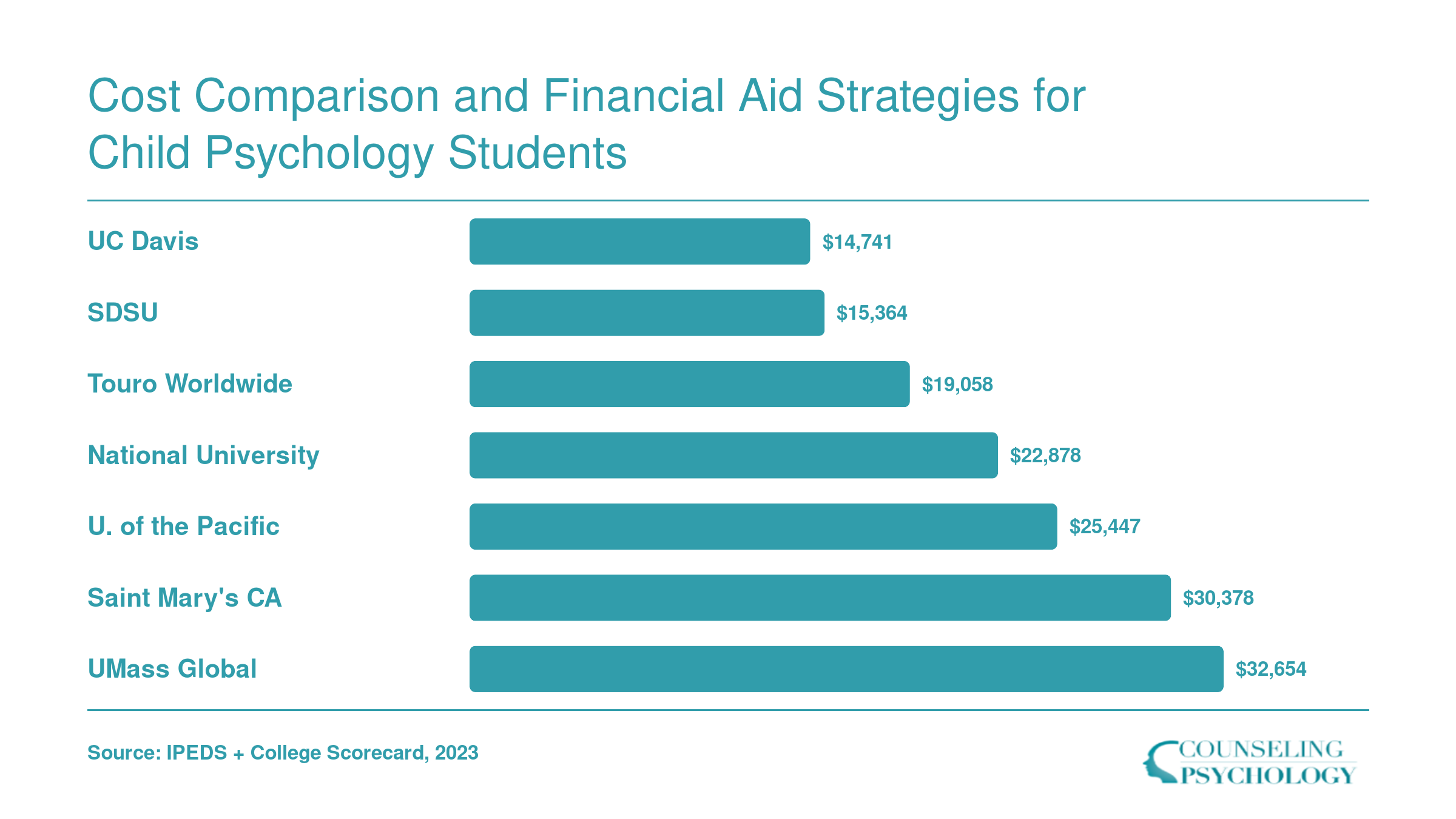
San Diego County faces a persistent shortage of child and adolescent mental health providers, yet the cost of graduate education keeps many qualified students from entering the field. Among the seven programs compared on this page, institution-wide net price averages range from about $14,700 at UC Davis to over $32,600 at UMass Global, with several campus-based and online options falling in between. That spread reflects not just tuition differences but also the varying aid packages and institutional resources each school brings to bear. For students exploring MFT programs in California or related child therapy tracks, recognizing that sticker prices often overstate what students actually pay is the first step toward a realistic budget.
Best Affordable Child Psychology Programs Near San Diego, Ranked by Value
This ranking highlights child psychology programs within reach of San Diego students, ordered primarily by estimated net price after financial aid. Net price figures are institution-wide averages reported to the federal government; they reflect what a typical first-time, full-time undergraduate receiving aid actually pays, so they are approximate rather than program-specific. We also weighed graduation rates, median graduate debt, and how well each program aligns with the needs of San Diego-area students pursuing child-focused careers.
- Institution-wide net price
- Graduation and retention rates
- Median graduate debt levels
- Program relevance to child psychology
- Regional accessibility for San Diego students
- Independent program research
- NCES-IPEDS federal institutional data — nces.ed.gov
- Internal program database
- College Scorecard graduate earnings — collegescorecard.ed.gov

University of California-Davis
UC Davis is a top-tier public research university whose Child Development M.S. sits within an interdisciplinary graduate group spanning the College of Agricultural and Environmental Sciences. The campus boasts an institution-wide graduation rate of about 86% and a median debt at graduation of $13,000, among the lowest figures on this list. Its location in the Sacramento Valley means a lower cost of living than coastal California, which can offset the distance from San Diego for students willing to relocate for two years.
- Two-year Master of Science with Plan I and Plan II options
- Covers cognitive and socio-emotional development from infancy through adolescence
- Supervised practical experience paired with theory and methodology coursework
- Interdisciplinary faculty drawn from multiple colleges and departments
- Prepares graduates for community-college teaching or doctoral study
- Admission deadlines fall in December and March each year
- California residents benefit from UC systemwide financial aid structure
Child Development, M.S. — On-Campus

San Diego State University
San Diego State University is the most geographically convenient public option on this list, sitting right in the city and carrying an institution-wide net price of roughly $15,364. The Child Development M.S. with an early childhood mental health concentration is specifically designed for working professionals, offering evening classes that let students keep local employment while studying. SDSU's CSU tuition structure and access to Cal Grants and State University Grants make it one of the most cost-conscious graduate pathways in the San Diego region.
- 30 to 32 graduate credits completed over approximately two years
- Concentration targets social and emotional development in young children
- Evening class schedule supports full-time employment
- Prepares graduates for leadership in educational and family service settings
- Requires a bachelor's degree and minimum 3.0 GPA for admission
- CSU tuition keeps per-credit costs well below private alternatives
- Local practicum connections to San Diego-area agencies and schools
Child Development, M.S. (Early Childhood Mental Health) — On-Campus

Touro University Worldwide
Touro University Worldwide is a nonprofit, California-based institution offering a fully online M.A. in Psychology with a Child and Adolescent Development concentration. The 36-credit program can be finished in about one year, making it one of the fastest routes to a child-focused master's degree. The institution-wide graduation rate is low at roughly 29%, and net price averages around $19,058, so prospective students should weigh speed and flexibility against those outcome metrics.
- 100% online with no residency requirement
- 36 credits completable in approximately one year
- Six start dates per year with eight-week sessions
- No GRE or GMAT required for admission
- Coursework covers trauma, behavioral development, and health-related issues
- Nonprofit, regionally accredited California institution
- Uniform tuition rate regardless of state residency
M.A. in Psychology, Child and Adolescent Development — On-Campus

Saint Mary's College of California
Saint Mary's College of California is a private liberal arts college in Moraga, near the San Francisco Bay Area, with an institution-wide graduation rate of about 70% and a 10:1 student-to-faculty ratio. Its Psychology B.A. with a Child/Adolescent Development concentration blends classroom theory with hands-on lab and field research. The sticker price is high at over $57,000, but institutional aid brings the average net price down to roughly $30,378, and small class sizes offer a personalized undergraduate experience that larger universities cannot easily replicate.
- Bachelor's-level concentration in child and adolescent development
- Small, discussion-based classes with experienced faculty
- Includes lab work, field research, and independent study opportunities
- Develops ethical problem-solving and scientific communication skills
- Prepares students for graduate school or entry roles in social services
- Campus-based program in Northern California's Bay Area
Psychology, B.A. (Child/Adolescent Development) — On-Campus

National University
National University is headquartered in San Diego and delivers its M.S. in Child and Adolescent Developmental Psychology entirely online, making it a local institution with flexible access. With year-round enrollment and a one-to-one learning model, the program is built for adult learners juggling careers. San Diego's large military community may also benefit from NU's military and veteran tuition discounts. The institution-wide net price sits at about $22,878, and the graduation rate is approximately 43%.
- Fully online, 30-credit master's with year-round enrollment
- Coursework covers ADHD, autism spectrum disorders, and psychopathology
- Optional 100-hour internship with potential local San Diego placements
- No GRE or GMAT required for admission
- One-to-one learning model provides individualized faculty interaction
- Military and veteran tuition discounts available through NU
- San Diego headquarters supports local networking and career services
M.S. in Child and Adolescent Developmental Psychology — On-Campus

University of Massachusetts Global
University of Massachusetts Global (formerly Brandman University) offers a fully online B.A. in Psychology with a Child Psychology concentration, making it a flexible undergraduate entry point for San Diego students who want to build foundational knowledge before pursuing graduate work. Transfer-friendly policies may benefit students coming from San Diego-area community colleges. The institution-wide graduation rate is about 43%, and the net price averages roughly $32,654, higher than most public alternatives on this list.
- Fully online bachelor's degree with a child psychology concentration
- Emphasizes scientific writing, critical thinking, and research methodology
- Senior capstone research project anchors upper-division coursework
- Cross-cultural psychology component broadens developmental perspective
- Designed to prepare graduates for California graduate programs
- Transfer-friendly for California community college students
B.A. in Psychology (Child Psychology) — Online

University of the Pacific
University of the Pacific, a private university in Stockton, offers a campus-based M.A. in Counseling Psychology with a Child and Adolescent Counseling emphasis. The curriculum is aligned with California LPCC licensure requirements, which can save graduates time and money that out-of-state programs might not. A 13:1 student-to-faculty ratio and an institution-wide graduation rate near 69% reflect solid academic support. The sticker price exceeds $55,000, but the average net price drops to about $25,447 after institutional aid.
- Campus-based master's aligned with California LPCC licensure standards
- Comprehensive curriculum spanning psychopathology and wellness promotion
- Designed specifically for child and adolescent mental health practice
- Bachelor's degree required for admission
- 13:1 student-to-faculty ratio supports close mentoring
- Located in Stockton; relocation needed for San Diego residents
- Institutional aid significantly reduces sticker price for many students
M.A. in Counseling Psychology (Child and Adolescent Counseling) — On-Campus
Certificate vs. Master's vs. Doctorate: What Each Child Psychology Degree Prepares You For
Choosing between a certificate, master's, or doctorate in child psychology isn't just about time or cost. It defines the scope of practice you'll hold in California and the professional title you can legally use. Each credential opens distinct career doors and carries specific regulatory requirements.
Certificate Programs: Entry-Level Roles Without Licensure
Certificate programs in child psychology or child development typically require 12 to 18 months and prepare graduates for paraprofessional roles such as behavioral technician, child development specialist, or therapeutic support staff. These programs provide foundational knowledge in child behavior, developmental milestones, and intervention techniques, but they do not qualify you for independent clinical licensure in California. Graduates work under the supervision of licensed professionals in schools, community agencies, and treatment centers. If you're exploring the field or need credentials quickly for entry-level work, a certificate is a practical starting point, but it won't allow you to diagnose, treat, or bill insurance independently.
Master's Degrees: The Pathway to Licensed Clinical Practice
A master's degree in counseling, marriage and family therapy, or clinical psychology positions you for independent licensure as a Licensed Marriage and Family Therapist or Licensed Professional Clinical Counselor through the California Board of Behavioral Sciences. These programs typically span two to three years and include supervised clinical practicum hours. Once licensed, you can work as a child therapist or counselor in private practice, hospitals, schools, and community mental health centers. You cannot use the title "psychologist," but you are authorized to provide diagnosis and treatment within your scope of practice. For many students seeking affordable, relatively quick entry into clinical child therapy, a master's degree is the most practical credential. If you're weighing what other careers in psychology are possible at this level, the options extend well beyond child-focused work.
Doctoral Degrees: The Only Route to the Psychologist Title
Becoming a licensed psychologist in California requires a doctoral degree, either a PsyD or PhD in clinical or developmental psychology, regulated by the California Board of Psychology.2 These programs demand five to seven years of study, including dissertation research, comprehensive exams, and a predoctoral internship. After graduation, candidates complete additional supervised hours before sitting for the Examination for Professional Practice in Psychology. Only licensed psychologists may use the title "psychologist" and conduct comprehensive psychological assessments, forensic evaluations, and advanced clinical interventions. The total timeline from bachelor's degree to licensure in California typically spans eight to eleven years.2 For a detailed look at child psychologist degree requirements, including step-by-step guidance, our career guide breaks down the full process.
Child Psychology vs. School Psychology: Scope and Setting
School psychologists earn an Educational Specialist degree or Pupil Personnel Services credential and work exclusively within K-12 educational settings under the oversight of the California Commission on Teacher Credentialing.4 They conduct psychoeducational evaluations, design interventions for learning and behavioral challenges, and consult with educators and families, but they cannot independently diagnose mental health conditions or practice outside schools. Clinical child psychologists, by contrast, work across hospitals, clinics, private practices, and research settings, with authority to diagnose and treat a full spectrum of psychological disorders in children.
Questions to Ask Yourself
Cost Comparison and Financial Aid Strategies for Child Psychology Students
Sticker price rarely tells the full story. The net price figures below reflect institution-wide averages after grants and scholarships, so your actual cost will depend on your financial profile, residency status, and aid package. One useful proxy for how accessible aid is at each school: the share of undergraduates receiving Pell Grants. Schools where 60% or more of students receive Pell funding tend to serve larger populations of lower-income students and often have robust aid offices. Among these seven programs, Pell recipient shares range from about 43% at Saint Mary's College of California up to roughly 76% at Touro University Worldwide, with UC Davis (72%), SDSU (70%), University of the Pacific (62%), UMass Global (62%), and National University (60%) falling in between.
How to Reduce Your Total Cost: Financial Aid Tips for Child Psychology Programs
Financial aid for child psychology students is the combination of federal loans, grants, school-funded assistantships, and outside scholarships that you assemble to bring the sticker price of a degree down to something manageable. Most graduate students rely on a mix of these sources rather than any single one, and the order in which you pursue them matters.
Start with the FAFSA and federal loans
File the Free Application for Federal Student Aid before any school's priority deadline. Graduate students in counseling and psychology programs are generally eligible for Direct Unsubsidized (Stafford) loans up to $20,500 per year, plus Grad PLUS loans to cover remaining costs of attendance. Pell Grants, worth noting, are reserved almost entirely for undergraduates, so master's and doctoral applicants should not count on them. Federal loans typically offer better repayment terms than private lenders, including income-driven plans and potential Public Service Loan Forgiveness if you work for a qualifying nonprofit or government employer.
Compare in-state public, out-of-state, and private tuition
The gap between sectors is real. Among California programs in our data, in-state graduate tuition at public universities like UC Davis and San Diego State sits in the $10,000 to $16,000 range, while private options such as University of the Pacific and Saint Mary's College run above $55,000. Even modest savings on annual tuition compound across a two- or three-year program.
Pursue assistantships, fellowships, and outside scholarships
Doctoral programs frequently offer graduate assistantships and fellowships that combine a tuition waiver with a living stipend, effectively zeroing out the cost of attendance for funded students. Master's-level funding is thinner but not absent. Students interested in online applied behavior analysis programs should note that many of the same scholarship opportunities apply across psychology subfields. Outside awards worth applying for include the COGDOP Graduate Student Scholarships through the American Psychological Foundation (nine awards of $5,000 each, with a June 26, 2026 deadline)1, broader APF Scholarships and Fellowships ranging from $300 to $25,000, APA Dissertation Research Awards ($1,000 to $5,000), the APAGS Basic Psychological Science Research Grant ($1,000)2, and the California School Psychology Foundation Scholarship ($1,000).3
California residents committing to work in underserved areas should look at the state's Behavioral Health Scholarship Program through HCAI, which has offered awards around $25,000 in exchange for a service commitment (most recently a 12-month obligation tied to a February 2025 cycle; check HCAI for the current year's terms).4
Don't overlook employer reimbursement
If you are already working in education, healthcare, or social services, ask whether your employer offers tuition reimbursement. School districts, county behavioral health agencies, and large hospital systems often subsidize coursework related to your role, which pairs especially well with evening or online master's formats designed for working professionals.
California Licensure Pathways for Child Therapists and Psychologists
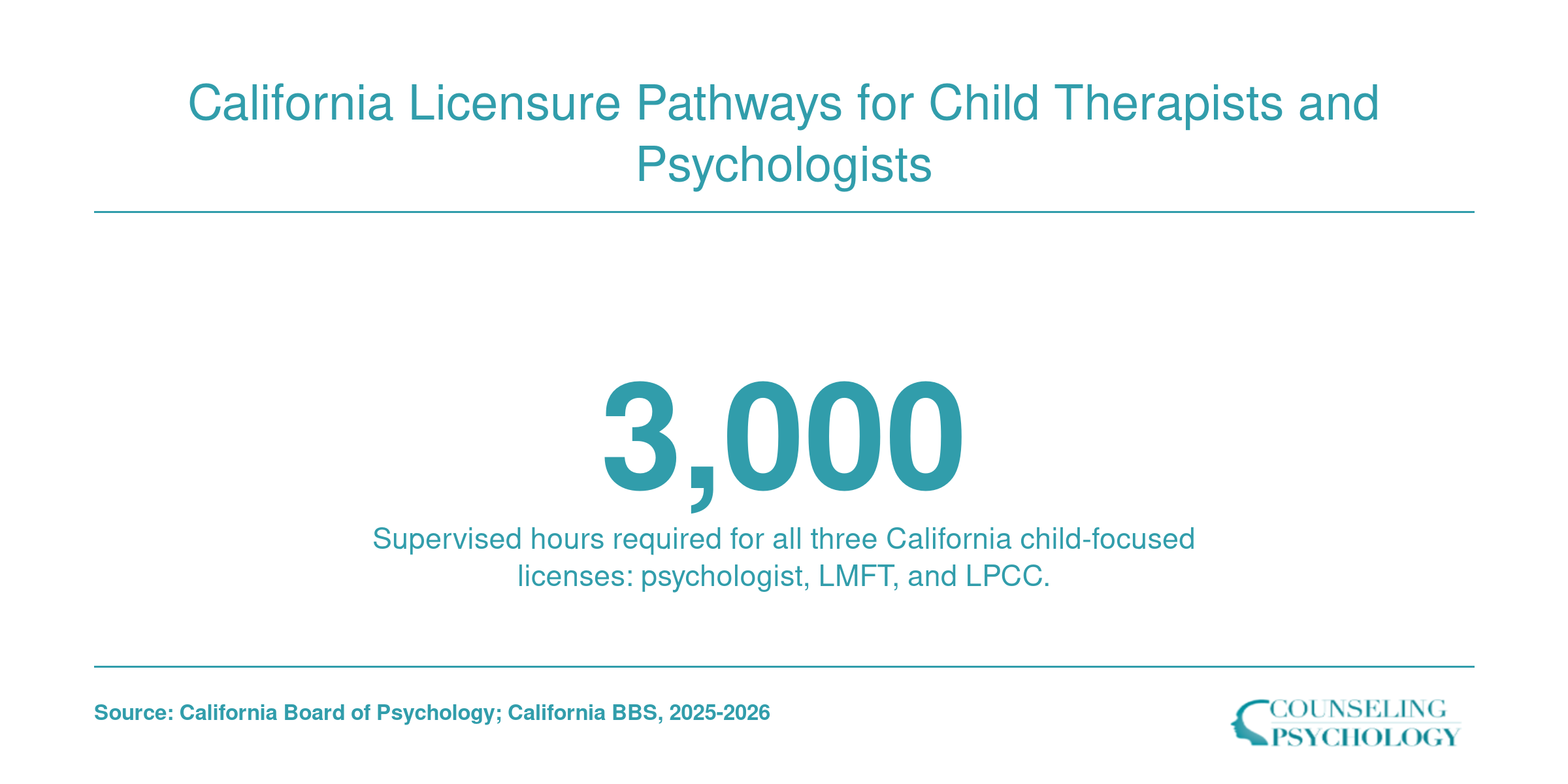
One of the most overlooked decisions in child psychology education is understanding which California licensing board governs your future career. The Board of Psychology oversees licensed psychologists who hold doctoral degrees, while the Board of Behavioral Sciences (BBS) licenses master's-level clinicians as LMFTs or LPCCs. Both paths require 3,000 supervised hours and ongoing continuing education, but the degree investment, exams, and timeline differ significantly. Choosing the right pathway before you enroll can save years and thousands of dollars.
How Long Does It Take to Become a Licensed Child Psychologist in California?
Becoming a licensed child psychologist in California requires a significant investment of time, but the timeline varies dramatically depending on whether you pursue a doctoral-level psychologist license or a master's-level therapist credential. Understanding both routes helps you choose the path that aligns with your career goals and the age of clients you want to serve.
Doctoral Path to Licensed Psychologist
This path prepares you for independent practice as a psychologist, often including assessment, diagnosis, and therapy with children and families. After a four-year bachelor's degree, you will enter a doctoral program in clinical, counseling, or school psychology with a child-focused emphasis. For a broader look at this career trajectory, see our guide on how to become a psychologist. These programs typically take four to seven years, including a full-time supervised internship. Most students complete them in five to six years.
Following the doctorate, California requires one to two years of postdoctoral supervised professional experience, totaling 3,000 hours for licensure. You must then pass the Examination for Professional Practice in Psychology (EPPP) and the California Psychology Law and Ethics Examination. In total, from high school graduation to licensed psychologist, the journey often spans 10 to 14 years. Many students enter doctoral programs directly after a bachelor's degree; some complete a master's first, which can strengthen research experience but adds two to three years. While California's Board of Psychology does not mandate APA accreditation, graduating from an APA-accredited program significantly streamlines the equivalency review and broadens future options, including eligibility for ABPP board certification.12
Master's Path to Licensed Therapist (LMFT or LPCC)
If your goal is to provide child therapy without the full scope of psychological assessment, a master's-level license as a Marriage and Family Therapist (LMFT) or Professional Clinical Counselor (LPCC) is a shorter route. You can learn more about the LMFT credential in our guide on how to become a marriage and family therapist. After a four-year bachelor's, you complete a two- to three-year master's program with child-development and family-systems coursework. You then accrue 3,000 hours of supervised professional experience, typically completed in about two years of full-time work, and pass the relevant licensing exams. The total time from high school usually ranges from eight to nine years. Although California does not require graduation from a COAMFTE- or CACREP-accredited program, such accreditation is highly regarded by the Board of Behavioral Sciences and can simplify the licensure application process.1
Choosing Between the Two Timelines
- Doctoral path: Allows for broader career roles, including psychological testing, research, and higher earning potential, but demands a longer commitment.
- Master's path: Gets you into direct child counseling sooner and often with less debt, though scope of practice is narrower.
- Bridge option: Some doctoral programs accept a prior master's for advanced standing, potentially shaving a year off the timeline.
- Accelerated programs: A few universities offer combined bachelor's-to-doctoral tracks or integrated master's programs that compress the overall duration.
Weigh the time investment against your professional aspirations. Both paths lead to meaningful work with children, and the right choice depends on the depth and breadth of practice you envision.
Related Articles
Career Outcomes and Salary Expectations for Child Psychologists in San Diego
The gap between master's-level and doctoral-level earnings in child psychology has widened in recent years, making degree choice a more consequential financial decision than ever. For students weighing programs near San Diego, understanding local wage data and cost-of-living realities is essential to making a sound investment.
What San Diego-Area Psychologists Actually Earn
Clinical psychologists in the San Diego-Carlsbad metropolitan area command strong wages compared to national figures. According to Bureau of Labor Statistics data from 2023, the mean annual wage for clinical psychologists in this metro area sits at approximately $147,760, with an hourly mean of $71.04.1 The metro area employs roughly 1,520 clinical psychologists, reflecting steady demand for doctoral-level practitioners.1
For context, the national median annual wage for clinical and counseling psychologists is $96,100, with the 25th percentile at $66,050 and the 75th percentile at $129,020.2 San Diego's mean wage significantly exceeds even the national 75th percentile, suggesting that doctoral-level psychologists who establish themselves locally can achieve above-average compensation.
Marriage and family therapists, who typically hold master's degrees and work under the MFT license pathway, earn considerably less.3 While metro-specific MFT wage data for San Diego was not available in the current dataset, national figures for this occupation tend to fall well below those of doctoral-level clinical psychologists.
Cost of Living Changes the Equation
San Diego's cost of living runs roughly 40% above the national average, which erodes the purchasing power of any salary. A clinical psychologist earning $147,000 in San Diego may have comparable real purchasing power to someone earning around $105,000 in a median-cost metro. Students should factor this reality into their calculations when comparing job offers or weighing relocation decisions.
Master's-level practitioners face a tighter squeeze. Lower starting salaries combined with San Diego's elevated housing, transportation, and childcare costs mean that debt loads matter more. Keeping total borrowing modest becomes especially important for those pursuing MFT or LPCC licensure rather than a doctorate. For a broader look at earning potential across specialties and degree levels, reviewing counselor salary benchmarks can provide helpful context.
Weighing Debt Against Earnings
Program-level earnings data for specific child psychology programs in California are not yet published for most institutions, which limits direct comparisons. However, institutional debt figures offer some guidance. San Diego State University reports a median graduate debt of $15,000, while National University and Touro University Worldwide show median debts around $25,000. Saint Mary's College of California reports approximately $23,700.
Students should compare these figures against realistic first-year earnings in their target career track. A master's-level therapist entering the workforce at $55,000 to $65,000 annually will take longer to recover from $25,000 in debt than a doctoral graduate entering at $90,000 or above. On the other hand, doctoral programs require additional years of training and tuition, so the total investment must be weighed carefully.
The Bigger Picture
Doctoral-level child psychologists earn significantly more than master's-level therapists, but they also accumulate more debt and spend additional years in training before entering practice. For students committed to clinical assessment, diagnosis, or academic research with children, the doctoral path typically delivers stronger long-term returns. Those drawn to school counseling, family therapy, or community mental health roles may find that counseling master's programs online offer faster entry and acceptable earnings, provided debt stays manageable.
Online vs. On-Campus Child Psychology Programs: What San Diego Students Should Know
Choosing between online and on-campus formats is not just a lifestyle decision. It can directly affect your licensure eligibility, practicum options, and long-term career trajectory in child psychology. Here is a practical breakdown of each format's strengths and limitations for students in the San Diego area.
Pros
- Online programs offer scheduling flexibility that benefits working professionals, especially those already employed in schools or community agencies.
- Total tuition can be significantly lower online. For example, Touro University Worldwide lists graduate tuition around $9,000, and National University's online child and adolescent developmental psychology master's runs about $16,416.
- Online enrollment opens the door to out-of-state programs you might not otherwise access, expanding your options beyond California institutions.
- On-campus programs near San Diego provide direct access to high-quality practicum sites such as Rady Children's Hospital, San Diego Unified School District, and local community mental health clinics.
- In-person formats make it easier to build supervision relationships and professional networks with faculty and clinical mentors, which often translate into job referrals.
- On-campus students typically have a smoother path to California licensure compliance, since local programs are designed with Board of Psychology and BBS requirements already built in.
Cons
- Even fully online programs require in-person practicum and internship hours. Finding and coordinating local placements on your own can be time-consuming and stressful.
- Not all online programs satisfy California's mandated coursework in areas like child abuse assessment and reporting, human sexuality, spousal or partner abuse, aging and long-term care, substance abuse, and suicide risk assessment. Missing even one topic means extra courses before you can sit for licensure exams.
- Online students often miss out on organic networking, peer study groups, and mentorship that form naturally in campus settings.
- On-campus programs in San Diego come with notably higher living and commuting costs, which can add thousands per year to your total educational investment.
- Campus-based schedules are less flexible, making it harder for students who work full time or have family obligations to keep pace with cohort timelines.
- Out-of-state online doctoral programs can meet California Board of Psychology requirements because APA accreditation is not mandatory; however, the program must be regionally accredited, include a professional practice component, and cover all six required coursework areas. Verify compliance before enrolling, because gaps discovered after graduation can delay licensure by a year or more.
San Diego County is home to premier clinical training sites including Rady Children's Hospital, San Diego Unified School District, and numerous community mental health agencies. Choosing a local child psychology program gives you direct access to these highly regarded practicum placements, strengthening your clinical skills and professional network before you graduate.
Admission Requirements and How to Apply to Child Psychology Programs
What GPA, prerequisites, and materials do you actually need to get into a child psychology program in California?
The answer depends on the degree level you are targeting, and requirements can shift from year to year, so verifying details directly with each program is essential. Here is a practical breakdown of what most programs expect.
GPA Expectations
Master's programs in child counseling or developmental psychology generally look for a cumulative undergraduate GPA of 3.0 or higher. Doctoral programs, particularly competitive PhD tracks, often prefer applicants with a 3.5 or above, though several APA-accredited California programs list 3.0 as their stated minimum.1 The SDSU/UCSD Joint Doctoral Program in Clinical Psychology and Alliant International University's PhD program are both APA-accredited and attract strong applicant pools, so a GPA well above the posted floor will strengthen your candidacy.2 Azusa Pacific University's PsyD program, for instance, lists a 3.0 minimum.3 At UC Irvine's Clinical Psychology PhD program, the minimum is also 3.0, but admitted cohorts typically exceed that threshold by a comfortable margin.4 If you are wondering how hard is it to get into grad school for psychology, these GPA benchmarks offer a useful starting point.
Prerequisite Coursework
Most programs expect you to arrive with foundational courses already completed. Common prerequisites include:
- Developmental psychology: Core to any child-focused track.
- Abnormal psychology: Provides the diagnostic and clinical framework programs build on.
- Statistics: Usually one semester minimum; some doctoral programs prefer two.
- Research methods: Especially important for PhD applicants, where research training begins immediately.
If you are missing one or two prerequisites, some master's programs allow conditional admission while you complete them. Doctoral programs are less flexible on this front.
Standardized Tests
The GRE landscape has changed significantly. As of the 2025-2026 cycle, UCLA's Clinical Psychology PhD program does not require the GRE. UC Merced's Psychological Sciences PhD program has also dropped the requirement6, and UC Irvine lists the GRE as optional.4 That said, some competitive programs still recommend or require scores, so check each school's current admissions page rather than assuming a blanket policy.
Application Materials
Beyond transcripts and test scores, programs typically ask for:
- Personal statement: This should clearly articulate your interest in child populations and your clinical or research goals.
- Letters of recommendation: Plan on three, ideally from faculty who can speak to your academic abilities and at least one supervisor from a clinical or research setting.
- Relevant experience: Volunteer work, paid positions, or research involving children carries real weight. Practicum hours in school counseling offices, pediatric clinics, or child development labs all count.
- CV or resume: Highlighting publications, conference presentations, or specialized training will set doctoral applicants apart.
Students interested in broader research careers may also want to explore developmental psychology masters programs as a stepping stone toward doctoral study.
Timeline for Applying
Doctoral programs in California generally set fall-admission deadlines between November and early February. UCLA's Clinical Psychology PhD deadline, for example, falls on November 1, while other programs extend into January or February. UC Irvine's deadline lands in the November-to-December window.4 Master's programs are more forgiving, with many operating on rolling admissions that continue through spring.
A practical approach: begin drafting your personal statement and requesting recommendation letters by early fall, at least two to three months before the earliest deadline on your list. This buffer gives recommenders adequate time and lets you tailor each application rather than rushing through a generic submission.
Frequently Asked Questions About Child Psychology Degrees in California
Prospective students often have overlapping questions about costs, timelines, and licensure rules for child psychology in California. The answers below draw on current California Board of Psychology requirements, program data from San Diego area schools, and national labor statistics to give you a clear starting point.