What you’ll learn in this article…
- Twelve CSWE-accredited advanced-standing MSW programs serve Orlando, ranging from 9 to 15 months of study.
- UCF's track requires 600 field hours, roughly 300 fewer than traditional MSW students complete.
- Healthcare social workers and social and community service managers earn the strongest salaries in the Orlando metro area.
- Most programs admit just one advanced-standing cohort per year, so missing a deadline can cost a full 12 months.
In-state tuition for advanced-standing MSW programs accessible from Orlando ranges from roughly $6,700 at Florida Atlantic University to nearly $19,700 at Barry University, yet every option on the list requires CSWE accreditation and leads to the same Florida LCSW eligibility. That gap in cost, combined with differences in credit requirements (32 to 39 hours), delivery format, and field-placement networks across Central Florida, makes the choice far more consequential than it appears at first glance.
BSW graduates who qualify can finish in as few as three semesters full-time, but accelerated timelines demand careful planning around practicum logistics, especially when a program's home campus sits hours from Orlando. Florida's post-degree supervised-experience requirement of two years means the MSW is only the midpoint of licensure, not the finish line.
Ranked: Best Advanced-Standing MSW Programs Near Orlando
Florida offers a strong lineup of CSWE-accredited advanced-standing MSW programs accessible to Orlando-area BSW graduates. Several can be completed entirely online with local field placements, while others require travel to a campus elsewhere in the state. Below, we rank 12 programs based on institutional outcomes, affordability, clinical preparation, and practical access for Central Florida residents. Program-level earnings data is not yet available for these MSW tracks, so we highlight institution-wide metrics where relevant.
- CSWE accreditation and licensure alignment
- Tuition and median graduate debt
- Institution-wide graduation and retention rates
- Delivery format and Orlando accessibility
- Clinical concentration and field hour requirements
- Internal program database
- NCES-IPEDS federal institutional data — nces.ed.gov
- Independent program research
- College Scorecard graduate earnings — collegescorecard.ed.gov

University of Central Florida
As the only Orlando-based public university on this list, UCF gives Central Florida residents an unmatched local advantage. Its fully online advanced-standing MSW runs 32 credit hours across roughly 16 months, with field placements arranged in the greater Orlando metro. In-state tuition of $8,872 and a median graduate debt of $18,190 keep costs competitive, and the institution posts a 78% graduation rate and 92% retention rate (both institution-wide figures, not MSW-specific). BSW graduates need a 3.3 GPA in their last 60 credits, and the advanced-standing cohort admits once per year in the fall.
- 32 credit hours, completable in about 16 months
- Fully online with accelerated 7-week terms
- 600 field hours arranged in the student's community
- Fall cohort admission only, plan applications accordingly
- CSWE-accredited, meets Florida LCSW exam eligibility
- Part-time pacing available for working professionals
- $487.45 per credit hour for in-state students
Master of Social Work Advanced Standing — Online

Florida State University
Florida State University's clinical-focused advanced-standing MSW is a 39-credit program with a 512-hour internship, and its online track lets Orlando students stay local for fieldwork. FSU charges roughly $444 per credit for Florida residents, putting estimated program cost well under $20,000 for in-state students. The university's 85.6% institution-wide graduation rate is the highest on this list, and median graduate debt sits at $18,000. Admission requires a BSW earned within the past seven years from a CSWE-accredited program.
- 39 credit hours with a Clinical Social Work concentration
- 512-hour internship, completable near your home community
- Online track available so Orlando students need not relocate
- Full-time or part-time pacing, with evening classes offered
- BSW must be from a CSWE-accredited program within 7 years
- Curriculum explicitly aligned with Florida LCSW requirements
- In-state tuition approximately $444 per credit hour
Master of Social Work Advanced Standing (Clinical) — On-Campus

University of South Florida
USF's online advanced-standing MSW stands out for its live, synchronous format: students attend sessions two evenings per week via video while completing the 35-credit program from anywhere in Florida. Orlando residents can finish in as few as three semesters full-time or five part-time. No GRE is required for applicants meeting GPA standards, lowering a common admissions barrier. Tuition runs $10,428 in-state, median graduate debt is about $17,988, and the institution-wide graduation rate is 76.8%.
- 35 credit hours, completable in 3 to 5 semesters
- Fully online with live sessions two evenings per week
- No GRE required for most applicants
- Field placement hours completed in person locally
- CSWE-accredited, qualifies graduates for Florida licensure exams
- Summer start options available to align with BSW graduation
- In-state tuition of $10,428 annually
Advanced Standing Master of Social Work — Online

Florida International University
FIU's 33-credit advanced-standing MSW meets Florida's clinical licensure requirements and is one of the leaner credit loads among Florida public university programs. The Miami campus serves students statewide, and while the format is campus-based, FIU's low in-state tuition of $11,334 and a median graduate debt of just $16,500 make it financially attractive. Applicants need a 3.25 GPA and a B or better in BSW coursework. The institution-wide graduation rate is 74.4%.
- 33 credit hours with clinical specialization focus
- Campus-based program in Miami, plan for commute or relocation
- Requires 3.25 GPA and B or better in all BSW courses
- Meets Florida LCSW licensure requirements
- Rolling admissions process
- In-state tuition of $11,334, out-of-state $24,439
- Median graduate debt of $16,500, among the lowest listed
Master of Social Work Advanced Standing — On-Campus

University of North Florida
UNF's advanced-standing MSW emphasizes advanced generalist practice with a social justice lens. The 33-credit on-campus program in Jacksonville starts each summer and features late afternoon and evening classes, accommodating students who work during the day. It requires 500 hours of field education. Tuition is $10,364 in-state, and median graduate debt of $15,531 is the lowest among the public universities here. The institution-wide graduation rate is 69.2%.
- 33 credit hours, begins in the summer semester
- 500 hours of advanced generalist field education
- Late afternoon and evening class schedule
- On-campus in Jacksonville, not available online
- Focus areas include children, families, and marginalized communities
- Biopsychosocial, economic, and spiritual wellbeing framework
- Lowest median graduate debt among public schools on this list ($15,531)
Master of Social Work Advanced Standing — On-Campus

Florida Atlantic University
FAU's hybrid advanced-standing MSW blends online coursework with on-campus components in Boca Raton and reports a 93% job placement rate within a year of graduation. The program emphasizes evidence-based clinical practice and requires a 3.5 GPA in the last 60 BSW credits, making it one of the more selective options. In-state tuition of $6,693 is the lowest sticker price on this list, though the campus location in South Florida means Orlando residents should plan around the on-site requirements.
- Hybrid format combining online and Boca Raton campus sessions
- 93% job placement rate within one year of graduation
- Requires 3.5 GPA in last 60 BSW credits
- Practicum placements in local South Florida communities
- In-state tuition of $6,693, the lowest listed
- CSWE-accredited with evidence-based practice emphasis
- Fully online path also available for some cohorts
Master of Social Work Advanced Standing — Hybrid

University of West Florida
The University of West Florida's CSWE-accredited online MSW offers a 30-credit advanced-standing track with a clinical concentration, one of the most streamlined credit loads on this list. The program is delivered entirely online, so Orlando students can complete coursework remotely while logging 600 clinical field hours at local agencies. At roughly $377.60 per credit for Florida residents, total program costs stay modest. Specialty areas include behavioral health and military-connected populations, relevant in a state with a large veteran community. The institution-wide graduation rate is 58.8%.
- 30 credit hours, among the leanest on this list
- Fully online delivery with local field placements
- 600 clinical field hours required
- Clinical concentration with behavioral health emphasis
- Specialization options for military-connected populations
- In-state tuition approximately $377.60 per credit
- Meets Florida LCSW licensure requirements
Master of Social Work Advanced Standing (Clinical) — Online

Florida Gulf Coast University
FGCU's campus-based MSW in Fort Myers centers on Clinical Community Practice, blending individual clinical skills with community-level advocacy and policy analysis. BSW holders can complete the program in one year, making it one of the fastest paths on this list. Admission requires a 3.0 GPA and a statistics course. In-state tuition is $8,961, and median graduate debt is $17,622. The program is CSWE-accredited, though the Fort Myers location means Orlando residents would need to relocate or commute. The institution-wide graduation rate is 57.4%.
- Clinical Community Practice concentration
- BSW holders can complete the program in one year
- Campus-based in Fort Myers, no online option listed
- Includes coursework in psychopathology and social policy
- Field education integrated throughout the curriculum
- 3.0 GPA and statistics prerequisite required for admission
- CSWE-accredited, prepares for Florida licensure exams
Master of Social Work Advanced Standing (Clinical Community Practice) — On-Campus

Ana G. Mendez University
Ana G. Mendez University is one of only two schools on this list physically located in Orlando, offering a hybrid MSW with a Clinical Specialization. The program requires 900 supervised practice hours and can be completed in two to four years. A key caveat: the MSW program currently holds CSWE candidacy status rather than full accreditation, which may affect licensure eligibility in some scenarios. Tuition is $10,455 regardless of residency, and median graduate debt is $12,188, the lowest overall on this list.
- Hybrid format with both online and Orlando campus components
- Clinical Specialization with 900 supervised practice hours
- CSWE candidacy status, not yet fully accredited
- Completion timeline of 2 to 4 years
- Tuition of $10,455, same for in-state and out-of-state
- Lowest median graduate debt on this list at $12,188
- Admission requires 2.75 GPA, interview, and essay
Master of Social Work (Clinical Specialization) — Hybrid

Barry University
Barry University's advanced-standing MSW in Miami combines clinical practice with leadership training in a 32-credit, campus-based program. A trauma-informed curriculum and hands-on internships distinguish the track. The 7:1 student-to-faculty ratio is far and away the most intimate learning environment on this list. However, tuition is $19,650 (same in-state and out-of-state), and median graduate debt reaches $26,997, the highest among these 12 schools. The institution-wide graduation rate of 37.9% is relatively low, though that figure reflects the entire university, not the MSW program specifically.
- 32 credits with clinical and leadership dual focus
- Trauma-informed curriculum throughout
- Campus-based in Miami, $675 per credit
- 7:1 student-to-faculty ratio, smallest on this list
- Requires 3.0 GPA, two recommendation letters, personal statement
- Financial aid options available to offset higher tuition
- CSWE-accredited, prepares graduates for LCSW licensure
Master of Social Work Advanced Standing (Clinical, Leadership) — On-Campus

Southeastern University
Southeastern University in Lakeland offers a CSWE-accredited advanced-standing MSW with a Clinical Social Work Practice concentration. Evening courses and tailored internship placements make the program workable for students balancing employment. The faith-based institution integrates a Christian worldview into its social work curriculum, which may appeal to some applicants. Tuition is $10,659 (same regardless of residency status), and median graduate debt is $21,500. The institution-wide graduation rate is 42.5%.
- Clinical Social Work Practice concentration
- Campus-based in Lakeland, about an hour from Orlando
- Evening courses designed for working students
- CSWE-accredited with counseling and psychotherapy skill building
- Christian worldview integrated into the curriculum
- Tailored internship placements
- Tuition $10,659 with financial aid available
Master of Social Work Advanced Standing (Clinical Social Work Practice) — On-Campus

Saint Leo University
Saint Leo University's online MSW focuses on Advanced Clinical Practice with a trauma-informed care emphasis. The program includes face-to-face webcam classes, daytime internship hours, and a required summer seminar on the Saint Leo campus north of Tampa. At 62 credit hours, this is a traditional-length MSW rather than a shortened advanced-standing track, so BSW graduates should confirm whether credit reductions apply. Tuition is $12,870 regardless of residency, and median graduate debt is $25,278. The institution-wide graduation rate is 45%.
- Advanced Clinical Practice concentration with trauma-informed focus
- Online delivery with live webcam class sessions
- 62 credit hours, longer than most advanced-standing tracks
- Daytime internship hours required
- Summer on-campus seminar at Saint Leo
- Prepares graduates for LCSW licensure
- Full-time and part-time scheduling tracks available
Master of Social Work: Advanced Clinical Practice — Online
What Is an Advanced-Standing MSW and Who Qualifies?
An advanced-standing MSW is a shortened master's degree track designed specifically for students who already hold a Bachelor of Social Work (BSW) from a CSWE-accredited program. While traditional MSW programs typically require 60 credits and two years of full-time study, advanced-standing pathways compress the curriculum to roughly 30 to 39 credits, allowing qualified candidates to graduate in as little as 9 to 12 months of full-time enrollment. Because BSW graduates have already completed foundational coursework in social work theory, human behavior, and field practice, advanced-standing programs waive the generalist year and move students directly into specialized clinical or macro-practice concentrations.
Core Eligibility Requirements
To qualify for advanced-standing admission, applicants must meet several specific criteria. First, the BSW must come from a CSWE-accredited institution. CSWE accreditation is the gold standard recognized by licensing boards and employers nationwide, and programs verify accreditation status during the application review. Second, most Florida programs require a minimum undergraduate GPA, commonly 3.0 on a 4.0 scale, though individual schools may set higher thresholds for competitive cohorts. Third, many schools impose recency windows, typically five to seven years. Florida State University and the University of West Florida, for example, accept BSW degrees earned within the past seven years, while other Florida programs may use a five-year cutoff.23 Applicants whose BSW falls outside these windows may still gain admission if they can demonstrate recent, relevant professional experience or continuing education in social work.
Out-of-State BSW Degrees and Additional Requirements
Because CSWE accreditation is a national standard, advanced-standing programs in Florida accept BSW degrees from CSWE-accredited schools in any state. Florida State University, the University of South Florida, and the University of West Florida all confirm that out-of-state BSW graduates are eligible without geographic restriction.253 However, applicants should verify that their BSW program held CSWE accreditation at the time of graduation, as some newer or unaccredited programs do not confer the credential needed for advanced standing. None of the major Florida programs currently require bridge courses or remedial work for older BSW degrees that fall within the stated recency window, though schools may request a portfolio, updated references, or evidence of continuing professional development for borderline cases.
How Long Does an Advanced-Standing MSW Take to Complete?
Full-time advanced-standing students typically complete their MSW in 9 to 12 months, depending on the program structure and whether field placement hours are concentrated in a single semester or distributed across two. Part-time and hybrid formats extend the timeline to 18 to 24 months, accommodating working professionals who cannot commit to daytime field placements. Summer-start cohorts often finish by the following spring, while fall-start tracks may span an academic year plus a summer session. Regardless of format, advanced-standing graduates earn the same MSW credential as traditional-track students and meet identical CSWE competencies, making them eligible for Florida LCSW licensure after accumulating the required post-degree supervised hours.
Questions to Ask Yourself
Program Comparison: Tuition, Credits, and Completion Time
Advanced-standing MSW tracks have moved away from the traditional two-year model, but completion windows still vary more widely than many applicants expect. A program advertised as "one year" may run 9, 12, or 15 months depending on whether summer field placements are integrated or optional. Central Florida universities each structure their advanced-standing tracks differently, and digging into the fine print saves surprises later.
Credit-Hour Totals and Curriculum Structure
Most advanced-standing MSW programs nationally require between 30 and 45 credit hours, reflecting CSWE's minimum competency expectations for students who already hold a BSW. To find exact credit-hour requirements for programs accessible from Orlando, start with each university's official advanced-standing curriculum page. UCF, FSU's online MSW, Barry University, and Florida Atlantic University all publish detailed program outlines that list core courses, electives, and field practicum hours.
The Council on Social Work Education accreditation database provides another reliable checkpoint. CSWE lists every accredited MSW program and notes their basic structure, including typical credit minimums. This database confirms that advanced-standing tracks are indeed shorter than traditional two-year programs, but it does not always capture recent curriculum updates or cohort-specific variations.
Full-Time Completion Timelines
Advertised completion times often assume full-time enrollment with no gaps. UCF's advanced-standing MSW, for example, may require 12 months of continuous enrollment including summer semesters, while FSU's online track allows for a slightly longer calendar due to asynchronous pacing. Barry and FAU structure their cohorts differently again, sometimes front-loading coursework before intensive field placements begin.
To confirm whether a program runs 9, 12, or 15 months, contact admissions offices directly. Email or phone conversations can clarify whether summer semesters are mandatory, whether part-time pathways exist, and how many field hours must be completed before graduation. Admissions staff can also provide current credit totals if the website lags behind recent curriculum changes.
Tuition and Fees
Tuition varies by institution type and residency status. Public universities like UCF and FAU typically charge lower per-credit rates for Florida residents, while private institutions such as Barry set flat tuition regardless of residency. Total program cost depends on credit hours, field placement fees, and technology charges. Request a detailed cost worksheet during the admissions conversation so you can compare true out-of-pocket totals, not just advertised per-credit rates.
Where to Look for General Social Work Requirements
The U.S. Bureau of Labor Statistics offers high-level overviews of social work education and training requirements, including the distinction between BSW and MSW preparation. However, BLS data does not drill down to program-specific credit hours or cohort schedules. For those details, university websites and direct program coordinator conversations remain the most accurate sources.
Online, Hybrid, and Campus-Based Options Near Orlando
Orlando students weighing an advanced-standing MSW can choose among fully remote programs headquartered in other Florida cities, hybrid degrees with occasional campus requirements, and a handful of in-person programs within commuting distance. Each offers a CSWE-accredited pathway without forcing a permanent relocation.
Which Programs Are Campus-Accessible from Orlando?
True campus-based options within a short drive are limited. The University of Central Florida (UCF) is based in Orlando but delivers its advanced-standing MSW entirely online, with no campus visits required. Ana G. Mendez University operates a hybrid program at its Orlando campus, blending online coursework with periodic in-person sessions. For students open to a longer commute, the University of North Florida in Jacksonville (about two hours away) and Florida Gulf Coast University in Fort Myers offer on-campus advanced-standing programs. Florida State University, University of South Florida, and University of West Florida all have campus headquarters elsewhere in the state but serve Orlando students through fully online tracks.
Fully Online Advanced-Standing MSWs for Florida Residents
Multiple Florida public universities provide completely online advanced-standing programs that meet CSWE standards and Florida licensure requirements. Florida State University's clinical-track MSW is entirely online, as is the University of Central Florida's accelerated 16-month option. The University of South Florida offers a fully online format with live sessions, and the University of West Florida has an online clinical concentration. Saint Leo University's online MSW uses webcam-based classes and includes a brief summer campus seminar, though the bulk of coursework is remote. In every case, fieldwork hours are completed in person at agencies near the student's home, a significant advantage for Orlando residents given the region's dense network of hospitals, behavioral health centers, and social service agencies. Students interested in related helping professions in the state may also want to explore the best MFT programs in Florida.
Hybrid and Limited-Residency Formats
Two programs in the ranked list have explicit hybrid structures. Florida Atlantic University describes its MSW as a mix of online and on-campus learning, which may require periodic travel to Boca Raton. Ana G. Mendez University's Orlando-based hybrid track includes in-person components alongside online work. Saint Leo's summer campus seminar adds a single short-term residency to an otherwise online curriculum. For Orlando residents, these formats typically mean one or two driving trips per term, not weekly commutes.
Local Field Placements: Orlando's Built-In Advantage
All advanced-standing MSW programs, regardless of delivery mode, require significant supervised fieldwork. Because placements are arranged near the student's community, Orlando students can tap into the metro's robust healthcare and social-services infrastructure. Providers such as AdventHealth, Orlando Health, and numerous community mental health centers serve as common practicum sites, allowing students to build clinical hours without leaving the area. This local focus holds true whether the degree-granting institution is UCF down the street or FSU in Tallahassee.
Field Placement Requirements and Clinical Sites in Central Florida
UCF's advanced-standing MSW track requires 600 field hours spread across two semesters, with students logging roughly 300 hours each term.1 That total is significantly lighter than the 900-plus hours traditional MSW students complete, reflecting the credit already earned through a CSWE-accredited BSW. Other programs in the region follow a similar pattern: advanced-standing students generally land in the 500 to 600 hour range, though the exact count depends on the school's curriculum design and whether any foundation-level practicum credit transfers in.
Where Orlando-Area Students Are Placed
The Orlando-Kissimmee metro is one of the largest and fastest-growing markets in the Southeast, which translates into a deep pool of placement sites. UCF alone partners with an estimated 800 to 850 agencies across Central Florida, spanning hospital systems, behavioral health providers, government offices, and schools. Common placement hosts include:
- AdventHealth system: Multiple hospital campuses and outpatient behavioral health programs across Orange, Seminole, and Osceola counties.
- Orlando Health: Acute care, psychiatric services, and community outreach programs within one of the region's flagship health systems.3
- Aspire Health Partners: One of Central Florida's largest community mental health providers, offering substance use treatment, crisis stabilization, and outpatient counseling.
- Department of Children and Families (DCF) offices: Child welfare and adult protective services placements in the Orlando district.
- Orange and Osceola County school districts: School social work roles that involve IEP coordination, crisis intervention, and family engagement.
- Orlando VA Medical Center: Serving veterans across a multi-county catchment area with mental health, case management, and homeless outreach programs.
Online Students Still Place Locally
Students enrolled in online MSW programs from universities outside the metro, such as FSU's distance track, still arrange supervised field placements in or near their home community. Orlando's size works in their favor. The region's mix of large hospital systems, nonprofits, and government agencies means students rarely struggle to find an approved site, though early outreach to the program's field education office is essential to avoid bottlenecks.
Clinical vs. Macro: Know What Your Placement Looks Like
The type of field site you land in depends heavily on your chosen concentration. Clinical (or direct-practice) students typically place in healthcare settings, outpatient therapy clinics, crisis units, or school-based counseling offices, building the supervised client contact hours that eventually count toward Florida LCSW requirements. Students interested in child welfare may also find placements that align with a path toward becoming a child abuse counselor. Macro-track students, by contrast, gravitate toward policy organizations, nonprofit administration, community development agencies, or legislative offices. Both tracks fulfill the same hour requirement, but the day-to-day experience differs dramatically, so align your placement search with your long-term career goals from the start.
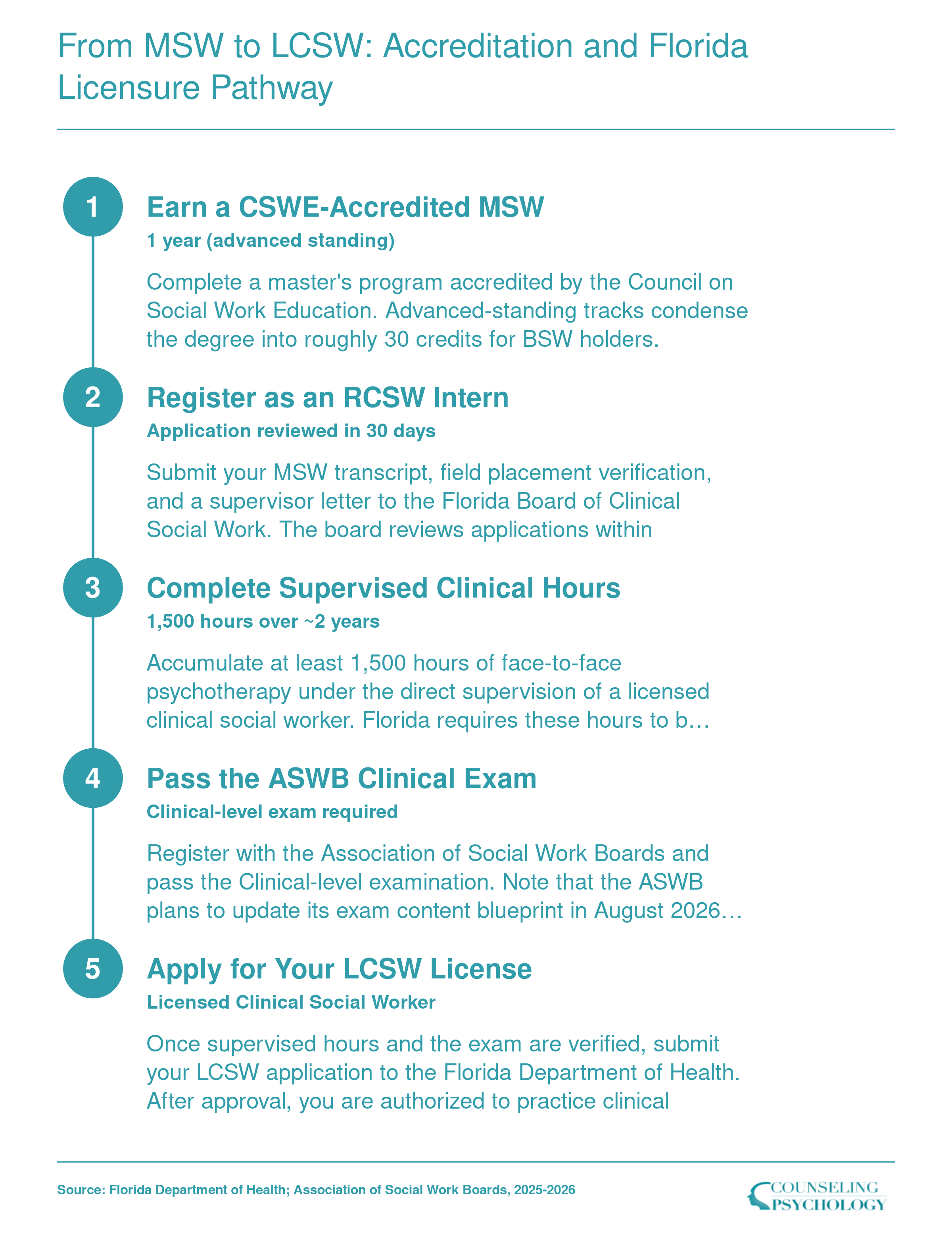
From MSW to LCSW: Accreditation and Florida Licensure Pathway
Every program ranked in this article holds Council on Social Work Education (CSWE) accreditation, which means graduates meet the educational prerequisite for clinical licensure in Florida. The pathway from diploma to LCSW follows a clear, sequential process governed by the Florida Department of Health.
In an advanced-standing program, you may need to declare a concentration before your first semester begins, so decide early whether clinical practice (the path toward LCSW licensure) or macro social work (policy, administration, community organizing) fits your goals. Some Orlando-area programs offer only a clinical track, so confirm concentration options with each school before submitting your application.
Career Outcomes and Earnings for MSW Graduates in Central Florida
BLS wage data for the Orlando-Kissimmee-Sanford metropolitan area shows solid earning potential across the three occupations most commonly pursued by MSW graduates. Healthcare social workers and social and community service managers command the strongest salaries in the region, while mental health and substance abuse social workers earn somewhat less but benefit from strong local demand driven by Central Florida's expanding behavioral health infrastructure. The table below compares Orlando MSA median wages against Florida statewide and national medians for each role. Note that program-level earnings reported by individual schools (typically one to two years after completion) are not yet available for most of the ranked programs in this article, so the BLS occupational figures remain the most reliable salary benchmark for prospective students.
| Occupation | Orlando MSA Median | Orlando MSA 25th/75th Percentile | Florida Statewide Median | National Median | Orlando MSA Employment |
|---|---|---|---|---|---|
| Healthcare Social Workers | $65,730 | $55,500 / $75,740 | $63,400 | $62,940 | 950 |
| Mental Health and Substance Abuse Social Workers | $49,650 | $44,110 / $57,420 | $48,020 | $53,710 | 580 |
| Social and Community Service Managers | $68,740 | $57,660 / $87,640 | $69,790 | $77,030 | 730 |
Application Deadlines and Cohort Start Dates (2026–2027)
Application cycles for advanced-standing MSW programs vary significantly, and missing a deadline can delay your start by an entire academic year. Most Central Florida programs admit one cohort annually for advanced-standing tracks, making it critical to plan your timeline carefully.
UCF's Dual-Track Application Windows
The University of Central Florida operates separate application processes for its online and campus-based advanced-standing MSW programs. For the 2026, 2027 academic year, the online track accepts applications through June 1, 2026, with a single fall cohort start.1 The on-campus option has an earlier April 1, 2026 deadline for domestic applicants, and international students face a significantly earlier cutoff of November 1, 2025.2 Both tracks follow fixed cohort models rather than rolling admission, so early submission won't accelerate your start date, but it does allow more time to secure field placements and process financial aid.
Other Program Timelines
FSU's online MSW advanced-standing program typically follows a similar fall-only cohort model, though specific 2026, 2027 deadlines were not available at press time. Barry University and Florida Atlantic University also maintain fixed annual cohorts for advanced-standing students. Some programs hold spring and summer informational sessions that can provide early clarity on prerequisite documentation, particularly around BSW transcript evaluations and field-hour verification.
Why Fixed Cohorts Matter
Unlike some graduate programs that admit students throughout the year, advanced-standing MSW tracks cluster students who share a BSW foundation and can move through specialized coursework together. This cohort structure means you cannot simply apply and start the next term. Recent BSW graduates aiming to begin immediately after May commencement should target programs with summer or early-fall starts and work backward from those dates to gather transcripts, references, and field-hour verification letters.
Verify Before You Commit
Deadlines shift annually based on academic calendars, accreditation cycles, and faculty availability. Always confirm current dates directly with each program's admissions office or official website, and check whether priority deadlines carry advantages for funding consideration or preferred field-placement assignments.
Frequently Asked Questions
Prospective students exploring advanced-standing MSW programs near Orlando often have overlapping questions about eligibility, timelines, and format. Below are direct answers drawn from current program requirements and publicly available data.