
What you’ll learn in this article…
- Project BEST promises low-cost addiction counselor training but publicly available details are nearly nonexistent.
- Alternative pathways like graduate certificates can reduce licensure costs from over $30,000 to roughly $5,000.
- Substance abuse counselor jobs are projected to grow 17% from 2024 to 2034, much faster than average.
- Addiction counseling credentials such as CADC, LADC, and LCADC each require different education and supervised experience levels.
Demand for addiction counselors has far outpaced supply: the BLS projects 17% job growth by 2034, but chronic shortages persist. A traditional master's degree and two years of supervised experience add a barrier of time and cost that filters out motivated career changers.
Programs like Project BEST and state-specific graduate certificates compress the timeline to under 18 months and can drop the price tag below $10,000. However, they often tether a license to one state's regulatory framework, creating a speed-to-practice trade-off that reshapes who enters the field and where they can practice.
Navigating the credentials, CADC, ADC, LADC, LCADC, demands a state-by-state lens. The mental health workforce shortage is one reason more states are opening flexible entry points into addiction counseling. The professionals who advance fastest are those who align their licensure path with the precise scope of practice and geographic mobility their career demands.
What Is Project BEST and How Does It Work?
Project BEST is an unusual entry in the world of addiction counseling licensure pathways. Despite its promise of alternative training, publicly available details are virtually nonexistent, making it a cautionary case for students and career changers.
Origins and Sponsorship
Unlike well-established programs with clear federal or association backing, Project BEST does not have an identifiable sponsoring agency.1 Publicly available records from entities like SAMHSA or NAADAC do not list Project BEST as an affiliated program. Early mentions suggest it may have originated as a localized pilot initiative, but no university or organization has stepped forward to claim ownership.2 This lack of clarity makes it difficult for prospective counselors to verify its credibility.
Eligibility and Education Pathways
Because no official eligibility criteria have been published, it is impossible to say who can apply.3 There are no documented education prerequisites, no list of participating institutions, and no confirmation that the program even offers formal training.4 For comparison, recognized alternative pathways typically require at least a high school diploma or bachelor's degree, coupled with supervised experience. Project BEST's absence from standard channels leaves students and career changers without a clear way to evaluate whether it fits their background.
Program Structure and Timeline
No curriculum model, credit hours, or completion timeline for Project BEST has been released.5 In the addiction counseling space, accelerated programs often compress licensing requirements into 12 to 24 months through intensive coursework and practicums. Without similar transparency from Project BEST, it is unclear whether it provides any structured education or supervised hours. Applicants should be cautious of any program that cannot demonstrate a track record of graduates earning state-recognized credentials.
State Recognition and Reciprocity
Perhaps the most critical gap: no state licensing board currently accepts Project BEST credentials as meeting education or experience requirements for addiction counselor licensure.6 This means even if someone completes the program, they would likely be unable to apply for a CADC, LADC, or similar title. Furthermore, because there is no multi-state recognition, the pathway offers zero reciprocity advantages. Counselors seeking social work licensure portability should verify that any program's credentials are explicitly accepted by the state(s) where they intend to practice.
Limitations and Cautions
Beyond the lack of state recognition, employer awareness of Project BEST is virtually nonexistent. Hiring managers in behavioral health agencies look for training from accredited institutions or programs with a proven history. Without employer buy-in, even a hypothetically sound curriculum would struggle to yield job offers. Prospective students should also be wary of any program that collects fees without clear outcomes data. Given these red flags, it is advisable to pursue better-documented alternative licensure pathways until more concrete information emerges. Those considering a deeper academic commitment might explore a doctorate in addiction counseling as a well-credentialed alternative.
Beyond Project BEST: Other Alternative and Accelerated Licensure Programs
Project BEST is only one of many routes reshaping how addiction counselors enter the field. While speed and cost savings are compelling, these alternatives often trade interstate portability for a quicker start. Knowing which programs are state-bound and which carry national clout helps you decide how broadly you want your career to reach.
National Fast-Track Certification: Sober College School of Addiction Studies
Sober College offers a Substance Use Counselor Education program that can be completed in four to six months, either self-paced or accelerated.1 With NAADAC, the Association for Addiction Professionals, as the issuing body, this credential holds national recognition, but licensure portability still depends on whether your target state accepts NAADAC certification in lieu of its own training requirements. It's a fit for career changers with a bachelor's degree who want to move quickly into counseling without committing to a full master's.
State-Centric Credentials: Florida's CAP and MCAP
In Florida, the Certified Addiction Professional (CAP) and the Master's Level Certified Addiction Professional (MCAP) are overseen by the Florida Certification Board.2 These credentials are locked to the state, so they won't automatically transfer across state lines. The pathway can be significantly shorter than a full degree: online graduate certificates in addiction counseling like the University of Florida's 12-month Graduate Certificate in Addiction and Recovery3 are designed to fulfill the educational component, and the Center for Addiction Studies and Research offers 161 hours of online coursework tailored to the CAP exam.4 A bachelor's degree is the baseline for CAP eligibility, while the MCAP requires a master's.
Provisional Licenses: A Foot in the Door
Some states, including Nebraska and Minnesota, use provisional licensing tiers to get aspiring counselors into supervised practice faster. Nebraska's Provisional Licensed Alcohol and Drug Counselor (PLADC) lets you start working under supervision while completing the remaining education hours. Minnesota has similar temporary or provisional levels. These are entry-level, state-specific licenses that typically require an associate degree or a set number of college credits, not necessarily a bachelor's. They're a good option if you need to earn while you learn, but they lock you into the issuing state until you fully upgrade to a higher credential.
Accelerated Master's and Certificate Programs
If you already hold a bachelor's in a related field, several universities offer condensed addiction counseling certificates that can fast-track your eligibility. City Vision University's Addiction Counseling Certificate takes eight months, and its companion master's in addiction counseling can be finished in 16 months.5 Grand Canyon University's master's in substance use disorders or addiction counseling wraps up in 16 months, while the University of Arkansas at Pine Bluff's master's requires only 27 credit hours and can be completed in 12 to 18 months.5 These are generally recognized across multiple states if the program meets standard accreditation benchmarks, but always verify with your target counseling licensure acronyms and credential board.
Traditional Vs. Alternative Licensure Pathways Compared
How do traditional and alternative addiction counseling licensure pathways compare in terms of salary, job prospects, and employer acceptance? As more states adopt flexible routes to licensure, prospective counselors are weighing the trade-offs between conventional master's degree programs and accelerated or certificate-based options. While concrete comparative data remains limited, emerging trends suggest that alternative pathways are closing the gap in both employability and earning potential.
How Employment and Salary Data Vary by Pathway
National occupation data from the Bureau of Labor Statistics (BLS) lumps addiction counselors into broader categories like "substance abuse, behavioral disorder, and mental health counselors." This aggregation makes it difficult to extract salary figures by licensure route. However, state-level workforce reports and job postings indicate that licensed addiction counselors earn competitive wages regardless of how they satisfied their education and supervised experience requirements. Median annual earnings for substance abuse counselors hover in the mid-$40,000 range nationally, with variation tied more to location and work setting than to the pathway chosen. Employers typically prioritize active state licensure and relevant hands-on experience over the specific credentialing path.
What Employers Think: Perception of Alternative Credentials
employer perception of online counseling psychology degrees is a well-documented concern for many prospective students, and similar questions arise around alternative addiction counseling credentials. Professional associations such as NAADAC and state certifying boards periodically survey employer attitudes. While traditional master's-level credentials still carry strong recognition, the workforce shortage has prompted many agencies to embrace graduates of alternative programs. Reports suggest that employers value the practical training and faster entry that certificate or apprenticeship pathways provide, especially in rural or underserved communities where recruiting seasoned clinicians remains difficult. Accreditation of the training program (e.g., NAADAC-approved or state-backed) often matters more to hiring managers than the degree level alone.
Enrollment Trends Point to Growing Acceptance
University and college reports indicate rising enrollment in graduate certificate programs and state-sponsored fast-track initiatives. Public institutions in several states have expanded post-baccalaureate certificates in addiction counseling to meet demand. These programs frequently partner with community treatment centers for clinical hours, directly feeding the workforce. The growth of such offerings reflects both student interest and employer willingness to hire alternative pathway completers.
Career Progression: Does the Pathway Matter Long-Term?
Academic literature on counselor career trajectories suggests that initial salary differences often disappear within a few years of full licensure. Peer-reviewed studies comparing traditionally prepared counselors with those from alternative routes (common in teaching and some healthcare fields) find that competency, not entry point, drives advancement. In addiction counseling, where the independent license (e.g., LADC or LCADC) requires a set number of supervised hours regardless of the initial education, the long-term career ceiling is similar. Many professionals who start with an alternative credential later pursue degrees in psychology or a related master's while working, further leveling the playing field.
Questions to Ask Yourself
Understanding Addiction Counseling Credentials: CADC, ADC, LADC, and LCADC
Addiction counseling credentials are the professional designations that tell employers, clients, and state regulators you have met the qualifications to treat substance use disorders. The specific letters after your name, CADC, ADC, LADC, LCADC, signal your education level, supervised experience, and scope of practice. Knowing what each means, and how they differ from state to state, helps you map out your substance abuse counselor career path without unnecessary detours.
Common Credential Acronyms Explained
- CADC (Certified Alcohol and Drug Counselor): Often an entry-level or mid-level certification. It typically requires a combination of relevant coursework, supervised work experience, and passing a standardized exam. In many states, you can earn a CADC with just a high school diploma or associate degree, though requirements rise with higher education levels.
- ADC (Alcohol and Drug Counselor): Similar to CADC, but some states use ADC as the initial credential and reserve CADC for advanced levels. In other states, ADC may stand for Associate Drug Counselor and serve as a temporary or provisional status before full certification.
- LADC (Licensed Alcohol and Drug Counselor): This is a state-issued license, not just a voluntary certification. It often requires a bachelor's or master's degree, thousands of hours of supervised clinical work, and passing a national or state exam. LADC holders can typically practice independently.
- LCADC (Licensed Clinical Alcohol and Drug Counselor): The most advanced clinical license in many states. It almost always requires a master's degree, extensive post-degree supervised hours, and may authorize the diagnosis and treatment of co-occurring mental health disorders.
State Variations: Same Acronym, Different Meaning
The exact title and requirements for addiction counseling credentials vary widely. In Illinois, a CADC can be earned with a high school diploma plus supervised experience, while in Michigan, a similar-sounding credential may require an associate's degree. Minnesota's LADC can be obtained at the bachelor's level, but New Jersey's LCADC demands a master's degree. Always check your state's specific counseling licensure requirements by state, as the acronym alone won't tell you the full picture.
Certification vs. License: Know the Difference
A certification is voluntary and issued by a private credentialing body, such as the IC&RC or NAADAC. It demonstrates you have met national or international standards of knowledge and skill. A license, in contrast, is a state mandate; practicing addiction counseling without one can lead to legal penalties. In many states, holding a national certification is a prerequisite to obtaining a state license, but the license is what grants you the legal right to work.
Credential Portability and Reciprocity
Credentials tied to IC&RC or NAADAC examinations tend to be the most portable, because many states accept these national certifications through reciprocity agreements. For example, the IC&RC Alcohol and Drug Counselor (ADC) credential is recognized in over 40 states and several countries. If your credential is purely state-specific and not based on a national exam, moving to another state often means meeting additional requirements, sometimes starting the licensure process over. Licenses like LADC and LCADC, when grounded in national standards, often qualify for expedited endorsement, but you must always verify with the new state's board.
Graduate Certificates and Their Role in Addiction Counseling Licensure
Can a graduate certificate in addiction counseling lead to a license, or do you need a full master's degree?
A graduate certificate can absolutely serve as a stepping stone, but whether it satisfies all education requirements for licensure depends heavily on your state's regulations and the specific credential you are seeking. These focused programs typically require 12 to 18 credit hours and concentrate on core competencies such as substance use assessment, treatment planning, ethics, and relapse prevention. Many are designed to be completed in one year of full-time study, though part-time options often extend that to 18 or 24 months.
What Does a Graduate Certificate Cover?
A well-designed graduate certificate goes beyond introductory coursework. You will usually study psychopharmacology of addictive substances, co-occurring mental health disorders, crisis intervention strategies, and culturally responsive care. Supervised practicum or internship hours are sometimes included, but they are not universal. Because the certificate is graduate-level, it carries academic weight when you apply for professional credentials like the CADC, ADC, or LADC. However, it is not a substitute for a master's degree in states that mandate a full 60-credit clinical mental health counseling program for LADC licensure. Prospective students exploring online addiction counseling degrees can compare program formats and credit requirements before deciding which path fits their goals.
When Is a Certificate Enough? State Acceptance
Acceptance varies significantly by state. In some jurisdictions, a graduate certificate from a regionally accredited institution can fulfill the substance-specific education requirements for a certified alcohol and drug counselor (CADC) credential when paired with a qualifying bachelor's or associate degree. For example, Illinois and Oregon have certification tiers that recognize graduate-level certificates, and Texas allows the 12-credit certificate to count toward the education units required for its Licensed Chemical Dependency Counselor (LCDC) pathway. Conversely, states like Massachusetts and Minnesota generally require a full master's degree in counseling or a closely related field for the Licensed Alcohol and Drug Counselor (LADC) license, and a certificate alone will not suffice. Always verify with the state's addiction counselor licensing board before enrolling.
A Bridge for Adjacent Professionals
Graduate certificates are especially valuable for licensed social workers, psychologists, psychiatric nurses, and marriage and family therapists who want to formally add addiction treatment to their scope of practice. Instead of pursuing a second master's degree, these professionals can complete the targeted credit hours, sit for the necessary exam, and often have their supervised experience count toward the new credential. This route not only saves time and money but also addresses the growing demand for integrated care providers who can address both mental health and substance use disorders. Professionals interested in how to formalize additional credentials might also look at counseling graduate certificate programs as a model for how focused coursework translates into licensure-eligible training.
How Certificates Fit With Project BEST
The Project BEST model and similar alternative pathways often incorporate a graduate certificate as the foundational academic component. Because Project BEST emphasizes accelerated, competency-based training, a pre-existing or concurrent certificate can satisfy the didactic education piece, leaving the candidate to focus on the required supervised clinical experience and exam preparation. If your state recognizes an alternative pathway, completing a graduate certificate may be the fastest way to meet its education prerequisites without enrolling in a full master's program.
State-By-State Addiction Counseling Licensure Requirements
Navigating addiction counseling licensure means balancing a national career vision against the reality that every state sets its own standards. The fastest way to stall your progress is to assume requirements in one state mirror those next door. Credential titles alone, CADC, ADC, LADC, LCADC, signal different education levels and scopes of practice, and the supervised hours, exams, and degree prerequisites behind them shift considerably from jurisdiction to jurisdiction.
Start with Federal Overviews, Then Drill Down to State Boards
The U.S. Bureau of Labor Statistics offers a broad outline on its substance abuse counselor career guide. That overview clarifies common tiers of practice and typical education expectations, but it cannot substitute for a state board's official regulations. Your first concrete step is to locate your state's professional counseling or addiction counselor licensing board website. These sites publish the required application forms, education minimums (often ranging from an associate degree to a master's), field experience hours, and the specific exams accepted. Bookmark the board's page and check it regularly; regulations can update as legislative sessions close.
Verify Exam and Credential Pathways with Professional Associations
Many states rely on exams administered or endorsed by NAADAC, the Association for Addiction Professionals, or IC&RC, the International Certification & Reciprocity Consortium. However, some states have their own jurisprudence exams or additional oral assessments. Contact these associations directly, as they maintain current lists of which jurisdictions accept which examinations and can clarify whether a National Certified Addiction Counselor (NCAC) credential or an IC&RC Alcohol and Drug Counselor (ADC) reciprocal credential aligns with your state's licensing ladder. This step protects you from studying for an exam that your intended state does not recognize.
Cross-Check with Graduate Certificate Program Pages
Accredited online graduate certificates in addiction counseling often publish state licensure eligibility information on their admissions or curriculum pages. Because these programs aim to make graduates employable, they track regulatory changes and disclose which states their curriculum satisfies, or does not satisfy. Review a few programs' disclosures even if you do not apply, simply to see side-by-side comparisons of education requirements. This can reveal, for instance, whether a certificate alone qualifies for a provisional license or must be paired with a related master's degree.
Document Your State's Specifics in One Place
Create a simple tracking sheet for the state where you plan to practice. List the credential title, minimum education level, clock hours of supervised work experience, accepted exams, and any continuing education mandates. Verify each item against at least two sources: the state board and either a professional association or a trusted university program page. When in doubt, call the board. A brief phone inquiry can clarify ambiguous language about whether online degrees or out-of-state practicum placements are accepted, saving months of misdirected effort.
The Real Cost of Becoming a Licensed Addiction Counselor
Traditional master's programs in addiction counseling can cost $30,000 to $80,000, but alternative pathways like graduate certificates and programs such as Project BEST slash the upfront investment. Below is a typical cost breakdown for a graduate certificate route that meets licensure requirements.
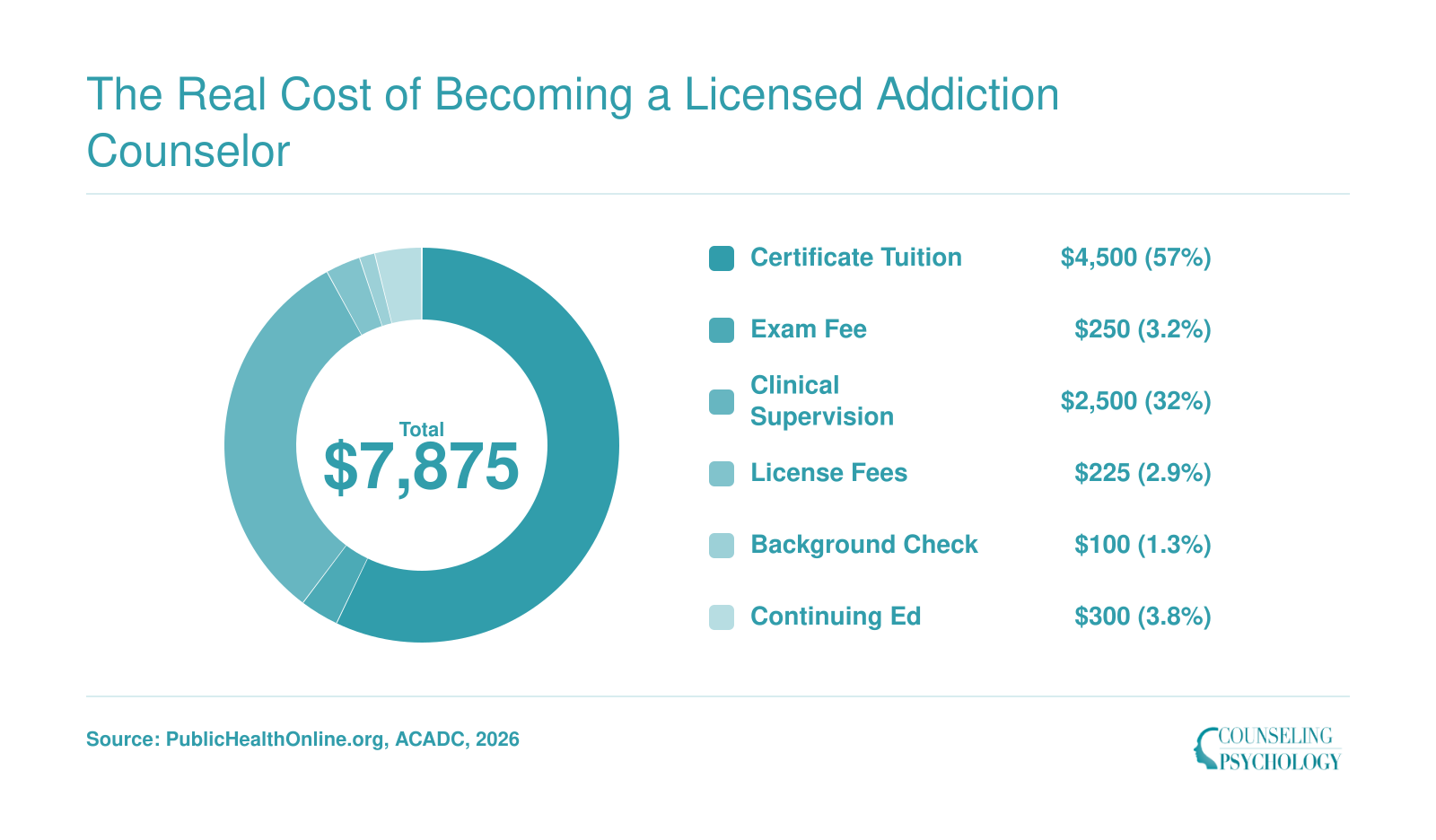
A traditional master’s degree can exceed $30,000. Alternative graduate certificates, like those through Project BEST, may cost as little as $5,000, cutting licensure expenses by roughly $25,000 or more.
Addiction Counselor Salary and Job Outlook by State
According to the Bureau of Labor Statistics, employment of substance abuse, behavioral disorder, and mental health counselors is projected to grow 17% from 2024 to 2034, much faster than the average for all occupations. In 2024, there were approximately 483,500 jobs in this field, with about 48,300 openings projected each year over the decade. The table below lists the five highest-paying states for this occupation, along with their employment levels, based on 2024 BLS data.
| State | Employment | Median Annual Wage |
|---|---|---|
| Alaska | 1,060 | $79,220 |
| New Mexico | 2,070 | $70,770 |
| Oregon | 6,410 | $69,660 |
| North Dakota | 1,180 | $66,450 |
| District of Columbia | 980 | $66,140 |
How to Choose the Right Licensure Pathway for You
Choosing the right licensure pathway is the single most consequential decision you will make on your journey to becoming an addiction counselor. The path you select directly shapes your timeline, budget, and career mobility. With the emergence of programs like Project BEST and other alternative routes, you now have more options than ever, but sorting through them requires a clear-eyed look at your own circumstances.
Match the Pathway to Your Profile
Your current education level is the primary filter. If you already hold a bachelor's degree in a behavioral science, a graduate certificate program may be the fastest route to qualifying for licensure. If you are starting from scratch, a traditional master's degree remains the standard, though accelerated options exist. Budget is equally critical: alternative pathways can cut costs by thousands of dollars, but they may limit reciprocity if you plan to move across state lines. Map out your target state's requirements now, because that single variable will either open or close the door to shortcuts like Project BEST. Understanding the cost of a counseling psychology master's degree early helps you weigh trade-offs before committing to any route.
A Step-by-Step Decision Checklist
Use this sequence to narrow your options:
- Check your state's requirements first. Licensure is state-specific, so no other factor matters if the pathway does not satisfy your state board's criteria.
- Determine if a graduate certificate qualifies. Some states accept a certificate plus supervised experience in lieu of a full master's; others do not. Confirm this before enrolling.
- Compare total costs and timelines. Add tuition, supervision fees, and exam costs, then weigh them against the time saved. A lower-cost alternative that takes two years instead of three may be worth it, but not at the expense of long-term flexibility.
- Verify exam acceptance. Most states use the IC&RC or NAADAC exams, but a few have unique testing requirements. Ensure your chosen pathway prepares you for the exam your state recognizes.
Plan for Portability and an Evolving Landscape
If relocation is a possibility, credential portability becomes a major factor. The earlier sections on CADC, ADC, LADC, and LCADC credentials showed that reciprocal agreements vary widely. A path that fast-tracks you into an ADC credential in one state may not transfer to another where the LADC carries stricter requirements. Look for CACREP accredited online counseling programs that align with the highest common denominator if you might move.
Finally, recognize that the licensure landscape is actively shifting. Initiatives like Project BEST are not isolated experiments; they signal a broader trend toward making addiction counseling careers more accessible. As workforce shortages persist, more states will likely adopt flexible pathways. By choosing a pathway that balances current requirements with emerging options, you position yourself to benefit from a field that is finally removing historical barriers to entry.
Frequently Asked Questions About Addiction Counseling Licensure
Here are clear answers to common questions about addiction counseling licensure pathways, including accelerated options like Project BEST, the fastest routes to practice, key credential differences, and what you can expect to pay.