
What you’ll learn in this article…
- In South Dakota, 62 of 66 counties face a provider shortage.
- A physician assistant notes farmers are told to 'rub some dirt on it'.
- Colleen Stegenga offers virtual sessions for clients in their cars.
In South Dakota, 62 of 66 counties lack enough mental health providers to meet geographic demand, leaving most farm families hours from the nearest therapist. The rural mental health workforce shortage compounds an already difficult situation for a population that rarely asks for help.
Farmers face a cascade of financial, environmental, and cultural pressures that generalist therapy rarely addresses: commodity price swings, drought, livestock disease, and the grinding isolation of work that never stops. The result is a suicide rate that remains stubbornly higher than the national average.
For counselors, closing this gap means mastering telehealth logistics, learning to talk about operating loans, and earning trust in communities where stoicism is both identity and armor.
Understanding the Farmer Mental Health Crisis: Prevalence, Suicide Rates, and Unique Stressors
The mental health crisis among farmers is one of the most underrecognized public health emergencies in rural America, marked by suicide rates that consistently outstrip those of the general working population. Despite the idyllic imagery often associated with farm life, those who work the land face a perfect storm of psychological pressures that demand urgent, specialized attention from the counseling community.
A Persistent Disparity in Suicide Rates
National data systems have identified agriculture as an occupation with elevated suicide risk. While exact figures fluctuate year to year, research consistently places farmers and ranchers at or near the top of high-risk occupational groups. Federal safety agencies and public health researchers link this disparity to a confluence of chronic stress, easy access to lethal means, and a cultural ethos that prizes self-reliance over help-seeking. The result is a disproportionate number of lives lost in farming communities, with ripple effects that destabilize families and entire rural economies. Counselors interested in this space may benefit from exploring what it takes to work as a suicide prevention counselor, since agricultural communities represent one of the highest-need populations for that specialty.
Beyond Suicide: Depression, Anxiety, and Substance Use
Suicide is only the most visible tip of the iceberg. Community surveys and clinical reports indicate that depression and anxiety are widespread among agricultural workers, often going undiagnosed for years. The stoicism ingrained in many farming cultures leads individuals to normalize persistent sadness, sleep disturbances, and irritability as just part of the job. Substance use, particularly alcohol, can become a silent coping mechanism, further masking underlying mental health conditions. Without routine screening or accessible care, these conditions worsen until they reach crisis proportions.
Unique Stressors Facing Agricultural Workers
Farmers operate in an environment where multiple stressors compound simultaneously. Financial insecurity from volatile commodity prices, trade disruptions, and rising input costs creates unrelenting pressure. Weather extremes, droughts, floods, early freezes, can wipe out a year's work in hours, leaving no room for error. The rural mental health provider shortage compounds these challenges by limiting social support and access to services, while the blurring of work and home life means there is little respite from the farm's demands. Moreover, the farm is often a multigenerational identity, not just a job; the prospect of losing the land can feel like a profound personal failure. These layered stressors require counselors to understand not just clinical symptoms but the entire ecosystem of a farmer's life.
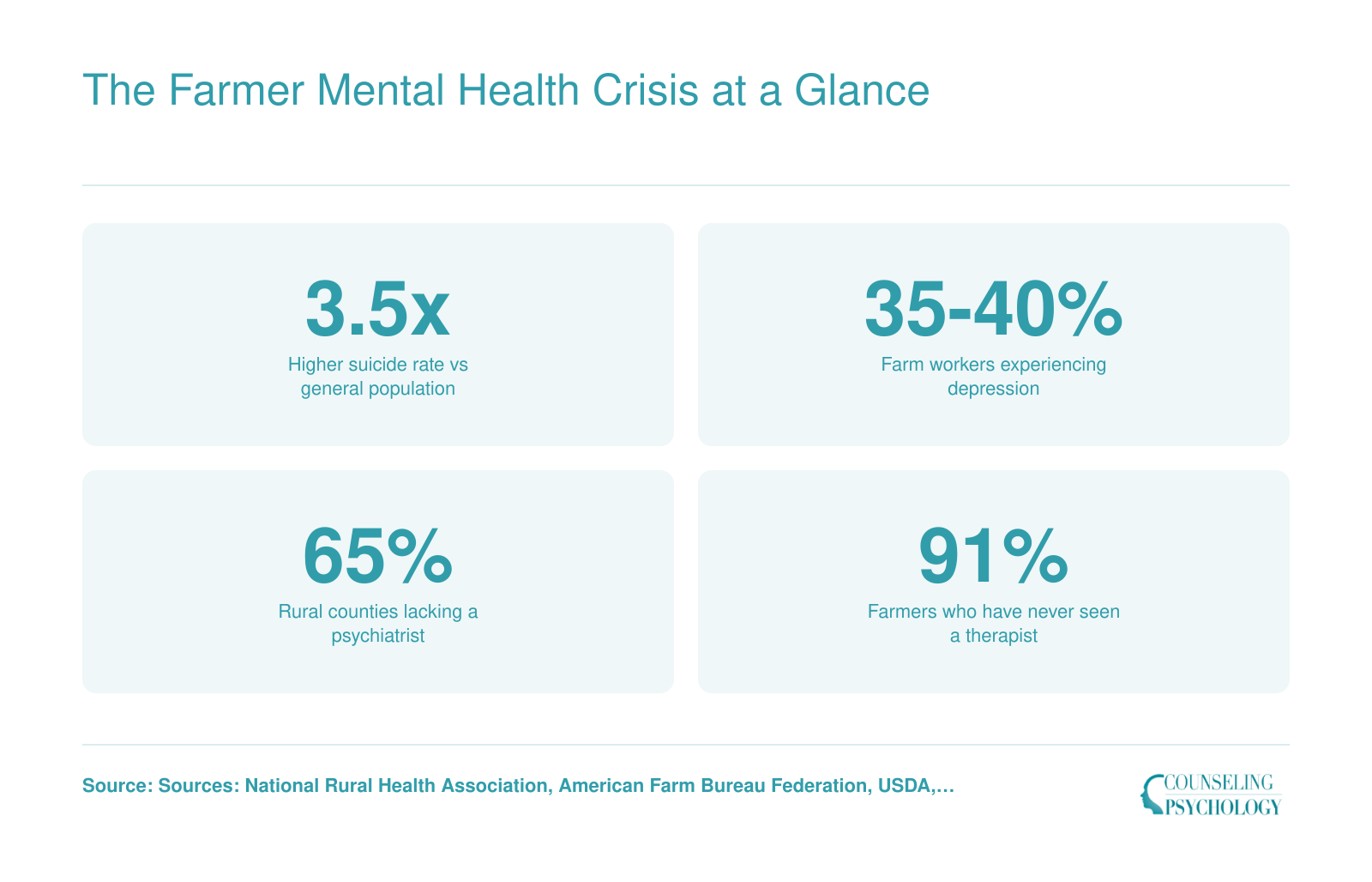
The Farmer Mental Health Crisis at a Glance
Farmers face a mental health crisis that is often unrecognized and untreated. The following statistics highlight the severity of the issue and the barriers to care.
Barriers to Mental Health Care in Agricultural Communities
Even when resources exist, significant barriers prevent farmers and ranchers from accessing mental health care. These obstacles are not merely logistical; they are cultural, systemic, and deeply rooted in agricultural identity.
Stigma and the 'Pull Your Bootstraps Up' Culture
In many rural communities, emotional distress is often dismissed as a sign of weakness. The prevailing ethos, as Karl Oehlke, a physician assistant on the Avera Behavioral Health team, describes it, is "that perception that you should just pull your bootstraps up or rub some dirt on it." This Midwestern stoicism, coupled with traditional masculinity norms and the proud self-reliance of farm life, creates a powerful resistance to seeking help. Farmers are conditioned to solve problems independently (machinery, weather, markets) and mental health can feel like just another thing to "tough out." Acknowledging depression or anxiety can be seen as a personal failure, making it difficult for individuals to reach out even in crisis.
Provider Shortages in Rural America
The national mental health workforce shortage hits rural counties hardest. South Dakota illustrates the severity: of its 66 counties, only four (McCook, Minnehaha, Turner, and Lincoln) do not have a geographic shortage of providers, and even those face population-based shortages.2 Dr. David Newman, chief medical officer of virtual care at Sanford Health, notes the challenge plainly: it is "hard to get providers to move to rural America."2 This means that even when a farmer decides to seek therapy, they may find no practicing counselor within a reasonable distance.
Practical Obstacles: Distance and Time
For those who do find a provider, attending sessions can be nearly impossible. Olivia Bury, a licensed professional counselor and behavioral health coordinator at AgriSafe Network, points out that farmers "probably don't want to drive an hour or two to go to therapy."2 During planting and harvest seasons, workdays stretch from dawn to dusk, making weekly appointments a logistical impossibility. Even in off-peak times, farm work is relentless, and taking half a day for a therapy visit disrupts essential tasks.
Lack of Privacy in Small Communities
In towns of a few hundred people, confidentiality is fragile. A pickup truck parked outside a mental health professional's office can become town gossip by evening. This fear of being seen and judged suppresses utilization even where services exist. For farmers, the risk of social exposure often outweighs the perceived benefit of therapy, reinforcing isolation.
Building Agricultural Cultural Competence as a Counselor
Effective therapy with agricultural clients demands more than generic clinical skills; you need to speak the language of farming life, from operating loans to calving season to the anxiety of a rainless July. multicultural competence in counseling extends into occupational identity, and in agricultural settings that means grasping how the farm economy, family legacy, and physical labor intertwine with mental health.
What Agricultural Cultural Competence Looks Like
At its core, this competence involves understanding farm operations, financial cycles like operating loan renewals and crop insurance deadlines, and the intergenerational dynamics that often place the weight of a multigenerational legacy on one individual's shoulders. A farmer's identity is frequently inseparable from their land and livelihood, making losses or transitions feel like personal failure. Clinicians who recognize these pressures can validate experiences without pathologizing the stressors that come with the occupation.
Training Programs That Build Competence
Several organizations offer targeted education for mental health providers who want to serve this population effectively.
- FarmResponse®: AgriSafe Network's online course delivers 3.5 hours of continuing education specifically for mental health providers, covering the agricultural context, common stressors, and appropriate interventions.1
- Down on the Farm Training Kit: Also from AgriSafe, this online resource dives deeper into farm culture and behavioral health.2
- Nurse Scholar Program: While originally for nurses, this 23-hour online program from AgriSafe includes modules on farmer mental health that benefit any rural practitioner.2
- QPR and CALM training: These crisis intervention and suicide prevention models are available in live online or in-person formats, teaching skills to question, persuade, and refer effectively in tight-knit communities.2
- Ongoing learning: AgriSafe's monthly Mental Health Innovations Exchange (with the AgriStress Response Network) and National Farm Safety and Health Week webinars provide low-barrier opportunities to stay current.3
Immediate Steps Counselors Can Take
You don't have to grow up on a farm to build trust with agricultural clients. Practical, low-cost actions can make a significant difference.
- Attend a local farm bureau meeting: These gatherings offer a window into the concerns, language, and relationships that shape daily life for producers in your area.
- Shadow a farmer for a day: Even a few hours seeing the physical demands and decision-making pace firsthand builds empathy that no textbook can replicate.
- Learn basic agricultural terminology: Understanding terms like "combine," "cover crop," or "farrowing" signals that you respect their world.
- Adapt intake questions: Ask about operation type, off-farm employment, and seasonal financial pressures. Instead of a generic stress inventory, inquire: "What does this year's cash flow look like for your operation?"
Addressing the Needs of Immigrant Farmworkers
Agricultural cultural competence must extend beyond farm owners. Immigrant and seasonal farmworkers face distinct challenges, including language barriers, precarious housing, and immigration-related anxiety. Culturally competent care for this group requires Spanish-language services, knowledge of visa programs, and an awareness of how fear of deportation can suppress help-seeking. Partnering with migrant health centers or promotora programs can bridge gaps that individual counselors cannot fill alone.
Evidence-Based Counseling Approaches for Farm Populations
What evidence-based therapies actually work for farmers, and how can counselors apply them in rural settings?
Farmers face intense, chronic stress from unpredictable weather, market volatility, isolation, and physical demands. While research specifically evaluating therapies in agricultural populations is limited, several evidence-based modalities show strong potential when adapted to farmers' unique circumstances.
Cognitive Behavioral Therapy and Trauma-Focused Approaches
Cognitive Behavioral Therapy (CBT) consistently improves depression, anxiety, emotional dysregulation, and interpersonal problems1, and its structured, problem-solving nature fits the pragmatic mindset of many farmers. When traumatic events such as accidents, livestock loss, or financial collapse underlie distress, trauma-focused therapies become critical. Trauma-Focused Cognitive Behavioral Therapy (TF-CBT) has shown improved behavioral health outcomes in child welfare settings2, and trauma-informed care combined with CBT and community interventions enhances mental health in underserved populations.3 For farmers, integrating trauma-informed principles ensures that therapy acknowledges the cumulative trauma of rural life without retriggering. Exposure therapy, which outperforms waitlist and treatment-as-usual in civilian and refugee samples4, may also benefit farmers with specific phobias or accident-related PTSD.
Solution-Focused Brief Therapy for Time-Pressed Farmers
Solution-Focused Brief Therapy (SFBT) aligns well with farmers' desire for efficient, tangible results. A 2022 meta-analysis found an overall effect size of 0.176 (Cohen's d), with a much larger effect (1.690) when compared to waitlist controls.5 While effects against treatment-as-usual were modest (0.140), SFBT's strength lies in its brevity and focus on client strengths, which is critical when farmers can only spare 30 minutes during lunch. Moreover, SFBT is inherently trauma-informed, making it a safe entry point for those reluctant to delve into past pain. Counselors report that virtual delivery of SFBT via phone or video, as practiced by providers like Colleen Stegenga in rural South Dakota, helps overcome barriers of distance and stigma; clients often step into a truck or barn office for a session.
Screening, Assessment, and Culturally Adapted Tools
Effective treatment starts with accurate screening. While validated farm-specific instruments such as the Farm Stress Survey are still in development, clinicians can adapt standard tools like the PHQ-9 by contextualizing questions. For example, asking "Did you feel down, depressed, or hopeless about the farm's future?" can improve relevance and engagement. Active research through the USDA's NIFA farm stress programs and extension services continues to refine such instruments. Counselors should stay informed through academic databases and rural health networks, and consider reaching out to researchers for the latest unpublished data.
Innovative On-Farm Models: Animal-Assisted Therapy
An emerging culturally congruent approach is animal-assisted therapy, which builds on farmers' deep bond with livestock. Colleen Stegenga, a licensed clinical social worker in Mt. Vernon, S.D., is transforming a 100-year-old barn into a therapeutic space featuring horses, mini highland cows, and babydoll sheep. For farmers who avoid clinic settings, the barn environment feels natural and nonjudgmental. While formal outcome studies are still lacking, such models tap into the restorative power of agricultural life and may improve both engagement and retention in counseling. Counselors exploring counseling specialty areas may find that agricultural and rural-focused practice represents a meaningful and underserved niche.
Telehealth and Virtual Care Models That Work for Farmers
Telehealth for farmers means delivering mental health care via phone or video to someone whose office is a tractor cab, a barn, or a field miles from the nearest town. By removing barriers of distance, time, and visibility, virtual sessions open a door that has long been closed for many in agricultural communities. For counselors, the model requires flexibility and an understanding that the therapeutic frame might look a little different when your client is joining from a grain truck on lunch break.
Virtual Sessions That Meet Farmers Where They Are
Colleen Stegenga, a licensed clinical social worker in rural South Dakota, has found phone and video sessions so successful that some patients now step into their car on lunch break for a session rather than missing a half-day of work for an office visit.1 She notes that virtual care works especially well for those who fear being recognized in a small-town waiting room or who simply cannot leave the farm. Her approach is built on making mental health support fit into the farmer's life, not the other way around.
Statewide and Health System Telehealth Programs
Broader telehealth implementations are expanding access across agricultural regions. Sanford Health's virtual behavioral health program connects patients in shortage areas with clinicians who may be based hundreds of miles away.1 In South Dakota, where only four of 66 counties have no geographic provider shortage, the rural mental health services gap is especially acute, and virtual platforms help bridge gaps that bricks-and-mortar clinics simply cannot. While specific utilization rates among agricultural populations are still being tracked, early indicators suggest that offering virtual care significantly reduces no-show rates and normalizes help-seeking, especially when a trusted primary care provider makes the referral.
Making Telehealth Work in Rural Settings
Counselors adopting telehealth clinical hours psychology students telehealth for farm clients need to prepare for a few practical realities. Inconsistent rural broadband often forces a fallback to phone-only sessions, so having a HIPAA-compliant platform that works on low bandwidth and a clear phone protocol is essential. Scheduling flexibility is non-negotiable: planting and harvest seasons may require early morning or late evening slots, and a sudden equipment breakdown can cancel a session without notice. Successful providers also build quick rapport by acknowledging the environment, maybe asking if the client can show them the view from the cab, rather than treating the setting as an obstacle.
Crisis Intervention and Suicide Prevention on the Farm
Crisis hotlines offer immediate emotional stabilization during an acute suicidal moment, while upstream suicide prevention programs address the chronic stressors that erode a farmer's resilience over time. A comprehensive approach integrates both: swift access to a compassionate listener when despair peaks, paired with community-based supports that reduce isolation and financial anxiety. For rural counselors, fluency in these parallel strategies is vital, as agricultural clients often experience crises differently than urban populations.
Immediate Crisis Support: Hotlines and Helplines
Several confidential, 24/7 helplines now exist specifically for agricultural communities. The Farm Aid Hotline has long connected callers to crisis counselors and financial assistance programs, while the AgriStress Helpline provides dedicated support for farmers and ranchers, often staffed by professionals trained in agricultural stress. These services are designed to overcome the stigma and logistical barriers that keep many farmers from seeking help: no appointments, no travel, and no names required. Counselors in rural areas should ensure that every client and every waiting room has these numbers within easy reach.
State and Regional Suicide Prevention Initiatives
A growing number of states are funding targeted farmer mental health programs. Examples include 605 Strong in South Dakota and Wisconsin's farmer mental health voucher program. Such initiatives typically offer free or low-cost counseling sessions, train local providers in agricultural literacy, and sponsor community outreach events. Even without published outcome data, these programs represent a structural commitment to reducing suicide risk. Rural practitioners can amplify their impact by staying informed about state-specific offerings, participating in referral networks, and advocating for expanded coverage in underserved areas. Counselors who want to formalize their skills in this space may also explore what it takes to become a suicide counselor working within crisis-focused career paths.
Integrating Crisis Resources into Counseling Practice
Effective crisis intervention on the farm begins with routine screening for suicidal ideation, framed neutrally: "How are you sleeping?" or "Have you felt like a burden to your family?" are less confrontational gateways than direct questioning. Counselors should develop farm-specific safety plans that account for lethal means common in agricultural settings, including firearms, pesticides, and heavy equipment, and coordinate with local emergency services who understand the landscape. Post-crisis follow-up is equally critical; a brief phone check-in within 24 hours of a hotline referral significantly reduces re-attempt risk. Finally, partnerships with cooperative extension agents, veterinarians, and ag lenders create a web of informal sentinels who can recognize warning signs and guide a farmer back to professional care.
Integrating Mental Health With Financial and Legal Support
Farmers rarely seek therapy saying "I'm depressed." More often, the presenting concern is a loan that can't be paid, a foreclosure notice, or a livestock feed bill that's outpacing revenue. If you ignore that financial dimension, you risk losing credibility with the very people you're trying to help. Agricultural stress is financial stress, and any effective intervention must recognize cash flow as part of the clinical picture.
The Financial Root of Agricultural Distress
When commodity prices drop, debt loads rise, and land values fluctuate, a farmer's entire identity and livelihood feel under siege. Mental health symptoms often surface as secondary reactions to economic strain. Counselors who treat only the emotional pain without connecting clients to concrete financial resources are missing the root cause and may see limited progress.
Wraparound Partnerships for Rural Mental Health
A coordinated care model brings mental health providers together with financial and legal allies. Key partners include USDA Farm Service Agency (FSA) staff, who offer loan restructuring and emergency assistance; university extension agents, trained in farm viability and stress management; certified agricultural mediators, who can resolve family business disputes without litigation; and farm financial advisors familiar with local market conditions. Community mental health counselors are well positioned to anchor these partnerships, translating clinical needs into language that financial and legal collaborators can act on. These professionals are not therapists, but they share the client's context and can reinforce emotional coping messages in everyday interactions.
Coordination in Action: Three Collaborative Strategies
- Joint intake referrals: When an extension educator senses a farmer is overwhelmed, they can make a warm handoff to a trusted counselor. Conversely, a therapist who hears "I can't afford to keep farming" can immediately refer to an FSA loan officer or a mediator, with the farmer's consent.
- Shared case conferences: With proper releases of information and a strong confidentiality framework, a counselor, FSA representative, and extension agent can hold brief, structured consultations. The focus stays on practical support: for example, aligning a debt repayment plan with the client's therapeutic goals for stress reduction and family communication.
- Co-located services: Hosting counseling hours at a county extension office removes the stigma of a mental health clinic. A farmer can see a therapist in the same building where they already go for crop advice, and then walk next door to talk through payment options with a financial counselor. This one-stop approach reduces logistical burdens and normalizes mental health support as part of whole-farm wellness.
Career Outlook and Salary for Rural Mental Health Counselors
According to the Bureau of Labor Statistics, substance abuse, behavioral disorder, and mental health counselors earned a median annual wage of $59,190 in 2024, with a range from $47,170 at the 25th percentile to $76,230 at the 75th percentile. The field is projected to grow 16.8% through 2034, far outpacing the national average for all occupations. While rural positions often pay less, many are eligible for loan repayment assistance, signing bonuses, and educational funds, with 29% of mental health organizations offering loan repayment and 46% offering signing bonuses.
| Metric | Value |
|---|---|
| Median Annual Wage | $59,190 |
| Average Annual Wage | $65,100 |
| 25th Percentile Wage | $47,170 |
| 75th Percentile Wage | $76,230 |
| Total Employment (2024) | 440,380 |
| Projected Job Growth (2024-2034) | 16.8% |
Frequently Asked Questions About Farmer Mental Health Counseling
Mental health professionals working with agricultural communities face distinct challenges, from geographic barriers to deep-rooted stigma. These concise answers draw on current strategies and research to equip rural counselors with practical guidance for supporting farmers in crisis.