
What you’ll learn in this article…
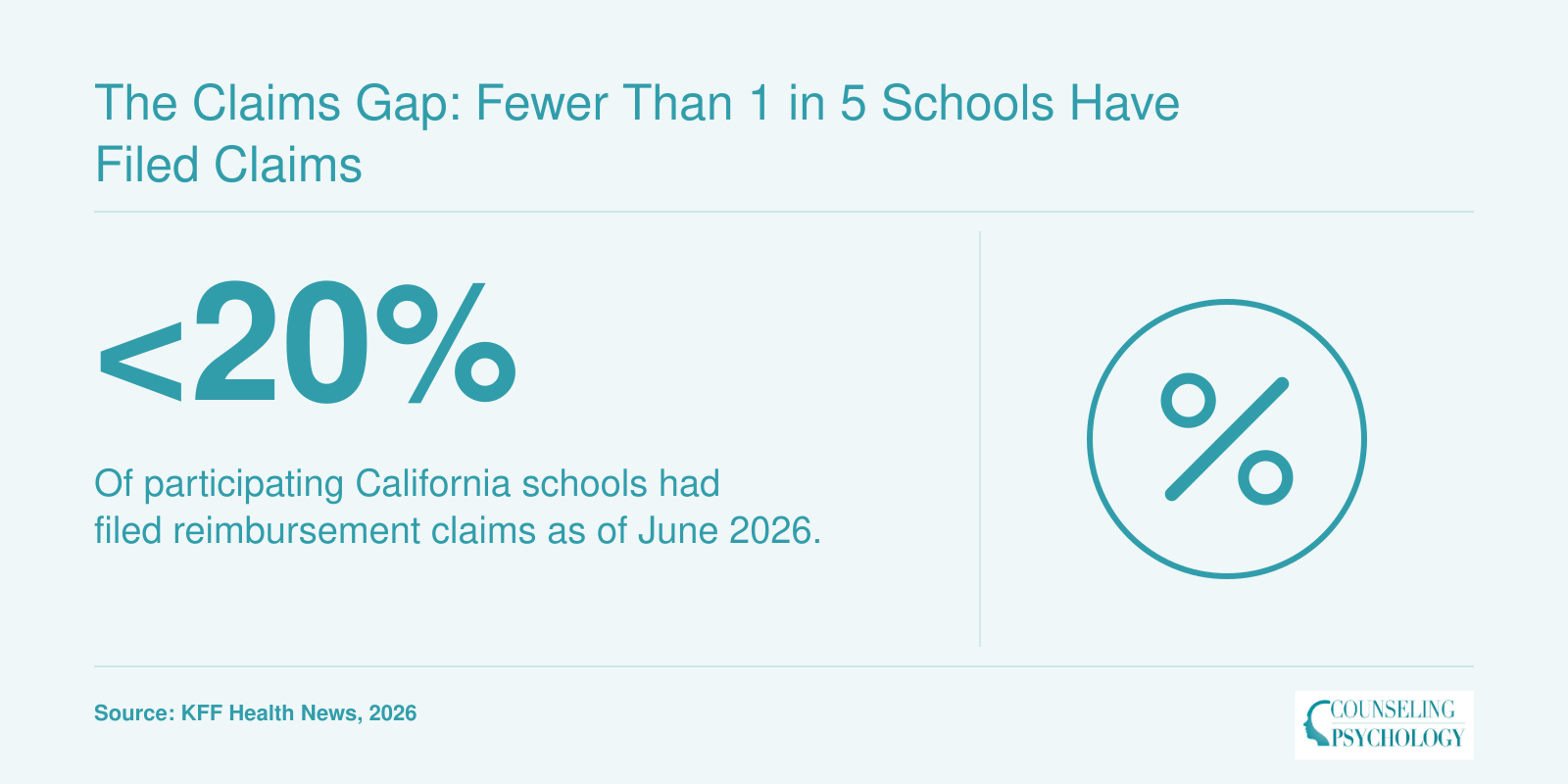
- Fewer than 1 in 5 schools filed claims as of June 2026.
- California's student-to-counselor ratio hit 527:1, double the recommendation.
- The CYBHI promised $500 million but delivered pennies after five years.
How does a $500 million mental health initiative leave schools handing out pink slips instead of providing care? Five years after California’s Children and Youth Behavioral Health Initiative launched, thousands of schools are still waiting for on-campus services. A reimbursement system meant to fund school counseling programs is gridlocked by incomplete infrastructure, unclear guidance, and workforce instability. By mid-2026, fewer than one in five participating schools had filed claims.1 Students sit on wait lists while counselors face layoffs. The promise of school-based care is colliding with a broken funding pipeline.
What Is California’s Children’s Mental Health Initiative?
Balancing the urgent need for youth mental health services amid a teen mental health provider shortage against the complexities of counselor reimbursement rate trends 2026 is the central challenge of California’s Children’s Youth Behavioral Health Initiative (CYBHI). Launched around 2021, the CYBHI and its Master Plan for Kids’ Mental Health aim to reshape how behavioral health care is delivered and funded in schools. The core premise: require health insurers to reimburse public schools, community colleges, and universities for on-campus mental health and substance use services, just as they would for care in a clinic.
Core Components of the Initiative
The CYBHI rests on three pillars. First, a multi-payer fee schedule that standardizes rates for school-based services across commercial plans and Medi-Cal, reducing billing fragmentation. Second, workforce expansion grants to train and hire more school counselors, social workers, and psychologists, a direct response to the mental health workforce shortage. Third, formal integration between school systems and health plans, including data-sharing and care coordination protocols. Together, these elements are intended to build a permanent infrastructure so that students can access care where they already spend much of their day.
Scaling School-Based Care
Participation is voluntary but the state envisions statewide adoption. Over 1,000 public schools, community colleges, and universities have enrolled. Yet enrollment alone does not guarantee services are being delivered or reimbursed. The initiative marks a significant policy shift, moving from grant-funded, time-limited programs to a sustainable insurance-based model. For mental health professionals, understanding CYBHI is critical: it sets the framework for how school-based roles are funded and how services are billed, directly affecting job stability and the reach of care.
The Broken Reimbursement Pipeline
As of June 1, 2026, fewer than one-fifth of participating schools had successfully filed claims through California’s multi-payer fee schedule, despite a state mandate that insurers reimburse for on-campus behavioral health services.1 The CYBHI Fee Schedule Program, launched in 2024, covers students up to age 26 and includes services like psychoeducation, therapy, screening, and case management. Schools must bill four separate payer types: Medi-Cal managed care, Medi-Cal fee-for-service, commercial health plans, and disability insurers, each with its own documentation rules.2
Administrative Barriers Pile Up
The process was meant to be seamless, but school billing offices quickly hit roadblocks. There is no universal claim form; insurers request different paperwork, and many districts lack staff trained in clinical coding and billing compliance. Required documents include a FERPA-compliant consent form, permission to bill private insurance, and detailed clinical progress notes. A single missing signature can trigger weeks of back-and-forth, and claim denials often stem from incomplete FERPA releases or confusion over billing rules, for example a service covered by an IEP cannot be billed through the fee schedule.3
Plumas Charter School’s Frustrating Wait
The experience of Plumas Charter School illustrates the delays. After five years of preparation and paperwork, the school received its first reimbursement check in April 2026 for just $8,000, while $12,000 in claims remained unpaid. “We’re constantly chasing documentation,” one administrator noted. The school had enrolled in the program, signed the required participation and data-sharing agreements, and trained staff, yet payment trickled in at a pace that cannot sustain a program.1
Unpaid Counselors and Pink Slips
This administrative nightmare has real consequences: school counselors and therapists go unpaid for months, forcing districts to issue pink slips. The promised $500 million in annual revenue has not materialized, and many schools have pulled back from providing services altogether.1 Without a streamlined billing infrastructure, even willing schools are effectively locked out of the reimbursement pipeline, leaving children waiting for care.
Plumas Charter School waited five years for its first $8,000 reimbursement check, barely a dent in the $12,000 still owed. The initiative that promised transformative funding left schools with pennies and pink slips instead.
Workforce Crisis: Not Enough Counselors to Go Around
California's schools are hemorrhaging mental health professionals at the very moment students need them most. The state's student-to-counselor ratio of 432:1 far exceeds the national average of 372:1 and is nearly double the 250:1 ratio recommended by the ASCA's 2024-25 student-to-counselor ratios report1. In PreK-8 settings, the ratio balloons to a staggering 737 students for every one counselor, leaving elementary and middle school children with minimal support.2 These numbers place California ninth-highest in the nation for counselor caseloads, but the raw figures only hint at the daily chaos inside schools.
Ratios That Fail Students
The mental health workforce shortage is not a hidden crisis: 68% of school counseling directors nationwide report a shortage in their field, and 55% say their own district is significantly understaffed. In the U.S., roughly 40% of public schools had a vacancy for a mental health professional in 2022-23, and an equal share described filling those roles as "very difficult." California mirrors this trend, with 3,710 projected annual openings for school counselors through 2032, a 10.5% job growth rate, yet the very funding that could sustain these positions is gridlocked.4
Layoffs and Lost Hiring
The Children and Youth Behavioral Health Initiative (CYBHI) was supposed to channel $500 million into school-based mental health services, but reimbursement delays have already triggered pink slips. School officials, forced to cut budgets in the absence of promised revenue, have laid off counselors and frozen hiring. This instability erodes the pipeline: new graduates see a field where jobs are created and then cut, where a single check for $8,000 can take five years to arrive, and they choose more stable career paths instead.
A Cycle That Deepens the Crisis
The inability to bill insurers consistently means schools cannot plan for sustained staffing. Rural districts, already grappling with fewer community providers, face the most acute shortages, with some ratios exceeding 500:1. Without reliable funding, schools cannot offer competitive salaries or permanent contracts, and the initiative's own goal of universal access to care collapses. The workforce crisis is not separate from the CYBHI's failure, it is a direct consequence of a system that promised to pay for care but has not yet shown it can deliver.
California’s student-to-counselor ratio is 527:1, more than double the 250:1 recommendation. Delays in CYBHI reimbursements have forced schools to cut mental health staff, leaving students with even fewer resources.
Who’s in and Who’s Out: The Participation Gap
A Two-Tier System Emerges
The California Children's Youth Behavioral Health Initiative (CYBHI) Fee Schedule Program promised to open a steady funding stream for school-based mental health care, but the reality is a patchwork. More than half of the state's school systems and colleges remain outside the program entirely, leaving millions of students without the intended services, even as California consistently ranks among the states with the highest need for counselors.states with the highest need for counselors As of July 2026, approximately 700 local educational entities, school districts, charter schools, county offices of education, and community colleges, had enrolled.1 Yet only 220 of those have actually submitted claims, a submission rate of just over 30 percent. Earlier in the year, reports indicated that fewer than one in five enrolled sites had filed claims, signaling that uptake has been painfully slow to improve.
The Cost of Administrative Friction
This gap is not driven by a lack of need or interest. School leaders consistently point to inadequate billing guidance, missing standardized forms, and persistent delays in claims processing as the primary barriers. The fear of investing staff time into complex paperwork, only to see claims denied or sit unpaid, has kept many administrators on the sidelines and casts uncertainty on those building a career in school counseling.career in school counseling Even among the 220 entities that have navigated the system, the disconnect is stark: clean claims submitted to managed care plans total roughly $15.8 million, but actual reimbursements distributed stand at $14.7 million,1 hinting at processing backlogs and uncertainty around final payment amounts. For many schools, the unpredictable revenue doesn't justify the administrative lift.
Where Participation Is Taking Hold
Despite the overall unevenness, some regions are finding modest success. Los Angeles County reported 54 entities in active onboarding by late 2025,2 and the Los Angeles Unified School District secured approximately $15,000 in early claims by spring 2025,2 one of the first signs that the reimbursement pipeline can work. Yet these examples remain outliers. The program covers 98 percent of California counties geographically,1 but that statistic masks the reality that most funding flows to a narrow slice of proactive districts with dedicated billing staff. For the majority, the promise of CYBHI dollars remains a frustrating paperwork exercise rather than a reliable source of support.
The Claims Gap: Fewer Than 1 in 5 Schools Have Filed Claims
Despite over 1,000 schools participating, the vast majority have not yet tapped into the promised reimbursement funds, leaving millions of dollars in critical mental health services unfunded.
Long Wait Times and the Real-World Toll on Students
The promise of timely school-based care collides with a stubborn reality: even five years after the Children and Youth Behavioral Health Initiative (CYBHI) launched, California has no statewide measure of how long students wait for mental health services.3 Local data points to delays that stretch from a few weeks to most of a school year, leaving children in limbo while their struggles intensify.
The Data Void
Statewide average wait times for school-linked youth therapy remain unreported.3 A formal outcomes study by Mathematica is not expected until late 2026 or 2027, leaving policymakers in the dark.3 What we do know comes from fragmented local snapshots. In Los Angeles County, community-based organizations serving youth reported waitlists of three to nine months during summer 2024.1 That same summer, the LA County School-Linked Program delivered about 20,000 therapy sessions but reached only 3,000 students, underscoring how far demand outpaces capacity.1 Digital tools launched under CYBHI, like Soluna for ages 13 to 25 and BrightLife Kids for ages 0 to 12, offer instant access, with Soluna’s average wait under one minute, but these apps provide coaching and light-touch support, not the ongoing therapy many students need.2 For a teenager in crisis, a one-minute app check-in cannot replace a months-long wait for counselors that work with kids.
Ripple Effects on Students
When children wait months for care, manageable concerns escalate. Untreated anxiety can turn into chronic school refusal; undiagnosed depression can lead to self-harm. Pediatric emergency departments across the state have reported rising numbers of mental health crises among youth, though direct attribution to CYBHI’s pace is impossible without better data.3 Early intervention windows close, and students who might have recovered with short-term counseling instead require intensive outpatient or inpatient services later. One Los Angeles school-based therapist, speaking on background, described the emotional toll: “Families call every week, tearful and desperate, and all I can say is the wait list still hasn’t moved.” The cost shows up in missed school days, strained relationships, and lost academic progress.
Rooted in Reimbursement Delays
These long waits are not just a staffing shortage; they are a direct symptom of the billing chaos that handicaps CYBHI. Schools cannot file claims quickly or reliably, so they cannot afford to hire or retain enough counselors, even as masters in counseling psychology california programs graduate qualified professionals. When a district or charter school waits months, sometimes years, for a check, it cannot expand its mental health team. The initiative promised a reliable funding pipeline, but until reimbursements flow smoothly, the pipeline stays dry, and students bear the consequences.
Questions to Ask Yourself
Related Articles
Policy Gridlock and Legislative Pressure
California’s Children and Youth Behavioral Health Initiative (CYBHI) has faced legislative and regulatory stalemate, preventing it from fully delivering on its promise to reimburse schools for student mental health services. After five years, persistent delays in processing claims, confusion over billing procedures, and a lack of standardized forms have kept promised funds from reaching campuses, even as demand for youth mental health care soars.
Legislative Scrutiny Intensifies
In 2025 and 2026, lawmakers including Assemblymember Dawn Addis publicly criticized the slow implementation. Legislative oversight hearings have called state agencies to account for the lagging reimbursement pipeline, pointing to a massive gap between the program’s $500 million revenue projection and the handful of checks actually cut. These sessions highlighted that fewer than one in five participating school systems had filed claims as of mid-2026, underscoring a systemic failure to translate policy into practice.
Governor’s Defense Falls Short of Success
Governor Newsom has defended the state’s efforts, noting that “no other state has done more” to embed behavioral health in schools. Yet he has stopped short of calling CYBHI a success, a tacit acknowledgment that the initiative remains far from its goal. The governor’s office now faces mounting pressure to deliver concrete fixes rather than aspirational comparisons.
Regulatory Fixes and Fiscal Pressures
A state working group convened its first session on March 18, 20262, to tackle the billing chaos by developing standardized forms and streamlining negotiations with health insurers. These efforts come as the initiative absorbs a $130 million budget cut in the 2025-2026 fiscal year1 and sees $1.3 billion in Proposition 35 funds redirected to other priorities. The pending federal approval of a reimbursement plan for federally qualified health centers3 adds another layer of uncertainty.
Can 2026 Break the Cycle?
With the June 2026 implementation deadline looming, the current legislative session offers a narrow window for meaningful reform. Breaking the gridlock will require more than technical fixes; it demands political will to force insurer compliance, stable funding commitments, and clearer state guidance. Without these, school-based mental health programs will continue to issue pink slips instead of hiring counselors for kids.
What This Means for Mental Health Professionals
School-based mental health professionals in California are operating in a system that promises robust funding but delivers bureaucratic paralysis. The Children and Youth Behavioral Health Initiative (CYBHI) was designed to reimburse schools for on-campus care, yet years of delayed payments and missing infrastructure have left many counselors and therapists in a precarious spot. Understanding the mechanics of this broken program is no longer optional; it is a survival skill.
Navigate the Fee Schedule, Even When It's Broken
Even if the reimbursement pipeline is clogged, you must grasp the state's fee schedule and billing codes. Knowing what services are reimbursable, from individual therapy to preventive screening, helps you document services correctly from day one. Connect with your district's billing coordinator early; often they are equally in the dark, but building that relationship can prevent claims from being rejected later. Keep meticulous records: date, duration, type of service, and any diagnostic codes. When systems eventually work, your backlog of claims will need that evidence.
Advocate for Systemic Change
Isolated frustration will not fix CYBHI; collective pressure can. Join your state professional association, whether it is the California Association of School Counselors or a behavioral health coalition. These groups have lobbying arms that can amplify your voice. Contact your state legislators directly, providing specific examples of how reimbursement delays hurt students. A brief, fact-based email describing a child who could not get follow-up care because your position was in jeopardy due to budget cuts carries more weight than abstract complaints. On-the-ground stories are the currency of policy change.
Protect Your Position While the System Catches Up
Job instability is a real threat: many districts have issued pink slips as promised CYBHI revenue failed to materialize. While pushing for long-term reform, you can take steps to insulate your career. Diversify your placements by seeking roles as a community mental health counselor at agencies that contract with multiple school sites, so you are not tied to a single district's fiscal health. Explore grant-funded positions: federal Title IV-A funds or local foundation grants sometimes support mental health staff independently of state reimbursement. Stay visible in your school community; show administrators, parents, and boards the measurable impact of your work through data on attendance improvements or discipline reductions. That visibility can make your position harder to cut.
Lead the Fight for Practiced Care
The CYBHI vision, accessible mental health support for every student who needs it, is sound. But right now, that vision is trapped between policy writing and funding flows. Mental health professionals are the only ones who can bridge that gap, armed with experience, documentation, and a commitment to the children waiting for services. Collective resilience is not just about weathering the storm; it is about shaping the system so the next cohort of school counselors inherits a working infrastructure, not one still waiting for its first $8,000 check.
Frequently Asked Questions About CYBHI and School Mental Health
California's Children's Mental Health Initiative promised to bring essential care into schools, but years after launch, families and professionals alike have questions about lingering delays and gaps. Here are answers grounded in the initiative's real-world rollout.