
What you’ll learn in this article…
- Lincoln High's AI chatbot increased student interactions 9x.
- The AI education market will reach $12.3 billion in 2026.
- ASCA has not yet published AI ethical guidance for counselors.
School counselors are sharply divided on artificial intelligence. A recent r/schoolcounseling thread captured the spectrum1: one counselor used AI to categorize graduation data, only to get a sum smaller than the inputs before the AI corrected itself; another avoids it entirely, equating AI-written recommendation letters to undermining the profession; a third found real value in editing emails and unifying course descriptions. With caseloads climbing and paperwork multiplying, AI is both tempting and risky. For counselors, adoption decisions hinge on whether the technology can be trusted without compromising student data or the relational core of the role.
The State of AI in School Counseling: What's Changing and Why It Matters
The integration of artificial intelligence into school counseling is accelerating, bringing both transformative opportunities and pressing concerns. AI can unlock efficiencies in scheduling, streamline documentation, and offer data-driven insights for student support. Yet many practitioners remain cautious. Recent discussions among school counselors reveal polarized attitudes1: some embrace AI for tasks like compiling graduation data or polishing emails, while others see it as a threat to the relational heart of counseling. Errors in AI-generated analyses, such as miscalculated sums, highlight why verification remains essential. As districts explore AI, school counselors must navigate rapid change without compromising ethical standards or student trust. Understanding the broader landscape of technology in counseling can help professionals make informed choices about adoption. As AI adoption grows, school counselors must carefully vet any tool for FERPA compliance and accuracy, ensuring that technology supports rather than replaces the human connection at the core of their work. Additionally, students pursuing counseling psychology careers can benefit from the best AI tools for psychology students, which mirror many of the same efficiencies seen in practice.
A recent r/schoolcounseling thread shows polarized views: "I avoid it at all cost," math errors in data tasks, and ethical concerns about AI writing letters of recommendation. But one counselor saved hours unifying course description tone, and another pointed out templates existed before AI. These experiences ground our balanced guidance.
What Counselors Must Know About FERPA and Student Data Privacy
Using AI tools with student data presents a clear choice: proactive compliance or reactive risk. While a scheduling assistant can reclaim hours each week, a single FERPA misstep can trigger federal sanctions and erode community trust. The legal landscape is layered, but a practical framework lets counselors deploy AI safely.
The FERPA 'School Official' Exception and Consent
FERPA protects education records for students attending schools that receive U.S. Department of Education funds.1 Generally, a signed, dated written consent is required before disclosing personally identifiable information from those records to a third party.2 However, the "school official" exception permits disclosure without consent when the vendor meets four conditions: it performs an institutional function, has a legitimate educational interest, is under the school's direct control regarding data use, and uses records only for authorized purposes.2 Any AI tool ingesting student schedules, grades, or demographic data must fit squarely within this exception, or counselors must obtain consent. Many districts pre-negotiate this status with approved vendors, but individual counselors should verify before uploading a single record.
Where State Laws and COPPA Add Extra Layers
Federal statutes do not work in isolation. COPPA imposes additional requirements when students are under 13, demanding verifiable parental consent for online collection of personal information, including newly covered biometric and government-issued identifiers.14 State laws often go further. California's SOPIPA and AB 1584, Illinois' SOPPA, and New York's Education Law 2-d are just a few examples.3 These statutes typically mandate public, specific contracts between schools and edtech providers, ban targeted advertising and selling of student data, require breach notification to both schools and parents, and enforce deletion of data when no longer needed.3 Counselors working with elementary populations or in states like California must stack these requirements on top of FERPA. A tool that is FERPA-compliant may still violate state law if it uses student inputs for product improvement or fails to delete artifacts at contract end.
Vetting a Vendor's Data Handling Agreement
The data handling agreement is the controlling document. Scrutinize it for three elements: - Encryption: Does the vendor encrypt data at rest and in transit? Look for AES-256 and TLS 1.2 or higher. - Data deletion policy: Is student information permanently deleted at contract termination, or merely archived? Is there a mechanism for a counselor to request immediate deletion of a specific record? - Model training: The most critical AI-specific question: Does the vendor use student inputs to train or fine-tune its models? If yes, the tool likely cannot be used with education records, as that constitutes an unauthorized disclosure under both FERPA and strict state laws.
A Pre-Use Questionnaire for Any AI Tool
Before introducing any AI into your workflow, ask the provider these six questions: - Does your tool currently serve any K-12 districts under a FERPA-compliant agreement? - Will you sign a data processing addendum that names our school as the "educational agency"? - How do you ensure that student data is siloed from other users and not used for model improvement? - What is your data breach notification timeline, and will you notify our school's data protection officer directly? - Can you delete specific records upon request, and how long does deletion take? - Is your product covered by any state-specific student privacy certifications (e.g., a California Student Data Privacy Agreement)?
Consult your district's data governance officer about approved tools and require written confirmation that an AI vendor meets all applicable federal, state, and local requirements before student information changes hands.
Ethical AI Use: Aligning With ASCA Standards and Professional Judgment
When does using artificial intelligence become a responsible tool in your practice, and when does it cross the line into ethical risk? For school counselors, the answer isn't always clear-cut. The American School Counselor Association (ASCA) has not yet released a standalone AI ethics code, though its AI in School Counseling Program and position statements offer a strong foundation.
ASCA's Guidance on Technology and Ethics
ASCA’s Ethical Standards (particularly A.2) require confidentiality of electronic student information. The position statement, The School Counselor and Student Safety with Digital Technology, reminds counselors to evaluate any technology for security, benefits, and limitations before use. Counselors must also refrain from using personal accounts for school business; only district-sanctioned platforms are appropriate for student data.
Core Principles: Confidentiality, Consent, and Bias
Any AI tool handling student data must meet FERPA standards, but ethical use goes deeper. Counselors are expected to maintain confidentiality, obtain informed consent when AI will process student information, and actively address potential bias in AI-generated recommendations. ASCA emphasizes that human professional judgment must remain at the center, not delegated to an algorithm.
Navigating the Gray Zones
What about using AI to draft a letter of recommendation? Many counselors see this as a starting point, but critics argue it can undermine the personal relationship. Similarly, AI-generated SEL activities may need careful review for developmental appropriateness. When analyzing group data for trends, ensure no individual student can be identified, and avoid uploading sensitive details to tools that train on user inputs.
A Practical Decision-Making Framework
Consider these guideposts before using AI: - Purpose: Does the task align with school counselor duties and student benefit? - Data sensitivity: Is personally identifiable information involved? - Transparency: Would you be comfortable explaining your use to a student or parent? - Consent: Have you obtained appropriate permission? - Bias check: Have you reviewed the output for fairness and accuracy? - Documentation: Note your reasoning in case review notes or planning logs.
Using AI to summarize public research or organize notes might be low-risk. Using it to make placement recommendations without human review crosses the line. Ultimately, AI should support, not supplant, your professional judgment. If you can’t justify your decision to a supervisor or a student’s family, it’s a red flag.
A Head-To-Head Comparison of AI Tools for School Counselors
Choosing the right AI tool as a school counselor often means weighing a tool's broad functionality against its concrete privacy guarantees and cost, though grant funding for school counselors can help offset expenses. The landscape splits roughly into three categories: scheduling assistants, documentation aids, and comprehensive platforms that support direct student interaction.
Scheduling tools like Calendly eliminate back-and-forth emails, freeing up time for student meetings. For documentation, AI notetakers such as Otter.ai and Fireflies generate transcripts and summaries of counseling sessions (with appropriate consent and data safeguards). On the student support side, platforms like MagicSchool (EdTech Institute’s MagicSchool AI review) and Brisk provide FERPA-compliant ways to draft SEL lessons, newsletters, and even offer chatbot-based guidance, while general-purpose tools like EduGenius fill gaps in lesson planning and content creation.
A Closer Look at Key Tools
- MagicSchool: Content creation and student-safe AI use. Standout features: 80+ educator tools, 50+ student-facing tools, RAINa chatbot, usage dashboards, SSO, SIS/LMS integration. Pricing: free; Plus $8.33, $12.99/month; Enterprise $3, $4/student/year.1 FERPA compliant: Yes. Integrations: Google Docs/Slides/Classroom; SSO via Google, Microsoft, Clever, ClassLink; Canvas, Schoology, Clever.2
- EduGenius: General AI assistant for educators. Features: lesson planning, quiz generation, content differentiation; smaller catalog than MagicSchool. Pricing: freemium; school pricing not clearly published. FERPA status: Not clearly documented. Integrations: some Google/LMS connections; verify per contract.
- Calendly: Appointment scheduling for students and families. Features: self-service booking pages, multiple event types, AI routing, reminders. Pricing: free; Standard/Teams $10, $20/user/month; Enterprise custom. FERPA status: Not explicit; use with a data processing agreement (DPA). Integrations: Google/Outlook calendars; Zoom/Teams/Meet; SSO at enterprise tier.
- Otter.ai: Meeting transcription and AI summaries. Features: live transcription, speaker identification, searchable transcripts. Pricing: free; Pro/Business $10, $30/user/month. FERPA status: Not K-12-specific; requires DPA. Integrations: Zoom, Meet, Teams; export to text/Word/PDF.
- Fireflies: AI notetaker for meetings. Features: bot joins calls, transcripts, AI summaries, searchable database. Pricing: free; Pro/Business $10, $20/user/month; Enterprise custom. FERPA status: Not education-specific; requires DPA. Integrations: Zoom, Meet, Teams, Webex; Slack, CRM.
- Brisk: AI assistant inside Google Workspace. Features: drafting emails, newsletters, SEL lessons; deep Google integration. Pricing: $99.99/year per educator. FERPA compliant: Yes. Integrations: Google Docs, Slides, Classroom.
AI for Caseload Management: Smarter Analytics and Workload Balancing
Reactive crisis management often dominates a school counselor's day, leaving little room for the strategic interventions that prevent problems before they escalate. AI shifts that balance by helping you move from firefighter to forecaster, aggregating attendance, behavior, and grade data to flag students who need support now.
Turning Data into Early Warnings
Modern platforms pull from multiple systems to create a unified risk profile. Panorama Education generates early-warning lists that identify students based on absences, behavioral incidents, and failing grades. Branching Minds goes further, suggesting tiered interventions tailored to each student's pattern. These aren't replacements for counselor judgment; they're radar systems that help you scan a huge school counselor caseload, often swollen by the mental health workforce shortage, and pinpoint where to aim your limited time.
Tools That Illuminate the Big Picture
Several purpose-built tools now address core caseload challenges. August tracks referrals over time so you can spot trends in discipline or SEL needs.5 eLuma Insight5 and FieldWorker provide visual dashboards that expose equity gaps, like disproportionate referrals for certain student groups. RevyvCare7 secures case notes and flags follow-up deadlines, while ClickUp8 logs counseling hours for accurate workload reporting. For safety monitoring, GoGuardian Beacon scans digital behavior for signs of self-harm and alerts designated staff.
Starting Small with Existing Data
You don't need a new software purchase to benefit. Export a semester's grades, attendance, and discipline records from your SIS, then ask an AI assistant (used off-line with de-identified data) to group students by risk factors or to summarize intervention outcomes. This low-tech approach is free, builds your data literacy, and helps you advocate for a formal tool later.
The Human Check: Auditing for Bias
AI models can inherit historical biases from data, so regular audits are essential. Compare flagged lists against demographic patterns; if an algorithm consistently labels one group as at-risk at higher rates than your professional judgment would, investigate. AI analytics are a starting point, not the final word. Pair every automated flag with a human review to uphold equity and ensure every student gets the tailored support they deserve.
Mastering Prompt Engineering for School Counselor Tasks
Prompt engineering simply means writing clear instructions so an AI tool produces exactly what you need, rather than a generic or irrelevant response. For anyone building a career in school counseling, this skill transforms vague outputs into targeted drafts of progress notes, parent emails, or SEL lesson ideas.
Starting with Reliable Guidance
The American School Counselor Association (ASCA) website offers technology integration guides that can inform your approach. Many school district IT departments or counseling offices also provide internal standards for using AI in administrative work. Before experimenting, check these resources to align your prompts with established expectations for tone, confidentiality, and professional language.
Learning from Peers
Professional forums like School Counselor Today or Reddit's r/schoolcounseling are where practitioners share effective prompts and cautionary tales. Observing real-world examples helps you avoid common pitfalls, such as prompts that yield hallucinated data or overly casual phrasing for parent communications. Even an informal search can surface phrasing that has worked for others in similar roles.
A Simple Framework for Better Prompts
Adopt a three-part structure for consistency: - Define the AI's role: "You are a school counselor writing a progress note." - Specify the task: "Summarize a student's academic and behavioral updates from these bullet points." - Set format constraints: "Use professional, objective language. Limit to 150 words. Do not include any identifying student information beyond initials."
By following this framework, you reduce the risk of vague or unhelpful outputs. Remember that no prompt is perfect on the first try, so refine it based on the AI's response and always verify any factual claims or data the tool generates.
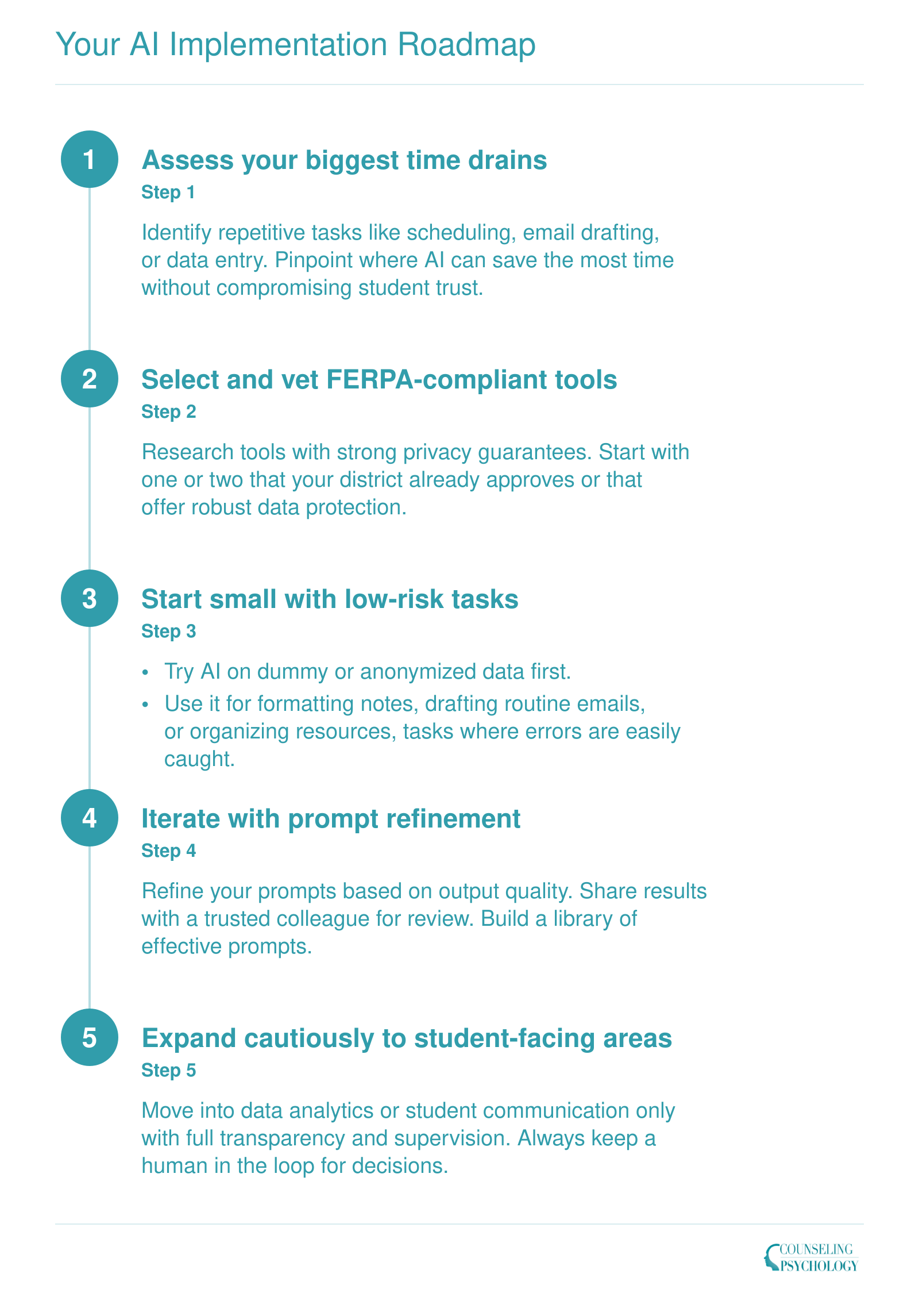
Your AI Implementation Roadmap
A practical, phased approach to integrating AI into your school counseling practice, from low-risk administrative tasks to thoughtful student-facing applications.
Navigating District Approval: How to Get AI Tools Greenlit
With over 80% of K-12 districts now using formal AI guidelines,1 securing district approval for an AI tool is not a barrier to innovation; it is a necessary step that aligns new technology with existing student-data protections and instructional priorities. School counselors can accelerate the process by understanding the typical review pipeline and building a compelling, compliant case.
The Approval Gauntlet
Most districts follow a nine-step workflow2, beginning with a request from a teacher or department and ending with ongoing monitoring and renewal. Counselors should identify the key decision-makers, typically the IT director, data privacy officer, and superintendent, and prepare the required documentation early. A Data Processing Agreement (DPA) from the vendor is non-negotiable3, and many districts require a Data Privacy Impact Assessment (DPIA) that maps data flows, analyzes risks, and outlines safeguards. Common objections include unclear data handling, equity of access, and lack of professional development, so be ready with answers.
A Real-World Model: Niles Township's Stoplight System
Niles Township High School District 219 in Illinois adopted a stoplight framework that categorizes AI use as red (prohibited), yellow (cited with caution), or green (required). This model gave counselors and teachers a clear map for proposing tools: any tool labeled “green” had already met privacy and pedagogical standards. Counselors aiming for district approval can mirror this approach by presenting the tool within a rubric that addresses safety, accountability, fairness, and efficacy, the SAFE benchmarks now recommended by multiple state guidelines.
Your Pitch Template: Time Savings, Equity, Compliance
When presenting to administrators, center the conversation on three pillars. First, quantify the time saved on routine tasks like scheduling and documentation, hours that can be reinvested in direct student support. Second, emphasize equity: AI can help scale personalized interventions across growing caseloads and a mental health workforce shortage, ensuring no student is left behind. Third, confirm FERPA compliance by showing that the vendor has completed a DPA and that the tool anonymizes or minimizes data wherever possible.
Building Trust with Colleagues and Families
Adoption fails without buy-in. Be transparent with colleagues by sharing examples of how you will retain human oversight, for instance, using AI to draft a communication plan but always reviewing and editing it personally. Engage parents through clear notices about data use and opt-out options, a requirement in states like Oklahoma.4 When counselors visibly blend technology with their professional judgment, skepticism often gives way to collaboration.
Real-World Success Stories: Counselors Using AI Effectively
Lincoln High School: 9x Increase in Student Interaction with AI
Lincoln High School deployed an AI chatbot to help students ask questions, schedule appointments, and receive immediate guidance outside of office hours. The tool, integrated with the school's student information system, allowed counselors to offload routine inquiries and focus on high-need students. Implementation involved a two-week pilot with a small group, training on appropriate queries, and clear guidelines for escalation to a human counselor when topics touched on safety or extreme distress.
- Student-counselor interactions rose by 9x as the chatbot acted as a triage layer, routing more students to in-person meetings.
- Career confidence jumped 72% after students used the AI to explore career paths and practice mock interviews.
- Academic goal setting improved by 65% as the tool sent automated reminders and check-ins on academic plans.3
Counselors reclaimed an estimated 5 to 10 hours per week previously spent on repetitive Q&A and scheduling, aligning with national trends showing 60, 70% of administrative tasks can be automated safely4, a meaningful shift given the ongoing shortage of mental health providers.
Sonar Mental Health: Expanding Access to 24/7 Support
Sonar Mental Health partnered with nine districts and served 4,500 students with an AI-driven wellness platform that offers 24/7 text-based support. Students can reach out anytime, and the system uses natural language processing to detect distress signals and alert counselors during school hours. Districts reported a 45% increase in mental health engagement5 after implementation, primarily because students felt more comfortable initiating conversations with an anonymous tool first, a critical step given the teen mental health provider shortage.
- Guidelines were critical: each district set clear norms that AI transcripts would be shared with a human counselor if the student consented or a risk flag triggered an automatic referral.
- Outcome: fewer students fell through the cracks during evenings and weekends, and counselors could review flagged conversations each morning to prioritize follow-ups.
When AI Goes Wrong: A Cautionary Tale
An Illinois counselor tried using an AI assistant to categorize two years of graduation data. The tool generated one sum, then on a second run produced a completely different figure, both smaller than the raw input numbers. When challenged, the AI replied, "Whoops, that was my mistake, sorry."2 This underscores the need for human oversight and verification, especially in data-sensitive tasks. Research shows that even popular models like ChatGPT can produce culturally insensitive responses in 15% of mental health queries1, making professional supervision non-negotiable. Adopt the double-check rule: never rely on unreviewed AI output for any student-facing communication or official data.
These stories reinforce the implementation roadmap covered earlier: start small, mandate oversight, and choose tools that align with FERPA and ASCA ethical guidelines to replicate success safely.
The Future of AI in School Counseling: Trends to Watch
By 2026, the global AI in education market is expected to reach $12.3 billion, a 36% annual growth rate since 20222. For school counselors, this investment signals tools that go far beyond scheduling, reshaping mental health intervention, IEP planning, and career guidance.
AI-driven mental health screening platforms are already used by over 200 schools through tools like Alongside, and nine new companies have been funded in K-12 mental health AI since 20221. These systems flag early warning signs from student writing or attendance, enabling early intervention. Personalized college and career planning engines generate postsecondary pathways using student data and local labor trends, while automated IEP and 504 prompts analyze records to suggest legally appropriate supports.
State and federal agencies are beginning to issue guidance on algorithmic bias and data privacy, though comprehensive regulations are still evolving. Counselors can expect clearer standards for student data use within two to three years.
Higher education provides a preview: adaptive learning platform adoption is projected to rise from 34% in 2023 to 71% by 2026, and 83% of institutions plan AI teaching assistants2. In K-12, this shift will free counselors from administrative tasks, allowing more direct student interaction. The relational core of counseling, trust and advocacy, cannot be automated, but AI can reduce the clerical backlog.
To prepare, counselors should stay informed through professional associations, join district pilot programs, and advocate for transparency and equity guardrails.