
What you’ll learn in this article…
- Alison Winter counseled a serial killer without a license for years.
- New York law demands three supervised years plus an exam for licensure.
- Unlicensed practice led to $60,000 in insurance fraud and felony charges.
Alison Winter collected $60,000 from insurers while counseling serial murder defendant Rex Heuermann in a Suffolk County jail. She had a master’s in social work but no license. In 2024, she faced grand larceny, fraud, and unauthorized practice charges.
For mental health professionals, the case exposes a critical reality: a graduate degree does not authorize independent clinical practice, and misrepresenting credentials can lead to felony charges. The gap between an MSW and an LCSW is years of supervised work and a licensing LCSW exam. Crossing that gap without authorization is a prosecutable offense with lasting consequences.
Inside the Gilgo Beach Jailhouse Sessions: A 'Therapist' Without a License
A Three-Year Deception
From November 2018 to May 2024, Alison Winter counseled Rex A. Heuermann inside the Suffolk County jail, presenting herself as a clinical social worker. Yet New York State’s Office of the Professions has no record of her holding any license to practice. In November 2024, Winter was arrested and charged with three counts of grand larceny, a scheme to defraud, and 14 counts of unauthorized practice of a profession, all felonies.1 Assistant District Attorney Cory Neunzig stated at her arraignment on November 26, 2024, that she practiced social work without a license throughout that entire period.
The Financial and Clinical Fallout
Prosecutors say Winter collected $60,000 in insurance reimbursements from Cigna and other insurers for claims filed since 2018 despite lacking a license.1 The unlicensed practice not only triggered insurance fraud charges but also placed her in a position to receive Heuermann’s most sensitive disclosures. Winter was present when Heuermann confessed to his wife and daughter that he killed eight women, and she later sat in court when he publicly admitted guilt. The exploitation of that access raises urgent questions about screening and oversight of therapists in high-stakes forensic settings.
Why This Case Matters for Every Licensed Professional
Melissa McCardle, a licensed clinical social worker and dean at Molloy University, explained that New York requires three years of supervised work (known as supervision hours) and a licensing exam to practice independently as a clinical social worker.supervision hours Winter earned a master’s in social work from Adelphi University in 1999, but a degree alone does not meet social work license requirements.social work license requirements This case erodes public trust in mental health services and highlights how unlicensed practice can quickly escalate into ethical nightmares and criminal liability. For any counselor, social worker, or MFT, it is a stark reminder that licensure compliance is non-negotiable, especially when working with clients whose cases capture national attention.
What ‘Practicing Therapy Without a License’ Actually Means, Legally and Ethically
What exactly makes providing therapy without a license a crime, and where does it cross the line from helpful conversation into illegal practice? In New York, the unauthorized practice of a profession isn’t about the setting (a jail, a private office, or a telehealth platform) or the label you give yourself. It’s about the activities you perform. Under the state’s Education Law, anyone who engages in assessment, diagnosis, or treatment of a mental disorder without holding a valid license is practicing illegally. This is true even if you call yourself a “coach,” a “consultant,” or a “peer supporter.” The law focuses on the function, not the job title.1
The Legal Line Between Therapy and Coaching
Life coaching is not regulated, but its scope is limited to goal-setting, motivation, and performance enhancement with generally functioning individuals. It does not involve diagnosing or treating mental health conditions. As soon as a practitioner starts identifying symptoms, using a diagnostic framework like the DSM-5, or creating a treatment plan, they have entered the realm of psychotherapy. At that point, a license is required. Coaches are also ethically bound to refer out when they suspect a mental health condition is present. Informed consent is critical: any unlicensed service should clearly state that it is not therapy and cannot address clinical issues. Billing health insurance for these activities (as happened in the Gilgo Beach case) adds a layer of fraud, because insurers reimburse only licensed clinical services.
Title Protection: Why “Therapist” Is a Protected Term
New York’s title protection laws reserve specific professional designations (such as Licensed Clinical Social Worker (LCSW), Licensed Mental Health Counselor (LMHC), Psychologist, and Psychiatrist) for those who have met the state’s education, supervision, and examination requirements. Even using the general term “therapist” (the distinction between a therapist and counselor is often misunderstood; see therapist vs counselor) or “psychotherapist” in a professional context may be interpreted as holding oneself out as a licensed practitioner, which can lead to disciplinary action. That’s why unlicensed individuals must be careful not to imply they provide clinical services. Peer supporters, for example, can share lived experience but must never claim to offer treatment.
Gray Areas: Coaching, Pastoral Counseling, and Volunteer Work
Many well-intentioned roles operate in gray zones. Pastoral counselors, for example, often provide emotional support within a spiritual framework, but if they diagnose or treat mental illness, they may be practicing without a license. Similarly, volunteer counselors at crisis hotlines must stay within a structured, non-diagnostic scope. The rule is simple: if you are doing clinical work, even for free or as a volunteer, you need a license. The felony charges in the Gilgo Beach case underscore that ignorance of this line is no defense, and the consequences can include grand larceny and insurance fraud accusations.
In 2023 alone, California regulators identified more than 1,300 individuals practicing mental health services without a license, according to ClinicMind data. That averages over 100 unlicensed practitioners per month, highlighting a widespread issue that state licensing boards continue to confront.
New York's Clinical Social Work License Requirements, and Why a Master's Isn't Enough
In New York, earning a master's degree in social work is just the beginning of a lengthy, supervised path toward independent clinical practice. Simply holding an MSW does not permit anyone to call themselves a licensed clinical social worker (LCSW) or to provide psychotherapy without proper oversight.
The Licensed Clinical Social Worker (LCSW) Pathway
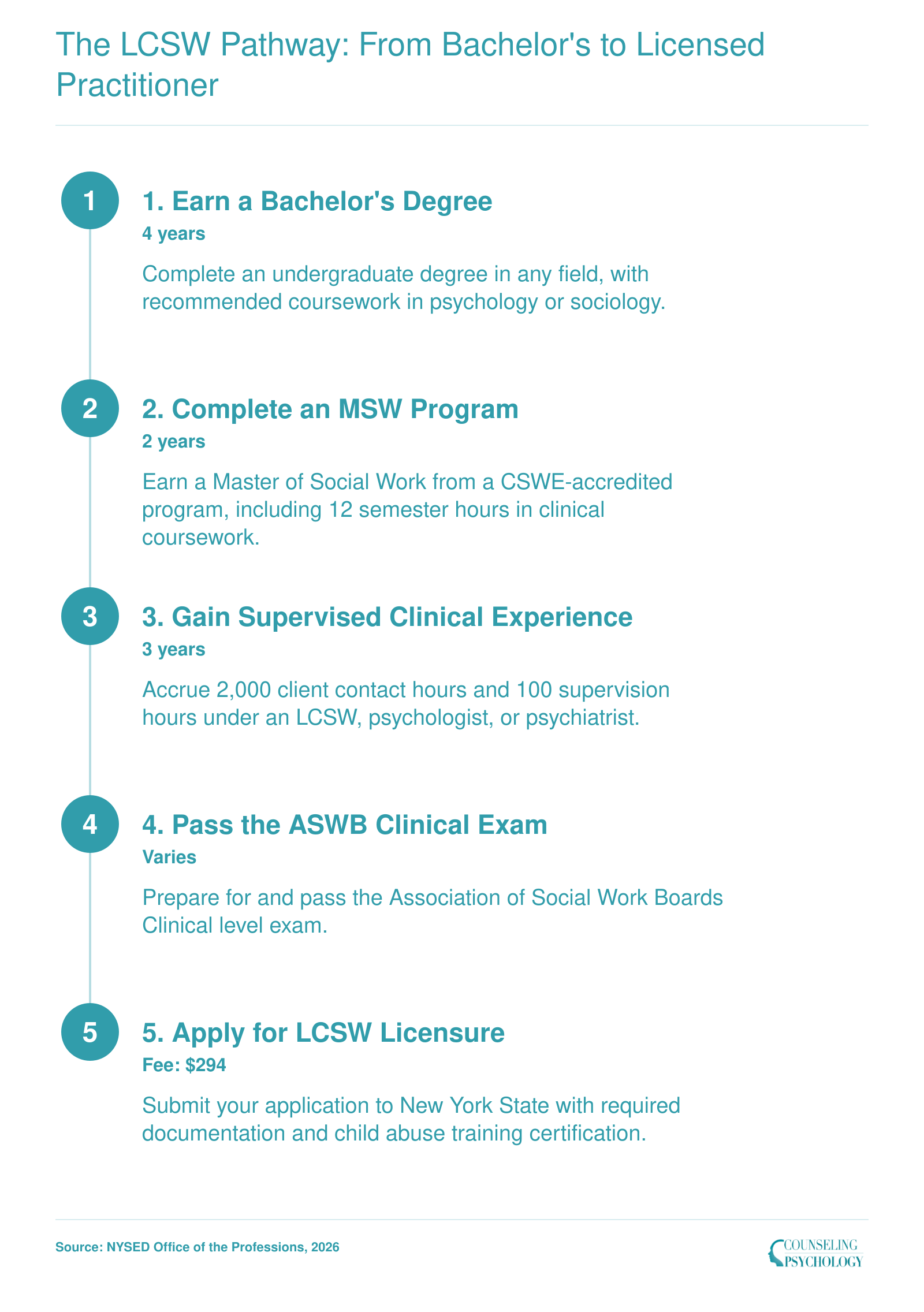
To become an LCSW in New York, candidates must first complete a Master of Social Work from a program accredited by the Council on Social Work Education (CSWE), totaling at least 60 semester hours1 including 12 hours of clinical coursework. After graduation, they enter a supervised experience phase that lasts a minimum of three years, during which they must accumulate 2,000 hours of direct clinical work3 and receive 100 hours of supervision4 from a qualified LCSW, psychologist, or psychiatrist. Only then can they sit for the Association of Social Work Boards (ASWB) Clinical Examination5. Applicants must also be at least 21 years old, complete training in child abuse identification and reporting, demonstrate good moral character, and pay a $294 application fee1.
Alison Winter's Unfinished Journey
Alison Winter earned her MSW from Adelphi University in 1999, a CSWE-accredited program, but there is no record that she ever completed the required post-graduate supervised experience or passed the licensing examination. Without these steps, she remained unlicensed and was practicing in a capacity reserved for LCSWs. The New York State Education Department confirms that Winter never held a license to practice clinical social work, which makes the nearly three years she counseled a high-profile inmate, and the insurance reimbursements she collected, legally problematic.
Similar Standards Across Mental Health Professions
New York's multi-year, supervised model is not unique. Licensed mental health counselors (LMHCs) typically need a 60-credit master's, 3,000 supervised hours, and passing the National Clinical Mental Health Counseling Examination. Licensed marriage and family therapists (LMFTs) follow a comparable track: a master's degree, 1,500 client contact hours (meeting specific LMFT supervision requirements), and a national exam. Across all these credentials, the message is consistent: a graduate degree alone grants no authority for independent practice.
No Exceptions for Correctional Settings
Whether in a private office or a county jail, providing clinical social work services without a license is illegal unless the individual holds a valid limited permit and works under strict supervision. Forensic and correctional settings do not relax these rules. The Winter case underscores that facilities must verify licensure diligently: failing to do so can lead to felony charges, insurance fraud, and profound ethical breaches.
The LCSW Pathway: From Bachelor's to Licensed Practitioner
Becoming a Licensed Clinical Social Worker (LCSW) in New York follows a defined educational and supervised practice pathway. While the specifics vary slightly, this general sequence also applies to aspiring Licensed Mental Health Counselors (LMHC) and Licensed Marriage and Family Therapists (LMFT).
A Practical Ethics Code for Unlicensed Mental Health Workers: What You Must Disclose
Working without a license can offer flexibility and fill care gaps, but it removes the institutional safety nets that licensed professionals rely on. Even if you are not bound by a licensing board, you must adopt a rigorous personal ethics code. Drawing from the foundational principles in the APA Code of Ethics, NASW, and ACA ethics codes, unlicensed mental health workers can build a defensible practice rooted in transparency, accountability, and client welfare.1
Informed Consent Is Non-Negotiable
The cornerstone of your ethical obligation is informed consent. Before any service begins, provide clients with a clear, written document that explicitly states: - Your unlicensed status and the fact that you are not a regulated health professional. - Your specific education, training, and scope of practice. - The exact nature of the services you will provide, including goals, methods, potential risks, benefits, and alternatives. - All fees and financial arrangements, ensuring they are fair and not exploitative. - The limits of confidentiality. Unlike licensed therapists, your communications may not be legally privileged. Disclose the specific situations where you may have to breach confidentiality: risk of serious imminent harm to self or others, child, elder, or dependent adult abuse, court orders, or public health mandates. - If you work under supervision, name your supervisor and explain the scope of oversight. Consent is not a one-time event; revisit it regularly and document any changes.
Define Your Competence and Its Limits
Stay strictly within the boundaries of your education, training, and supervised experience. You cannot diagnose or treat mental disorders, prescribe medication, or provide regulated psychotherapy. If a client’s needs exceed your competence, you have an ethical duty to refer them to a licensed practitioner. To maintain competence, seek regular supervision or consultation from a qualified professional, and engage in ongoing professional development. Fidelity to your role requires honesty about what you can and cannot do.
Navigate Boundaries with Extra Caution
Without institutional oversight, the risk of dual relationships and boundary violations rises sharply. Avoid any relationship that could impair your objectivity or risk exploitation. Romantic or sexual relationships with current clients are strictly prohibited; even with former clients, maintaining therapist ethical boundaries sexual relationships requires extreme caution.1 Keep physical contact minimal and only when therapeutically necessary, with explicit consent. Financial exploitation, such as excessive fees or accepting kickbacks for referrals, is never acceptable. Maintain responsible, secure records and limit access to protect privacy.
A Quick Self-Audit Checklist
Ask yourself these questions before each client engagement: - Am I clear about my role, and does my client fully understand it in writing? - Do I have a qualified supervisor or consultant available for guidance? - Have I explicitly discussed confidentiality limits and the possibility that my records could be subpoenaed? - Am I practicing within the boundaries of my documented competence, or do I need to refer? - Are my personal interests in any way compromising this professional relationship?
By embedding these practices, you uphold the ethical pillars of autonomy, beneficence, justice, and accountability, even as an unlicensed helper.
Questions to Ask Yourself
When Unlicensed Therapy Becomes a Felony: Fraud, Grand Larceny, and Jail Time
A single unlicensed therapist can defraud insurers of $60,000 in just a few years. In the Gilgo Beach case, Alison Winter allegedly collected that sum from Cigna and other insurers while counseling a serial murder defendant without a license. The legal logic is straightforward: every claim form she submitted attested to a licensed status she did not have, turning each filing into a potential charge of fraud.
The Insurance-Reimbursement Trap
Health insurance panels require a valid state-issued license for credentialing and reimbursement. An unlicensed practitioner cannot legitimately join a network, yet many exploit streamlined electronic billing to slip claims through. The Winter case shows why this is so dangerous: from November 2018 to May 2024, she allegedly billed for therapy sessions in a county jail, and the $60,000 in payments now constitutes grand larceny.
A National Pattern of Criminal Charges
The Gilgo Beach case is not an outlier. In 2024, Ramon Apellaniz was convicted of larceny and health care fraud for submitting over 12,700 Medicaid claims without a license; he received an eight-year prison sentence suspended after 15 months, five years’ probation, and a restitution order of more than $900,000.1 Sharonda Avery faced charges of practicing psychology without a license, obtaining money by false pretenses, and perjury.2 Evelyn S. Wilson was sentenced to five years’ probation for third-degree theft by deception after holding herself out as a therapist.3 More recently, in 2026, Daniel Robinson was charged with health care fraud and money laundering for a multimillion-dollar scheme involving unlicensed behavioral health services.4
Beyond Prison: Career-Endering Consequences
Felony convictions regularly lead to permanent exclusion from state licensure, meaning a person can never legally practice counseling, social work, or psychology. Even when a license is not yet held, a fraud conviction creates a record that follows the individual into any regulated profession, and a future LPC criminal background check will likely reveal it. Administrative fines are also common: state licensing boards can levy civil penalties regardless of whether the violator ever held a license, and professional liability insurers typically refuse coverage for fraudulent acts, leaving defendants personally exposed.
When Licensed Professionals Become Accomplices
The same criminal logic applies to supervising or billing under another professional’s license. If a licensed clinician knowingly allows an unlicensed person to provide therapy and then submits claims under the licensee’s name, both parties face conspiracy, fraud, and unauthorized practice charges. The Justice Department has prosecuted numerous behavioral health providers for this exact pattern,6 including the $8 million Lahor Behavioral Services fraud4 and a New Jersey physician who billed $3 million for work done by unqualified staff.5 Licensed supervisors must verify the credential status of everyone billing under their name, otherwise they risk their own career and freedom.
If you call yourself a therapist, the law will likely treat you like one, regardless of what you charge or where you work. Misrepresenting your credentials in any setting, even a jail, can lead to felony charges and loss of your career. Always be transparent about your licensure status.
Therapist Confidentiality and Crime: Are You a Mandated Reporter for Murder?
Mental health professionals face no general legal duty to report a client's past admission of murder, but the obligation to protect potential future victims creates a narrow and widely misunderstood exception.
The General Rule: Past Crimes Stay Confidential
Under New York law and most state statutes, therapists are not required to report a client's confession to a crime that occurred in the past.5 Confidentiality is a cornerstone of the therapeutic relationship, and unless there is an ongoing, identifiable threat, the clinician has no obligation to disclose. This means that if a client admits to a murder committed years ago, the therapist typically maintains confidentiality. The duty of care focuses on prevention of future harm, not punishment of past acts.
The Tarasoff Exception: A Duty to Protect, Not Just Warn
The well-known Tarasoff principle, recognized in New York as a duty to protect, requires therapists to take reasonable steps when a client presents a serious risk of violence to a specific, identifiable individual. In New York, Mental Hygiene Law § 9.46 mandates that mental health professionals report when they determine a patient is likely to engage in conduct that would cause serious harm to self or others.1 This obligation extends beyond warning the potential victim; it may involve notifying law enforcement or initiating involuntary hospitalization. Critically, this duty does not apply to vague or nonspecific threats. It activates when the threat is imminent and the target is reasonably identifiable.
Other Mandatory Reporting Requirements
Confidentiality also yields to several other well-defined statutory exceptions. All mental health professionals are mandated reporters of child abuse or maltreatment.2 In New York, failure to report suspected child abuse is a misdemeanor with potential civil liability.2 Additionally, New York requires mental health professionals to report abuse of vulnerable adults under the Justice Center's requirements.3 Therapists may also be compelled to disclose information through a valid court order. Good faith reporting under these statutes generally provides immunity from liability.4
The Gilgo Beach Case: Unlicensed and Unprotected
The case of Alison Winter, who counseled Rex Heuermann without a license, adds a crucial layer. Because Winter was not a licensed professional, she likely lacked the legal privilege that protects client-therapist communications. Had she been licensed, her obligation would depend on whether Heuermann's statements indicated a future threat to identifiable victims. Given that he was in custody and the confessions related to past murders, a licensed therapist might argue there was no ongoing danger. However, if the sessions revealed undiscovered victims or continuing criminal activity, the calculus changes. Even so, the therapist must carefully document clinical reasoning and seek therapist peer consultation and legal counsel.
Ethical Codes and Documentation
Both the American Psychological Association and the National Association of Social Workers ethical guidelines stress the importance of consultation when confronting these dilemmas. Clinicians should not make unilateral decisions about breaking confidentiality. Instead, they are advised to seek supervision, document their decision-making process, and inform the client of the limits of confidentiality at the outset of treatment. Proactive discussion can prevent misunderstandings and protect both the client and the practitioner.
Protect Your Career and Your Clients: Proactive Steps for Licensed and Unlicensed Professionals
The mental health field is increasingly emphasizing proactive credential verification to prevent breaches of public trust.
Maintain Active License Verification
- Routinely check your own license status on your state's online database. In New York, the Office of the Professions offers a verification search; all states have similar portals. Set a calendar reminder to confirm your status annually.
- When hiring or collaborating, verify others' credentials through primary sources, not just resumes. The Gilgo Beach case shows how easily unlicensed practitioners slip through when agencies rely on self-reported credentials.
Secure Malpractice Insurance
- Even if your role doesn't require it, malpractice insurance signals commitment to ethical care and protects you from personal liability. Many professional associations offer group rates. For unlicensed practitioners, some policies cover supervised work; clarify coverage with your insurer.
Create a Safe Referral Protocol
- If someone requests therapy and you lack an independent license, immediately refer them to a licensed therapist. Document the referral in writing, including the date and the colleague's contact information. Never offer even informal counseling, as it may breach state practice acts.
- For supervisees: ensure all clients know your supervisor's full name, license type, and how to reach them. Post this information visibly in your office and include it in intake paperwork.
Push for Institutional Vetting
- Correctional facilities and community agencies must implement rigorous credential checks that go beyond a resume review. Verify licenses directly with state boards, require primary-source documentation, and conduct periodic re-verification. The Suffolk County jail incident demonstrates the catastrophic consequences of skipping these steps.
A license isn't just a piece of paper; it's the guarantee that someone has met minimum standards of competence and ethics.
How to Report an Unlicensed Therapist: A Step-By-Step Guide for Clients and Colleagues
Anonymous tip versus documented complaint: both can trigger an investigation, but the level of detail you provide determines how quickly the board can act. Whether you’re a client who discovered your therapist has no license or a professional who sees a colleague practicing without credentials, the reporting process follows a clear path designed to protect the public.
Gathering the Evidence
Begin by collecting any materials that suggest the individual is offering therapy services. This includes invoices, insurance statements, contracts, advertisements, emails, or text messages that refer to counseling, diagnosis, or treatment. Use the New York State Education Department’s online license lookup to verify whether the person holds a current registration. If no license exists, that documentation will be central to your complaint.
Filing a Confidential Complaint
In New York, complaints go to the Office of the Professions in writing. You can download the Discipline Complaint Form, then mail or fax it to 212-951-64201. For general questions, call 1-800-442-8106 or email [email protected]2. You may submit anonymously, though providing your contact information often expedites the process. The agency keeps your identity confidential during the investigation.
What Happens After You File
The Office of the Professions screens every complaint. If it falls within their jurisdiction, they open an investigation and request a response from the individual, who typically has 30 days to reply. After case review, possible outcomes include a cease-and-desist order, referral to the Attorney General or District Attorney for criminal prosecution, or formal disciplinary charges. Practicing without a license is a felony under New York Education Law §6512, carrying potential jail time and fines4.
Ethical Duties for Licensed Professionals
Both the NASW Code of Ethics (2021) and the ACA Code of Ethics (2014) require licensed social workers and counselors to report serious unethical behavior, especially when clients are at risk5. Failing to report a known unlicensed practitioner can itself constitute an ethical violation. If you encounter an unlicensed colleague, your obligation is to protect client welfare by notifying the board.
Protecting Yourself Legally
Stick to facts when filing. Do not post public accusations or speculate online, as that could expose you to defamation claims. Simply provide the evidence to the regulatory body. The board, not you, will determine if a violation occurred. Let the investigation take its course.
Frequently Asked Questions About Unlicensed Therapy and Licensing
The Gilgo Beach case highlights serious risks when individuals practice therapy without a license. Below are answers to common questions about licensure, legal boundaries, and what to do if you suspect unlicensed practice.