
What you’ll learn in this article…
- New federal rules strip Grad PLUS loans from master's counseling programs.
- Annual federal loans for affected students now cap at $20,500.
- Over 6,800 mental health shortage areas may deepen due to funding gaps.
As of July 2026, the U.S. Department of Education reclassified most master’s programs in clinical mental health counseling, social work, and marriage and family therapy, removing them from the “professional degree” category for federal aid purposes. The immediate result: a new annual loan cap of $20,500 and the loss of Grad PLUS eligibility, leaving many students to cover gaps of $10,000 or more. The change lands squarely on a behavioral health workforce that already needs 31,000 more full-time providers to serve 137 million Americans living in shortage areas.
Why Were Counseling and Social Work Degrees Reclassified?
In late 2025, the U.S. Department of Education issued a regulatory update that narrowed the definition of a "professional degree" for federal student aid purposes. As a result, many master's-level counseling and social work programs no longer qualify for the same loan limits as doctoral-level professional programs like medicine or law.
Why the Definition Changed
The revision sought to align federal aid more closely with the time, cost, and licensure demands traditionally associated with professional practice. Historically, the "professional degree" label was tied to programs that required at least six years of postsecondary study and led to licensure in fields where a graduate credential was the minimum for entry. By tightening these criteria, the Department of Education aimed to distinguish degrees that demand an extended academic commitment from those that, while rigorous, are completed in a shorter time frame.
Critics argue the change overlooks the reality that licensed professional counselors and social workers, despite the difference between counseling and social work, increasingly serve as frontline mental health providers, often completing thousands of hours of supervised clinical work after earning a two-year master's degree. Supporters, however, maintain that the reclassification simply brings the regulatory language in line with program length and prevents loan limits from outpacing typical borrowing needs.
How to Verify the Details for Your Program
Because the final rule's impact varies by program length, CIP code, and accreditation status (factors that differ among the types of counseling degrees), current and prospective students should take three steps:
- Check the Federal Register: The official rule and preamble contain the precise criteria used. Look for Docket ID ED-2023-OPE-0120 on regulations.gov, which includes the final definition and any exceptions.
- Contact your school's financial aid office: Aid administrators have the most current guidance on how the reclassification affects borrowing caps for your specific degree path.
- Consult professional associations: Organizations like the Council on Social Work Education (CSWE) and the American Counseling Association (ACA) have published member advisories and FAQs summarizing the changes.
Understanding the Broader Context
The reclassification arrives amid severe behavioral health workforce shortages. By moving these programs out of the "professional degree" category, graduate students are redirected toward Grad PLUS loans and private alternatives sooner, potentially limiting access for those from lower-income backgrounds. Professional associations continue to advocate for a legislative fix, while many universities are reexamining tuition structures and institutional aid to fill the gap.
How Federal Financial Aid and Loan Limits Changed
The reclassification introduces a stark tradeoff: lower borrowing limits may reduce long-term debt, but they also threaten to price many aspiring counselors and social workers out of graduate education. As of July 1, 2026, the federal aid landscape for these students has shifted dramatically.
New Annual and Aggregate Caps
For graduate programs no longer deemed professional (including most counseling and social work degrees), annual Direct Unsubsidized Loan borrowing is capped at $20,500. The separate aggregate limit for graduate non-professional study is $100,000.1 When combined with any outstanding undergraduate loans, the overall federal student loan ceiling can reach $257,5002, though that total includes all prior borrowing and is not a fresh pool for graduate school alone.
These caps stand in sharp contrast to the pre-2026 framework, where graduate and professional students could borrow up to $20,500 annually in Direct Unsubsidized Loans and then cover any gap through cost-of-attendance-based Grad PLUS Loans.2 The practical result: many students who once financed tuition, fees, and living costs entirely through federal loans now face a hard stop far below the actual price of most programs.
Grad PLUS Loans Eliminated for New Borrowers
Beginning with the 2026-2027 award year, Grad PLUS Loans are unavailable to new borrowers in non-professional graduate programs.2 This removal is the most consequential change, since Grad PLUS previously functioned as the safety valve allowing students to borrow up to the full cost of attendance. Without Grad PLUS, counseling and social work enrollees must either fund the difference through private loans, savings, institutional aid, or counseling scholarships.
For continuing students who borrowed Grad PLUS before the cutoff, a three-year interim exception runs through June 30, 2029.3 During this period, eligible existing borrowers may access a limited Grad PLUS option capped at $20,500 annually, offering a temporary bridge but not a full cost-of-attendance solution.
What This Means for Borrowing Power
To put the numbers into context: the typical master's in social work or counseling can cost between $40,000 and $100,000 in tuition alone (see the cost of an MSW). Under the old rules, a student could cover the entire amount with federal loans. Now, the $20,500 annual limit means even a two-year program provides at most $41,000 in Direct Unsubsidized Loans, leaving a significant funding gap. The aggregate ceiling further restricts those needing longer or multiple attempts at licensure.
Prospective students should carefully calculate their expected total program cost and federal loan eligibility before enrolling. While lower federal borrowing may reduce long-term debt burdens, it also raises immediate affordability challenges that demand creative financial planning.
Which Counseling and Social Work Programs Are Affected?
What counseling and social work degrees are affected by the reclassification? The answer hinges on whether a program’s Classification of Instructional Programs (CIP) code appears on the Department of Education’s list of fields qualifying for the professional degree designation.1 Programs on the list continue to enjoy access to Grad PLUS loans and higher annual limits; those left off are now capped at the Direct Unsubsidized Loan limit, $20,500 per year for graduate students, with no Grad PLUS eligibility.
Covered Programs Retain Full Loan Access
- Master of Social Work (MSW): CIP code 44.0701 is included in the DOE’s qualifying list. MSW students remain eligible for Direct Unsubsidized Loans plus Grad PLUS loans up to the cost of attendance.
- MA in Clinical Mental Health Counseling: CIP code 51.1508 for Mental Health Counseling appears on the approved list. Students in these programs continue to have full federal loan access.
- MA in School Counseling: CIP code 13.1101 (Counselor Education/School Counseling and Guidance Services) is covered. School counseling master’s students face no reduction in federal aid eligibility.
- PhD in Clinical Psychology: CIP code 42.2801 is explicitly listed among qualifying fields. Students in this doctoral degree in psychology retain professional degree status and full loan access.
Programs Reclassified as Non-Professional
Several closely related degrees were not included on the DOE’s list, losing access to Grad PLUS loans and higher borrowing limits.1 Affected students now rely solely on Direct Unsubsidized Loans, which may fall short of tuition at private or out-of-state institutions. - Counseling Psychology (MA/PhD): CIP code 42.2803 for Counseling Psychology is absent from the qualifying list. Whether in a psychology department or a school of education, students in a masters in counseling psychology now face the non-professional loan cap. - Potential Others: While data is still emerging, programs such as PhD in Counselor Education, School Psychology, and other behavioral health degrees whose CIP codes were omitted face similar uncertainty unless their codes are added in later guidance.
The Clinical Psychology Exception
The distinction between clinical vs counseling psychology PhD programs illustrates the rule’s uneven impact. Clinical psychology doctoral programs retain Grad PLUS eligibility because their CIP code (42.2801) is explicitly recognized. Meanwhile, counseling psychology, often housed in the same psychology departments and leading to the same licensure, is left out simply due to its CIP code assignment. This creates a financial gulf between two paths to the same licensed psychologist role.
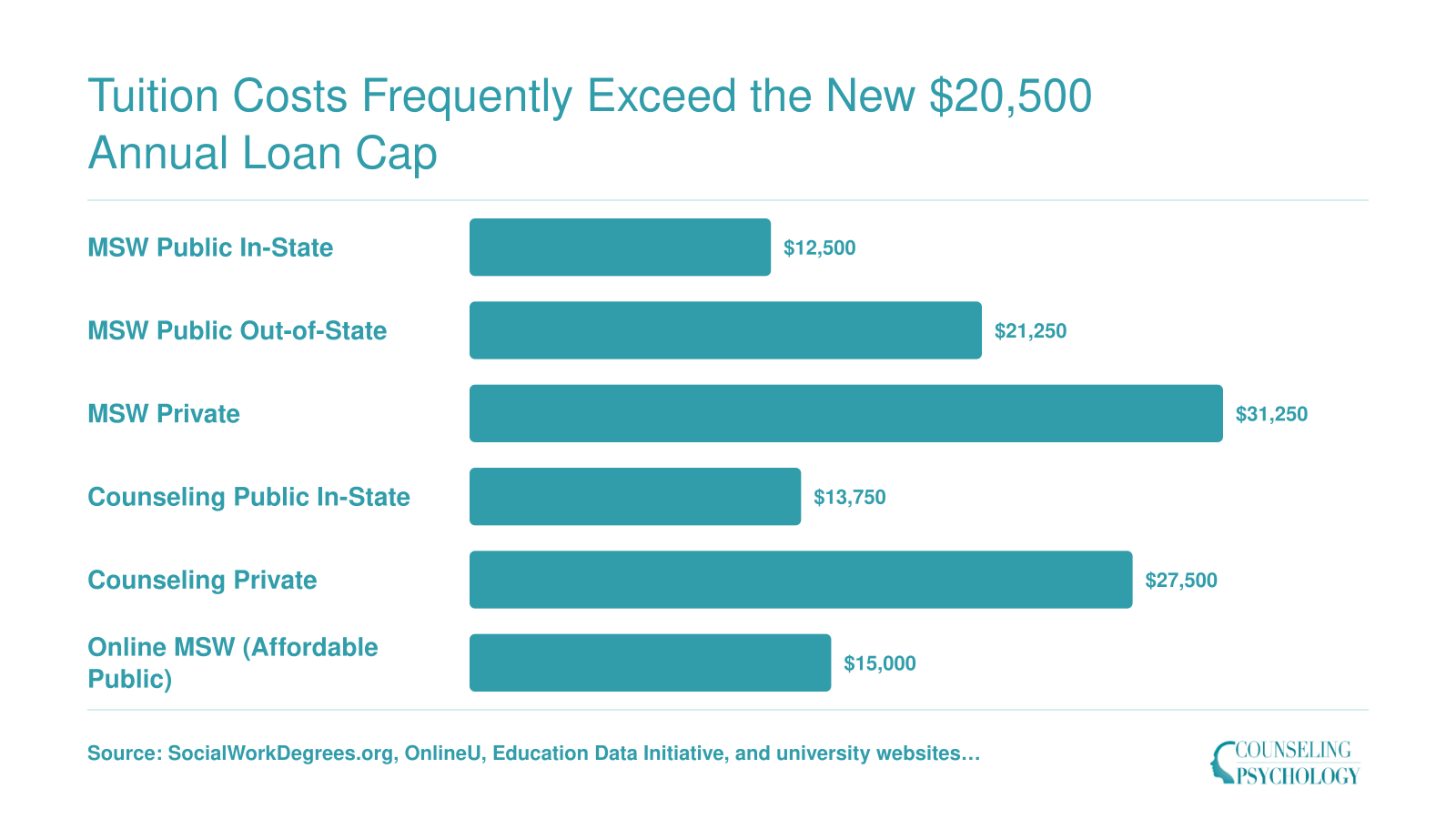
Tuition Costs Frequently Exceed the New $20,500 Annual Loan Cap
Tuition for accredited master's programs in social work and counseling varies widely by institution type. The new federal annual loan cap of $20,500 often falls short of actual costs, leaving students to cover gaps of $10,000 or more.
The Behavioral Health Workforce by the Numbers
Even before the degree reclassification, the behavioral health field was facing a critical labor shortage. HRSA data shows that over 6,800 mental health practitioner shortage areas exist, affecting 137 million Americans, with a projected shortfall of 31,000 full-time equivalent providers. Looking ahead to 2038, baseline estimates project a need for nearly 100,000 additional mental health counselors alone, and elevated demand scenarios push that figure above 200,000. With new loan limits potentially reducing the pipeline of graduates entering these fields, the already strained workforce may struggle to keep up with growing demand.
| Occupation | Total Employment | Median Annual Wage |
|---|---|---|
| Mental Health and Substance Abuse Social Workers | 125,910 | $60,060 |
| Marriage and Family Therapists | 65,870 | $63,780 |
| Substance Abuse, Behavioral Disorder, and Mental Health Counselors | 440,380 | $59,190 |
Questions to Ask Yourself
What Current Students Need to Know (By Cohort)
For students already enrolled in counseling or social work master's programs, the reclassification creates a sharp divide between those who can still borrow what they need and those who must suddenly make a much tighter budget work. Understanding which side of the line you fall on, and what actions could accidentally push you across it, is critical before registering for your next term.
The Grandfathering Provision: Who Keeps Grad PLUS Access
The One Big Beautiful Bill Act includes a narrow grandfather clause for students who began their program before the July 1, 2026 cutoff. If you first borrowed a Grad PLUS loan for your current degree program and the loan was disbursed on or before June 30, 20261, you can continue borrowing Grad PLUS funds to finish that same program. This protection lasts for up to three years after July 1, 2026, or until you complete the credential, whichever happens first.
This extension is not automatic. You must maintain continuous enrollment without switching degree objectives, transferring to a different school, or changing your program's CIP code.3 Even a temporary leave of absence that leads to a formal withdrawal and later re-enrollment can terminate your grandfathered status, as federal regulators have adopted a strict interpretation of continuous enrollment.4
Edge Cases: Advanced Standing, Dual Degrees, and Leaves of Absence
The Department of Education has not issued blanket protections for students in hybrid or accelerated pathways. Specific scenarios raise significant risk:
- Advanced standing: If you return to a counseling or social work program after summer 2026 with advanced standing MSW credits advanced standing MSW, your new start date may be treated as a fresh enrollment. When the advanced standing move changes your CIP code or degree objective, the grandfather provision typically does not apply.4
- Dual degrees: Grandfathering follows the program, not the student. If you are pursuing an MSW dual degree program MSW dual degree programs, such as a combined MSW/JD, and took a Grad PLUS disbursement for the social work portion before July 1, only that specific program's continued costs are protected.3 Any additional Stafford or private borrowing for the law degree would fall under the new, lower loan caps.
- Leaves of absence and withdrawals: A leave that becomes a formal withdrawal severs the continuous enrollment requirement.4 Even if you return to the same program at the same university, you may re-enter as a new student under the post-2026 rules, losing Grad PLUS eligibility entirely.
- Transferring or switching programs: Whether you move to a different institution or simply change your master's track within the same department, any break in the original program's CIP code or degree objective ends grandfather protection.34
What You Should Do Now
- Verify your disbursement date: Confirm with your financial aid office that a Grad PLUS loan was actually applied to your account on or before June 30, 2026. A pending application is not enough.
- Request a written determination: Ask your school to confirm in writing that you qualify for the grandfather provision and specify the exact date when your protection ends.
- Model worst-case borrowing scenarios: Even with grandfathering, the clock is ticking. Plan your course load to finish before the three-year window closes, and understand what the trade-off would be if you had to rely only on Stafford loans ($20,500 annual cap, $100,000 aggregate)2 for any remaining terms.
- Pause before any status change: Before you take a leave, transfer, or add a second degree, meet with financial aid to learn how the move would reclassify your eligibility.
The rules are narrow enough that even an innocent administrative step can cost you tens of thousands in borrowing capacity. Your best move is to get unambiguous, personalized guidance from your financial aid office right now.
How to Pay for Your Degree: Alternative Funding Options
Beyond federal loans, counseling and social work degree students can tap a mix of scholarships, grants, loan repayment programs, and employer benefits to reduce out-of-pocket costs. These options help fill the gap created by recent federal loan limits and don't have to be repaid if you meet service commitments.
Scholarships and Grants from Institutions
Many universities offer need-based and merit-based aid directly. Look for CSWE-accredited program grants, departmental scholarships, and diversity fellowships. For example, the CUNY Social Work Fellows Program distributed $3 million in 2026 to 95 students1, showing how institutional support can be substantial. Ask your admissions office about targeted fellowships for behavioral health, child welfare, or rural practice.
Federal Loan Repayment and HRSA Workforce Programs
The National Health Service Corps (NHSC) loan repayment program now covers licensed professional counselors, marriage and family therapists, and clinical social workers who serve in Health Professional Shortage Areas, helping to address the mental health workforce shortage. You could receive up to $50,000 in loan repayment for a two-year commitment.2
The HRSA Behavioral Health Workforce Education and Training (BHWET) program provides grants to accredited institutions, which then award stipends to students. Master's-level trainees can get $10,000, while doctoral students may receive $25,000.3 Counseling programs also offer field-year stipends ranging from $10,000 to $25,000.1 Overall, the national BHWET program authorized $225 million to expand the behavioral health pipeline.2
Additionally, the HRSA Scholarships for Disadvantaged Students (SDS) program awards need-based scholarships to graduate students from disadvantaged backgrounds pursuing clinical social work, mental health counseling, marriage and family therapy, rehabilitation counseling, or clinical psychology.4
State-Specific Loan Repayment Programs
Many states run loan repayment programs for mental health providers. California's Licensed Mental Health Services Provider Education Program is one example that helps licensed clinicians in underserved areas. Check with your state's health department or higher education agency for similar initiatives.
Employer Tuition Assistance and Service Commitments
Behavioral health employers often reimburse tuition, typically $3,000 to $10,000 per year, in exchange for a service commitment. Hospitals, community clinics, and government agencies may offer such benefits, which can be especially helpful for aspiring community mental health counselors. This arrangement can reduce your borrowing while securing a job upon graduation.
Combining These Sources
To make graduate school affordable, stack these options. Apply for institutional aid early, complete the FAFSA to qualify for HRSA scholarships, and research state programs. After you start working, enroll in NHSC loan repayment to manage debt. With careful planning, you can fund your education without relying solely on loans.
Licensure and Professional Identity: What the Reclassification Does Not Change
Federal loan classification and state licensure operate on entirely separate tracks, and the recent degree reclassification does not merge them. Your ability to become a Licensed Clinical Social Worker (LCSW), Licensed Professional Counselor (LPC), or Licensed Marriage and Family Therapist (LMFT) remains governed by state licensing boards, not by the U.S. Department of Education.2
Separate Paths: Federal Aid vs. State Licensure
State licensing boards set their own education, examination, and experience requirements under state law. The federal government's decision to reclassify counseling and social work degrees as "professional" rather than "graduate" degrees changes only the federal loan limits attached to those programs. It does not reach into state statute, nor does it invalidate the degrees themselves for licensure purposes. Every U.S. state and territory ties social work licensure to CSWE-accredited programs, and that accreditation remains fully intact.
Professional Associations Weigh In
Both the American Counseling Association and CSWE have issued statements clarifying that the rule change is purely about federal loan eligibility. The Social Work Leadership Roundtable, while warning of workforce consequences, has focused its advocacy on loan policy, not on state licensure standards.1 Their concerns center on financial barriers, not on the professional validity of the degrees.
Focus on Meeting State Requirements
Prospective and current students should continue to prioritize meeting their specific state's licensure requirements. These include completing a CSWE-accredited program for social work, passing board-recognized exams, and fulfilling supervised practice hours. The Social Work Licensure Compact, an interstate agreement that improves social work licensure portability, still relies on state-based authority and does not create a national license. Your professional path is defined by state law, not federal loan classifications.