

What you’ll learn in this article…
- Net price after institutional aid, not sticker tuition, drives every ranking position in this list of Chicago-area I-O psychology programs.
- I-O psychologists in the Chicago metro earn well above the national median for psychology professions according to BLS data.
- Program formats range from fully online to on-campus, with online options limited to a handful of ranked schools.
- Terminal master's and PhD-pathway programs require different admissions profiles, so confirm each school's track before applying.
Graduate tuition for I-O psychology master's programs near Chicago ranges from roughly $10,000 to more than $47,000 in total program costs, a spread wide enough to make school selection a genuinely high-stakes financial decision.
Chicago is one of the largest corporate and consulting hubs in the Midwest, which translates to real employer demand for professionals trained in talent assessment, organizational development, and workforce analytics. That labor-market context makes the region an attractive place to study I-O psychology, but it also means programs understand their leverage and price accordingly.
Affordability is not simply a matter of sticker tuition. Public institutions like Southern Illinois University-Edwardsville and Illinois State University post in-state tuition well under $11,000 per year, while private programs in the city can run three to four times that figure before financial aid. Students earlier in their education may first want to consider an industrial organizational psychology bachelor degree before committing to graduate costs. Where you land after aid is the number that actually matters.
Best Affordable I-O Psychology Master's Programs Near Chicago
These programs are ranked primarily by affordability, with net price and financial aid metrics carrying the most weight. Prestige alone does not drive position; what matters here is how much you actually pay after institutional aid, paired with program quality and career-relevant training. Program-level post-completion earnings data (at the one-year and two-year marks) are not yet published for these I-O master's tracks, so we provide institution-wide 10-year median earnings as a broader reference point instead.
- Net price after financial aid
- Tuition and fee structure
- Institutional graduation and retention rates
- Post-completion earnings potential
- Program format and career alignment
- NCES-IPEDS federal institutional data — nces.ed.gov
- College Scorecard graduate earnings — collegescorecard.ed.gov
- Internal program database
- Independent program research

Southern Illinois University-Edwardsville
SIUE delivers a scientist-practitioner I-O master's with one of the lowest net prices on this list, at $14,889. The university sits in the St. Louis metro, which translates to significantly lower living costs than downtown Chicago. With a 15:1 student-faculty ratio and both research and applied exit options, students get personalized training that prepares them for corporate roles or doctoral study. Institution-wide, SIUE reports a 57% graduation rate and median earnings of $56,346 at the ten-year mark.
- Scientist-practitioner model with research or fieldwork exit tracks
- Traditional daytime course schedule on campus
- In-state tuition of $10,488 with a net price of $14,889
- Median graduate debt of $20,500 at the institutional level
- Proximity to St. Louis metro for employer networking
- 15:1 student-faculty ratio supports close mentorship
Industrial-Organizational Psychology MA — On-Campus

Illinois State University
Illinois State's two-year, full-time I-O master's trains scientist-practitioners to address workplace and organizational challenges in business, government, and industrial settings. In-state tuition sits at $10,218, and the institution-wide net price is $19,398, making it one of the most affordable public options for Chicago-area residents. ISU reports a 64.5% graduation rate and institution-wide median earnings of $62,117 at ten years post-enrollment. The program also houses a Social Psychology concentration within the same department for students wanting broader behavioral science training.
- Full-time, two-year on-campus program
- Scientist-practitioner training framework
- In-state tuition of $10,218; out-of-state $13,062
- Focus on research methodology and organizational behavior
- Institutional median graduate debt of $20,482
- Prepares graduates for HR, consulting, and organizational development
- Campus-based two-year program alongside I-O cohort
- Emphasis on social psychology theory and research
- Full-time enrollment required
- Same scientist-practitioner model as I-O track
- Shared department resources and faculty mentorship
- Useful foundation for doctoral study in social or applied psychology
Industrial/Organizational-Social Psychology, Industrial/Organizational Psychology Concentration — On-Campus
Industrial/Organizational-Social Psychology, Social Psychology Concentration — On-Campus

The Chicago School at Chicago
The Chicago School of Professional Psychology places its flagship campus in downtown Chicago, giving I-O students direct access to the city's corporate and nonprofit employers for 600-hour internships. The program is available online and on campus, with full-time (two-year) and part-time (three-year) pacing. A Human Resources concentration lets students specialize in talent management and workforce planning. While net price data is not reported for this institution, its flexibility and Chicago-embedded practicum network make it a strong option for working professionals seeking career advancement without relocating.
- Online and on-campus delivery options
- 600 hours of required internship experience
- Full-time (2-year) or part-time (3-year) pacing
- Curriculum aligned with SIOP competency guidelines
- Internship and Applied Research exit tracks available
- 3.0 GPA recommended for admission
- Designed for working professionals in the Chicago metro
- Specialization in talent management and employee relations
- Same flexible online/campus format as the general track
- Strategic workforce planning coursework
- Targeted preparation for HR leadership roles
- Internship placements with Chicago-area organizations
- Integrates psychological insights with business strategy
M.A. Industrial and Organizational Psychology — Online
M.A. Industrial and Organizational Psychology, Human Resources Concentration — Online

Roosevelt University
Roosevelt University offers a STEM-designated I-O master's on its downtown Loop campus, placing students within walking distance of major Chicago employers. The net price of $20,194 is competitive among private, in-city options. Roosevelt also offers a dual MA in I-O Psychology and MBA for students who want both psychological and business credentials in about three years. The institution-wide graduation rate is 35.1%, and median earnings reach $48,712 at the ten-year mark. A small 11:1 student-faculty ratio means more direct faculty interaction than at larger programs.
- STEM-designated two-year campus program
- Downtown Chicago Loop location
- Net price of $20,194 after institutional aid
- Tuition of $20,935 (same in-state and out-of-state)
- Multiple start dates with fall and spring entry
- 11:1 student-faculty ratio for close mentorship
- Internship opportunities with Chicago-area organizations
- Three-year combined degree on the Chicago campus
- STEM-designated with F1 visa eligibility
- Merges I-O psychological training with business strategy
- 3.0 GPA and letter of intent required
- Fall and spring start dates available
- Prepares graduates for HR leadership and consulting roles
Master's in Industrial Organizational Psychology — On-Campus
Dual MA in Industrial/Organizational Psychology and MBA — On-Campus

Illinois Institute of Technology
Illinois Tech delivers a rigorous 36-credit M.S. in I-O Psychology that shares coursework with doctoral students, giving master's candidates exposure to Ph.D.-level methods without a doctoral time commitment. The sticker-price tuition of $35,222 is offset by substantial institutional aid: the net price drops to $18,425, and partial tuition scholarships and teaching assistantships are available. The university's 75.2% graduation rate and institution-wide median earnings of $82,592 at ten years are the highest on this list. Fall-only admission and STEM designation round out the profile.
- 36-credit STEM-designated campus program
- Courses shared with Ph.D. students for advanced rigor
- Net price of $18,425 after institutional aid
- Partial tuition scholarships and teaching assistantships
- International program component available
- Fall-semester-only admissions cycle
- Institution-wide median earnings of $82,592 at ten years
Master of Science in Industrial-Organizational Psychology — On-Campus

Elmhurst University
Elmhurst University's part-time, evening I-O master's is built for Chicago-area professionals who want to keep working while earning their degree. The cohort model fosters tight professional networks, and suburban Elmhurst offers lower living costs than downtown Chicago. The net price is $24,185, with institution-wide median graduate debt of $20,489. Elmhurst reports a 70% graduation rate and median earnings of $61,462 at the ten-year mark. GRE scores are optional, lowering another barrier to entry.
- Two-year, part-time evening campus program
- Cohort model for structured peer networking
- Net price of $24,185 after institutional aid
- GRE optional for admission
- Hands-on projects focused on organizational interventions
- Prerequisites in psychology and statistics required
- Suburban location reduces housing and commute costs
Master of Arts in Industrial/Organizational Psychology — On-Campus

DePaul University
DePaul's I-O program is structured as a combined MA/PhD track rather than a standalone terminal master's, which means funding and assistantships tend to be oriented toward doctoral training. The net price of $30,902 is the highest on this list, but students gain access to research opportunities (including NASA-funded projects), internships with major corporations, and a 201,000-plus alumni network. The institution reports a 67.8% graduation rate and median earnings of $68,751 at ten years. Students who want only a master's should confirm whether the program accommodates terminal-master's exits before applying.
- Combined MA/PhD track, not a standalone terminal master's
- Four-year expected completion for full sequence
- Lincoln Park Campus in Chicago
- NASA-funded research opportunities available
- Internships with major Chicago-area corporations
- 97% post-graduation employment or placement rate
- Secondary specialization options across psychology
- Net price of $30,902, the highest among listed programs
Industrial-Organizational Psychology MA/PhD — On-Campus

Adler University
Adler University blends I-O training with a social justice mission, requiring a 200-hour Social Justice Practicum typically completed with Chicago-area community organizations. The campus program and multiple online tracks (including Data Science, Training and Development, and Human Resources Management concentrations) give students unusual flexibility. The online versions can be finished in about 12 months, which compresses total cost of attendance for students who keep working. Net price and graduation rate data are not currently reported for Adler, so prospective students should request detailed cost-of-attendance figures directly from the admissions office.
- 45-credit campus program in downtown Chicago
- 200-hour Social Justice Practicum with local organizations
- Thesis and non-thesis completion options
- Small, collaborative class sizes
- 3.0 GPA minimum for admission
- Prepares for HR, consulting, and organizational roles
- Fully online, completable in approximately 12 months
- Concentrations in Data Science, Training and Development, or HR Management
- Asynchronous format designed for working professionals
- 200-hour social justice internship included
- Prepares students for SHRM certification
- Flexible pacing reduces total cost of attendance
- 3.0 GPA admission requirement
M.A. in Industrial & Organizational Psychology (Campus) — On-Campus
M.A. in Industrial & Organizational Psychology (Online) — On-Campus
Chicago I-O Psychology Tuition Comparison Table
The table below puts six I-O psychology master's programs near Chicago side by side on the cost metrics that matter most. Published tuition figures are program-level where available; net price is an institution-level average (drawn from IPEDS and College Scorecard) and reflects aid typically awarded to undergraduates, so your actual graduate cost may differ. Program-level median debt at completion is not yet published for any of these I-O programs, so the table shows institution-wide median graduate debt as a borrowing benchmark.
| School | In-State Tuition | Out-of-State Tuition | Net Price (Avg.) | Median Graduate Debt | Format |
|---|---|---|---|---|---|
| Southern Illinois University-Edwardsville | $10,488 | $10,488 | $14,889 | $20,500 | On-campus |
| Illinois State University | $10,218 | $13,062 | $19,398 | $20,482 | On-campus |
| Roosevelt University | $20,935 | $20,935 | $20,194 | $22,000 | On-campus |
| Illinois Institute of Technology | $35,222 | $35,222 | $18,425 | $25,000 | On-campus |
| Elmhurst University | $34,460 | $34,460 | $24,185 | $20,489 | On-campus (evening) |
| DePaul University | $23,358 | $23,358 | $30,902 | $23,168 | On-campus |
Questions to Ask Yourself
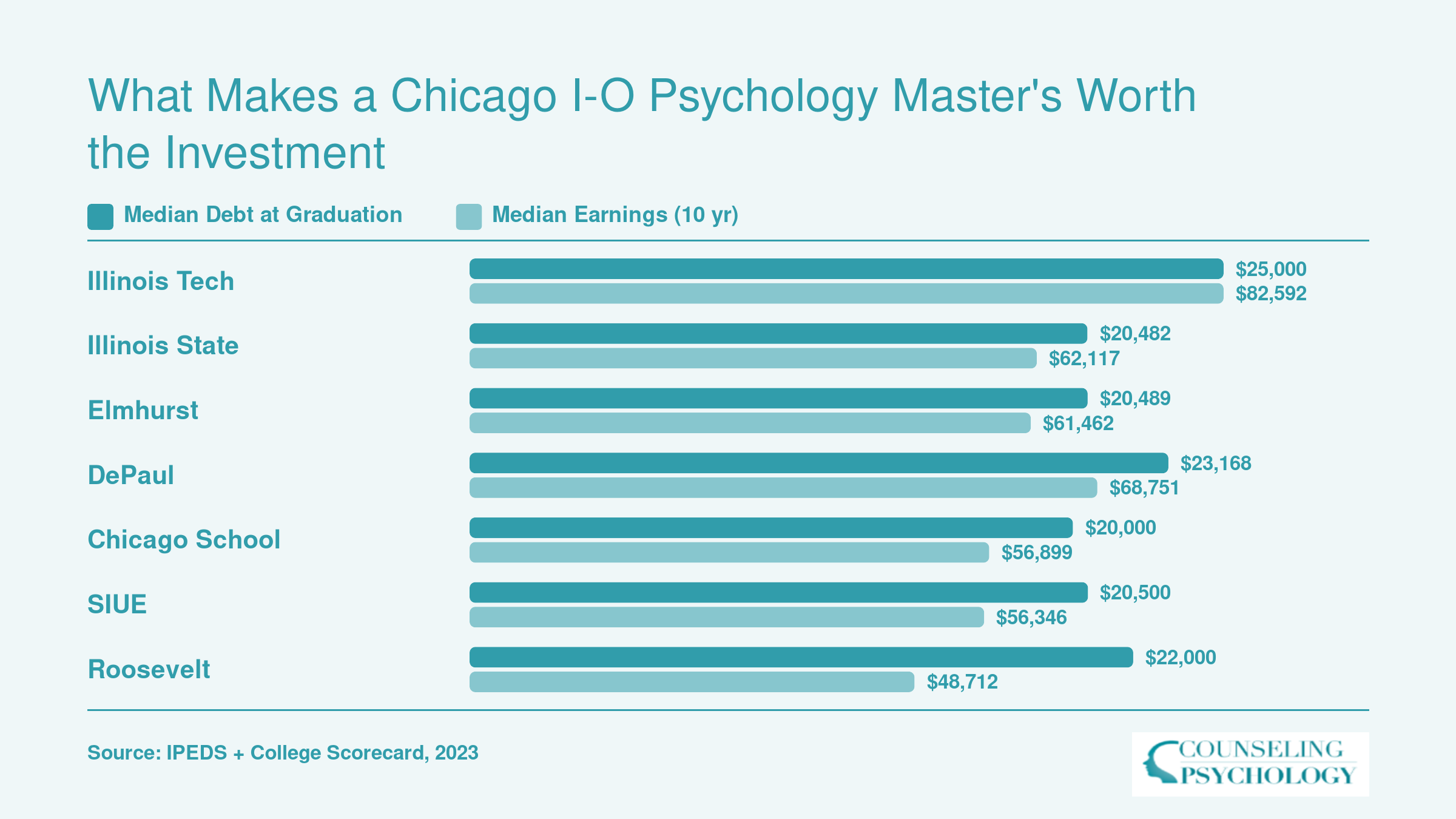
What Makes a Chicago I-O Psychology Master's Worth the Investment
How quickly can you recoup a Chicago-area I-O psychology master's degree? Program-level earnings at one and four years post-completion are not yet published for these schools, but institution-wide median earnings at ten years and median graduate debt tell a compelling story. Across all seven programs listed here, median debt at graduation ranges from $20,000 to $25,000, while institution-wide median earnings ten years out range from roughly $49,000 to $83,000. Even at the lower end, graduates are earning more than double their total debt load within a decade. At Illinois Tech, the ratio climbs above three-to-one. For students weighing sticker price against long-term payoff, comparing debt to eventual earnings is the clearest lens on return on investment.
Related Articles
Online vs. On-Campus vs. Hybrid: Comparing I-O Psychology Program Formats and Costs
One of the most common questions prospective students ask: Can you earn an I-O psychology master's online from a Chicago-area school? The short answer is yes, but your options are limited. Among the programs ranked here, The Chicago School at Chicago is the only institution offering a fully online I-O psychology master's. The remaining seven programs, including Illinois Institute of Technology, Roosevelt University, DePaul University, Elmhurst University, SIUE, Illinois State University, and Adler University, are structured as on-campus programs. No hybrid format is currently listed among these schools, though individual courses at some institutions may blend modalities. Below is a side-by-side look at what each format typically delivers.
| Factor | Online (e.g., The Chicago School) | On-Campus (e.g., SIUE, Illinois State, Roosevelt, Illinois Tech, Elmhurst, DePaul, Adler) |
|---|---|---|
| Tuition Range (Annual, IPEDS) | Approx. $35,328 | Ranges from approx. $10,218 (Illinois State, in-state) to $47,179 (Adler University) |
| Flexibility for Working Professionals | High: asynchronous or evening options, full-time or part-time pacing (two to three years) | Varies: some offer evening cohorts (Elmhurst) or downtown access (Roosevelt), but most require daytime attendance |
| Networking and Peer Collaboration | Virtual cohorts and discussion forums; networking depends on student initiative and program events | Stronger organic networking through shared labs, cohort models, and proximity to Chicago employers |
| Access to Practica and Applied Projects | 600-hour internship requirement built in; students arrange placements in their local market | Internships and fieldwork often facilitated through faculty connections to Chicago-area organizations; Adler includes a 200-hour social justice practicum |
| Faculty Interaction | 17:1 student-to-faculty ratio; interaction primarily through virtual office hours and email | Ratios from 11:1 (Roosevelt) to 19:1 (Illinois State); in-person mentorship and research collaboration more accessible |
| Best Suited For | Students balancing work or family commitments, or those located outside the Chicago metro who want a Chicago-affiliated degree | Students who can relocate to or commute within Chicago or central Illinois and want hands-on research, corporate partnerships, or a potential PhD pathway (e.g., DePaul's combined MA/PhD track) |
Financial Aid, Scholarships, and Assistantships for I-O Psychology Students
Financial aid for I-O psychology master's students in the Chicago area comes from federal grants, institutional scholarships, graduate assistantships, and external awards. Understanding which programs typically serve higher-need populations and which offer competitive internal funding can help you target applications strategically and plan your budget.
Federal Aid and Student Financial Need
Federal Pell Grants serve undergraduates with exceptional need, but the proportion of Pell recipients at an institution signals how much the school historically enrolls students from lower-income backgrounds and, by extension, how deeply its financial aid office engages with need-based packaging. Among Chicago-area I-O programs, Roosevelt University reports the highest share of Pell recipients at 63 percent, followed closely by Illinois Institute of Technology at 62 percent and The Chicago School at 62 percent. DePaul, Elmhurst, Southern Illinois University Edwardsville, and Illinois State all report Pell shares between 48 and 57 percent. While graduate students are not eligible for Pell themselves, these figures suggest institutional familiarity with need-based aid structures and financial counseling.
To access federal loans and work-study, complete the Free Application for Federal Student Aid (FAFSA) as early as October 1 for the following academic year. Priority deadlines vary by school but typically fall in February or March. Filing early maximizes eligibility for limited funds.
Graduate Assistantships and Institutional Awards
Graduate assistantships offer tuition remission or stipends in exchange for teaching, research, or administrative work. Elmhurst University's I-O program offers assistantships requiring 10 to 20 hours per week, compensated through stipend or partial tuition remission.1 The Chicago School highlights "generous financial and scholarship packages, fellowships, and paid employment" for I-O students, though specific award amounts and eligibility are determined case by case. Illinois Institute of Technology mentions partial tuition scholarships and possible teaching assistantships for I-O students; applicants should inquire during the admission process, as awards are competitive and tied to program needs.
DePaul's combined MA/PhD track historically funds doctoral students through research and teaching roles, and students interested in that pathway can explore industrial organizational psychology phd programs more broadly. Standalone master's students should contact the department directly to ask about current funding opportunities. Roosevelt, Adler, and National Louis do not publish detailed assistantship figures for I-O programs; reach out to financial aid and program coordinators for the latest openings.
External Scholarships and Professional Organization Awards
Blacks in I-O Psychology (BIOP) offers the CMA Global Scholarship to current master's or doctoral students enrolled in accredited I-O programs.3 Applicants must be BIOP members for at least one year and cannot apply to both the CMA and DCI scholarships in the same cycle. The award is portable to any accredited program, making it a valuable option for students at any Chicago-area school.
Professional societies such as the Society for Industrial and Organizational Psychology (SIOP) and regional chapters occasionally announce student awards; monitor their websites in late fall and winter.
Employer Tuition Assistance and Net Price Considerations
Many I-O students work full time in human resources, consulting, or talent management roles while pursuing part-time study. Employer tuition reimbursement programs can cover a significant portion of costs; check your company's HR policies and ask whether the benefit requires a service commitment post-graduation.
Average net price figures in federal data reflect undergraduate aid packaging and do not account for graduate-specific awards or out-of-pocket costs after assistantships. Contact each program's financial aid office for a personalized estimate based on your enrollment status, residency, and funding profile. Individual packages vary widely, and direct communication ensures you understand exactly what aid you qualify for before committing.
Admissions Requirements and Application Tips for Chicago I-O Programs
DePaul's terminal MS in I-O Psychology asks for a 3.2 minimum GPA (3.5 recommended), the General GRE, and a bachelor's that includes at least 10 psychology courses, with statistics and research methods among them.1 That single profile gives you a useful benchmark for how selective Chicago-area I-O admissions can run, and where flexibility tends to live.
GRE Requirements Across the Chicago Market
GRE policy is the first thing to confirm before you build an application timeline. DePaul still requires the General GRE for both its terminal MS and its combined MA/PhD track as of the 2025-26 cycle.2 Other Chicago-area programs at Illinois Tech, The Chicago School, Adler, Roosevelt, and National Louis have shifted policies in recent years, with several moving to GRE-optional or test-flexible review. Because these policies change cycle to cycle, verify directly on each program's admissions page before you register for a test date. If you are applying to a mix of programs and even one requires the GRE, sit for it: a strong score becomes a free signal at the optional schools.
Do You Need a Psychology Background?
Short answer: not always, but you need the right coursework. DePaul's MS expects 10 psychology courses including statistics and research methods, which is a high bar for career switchers.1 The MA/PhD track expects a strong psychology and research methods background overall.2 If your undergraduate degree is in business, engineering, sociology, or another adjacent field, plan to complete prerequisite coursework before applying, typically introductory psychology, statistics, research methods, and ideally a course in industrial or organizational behavior. Community college courses and post-baccalaureate certificates both count at most programs. Applicants coming from technical disciplines like engineering may also want to explore engineering psychology masters to see whether that specialization better fits their background. Some Chicago-area schools admit non-psychology majors with conditional coursework requirements built into the first year.
Terminal MS vs. MA/PhD: Apply to the Right Door
This is the most common mistake we see. DePaul runs two separate I-O pathways: the terminal MS (a two-year applied degree with a May 1 application deadline) and the combined MA/PhD (a roughly four-year research doctorate where the MA is earned along the way, not as a standalone exit point).3 The MA/PhD is not admitting for 2026-27, with the next cohort entering Fall 2027.2 If you want to practice as an I-O consultant or internal practitioner, the terminal MS is the correct application. If your goal is research, academia, or a doctoral-level consulting role, the MA/PhD is the right door, even though it means waiting a cycle at DePaul.
Rounding Out the Application
Beyond GPA and test scores, expect to submit three letters of recommendation (at least one from a faculty member who can speak to research or analytical ability), a personal statement that names specific faculty whose work aligns with yours, and a resume highlighting any relevant work, internship, or research experience. Applied experience in HR, talent analytics, training, or organizational consulting strengthens terminal-master's applications; research experience and a clear methodological fit strengthen MA/PhD applications. If you are still exploring broader online master's in psychology programs, comparing admissions criteria across specializations can help you pinpoint where your profile is most competitive.
Before you apply, confirm whether each program operates as a terminal master's (focused on immediate workforce entry) or explicitly supports a pathway to doctoral study. Choosing a terminal track when you plan to pursue a PhD can mean repeating coursework and credentials, adding years and tens of thousands of dollars to your total educational investment.
Career Outcomes and Salary Expectations for I-O Psychologists in the Chicago Metro Area
Industrial-organizational psychology master's graduates in the Chicago metro area enter a job market that pays well above the national average for psychology professions, though precise metro-level wage data for I-O psychologists is limited due to small sample sizes.1 Nationally, the Bureau of Labor Statistics reports that industrial-organizational psychologists earned a median annual wage of $140,000 in 2023, placing the occupation among the highest-paid psychology specializations.2 While the BLS does not publish metro-specific wage estimates for the Chicago-Naperville-Elgin MSA due to limited employment counts in this occupation, state-level data from the Illinois Department of Employment Security provides a proxy for regional earnings through its annual OEWS data release.3
Understanding the Difference Between Occupational Wages and Graduate Earnings
When evaluating return on investment, prospective students should distinguish between two distinct data points: BLS occupational wages and College Scorecard program-completer earnings. The BLS national median of $140,000 reflects experienced practitioners across all education levels and career stages within the occupation. College Scorecard earnings, by contrast, track specific cohorts of program completers one, two, or four years after graduation and include only those working and not enrolled in further study. The programs listed in this guide do not yet report earnings data in the federal scorecard system, which means first-year post-completion salary benchmarks are not available for direct comparison. This absence does not indicate poor outcomes but rather reflects reporting lags or sample-size thresholds in the federal data collection process.
Major Employers and Industry Sectors Hiring I-O Psychologists in Chicago
The Chicago metro area supports a robust market for I-O psychology talent across multiple sectors.4 Major employers include management consulting firms such as Aon, Korn Ferry, and Mercer, which maintain significant Chicago offices and hire people scientists, talent assessment consultants, and organizational development specialists. The region's Fortune 500 headquarters, including Abbott, Walgreens Boots Alliance, and Caterpillar, employ internal I-O psychologists to manage talent analytics, employee engagement, and leadership development programs. Healthcare systems like Northwestern Medicine and Rush University Medical Center increasingly rely on I-O psychologists to optimize workforce performance and reduce burnout. Technology companies with Chicago operations, including Google and Salesforce, hire I-O professionals under titles such as people analytics manager and organizational effectiveness consultant. Universities and research institutions, including Northwestern University and the University of Chicago, employ I-O psychologists in both academic and applied research roles. For a broader look at the profession, our guide on how to become an industrial organizational psychologist covers education pathways and career milestones in detail.
Is a Master's in I-O Psychology Worth It?
The value proposition of an I-O psychology master's degree hinges on both salary potential and employment accessibility. Nationally, the occupation enjoys a low unemployment rate and strong demand driven by organizations' growing reliance on data-driven talent strategies. The six-figure median salary positions I-O psychology among the most lucrative master's-level psychology careers, significantly outpacing clinical and counseling psychology roles that require licensure and additional supervised hours. Students exploring the full landscape of I/O psychology master's programs nationwide can compare curricula, format, and cost across a wider set of options. In the Chicago metro, where cost of living exceeds the national average but corporate compensation packages remain competitive, graduates with quantitative skills, business acumen, and hands-on project experience command premium starting salaries. Students who complete internships with Chicago-area consulting firms or corporate clients often convert those placements into full-time offers at compensation levels that justify the tuition investment within three to five years. The key to realizing this return lies in selecting programs that emphasize applied research, statistical training, and professional networking within the local business community.
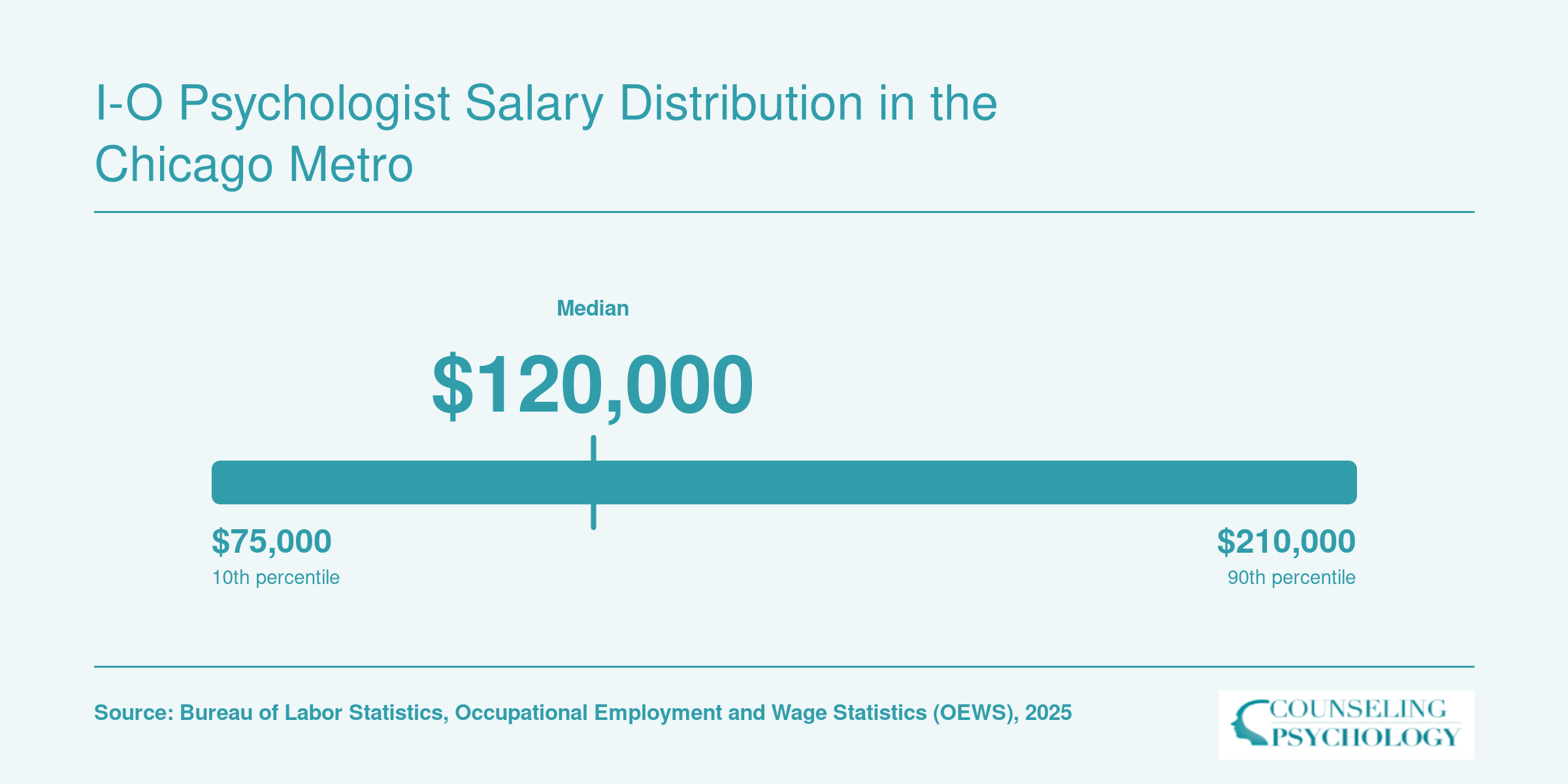
I-O Psychologist Salary Distribution in the Chicago Metro
The Bureau of Labor Statistics publishes wage percentile data for industrial-organizational psychologists (SOC 19-3032) at both the national and metro-area level. As of the most recent OEWS release, Chicago-Naperville-Elgin MSA wages for I-O psychologists are available through the OEWS query system, though granular metro percentile figures should be verified directly because sample sizes for this niche occupation can be small. Nationally, I-O psychologists command salaries well above most psychology specialties, and Chicago metro compensation has historically tracked at or above the national median.
How We Ranked These Affordable I-O Psychology Programs
This ranking prioritizes net price and financial aid access above all else. Because the framing of this article is affordability, we weighted cost metrics most heavily, ensuring that schools at the top of the list offer the lowest expected out-of-pocket expense for typical master's students in industrial-organizational psychology programs near Chicago.
Data Sources
We pulled tuition and fee data from the Integrated Postsecondary Education Data System (IPEDS), which reports published sticker prices and mandatory fees for graduate programs. Net price estimates come from the College Scorecard, which reflects average total cost after federal, state, and institutional aid for students receiving Title IV aid. Program-level outcomes, where available, also come from the College Scorecard. Graduation rates are institution-wide figures reported through IPEDS, covering all graduate programs at each university.
What This Ranking Does Not Measure
We do not assess curriculum quality, faculty-to-student ratios, research output, or student satisfaction. Those dimensions matter enormously when choosing a program, but they are not captured in federal datasets, and introducing subjective scores would obscure the transparency of a cost-focused ranking. If your priorities include faculty mentorship, applied internship placements, or specialized electives in talent analytics or organizational development, you will need to evaluate those factors independently through program websites, informational interviews, and campus visits. Students who decide to pursue further specialization may also want to explore applied psychology masters programs for additional options.
Important Limitations
Graduation rates reflect the entire institution, not just the I-O psychology cohort. Net price is an average across all aid recipients; your actual cost will depend on your FAFSA profile, merit scholarships, assistantship offers, and residency status. A program ranked lower on affordability may become cheaper for you personally if it offers a teaching or research assistantship with a tuition waiver. Treat these rankings as a starting point, not a final verdict.
Frequently Asked Questions About I-O Psychology Master's Programs Near Chicago
Prospective students often have overlapping questions about cost, format, prerequisites, and return on investment for industrial-organizational psychology programs in the Chicago metro. The answers below draw on tuition data, admissions details, and salary figures discussed throughout this article.